Volume 1 · pp. 146–148
Tractate IX, Chapter III: How these five are certain natures, and how they are universals, and how intelligible, and how simple
A marker with ≈ is an approximate page boundary, placed by measure of the text; the page photographs remain the authority. In the paired views, clicking a page marker brings that page into view.
CAPUT III.
Qualiter haec quinque sunt naturae quaedam, et qualiter universalia, et qualiter intelligibilia, et qualiter simplicia.
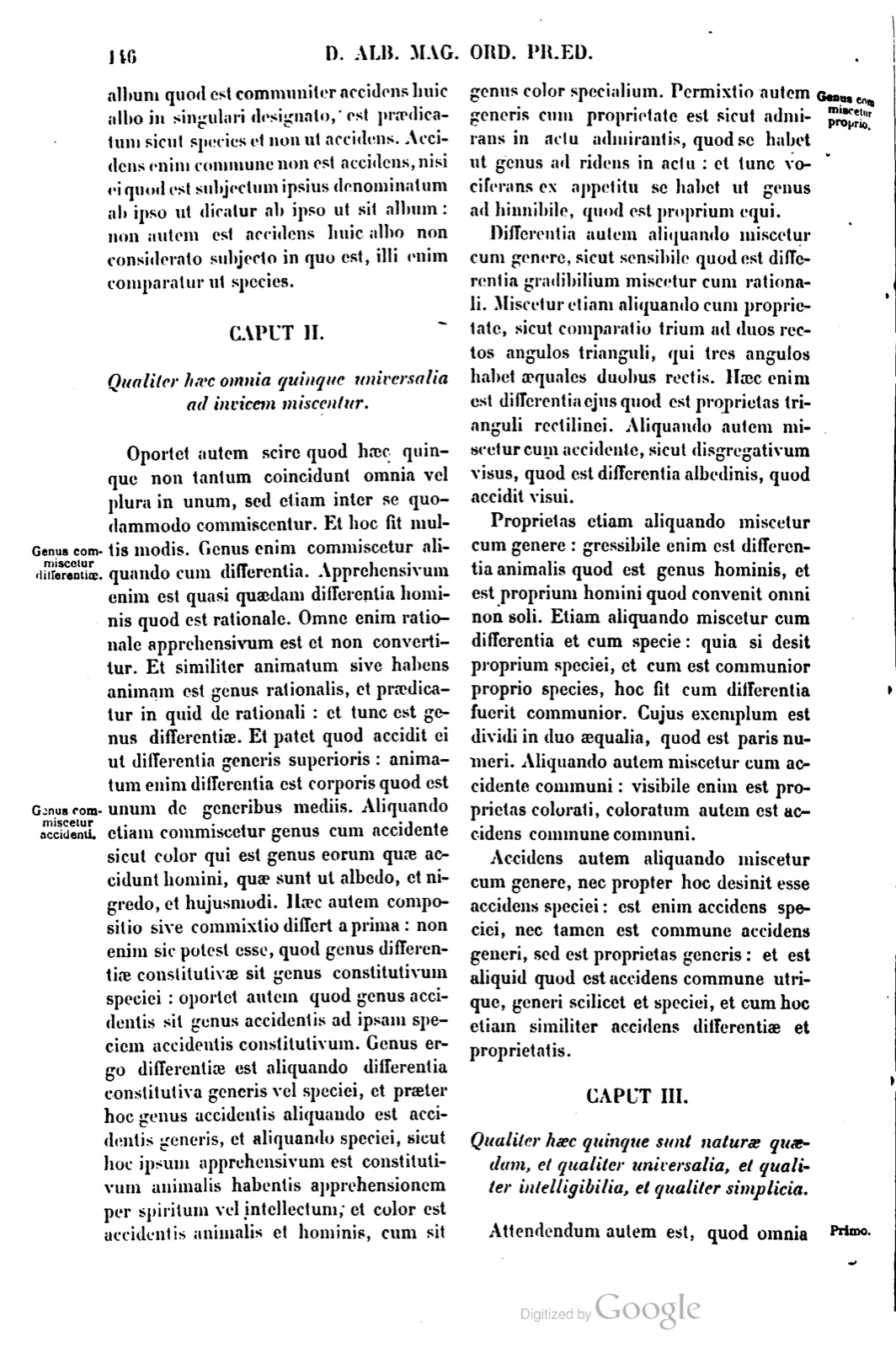
Attendendum autem est, quod omnia quinque quadrupliciter considerari possunt. Si enim in se accipiantur, ita quod ipsa res sive natura sine aliquo respectu sibi composito accipiantur, et ipsa natura simplex consideretur, sic sunt naturae quaedam ista quinque, et praecipue genera, et species quae absoluto intellectu assequi possunt: tamen de aliis est verum quando non accipitur id quod est differentia in ratione differentiae, sed in ratione entis vel naturae cujusdam: et hoc est verum de proprio quando accipitur id quod est proprium non in proprii ratione, sed in simplicitate cujusdam entis: et hoc etiam verum est de accidente quando accipitur ut pars entis, et non in ratione qua addit ad substantiam. Sic ergo haec praeaccepta sunt naturae quaedam, ut dicunt Avicenna et Alfarabius.
Si autem accipiunt haec praedicta secundum quod naturae illi simplici additur aptitudo ad hoc quod sint in pluribus inferioribus, tunc illa jam efficiuntur universalia, quia universale ab habere aptitudinem dicitur universale, et non ab actu quo efficiatur actu universale. Utrum autem haec aptitudo sit in re quae sua simplicitate apta sit existere in pluribus, et per multiplicationem differentiae dividentis, vel per divisionem materiae in pluribus actu efficiatur: vel sit in solo intellectu, ita quod nihil naturae sit in pluribus, sed solus intellectus similitudinem naturae unius ad eamdem naturam in specie in alio accipiat et in seipso assimilet, quaestio fuit. Et primo quidem modo illi dixerunt qui reales vocabantur. Secundo autem modo dixerunt hi qui dicebantur nominales. Et hoc ad praesens non est disserendum: tamen in praecedentibus in tractatu communi de universalibus hoc sustinuimus quod dixerunt reales. Quocumque autem modo, patet quod simplex natura non est universale, sed natura accepta in tali aptitudine.
Haec autem eadem natura accepta in lumine intelligentiae, cujus ipsa est splendor quidam et radius, secundum quod dicimus, quod omnis forma sive natura simplex splendor est, et radius intelligentiae in anima similis sibi in esse spirituali, sive intellectuali, propter hoc quod ipsa natura per intellectualem naturam quae in ipsa est ut pars essentialis ejus, operatur ad esse spirituale, sicut lumen in perspicuo operatur colorem secundum esse spirituale, quem tamen in corpore terminato operatur secundum esse materiale ipsius: eo quod actus activorum sunt in patientibus bene dispositis secundum possibilitatem recipientium actus illos, et non secundum potentiam agentis. Hoc ergo modo ista quinque vel sunt naturae simplices, vel universalia, vel intellectus quidam in anima existentes.
CHAPTER III.
How these five are certain natures, and how they are universals, and how intelligible, and how simple.
But one must attend to this, that all five can be considered in four ways. For if they are taken in themselves, so that the things themselves or natures are taken without some relation composed with them, and the simple nature itself is considered, in this way those five are certain natures, and chiefly genera and species, which can be obtained by an absolute act of understanding. Yet this is true of the others when that which is difference is not taken under the account of difference, but under the account of being or of a certain nature; and this is true of proper when that which is proper is taken not under the account of proper, but in the simplicity of a certain being; and this is also true of accident when it is taken as a part of being, and not under the account by which it adds to substance. Thus therefore these things taken beforehand are certain natures, as Avicenna and Alfarabius say.
But if these aforesaid things are taken according as aptitude for this, that they should be in many inferiors, is added to that simple nature, then they are now made universals, because universal is called universal from having aptitude, and not from the act by which it is made a universal in act. But whether this aptitude is in the thing which by its simplicity is apt to exist in many, and by multiplication of the dividing difference, or by division of matter, is made in act in many, or whether it is in the intellect alone, so that nothing of nature is in many, but only the intellect takes the likeness of one nature to the same nature in species in another and assimilates it in itself, was a question. And in the first way indeed those spoke who were called realists. But in the second way those spoke who were called nominalists. And this is not to be discussed at present; nevertheless in the preceding matters, in the common treatise on universals, we maintained what the realists said. But in whatever way, it is clear that simple nature is not universal, but nature taken in such aptitude.
But this same nature taken in the light of intelligence, of which it is itself a certain splendor and ray, according as we say that every form or simple nature is a splendor and ray of intelligence in the soul, like to itself in spiritual or intellectual being, on account of this, that the nature itself, through the intellectual nature which is in it as its essential part, works toward spiritual being, as light in the transparent works color according to spiritual being, which nevertheless in a terminated body it works according to its material being, because the acts of active things are in well-disposed patients according to the possibility of those receiving those acts, and not according to the power of the agent. Therefore in this way those five are either simple natures, or universals, or certain intellects existing in the soul.
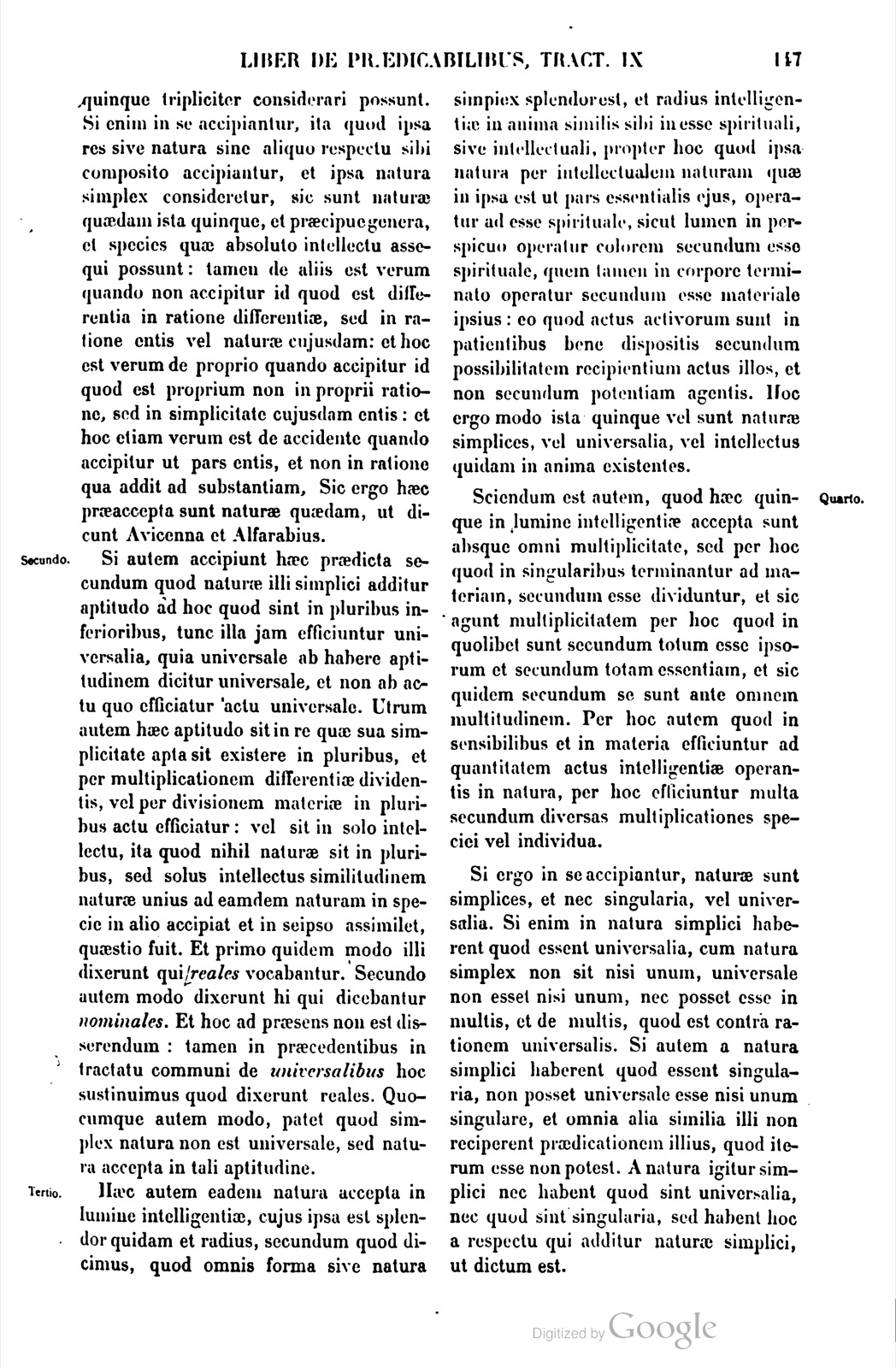
Sciendum est autem, quod haec quinque in lumine intelligentiae accepta sunt absque omni multiplicitate, sed per hoc quod in singularibus terminantur ad materiam, secundum esse dividuntur, et sic agunt multiplicitatem per hoc quod in quolibet sunt secundum totum esse ipsorum et secundum totam essentiam, et sic quidem secundum se sunt ante omnem multitudinem. Per hoc autem quod in sensibilibus et in materia efficiuntur ad quantitatem actus intelligentiae operantis in natura, per hoc efficiuntur multa secundum diversas multiplicationes speciei vel individua.
Si ergo in se accipiantur, naturae sunt simplices, et nec singularia, vel universalia. Si enim in natura simplici haberent quod essent universalia, cum natura simplex non sit nisi unum, universale non esset nisi unum, nec posset esse in multis, et de multis, quod est contra rationem universalis. Si autem a natura simplici haberent quod essent singularia, non posset universale esse nisi unum singulare, et omnia alia similia illi non reciperent praedicationem illius, quod iterum esse non potest. A natura igitur simplici nec habent quod sint universalia, nec quod sint singularia, sed habent hoc a respectu qui additur naturae simplici, ut dictum est.
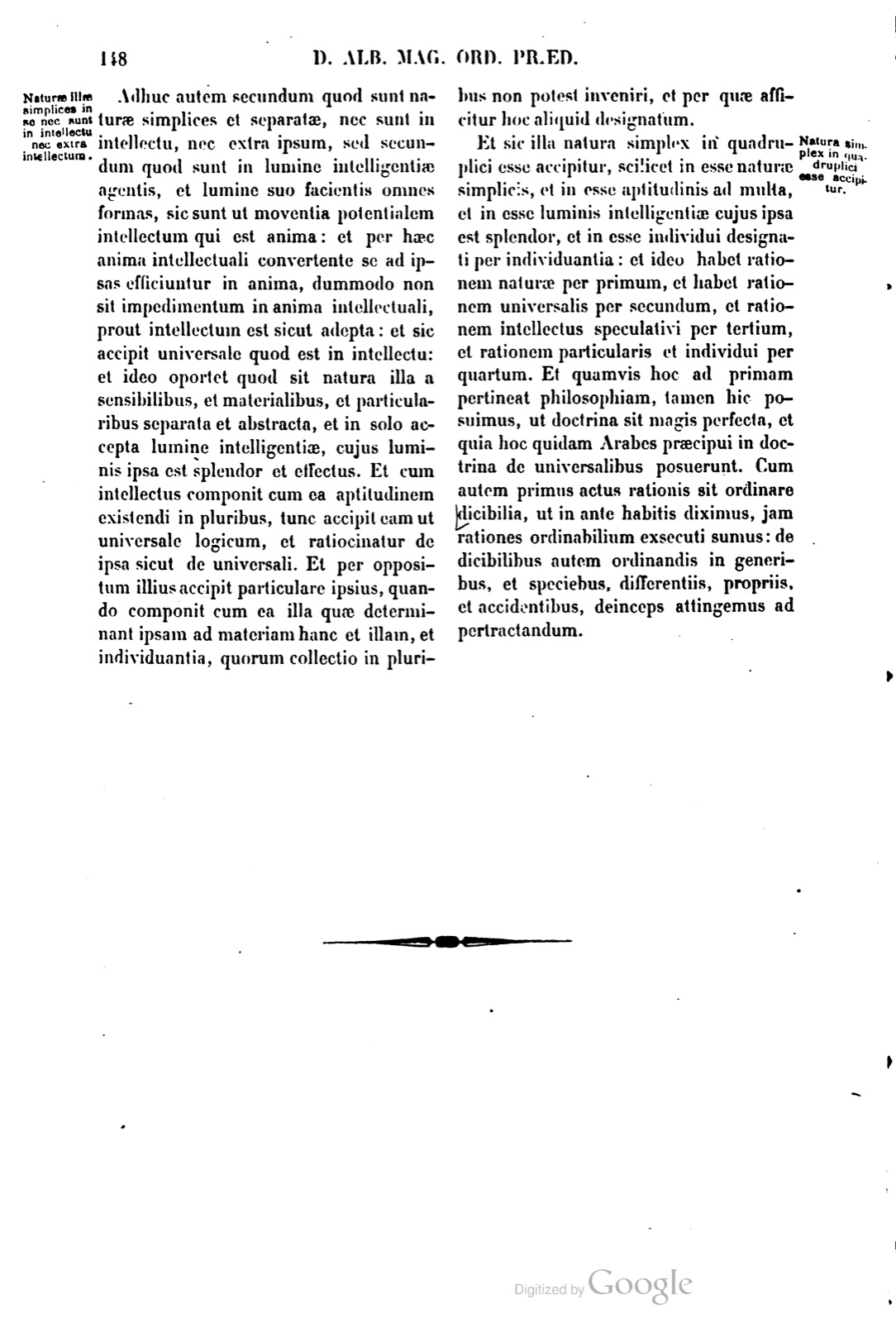
Adhuc autem secundum quod sunt naturae simplices et separatae, nec sunt in intellectu, nec extra ipsum, sed secundum quod sunt in lumine intelligentiae agentis, et lumine suo facientis omnes formas, sic sunt ut moventia potentialem intellectum qui est anima: et per haec anima intellectuali convertente se ad ipsas efficiuntur in anima, dummodo non sit impedimentum in anima intellectuali, prout intellectum est sicut adepta: et sic accipit universale quod est in intellectu: et ideo oportet quod sit natura illa a sensibilibus, et materialibus, et particularibus separata et abstracta, et in solo accepta lumine intelligentiae, cujus luminis ipsa est splendor et effectus. Et cum intellectus componit cum ea aptitudinem existendi in pluribus, tunc accipit eam ut universale logicum, et ratiocinatur de ipsa sicut de universali. Et per oppositum illius accipit particulare ipsius, quando componit cum ea illa quae determinant ipsam ad materiam hanc et illam, et individuantia, quorum collectio in pluribus non potest inveniri, et per quae afficitur hoc aliquid designatum.
But it must be known that these five, taken in the light of intelligence, are without all multiplicity; but through this, that in singulars they are terminated to matter, they are divided according to being, and thus they bring about multiplicity through this, that in each thing they are according to their whole being and according to their whole essence, and so indeed according to themselves they are before every multitude. But through this, that in sensible things and in matter they are made according to the quantity of the act of intelligence working in nature, through this they are made many according to the diverse multiplications of species or individual things.
Therefore if they are taken in themselves, they are simple natures and neither singular things nor universals. For if they had from simple nature that they were universals, since simple nature is only one, the universal would be only one, nor could it be in many and of many, which is contrary to the account of universal. But if from simple nature they had that they were singular things, the universal could be only one singular, and all other things similar to it would not receive its predication, which again cannot be. Therefore from simple nature they have neither that they are universals nor that they are singular things, but they have this from a relation which is added to simple nature, as has been said.
Further, according as they are simple and separate natures, they are neither in the intellect nor outside it; but according as they are in the light of agent intelligence, and in its light making all forms, thus they are as things moving the potential intellect which is the soul; and through these, when the intellectual soul turns itself toward them, they are made in the soul, provided that there is no impediment in the intellectual soul, according as the understood thing is as something acquired; and thus it receives the universal which is in the intellect. And therefore it is necessary that that nature be separated and abstracted from sensible, material, and particular things, and taken in the light of intelligence alone, of whose light it is itself the splendor and effect. And when the intellect composes with it the aptitude of existing in many, then it takes it as a logical universal and reasons about it as about a universal. And by opposition to that it takes its particular, when it composes with it those things which determine it to this matter and that, and individuating things, the collection of which cannot be found in many, and through which this designated something is affected.
Et sic illa natura simplex in quadruplici esse accipitur, scilicet in esse naturae simplicis, et in esse aptitudinis ad multa, et in esse luminis intelligentiae cujus ipsa est splendor, et in esse individui designati per individuantia: et ideo habet rationem naturae per primum, et habet rationem universalis per secundum, et rationem intellectus speculativi per tertium, et rationem particularis et individui per quartum. Et quamvis hoc ad primam pertineat philosophiam, tamen hic posuimus, ut doctrina sit magis perfecta, et quia hoc quidam Arabes praecipui in doctrina de universalibus posuerunt. Cum autem primus actus rationis sit ordinare dicibilia, ut in ante habitis diximus, jam rationes ordinabilium exsecuti sumus: de dicibilibus autem ordinandis in generibus, et speciebus, differentiis, propriis, et accidentibus, deinceps attingemus ad pertractandum.
### Marginal Labels
- Primo.
- Secundo.
- Tertio.
- Quarto.
- Naturae illae simplices in se nec sunt in intellectu nec extra intellectum.
- Natura simplex in quadruplici esse accipitur.
And thus that simple nature is taken in fourfold being, namely in the being of simple nature, and in the being of aptitude to many, and in the being of the light of intelligence of which it itself is the splendor, and in the being of an individual designated through individuating things. And therefore it has the account of nature through the first, and has the account of universal through the second, and the account of speculative intellect through the third, and the account of particular and individual through the fourth. And although this belongs to first philosophy, nevertheless we have set it down here so that the doctrine may be more perfect, and because certain eminent Arabs set this down in the doctrine on universals. But since the first act of reason is to order sayables, as we said in the preceding matters, we have now pursued the accounts of orderable things; but concerning sayables to be ordered in genera, species, differences, propers, and accidents, henceforth we shall turn to treating them.
### Marginal Labels
- First.
- Second.
- Third.
- Fourth.
- Those simple natures in themselves are neither in the intellect nor outside the intellect.
- Simple nature is taken in fourfold being.
If a page does not appear, its photograph has not been uploaded yet.