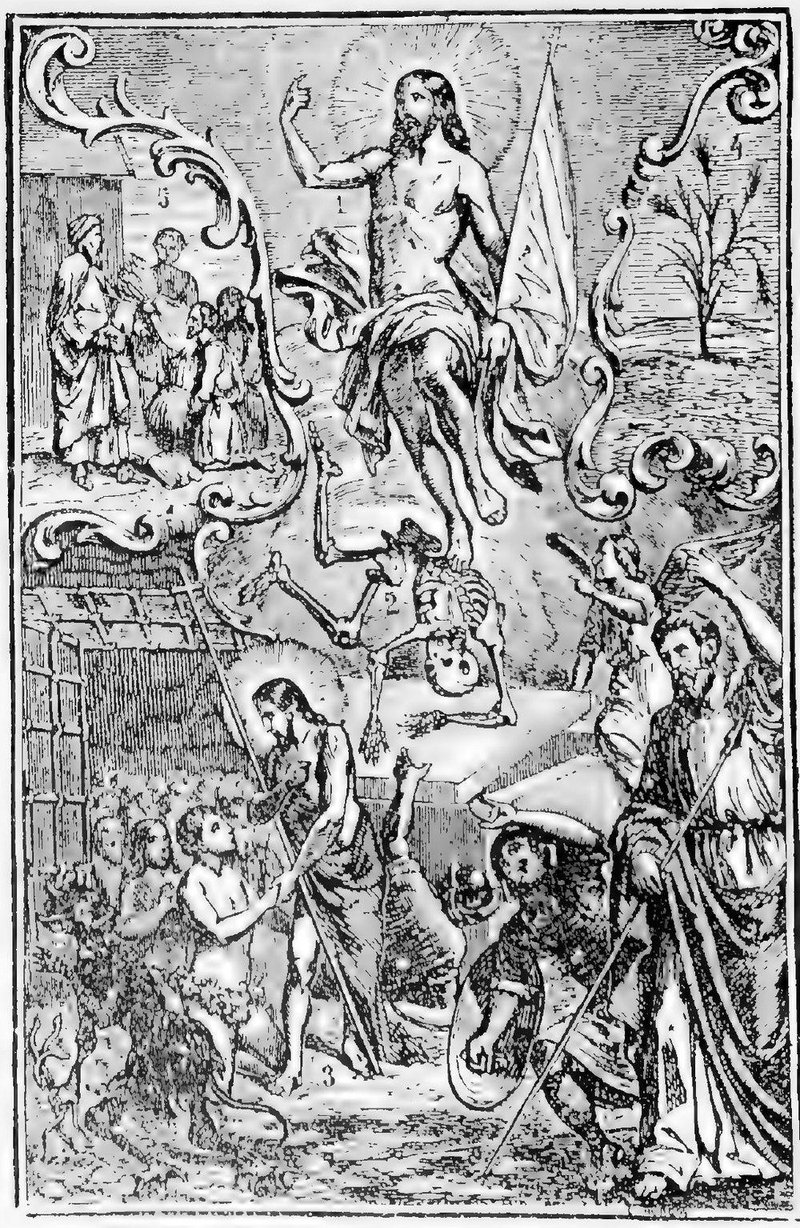
Plate XI. He descended into hell; the third day he rose again from the dead. The apostle St. Thomas. 1. Jesus Christ risen. 2. Death. 3. Jesus Christ in limbo. 4. Wheat, symbol of the resurrection. 5. The parable of the wheat and the cockle.
Look, son. Do you see in the plate that figure rising up (no. 1)? You know already that it is Jesus risen. Under his feet he has death (no. 2), to which it had been prophesied that he would say: O death, I will be thy death (Osee 13:14). And indeed death was made to die, by his giving life to the one it had robbed of life; for death ceases then to be death. That is what Jesus did by rising. Further down is the holy sepulchre, the Angel rolling back the stone, and the soldiers who were keeping guard.
As soon as Jesus died, his soul, united to the divinity, descended into hell, that is, into the lower place, where the souls of the holy Fathers were held. They could not enter heaven until Jesus Christ had paid the price of the redemption. You will see this in no. 3. It represents Jesus Christ at the moment when he descended into Abraham’s bosom, or limbo, to free the souls of the holy Fathers who were awaiting his coming. So was fulfilled what David said: In thee have our fathers hoped: they have hoped, and thou hast delivered them (Ps. 21:5). See how the devils flee in shame and confusion. Notice that one of them has three snakes in his hand. They signify the three snares the devils use to catch and entangle souls: the love of pleasures, the love of honors and the love of gain. But these happy souls say: “The snare is broken, the prisons are opened, and we
have been set free by the merits of Jesus Christ.” Laqueus contritus est, et nos liberati sumus [The snare is broken, and we are delivered] (Ps. 123:7).
There is a place called the hell of the damned. Jesus Christ did not descend there except by his power, making the reprobate feel their unbelief and malice. There is another called purgatory, to which he seems to have descended in effect, to bring those afflicted souls the hope of salvation. But into the limbo of the holy Fathers he descended really and in his very being, says St. Thomas, giving them the light of glory. Ah, how grateful those souls must have been to Jesus, seeing all he had done and suffered for them and the great benefit he brought them!
Those ears of wheat you see in no. 4 are a figure of the resurrection, both bodily and mystical. Jesus Christ says in the holy Gospel: Unless the grain of wheat falling into the ground die, itself remaineth alone. But if it die, it bringeth forth much fruit (John 12:24–25). Before his death Jesus Christ preached, healed the sick, cast devils out of bodies and raised the dead, but he was almost alone. Then he died and was buried; and having sprung up, or risen, like a most beautiful grain of wheat, what beautiful and abundant ears he has produced: the Apostles, Pontiffs, Priests and all the faithful! They also signify that if we live according to the evil inclination of nature, we shall produce no fruit of eternal life; rather we shall commit sins. But if we try to die by resisting our passions, curbing and mortifying them, and to live according to Jesus Christ, we shall produce much fruit of good works. On the other side of the plate (no. 5) is shown the Gospel parable of the field in which good wheat and cockle sprang up. They grew up together and were reaped together; but the master ordered the reapers to burn the cockle and store the good wheat in the barn (Matt. 13:24–30). In this parable the world is the field, in which Jesus Christ, by himself and through those he sends, has sown the good wheat, which is the good Christians; the cockle is the wicked. The Angels are the reapers, and Jesus Christ himself is the master. On the day of the general resurrection, or of judgment, he will order the Angels to cast the wicked into the fire of hell and to carry the good like good wheat into the barns of the heavenly homeland.
So, my son, you must try to live well and holily; otherwise you would be lost for ever. Keep in mind what St. Paul says: If you be risen with Christ (by Baptism or a good confession), seek the things that are above… Mind the things that are above, not the things that are upon the earth (Col. 3:1–2).
The resurrection of Jesus Christ is one of the most convincing proofs that he is true God and true man. It follows that the doctrine he taught is divine and the religion he established is divine. Let us leave aside the prophecies that announced him as God, and the miracles he worked in proof of his divinity, as he himself said: Though you will not believe me, believe the works (John 10:38). Suppose too that in his life and death he had not given such clear proofs of being God; Rousseau himself acknowledged them when he said: “If the life and death of Socrates are those of a sage, the life and death of Jesus Christ can only be those of a God.”1 Even if there were none of these and other proofs of the divinity of Jesus Christ, I say that the resurrection alone is more than enough.
Jesus had often said that he would die, but he also added that on the third day he would rise again. And he said this not only to the Apostles but also to his most bitter enemies. One day he even told them that the temple of his body would be destroyed, but that he would rebuild it in three days (John 2:19). And when his enemies asked him for a sign of the divinity of his mission, he answered them: An evil and adulterous generation seeketh a sign: and a sign shall not be given it, but the sign of Jonas the prophet. For as Jonas was in the whale’s belly three days and three nights (and afterwards came out of it alive), so shall the Son of man be in the heart of the earth three days and three nights (Matt. 12:39–40), but afterwards he will rise again. Jesus Christ’s enemies were so convinced that by these words he meant his resurrection that, on the strength of this conviction, they asked Pilate for soldiers to guard his tomb. For they said: lest perhaps his disciples come and steal him away (the body of Jesus), and say to the people: He is risen from the dead; and the last error shall be worse than the first (Matt. 27:64). O adorable designs of God! The soldiers posted by the enemies of Jesus Christ to guard the tomb were the first witnesses of his resurrection. Look at them, my son, and notice how stunned and terrified they are. You see, then, how the prophecies were fulfilled.
You must also notice that he raised himself by his own power or might, as St. Thomas says. This power or might had to be wholly divine, because human power or might does not reach so far: it ends with death. If not, let them name you a man, however brave and wise he may have been, who knew how or was able to raise himself.
Knowing, then, that Jesus is God, adore him as God; respect and obey his commands as divine. Follow his religion as divine and as the only one in which you can be saved. For just as there is only one true God, so there is not and cannot be more than one true religion, outside of which, therefore, no one can be saved.
Try to live well and holily. If in life you imitate Christ, you will also follow him in the resurrection on the day of the general or final judgment. He was the first to rise never to die again. As head and king of the predestined, he went ahead. And to give us a sample of what will happen to us and to our bodies, which will have the four endowments (impassibility, subtlety, agility and brightness),2 see him all shining. See how nothing is an obstacle to him: he comes out of the tomb without first removing the stone that closed it. If the Angel removed it, it was after he had already risen. He passes or moves in an instant from one place to another, and can never again suffer or die.
Q. What is the fifth article of the Creed?
A. He descended into hell; the third day he rose again from the dead.
Q. What does “he descended into hell” mean?
A. That the soul of Christ, after his death, descended into Abraham’s bosom to set free the holy souls who were awaiting his coming.
Q. Did he show himself in other places, at least in effect?
A. Yes. He showed himself in the hell of the damned as conqueror and judge, and in purgatory as consoler.
Q. What does “the third day he rose again from the dead” mean?
A. That on the third day after his death his soul was joined again to his body.