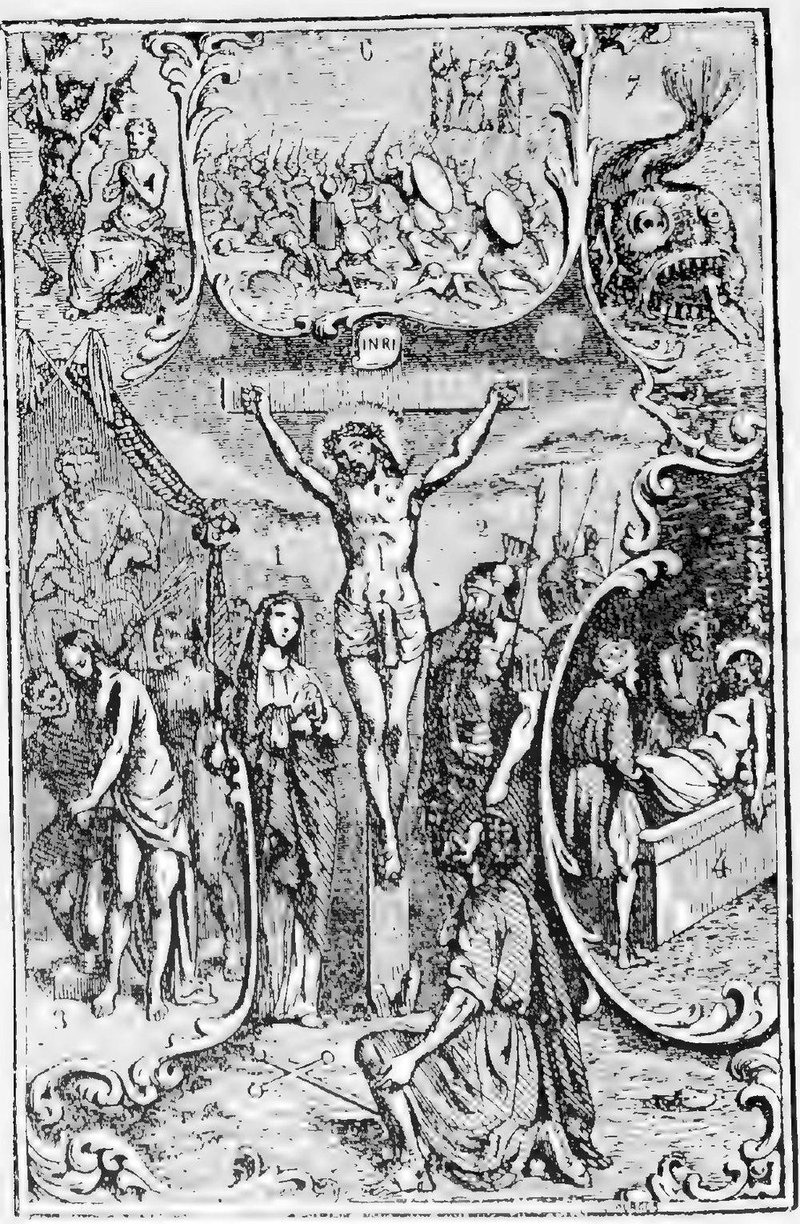
Plate X. Suffered under Pontius Pilate, was crucified, dead and buried. The apostle St. James the Less. 1. Most holy Mary. 2. The Centurion. 3. Jesus suffering the scourges. 4. Jesus in the tomb. 5. Patient Job, a figure of Jesus. 6. Moses with his arms in the form of a cross. 7. Jonas.
Look, my son. Alas! Do you not see our good Jesus already nailed to the cross, and his dear Mother (no. 1) standing beside it, with St. John, the Magdalen and the other Marys? What sorrow! Do you see that soldier (no. 2)? He is the Centurion. Witnessing what happened at the death of Jesus, he put his hand to his forehead, reflected and exclaimed: Indeed this was the Son of God (Matt. 27:54). The Centurion reported it to Pilate, who informed the Emperor of all that had happened at the death of Jesus. The Emperor therefore wanted him counted among the gods of the empire and statues raised to him, because he considered him more than a man.1 St. Dionysius, who was one of the judges of the Areopagus in Athens, had no knowledge of Jesus Christ; and seeing what happened on the day of his death he exclaimed: “Either the Author of nature is suffering, or the fabric of the universe is about to dissolve.” There are even some who claim that the strange and singular crags of Montserrat are an effect of the earthquake that happened on the day Jesus died.
In no. 3 the scourging of Jesus is shown, and in no. 4 his being laid in the tomb. At the top of the plate are the passages of the Old Testament that already pointed to what was to happen in the New and in the person of Jesus. The first (no. 5) is Job, a most expressive figure of Jesus. Innocent Job suffered with rare patience the ill-treatment with which the devil afflicted him. Innocent Jesus suffered with patience all that the Jews, urged on by the devil, made him suffer. The other (no. 6) is Moses. Seeing that God was punishing the people for their sins by sending the Amalecites against them, he ordered Joshua to take a division and go and attack them, while he himself would go up the next day onto a nearby hill, holding in his hand the rod God had given him, which by its power was a figure of the cross. And to make this figure more expressive, God allowed that when the arms of Moses, which he held raised to heaven praying for his people, sank from fatigue, the Amalecites won. But when Moses held them raised in the form of a cross, holding in his hand the figure of the cross of Jesus Christ and so representing him crucified on Mount Calvary, then the people of God won and utterly defeated Amalec. And so it came about. For Aaron and Hur, who were there, noticing this, held up his arms; and in this posture they completed the holy cross of Christ (Exod. 17:8–13). The cross too held up his arms, nailed to it, so that by his death the infernal Amalec might be completely defeated.
The one you see in the mouth of the whale (no. 7) is Jonas, a figure of Jesus, as the Savior himself says in St. Matthew: As Jonas was in the whale’s belly three days and three nights: so shall the Son of man be in the heart of the earth three days and three nights (Matt. 12:40).
It is said that he suffered under Pontius Pilate in proof of the truth of the passion and death of Jesus, as St. Peter Chrysologus explains. The pains Jesus suffered are countless. He was arrested with the greatest ignominy. He was scourged, struck in the face, spat upon, crowned with thorns and falsely accused; and though he was found innocent, he was condemned by Pilate to die on the cross. St. Thomas says that Jesus suffered more than all the Martyrs together. And for all that the Prophets, Evangelists and contemplative persons have said of the pains of Jesus, many of them are still unknown and will not be known until the day of the general judgment. On that day they will be made public, so that the good may have reason to praise him, and the wicked may be confounded and put to shame.
The Creed also says that he was crucified. Death on the cross was the punishment the Romans inflicted, and it was as infamous as it was painful. Jesus chose to accept this way of dying, to save and redeem us, for many reasons. I will point out to you some of those the holy Fathers give. First, it was very fitting that, as death came to us from a tree, so life too should come to us from a tree, which the cross is. Second, Jesus came to be mediator between heaven and earth, and that is why he chose to be raised up and placed between heaven and earth, as he assures us, saying: And I, if I be lifted up from the earth, will draw all things to myself (John 12:32). Third, Jesus is the cornerstone that is to join the two walls, which are figures of the Hebrew and Gentile peoples, of the Old and New Testaments. Placed on the cross, he has his arms stretched out to draw them to himself with each hand and form this union. Fourth, because in the four arms of the cross the four corners of the earth are represented. Fifth, because the four ends of the cross signify the four virtues Christ practiced in a special way in his passion, namely humility, obedience, patience and love. He is innocent and Lord, and suffers so infamous a death: what humility! He obeys the eternal Father, he obeys the judges without answering back, and that even unto death: what obedience! He suffers such terrible torments for all men, not excepting his enemies: what love!
Then the Creed goes on: “dead and buried”. It is most certain that Jesus died. So that we might all be convinced that he had really died, he chose to be buried and to remain three days, or parts of them, in the tomb, having first been wrapped in a shroud.
Ah! If we fixed our attention on the passion and death of this God-Man, how grateful we would be to him for all he suffered for us! Tell me, my son: if you were under arrest now and they were taking you to be shot, and someone came up and said to the soldiers, “Let this boy go home, and shoot me in his place”, what would you do for such a person? Ah! Whenever you remembered so great a favor you would say: “I can never repay him.” And you would be ready to do whatever you were asked for his sake, however costly it might be to you. Think, then, that this is what Jesus did for you. And will you not be grateful to him? Yes, yes: love good Jesus, believe him, never offend him; for by offending him you would crucify him again, as St. Paul says (Heb. 6:6). Ah! If people thought of the death of Jesus, they would never sin. The most effective remedy for not sinning, says St. Augustine, and the best means of acquiring the virtues, is the remembrance of the passion and death of Jesus. Meditate on it, then, my son, and in this way you will never sin, and you will advance in perfection.
Q. What is the fourth article of the Creed?
A. Suffered under Pontius Pilate, was crucified, dead and buried.
Q. What does “suffered under Pontius Pilate” mean?
A. That Pilate was the judge who condemned him to death.
Q. What does “was crucified” mean?
A. That he was nailed to a cross.
Q. What does “dead” mean?
A. That his soul was separated from his body.
Q. What does “buried” mean?
A. That after he died he was laid in a tomb.
Footnotes
-
Apology 5 and 21. ↩