Works › The Book on the Sacrament of the Eucharist
Volume 38 · pp. 341–346
Chapter II, nos. 1 through beginning of 5
A marker with ≈ is an approximate page boundary, placed by measure of the text; the page photographs remain the authority. In the paired views, clicking a page marker brings that page into view.
CAPUT II. De hujus sacrificii sanctitate.
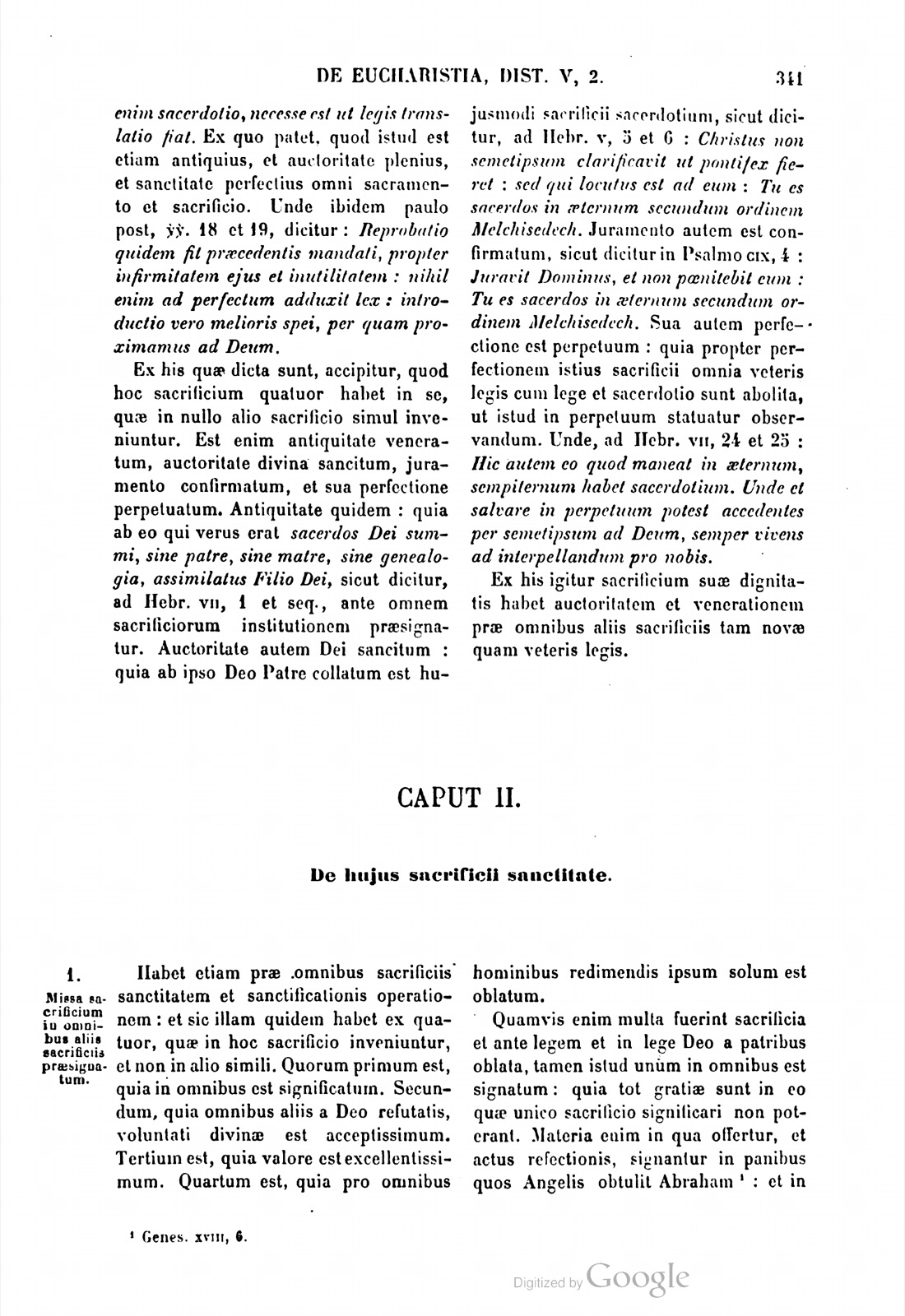
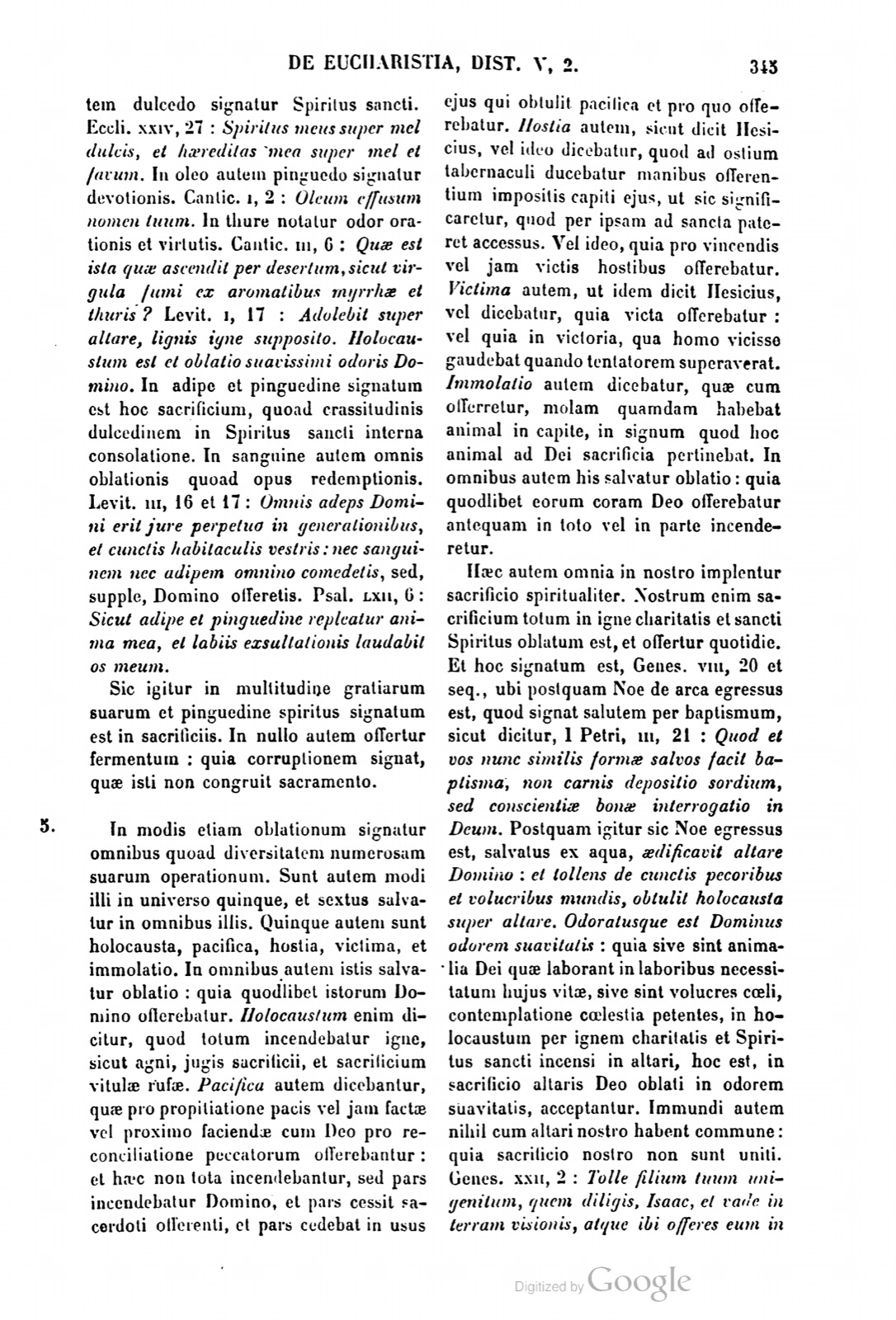
1. Habet etiam prae omnibus sacrificiis sanctitatem et sanctificationis operationem: et sic illam quidem habet ex quatuor, quae in hoc sacrificio inveniuntur, et non in alio simili. Quorum primum est, quia in omnibus est significatum. Secundum, quia omnibus aliis a Deo refutatis, voluntati divinae est acceptissimum. Tertium est, quia valore est excellentissimum. Quartum est, quia pro omnibus hominibus redimendis ipsum solum est oblatum.
Quamvis enim multa fuerint sacrificia et ante legem et in lege Deo a patribus oblata, tamen istud unum in omnibus est signatum: quia tot gratiae sunt in eo quae unico sacrificio significari non poterant. Materia enim in qua offertur, et actus refectionis, signantur in panibus quos Angelis obtulit Abraham:1 et in panibus propositionis qui offerri praecipiuntur:2 et in panibus primitiarum qui praecipiuntur offerri.3 Hoc etiam signatur per panem qui paratus fuit Eliae pro viatico.4 Signatur etiam per subcinericium panem hordeaceum, qui visus est volvi in castra Madian, qui veniens ad tabernaculum percussit illud, et terrae penitus coaequavit.5 Et in omnibus illis materia istius sacrificii designatur.
Per omnes autem oblationes animalium signatur Christus passus, qui in hoc sacrificio est res et signum. Qui primo signatur per agnum quem obtulit Abel.6 Secundo, signatur per turturem et vaccam triennem, quam obtulit Abraham.7 Signatur etiam per vitulum tenerrimum et optimum quem obtulit Abraham Angelis.8 Signatur etiam per agnum paschalem et haedum.9 Signatur per arietes et vitulos et hircos, qui in Levitico in multis locis praecipiuntur offerri, praecipue tamen signatur per immolationem vervecis sive arietis, quem Patriarcha pro unigenito offerebat.10 Signatur principaliter per holocaustum vitulae rufae, cujus cineribus et sanguine omnia expiabantur, et cujus sanguis per pontificem semel in anno in sancta sanctorum inferebatur, sicut dicitur, Levit. XVI, 3. Signatur propter diversitatem gratiarum quas continet in omnibus sacrificiis salis, similaginis, mellis, olei, thuris, et adipis. Mel enim quamvis non sit oblatio legis, sicut dicitur, Levit. II, 11, tamen est in verbis sapientiae, et ostendit dulcedinem sacrificii, quae est in holocaustis et pacificis, quae Domino offerebantur, sicut tangitur, Levit. I et II, et deinceps usque ad cap. IV et VIII.
Horum omnium sacrificiorum diversitas ex maxima diversitate tangitur.11 Principaliter tamen signatur per juge sacrificium agni, quod κατὰ mane et κατὰ vespere praecipitur offerri.12 Tot enim gratiarum est istud sacrificium, quod omnibus his modis adhuc imperfecte signatur.
Signatur etiam in modis oblationum: quia signatur in holocaustis et pacificis, in hostiis, in victimis, et immolationibus, quoad diversitatem suarum operationum, in quibus continetur.13 Sicut enim Dominus in seipso ad nos veniens, omnia nobis attulit genera gratiarum, sicut dicitur, Joan. I, 17: Gratia et veritas per Jesum Christum facta est. Et ibidem, v. 16: De plenitudine ejus nos omnes accepimus, et gratiam pro gratia. Ita sacrificium dedit nobis frequentandum, in quo gratia in omnibus signata superimpleretur, et non sic liberaret ab onere legalium sacrificiorum. Act. XV, 10: Quid tentatis Deum, imponere jugum super cervices discipulorum, quod neque patres nostri neque nos portare potuimus? Sic enim lex tota in uno impletur, quod est finis omnium. Matth. V, 18: Iota unum aut unus apex non praeteribit a lege, donec omnia fiant. Ad Roman. X, 4: Finis legis, Christus, ad justitiam omni credenti. In omnibus enim praedictis istud solum sacrificium designatur.
CHAPTER II. On the holiness of this sacrifice.
1. It also has holiness and the operation of sanctification before all sacrifices; and thus it has this from four things which are found in this sacrifice and not in another like it. The first of these is because it is signified in all. The second is because, with all others rejected by God, it is most acceptable to the divine will. The third is because it is most excellent in value. The fourth is because it alone was offered for the redemption of all men.
For although there were many sacrifices offered to God by the fathers both before the Law and in the Law, nevertheless this one sacrifice is signified in all, because there are so many graces in it which could not be signified by one single sacrifice. For the matter in which it is offered, and the act of refreshment, are signified in the breads which Abraham offered to the Angels,1 and in the breads of proposition which are commanded to be offered,2 and in the breads of first-fruits which are commanded to be offered.3 This is also signified by the bread which was prepared for Elijah as viaticum.4 It is also signified by the barley hearth-cake, which was seen to roll into the camp of Midian, which, coming to the tabernacle, struck it and leveled it completely to the ground.5 And in all those things the matter of this sacrifice is designated.
But through all offerings of animals Christ suffered is signified, who in this sacrifice is reality and sign. He is first signified through the lamb which Abel offered.6 Secondly, he is signified through the turtledove and the three-year-old cow which Abraham offered.7 He is also signified through the very tender and best calf which Abraham offered to the Angels.8 He is also signified through the paschal lamb and kid.9 He is signified through rams and calves and he-goats, which in many places in Leviticus are commanded to be offered; nevertheless he is especially signified through the immolation of the wether or ram which the Patriarch offered for his only-begotten.10 He is principally signified through the holocaust of the red heifer, by whose ashes and blood all things were expiated, and whose blood was brought by the pontiff once a year into the Holy of Holies, as is said, Leviticus 16:3. He is signified, on account of the diversity of graces which he contains, in all sacrifices of salt, fine flour, honey, oil, incense, and fat. For honey, although it is not an offering of the Law, as is said, Leviticus 2:11, nevertheless is in the words of wisdom and shows the sweetness of the sacrifice, which is in holocausts and peace-offerings which were offered to the Lord, as is touched on in Leviticus 1 and 2 and thereafter up to chapters 4 and 8.
The diversity of all these sacrifices is touched upon from the greatest diversity.11 Nevertheless it is principally signified through the continual sacrifice of the lamb, which is commanded to be offered κατὰ morning and κατὰ evening.12 For this sacrifice is of so many graces that by all these modes it is still signified imperfectly.
It is also signified in the modes of offerings, because it is signified in holocausts and peace-offerings, in hosts, in victims, and in immolations, with respect to the diversity of its operations in which it is contained.13 For just as the Lord, coming to us in himself, brought to us all kinds of graces, as is said, John 1:17: "Grace and truth were made through Jesus Christ." And in the same place, v. 16: "From his fullness we all have received, and grace for grace." So he gave us a sacrifice to be frequented, in which the grace signified in all things would be super-fulfilled, and would not thus free us from the burden of legal sacrifices. Acts 15:10: "Why do you test God, to place a yoke upon the necks of the disciples, which neither our fathers nor we were able to bear?" For thus the whole Law is fulfilled in one, which is the end of all. Matthew 5:18: "One iota or one apex will not pass from the Law until all things are done." Romans 10:4: "The end of the Law is Christ, unto justice for everyone believing." For in all the aforesaid things this sacrifice alone is designated.
2. Quinque enim sunt in materia per quae signatur in quinque panum generibus, scilicet naturae puritas, naturae sanctitas, regalis dignitas, nutrimenti efficacitas, et super inimicos omnes triumphans humilitas.
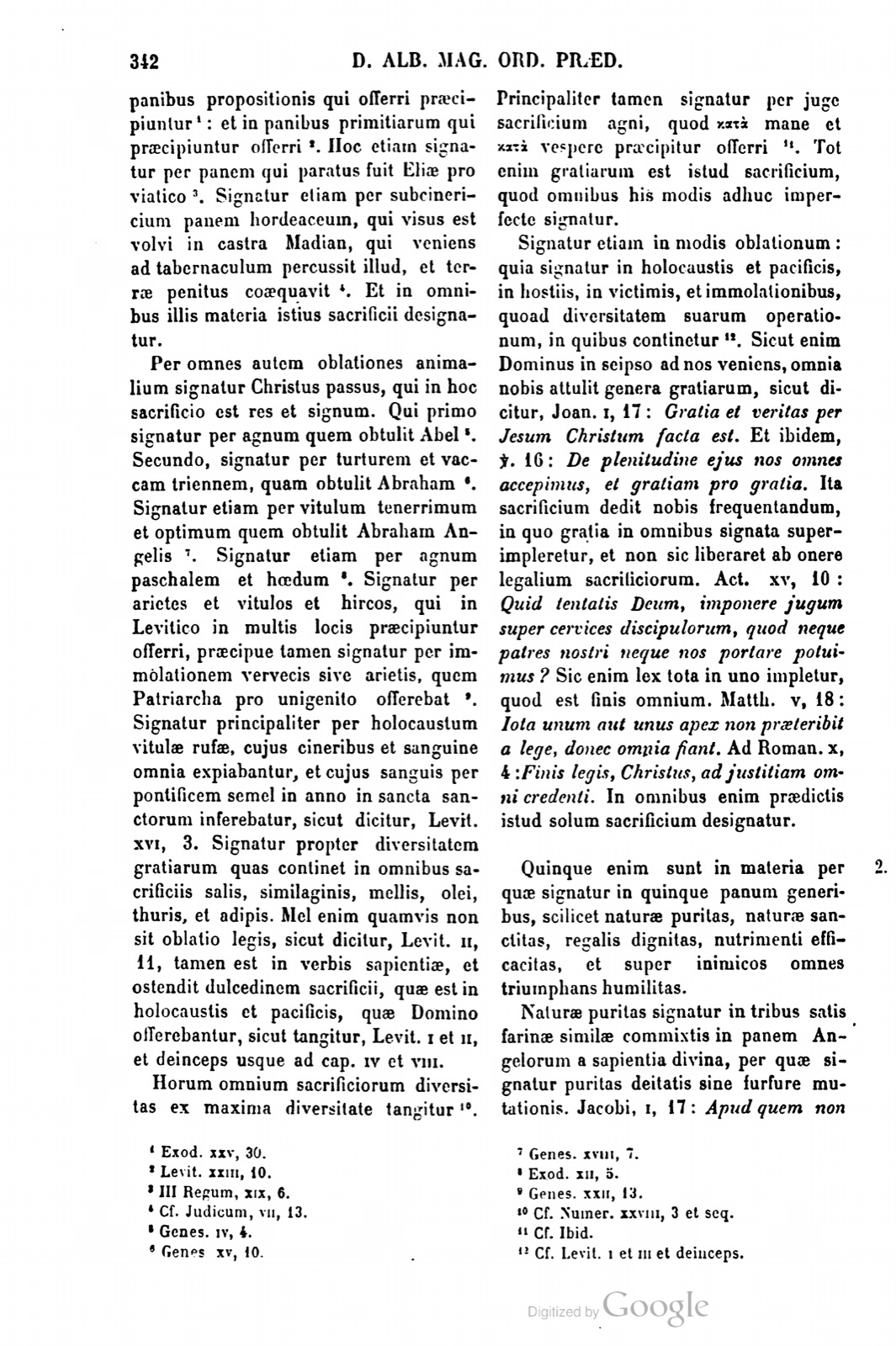
Naturae puritas signatur in tribus satis farinae similae commixtis in panem Angelorum a sapientia divina, per quae signatur puritas deitatis sine furfure mutationis. Jacobi, I, 17: Apud quem non est transmutatio, nec vicissitudinis obumbratio. Signatur etiam puritas animae sine furfure peccati originalis. Sapient. VII, 19: Sortitus sum animam bonam. Signatur etiam puritas corporis sine furfure libidinis. Sapient. VIII, 20: Cum essem magis bonus, veni ad corpus incoinquinatum. Sapient. VII, 24: Attingit autem ubique propter suam munditiam. Et post pauca, v. 25: Et ideo nihil inquinatum in eam incurrit.
Naturae autem sanctitas per panes signatur propositionis, de quibus dicitur, I Regum, XXI, 4: Non habeo laicos panes ad manum, sed tantum panem sanctum: si mundi sunt pueri, maxime a mulieribus, manducent. Non enim licebat illos panes comedere nisi a sanctis in loco sancto.
Dignitas autem nobilitatis regalis signatur per panes primitiarum: quia primitiae nobiliores erant inter fructus. Jerem. II, 3: Sanctus Israel Domino, primitiae frugum ejus. Proverb. III, 9: Honora Dominum de tua substantia, et de primitiis frugum tuarum da ei, scilicet pauperibus. Genes. XLII, 11 et seq.: Sumite de optimis terrae frugibus in vasis vestris, et deferte viro munera... Deus autem meus omnipotens faciat vobis eum placabilem.
Nutrimenti efficacitas et viatici virtus signatur in pane Eliae, qui in fortitudine illius cibi ambulavit quadraginta diebus et quadraginta noctibus usque ad montem Dei Horeb.14 Et ideo viaticum appellatur: quia per totam viam confortat ad ambulandum. Unde dicitur, Josue, V, 12, quod per totam viam deserti non defecit cibus mannatis filiis Israel. Joan. VI, 49: Patres vestri manducaverunt manna in deserto, et mortui sunt. Sed humilitas Christi patientis et mortalitas signatur in subcinericio hordeaceo, quae humilis passio omnia castra subvertit inimicorum. Ad Philip. II, 7 et seq.: Semetipsum exinanivit, formam servi accipiens, in similitudinem hominum factus, et habitu inventus ut homo. Humiliavit semetipsum, factus obediens, scilicet Patri, usque ad mortem, mortem autem crucis. Propter quod et Deus exaltavit illum, et donavit illi nomen quod est super omne nomen, ut in nomine Jesu omne genu flectatur coelestium, terrestrium, et infernorum, et omnis lingua confiteatur quia Dominus Jesus in gloria est Dei Patris. Quamvis enim humilitas durus cortex hordei videatur esse, et passio mortalitatis videatur decoctio, sub cinere tamen virtus confortativa latet intus, quae diabolum vincit et omnia castra subvertit inimicorum.
2. For there are five things in the matter through which it is signified in five kinds of bread, namely purity of nature, holiness of nature, royal dignity, efficacy of nourishment, and humility triumphing over all enemies.
Purity of nature is signified in the three measures of fine flour mixed into the bread of Angels by divine wisdom, through which is signified the purity of deity without bran of change. James 1:17: "With whom there is no transmutation, nor shadowing of vicissitude." The purity of the soul without bran of original sin is also signified. Wisdom 7:19: "I was allotted a good soul." The purity of the body without bran of lust is also signified. Wisdom 8:20: "When I was more good, I came to an undefiled body." Wisdom 7:24: "But she reaches everywhere because of her cleanness." And a little after, v. 25: "And therefore nothing defiled runs into her."
But holiness of nature is signified through the loaves of proposition, concerning which it is said, I Kings 21:4: "I do not have common loaves at hand, but only holy bread; if the boys are clean, especially from women, let them eat." For it was not lawful for any except holy persons to eat those loaves in a holy place.
But the dignity of royal nobility is signified through the loaves of first-fruits, because first-fruits were nobler among fruits. Jeremiah 2:3: "Israel is holy to the Lord, the first-fruits of his crops." Proverbs 3:9: "Honor the Lord from your substance, and from the first-fruits of your crops give to him," namely to the poor. Genesis 42:11 and following: "Take from the best fruits of the land in your vessels, and carry gifts to the man... But may my almighty God make him placable to you."
The efficacy of nourishment and the power of viaticum is signified in the bread of Elijah, who in the strength of that food walked forty days and forty nights as far as the mountain of God, Horeb.14 And therefore it is called viaticum, because through the whole way it strengthens for walking. Hence it is said, Joshua 5:12, that through the whole way of the desert the food of manna did not fail the sons of Israel. John 6:49: "Your fathers ate manna in the desert, and they died." But the humility of Christ suffering and mortality is signified in the barley hearth-cake, which humble Passion overturns all camps of enemies. Philippians 2:7 and following: "He emptied himself, taking the form of a servant, made in the likeness of men, and found in habit as a man. He humbled himself, made obedient," namely to the Father, "unto death, even death of the cross. On account of this God also exalted him and gave him the name which is above every name, that in the name of Jesus every knee of heavenly, earthly, and infernal things should bend, and every tongue confess that the Lord Jesus is in the glory of God the Father." For although humility seems to be the hard husk of barley, and the Passion of mortality seems to be cooking, nevertheless under the ash a strengthening power lies hidden within, which conquers the devil and overturns all camps of enemies.
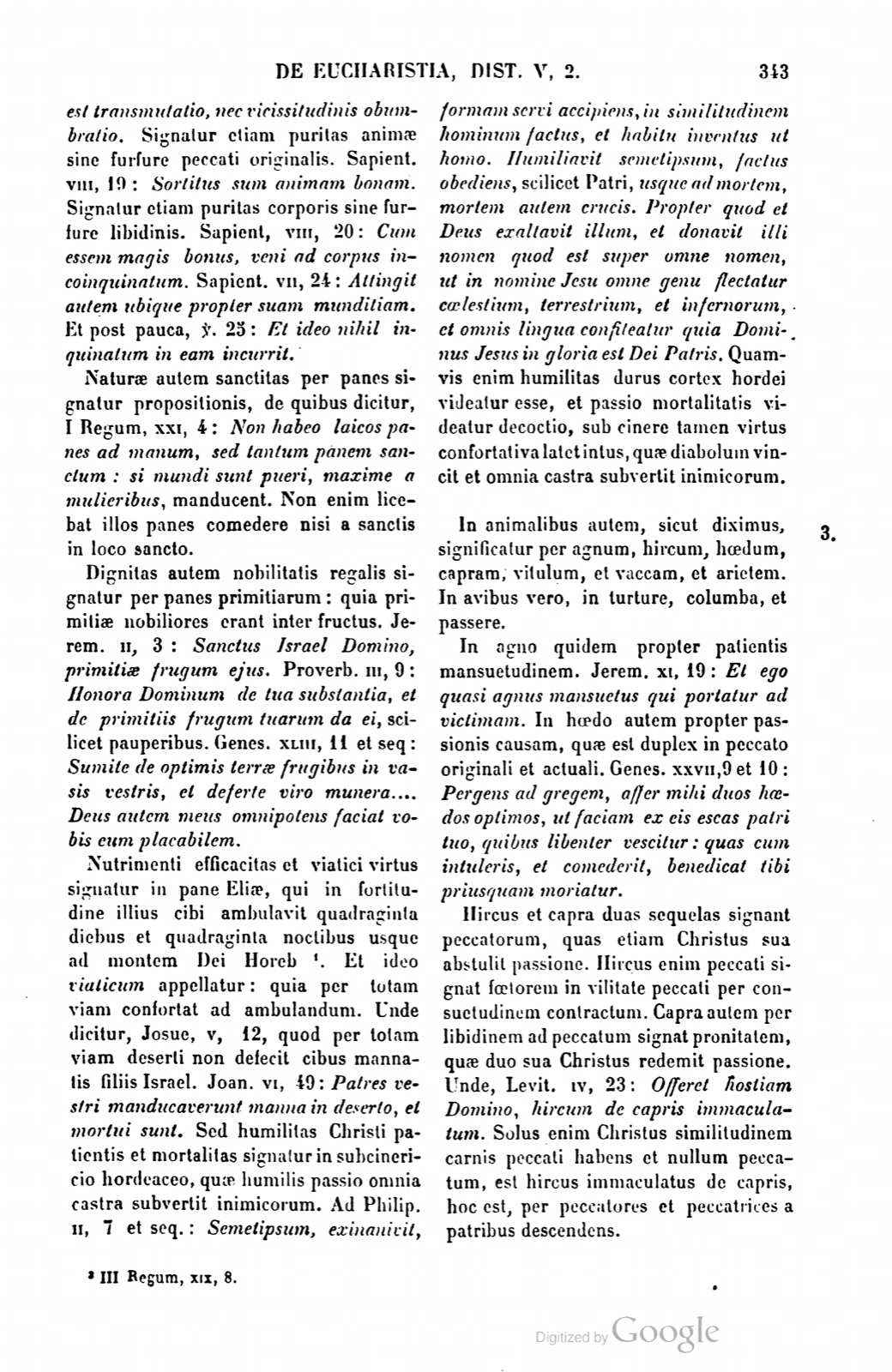
3. In animalibus autem, sicut diximus, significatur per agnum, hircum, haedum, capram, vitulum, et vaccam, et arietem. In avibus vero, in turture, columba, et passere.
In agno quidem propter patientis mansuetudinem. Jerem. XI, 19: Et ego quasi agnus mansuetus qui portatur ad victimam. In haedo autem propter passionis causam, quae est duplex in peccato originali et actuali. Genes. XXVII, 9 et 10: Pergens ad gregem, affer mihi duos haedos optimos, ut faciam ex eis escas patri tuo, quibus libenter vescitur: quas cum intuleris, et comederit, benedicat tibi priusquam moriatur.
Hircus et capra duas sequelas signant peccatorum, quas etiam Christus sua abstulit passione. Hircus enim peccati signat foetorem in vilitate peccati per consuetudinem contractum. Capra autem per libidinem ad peccatum signat pronitatem, quae duo sua Christus redemit passione. Unde, Levit. IV, 23: Offeret hostiam Domino, hircum de capris immaculatum. Solus enim Christus similitudinem carnis peccati habens et nullum peccatum, est hircus immaculatus de capris, hoc est, per peccatores et peccatrices a patribus descendens.
Vervex autem sive aries dux gregis, principatum Christi in regno fidelium designat. Proverb. XXX, 29 et seq.: Tria sunt quae bene gradiuntur: ... aries, scilicet dux gregis, nec est rex, qui resistat ei. Apocal. XIV, 1: Et vidi, et ecce Agnus stabat supra montem Sion, et cum eo centum quadraginta quatuor millia, habentes nomen ejus, et nomen Patris ejus scriptum in frontibus suis. Sic offertur ab Abraham, Genes. XXII, 13, quia ibi repraesentat qualiter immortalis manet deitas, sicut Isaac, et immolatur humanitas ducis nostri gregis, quod signat aries immolatus.
Commemoratio autem passionis quae quotidie fit in oblatione hujus sacrificii in altari, signatur per juge sacrificium, quod mane fiebat et vespere. Mane quidem ad gratiam virtutis, quia mane in vita ista egemus ad meritum: vespere autem in periculosa infirmitate, quia tunc sacramento egemus ad viaticum. De quibus duobus dicitur in Psalmo CXL, 2: Dirigatur oratio mea sicut incensum, supple, matutinum, in conspectu tuo: elevatio manuum mearum, supple, in recommendatione animae, sacrificium vespertinum. Eccle. XI, 6: Mane semina semen tuum, et vespere ne cesset manus tua: quia nescis quid magis oriatur, hoc aut illud: et si utrumque simul, melius erit.
In vitulis autem boum repraesentabatur hoc sacrificium propter saginae maturitatem et utilitatem. Saginatus est enim vitulus omni pinguedine devotionis. Luc. XV, 23, occidit pater vitulum saginatum, quia salvum filium recepit. Mature etiam etiam incedit bos et caute, et fortiter ungulam figit. Ezechiel. I, 7: Planta pedis eorum planta pedis vituli. Utile est ad arandum. Sic Christus caute pedem posuit, nulli malum et omnibus bonum exemplum dando, hominum corda vomere praedicationis aravit, sicut dicitur, Proverb. XIV, 4: Ubi plurimae segetes, ibi manifesta est fortitudo bovis.
3. But in animals, as we said, he is signified through the lamb, he-goat, kid, she-goat, calf and cow, and ram. But in birds, in the turtledove, dove, and sparrow.
In the lamb indeed because of the meekness of the one suffering. Jeremiah 11:19: "And I was like a meek lamb which is carried to the victim." But in the kid because of the cause of the Passion, which is double in original and actual sin. Genesis 27:9 and 10: "Going to the flock, bring me two best kids, that I may make from them foods for your father, by which he is gladly fed; when you have brought them and he has eaten, he may bless you before he dies."
The he-goat and she-goat signify two consequences of sins, which Christ also took away by his Passion. For the he-goat signifies the stench of sin contracted in the vileness of sin through custom. But the she-goat through lust signifies inclination to sin; Christ redeemed these two by his Passion. Hence, Leviticus 4:23: "He will offer to the Lord a victim, an immaculate he-goat from the goats." For Christ alone, having the likeness of the flesh of sin and no sin, is the immaculate he-goat from the goats, that is, descending through sinners male and female from the fathers.
But the wether or ram, leader of the flock, designates the principate of Christ in the kingdom of the faithful. Proverbs 30:29 and following: "There are three things which walk well: ... the ram," namely the leader of the flock, "and there is no king who resists him." Apocalypse 14:1: "And I saw, and behold the Lamb was standing upon Mount Sion, and with him one hundred forty-four thousand, having his name and the name of his Father written on their foreheads." Thus he is offered by Abraham, Genesis 22:13, because there it represents how immortal deity remains, like Isaac, and the humanity of the leader of our flock is immolated, which the immolated ram signifies.
But the commemoration of the Passion which is made daily in the offering of this sacrifice on the altar is signified through the continual sacrifice which was made morning and evening. Morning indeed for the grace of virtue, because in the morning, in this life, we need it for merit; but evening in dangerous weakness, because then we need the sacrament as viaticum. Concerning these two things it is said in Psalm 140:2: "Let my prayer be directed like incense," supply, morning incense, "in your sight; the lifting up of my hands," supply, in the recommendation of the soul, "as the evening sacrifice." Ecclesiastes 11:6: "In the morning sow your seed, and in the evening let not your hand cease, because you do not know which may rise more, this or that; and if both together, it will be better."
But in the calves of oxen this sacrifice was represented because of the maturity and usefulness of fattening. For the calf was fattened with all the fatness of devotion. Luke 15:23: the father killed the fatted calf because he received his son safe. The ox also walks maturely and cautiously, and fixes the hoof strongly. Ezekiel 1:7: "The sole of their foot was the sole of the foot of a calf." It is useful for plowing. Thus Christ cautiously placed his foot, giving evil example to none and good example to all, and plowed the hearts of men with the plowshare of preaching, as is said, Proverbs 14:4: "Where the harvests are very many, there the strength of the ox is manifest."
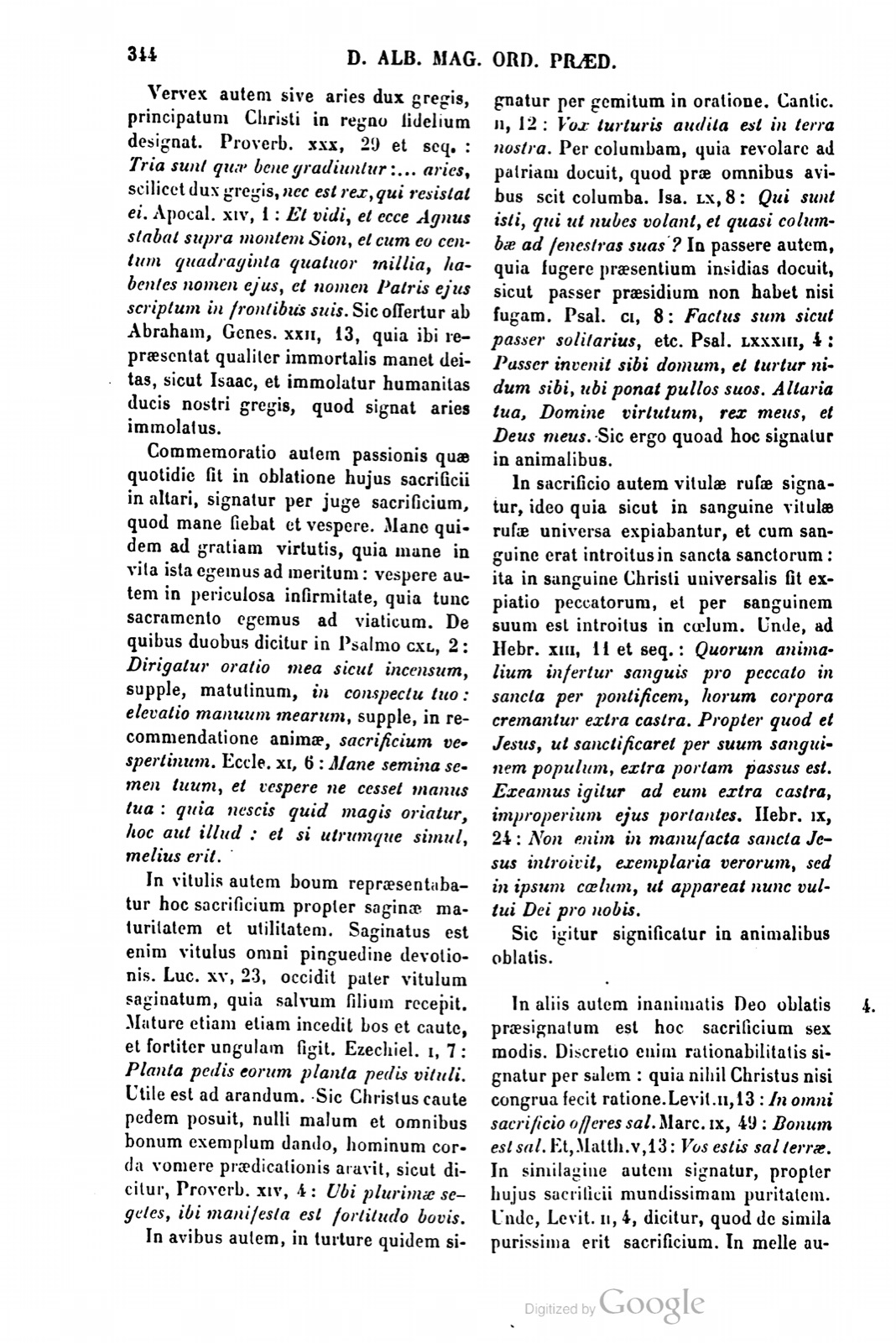
In avibus autem, in turture quidem signatur per gemitum in oratione. Cantic. II, 12: Vox turturis audita est in terra nostra. Per columbam, quia revolare ad patriam docuit, quod prae omnibus avibus scit columba. Isa. LX, 8: Qui sunt isti, qui ut nubes volant, et quasi columbae ad fenestras suas? In passere autem, quia fugere praesentium insidias docuit, sicut passer praesidium non habet nisi fugam. Psal. CI, 8: Factus sum sicut passer solitarius, etc. Psal. LXXXII, 4: Passer invenit sibi domum, et turtur nidum sibi, ubi ponat pullos suos. Altaria tua, Domine virtutum, rex meus, et Deus meus. Sic ergo quoad hoc signatur in animalibus.
In sacrificio autem vitulae rufae signatur, ideo quia sicut in sanguine vitulae rufae universa expiabantur, et cum sanguine erat introitus in sancta sanctorum: ita in sanguine Christi universalis fit expiatio peccatorum, et per sanguinem suum est introitus in caelum. Unde, ad Hebr. XIII, 11 et seq.: Quorum animalium infertur sanguis pro peccato in sancta per pontificem, horum corpora cremantur extra castra. Propter quod et Jesus, ut sanctificaret per suum sanguinem populum, extra portam passus est. Exeamus igitur ad eum extra castra, improperium ejus portantes. Hebr. IX, 24: Non enim in manufacta sancta Jesus introivit, exemplaria verorum, sed in ipsum caelum, ut appareat nunc vultui Dei pro nobis.
Sic igitur significatur in animalibus oblatis.
4. In aliis autem inanimatis Deo oblatis praesignatum est hoc sacrificium sex modis. Discretio enim rationabilitatis signatur per salem: quia nihil Christus nisi congrua fecit ratione. Levit. II, 13: In omni sacrificio offeres sal. Marc. IX, 49: Bonum est sal. Et, Matth. V, 13: Vos estis sal terrae. In similagine autem signatur, propter hujus sacrificii mundissimam puritatem. Unde, Levit. I, 4, dicitur, quod de simila purissima erit sacrificium. In melle autem dulcedo signatur Spiritus sancti. Eccli. XXIV, 27: Spiritus meus super mel dulcis, et haereditas mea super mel et favum. In oleo autem pinguedo signatur devotionis. Cantic. I, 2: Oleum effusum nomen tuum. In thure notatur odor orationis et virtutis. Cantic. III, 6: Quae est ista quae ascendit per desertum, sicut virgula fumi ex aromatibus myrrhae et thuris? Levit. I, 17: Adolebit super altare, lignis igne supposito. Holocaustum est et oblatio suavissimi odoris Domino. In adipe et pinguedine signatum est hoc sacrificium, quoad crassitudinis dulcedinem in Spiritus sancti interna consolatione. In sanguine autem omnis oblationis quoad opus redemptionis. Levit. III, 16 et 17: Omnis adeps Domini erit jure perpetuo in generationibus, et cunctis habitaculis vestris: nec sanguinem nec adipem omnino comedetis, sed, supple, Domino offeretis. Psal. LXII, 6: Sicut adipe et pinguedine repleatur anima mea, et labiis exsultationis laudabit os meum.
Sic igitur in multitudine gratiarum suarum et pinguedine spiritus signatum est in sacrificiis. In nullo autem offertur fermentum: quia corruptionem signat, quae isti non congruit sacramento.
5. In modis etiam oblationum signatur omnibus quoad diversitatem numerosam suarum operationum. Sunt autem modi illi in universo quinque, et sextus salvatur in omnibus illis. Quinque autem sunt holocausta, pacifica, hostia, victima, et immolatio. In omnibus autem istis salvatur oblatio: quia quodlibet istorum Domino offerebatur. Holocaustum enim dicitur, quod totum incendebatur igne, sicut agni, jugis sacrificii, et sacrificium vitulae rufae. Pacifica autem dicebantur, quae pro propitiatione pacis vel jam factae vel proximo faciendae cum Deo pro reconciliatione peccatorum offerebantur: et haec non tota incendebantur, sed pars incendebatur Domino, et pars cessit sacerdoti offerenti, et pars cedebat in usus ejus qui obtulit pacifica et pro quo offerebatur. Hostia autem, sicut dicit Hesicius, vel ideo dicebatur, quod ad ostium tabernaculi ducebatur manibus offerentium impositis capiti ejus, ut sic significaretur, quod per ipsam ad sancta pateret accessus. Vel ideo, quia pro vincendis vel jam victis hostibus offerebatur. Victima autem, ut idem dicit Hesicius, vel dicebatur, quia victa offerebatur: vel quia in victoria, qua homo vicisse gaudebat quando tentatorem superaverat. Immolatio autem dicebatur, quae cum offerretur, molam quamdam habebat animal in capite, in signum quod hoc animal ad Dei sacrificia pertinebat. In omnibus autem his salvatur oblatio: quia quodlibet eorum coram Deo offerebatur antequam in toto vel in parte incenderetur.
But in birds, in the turtledove indeed he is signified through groaning in prayer. Canticles 2:12: "The voice of the turtledove has been heard in our land." Through the dove, because he taught to fly back to the fatherland, which the dove knows before all birds. Isaiah 60:8: "Who are these who fly like clouds, and like doves to their windows?" But in the sparrow, because he taught to flee present snares, as the sparrow has no protection except flight. Psalm 101:8: "I have been made like a solitary sparrow," etc. Psalm 82:4: "The sparrow has found a house for herself, and the turtledove a nest for herself, where she may place her young. Your altars, Lord of hosts, my king and my God." Thus therefore with respect to this he is signified in animals.
But in the sacrifice of the red heifer he is signified, because just as in the blood of the red heifer all things were expiated, and with blood there was entrance into the Holy of Holies, so in the blood of Christ universal expiation of sins is made, and through his blood there is entrance into heaven. Hence, Hebrews 13:11 and following: "The animals whose blood is brought for sin into the holy places by the pontiff, their bodies are burned outside the camp. On account of this Jesus also, that he might sanctify the people through his own blood, suffered outside the gate. Therefore let us go out to him outside the camp, bearing his reproach." Hebrews 9:24: "For Jesus did not enter into holy places made by hand, examples of the true things, but into heaven itself, that he may now appear before the countenance of God for us."
Thus therefore he is signified in offered animals.
4. But in other inanimate things offered to God, this sacrifice was pre-signified in six modes. For discernment of reasonableness is signified through salt, because Christ did nothing except by fitting reason. Leviticus 2:13: "In every sacrifice you shall offer salt." Mark 9:49: "Salt is good." And Matthew 5:13: "You are the salt of the earth." But in fine flour he is signified because of the most clean purity of this sacrifice. Hence, Leviticus 1:4, it is said that the sacrifice will be from the purest fine flour. But in honey the sweetness of the Holy Spirit is signified. Ecclesiasticus 24:27: "My spirit is sweet above honey, and my inheritance above honey and honeycomb." But in oil the fatness of devotion is signified. Canticles 1:2: "Your name is oil poured out." In incense is noted the odor of prayer and virtue. Canticles 3:6: "Who is this who ascends through the desert, like a rod of smoke from the spices of myrrh and incense?" Leviticus 1:17: "He will burn it on the altar, with wood placed under the fire. It is a holocaust and an offering of sweetest odor to the Lord." In fat and fatness this sacrifice is signified with respect to the sweetness of richness in the internal consolation of the Holy Spirit. But in the blood of every offering with respect to the work of redemption. Leviticus 3:16 and 17: "All fat will be the Lord's by a perpetual right in your generations and in all your dwellings; neither blood nor fat shall you eat at all," but, supply, "you shall offer it to the Lord." Psalm 62:6: "Let my soul be filled as with fat and fatness, and my mouth will praise with lips of exultation."
Thus therefore in the multitude of his graces and the fatness of spirit it was signified in sacrifices. But leaven is offered in none, because it signifies corruption, which does not suit that sacrament.
5. It is also signified in the modes of offerings, in all of them with respect to the numerous diversity of its operations. But those modes in the whole are five, and the sixth is preserved in all of them. But the five are holocausts, peace-offerings, host, victim, and immolation. But in all these offering is preserved, because any of them was offered to the Lord. For a holocaust is said to be what was wholly burned by fire, like the lambs of the continual sacrifice and the sacrifice of the red heifer. But peace-offerings were those which were offered for the propitiation of peace either already made or soon to be made with God for the reconciliation of sins; and these were not wholly burned, but part was burned to the Lord, and part yielded to the priest offering, and part yielded to the uses of him who offered the peace-offerings and for whom it was offered. But host, as Hesychius says, was so called either because it was led to the door of the tabernacle with the hands of those offering imposed on its head, so that thus it might be signified that through it access to the holy places lay open; or because it was offered for enemies to be conquered or already conquered. But victim, as the same Hesychius says, was so called either because it was offered after being conquered, or because in victory, by which a man rejoiced that he had conquered when he had overcome the tempter. But immolation was so called because, when it was offered, the animal had a certain meal on its head, as a sign that this animal pertained to the sacrifices of God. But in all these offering is preserved, because each of them was offered before God before it was burned wholly or in part.
Haec autem omnia in nostro implentur sacrificio spiritualiter. Nostrum enim sacrificium totum in igne charitatis et sancti Spiritus oblatum est, et offertur quotidie. Et hoc signatum est, Genes. VIII, 20 et seq., ubi postquam Noe de arca egressus est, quod signat salutem per baptismum, sicut dicitur, I Petri, III, 21: Quod et vos nunc similis formae salvos facit baptisma, non carnis depositio sordium, sed conscientiae bonae interrogatio in Deum. Postquam igitur sic Noe egressus est, salvatus ex aqua, aedificavit altare Domino: et tollens de cunctis pecoribus et volucribus mundis, obtulit holocausta super altare. Odoratusque est Dominus odorem suavitatis: quia sive sint animalia Dei quae laborant in laboribus necessitatum hujus vitae, sive sint volucres caeli, contemplatione coelestia petentes, in holocaustum per ignem charitatis et Spiritus sancti incensi in altari, hoc est, in sacrificio altaris Deo oblati in odorem suavitatis, acceptantur. Immundi autem nihil cum altari nostro habent commune: quia sacrificio nostro non sunt uniti. Genes. XXII, 2: Tolle filium tuum unigenitum, quem diligis, Isaac, et vade in terram visionis, atque ibi offeres eum in holocaustum super unum montium quem monstravero tibi. Mons autem ille elevationem spiritus designat.
Haec hostia etiam inter omnes singulariter est pacifica, quae pacem fecit inter nos et Deum, sicut dicitur, ad Ephes. II, 14: Ipse est pax nostra: qui fecit utraque unum, et medium parietem maceriae solvens, inimicitias in carne sua. Isa. XXVI, 12: Domine, dabis pacem nobis: omnia enim opera nostra operatus es nobis. Joan. XVI, 33, dicit discipulis: Haec locutus sum vobis ut in me pacem habeatis. In mundo pressuram habebitis, etc. Haec etiam hostia pacifica est divisa: quia pars Deo ad laudem offertur, pars autem pro Ecclesia laborante, et pars pro purgandis in purgatorio, sicut in ante habitis diximus.
But all these things are spiritually fulfilled in our sacrifice. For our whole sacrifice was offered in the fire of charity and of the Holy Spirit, and is offered daily. And this was signified, Genesis 8:20 and following, where after Noah went out of the ark, which signifies salvation through baptism, as is said, I Peter 3:21: "Which now also saves you in a similar form, baptism, not the putting away of filths of the flesh, but the interrogation of a good conscience into God." Therefore after Noah had gone out thus, saved from water, he built an altar to the Lord; and taking from all clean cattle and birds, he offered holocausts upon the altar. And the Lord smelled the odor of sweetness, because whether they are animals of God which labor in the labors of the necessities of this life, or whether they are birds of heaven seeking heavenly things by contemplation, when enkindled into a holocaust by the fire of charity and the Holy Spirit on the altar, that is, in the sacrifice of the altar offered to God as an odor of sweetness, they are accepted. But the unclean have nothing common with our altar, because they are not united to our sacrifice. Genesis 22:2: "Take your only-begotten son, whom you love, Isaac, and go into the land of vision, and there offer him as a holocaust upon one of the mountains which I will show you." But that mountain designates the elevation of spirit.
This host also among all is singularly peaceful, which made peace between us and God, as is said, Ephesians 2:14: "He is our peace, who made both one, dissolving the middle wall of partition, the enmities in his flesh." Isaiah 26:12: "Lord, you will give peace to us, for you have worked all our works for us." John 16:33 says to the disciples: "These things I have spoken to you that in me you may have peace. In the world you will have pressure," etc. This peaceful host is also divided, because part is offered to God for praise, but part for the laboring Church, and part for those being purged in purgatory, as we said in what was held before.
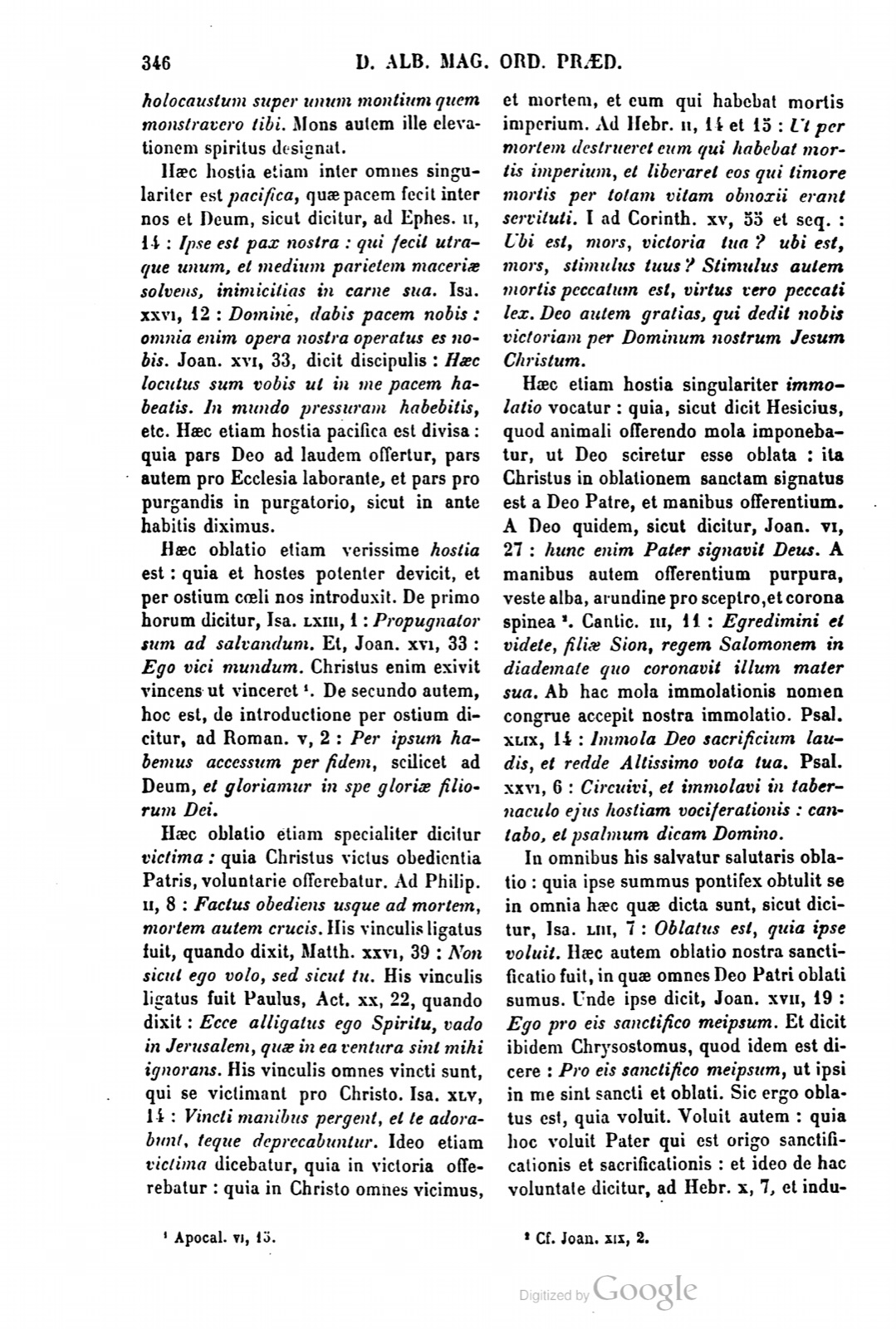
Haec oblatio etiam verissime hostia est: quia et hostes potenter devicit, et per ostium coeli nos introduxit. De primo horum dicitur, Isa. LXIII, 1: Propugnator sum ad salvandum. Et, Joan. XVI, 33: Ego vici mundum. Christus enim exivit vincens ut vinceret.15 De secundo autem, hoc est, de introductione per ostium dicitur, ad Roman. V, 2: Per ipsum habemus accessum per fidem, scilicet ad Deum, et gloriamur in spe gloriae filiorum Dei.
Haec oblatio etiam specialiter dicitur victima: quia Christus victus obedientia Patris, voluntarie offerebatur. Ad Philip. II, 8: Factus obediens usque ad mortem, mortem autem crucis. His vinculis ligatus fuit, quando dixit, Matth. XXVI, 39: Non sicut ego volo, sed sicut tu. His vinculis ligatus fuit Paulus, Act. XX, 22, quando dixit: Ecce alligatus ego Spiritu, vado in Jerusalem, quae in ea ventura sint mihi ignorans. His vinculis omnes vincti sunt, qui se victimant pro Christo. Isa. XLV, 14: Vincti manibus pergent, et te adorabunt, teque deprecabuntur. Ideo etiam victima dicebatur, quia in victoria offerebatur: quia in Christo omnes vicimus, et mortem, et eum qui habebat mortis imperium. Ad Hebr. II, 14 et 15: Ut per mortem destrueret eum qui habebat mortis imperium, et liberaret eos qui timore mortis per totam vitam obnoxii erant servituti. I ad Corinth. XV, 55 et seq.: Ubi est, mors, victoria tua? ubi est, mors, stimulus tuus? Stimulus autem mortis peccatum est, virtus vero peccati lex. Deo autem gratias, qui dedit nobis victoriam per Dominum nostrum Jesum Christum.
Haec etiam hostia singulariter immolatio vocatur: quia, sicut dicit Hesicius, quod animali offerendo mola imponebatur, ut Deo sciretur esse oblata: ita Christus in oblationem sanctam signatus est a Deo Patre, et manibus offerentium. A Deo quidem, sicut dicitur, Joan. VI, 27: hunc enim Pater signavit Deus. A manibus autem offerentium purpura, veste alba, arundine pro sceptro, et corona spinea.16 Cantic. III, 11: Egredimini et videte, filiae Sion, regem Salomonem in diademate quo coronavit illum mater sua. Ab hac mola immolationis nomen congrue accepit nostra immolatio. Psal. XLIX, 14: Immola Deo sacrificium laudis, et redde Altissimo vota tua. Psal. XXVI, 6: Circuivi, et immolavi in tabernaculo ejus hostiam vociferationis: cantabo, et psalmum dicam Domino.
In omnibus his salvatur salutaris oblatio: quia ipse summus pontifex obtulit se in omnia haec quae dicta sunt, sicut dicitur, Isa. LIII, 7: Oblatus est, quia ipse voluit. Haec autem oblatio nostra sanctificatio fuit, in quae omnes Deo Patri oblati sumus. Unde ipse dicit, Joan. XVII, 19: Ego pro eis sanctifico meipsum. Et dicit ibidem Chrysostomus, quod idem est dicere: Pro eis sanctifico meipsum, ut ipsi in me sint sancti et oblati. Sic ergo oblatus est, quia voluit. Voluit autem: quia hoc voluit Pater qui est origo sanctificationis et sacrificationis: et ideo de hac voluntate dicitur, ad Hebr. X, 7, et inducit
This offering also is most truly a host, because it both powerfully conquered enemies and introduced us through the door of heaven. Concerning the first of these it is said, Isaiah 63:1: "I am a defender unto saving." And John 16:33: "I have conquered the world." For Christ went forth conquering that he might conquer.15 But concerning the second, that is, concerning introduction through the door, it is said, Romans 5:2: "Through him we have access by faith," namely to God, "and we glory in the hope of the glory of the sons of God."
This offering is also specially called victim, because Christ, conquered by obedience to the Father, was offered voluntarily. Philippians 2:8: "Made obedient unto death, even death of the cross." He was bound by these chains when he said, Matthew 26:39: "Not as I will, but as you." Paul was bound by these chains, Acts 20:22, when he said: "Behold, I, bound by the Spirit, go to Jerusalem, not knowing what things are going to happen to me in it." By these chains all are bound who make themselves victims for Christ. Isaiah 45:14: "They will go bound in hands, and they will adore you and beseech you." Therefore also it was called victim because it was offered in victory, because in Christ we all have conquered both death and him who had the empire of death. Hebrews 2:14 and 15: "That through death he might destroy him who had the empire of death, and free those who through fear of death throughout the whole of life were subject to servitude." I Corinthians 15:55 and following: "Where, death, is your victory? where, death, is your sting? But the sting of death is sin, and the power of sin is the Law. But thanks be to God, who gave us victory through our Lord Jesus Christ."
This host also is singularly called immolation, because, as Hesychius says, meal was imposed on an animal to be offered, so that it might be known to be offered to God; so Christ was signed for holy offering by God the Father and by the hands of those offering. By God indeed, as is said, John 6:27: "For him the Father, God, has signed." But by the hands of those offering, with purple, a white garment, a reed for a scepter, and a thorny crown.16 Canticles 3:11: "Go forth and see, daughters of Sion, King Solomon in the diadem with which his mother crowned him." From this meal of immolation our immolation fittingly received its name. Psalm 49:14: "Immolate to God the sacrifice of praise, and render your vows to the Most High." Psalm 26:6: "I went around and immolated in his tabernacle a host of shouting; I will sing and speak a psalm to the Lord."
In all these the saving offering is preserved, because the highest pontiff himself offered himself into all these things which have been said, as is said, Isaiah 53:7: "He was offered because he himself willed." But this offering was our sanctification, in which we all were offered to God the Father. Hence he himself says, John 17:19: "For them I sanctify myself." And Chrysostom says in the same place that to say, "For them I sanctify myself," is the same as: that they may be holy and offered in me. Thus therefore he was offered because he willed. But he willed because the Father willed this, who is the origin of sanctification and sacrifice; and therefore concerning this will it is said, Hebrews 10:7, and he introduces
Notes
- Genesis 18:6. (Genes. XVIII, 6.) ↩
- Exodus 25:30. (Exod. XXV, 30.) ↩
- Leviticus 23:10. (Levit. XXIII, 10.) ↩
- III Kings 19:6. (III Regum, XIX, 6.) ↩
- Compare Judges 7:13. (Cf. Judicum, VII, 13.) ↩
- Genesis 4:4. (Genes. IV, 4.) ↩
- Genesis 15:10. (Genes. XV, 10.) ↩
- Genesis 18:7. (Genes. XVIII, 7.) ↩
- Exodus 12:5. (Exod. XII, 5.) ↩
- Genesis 22:13. (Genes. XXII, 13.) ↩
- Compare Numbers 28:3 and following. (Cf. Numer. XXVIII, 3 et seq.) ↩
- Compare the same place. (Cf. Ibid.) ↩
- Compare Leviticus 1 and 3 and thereafter. (Cf. Levit. I et III et deinceps.) ↩
- III Kings 19:8. (III Regum, XIX, 8.) ↩
- Apocalypse 6:15. (Apocal. VI, 15.) ↩
- Compare John 19:2. (Cf. Joan. XIX, 2.) ↩
If a page does not appear, its photograph has not been uploaded yet.