Works › The Book on the Sacrament of the Eucharist
Volume 38 · pp. 335–337
Chapter IV. That this sacrament makes one communicate with the sufferings of the mystical body.
A marker with ≈ is an approximate page boundary, placed by measure of the text; the page photographs remain the authority. In the paired views, clicking a page marker brings that page into view.
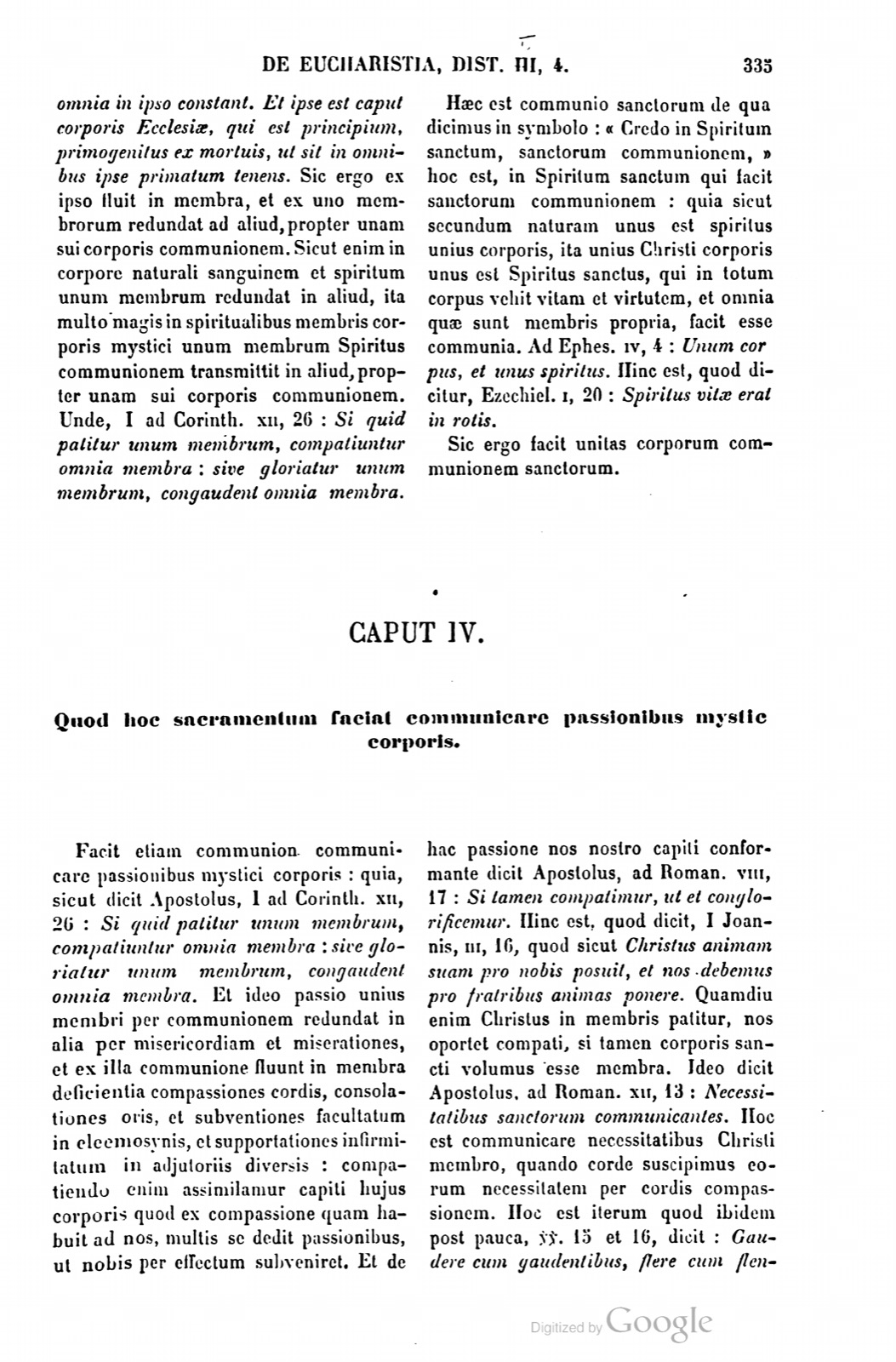
CAPUT IV. Quod hoc sacramentum faciat communicare passionibus mystici corporis.
Facit etiam communionem communicare passionibus mystici corporis: quia, sicut dicit Apostolus, I ad Corinth. XII, 26: Si quid patitur unum membrum, compatiuntur omnia membra: sive gloriatur unum membrum, congaudent omnia membra. Et ideo passio unius membri per communionem redundat in alia per misericordiam et miserationes, et ex illa communione fluunt in membra deficientia compassiones cordis, consolationes oris, et subventiones facultatum in eleemosynis, et supportationes infirmitatum in adjutoriis diversis: compatiendo enim assimilamur capiti hujus corporis quod ex compassione quam habuit ad nos, multis se dedit passionibus, ut nobis per effectum subveniret. Et de hac passione nos nostro capiti conformante dicit Apostolus, ad Roman. VIII, 17: Si tamen compatimur, ut et conglorificemur. Hinc est, quod dicit, I Joannis, III, 16, quod sicut Christus animam suam pro nobis posuit, et nos debemus pro fratribus animas ponere. Quamdiu enim Christus in membris patitur, nos oportet compati, si tamen corporis sancti volumus esse membra. Ideo dicit Apostolus, ad Roman. XII, 13: Necessitatibus sanctorum communicantes. Hoc est communicare necessitatibus Christi membro, quando corde suscipimus eorum necessitatem per cordis compassionem. Hoc est iterum quod ibidem post pauca, v. 15 et 16, dicit: Gaudere cum gaudentibus, flere cum flentibus: idipsum invicem sentientes.
CHAPTER IV. That this sacrament makes one communicate with the sufferings of the mystical body.
It also makes communion communicate with the sufferings of the mystical body, because, as the Apostle says, I Corinthians 12:26: "If one member suffers anything, all the members suffer together; or if one member is glorified, all the members rejoice together." And therefore the suffering of one member through communion overflows into the others through mercy and compassion, and from that communion there flow into deficient members compassions of heart, consolations of the mouth, and help of faculties in alms, and supports of weaknesses in diverse aids. For by suffering together we are assimilated to the head of this body, who from the compassion which he had toward us gave himself to many sufferings, so that he might help us by effect. And concerning this suffering conforming us to our head the Apostle says, Romans 8:17: "If nevertheless we suffer together, that we may also be glorified together." Hence it is that I John 3:16 says that just as Christ laid down his soul for us, we also ought to lay down our souls for the brothers. For as long as Christ suffers in the members, we ought to suffer together, if nevertheless we wish to be members of the holy body. Therefore the Apostle says, Romans 12:13: "Communicating with the necessities of the saints." This is to communicate with the necessities of a member of Christ, when by heart we receive their necessity through compassion of heart. This again is what in the same place a little after, v. 15 and 16, he says: "To rejoice with those rejoicing, to weep with those weeping, feeling the selfsame thing toward one another."
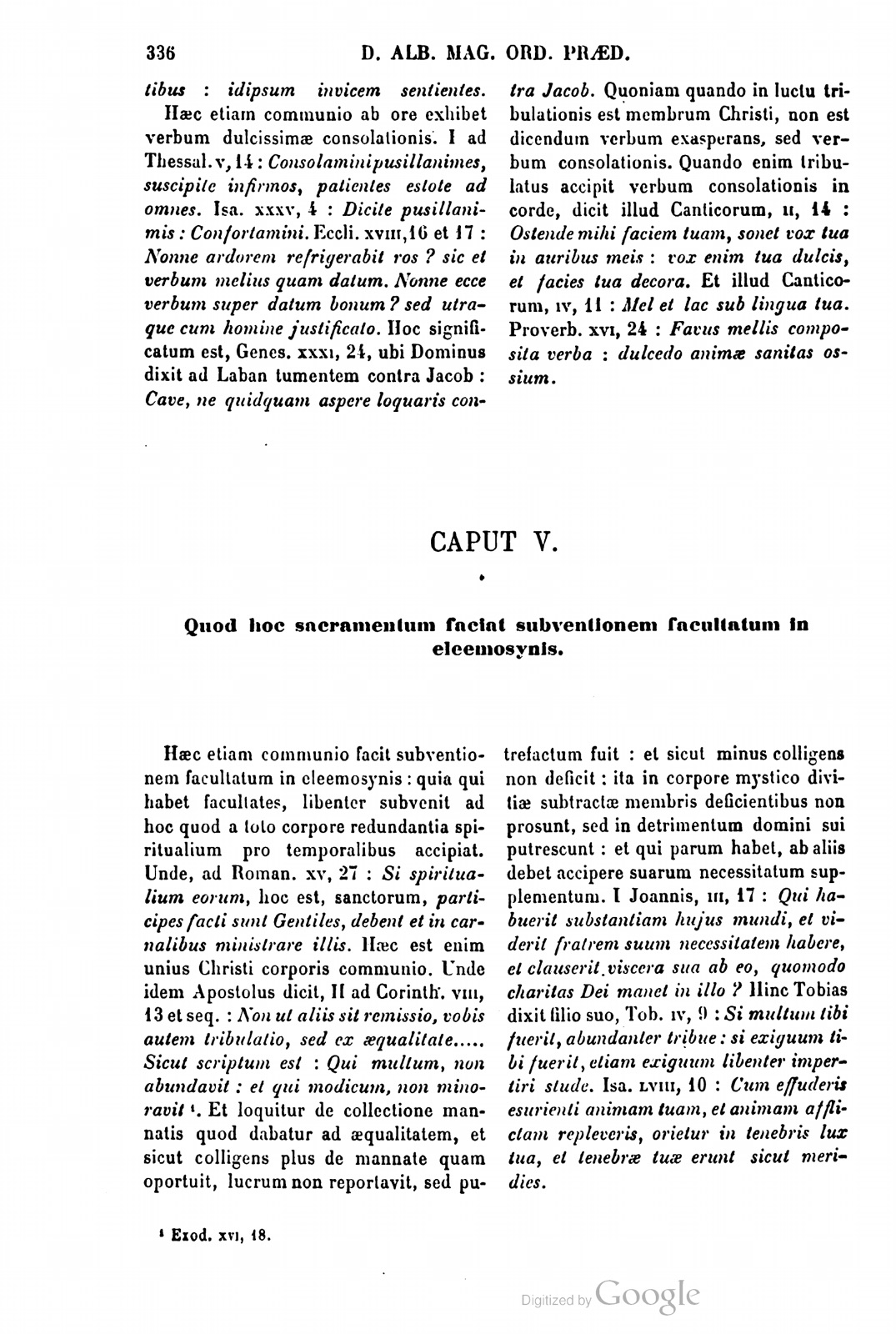
Haec etiam communio ab ore exhibet verbum dulcissimae consolationis. I ad Thessal. V, 14: Consolamini pusillanimes, suscipite infirmos, patientes estote ad omnes. Isa. XXXV, 4: Dicite pusillanimis: Confortamini. Eccli. XVIII, 16 et 17: Nonne ardorem refrigerabit ros? sic et verbum melius quam datum. Nonne ecce verbum super datum bonum? sed utraque cum homine justificato. Hoc significatum est, Genes. XXXI, 24, ubi Dominus dixit ad Laban tumentem contra Jacob: Cave, ne quidquam aspere loquaris contra Jacob. Quoniam quando in luctu tribulationis est membrum Christi, non est dicendum verbum exasperans, sed verbum consolationis. Quando enim tribulatus accipit verbum consolationis in corde, dicit illud Canticorum, II, 14: Ostende mihi faciem tuam, sonet vox tua in auribus meis: vox enim tua dulcis, et facies tua decora. Et illud Canticorum, IV, 11: Mel et lac sub lingua tua. Proverb. XVI, 24: Favus mellis composita verba: dulcedo animae sanitas ossium.
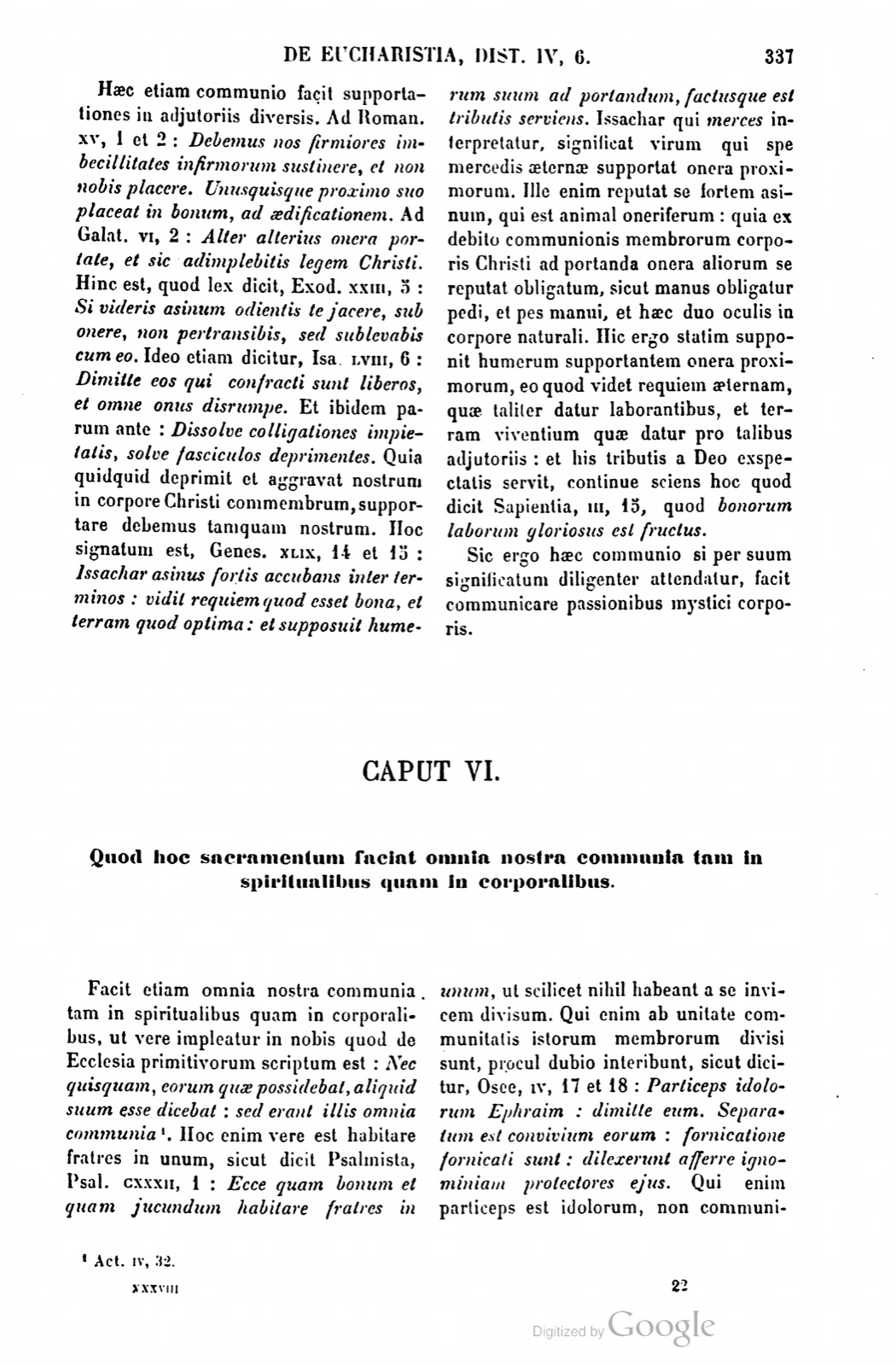
Haec etiam communio facit supportationes in adjutoriis diversis. Ad Roman. XV, 1 et 2: Debemus nos firmiores imbecillitates infirmorum sustinere, et non nobis placere. Unusquisque proximo suo placeat in bonum, ad aedificationem. Ad Galat. VI, 2: Alter alterius onera portate, et sic adimplebitis legem Christi. Hinc est, quod lex dicit, Exod. XXIII, 3: Si videris asinum odientis te jacere sub onere, non pertransibis, sed sublevabis cum eo. Ideo etiam dicitur, Isa. LVIII, 6: Dimitte eos qui confracti sunt liberos, et omne onus disrumpe. Et ibidem parum ante: Dissolve colligationes impietatis, solve fasciculos deprimentes. Quia quidquid deprimit et aggravat nostrum in corpore Christi commembrum, supportare debemus tamquam nostrum. Hoc signatum est, Genes. XLIX, 14 et 15: Issachar asinus fortis accubans inter terminos: vidit requiem quod esset bona, et terram quod optima: et supposuit humerum suum ad portandum, factusque est tributis serviens. Issachar qui merces interpretatur, significat virum qui spe mercedis aeternae supportat onera proximorum. Ille enim reputat se fortem asinum, qui est animal oneriferum: quia ex debito communionis membrorum corporis Christi ad portanda onera aliorum se reputat obligatum, sicut manus obligatur pedi, et pes manui, et haec duo oculis in corpore naturali. Hic ergo statim supponit humerum supportantem onera proximorum, eo quod videt requiem aeternam, quae taliter datur laborantibus, et terram viventium quae datur pro talibus adjutoriis: et his tributis a Deo exspectatis servit, continue sciens hoc quod dicit Sapientia, III, 15, quod bonorum laborum gloriosus est fructus.
This communion also displays from the mouth the word of sweetest consolation. I Thessalonians 5:14: "Console the fainthearted, receive the weak, be patient toward all." Isaiah 35:4: "Say to the fainthearted: Be strengthened." Ecclesiasticus 18:16 and 17: "Will not dew cool heat? so also a word is better than a gift. Behold, is not a word above a good gift? but both are with a justified man." This was signified, Genesis 31:24, where the Lord said to Laban swelling against Jacob: "Beware lest you speak anything harshly against Jacob." Since when a member of Christ is in the mourning of tribulation, a bittering word must not be said, but a word of consolation. For when one in tribulation receives a word of consolation in the heart, he says that of Canticles 2:14: "Show me your face, let your voice sound in my ears; for your voice is sweet, and your face comely." And that of Canticles 4:11: "Honey and milk are under your tongue." Proverbs 16:24: "Ordered words are a honeycomb, sweetness of the soul, health of bones."
This communion also makes supports in diverse aids. Romans 15:1 and 2: "We who are stronger ought to sustain the weaknesses of the weak, and not to please ourselves. Let each one please his neighbor unto good, for edification." Galatians 6:2: "Bear one another's burdens, and thus you will fulfill the law of Christ." Hence it is that the Law says, Exodus 23:3: "If you see the ass of one hating you lying under a burden, you shall not pass by, but you shall lift it with him." Therefore it is also said, Isaiah 58:6: "Release those who have been broken as free, and burst every burden." And in the same place a little before: "Dissolve the bindings of impiety, loose the bundles that depress." Because whatever depresses and weighs down our co-member in the body of Christ, we ought to support as our own. This was signified, Genesis 49:14 and 15: "Issachar is a strong ass lying between the boundaries; he saw rest that it was good, and the land that it was very good, and he placed his shoulder for bearing, and was made serving under tributes." Issachar, which is interpreted "wages," signifies a man who in hope of eternal wage supports the burdens of neighbors. For he considers himself a strong ass, which is a burden-bearing animal, because from the debt of communion of the members of Christ's body he considers himself obligated to bear the burdens of others, just as the hand is obligated to the foot, and the foot to the hand, and these two to the eyes in the natural body. Therefore this one immediately places under the burden a shoulder supporting the burdens of neighbors, because he sees eternal rest, which is given in such a way to those laboring, and the land of the living which is given for such aids; and he serves these tributes expected from God, continually knowing this which Wisdom 3:15 says, that of good labors the fruit is glorious.
Sic ergo haec communio si per suum significatum diligenter attendatur, facit communicare passionibus mystici corporis.
Thus therefore this communion, if it is diligently attended through its signified thing, makes one communicate with the sufferings of the mystical body.
If a page does not appear, its photograph has not been uploaded yet.