Works › Commentary on the Apocalypse of Blessed John
Volume 38 · pp. 729–740
Exposition on Chapter XVIII of the Apocalypse
A marker with ≈ is an approximate page boundary, placed by measure of the text; the page photographs remain the authority. In the paired views, clicking a page marker brings that page into view.
IN CAPUT XVIII APOCALYPSIS ENARRATIO.
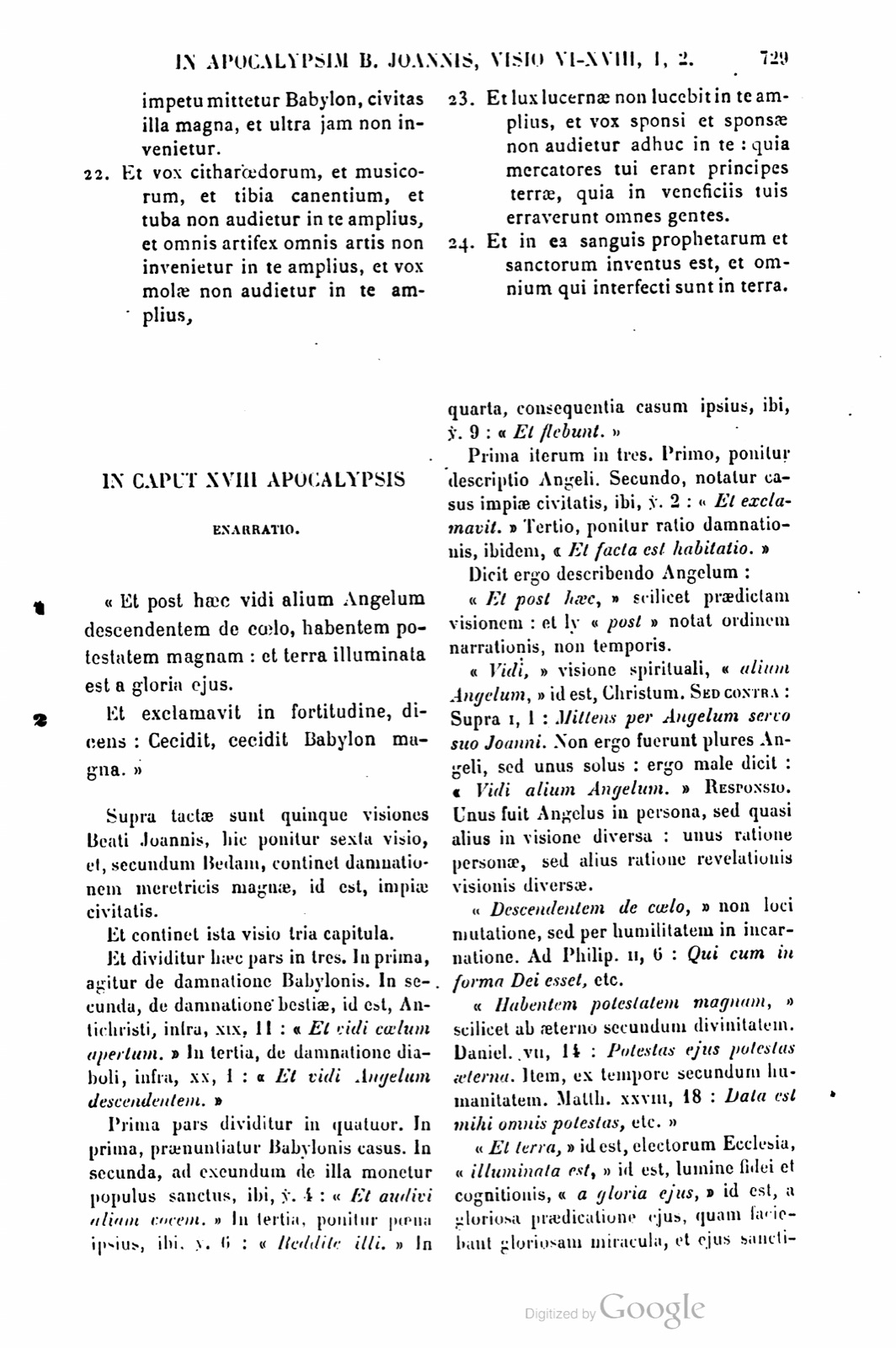
1. "Et post haec vidi alium Angelum descendentem de coelo, habentem potestatem magnam: et terra illuminata est a gloria ejus. 2. Et exclamavit in fortitudine, dicens: Cecidit, cecidit Babylon magna."
Supra tactae sunt quinque visiones Beati Joannis, hic ponitur sexta visio, et, secundum Bedam, continet damnationem meretricis magnae, id est, impiae civitatis. Et continet ista visio tria capitula. Et dividitur haec pars in tres. In prima, agitur de damnatione Babylonis. In secunda, de damnatione bestiae, id est, Antichristi, infra, XIX, 11: "Et vidi coelum apertum." In tertia, de damnatione diaboli, infra, XX, 1: "Et vidi Angelum descendentem." Prima pars dividitur in quatuor. In prima, praenuntiatur Babylonis casus. In secunda, ad exeundum de illa monetur populus sanctus, ibi, v. 4: "Et audivi aliam vocem." In tertia, ponitur poena ipsius, ibi, v. 6: "Reddite illi." In quarta, consequentia casum ipsius, ibi, v. 9: "Et flebunt." Prima iterum in tres. Primo, ponitur descriptio Angeli. Secundo, notatur casus impiae civitatis, ibi, v. 2: "Et exclamavit." Tertio, ponitur ratio damnationis, ibidem, "Et facta est habitatio."
Dicit ergo describendo Angelum: "Et post haec," scilicet praedictam visionem: et ly "post" notat ordinem narrationis, non temporis. "Vidi," visione spirituali, "alium Angelum," id est, Christum. SED CONTRA: Supra I, 1: Mittens per Angelum servo suo Joanni. Non ergo fuerunt plures Angeli, sed unus solus: ergo male dicit: "Vidi alium Angelum." RESPONSIO. Unus fuit Angelus in persona, sed quasi alius in visione diversa: unus ratione personae, sed alius ratione revelationis visionis diversae. "Descendentem de coelo," non loci mutatione, sed per humilitatem in incarnatione. Ad Philip. II, 6: Qui cum in forma Dei esset, etc. "Habentem potestatem magnam," scilicet ab aeterno secundum divinitatem. Daniel. VII, 14: Potestas ejus potestas aeterna. Item, ex tempore secundum humanitatem. Matth. XXVIII, 18: Data est mihi omnis potestas, etc. "Et terra," id est, electorum Ecclesia, "illuminata est," id est, lumine fidei et cognitionis, "a gloria ejus," id est, a gloriosa praedicatione ejus, quam faciebant gloriosam miracula, et ejus sanctitas. Joan. I, 14: Vidimus gloriam ejus.
"Et exclamavit in fortitudine, dicens, etc." "Et exclamavit," id est, excellenter clamavit praedicando, "in fortitudine," id est, praedicatione audaci, et constanti, et efficaci, "dicens: Cecidit, cecidit Babylon magna," id est, tota congregatio reproborum confusione digna. Et congeminat: [Marginal label: Casus duplex.] "Cecidit, cecidit," propter duplicem casum, scilicet in culpam, et in poenam: vel propter corporis et animae damnationem: vel propter damnationis continuitatem: vel propter duplicem damnationis causam, id est, peccatum omissionis, et commissionis. Isa. XXI, 9: Cecidit, cecidit Babylon, et omnia sculptilia deorum ejus contrita sunt in terram.
"Et facta est habitatio daemoniorum, et custodia omnis spiritus immundi, et custodia omnis volucris immundae, et odibilis." Hic ponitur causa damnationis ejus. Et ponitur duplex. Prima est, quia omnes spiritus immundi habitant in ea. Secunda est, quia ab ipsa nascitur omnis immunditia, ibi, v. 3: "Quia de vino irae fornicationis ejus." Et ecce causa: "Et," pro quia, "facta est," per peccatum, "habitatio," id est, sedes, et locus, "daemoniorum," id est, spirituum vexantium per malitiam: "et custodia," per confusionis contemptum, "omnis spiritus immundi," per luxuriam: "et custodia omnis volucris immundae," id est, daemonum per superbiam, "et odibilis," sicut dicitur, Eccli. X, 7: Odibilis coram Deo est et hominibus superbia. Dicuntur ergo daemones per malitiam, spiritus immundi per luxuriam, volucres immundae per elationem.
EXPOSITION ON CHAPTER XVIII OF THE APOCALYPSE.
1. "And after these things I saw another Angel descending from heaven, having great power, and the earth was illumined by his glory. 2. And he cried out in strength, saying: Fallen, fallen is Babylon the great."
Above, five visions of Blessed John have been touched upon; here the sixth vision is set down, and, according to Bede, it contains the damnation of the great harlot, that is, of the impious city. And that vision contains three chapters. And this part is divided into three parts. In the first, the damnation of Babylon is treated. In the second, the damnation of the beast, that is, of Antichrist, below, 19:11: "And I saw heaven opened." In the third, the damnation of the devil, below, 20:1: "And I saw an Angel descending." The first part is divided into four. In the first, the fall of Babylon is foretold. In the second, the holy people is admonished to go out from her, there at verse 4: "And I heard another voice." In the third, her punishment is set down, there at verse 6: "Render to her." In the fourth, the things consequent upon her fall are set down, there at verse 9: "And they will weep." The first is again divided into three. First, the description of the Angel is set down. Secondly, the fall of the impious city is marked, there at verse 2: "And he cried out." Thirdly, the reason for the damnation is set down, in the same place, "And she has become a dwelling."
Therefore he says, describing the Angel: "And after these things," namely the aforesaid vision; and the term "after" marks the order of narration, not of time. "I saw," with spiritual vision, "another Angel," that is, Christ. ON THE CONTRARY: Above 1:1: Sending by his Angel to his servant John. Therefore there were not several Angels, but only one; therefore he says badly: "I saw another Angel." RESPONSE. There was one Angel in person, but, as it were, another in a diverse vision: one by reason of person, but another by reason of the revelation of a diverse vision. "Descending from heaven," not by change of place, but through humility in the incarnation. Philippians 2:6: Who, although he was in the form of God, etc. "Having great power," namely from eternity according to divinity. Daniel 7:14: His power is eternal power. Likewise, in time according to humanity. Matthew 28:18: All power has been given to me, etc. "And the earth," that is, the Church of the elect, "was illumined," that is, by the light of faith and knowledge, "by his glory," that is, by his glorious preaching, which miracles and his holiness made glorious. John 1:14: We saw his glory.
"And he cried out in strength, saying, etc." "And he cried out," that is, he cried out excellently by preaching, "in strength," that is, with bold, constant, and efficacious preaching, "saying: Fallen, fallen is Babylon the great," that is, the whole congregation of the reprobate, worthy of confusion. And he repeats: [Marginal label: A twofold fall.] "Fallen, fallen," because of a twofold fall, namely into guilt and into punishment; or because of the damnation of body and soul; or because of the continuity of damnation; or because of the twofold cause of damnation, that is, the sin of omission and of commission. Isaiah 21:9: Fallen, fallen is Babylon, and all the graven images of her gods have been broken to the ground.
"And she has become a dwelling of demons, and a prison of every unclean spirit, and a prison of every unclean and hateful bird." Here the cause of her damnation is set down. And a twofold cause is set down. The first is that all unclean spirits dwell in her. The second is that every uncleanness is born from her, there at verse 3: "Because of the wine of the wrath of her fornication." And behold the cause: "And," for because, "she has become," through sin, "a dwelling," that is, a seat and place, "of demons," that is, of spirits harassing through malice; "and a prison," through contempt of confusion, "of every unclean spirit," through lust; "and a prison of every unclean bird," that is, of demons through pride, "and hateful," as is said in Ecclesiasticus 10:7: Pride is hateful before God and men. Therefore they are called demons through malice, unclean spirits through lust, unclean birds through elation.
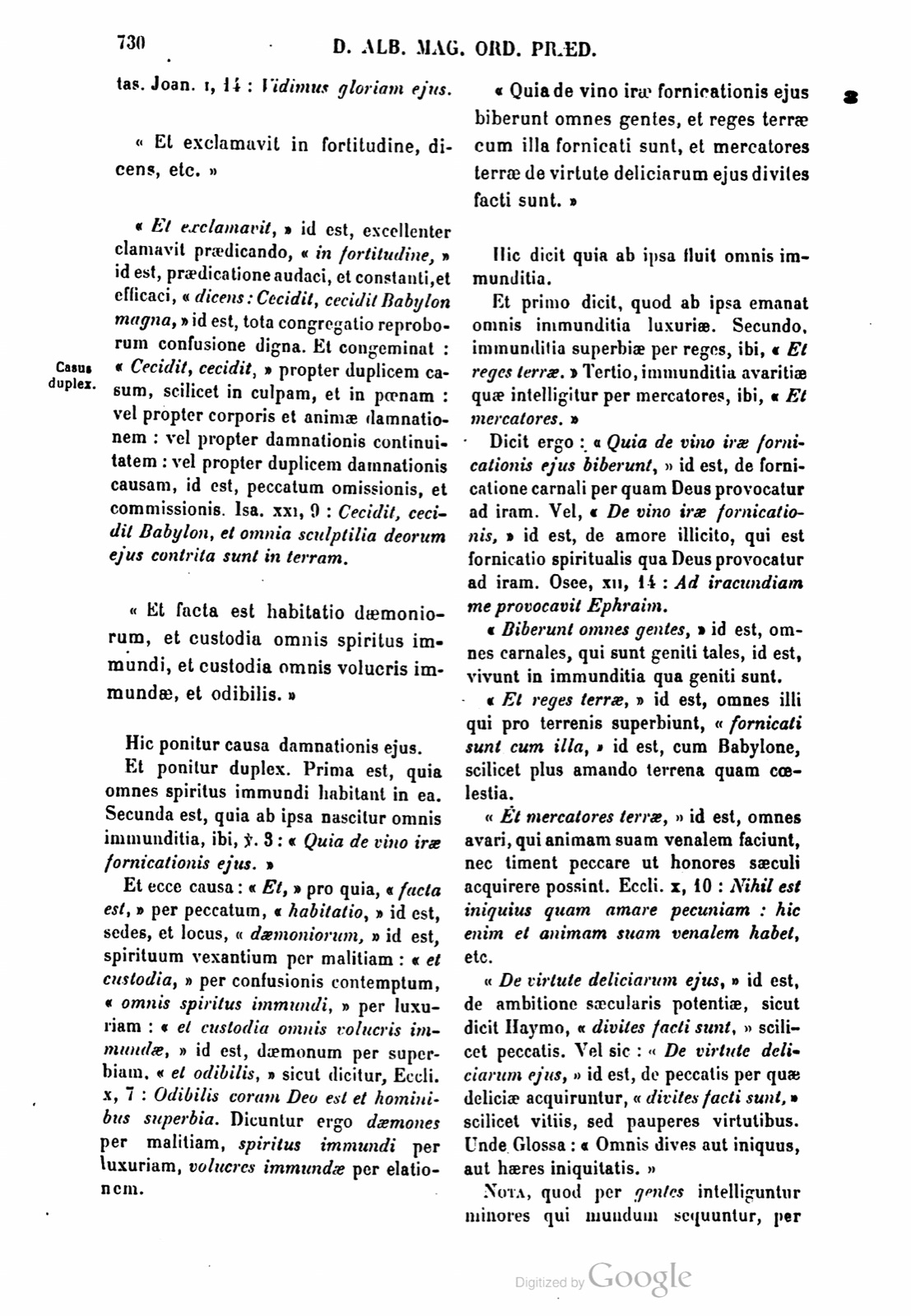
3. "Quia de vino irae fornicationis ejus biberunt omnes gentes, et reges terrae cum illa fornicati sunt, et mercatores terrae de virtute deliciarum ejus divites facti sunt."
Hic dicit quia ab ipsa fluit omnis immunditia. Et primo dicit, quod ab ipsa emanat omnis immunditia luxuriae. Secundo, immunditia superbiae per reges, ibi, "Et reges terrae." Tertio, immunditia avaritiae quae intelligitur per mercatores, ibi, "Et mercatores." Dicit ergo: "Quia de vino irae fornicationis ejus biberunt," id est, de fornicatione carnali per quam Deus provocatur ad iram. Vel, "De vino irae fornicationis," id est, de amore illicito, qui est fornicatio spiritualis qua Deus provocatur ad iram. Osee, XII, 14: Ad iracundiam me provocavit Ephraim. "Biberunt omnes gentes," id est, omnes carnales, qui sunt geniti tales, id est, vivunt in immunditia qua geniti sunt. "Et reges terrae," id est, omnes illi qui pro terrenis superbiunt, "fornicati sunt cum illa," id est, cum Babylone, scilicet plus amando terrena quam coelestia. "Et mercatores terrae," id est, omnes avari, qui animam suam venalem faciunt, nec timent peccare ut honores saeculi acquirere possint. Eccli. X, 10: Nihil est iniquius quam amare pecuniam: hic enim et animam suam venalem habet, etc. "De virtute deliciarum ejus," id est, de ambitione saecularis potentiae, sicut dicit Haymo, "divites facti sunt," scilicet peccatis. Vel sic: "De virtute deliciarum ejus," id est, de peccatis per quae deliciae acquiruntur, "divites facti sunt," scilicet vitiis, sed pauperes virtutibus. Unde Glossa: "Omnis dives aut iniquus, aut haeres iniquitatis." NOTA, quod per gentes intelliguntur minores qui mundum sequuntur, per reges majores, per mercatores mediocres. Vel, per gentes luxuriosi, per reges superbi, per mercatores avari.
4. "Et audivi aliam vocem de coelo, dicentem: Exite de illa, populus meus, ut ne participes sitis delictorum ejus, et de plagis ejus non accipiatis."
Supra ostendit mulieris damnationem, hic monet populum ut fugiat eam. Et dicuntur quatuor. Primo, monet Sanctos ut de societate ejus exeant. Secundo, ne ejus operibus consensum praebeant, ibi, "Et ne participes sitis." Tertio, reddit causam, ibi, "Et de plagis ejus." Quarto probat, quod digni sunt sustinere poenam, ibi, v. 5: "Quoniam pervenerunt peccata." Dicit ergo: "Et audivi aliam vocem," id est, intellexi divinam inspirationem, vel Christi praedicationem: quae dicitur alia a praecedente, quia illa fuit de praenuntiatione casus civitatis, haec est de admonitione Sanctorum ut recedant ne sint participes in peccatis. "De coelo," id est, de Ecclesia quae celat divina mysteria infidelibus. Vel, "De coelo," id est, de Christo. Vel, de Ecclesia quae est casa helios, id est, solis, scilicet Christi. "Dicentem: Exite," non corpore, sed mente, et vitae dissimilitudine, "de illa," scilicet de consortio malorum, sive mundi malitia. Isa. LII, 11: Exite inde, pollutum nolite tangere. "Populus meus," per praedestinationem et electionem. Joan. XV, 16: Non vos me elegistis, sed ego elegi vos, etc. "Ut ne participes sitis delictorum ejus," id est, ne malis ejus operibus assensum praebeatis. Quia, Eccli. XIX, 3: Qui se jungit fornicariis, erit nequam. Vel, "Deliciarum ejus," id est, peccatorum, quorum delectatione contrahitur ad mollitiem. "Et de plagis ejus non accipiatis." Quasi dicat: Si non fueritis similes in culpa, non eritis similes in poena.
3. "Because all nations have drunk of the wine of the wrath of her fornication, and the kings of the earth have fornicated with her, and the merchants of the earth have been made rich from the power of her delights."
Here he says that every uncleanness flows from her. And first he says that every uncleanness of lust emanates from her. Secondly, the uncleanness of pride through kings, there, "And the kings of the earth." Thirdly, the uncleanness of avarice, which is understood through the merchants, there, "And the merchants." Therefore he says: "Because they drank of the wine of the wrath of her fornication," that is, of carnal fornication through which God is provoked to wrath. Or, "Of the wine of the wrath of fornication," that is, of illicit love, which is spiritual fornication by which God is provoked to wrath. Hosea 12:14: Ephraim provoked me to wrath. "All nations have drunk," that is, all carnal persons, who were begotten as such, that is, live in the uncleanness in which they were begotten. "And the kings of the earth," that is, all those who are proud because of earthly things, "have fornicated with her," that is, with Babylon, namely by loving earthly things more than heavenly things. "And the merchants of the earth," that is, all the avaricious, who make their soul saleable and do not fear to sin so that they may be able to acquire the honors of the age. Ecclesiasticus 10:10: Nothing is more wicked than to love money, for this one has even his soul for sale, etc. "From the power of her delights," that is, from ambition for secular power, as Haymo says, "they have been made rich," namely in sins. Or thus: "From the power of her delights," that is, from sins through which delights are acquired, "they have been made rich," namely in vices, but poor in virtues. Hence the Gloss: "Every rich man is either unjust or heir of injustice." NOTE that by nations are understood the lesser ones who follow the world, by kings the greater ones, by merchants those in the middle. Or, by nations the lustful, by kings the proud, by merchants the avaricious.
4. "And I heard another voice from heaven, saying: Go out from her, my people, so that you may not be participants in her offenses, and may not receive from her plagues."
Above he showed the damnation of the woman; here he admonishes the people to flee her. And four things are said. First, he admonishes the Saints to go out from her society. Secondly, not to offer consent to her works, there, "And so that you may not be participants." Thirdly, he gives the cause, there, "And from her plagues." Fourthly, he proves that they are worthy to endure punishment, there at verse 5: "For her sins have reached." Therefore he says: "And I heard another voice," that is, I understood a divine inspiration or the preaching of Christ, which is called another in relation to the preceding one, because that one was about the foretelling of the fall of the city; this one is about the admonition of the Saints that they should withdraw lest they become participants in sins. "From heaven," that is, from the Church which conceals the divine mysteries from unbelievers. Or, "from heaven," that is, from Christ. Or, from the Church, which is casa helios, that is, the house of the sun, namely of Christ. "Saying: Go out," not in body, but in mind and in unlikeness of life, "from her," namely from the fellowship of the evil, or from the malice of the world. Isaiah 52:11: Go out from there; do not touch what is polluted. "My people," through predestination and election. John 15:16: You did not choose me, but I chose you, etc. "So that you may not be participants in her offenses," that is, so that you may not offer assent to her evil works. Because Ecclesiasticus 19:3 says: He who joins himself to fornicators will be wicked. Or, "of her delights," that is, of sins, by whose delectation one is drawn into softness. "And may not receive from her plagues." As if he said: If you have not been alike in guilt, you will not be alike in punishment.
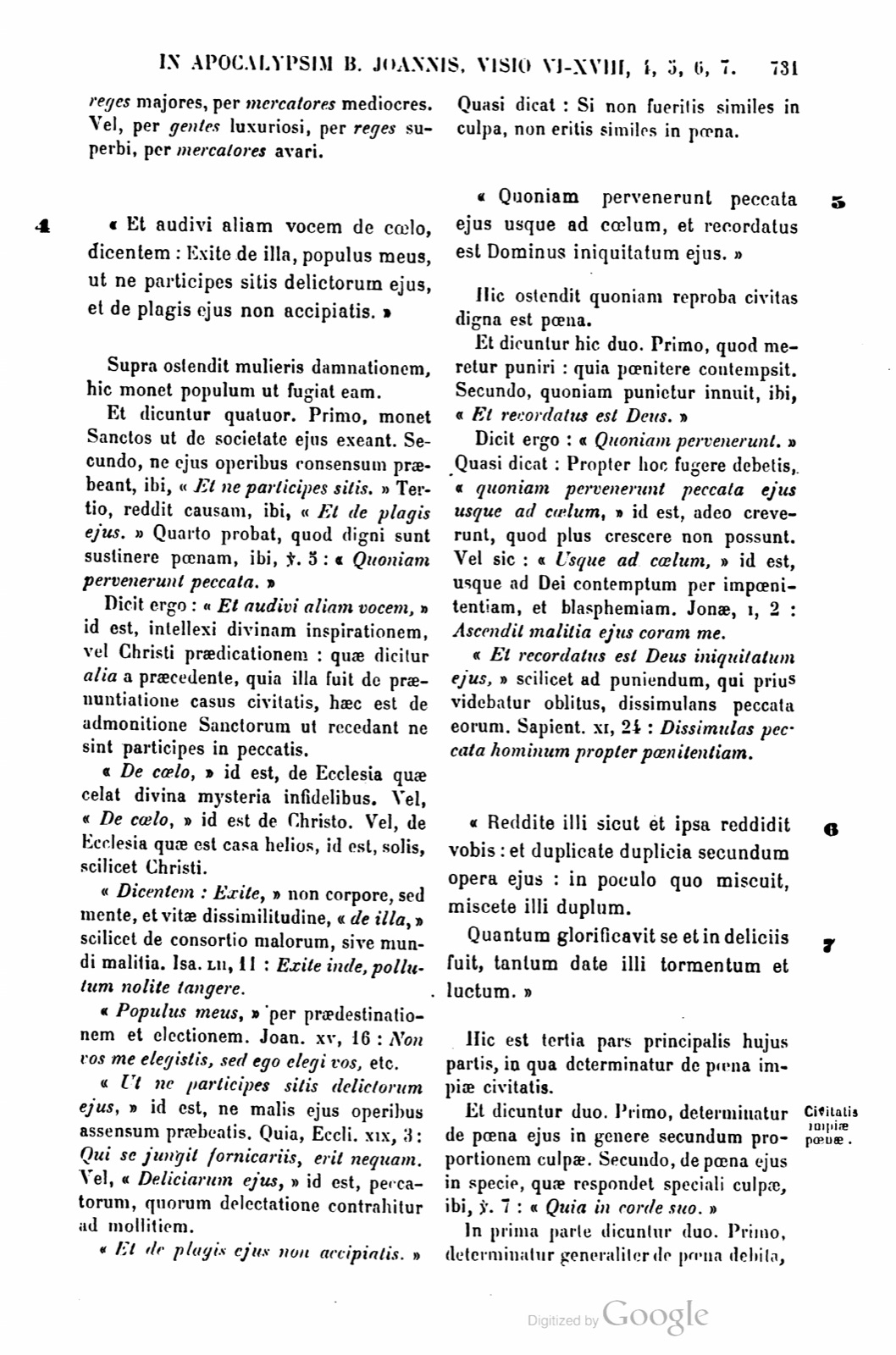
5. "Quoniam pervenerunt peccata ejus usque ad coelum, et recordatus est Dominus iniquitatum ejus."
Hic ostendit quoniam reproba civitas digna est poena. Et dicuntur hic duo. Primo, quod meretur puniri: quia poenitere contempsit. Secundo, quoniam punietur innuit, ibi, "Et recordatus est Deus." Dicit ergo: "Quoniam pervenerunt." Quasi dicat: Propter hoc fugere debetis, "quoniam pervenerunt peccata ejus usque ad coelum," id est, adeo creverunt, quod plus crescere non possunt. Vel sic: "Usque ad coelum," id est, usque ad Dei contemptum per impoenitentiam, et blasphemiam. Jonae, I, 2: Ascendit malitia ejus coram me. "Et recordatus est Deus iniquitatum ejus," scilicet ad puniendum, qui prius videbatur oblitus, dissimulans peccata eorum. Sapient. XI, 24: Dissimulas peccata hominum propter poenitentiam.
6. "Reddite illi sicut et ipsa reddidit vobis: et duplicate duplicia secundum opera ejus: in poculo quo miscuit, miscete illi duplum. 7. Quantum glorificavit se et in deliciis fuit, tantum date illi tormentum et luctum."
[Marginal label: Civitatis impiae poenae.] Hic est tertia pars principalis hujus partis, in qua determinatur de poena impiae civitatis. Et dicuntur duo. Primo, determinatur de poena ejus in genere secundum proportionem culpae. Secundo, de poena ejus in specie, quae respondet speciali culpae, ibi, v. 7: "Quia in corde suo." In prima parte dicuntur duo. Primo, determinatur generaliter de poena debita, quia Sanctos afflixit. Secundo, de poena debita pro his quae in se commisit, ibi, v. 7: "Quantum glorificavit se." In prima dicuntur tria. Primo, dicit ut Sancti puniant eam. Secundo, ut dupliciter puniendam judicent, ibi, "Et duplicate illi." Tertio, ut in corpore et anima judicent puniendam, ibi, "In poculo quo miscuit."
Dicit ergo: "Reddite illi," id est, congregationi malorum, "sicut et ipsa reddidit vobis," scilicet vos affligendo et opprimendo. SED CONTRA: Matth. V, 44: Benefacite his qui oderunt vos. RESPONSIO. Non licet malum pro malo reddere, vindicando propriam injuriam, sed injuriam Dei. Unde Glossa hic: "Sicut vindictam meam de vobis qui purgamini exercuit: sic injuriam meam vos vindicate in illis." "Et duplicate illi duplicia," id est, punite. Vel, duplicata tormenta judicate, scilicet in anima et in corpore, et in quolibet dupliciter. In corpore, calore et frigore. Job, XXIV, 19: Ad nimium calorem transeat ab aquis nivium. In anima, verme conscientiae, et carentia visionis divinae. "Secundum opera ejus." Glossa interlinearis: "Secundum quod ipsi peccaverunt." Jerem. L, 29: Reddite ei secundum opus suum: juxta omnia quae fecit, facite illi. "In poculo quo miscuit," scilicet vobis perversa suggerendo, vel poenas inferendo. Vel, "Miscuit," quia mel dulcedinis verborum cum veneno infidelitatis. "Miscete illi duplum," id est, judicate duplicem poenam illi inferendam, scilicet in corpore et anima puniendos. Quasi diceret: Ipsi vos afflixerunt in corpore tantum: et vos judicate illos in corpore, et anima. Unde ly duplum non refertur ad meritum, sed ad factum.
5. "For her sins have reached all the way to heaven, and the Lord has remembered her iniquities."
Here he shows that the reprobate city is worthy of punishment. And two things are said here. First, that she deserves to be punished, because she scorned to repent. Secondly, he intimates that she will be punished, there, "And God has remembered." Therefore he says: "For they have reached." As if he said: For this reason you must flee, "because her sins have reached all the way to heaven," that is, they have grown so much that they cannot grow more. Or thus: "All the way to heaven," that is, all the way to contempt of God through impenitence and blasphemy. Jonah 1:2: Her malice has ascended before me. "And God has remembered her iniquities," namely for punishing, he who before seemed to have forgotten, while dissembling their sins. Wisdom 11:24: You overlook the sins of men for repentance.
6. "Render to her as she also rendered to you; and double double things according to her works; in the cup in which she mixed, mix double for her. 7. As much as she glorified herself and was in delights, so much give her torment and mourning."
[Marginal label: The punishments of the impious city.] This is the third principal part of this part, in which the punishment of the impious city is determined. And two things are said. First, her punishment is determined in general according to the proportion of guilt. Secondly, her punishment in species, which corresponds to special guilt, there at verse 7: "Because in her heart." In the first part two things are said. First, determination is made generally about the punishment owed, because she afflicted the Saints. Secondly, about the punishment owed for those things which she committed in herself, there at verse 7: "As much as she glorified herself." In the first, three things are said. First, he says that the Saints should punish her. Secondly, that they should judge her to be punished twofold, there, "And double to her." Thirdly, that they should judge her to be punished in body and soul, there, "In the cup in which she mixed."
Therefore he says: "Render to her," that is, to the congregation of the evil, "as she also rendered to you," namely by afflicting and oppressing you. ON THE CONTRARY: Matthew 5:44: Do good to those who hate you. RESPONSE. It is not permitted to render evil for evil by avenging one's own injury, but the injury of God. Hence the Gloss here says: "As she exercised my vengeance upon you who are being cleansed, so you should avenge my injury in them." "And double double things to her," that is, punish. Or, judge that doubled torments should be inflicted, namely in soul and in body, and in each in two ways. In the body, by heat and cold. Job 24:19: Let him pass from the waters of snow to excessive heat. In the soul, by the worm of conscience and the lack of the divine vision. "According to her works." The interlinear Gloss: "According to what they themselves sinned." Jeremiah 50:29: Render to her according to her work; according to all that she has done, do to her. "In the cup in which she mixed," namely by suggesting perverse things to you or by inflicting punishments. Or, "she mixed," because the honey of sweetness of words was with the poison of unbelief. "Mix double for her," that is, judge that a double punishment must be inflicted upon her, namely that they must be punished in body and soul. As if he said: They afflicted you only in the body; and you should judge them in body and soul. Hence the term double is not referred to merit, but to fact.
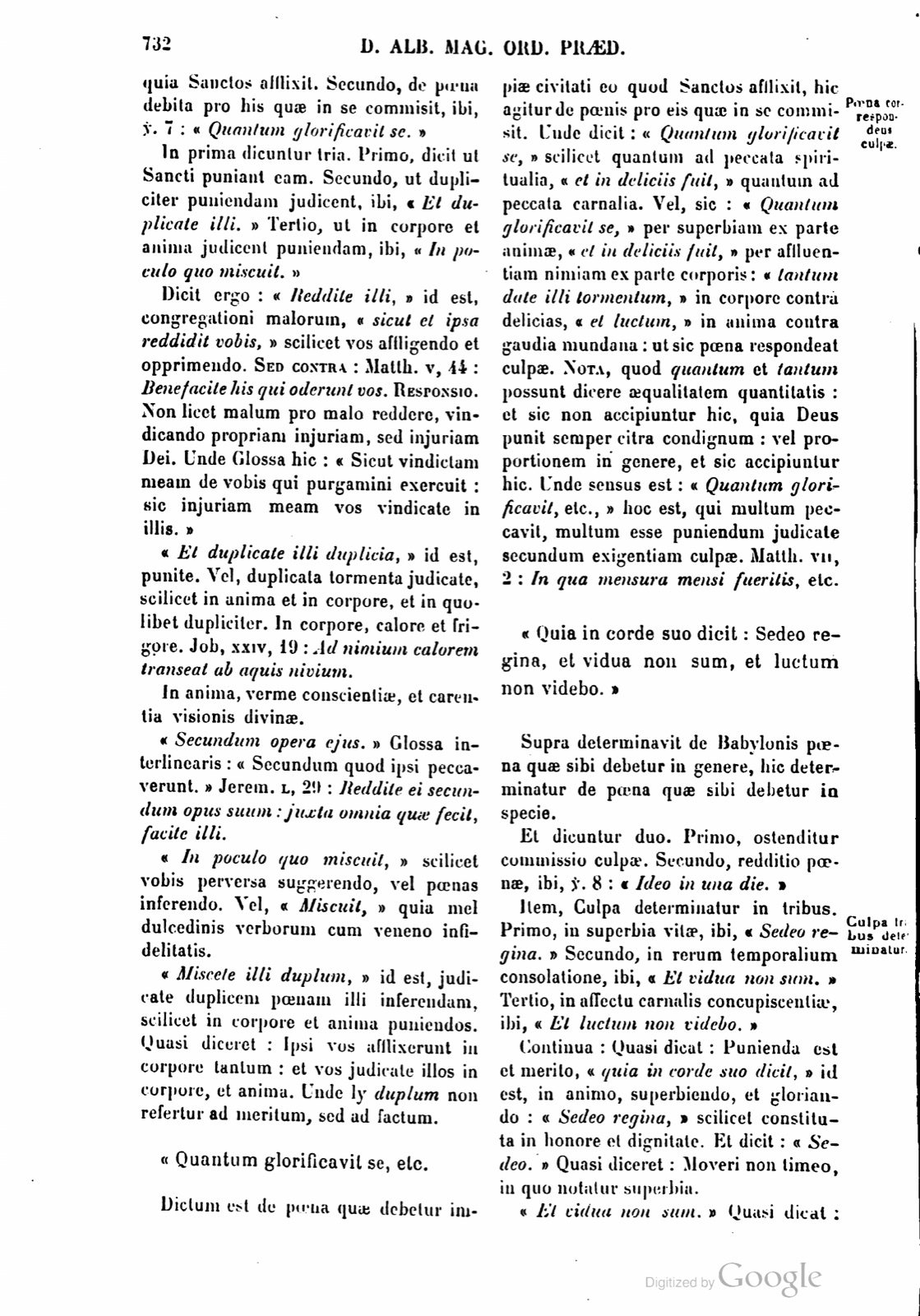
"Quantum glorificavit se, etc." [Marginal label: Proportio respondens culpae.] Dictum est de poena quae debetur impiae civitati eo quod Sanctos afflixit, hic agitur de poenis pro eis quae in se commisit. Unde dicit: "Quantum glorificavit se," scilicet quantum ad peccata spiritualia, "et in deliciis fuit," quantum ad peccata carnalia. Vel, sic: "Quantum glorificavit se," per superbiam ex parte animae, "et in deliciis fuit," per affluentiam nimiam ex parte corporis: "tantum date illi tormentum," in corpore contra delicias, "et luctum," in anima contra gaudia mundana: ut sic poena respondeat culpae. NOTA, quod quantum et tantum possunt dicere aequalitatem quantitatis: et sic non accipiuntur hic, quia Deus punit semper citra condignum: vel proportionem in genere, et sic accipiuntur hic. Unde sensus est: "Quantum glorificavit, etc.," hoc est, qui multum peccavit, multum esse puniendum judicate secundum exigentiam culpae. Matth. VII, 2: In qua mensura mensi fueritis, etc.
7. "Quia in corde suo dicit: Sedeo regina, et vidua non sum, et luctum non videbo."
Supra determinavit de Babylonis poena quae sibi debetur in genere, hic determinatur de poena quae sibi debetur in specie. Et dicuntur duo. Primo, ostenditur commissio culpae. Secundo, redditio poenae, ibi, v. 8: "Ideo in una die." Item, [Marginal label: Culpa in tribus determinatur.] Culpa determinatur in tribus. Primo, in superbia vitae, ibi, "Sedeo regina." Secundo, in rerum temporalium consolatione, ibi, "Et vidua non sum." Tertio, in affectu carnalis concupiscentiae, ibi, "Et luctum non videbo." Continua: Quasi dicat: Punienda est et merito, "quia in corde suo dicit," id est, in animo, superbiendo, et gloriando: "Sedeo regina," scilicet constituta in honore et dignitate. Et dicit: "Sedeo." Quasi diceret: Moveri non timeo, in quo notatur superbia. "Et vidua non sum." Quasi dicat: Multos habeo consolatores, et multas consolationes. "Et luctum non videbo," id est, non amittam delicias carnales, pro quibus oporteat me lugere. SED CONTRA: Dicitur, Luc. VI, 25: Vae vobis qui ridetis nunc, quia lugebitis et flebitis.
"As much as she glorified herself, etc." [Marginal label: The proportion corresponding to guilt.] It has been said about the punishment owed to the impious city because she afflicted the Saints; here the punishments for those things which she committed in herself are treated. Hence he says: "As much as she glorified herself," namely as to spiritual sins, "and was in delights," as to carnal sins. Or thus: "As much as she glorified herself," through pride on the part of the soul, "and was in delights," through excessive abundance on the part of the body: "so much give her torment," in the body against delights, "and mourning," in the soul against worldly joys, so that thus punishment may correspond to guilt. NOTE that as much and so much can signify equality of quantity; and thus they are not taken here, because God always punishes short of condign punishment; or they can signify proportion in kind, and thus they are taken here. Hence the sense is: "As much as she glorified herself, etc.," that is, judge that one who sinned much is to be punished much according to the requirement of guilt. Matthew 7:2: In the measure by which you have measured, etc.
7. "Because in her heart she says: I sit as queen, and I am not a widow, and I will not see mourning."
Above he determined concerning the punishment of Babylon which is owed to her in general; here he determines concerning the punishment owed to her in species. And two things are said. First, the commission of guilt is shown. Secondly, the rendering of punishment, there at verse 8: "Therefore in one day." Likewise, [Marginal label: Guilt is determined in three things.] guilt is determined in three things. First, in pride of life, there, "I sit as queen." Secondly, in consolation of temporal things, there, "And I am not a widow." Thirdly, in the affection of carnal concupiscence, there, "And I will not see mourning." The continuation is: As if he said: She is to be punished, and deservedly, "because in her heart she says," that is, in her soul, by being proud and glorying: "I sit as queen," namely established in honor and dignity. And he says: "I sit." As if he said: I do not fear being moved; in this pride is marked. "And I am not a widow." As if she said: I have many consolers and many consolations. "And I will not see mourning," that is, I will not lose carnal delights because of which I would have to mourn. ON THE CONTRARY: It is said, Luke 6:25: Woe to you who laugh now, because you will mourn and weep.
8. "Ideo in una die venient plagae ejus, mors, et luctus, et fames: et igne comburetur, quia fortis est Deus, qui judicabit illam."
Posita culpa subjungitur poena. Et dicuntur hic quatuor. Primo, dicitur generaliter, quod poenam habebit. Secundo, quod speciales poenas sustinebit, ibi, "Et mors, et luctus." Tertio, quod pro libidine illa aeternaliter ardebit, ibi, "Et igne comburetur." Quarto probat, quod ita erit, ibi, "Quia fortis, etc." [Marginal label: Diversae poenae.] Continua: "Sedeo regina," dicit Babylon, "ideo," id est, merito jactantiae, "in die una," id est, in die judicii, "venient plagae ejus," id est, poenae ejus, id est, ultiones debitae pro peccatis suis: "mors," id est, carentia visionis Dei qui est vita animae, "et luctus," pro acerbitate poenarum, "et fames," id est, defectus omnium bonorum. Deuter. XXXII, 24: Consumentur fame, etc. "Et igne comburetur," aeternarum flammarum. Vel sic: "Mors," dejiciens a dignitate, contra hoc quod dixerat: "Sedeo regina." "Et luctus," dejiciens a gaudio, contra hoc quod dixit: "Et luctum non videbo." "Et fames," id est, defectus temporalium, contra hoc quod dixit: "Vidua non sum." "Et igne comburetur." Matth. XXV, 41: Discedite a me, maledicti, in ignem aeternum, qui paratus, etc. "Quia fortis est Deus," id est, precibus non flectitur, ut dicit Glossa, "qui judicabit illam," id est, Babylonem, malorum congregationem, scilicet in judicio condemnationis.
9. "Et flebunt, et plangent se super illam reges terrae, qui cum illa fornicati sunt, et in deliciis vixerunt, cum viderint fumum incendii ejus: 10. Longe stantes propter timorem tormentorum ejus, dicentes: Vae, vae civitas illa magna Babylon civitas illa fortis, quoniam una hora venit judicium tuum!"
Haec est quarta pars principalis hujus partis, in qua determinatur de consequentibus casum impiae civitatis. Et dicuntur quatuor. Primo, ponitur fletus et planctus reproborum. Secundo, exsultatio et laetitia Sanctorum, ibi, v. 20: "Exsulta super eam, coelum." Tertio, damnationis exemplum, ibi, v. 21: "Et sustulit unus Angelus." Quarto, a gratiarum actione laudatur judicium divinum, ibi, infra, XIX, 1: "Post haec audivi quasi vocem turbarum multarum." [Marginal label: Fletus damnatorum.] In prima determinatur fletus reproborum tripliciter. Primo, fletus regum. Secundo, negotiatorum, ibi, v. 11: "Et negotiatores terrae." Tertio, gubernatorum, ibi, v. 17: "Et omnis gubernator." Et per reges intelliguntur illi qui praesunt in regimine temporali, per nautas qui praesunt in regimine spirituali, per negotiatores utrorumque subditi. Dicit ergo: "Et flebunt," corde interius, "et plangent se," voce exterius, "super illam," id est, super seipsos, "reges terrae." Glossa, id est, principes saeculi. "Qui," id est, quia "cum illa," id est, cum Babylone, id est, cum seipsis, "fornicati sunt," scilicet plus terrena quam Deum diligentes, et immunditiae carnis servientes: "et in deliciis vixerunt," id est, in gaudio et festive epulantes.
Et subdit quando hoc erit: "Cum viderint fumum incendii ejus," id est, incendium ejus fumosum. "Longe stantes propter timorem tormentorum ejus, etc." "Longe stantes," scilicet voluntate et affectu, non actu, quia vellent fugere si possent, "propter timorem tormentorum ejus," quia plus cruciabit eos timor et horror continuationis poenae, quam ipse sensus. [Marginal label: Vae multiplex.] "Dicentes," lamentando: "Vae," pro amissione gloriae. "Vae," pro sustinentia poenae. "Vae," propter poenae acerbitatem. "Vae," propter acerbitatis continuitatem. Vel sic: "Vae," propter poenam animae. "Vae," propter poenam in corpore. Amos, V, 16: Cunctis qui foris sunt, id est, extra civitatem Sanctorum, dicetur: Vae, vae. "Dicentes: Vae, vae civitas illa," id est, malorum congregatio: "magna," propter multitudinem impiorum, et enormitatem scelerum: "Babylon," digna confusione: "civitas illa fortis," non virtutibus, sed vitiis, et malis operibus, et Sanctorum persecutionibus. Jerem. XXIII, 10: Factus est cursus eorum malus, et fortitudo eorum dissimilis. Fortis ad Sanctos persequendum, et debilis ad adjuvandum vel bene operandum. "Quoniam una hora," scilicet mortis, vel judicii, "venit judicium tuum," id est, aeternum supplicium. Vel, "Una hora," id est, subito, "venit judicium tuum," id est, tua damnatio. Job, XXI, 13: Ducunt in bonis dies suos, et in puncto ad inferna descendunt.
8. "Therefore in one day her plagues will come, death, and mourning, and famine; and she will be burned with fire, because God is strong, who will judge her."
After the guilt has been set down, punishment is added. And four things are said here. First, it is said generally that she will have punishment. Secondly, that she will endure special punishments, there, "And death, and mourning." Thirdly, that because of that lust she will burn eternally, there, "And she will be burned with fire." Fourthly, he proves that it will be so, there, "Because he is strong, etc." [Marginal label: Diverse punishments.] The continuation is: "I sit as queen," Babylon says, "therefore," that is, because of the merit of boasting, "in one day," that is, on the day of judgment, "her plagues will come," that is, her punishments, that is, acts of vengeance owed for her sins: "death," that is, the lack of the vision of God, who is the life of the soul, "and mourning," because of the bitterness of punishments, "and famine," that is, the lack of all goods. Deuteronomy 32:24: They will be consumed by hunger, etc. "And she will be burned with fire," of eternal flames. Or thus: "Death," casting her down from dignity, against what she had said: "I sit as queen." "And mourning," casting her down from joy, against what she said: "And I will not see mourning." "And famine," that is, the lack of temporal things, against what she said: "I am not a widow." "And she will be burned with fire." Matthew 25:41: Depart from me, accursed ones, into eternal fire which has been prepared, etc. "Because God is strong," that is, he is not bent by prayers, as the Gloss says, "who will judge her," that is, Babylon, the congregation of the evil, namely in the judgment of condemnation.
9. "And the kings of the earth who fornicated with her and lived in delights will weep and lament themselves over her, when they have seen the smoke of her burning; 10. standing far away because of fear of her torments, saying: Woe, woe, that great city Babylon, that strong city, because in one hour your judgment has come!"
This is the fourth principal part of this part, in which determination is made concerning the things consequent upon the fall of the impious city. And four things are said. First, the weeping and lamentation of the reprobate is set down. Secondly, the exultation and gladness of the Saints, there at verse 20: "Rejoice over her, heaven." Thirdly, the example of damnation, there at verse 21: "And one Angel took up." Fourthly, from thanksgiving the divine judgment is praised, there below, 19:1: "After these things I heard as it were the voice of many crowds." [Marginal label: The weeping of the damned.] In the first, the weeping of the reprobate is determined in three ways. First, the weeping of kings. Secondly, of merchants, there at verse 11: "And the merchants of the earth." Thirdly, of pilots, there at verse 17: "And every pilot." And by kings are understood those who preside in temporal rule, by sailors those who preside in spiritual rule, by merchants the subjects of both. Therefore he says: "And they will weep," inwardly in heart, "and lament themselves," outwardly in voice, "over her," that is, over themselves, "the kings of the earth." The Gloss says, that is, princes of the age. "Who," that is, because "with her," that is, with Babylon, that is, with themselves, "have fornicated," namely loving earthly things more than God, and serving the uncleanness of the flesh; "and have lived in delights," that is, feasting in joy and festivity.
And he adds when this will be: "When they have seen the smoke of her burning," that is, her smoky burning. "Standing far away because of fear of her torments, etc." "Standing far away," namely in will and affection, not in act, because they would wish to flee if they could, "because of fear of her torments," because the fear and horror of the continuation of punishment will torture them more than the very sensation. [Marginal label: Woe is manifold.] "Saying," by lamenting: "Woe," because of the loss of glory. "Woe," because of the endurance of punishment. "Woe," because of the bitterness of punishment. "Woe," because of the continuity of bitterness. Or thus: "Woe," because of the punishment of the soul. "Woe," because of punishment in the body. Amos 5:16: To all who are outside, that is, outside the city of the Saints, it will be said: Woe, woe. "Saying: Woe, woe, that city," that is, the congregation of the evil; "great," because of the multitude of the impious and the enormity of crimes; "Babylon," worthy of confusion; "that strong city," not with virtues, but with vices and evil works, and with persecutions of the Saints. Jeremiah 23:10: Their course has been made evil, and their strength unlike. Strong for persecuting the Saints, and weak for helping or working well. "Because in one hour," namely of death or judgment, "your judgment has come," that is, eternal punishment. Or, "one hour," that is, suddenly, "your judgment has come," that is, your damnation. Job 21:13: They lead their days in good things, and in a moment they go down to hell.
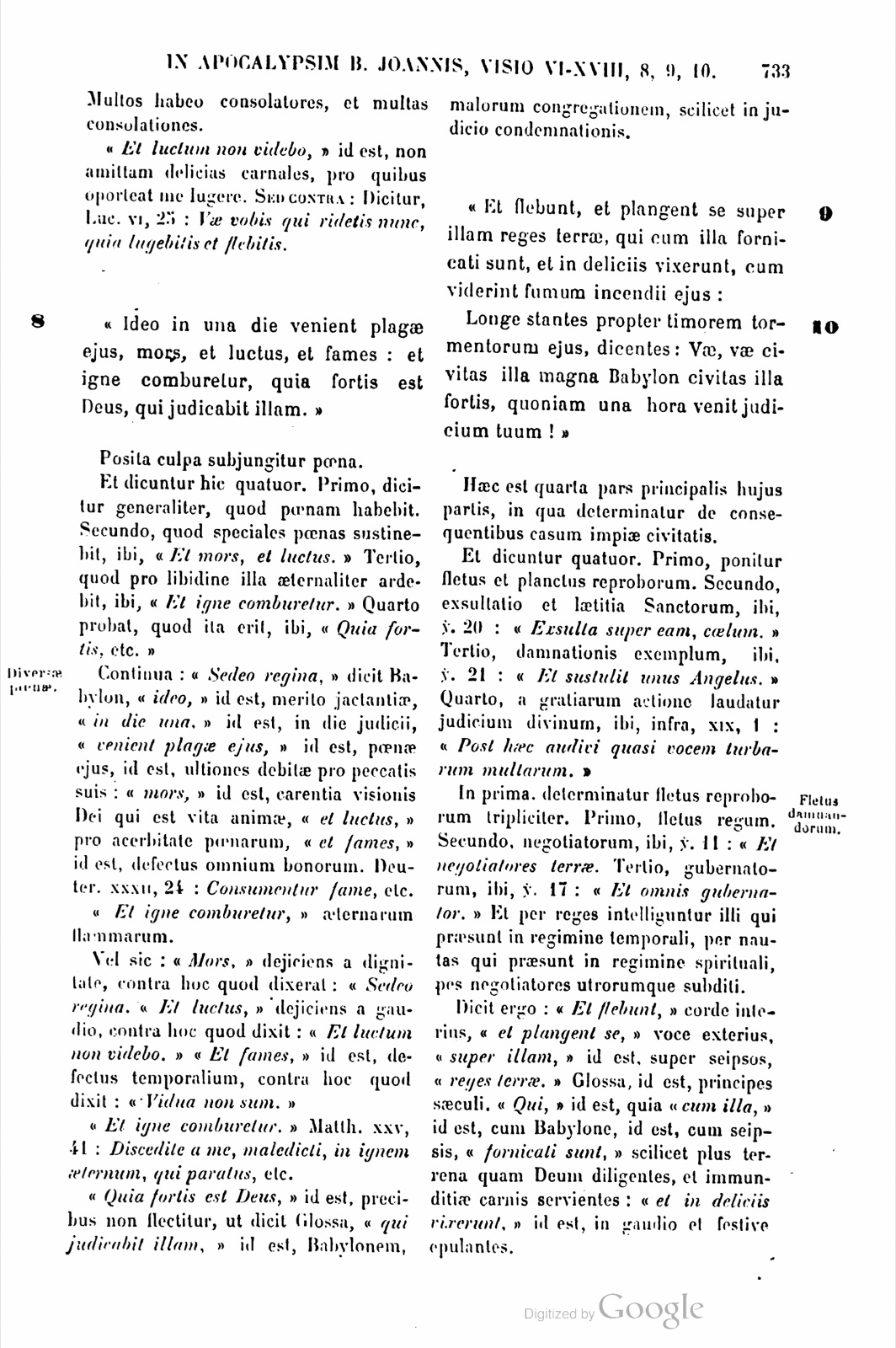
11. "Et negotiatores terrae flebunt, et lugebunt super illam, quoniam merces eorum nemo emet amplius: 12. Merces auri, et argenti, et lapidis pretiosi, et margaritae, et byssi, et purpurae, et serici, et cocci, et omne lignum thyinum, et omnia vasa eboris, et omnia vasa de lapide pretioso, et aeramento, et ferro, et marmore."
Hic agit de fletu negotiatorum. Et dicuntur quatuor. Primo, ostendit eorum fletum, Babylone destructa. Secundo, hujus causam, ibi, "Quoniam merces eorum." Tertio, quod vellent longe stare ab ea, ibi, v. 15: "Mercatores horum." Quarto, vocalis eorum querela, ibi, v. 16: "Et dicentes: Vae, vae." Dicit ergo: "Et negotiatores terrae." Ad litteram, sicut dicit Glossa, qui pro terrenis animas suas venales habent, sicut avari, id est, qui fraudulenter divitias congregaverunt, dolebunt in morte et in judicio et in inferno. Unde dicit: "Flebunt," id est, dolebunt in corde, "et lugebunt" oculis. Vel, "Flebunt" lacrymis, "et lugebunt" planctu miserabili, "super illam." Glossa, quia illa perire dolebunt, in quibus putabant prosperitatem. Unde subditur: "Quoniam merces eorum," scilicet in quibus gloriabantur, "nemo emet amplius," id est, defecit emptio et venditio, et ita gloria sua privabuntur. Zachar. XIV, 21: Non erit mercator ultra in domo Domini exercituum in die illa.
"Merces auri et argenti," supple, nemo emet amplius: "et lapidis pretiosi," carbunculi, "et margaritae, et byssi," [Marginal label: Byssus.] quod est linum candidissimum crescens in Aegypto, vel pannus factus de eo, "et purpurae, et serici, et cocci, et omne lignum thyinum" [Marginal label: Thyina.] id est, cedrinum, secundum aliquos, vel est aliud lignum imputribile, de quo, III Regum, X, 12: Fecit rex Salomon de lignis thyinis citharas lyrasque cantoribus. "Et omnia vasa eboris, et omnia vasa de lapide pretioso, et aeramento," id est, aere, "et ferro, et vitro, et marmore." Et haec omnia pertinent ad visum.
11. "And the merchants of the earth will weep and mourn over her, because no one will buy their merchandise any more: 12. merchandise of gold, and of silver, and of precious stone, and of pearl, and of fine linen, and of purple, and of silk, and of scarlet, and every thyine wood, and all vessels of ivory, and all vessels of precious stone, and brass, and iron, and marble."
Here he treats the weeping of the merchants. And four things are said. First, he shows their weeping when Babylon has been destroyed. Secondly, the cause of this, there, "Because their merchandise." Thirdly, that they would wish to stand far away from her, there at verse 15: "The merchants of these things." Fourthly, their vocal complaint, there at verse 16: "And saying: Woe, woe." Therefore he says: "And the merchants of the earth." According to the letter, as the Gloss says, those who have their souls saleable for earthly things, like the avaricious, that is, those who fraudulently gathered riches, will grieve in death and in judgment and in hell. Hence he says: "They will weep," that is, they will grieve in the heart, "and they will mourn" with the eyes. Or, "They will weep" with tears, "and they will mourn" with miserable lamentation, "over her." The Gloss says, because they will grieve that those things perish in which they thought prosperity consisted. Hence it is added: "Because their merchandise," namely the things in which they gloried, "no one will buy any more," that is, buying and selling have failed, and thus they will be deprived of their glory. Zechariah 14:21: There will no longer be a merchant in the house of the Lord of hosts on that day.
"Merchandise of gold and silver," supply, no one will buy any more; "and of precious stone," carbuncle, "and of pearl, and of fine linen," [Marginal label: Fine linen.] which is the whitest linen growing in Egypt, or cloth made from it, "and of purple, and of silk, and of scarlet, and every thyine wood" [Marginal label: Thyine things.] that is, cedar, according to some, or it is another incorruptible wood, of which 3 Kings 10:12 says: King Solomon made harps and lyres for singers from thyine woods. "And all vessels of ivory, and all vessels of precious stone, and brass," that is, bronze, "and iron, and glass, and marble." And all these things pertain to sight.
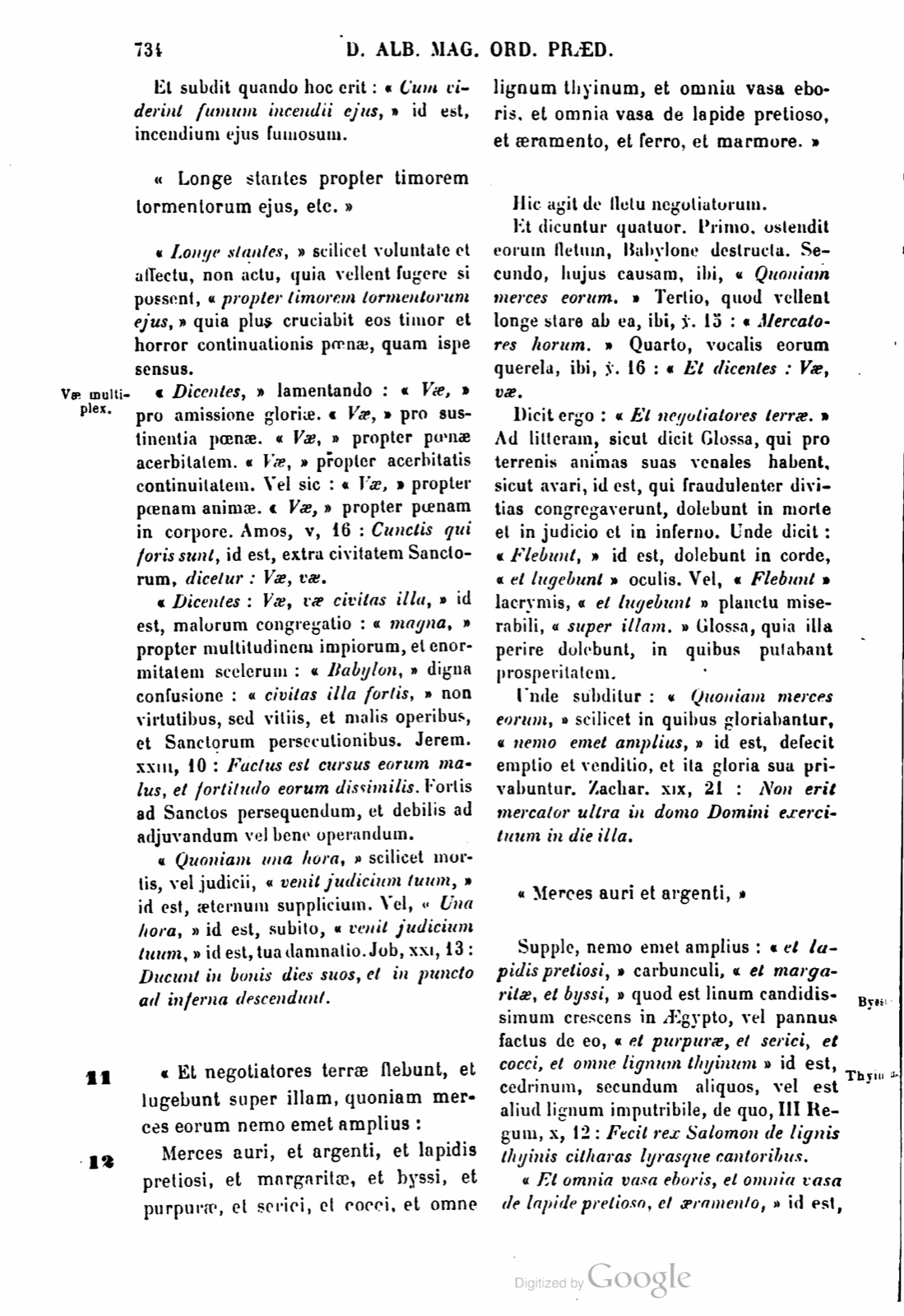
Deinde subdit quae pertinent ad olfactum, dicens: 13. "Et cinnamomum, et odoramentorum, et unguenti, et thuris." [Marginal label: Cinnamomum.] "Et cinnamomum," quod dicitur quasi cannamomum, etc.: species aromatica crescens ad modum cannae, et est cinerei coloris, quod fractum spirat suavem odorem. [Marginal label: Amomum.] "Et amomum," quod est species seminis quod facit effluere menstrua et urinam. "Et odoramentorum," supple, nemo emet amplius mercem, "et unguenti, et thuris." Haec omnia pertinent ad olfactum. Postea subdit ea quae pertinent ad gustum, dicens: "Et vini, et olei, et similae, et tritici." "Et vini," ad bibendum, "et olei," ad cibos condiendum, "et similae, et tritici," ad comedendum. Et differunt: [Marginal label: Similae.] quia simila est farina delicatissima: triticum est granum. Deinde tangit ea quae sunt accommodata usibus hominum, dicens: "Et jumentorum, et ovium, et equorum, et rhedarum, et mancipiorum, et animarum hominum."
14. "Et poma desiderii animae tuae discesserunt a te: et omnia pinguia et praeclara perierunt a te, et amplius illa jam non invenient. 15. Mercatores horum, qui divites facti sunt, ab ea longe stabunt propter timorem tormentorum ejus, flentes, ac lugentes, 16. Et dicentes: Vae, vae civitas illa magna, quae amicta erat bysso, et purpura, et cocco, et deaurata erat auro, et lapide pretioso, et margaritis: 17. Quoniam una hora destitutae sunt tantae divitiae!"
[Marginal label: Jumenta.] "Et jumentorum," supple, nemo emet mercem. Et dicuntur hic jumenta quae juvant hominem, ministrando cibum, vel ex se, vel ex operibus suis. "Et ovium," quae praestant vestimenta hominum, "et equorum," ad homines portandum, "et rhedarum," id est, quadrigarum, vel curruum ad necessaria trahendum, "et mancipiorum," qui tantum corpore vel ad tempus serviunt, "et animarum hominum," scilicet qui mente et corpore serviunt, servando ritum eorum et cultum quibus venduntur. Vel sic: "Et animarum hominum," qui serviunt ad totam vitam.
"Et poma desiderii animae tuae discesserunt a te, etc." "Poma desiderii tui," id est, quae desiderabat anima tua, per quae intelliguntur omnes fructus. Vel, secundum Glossam, sunt quaecumque minima quibus immoderate adhaerent, et pro eis damnabuntur. "Discesserunt a te." Sicut dicit Haymo, hoc fit quando hostes de regno ad regnum insurgentes, non solum depopulantur urbes, sed omni malignitate regiones vastant, et incendio cremant. Et haec omnia praedicta pertinent ad visum et gustum. "Et omnia pinguia," id est, omnia delectabilia gustui, "et praeclara," id est, delectabilia visui, "perierunt," vel praeterierunt, "a te," o Babylon meretrix. Sapient. V, 9: Transierunt omnia tamquam umbra. Et nota, quod licet rerum mutabilium transeat praesentia, tamen in mente malorum remanebit memoria delectationis.
Then he adds those things which pertain to smell, saying: 13. "And cinnamon, and of perfumes, and ointment, and frankincense." [Marginal label: Cinnamon.] "And cinnamon," which is said as if cannamomum, etc.: an aromatic species growing in the manner of a reed, and it is of ashen color; when broken it breathes forth a sweet odor. [Marginal label: Amomum.] "And amomum," which is a species of seed that makes menses and urine flow out. "And of perfumes," supply, no one will buy the merchandise any more, "and ointment, and frankincense." All these things pertain to smell. Afterward he adds those things which pertain to taste, saying: "And wine, and oil, and fine flour, and wheat." "And wine," for drinking, "and oil," for seasoning foods, "and fine flour, and wheat," for eating. And they differ: [Marginal label: Fine flour.] because fine flour is the most delicate flour; wheat is grain. Then he touches upon those things which are suited to human uses, saying: "And beasts of burden, and sheep, and horses, and carriages, and slaves, and souls of men."
14. "And the fruits of the desire of your soul have departed from you; and all fat and splendid things have perished from you, and they will no longer find those things now. 15. The merchants of these things, who have been made rich, will stand far away from her because of fear of her torments, weeping and mourning, 16. and saying: Woe, woe, that great city, which was clothed in fine linen, and purple, and scarlet, and was gilded with gold, and precious stone, and pearls; 17. because in one hour so great riches have been made destitute!"
[Marginal label: Beasts of burden.] "And of beasts of burden," supply, no one will buy the merchandise. And beasts of burden are here those things which help a man by furnishing food, either from themselves or from their works. "And of sheep," which provide the garments of men, "and of horses," for carrying men, "and of carriages," that is, four-horse vehicles or carts for drawing necessary things, "and of slaves," who serve only with the body or for a time, "and of souls of men," namely those who serve in mind and body, by keeping the rite and cult of those to whom they are sold. Or thus: "And of souls of men," who serve for their whole life.
"And the fruits of the desire of your soul have departed from you, etc." "The fruits of your desire," that is, the things which your soul desired, through which all fruits are understood. Or, according to the Gloss, they are whatever least things to which they cling immoderately, and for these they will be damned. "They have departed from you." As Haymo says, this happens when enemies rising from kingdom to kingdom not only depopulate cities, but with every malice lay waste the regions and burn them with fire. And all these things said before pertain to sight and taste. "And all fat things," that is, all things delightful to taste, "and splendid things," that is, things delightful to sight, "have perished," or passed by, "from you," O Babylon the harlot. Wisdom 5:9: All things have passed by like a shadow. And note that, although the presence of mutable things passes away, nevertheless in the mind of the evil there will remain the memory of delight.
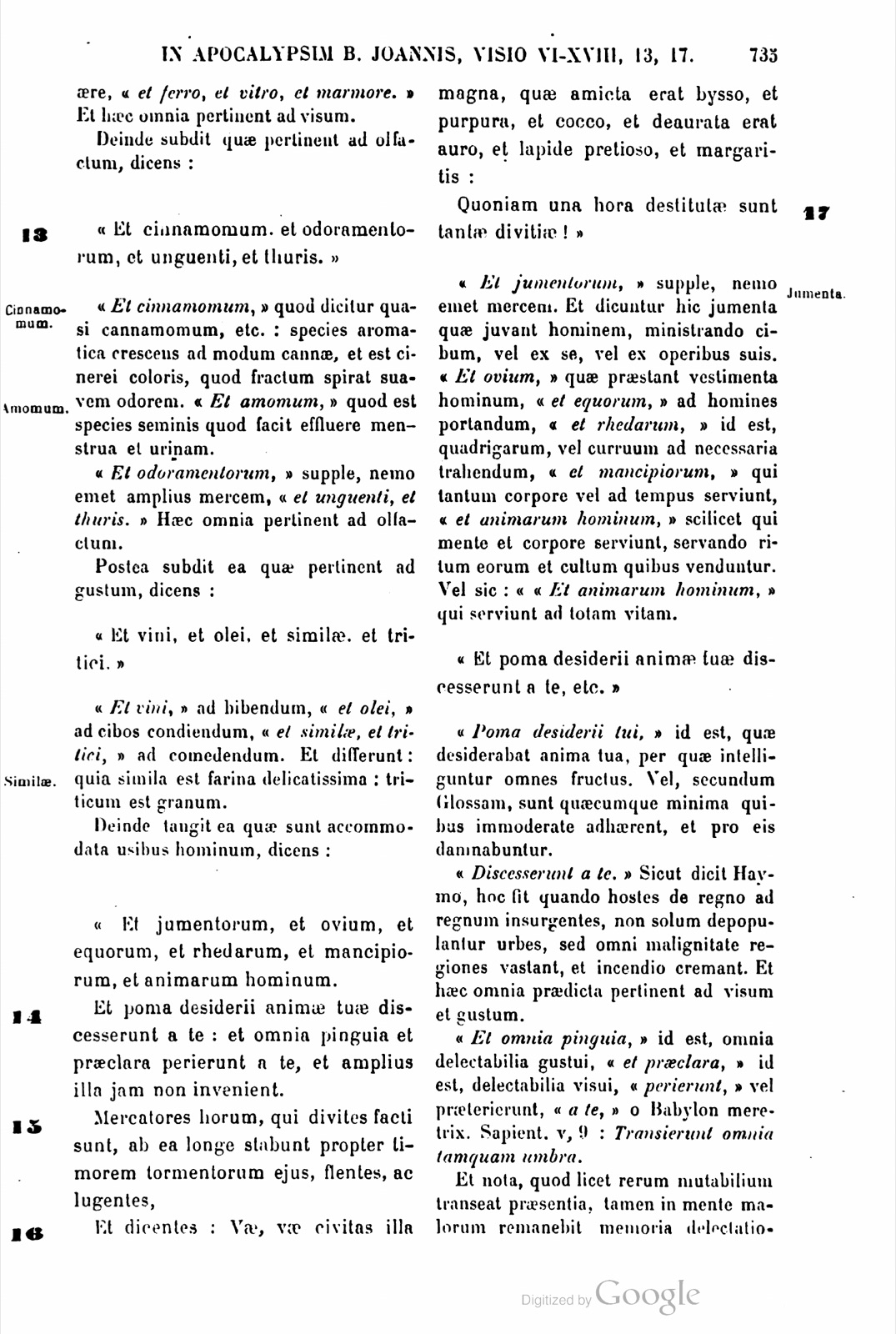
delectationis pungens, quam potuissent evasisse. "Et amplius illa jam non invenient," id est, non vendentur: quia jam non erit tempus negotiandi vel locus.
"Mercatores horum," id est, praedictarum mercium, "qui divites facti sunt," scilicet temporaliter, licet pauperes spiritualiter. Haymo: "Divites non virtutibus sed peccatis." "Ab ea," id est, mercatoribus factis in Babylone, "longe stabunt," id est, desiderabunt longe stare, tamen non poterunt. Vel, "Longe stabunt ab ea," scilicet voluntate, non corpore, id est, dolebunt quod non steterunt longe a commissione praedictorum, scilicet quando potuerunt. Vel, "Longe stabunt," quia jam talia exercere non poterunt, "propter timorem tormentorum ejus," id est, propter tormenta ejus, quorum continuatio semper timebitur, et praesentia semper sentietur. "Flentes," pro commissis, "ac lugentes," pro omissis.
"Et dicentes: Vae, vae civitas illa magna, etc." "Et dicentes," sono vocis: "Vae, vae," scilicet pro poena animae et corporis, vel pro poena sensus et damni. Nota, quod non ponitur aliquod nomen exprimens dolorem, ut ostendatur inexplicabilis. "Civitas illa magna," id est, congregatio malorum in inferno, "quae erat amicta." Glossa, circumdata, "bysso," sicut dives epulo 1. Bysso ad mollitiem carnis. "Et purpura, et cocco," propter vanitatem mundi, vel delectationem oculi: "et deaurata erat auro, et lapide pretioso, et margaritis." "Quoniam una hora," id est, momento mortis, "destitutae sunt tantae divitiae!" Sapient. V, 8 et 9: Quid nobis profuit superbia? et divitiarum jactantia quid contulit nobis? Transierunt omnia illa tamquam umbra. Et nota, quod beatus Joannes poenam mundanorum aggravavit in duobus. [Marginal label: Poena mundanorum.] Primo, quia pristinam felicitatem ad memoriam eis reducit. Secundo, quia cito defecisse ostendit. Unde Gregorius: "Non est tanti honoris excelsa tenuisse, quanti doloris de excelsis cecidisse."
Nota ab illo loco: "Et negotiatores terrae, etc.," exponitur spiritualiter sic: "Negotiatores terrae," id est, cupidi, vel hypocritae, vel haeretici, qui vendunt mundo virtutes et opera pro humana laude. Tales flebunt: quia jam nullus emet merces eorum: "merces auri," id est, sapientiae, "et argenti," id est, eloquentiae, "et lapidis pretiosi," id est, eminentiam conversationis sanctae, "et margaritae," id est, candorem bonae vitae, "et byssi," sanctorum justificationem, "et purpura," martyrii amorem, "et serici," id est, virginitatis splendorem, "et cocci," charitatem, "et omne lignum thyinum," constantiam indeficientem, "et eboris," scilicet castitatis, "aes" longanimitatis, "ferrum" patientiae, "marmor" humilitatis, "cinnamomum" poenitentiae, "amomum" bonae opinionis, "et odoramentorum," scilicet orationum, "et unguentorum," id est, donorum Spiritus sancti, "et thuris" devotionis, "vini" compunctionis, "olei" pietatis, "similae" puritatis, "tritici" firmitatis, "jumentorum," id est, laborum spiritualium, "ovium" innocentiae, "equorum" fortitudinis, "rhedarum" consilii et auxilii, "mancipiorum" mutui servitii, "et animarum" rationabilitatis, "poma desiderii," id est, odorem bonae famae, "et pinguia," id est, devotio, "et praeclara," id est, bona conversatio.
of delight, stinging them, which they could have escaped. "And now they will no longer find those things," that is, they will not be sold, because there will no longer be a time or place for trading.
"The merchants of these things," that is, of the aforesaid wares, "who have been made rich," namely temporally, although spiritually poor. Haymo says: "Rich not in virtues but in sins." "From her," that is, when they have been made merchants in Babylon, "they will stand far away," that is, they will desire to stand far away, yet they will not be able. Or, "They will stand far away from her," namely in will, not in body, that is, they will grieve that they did not stand far away from the commission of the aforesaid things, namely when they could. Or, "They will stand far away," because now they will not be able to exercise such things, "because of fear of her torments," that is, because of her torments, whose continuation will always be feared and whose presence will always be felt. "Weeping," for sins committed, "and mourning," for things omitted.
"And saying: Woe, woe, that great city, etc." "And saying," by the sound of the voice: "Woe, woe," namely because of the punishment of soul and body, or because of the punishment of sense and of loss. Note that no name expressing grief is set down, so that it may be shown to be inexplicable. "That great city," that is, the congregation of the evil in hell, "which was clothed." The Gloss says, surrounded, "in fine linen," as the rich feaster was 1. Fine linen is for the softness of the flesh. "And purple, and scarlet," because of the vanity of the world, or the delight of the eye; "and was gilded with gold, and precious stone, and pearls." "Because in one hour," that is, in the moment of death, "so great riches have been made destitute!" Wisdom 5:8 and 9: What has pride profited us? And what has the boasting of riches brought us? All those things have passed by like a shadow. And note that blessed John made the punishment of worldly people heavier in two things. [Marginal label: The punishment of worldly people.] First, because he brings their former happiness back to their memory. Secondly, because he shows that it failed quickly. Hence Gregory says: "It is not of so much honor to have held lofty things, as it is of grief to have fallen from lofty things."
Note that from that place: "And the merchants of the earth, etc.," it is expounded spiritually thus: "The merchants of the earth," that is, the covetous, or hypocrites, or heretics, who sell virtues and works to the world for human praise. Such people will weep, because now no one buys their wares: "merchandise of gold," that is, of wisdom; "and of silver," that is, of eloquence; "and of precious stone," that is, the eminence of holy conduct; "and of pearl," that is, the whiteness of a good life; "and of fine linen," the justification of the saints; "and of purple," love of martyrdom; "and of silk," that is, the splendor of virginity; "and of scarlet," charity; "and every thyine wood," unfailing constancy; "and of ivory," namely of chastity; "bronze" of long-suffering; "iron" of patience; "marble" of humility; "cinnamon" of penance; "amomum" of good opinion; "and of perfumes," namely of prayers; "and of ointments," that is, of the gifts of the Holy Spirit; "and of frankincense" of devotion; "wine" of compunction; "oil" of piety; "fine flour" of purity; "wheat" of firmness; "beasts of burden," that is, of spiritual labors; "sheep" of innocence; "horses" of fortitude; "carriages" of counsel and aid; "slaves" of mutual service; "and souls" of rationality; "fruits of desire," that is, the odor of good fame; "and fat things," that is, devotion; "and splendid things," that is, good conduct.
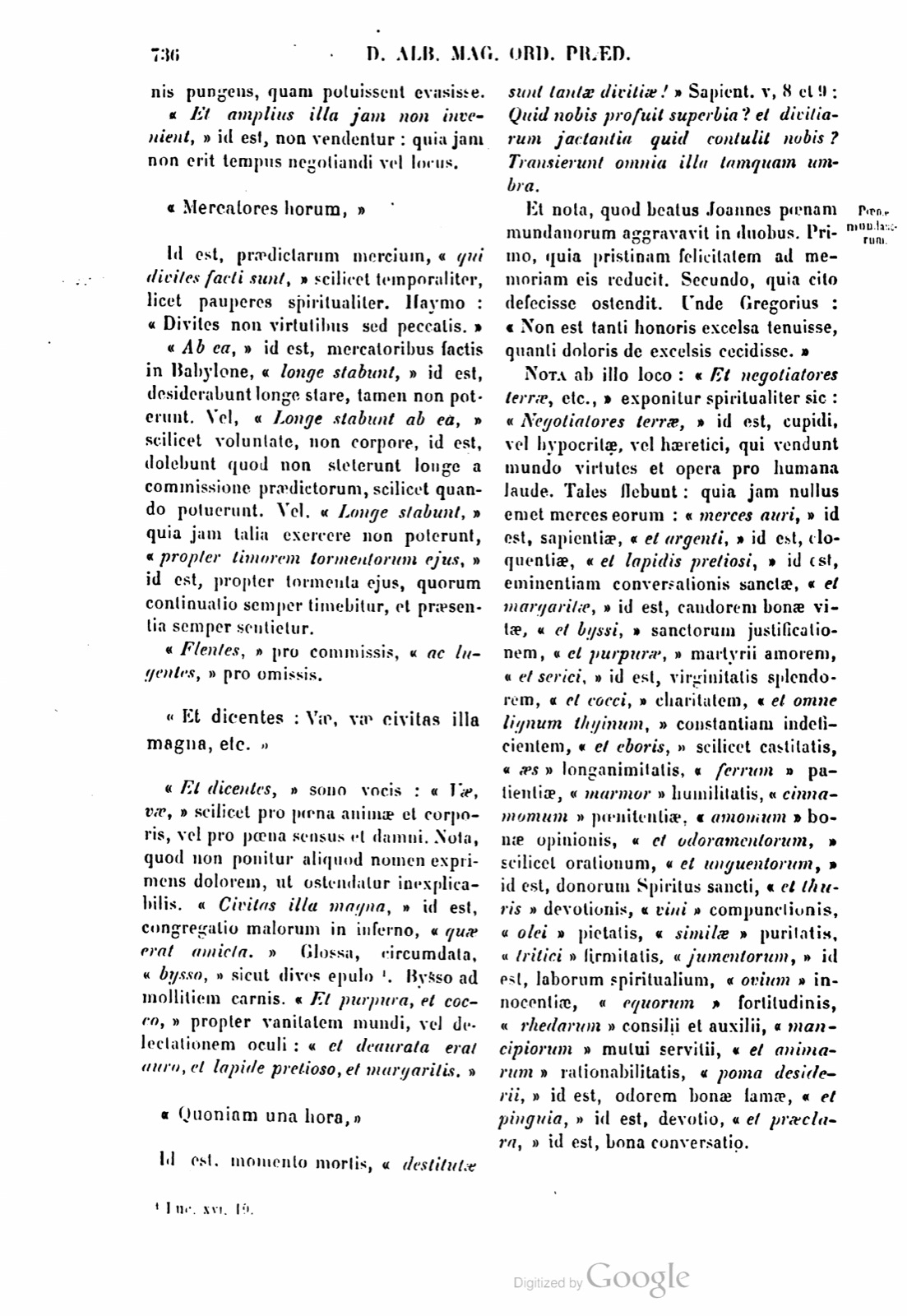
17. "Et omnis gubernator, et omnis qui in lacum navigat, et nautae, et qui in mari operantur, longe steterunt, 18. Et clamaverunt videntes locum incendii ejus, dicentes: Quae similis civitati huic magnae?"
Hic agitur de fletu gubernatorum et nautarum. Et dicuntur tria. Primo, ostenditur simplex eorum poena. Secundo, poenae causa, ibi, v. 19: "Et miserunt." Tertio, poenae vehementia, ibidem, "Et clamaverunt." Dicit ergo: "Et omnis gubernator." Ad litteram, vel Episcopus qui regit navem Ecclesiae, vel sunt praelati majores. Act. XX, 28: In quo Spiritus sanctus posuit episcopos regere Ecclesiam Dei. "Et omnis qui in lacum navigat." Lacus mundus est: navigat per lacum qui ad majora suspirat: et per hoc intelliguntur mediocres, ut archidiaconi, et diaconi, et decani, qui ad majora aspirant. "Et nautae." Et per hoc intelliguntur minores, ut plebani, et rurales. "Et qui in mari operantur," id est, Doctores et Praedicatores. Psal. CVI, 23: Qui descendunt mare in navibus, etc. "Longe steterunt," id est, stabunt a suis praelationibus degradati, et in infernum detrusi. Vel, "Longe steterunt," id est, stabunt a Deo per poenam, qui ante longe steterunt per culpam.
"Et clamaverunt," scilicet prae timore, dolore, et horrore, "videntes locum incendii ejus," id est, infernum succensum igne, et sulphure: vel seipsos projectos in ignem inferni. "Dicentes," prae stupore: "Quae similis civitati huic magnae?" supple, quae prius fuit in gloria, quae modo est in miseria et poena. Haymo: "Nulla civitas illi magnae honore aequari potuit."
19. "Et miserunt pulverem super capita sua, et clamaverunt flentes et lugentes, dicentes: Vae, vae civitas illa magna, in qua divites facti sunt omnes qui habebant naves in mari, de pretiis ejus: quoniam una hora desolata est!"
Supra ostendit damnationem, hic ostendit causam. Causa autem damnationis est concupiscentia terrenorum. Continua ita: Damnabuntur. [Marginal label: Pulvis terrae.] "Et," id est, quia "miserunt pulverem super capita sua," id est, in mente habuerunt terrena per amorem, non spiritualia. Vel sic: "Miserunt," id est, mittent, "pulverem super capita sua," scilicet ad modum poenitentis: sed sera erit tunc poenitentia, quia locus non erit poenitendi. Vel, "Pulverem," scilicet desperationis, qui maxime facit vilem et abjectum, "super capita sua," id est, corda, quod est principale membrum hominis. Vel, "Miserunt pulverem super capita sua," id est, se recognoverunt esse pulverem.
"Et clamaverunt," id est, clamabunt prae nimio dolore, "flentes," corde, "et lugentes," oculis. Vel, fletus notat ubertatem lacrymarum, luctus verba miserabilia. "Dicentes," plangendo: "Vae, vae," pro poena corporis et animae, "civitas illa magna," multitudine peccatorum, et populorum, "in qua divites facti sunt," scilicet quondam, "omnes qui habebant naves in mari." Ad litteram: quia multi ditantur in mundo ex his quae in navigio deferunt. "De pretiis ejus," scilicet conducendis. Vel, "De pretiis ejus," id est, de mercibus quae illo pretio emebantur, tunc quidem divites fuerunt, sed modo pauperes sunt in aeternum. Aliter: Habentes naves in mari sunt rectores Ecclesiae, qui modo ditantur ad litteram "de pretiis ejus," id est, de divitiis. Unde dicunt illud Zachariae, XI, 5: Benedictus Dominus, divites facti sumus. Sed certe pauperes et miseri sunt: quia cito deficient eis istae divitiae, et peribunt in maxima defectione. Unde sequitur: "Quoniam una hora," id est, cito, vel subito adveniente die judicii, "desolata est," scilicet omni gaudio, et spe destituta. Nam post diem judicii mali erunt destituti omni gaudio. Jerem. XXV, 10: Perdam ex eis vocem gaudii et vocem laetitiae.
17. "And every pilot, and everyone who sails on the lake, and sailors, and those who work on the sea, stood far off; 18. And they cried out, seeing the place of her burning, saying: What is like this great city?"
Here the weeping of pilots and sailors is treated. And three things are said. First, their simple punishment is shown. Secondly, the cause of the punishment, there at verse 19: "And they cast." Thirdly, the vehemence of the punishment, in the same place, "And they cried out." Therefore he says: "And every pilot." According to the letter, either a Bishop who rules the ship of the Church, or they are greater prelates. Acts 20:28: In which the Holy Spirit placed bishops to rule the Church of God. "And everyone who sails on the lake." The lake is the world; one sails through the lake who aspires to greater things; and through this are understood the middling ones, such as archdeacons, deacons, and deans, who aspire to greater things. "And sailors." And through this are understood the lesser ones, such as parish priests and country clerics. "And those who work on the sea," that is, Doctors and Preachers. Psalm 106:23: Those who go down to the sea in ships, etc. "They stood far off," that is, they will stand degraded from their prelacies and thrust down into hell. Or, "They stood far off," that is, they will stand far from God through punishment, who before stood far off through guilt.
"And they cried out," namely because of fear, grief, and horror, "seeing the place of her burning," that is, hell kindled with fire and sulfur; or themselves cast into the fire of hell. "Saying," from astonishment: "What is like this great city?" supply, which formerly was in glory, which now is in misery and punishment. Haymo says: "No city could be equaled to that great one in honor."
19. "And they cast dust upon their heads, and cried out weeping and mourning, saying: Woe, woe, that great city, in which all who had ships on the sea were made rich from her prices; because in one hour she has been made desolate!"
Above he showed the damnation; here he shows the cause. Now the cause of damnation is concupiscence of earthly things. The continuation is thus: They will be damned. [Marginal label: Dust of the earth.] "And," that is, because "they cast dust upon their heads," that is, in their mind they had earthly things through love, not spiritual things. Or thus: "They cast," that is, they will cast, "dust upon their heads," namely in the manner of a penitent person; but penance will then be late, because there will not be a place for doing penance. Or, "dust," namely of desperation, which especially makes one vile and abject, "upon their heads," that is, hearts, which is the principal member of a man. Or, "They cast dust upon their heads," that is, they recognized themselves to be dust.
"And they cried out," that is, they will cry out because of excessive grief, "weeping," in heart, "and mourning," with the eyes. Or, weeping marks the abundance of tears; mourning marks miserable words. "Saying," by lamenting: "Woe, woe," because of the punishment of body and soul, "that great city," in the multitude of sins and peoples, "in which all who had ships on the sea were made rich," namely formerly. According to the letter, because many are enriched in the world from the things which they carry in a ship. "From her prices," namely of things to be hired. Or, "From her prices," that is, from the merchandise which was bought for that price, they were indeed rich then, but now they are poor forever. Otherwise: Those having ships on the sea are rulers of the Church, who now are made rich according to the letter "from her prices," that is, from riches. Hence they say that saying of Zechariah 11:5: Blessed be the Lord, we have been made rich. But certainly they are poor and wretched, because those riches will quickly fail them, and they will perish in the greatest failing. Hence it follows: "Because in one hour," that is, quickly or suddenly, when the day of judgment comes, "she has been made desolate," namely destitute of every joy and hope. For after the day of judgment the evil will be destitute of every joy. Jeremiah 25:10: I will destroy from them the voice of joy and the voice of gladness.
20. "Exsulta super eam, coelum, et sancti Apostoli, et Prophetae, quoniam judicabit Deus judicium vestrum de illa."
Hic determinatur de gaudio Sanctorum consequente casum illorum. Et dicuntur duo. Primo, invitantur Sancti ad gaudendum. Secundo, ponitur ratio gaudii eorum, ibi, "Quoniam Deus judicabit." [Marginal label: Gaudia Sanctorum.] Unde dicit: "Exsulta," id est, laetitiam mentis intus conceptam exterius ostende, "super eam," id est, super Babylonis damnationem, "coelum," id est, sancti. Et exponit per partes qui sunt illi: "Et sancti Apostoli." Vel, "Coelum," id est, Angeli, "et sancti Apostoli," id est, sancti majores, "et Prophetae," id est, minores. NOTA: Isti specialiter invitantur ad gaudendum: quia ab Apostolis et Prophetis praenuntiata fuerunt. "Quoniam judicabit Deus judicium vestrum de illa," id est, damnabit illam juste, quae vos damnavit injuste. Hoc est judicium quod quaerebant, Supra, VI, 10: Usquequo, Domine, sanctus et verus, non judicas, et non vindicas sanguinem nostrum? Et ideo dicit: "Vestrum," scilicet quod petebatis.
21. "Et sustulit unus Angelus fortis lapidem quasi molarem magnum, et misit in mare, dicens: Hoc impetu mittetur Babylon, civitas illa magna, et ultra jam non invenietur."
Hic ponitur exemplum damnationis Babylonis. Et dicuntur hic tria. Primo, ponitur exemplum damnationis Babylonis in amaritudine poenae. Secundo, in ablatione omnis laetitiae mundanae, ibi, v. 22: "Et vox citharaedorum." Tertio, ponitur ratio horum, scilicet immensitas culpae, ibi, v. 23: "Quia mercatores tui." [Marginal label: Diversa poena damnatorum.] Dicit ergo: "Et sustulit unus Angelus," id est, Christus, qui dicitur unus, quia singularis, invariabilis. [Marginal label: Christus dicitur Angelus.] "Fortis." Glossa, quia aereas potestates devicit. Et dicitur, "sustulit," id est, in altum elevari permisit. "Lapidem molarem magnum," id est, multitudinem malorum, qui dicuntur lapides, quia duri et obstinati in peccatis: molares, quia volvuntur in temporalibus istis. [Marginal label: Mali dicuntur lapides.] Psal. XI, 9: In circuitu impii ambulant: magni propter superbiam cordis. "Et misit in mare," id est, in amaritudinem inferni. Exod. XV, 5: Descenderunt in profundum quasi lapis. "Dicens," supple, per Praedicatores suos: "Hoc impetu," id est, hac velocitate, "mittetur," scilicet in infernum, "Babylon, civitas illa magna," id est, impiorum multitudo, in qua multi et magni sunt: "et ultra non invenietur," scilicet in societate Sanctorum postquam ceciderit in infernum. Vel sic: "Et ultra non invenietur," scilicet in mundo, quia non revertetur ut vivat in pristinis deliciis, vel ut poenitentiam agat. Sapient. II, 1: Non est qui agnitus sit reversus ab inferis.
20. "Rejoice over her, heaven, and holy Apostles and Prophets, because God will judge your judgment concerning her."
Here determination is made concerning the joy of the Saints consequent upon their fall. And two things are said. First, the Saints are invited to rejoice. Secondly, the reason for their joy is set down, there, "Because God will judge." [Marginal label: The joys of the Saints.] Hence he says: "Rejoice," that is, show outwardly the gladness of mind conceived inwardly, "over her," that is, over the damnation of Babylon, "heaven," that is, the saints. And he explains by parts who they are: "And holy Apostles." Or, "heaven," that is, Angels, "and holy Apostles," that is, the greater saints, "and Prophets," that is, the lesser. NOTE: These are specially invited to rejoice, because these things had been foretold by Apostles and Prophets. "Because God will judge your judgment concerning her," that is, he will justly damn her, who unjustly damned you. This is the judgment which they were seeking, above, 6:10: How long, Lord, holy and true, do you not judge and not avenge our blood? And therefore he says: "Your," namely that which you were seeking.
21. "And one strong Angel took up a stone as it were a great millstone, and cast it into the sea, saying: With this force Babylon, that great city, will be thrown down, and now she will be found no more."
Here the example of the damnation of Babylon is set down. And three things are said here. First, the example of Babylon's damnation is set down in the bitterness of punishment. Secondly, in the removal of every worldly gladness, there at verse 22: "And the voice of harp-players." Thirdly, the reason for these things is set down, namely the immensity of guilt, there at verse 23: "Because your merchants." [Marginal label: Diverse punishment of the damned.] Therefore he says: "And one Angel took up," that is, Christ, who is called one because singular and invariable. [Marginal label: Christ is called Angel.] "Strong." The Gloss says, because he conquered the aerial powers. And it is said, "he took up," that is, he permitted to be lifted on high. "A great millstone," that is, the multitude of the evil, who are called stones because they are hard and obstinate in sins; millstones, because they are rolled about in these temporal things. [Marginal label: The evil are called stones.] Psalm 11:9: The impious walk in a circuit; great because of pride of heart. "And he cast it into the sea," that is, into the bitterness of hell. Exodus 15:5: They went down into the depth like a stone. "Saying," supply, through his Preachers: "With this force," that is, with this speed, "Babylon, that great city," that is, the multitude of the impious, in which there are many and great ones, "will be thrown," namely into hell, "and will no longer be found," namely in the society of the Saints after she has fallen into hell. Or thus: "And she will no longer be found," namely in the world, because she will not return to live in her former delights or to do penance. Wisdom 2:1: There is no one who is known to have returned from the lower regions.
22. "Et vox citharaedorum, et musicorum, et tibia canentium, et tuba non audietur in te amplius, et omnis artifex omnis artis non invenietur in te amplius, et vox molae non audietur in te amplius, 23. Et lux lucernae non lucebit in te amplius, et vox sponsi et sponsae non audietur adhuc in te."
"Et vox citharaedorum, et musicorum, et tibia canentium, et tuba non audietur amplius in te." Quasi dicat: Nullum consolatorium auditus audietur in civitate damnata, sed potius planctus et gemitus. Ezechiel. XXVI, 13: Quiescere faciam multitudinem canticorum tuorum: et sonitus citharum tuarum non audietur amplius. "Et omnis artifex." Hoc dicit quoad practicam. "Omnis artis," quoad theoricam, "non invenietur in te amplius." Quasi dicat: Nullum officium vel artificium est ibi, unde homo possit panem lucrari, vel aliquid apud Deum mereri. Eccle. IX, 10: Quodcumque facere potest manus tua, instanter operare: quia nec opus, nec ratio, nec sapientia, nec scientia erunt apud inferos. [Marginal label: Utrum scientia maneat in inferno?] Et est hic argumentum, quod illi non erunt memores scientiae suae in inferno, quod est satis probabile. Si enim homine adhuc vivente, facit aliqua infirmitas eum amittere scientiam aliquam: multo fortius poena infernalis, quae omnem infirmitatem corporalem excedit: tamen si habet aliquam, hoc non erit ad consolationem, sed potius ad dolorem. "Et vox molae non audietur in te amplius," quae scilicet est ad victualia praeparanda. Glossa: "Ibi non exquirentur panes delicatissimi." Unde per hoc removetur delectabile gustus.
Iterum convertit vocem suam ad Babylonem ad majorem confusionem ipsius: "Et lux lucernae non lucebit tibi amplius," quia scilicet auferetur ab eis delectabile visus: quia, Eccle. XI, 7: Dulce lumen, et delectabile est oculis videre solem. Isidorus: "Sol non descendet amplius sub terram, sed stabit in Oriente, ne ejus lumine perfruantur damnati." "Et vox sponsi et sponsae," id est, cantilenae nuptiales. Vel, gaudium quod solet fieri in nuptiis "non audietur adhuc," id est, amplius, "in te," scilicet in inferno, ubi tu eris.
23. "Quia mercatores tui erant principes terrae, quia in veneficiis tuis erraverunt omnes gentes. 24. Et in ea sanguis Prophetarum et Sanctorum inventus est, et omnium qui interfecti sunt in terra."
Hic tangitur, quare haec civitas privabitur omni consolatione et delectatione. Et primo, tangitur quoad inordinationem concupiscentiae. Secundo, quoad inordinationem rationalis, ibi, "Quia in veneficiis." Tertio, quoad inordinationem irascibilis, ibi, v. 24: "Et in ea sanguis." Continua: Ista praedicta non invenientur in te: et haec est causa: "quia mercatores tui," id est, dantes spiritualia pro terrenis, animas suas commutantes pro temporalibus divitiis, "erant principes terrae," tuae ad litteram. Quasi dicat: Tales eligebas principes tibi, qui multiplicarent tibi terrena, et amarent: et in hoc tangitur inordinatio concupiscibilis. "Quia," vel quoniam "in veneficiis tuis," id est, maleficiis ad litteram, quibus homines habent odio uxores suas. Vel sic: "Veneficiis," id est, potionibus mortiferis, vel persuasionibus perversis, et malis exemplis. "Erraverunt omnes gentes," id est, aliqui de omnibus, ut sit distributio pro generibus singulorum, non pro singulis generum. Vel, "Omnes gentes," scilicet qui erraverunt similiter. Joan. I, 9: Qui illuminat omnem hominem, etc. Quasi dicat: Nullus erravit de gentibus nisi per tua veneficia. Et in hoc notatur inordinatio rationalis.
22. "And the voice of harp-players, and musicians, and of those playing the pipe, and trumpet will not be heard in you any more; and no artisan of any art will be found in you any more; and the voice of the mill will not be heard in you any more; 23. And the light of the lamp will not shine in you any more, and the voice of bridegroom and bride will no longer be heard in you."
"And the voice of harp-players, and musicians, and of those playing the pipe, and trumpet will no longer be heard in you." As if he said: No consolation of hearing will be heard in the damned city, but rather lamentation and groaning. Ezekiel 26:13: I will make the multitude of your songs cease, and the sound of your harps will no longer be heard. "And every artisan." He says this as to practice. "Of every art," as to theory, "will no longer be found in you." As if he said: No office or art is there by which a man can earn bread or merit anything before God. Ecclesiastes 9:10: Whatever your hand is able to do, work earnestly, because neither work, nor reason, nor wisdom, nor knowledge will be in the lower world. [Marginal label: Whether knowledge remains in hell?] And here there is an argument that they will not remember their knowledge in hell, which is quite probable. For if, while a man is still living, some infirmity makes him lose some knowledge, much more will infernal punishment, which exceeds every bodily infirmity; nevertheless if he has any knowledge, this will not be for consolation, but rather for grief. "And the voice of the mill will not be heard in you any more," which namely is for preparing victuals. The Gloss says: "There the most delicate breads will not be sought." Hence through this the delight of taste is removed.
Again he turns his voice to Babylon for her greater confusion: "And the light of the lamp will not shine for you any more," because, namely, the delight of sight will be taken from them; because Ecclesiastes 11:7 says: Light is sweet, and it is delightful for the eyes to see the sun. Isidore says: "The sun will no longer descend under the earth, but will stand in the East, lest the damned enjoy its light." "And the voice of bridegroom and bride," that is, nuptial songs. Or, the joy that is accustomed to happen at weddings "will no longer be heard," that is, any more, "in you," namely in hell, where you will be.
23. "Because your merchants were the princes of the earth, because in your sorceries all nations went astray. 24. And in her the blood of Prophets and Saints was found, and of all who have been slain on the earth."
Here it is touched upon why this city will be deprived of every consolation and delight. And first, it is touched upon as to the disordering of concupiscence. Secondly, as to the disordering of the rational part, there, "Because in your sorceries." Thirdly, as to the disordering of the irascible part, there at verse 24: "And in her blood." The continuation is: Those aforesaid things will not be found in you; and this is the cause: "because your merchants," that is, those giving spiritual things for earthly things, exchanging their souls for temporal riches, "were the princes of the earth," yours according to the letter. As if he said: You chose such princes for yourself, who would multiply and love earthly things for you; and in this the disordering of the concupiscible part is touched. "Because," or since "in your sorceries," that is, in evil deeds according to the letter, by which men have hatred for their wives. Or thus: "sorceries," that is, deadly potions, or perverse persuasions and evil examples. "All nations went astray," that is, some from all, so that there is a distribution for kinds of individuals, not for individuals of kinds. Or, "all nations," namely those who went astray similarly. John 1:9: Who illumines every man, etc. As if he said: No one from the nations went astray except through your sorceries. And in this the disordering of the rational part is marked.
"Et in ea sanguis Prophetarum, etc." Quasi dicat: Et etiam puniris, quia "in ea sanguis Prophetarum," id est, peccatum pro effusione sanguinis, "et Sanctorum inventus est." Et quia multos occidit, ideo addit: "Et omnium qui interfecti sunt in terra." Quasi dicat: Non solum sanguis Sanctorum requiretur a te, sed etiam malorum quos occidisti injuste, licet essent digni occidi. Unde Glossa: "Si malus malum occiderit, non excusat nequitia occisi, sed cum justitia excusat, ut si juste et a justo judice occidatur." Et in hoc notatur inordinatio irascibilis.
Hic sunt dubitabilia.
[Marginal label: Dub. 1.] Primo, super illo verbo v. 10: "Longe stantes propter timorem tormentorum ejus," quaeritur, Quomodo sint longe a civitate succensa, cum ipsi sint ipsa civitas? RESPONSIO. Glossa, Voluntate, non actu: quia vellent fugere, sed non poterunt. Sed quid est quod dicit: "Propter timorem tormentorum ejus?" deberet enim dicere propter sensum. RESPONSIO: Hoc dicit, quia plus cruciabit eos interius cogitatio de continuatione doloris, quam sensus exterioris tormenti.
[Marginal label: Dub. 2.] Secundo, super illo verbo v. 14: "Et poma desiderii animae tuae," quaeritur, Cum certum sit quod homines plus delectentur in rebus aliis, quam in pomis, quare in pomis addit desiderii animae tuae, et non cum aliis? RESPONSIO Haymonis: "In hoc ostenditur, quod non solum in majoribus, sed etiam in minoribus valde offenditur Deus, si ultra quam appeti debeant appetantur."
[Marginal label: Dub. 3.] Tertio, super illo verbo v. 21: "Et ultra jam non invenietur." CONTRA: Isa. XXIV, 22: Congregabuntur in congregatione unius fascis in lacum, et claudentur ibi in carcere, et post multos dies visitabuntur. [Marginal label: Duplex visitatio.] RESPONSIO. Duplex est visitatio. Alia ad liberationem: hac visitati sunt homines in adventu primo. Alia ad damnationem: hac visitabuntur omnes mali in judicio, quando venient omnes de inferno, et resumptis corporibus simul in corpore et anima in perpetuum recludentur in infernum, audita sententia. De prima non loquitur Isaias, sed de secunda visitatione.
"And in her the blood of Prophets, etc." As if he said: And you are also punished because "in her the blood of Prophets," that is, the sin for the shedding of blood, "and of Saints was found." And because she killed many, therefore he adds: "And of all who have been slain on the earth." As if he said: Not only will the blood of the Saints be required from you, but also of the evil whom you killed unjustly, although they were worthy to be killed. Hence the Gloss says: "If an evil person kills an evil person, the wickedness of the slain one does not excuse him, but it excuses with justice, as if he is killed justly and by a just judge." And in this the disordering of the irascible part is marked.
Here there are doubtful matters.
[Marginal label: Dub. 1.] First, on that word of verse 10: "Standing far off because of fear of her torments," it is asked: How are they far from the burned city, since they themselves are that city? RESPONSE. The Gloss says, in will, not in act, because they would wish to flee, but will not be able. But what is this that he says: "Because of fear of her torments?" For he ought to say because of the sensation. RESPONSE: He says this because the thought concerning the continuation of pain will torture them more inwardly than the sense of the exterior torment.
[Marginal label: Dub. 2.] Secondly, on that word of verse 14: "And the fruits of the desire of your soul," it is asked: Since it is certain that men are more delighted in other things than in fruits, why with fruits does he add of the desire of your soul, and not with the others? RESPONSE of Haymo: "In this it is shown that God is greatly offended not only in greater things, but also in lesser things, if they are desired beyond what they ought to be desired."
[Marginal label: Dub. 3.] Thirdly, on that word of verse 21: "And now she will no longer be found." ON THE CONTRARY: Isaiah 24:22: They will be gathered in the gathering of one bundle into the lake, and they will be shut there in prison, and after many days they will be visited. [Marginal label: Twofold visitation.] RESPONSE. Visitation is twofold. One is for liberation: by this men were visited in the first advent. The other is for damnation: by this all the evil will be visited in judgment, when all will come from hell, and, having resumed their bodies, will be shut up forever in hell together in body and soul after the sentence has been heard. Isaiah does not speak about the first, but about the second visitation.
Notes
- Luke 16:19. (Luc. XVI, 19.) ↩
If a page does not appear, its photograph has not been uploaded yet.