Works › Commentary on the Apocalypse of Blessed John
Volume 38 · pp. 717–727
Chapter XVII and the Opening Exposition on Chapter XVII of the Apocalypse
A marker with ≈ is an approximate page boundary, placed by measure of the text; the page photographs remain the authority. In the paired views, clicking a page marker brings that page into view.
CAPUT XVII.
Mulier fornicaria sive Babylon variis induta ornamentis, et ebria martyrum sanguine, sedet super bestiam septem capitum et decem cornuum: quae omnia hic declarat Angelus.
1. Et venit unus de septem Angelis qui habebant septem phialas, et locutus est mecum, dicens: Veni, ostendam tibi damnationem meretricis magnae, quae sedet super aquas multas: 2. Cum qua fornicati sunt reges terrae, et inebriati sunt qui inhabitant terram de vino prostitutionis ejus. 3. Et abstulit me in spiritu in desertum. Et vidi mulierem sedentem super bestiam coccineam, plenam nominibus blasphemiae, habentem capita septem et cornua decem. 4. Et mulier erat circumdata purpura et coccino, et inaurata auro, et lapide pretioso, et margaritis, habens poculum aureum in manu sua, plenum abominatione, et immunditia fornicationis ejus: 5. Et in fronte ejus nomen scriptum: Mysterium, Babylon magna, mater fornicationum et abominationum terrae. 6. Et vidi mulierem ebriam de sanguine sanctorum, et de sanguine martyrum Jesu. Et miratus sum, cum vidissem illam, admiratione magna. 7. Et dixit mihi Angelus: Quare miraris? Ego dicam tibi sacramentum mulieris, et bestiae quae portat eam, quae habet capita septem et cornua decem. 8. Bestia quam vidisti, fuit, et non est: et ascensura est de abysso, et in interitum ibit: et mirabuntur inhabitantes terram (quorum non sunt scripta nomina in libro vitae a constitutione mundi) videntes bestiam, quae erat, et non est. 9. Et hic est sensus, qui habet sapientiam: Septem capita, septem montes sunt, super quos mulier sedet, et reges septem sunt. 10. Quinque ceciderunt: unus est, et alius nondum venit: et cum venerit, oportet illum breve tempus manere. 11. Et bestia, quae erat, et non est, et ipsa octava est, et de septem est, et in interitum vadit. 12. Et decem cornua quae vidisti, decem reges sunt, qui regnum nondum acceperunt: sed potestatem tamquam reges una hora accipient post bestiam. 13. Hi unum consilium habent, et virtutem et potestatem suam bestiae tradent. 14. Hi cum Agno pugnabunt, et Agnus vincet illos: quoniam Dominus dominorum est, et Rex regum 1: et qui cum illo sunt, vocati, electi et fideles. 15. Et dixit mihi: Aquae quas vidisti ubi meretrix sedet, populi sunt, et gentes, et linguae. 16. Et decem cornua quae vidisti in bestia, hi odient fornicariam, et desolatam facient illam et nudam, et carnes ejus manducabunt, et ipsam igni concremabunt. 17. Deus enim dedit in corda eorum ut faciant quod placitum est illi, ut dent regnum suum bestiae, donec consummentur verba Dei. 18. Et mulier quam vidisti, est civitas magna, quae habet regnum super reges terrae.
IN CAPUT XVII APOCALYPSIS ENARRATIO.
1. "Et venit unus de septem Angelis qui habebant septem phialas, et locutus est mecum, dicens: Veni, ostendam tibi damnationem meretricis magnae, quae sedet super aquas multas: 2. Cum qua fornicati sunt reges terrae, et inebriati sunt qui inhabitant terram de vino prostitutionis ejus."
CHAPTER XVII.
The fornicating woman, or Babylon, clothed with various ornaments and drunk with the blood of martyrs, sits upon the beast of seven heads and ten horns; all of which things the Angel here declares.
1. And one of the seven Angels who had the seven bowls came, and spoke with me, saying: Come, I will show you the damnation of the great harlot, who sits upon many waters; 2. with whom the kings of the earth have fornicated, and those who inhabit the earth have been made drunk from the wine of her prostitution. 3. And he took me away in spirit into a desert. And I saw a woman sitting upon a scarlet beast, full of names of blasphemy, having seven heads and ten horns. 4. And the woman was clothed in purple and scarlet, and gilded with gold and precious stone and pearls, having a golden cup in her hand, full of abomination and the uncleanness of her fornication. 5. And on her forehead a name was written: Mystery, great Babylon, mother of fornications and abominations of the earth. 6. And I saw the woman drunk from the blood of saints and from the blood of the martyrs of Jesus. And I marveled, when I had seen her, with great admiration. 7. And the Angel said to me: Why do you marvel? I will tell you the sacrament of the woman and of the beast that carries her, which has seven heads and ten horns. 8. The beast which you saw was, and is not; and it is about to ascend from the abyss, and it will go into destruction; and those inhabiting the earth will marvel, whose names have not been written in the book of life from the constitution of the world, seeing the beast which was and is not. 9. And here is the sense, which has wisdom: The seven heads are seven mountains, upon which the woman sits, and they are seven kings. 10. Five have fallen; one is, and another has not yet come; and when he comes, he must remain a short time. 11. And the beast which was and is not, it too is the eighth, and is of the seven, and goes into destruction. 12. And the ten horns that you saw are ten kings, who have not yet received a kingdom, but will receive power as kings for one hour after the beast. 13. These have one counsel, and they will hand over their strength and power to the beast. 14. These will fight with the Lamb, and the Lamb will conquer them, because he is Lord of lords and King of kings 1; and those who are with him are called, elect, and faithful. 15. And he said to me: The waters that you saw where the harlot sits are peoples and nations and tongues. 16. And the ten horns that you saw in the beast, these will hate the fornicator, and will make her desolate and naked, and will eat her flesh, and will burn her with fire. 17. For God gave into their hearts that they should do what is pleasing to him, that they should give their kingdom to the beast, until the words of God are consummated. 18. And the woman whom you saw is the great city, which has kingdom over the kings of the earth.
EXPOSITION ON CHAPTER XVII OF THE APOCALYPSE.
1. "And one of the seven Angels who had the seven bowls came, and spoke with me, saying: Come, I will show you the damnation of the great harlot, who sits upon many waters; 2. with whom the kings of the earth have fornicated, and those who inhabit the earth have been made drunk from the wine of her prostitution."
Hic est tertia pars principalis hujus visionis. Et ostenditur hic causa reprobationis malorum. Et dividitur in quatuor partes. In prima, promittit se Angelus ostensurum causam damnationis malorum reproborum. In secunda, ostendit figuras similitudinum, ibi, v. 3: "Et abstulit me." In tertia, ponitur admiratio Joannis, ibi, v. 6: "Et miratus sum." In quarta, sequitur expositio visionis, ibi, v. 7: "Et dixit mihi Angelus." Dicit ergo: "Et venit," per inspirationem et doctrinam, "ad me" 2, id est, ad Ecclesiam, "unus de septem Angelis," id est, Christus qui est excellens et singularis. Joan. III, 31: Qui de coelo venit, super omnes est. Et sic Angelus gerit personam Christi, Joannes personam Ecclesiae. Secundum Hieronymum, exponitur sic: "Et venit unus de septem Angelis," id est, universi Praedicatores, quorum officium est denuntiare plagas malorum, qui dicuntur unus, quia unum officium exercent, et habent unum finem, et mittuntur ab uno. "Qui habebant septem phialas," id est, universitatem praedicationis qua plagantur mali ad mortem, et boni ad salutem, ut, supra, XVI, passim, expositum est. "Et locutus est mecum," scilicet per praedicationem et doctrinam, sive per inspirationem vel revelationem, "dicens," interius in corde, sine strepitu vocis: "Veni," gressibus fidei, et intelligentiae, sicut dicit Haymo. "Ostendam tibi damnationem," id est, causam damnationis, "meretricis magnae." [Marginal label: Quid per meretricem magnam.] NOTA: Per meretricem intelligitur civitas reproborum: quia sicut mulier meretricatur quando virum dimittit, sic anima quando relicto Creatore, daemonibus se prostituit, serviendo multis immunditiis. Dicitur magna, propter efficaciam decipiendi, et propter multitudinem reproborum. Vel, "civitatis magnae," id est, vanitatis mundanae, vel carnalis voluptatis, vel Antichristi. "Quae sedet super aquas multas," id est, super populos multos: quia sicut aquae defluunt in mortem continue. II Regum, XIV, 14: Omnes morimur, et quasi aquae dilabimur in terram. Haymo: "Sedere super aquas multas nihil aliud est, quam regnare super populos multos: quia videlicet luxuria carnis in multis dominatur: hoc enim genere peccati diabolus multos ad se trahit."
"Cum qua fornicati sunt reges terrae, etc." "Cum qua," supple, meretrice, "fornicati sunt," scilicet Deum deserendo, et daemoni adhaerendo, indebita exercendo carnis immunditiam sectando, "reges terrae." Ad litteram majores principes saeculi. "Et inebriati sunt," id est, extra briam, id est, mensuram positi, "qui inhabitant terram," id est, minores, qui plus diligunt terrena quam coelestia: "de vino prostitutionis ejus," id est, delectatione manifestae fornicationis spiritualis, et corporalis. Joel, I, 5: Expergiscimini, ebrii: et flete, et ululate, omnes qui bibitis vinum in dulcedine. Quasi dicat: Poenitentiam agite, qui inebriati estis vino fornicationis spiritualis, vel corporalis delectationis.
3. "Et abstulit me in spiritu in desertum."
Here is the third principal part of this vision. And here the cause of the reprobation of the evil is shown. And it is divided into four parts. In the first, the Angel promises that he will show the cause of the damnation of the reprobate evil. In the second, he shows the figures of likenesses, there at verse 3: "And he took me away." In the third, the wonder of John is set down, there at verse 6: "And I marveled." In the fourth, the exposition of the vision follows, there at verse 7: "And the Angel said to me." Therefore he says: "And he came," through inspiration and doctrine, "to me" 2, that is, to the Church, "one of the seven Angels," that is, Christ, who is excellent and singular. John 3:31: He who comes from heaven is above all. And thus the Angel bears the person of Christ; John bears the person of the Church. According to Jerome, it is expounded thus: "And one of the seven Angels came," that is, all the Preachers, whose office is to announce the plagues of the evil, who are called one because they exercise one office and have one end and are sent by one. "Who had the seven bowls," that is, the universality of preaching by which the evil are plagued to death and the good to salvation, as was expounded above throughout chapter 16. "And he spoke with me," namely through preaching and doctrine, or through inspiration or revelation, "saying," inwardly in the heart, without the noise of a voice: "Come," by the steps of faith and understanding, as Haymo says. "I will show you the damnation," that is, the cause of damnation, "of the great harlot." [Marginal label: What is meant by the great harlot.] NOTE: By harlot is understood the city of the reprobate, because as a woman commits harlotry when she dismisses her husband, so the soul does when, with the Creator left behind, it prostitutes itself to demons by serving many uncleannesses. She is called great because of the efficacy of deceiving and because of the multitude of the reprobate. Or, "of the great city," that is, of worldly vanity, or carnal pleasure, or Antichrist. "Who sits upon many waters," that is, upon many peoples, because like waters they flow continuously into death. 2 Kings 14:14: We all die and slip down into the earth like waters. Haymo: "To sit upon many waters is nothing other than to reign over many peoples, because evidently the lust of the flesh rules in many; for by this kind of sin the devil draws many to himself."
"With whom the kings of the earth have fornicated, etc." "With whom," supply, the harlot, "the kings of the earth have fornicated," namely by deserting God and adhering to the demon, by practicing unlawful things, by following uncleanness of the flesh. Literally, the greater princes of the age. "And they have been made drunk," that is, placed extra briam, that is, beyond measure, "who inhabit the earth," that is, the lesser ones, who love earthly things more than heavenly ones; "from the wine of her prostitution," that is, from the delight of manifest spiritual and bodily fornication. Joel 1:5: Wake up, drunkards, and weep and howl, all you who drink wine in sweetness. As if he said: Do penance, you who have been made drunk with the wine of spiritual fornication or of bodily delight.
3. "And he took me away in spirit into a desert."
Hic est secunda pars capituli, ubi ostenditur Joanni causa reprobationis malorum, sive damnationis reproborum. Et dividitur haec pars in duas. In prima, ponitur elevatio Joannis in spiritu ad cognoscendum merita reproborum. In secunda, ostenduntur ei diversae causae damnationis eorum, ibi, "Et vidi mulierem sedentem." Dicit ergo: "Et abstulit me," id est, separavit me a cognitione quam tenebam, ad cognitionem quae sequitur. "Et abstulit," id est, sustulit: sed quo abstulit? "in desertum," id est, in corda reproborum deserta a gratia Dei cognoscenda: "in spiritu," quia talia corporeis oculis non possunt videri: ergo in spiritu, id est, in visione spirituali.
"Et vidi mulierem sedentem super bestiam coccineam, plenam nominibus blasphemiae, habentem capita septem et cornua decem. 4. Et mulier erat circumdata purpura et coccino, et inaurata auro, et lapide pretioso, et margaritis, habens poculum aureum in manu sua, plenum abominatione, et immunditia fornicationis ejus: 5. Et in fronte ejus nomen scriptum: Mysterium, Babylon magna, mater fornicationum et abominationum terrae. 6. Et vidi mulierem ebriam de sanguine Sanctorum, et de sanguine martyrum Jesu."
Hic ostenditur plures causae damnationis reproborum. Prima ostenditur per sedem. Secunda, per amictum, ibi, v. 4: "Et mulier erat circumdata." Tertia, per officium, ibidem, "Habens poculum aureum." Quarta, per nomen in fronte scriptum, ibi, v. 5: "Et in fronte ejus." Quinta, per nocendi affectum, ibi, v. 6: "Et vidi mulierem." Dicit ergo: [Marginal label: Mulier caput peccati.] "Et vidi," in visione spirituali, "mulierem," id est, malorum congregationem, quae signatur per mulierem, propter mollitiem vitae, et fallendi facilitatem. Item, sicut dicit Haymo, quia a muliere sumpsit peccatum inchoationem. "Sedentem," id est, innitentem, et quiescentem, "super bestiam," id est, super Antichristum, qui bestia dicitur propter suam crudelitatem, et propter vitam bestialem quam ducet, "coccineam," id est, sanguineam: quia coccus habet colorem sanguineum. [Marginal label: Antichristus dicitur bestia coccinea.] Haymo: "Bestia coccinea dicitur, sive propter peccata innumerabilia quibus Antichristus erit cruentus, sive propter sanguinem Sanctorum quem effundet." "Plenam nominibus blasphemiae," quia Deum et suos Sanctos blasphemabit ore et opere. Item, "Plenam nominibus blasphemiae," quia ad litteram multa nomina habebit, quae in prima facie ostendent ipsum esse Christum, quod erit blasphemia. "Habentem capita septem," id est, omnes malos reges: quia septenarius universitatem demonstrat: "et cornua decem," id est, omnia regna Antichristo subjecta. NOTA: Septem dicuntur omnes, propter septiformem gratiam Spiritus sancti quam impugnabunt. Item, decem, propter decalogum quem impugnabunt. Ergo per septem capita, et decem cornua, describitur a potestate qua impugnabit Ecclesiam Sanctorum, qui septiformi gratia pleni sunt, et observant decalogum. Vel sic: "Habentem capita septem," id est, universa vitia, "et cornua decem," id est, universa regna sibi subjecta, decalogum impugnantia.
Here is the second part of the chapter, where the cause of the reprobation of the evil, or of the damnation of the reprobate, is shown to John. And this part is divided into two. In the first, the elevation of John in spirit is set down for knowing the merits of the reprobate. In the second, diverse causes of their damnation are shown to him, there, "And I saw a woman sitting." Therefore he says: "And he took me away," that is, separated me from the knowledge which I was holding, to the knowledge that follows. "And he took away," that is, lifted up; but where did he take him? "Into a desert," that is, into the hearts of the reprobate, deserted by the grace of God, to be known; "in spirit," because such things cannot be seen with bodily eyes; therefore in spirit, that is, in spiritual vision.
"And I saw a woman sitting upon a scarlet beast, full of names of blasphemy, having seven heads and ten horns. 4. And the woman was clothed in purple and scarlet, and gilded with gold and precious stone and pearls, having a golden cup in her hand, full of abomination and the uncleanness of her fornication. 5. And on her forehead a name was written: Mystery, great Babylon, mother of fornications and abominations of the earth. 6. And I saw the woman drunk from the blood of Saints and from the blood of the martyrs of Jesus."
Here several causes of the damnation of the reprobate are shown. The first is shown through the seat. The second, through clothing, there at verse 4: "And the woman was clothed." The third, through office, in the same place, "Having a golden cup." The fourth, through the name written on the forehead, there at verse 5: "And on her forehead." The fifth, through the affection of doing harm, there at verse 6: "And I saw the woman." Therefore he says: [Marginal label: Woman, the head of sin.] "And I saw," in spiritual vision, "a woman," that is, the congregation of the evil, which is signified by a woman because of softness of life and ease of deceiving. Likewise, as Haymo says, because sin took its beginning from a woman. "Sitting," that is, leaning upon and resting, "upon the beast," that is, upon Antichrist, who is called beast because of his cruelty and because of the bestial life that he will lead, "scarlet," that is, blood-colored, because scarlet has a bloody color. [Marginal label: Antichrist is called a scarlet beast.] Haymo: "The beast is called scarlet, either because of the innumerable sins with which Antichrist will be bloody, or because of the blood of the Saints which he will pour out." "Full of names of blasphemy," because he will blaspheme God and his Saints by mouth and deed. Likewise, "Full of names of blasphemy," because literally he will have many names, which on first appearance will show him to be Christ, which will be blasphemy. "Having seven heads," that is, all evil kings, because seven demonstrates universality; "and ten horns," that is, all kingdoms subject to Antichrist. NOTE: All are called seven because of the sevenfold grace of the Holy Spirit which they will attack. Likewise, ten because of the Decalogue which they will attack. Therefore through the seven heads and the ten horns he is described from the power by which he will attack the Church of the Saints, who are full of sevenfold grace and observe the Decalogue. Or thus: "Having seven heads," that is, all vices, "and ten horns," that is, all kingdoms subject to him, attacking the Decalogue.
"Et mulier erat circumdata purpura et coccino, etc." [Marginal label: Purpura.] "Et mulier," id est, tota congregatio malorum, "erat circumdata purpura," id est, simulatione pietatis et clementiae quam mentiuntur reprobi se habere. Sicut dicit Haymo, purpura regium est indumentum. Per hoc quod induta est purpura, videtur habere proprietatem et virtutem regiam, quae est clementia: sed mentietur. Unde sequitur: "Et coccino." Coccinum sanguinei coloris est, et signat crudelitatem illius mulieris, et effusionem sanguinis bonorum. Unde Glossa: "Circumdata erat coccino: quia occidet nolentes acquiescere." "Et inaurata auro." NOTA: Per aurum sapientia intelligitur. Haec ergo mulier subtilissima simulabit se habere vestem auream, id est, sapientiam. Glossa: "Videbitur sapientia divina illuminare." Et in hoc intelligitur simulatio de bonis spiritualibus quae pertinent ad intellectum. "Et lapide pretioso." Per lapidem pretiosum intelliguntur virtutes gratuitae, scilicet fides, spes, charitas, quae lapis dicuntur, quia per eas Ecclesia firmatur et defenditur: pretiosus, quia sunt Dei munus. Vel sic: "Lapide pretioso." Glossa, id est, charitate. "Et margaritis," id est, aliis virtutibus, quas haec meretrix mentietur se habere. "Habens poculum aureum," id est, abundantiam temporalium, quae exterius fulget sicut aurum, "in manu sua," id est, in potestate sua, quod illa temporalia possidebit, et tradet quibus voluerit. Vel, "Poculum aureum," id est, sacram Scripturam, "in manu sua," id est, potestate: quia multi scient corde. Vel, "In manu sua," quia exponent eam sicut voluerint. Vel, "Poculum aureum," id est, delectationem carnalem, vel mundi sapientiam. "Plenum abominatione," id est, superbia, vel errore, et falsitate, "et immunditia fornicationis ejus," id est, immunda fornicatione tam mentis quam corporis: et illam quae est mentis, docebunt aperte: illam quae est corporis, occulte.
"Et in fronte ejus nomen scriptum, etc." [Marginal label: Mysterium quid?] "Et in fronte ejus," id est, in aperta operatione ejus, "nomen scriptum," id est, malitia obstinata: "Mysterium," id est, occultum, vel secretum. Nam mysterium est in quo aliud videtur, aliud intelligitur. [Marginal label: Quaestio.] Sed quaeritur, Si nomen ejus est scriptum in fronte, quomodo dicitur mysterium? RESPONSIO secundum Haymonem: Quia perfecti et sapientes facile cognoscent ejus opera: ideo dicitur scriptum in fronte. Quia vero simplices non cognoscunt: ideo dicit mysterium. Perfectis ergo erit in fronte, id est, apertum, sed reprobis erit mysterium, id est, occultum. Nec mirum, quia excaecavit illos malitia eorum 3. Deinde sequitur nomen scriptum: "Babylon magna," id est, propter enormitatem scelerum, et multitudinem reproborum, "mater fornicationum," id est, radix omnium peccatorum. Vel, "mater fornicationum." Glossa, dans exemplum faciendi peccatum. "Et abominationum terrae," id est, peccatorum exquisitorum, quae dicuntur abominationes propter foetorem eorum.
"And the woman was clothed in purple and scarlet, etc." [Marginal label: Purple.] "And the woman," that is, the whole congregation of the evil, "was clothed in purple," that is, with the pretense of piety and clemency which the reprobate lie that they have. As Haymo says, purple is a royal garment. By the fact that she is clothed in purple, she seems to have the royal property and virtue, which is clemency; but she will lie. Hence there follows: "And scarlet." Scarlet is of a bloody color and signifies the cruelty of that woman and the shedding of the blood of the good. Hence the Gloss says: "She was clothed in scarlet because she will kill those unwilling to acquiesce." "And gilded with gold." NOTE: By gold wisdom is understood. Therefore that most subtle woman will simulate that she has a golden garment, that is, wisdom. The Gloss: "Divine wisdom will seem to illuminate." And in this is understood a simulation of spiritual goods which pertain to the intellect. "And with precious stone." By precious stone are understood the gratuitous virtues, namely faith, hope, charity, which are called stone because through them the Church is strengthened and defended; precious, because they are God's gift. Or thus: "With precious stone." The Gloss: that is, with charity. "And with pearls," that is, with other virtues which this harlot will lie that she has. "Having a golden cup," that is, abundance of temporal things, which outwardly shines like gold, "in her hand," that is, in her power, because she will possess those temporal things and hand them over to whomever she wishes. Or, "A golden cup," that is, Sacred Scripture, "in her hand," that is, in power, because many will know it by heart. Or, "In her hand," because they will expound it as they wish. Or, "A golden cup," that is, carnal delight or worldly wisdom. "Full of abomination," that is, pride, or error, and falsity, "and the uncleanness of her fornication," that is, with unclean fornication both of mind and of body; and the fornication which is of the mind they will teach openly, but that which is of the body, secretly.
"And on her forehead a name was written, etc." [Marginal label: What is mystery?] "And on her forehead," that is, in her open operation, "a name written," that is, obstinate malice: "Mystery," that is, hidden or secret. For a mystery is that in which one thing is seen and another is understood. [Marginal label: Question.] But it is asked: If her name is written on her forehead, how is it called mystery? RESPONSE according to Haymo: Because the perfect and wise will easily know her works; therefore it is called written on the forehead. But because the simple do not know, therefore he says mystery. Therefore for the perfect it will be on the forehead, that is, open, but for the reprobate it will be a mystery, that is, hidden. Nor is this surprising, because their malice blinded them 3. Then the written name follows: "Great Babylon," that is, because of the enormity of crimes and multitude of the reprobate, "mother of fornications," that is, root of all sins. Or, "mother of fornications." The Gloss: giving an example of committing sin. "And of abominations of the earth," that is, of carefully contrived sins, which are called abominations because of their stench.
"Et vidi mulierem ebriam de sanguine sanctorum, etc." "Et vidi mulierem," id est, malorum congregationem, scilicet mollia diligentem, et nihil vigoris habentem, "ebriam de sanguine Sanctorum," scilicet illorum qui ante adventum Domini mortui sunt pro justitia: "et de sanguine," id est, de effusione sanguinis, "martyrum Jesu," id est, eorum qui propter testimonium Jesu mortui sunt post ejus adventum. Ad Hebr. XI, 37: In occisione gladii mortui sunt. Et dicit ebriam, quia semper sitientem Sanctorum mortem, et tamen multum repletam: sicut ebrius appetit potum, tamen non indiget.
"Et miratus sum cum vidissem illam, admiratione magna." Hic est tertia pars hujus capituli, ubi ponitur admiratio Joannis. Unde dicit: "Et miratus sum cum vidissem illam," scilicet meretricem, et suae damnationis causam, "admiratione magna," scilicet quia vidi eam sic descriptam quantum ad esse, quantum ad officium, quantum ad nomen, quantum ad habitum, et sic exaltatam, et postea conculcatam. [Marginal label: Quaestio.] Hic quaeritur, Quomodo miratur Joannes, cum sciret causam damnationis mulieris? RESPONSIO. Licet sciret in generali, tamen scivit postea expressius et magis in speciali. Vel dicendum, sicut dicit Glossa, quod Joannes gerit hic personam illorum qui admirantur quod Deus permittit malos exaltari, et florere in mundo, et bonos deprimi.
7. "Et dixit mihi Angelus: Quare miraris? Ego dicam tibi sacramentum mulieris, et bestiae quae portat eam, quae habet capita septem et cornua decem."
Hic est quarta pars capituli, ubi ponitur expositio hujus visionis. Et dicuntur tria. Primo, arguitur Joannes, quare miratur. Secundo, visionis expositio ei promittitur, ibi, "Ego dicam tibi." Tertio, expositio sequitur, ibi, v. 8: "Bestia quam vidisti." Dicit ergo: "Et dixit mihi Angelus: Quare miraris?" Quasi dicat: Noli mirari. "Ego dicam tibi," id est, revelabo, "sacramentum mulieris, et bestiae quae portat eam," id est, quid significet illa mulier, et quid bestia, et etiam damnationem illorum. "Quae habet capita septem et decem cornua," id est, omnes reges reprobos, et omnia regna illis subjecta, sicut dicit Haymo.
8. "Bestia quam vidisti, fuit, et non est: et ascensura est de abysso, et in interitum ibit: et mirabuntur inhabitantes terram (quorum non sunt scripta nomina in Libro vitae a constitutione mundi) videntes bestiam, quae erat, et non est. 9. Et hic est sensus, qui habet sapientiam: Septem capita, septem montes sunt, super quos mulier sedet, et reges septem sunt. 10. Quinque ceciderunt: unus est, et alius nondum venit: et cum venerit, oportet illum breve tempus manere."
Hic incipit Angelus exponere visionem beato Joanni. Et dicuntur quinque. Primo, exponitur sacramentum bestiae. Secundo, quid sint septem capita bestiae, ibi, v. 9: "Septem capita, etc." Tertio, quid sunt decem cornua, ibi, v. 12: "Et decem cornua, etc." Quarto, quid sunt aquae super quas sedet meretrix, ibi, v. 15: "Aquae quas vidisti." Quinto, quid sit illa mulier meretrix, ibi, v. 18: "Et mulier." Dicit ergo: "Bestia quam vidisti," id est, Antichristus bestialis, et crudelis, "fuit." Hoc dicit pro tempore in quo potestatem habet, et regnabit. "Et non est." Hoc dicit, quia parum durabit. Daniel. XI, 20: In paucis diebus conteretur. Est ergo sensus: "Fuit, et non est," id est, magnificabitur, sed cito deprimetur. "Et ascensura est," scilicet ad regnum, "de abysso," id est, per abyssum. [Marginal label: Abyssus.] NOTA: Abyssus dicitur quasi sine bysso, id est, candore, et signat corda reproborum quae sunt sine candore, id est, sine gratia. Genes. I, 2: Tenebrae erant super faciem abyssi. De abysso ergo ascensurus est Antichristus: quia per reprobos extolletur ad regnum. Secundum Haymonem, abyssus dicitur profunda perfidia Judaeorum, de qua nascetur Antichristus. "Et in interitum ibit," id est, in mortem aeternam dejicietur: "et mirabuntur," scilicet ex subita morte Antichristi, "inhabitantes terram," id est, reprobi, qui mente terram inhabitant, et terrenis inhaerent. "Quorum non sunt scripta nomina in Libro vitae," sed potius in terra. Jerem. XVII, 13: Recedentes a te, in terra scribentur. "A constitutione mundi," scilicet per praedestinationem. Ad Ephes. I, 4: Elegit nos in ipso ante mundi constitutionem. Et per hoc innuitur differentia inter illos qui scripti sunt secundum praesentem justitiam, et illos qui scribuntur secundum praedestinationem. "Videntes bestiam," id est, Antichristum, "quae erat," scilicet in tanta potestate, "et non est," quia cito periit. Eccli. X, 11: Omnis potentatus brevis vita.
"And I saw the woman drunk from the blood of saints, etc." "And I saw the woman," that is, the congregation of the evil, namely loving soft things and having no vigor, "drunk from the blood of Saints," namely of those who before the coming of the Lord died for justice; "and from the blood," that is, from the shedding of blood, "of the martyrs of Jesus," that is, of those who died after his coming because of the testimony of Jesus. Hebrews 11:37: They died by the slaughter of the sword. And he says drunk because she is always thirsting for the death of the Saints, and yet much filled, just as a drunk person seeks drink and nevertheless does not need it.
"And I marveled when I had seen her, with great admiration." Here is the third part of this chapter, where John's admiration is set down. Hence he says: "And I marveled when I had seen her," namely the harlot and the cause of her damnation, "with great admiration," namely because I saw her thus described as to being, as to office, as to name, as to clothing, and thus exalted and afterward trampled down. [Marginal label: Question.] Here it is asked how John marvels, since he knew the cause of the damnation of the woman. RESPONSE. Although he knew it in general, nevertheless afterward he knew it more expressly and more in particular. Or it must be said, as the Gloss says, that John here bears the person of those who wonder that God permits the evil to be exalted and to flourish in the world, and the good to be pressed down.
7. "And the Angel said to me: Why do you marvel? I will tell you the sacrament of the woman and of the beast that carries her, which has seven heads and ten horns."
Here is the fourth part of the chapter, where the exposition of this vision is set down. And three things are said. First, John is reproved as to why he marvels. Secondly, the exposition of the vision is promised to him, there, "I will tell you." Thirdly, the exposition follows, there at verse 8: "The beast which you saw." Therefore he says: "And the Angel said to me: Why do you marvel?" As if he said: Do not marvel. "I will tell you," that is, I will reveal, "the sacrament of the woman and of the beast that carries her," that is, what that woman signifies and what the beast signifies, and also their damnation. "Which has seven heads and ten horns," that is, all reprobate kings and all kingdoms subject to them, as Haymo says.
8. "The beast which you saw was, and is not; and it is about to ascend from the abyss, and it will go into destruction; and those inhabiting the earth will marvel, whose names have not been written in the Book of Life from the constitution of the world, seeing the beast which was and is not. 9. And here is the sense, which has wisdom: The seven heads are seven mountains, upon which the woman sits, and they are seven kings. 10. Five have fallen; one is, and another has not yet come; and when he comes, he must remain a short time."
Here the Angel begins to expound the vision to blessed John. And five things are said. First, the sacrament of the beast is expounded. Secondly, what the seven heads of the beast are, there at verse 9: "The seven heads, etc." Thirdly, what the ten horns are, there at verse 12: "And the ten horns, etc." Fourthly, what the waters are upon which the harlot sits, there at verse 15: "The waters which you saw." Fifthly, what that harlot woman is, there at verse 18: "And the woman." Therefore he says: "The beast which you saw," that is, bestial and cruel Antichrist, "was." He says this for the time in which he has power and will reign. "And is not." He says this because he will last a little while. Daniel 11:20: In a few days he will be crushed. Therefore the sense is: "He was, and is not," that is, he will be magnified, but quickly pressed down. "And he is about to ascend," namely to kingdom, "from the abyss," that is, through the abyss. [Marginal label: Abyss.] NOTE: Abyss is said as if without byssus, that is, without whiteness, and signifies the hearts of the reprobate, which are without whiteness, that is, without grace. Genesis 1:2: Darknesses were over the face of the abyss. Therefore Antichrist is going to ascend from the abyss because through the reprobate he will be lifted up to kingdom. According to Haymo, the abyss is called the deep unbelief of the Jews, from which Antichrist will be born. "And he will go into destruction," that is, he will be cast down into eternal death; "and they will marvel," namely at the sudden death of Antichrist, "those inhabiting the earth," that is, the reprobate, who inhabit the earth in mind and cling to earthly things. "Whose names have not been written in the Book of Life," but rather on the earth. Jeremiah 17:13: Those withdrawing from you will be written on the earth. "From the constitution of the world," namely through predestination. Ephesians 1:4: He chose us in him before the constitution of the world. And through this is suggested the difference between those who are written according to present justice and those who are written according to predestination. "Seeing the beast," that is, Antichrist, "which was," namely in such great power, "and is not," because he quickly perished. Ecclesiasticus 10:11: Every principality is of short life.
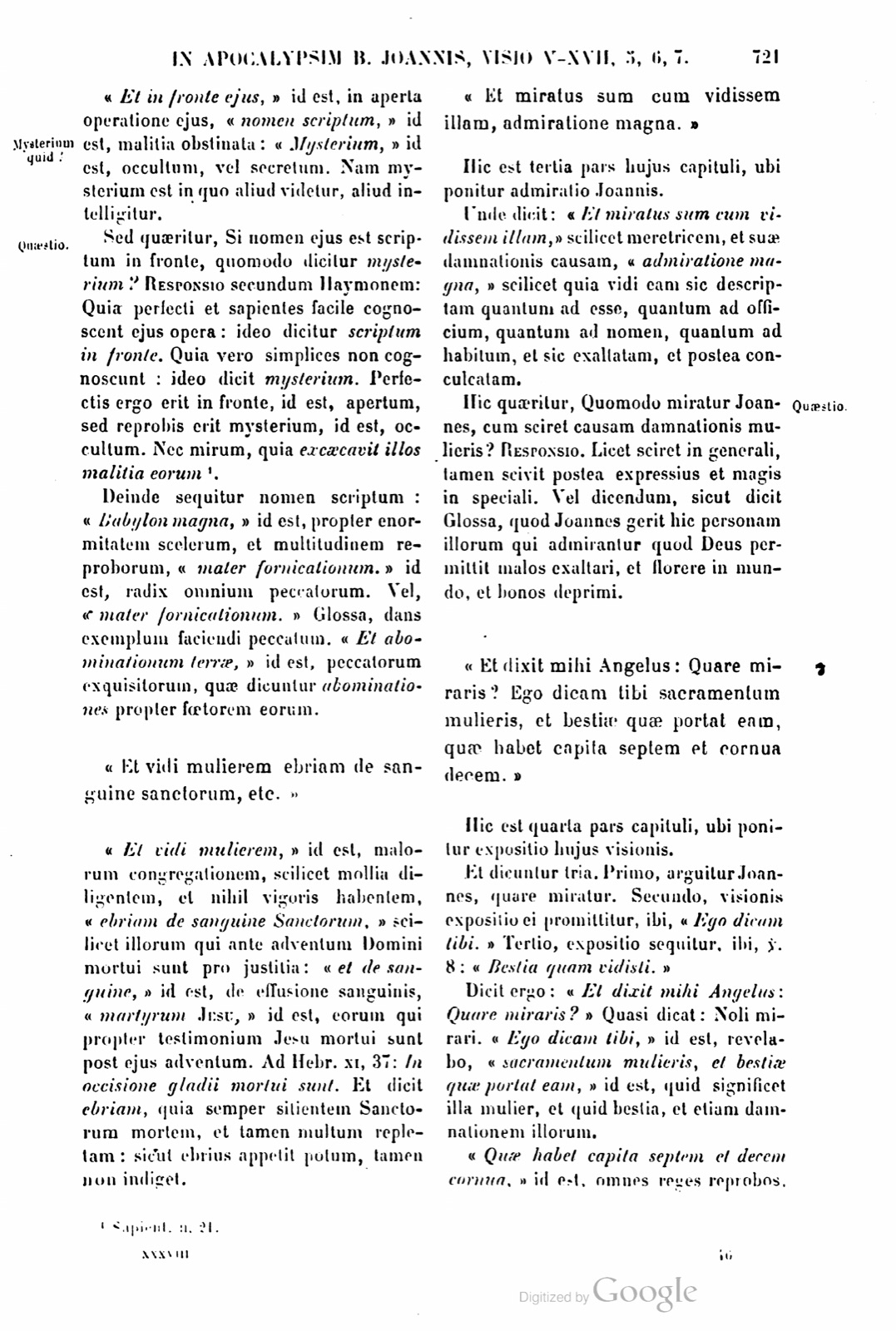
Aliter exponitur sic de diabolo: "Bestia," id est, diabolus qui homines bestiales facit, "quam vidisti," visione spirituali, "fuit," scilicet ante adventum Christi in magna potestate, "et non est," quia per adventum Christi diminuta est: "et ascensura est de abysso," scilicet de occulto et profundo malo in apertam saevitiam, scilicet tempore Antichristi, "et in interitum ibit," id est, in aeternam damnationem: "et mirabuntur," scilicet de subita dejectione tantae potestatis, "inhabitantes terram," scilicet per amorem, "quorum non sunt scripta nomina a constitutione mundi," id est, per aeternam praedestinationem: "videntes bestiam, quae erat," scilicet in magna potestate, "et non est," quia cito periit.
"Et hic est sensus, etc." Hic est visa poena illius bestiae, unde potest haberi sensus ut caveamus a tali dejectione. Poeta: Felix quem faciunt aliena pericula cautum. Qui autem sit sensus, ostendit dicens, supple, ei: "Qui habet sapientiam," id est, intelligentiam ut judicet de unaquaque re secundum valorem suum. Ei, inquam, est sensus ut sciat cavere ne cadat in similem damnationem. Sed aliqui sunt sicut porci, qui vident socios suos duci ad macellum de augea furfuris, et tamen iidem remanent adhuc. "Septem capita," scilicet bestiae, "septem montes sunt," id est, omnes superbi, qui montes dicuntur propter tumorem superbiae: "super quos mulier sedet," id est, quibus innititur et fulcitur malorum congregatio mollis et lasciva. "Et reges septem sunt." Et pro id est. Unde Beda: "Capita bestiae reges mundi sunt, et ob tumorem superbiae montibus adaequati. Isti dicuntur montes, et capita, et reges: capita, quia in subjectos influunt malitiam, tum per malum exemplum, tum per malam suggestionem: montes propter superbiam: reges, quia subditos in malo gubernant." De his, Osee, VIII, 4: Ipsi regnaverunt, et non ex me.
It is expounded in another way thus about the devil: "The beast," that is, the devil who makes men bestial, "which you saw," by spiritual vision, "was," namely before the coming of Christ in great power, "and is not," because through the coming of Christ it has been diminished; "and it is about to ascend from the abyss," namely from hidden and deep evil into open savagery, namely in the time of Antichrist; "and it will go into destruction," that is, into eternal damnation; "and they will marvel," namely at the sudden casting down of such great power, "those inhabiting the earth," namely through love, "whose names have not been written from the constitution of the world," that is, through eternal predestination; "seeing the beast which was," namely in great power, "and is not," because it quickly perished.
"And here is the sense, etc." Here the seen punishment of that beast is present, from which a sense can be had so that we may beware of such dejection. The Poet: Happy is he whom others' perils make cautious. But what the sense is, he shows by saying, supply, to him: "He who has wisdom," that is, understanding so that he may judge concerning each thing according to its own value. To him, I say, there is sense, so that he may know to beware lest he fall into a similar damnation. But some are like pigs, who see their companions led to the butcher-shop from a trough of bran, and yet they themselves still remain. "The seven heads," namely of the beast, "are seven mountains," that is, all the proud, who are called mountains because of the swelling of pride, "upon which the woman sits," that is, upon whom the soft and wanton congregation of the evil leans and is supported. "And they are seven kings." And it is for "are." Hence Bede says: "The heads of the beast are the kings of the world, and because of the swelling of pride are made equal to mountains. They are called mountains and heads and kings: heads, because they pour malice into their subjects, both through evil example and through evil suggestion; mountains because of pride; kings, because they govern subjects in evil." Concerning them Hosea 8:4 says: They have reigned, and not from me.
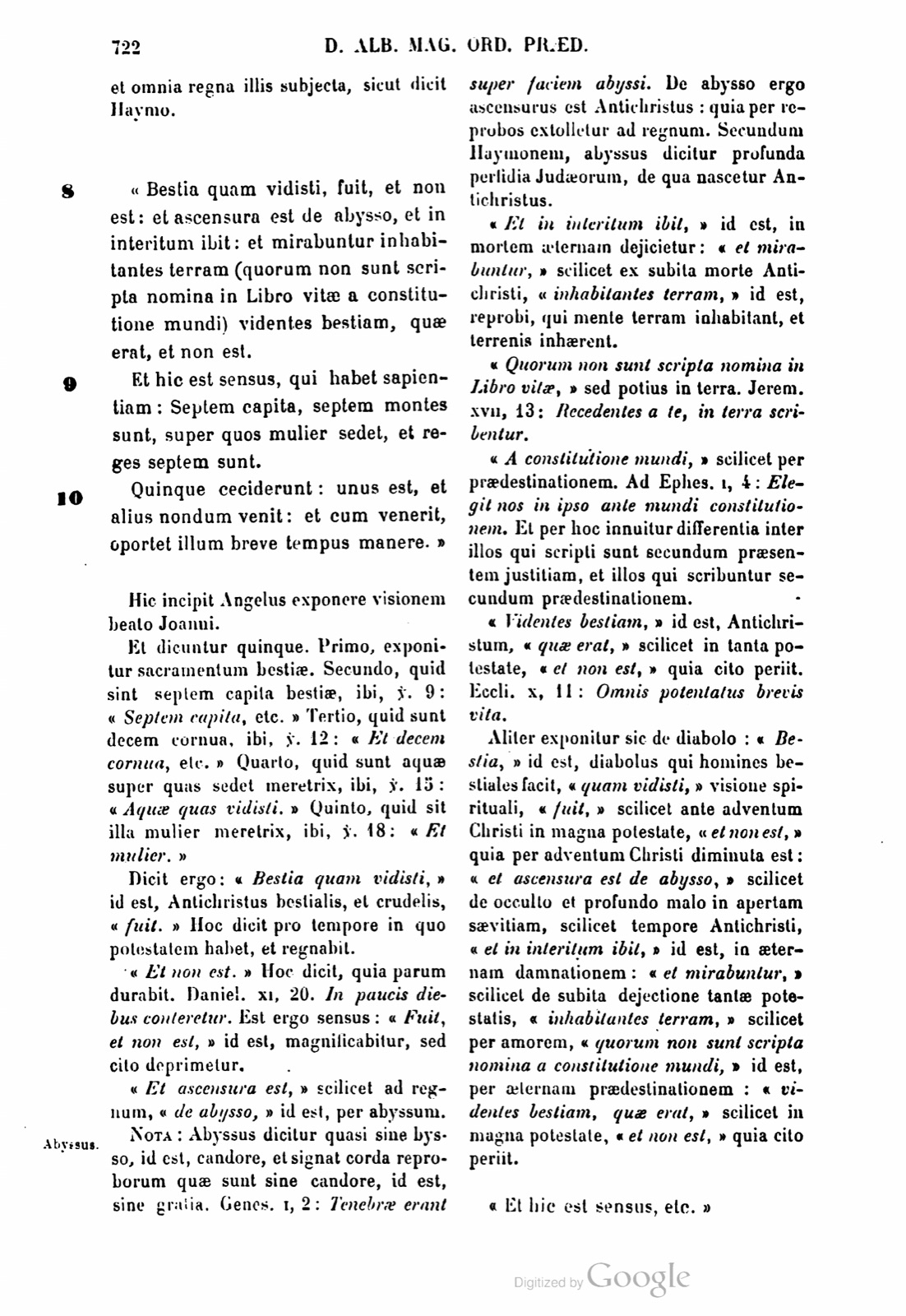
"Quinque ceciderunt, etc." [Marginal label: Reges septem valde mali.] NOTA: Aliter per septem reges intelliguntur septem aetates in quibus regnaverunt mali. Horum regum primus regnavit in tempore ante diluvium in quo omnis caro corrupit viam suam 4: et iste cecidit per diluvium. Secundus regnavit a Noe usque ad Abraham, quando aedificabatur turris Babel, id est, confusionis: et iste cecidit per confusionem linguarum, et dispersionem eorum qui turrim aedificaverunt 5. Tertius regnavit ab Abraham usque ad Moysen, in quo abundavit malitia super terram, et maxime peccatum contra naturam: et iste cecidit in subversione quinque civitatum, quae perierunt igne et sulphure 6. Quartus regnavit a Moyse usque ad transmigrationem Babylonis. In tempore autem illo maxime regnavit peccatum idololatriae, sicut patet in libris Prophetarum. Psal. LXXVII, 58: Et in sculptilibus suis ad aemulationem eum provocaverunt. Et iste cecidit in destructione regum Juda, de quo, Jerem. LII, 10: Omnes principes Juda occidit, scilicet rex Babylonis, in Reblatha, scilicet propter peccatum idololatriae. Quintus regnavit a transmigratione Babylonis usque ad Christum, in quo tempore fuit maxima persecutio legis Dei: et iste cecidit in casu Antiochi, de quo dicitur, II Machab. IX, 28: Igitur homicida et blasphemus, pessime percussus, et ut ipse alios tractaverat, peregre in montibus miserabili obitu vita functus est. Hi sunt quinque reges, id est, universitas malorum qui in illis quinque temporibus ceciderunt. Est ergo sensus: "Quinque ceciderunt," id est, quinque status vel aetates transierunt: "unus est," id est, status gratiae sub Christo, et durabit usque ad tempus Antichristi: "et alius nondum venit," id est, status in fine saeculi sub Antichristo. "Et cum venerit," scilicet Antichristus, et sui. "Venerit," inquam, et in magna potestate apparuerit, "oportet illum breve tempus manere," scilicet tribus annis et dimidio. Aliter exponitur secundum Glossam et Haymonem: "Quinque reges," quinque sensus corporis sunt, qui in Adam fuerunt corrupti. Sextus est Christus qui nunc regnat. Septimus, Antichristus qui nondum venit, sed in fine regnabit. Unde dicit: Et alius nondum est," scilicet Antichristus, "et cum venerit,"
"Five have fallen, etc." [Marginal label: The seven very evil kings.] NOTE: In another way, by the seven kings are understood the seven ages in which the evil have reigned. The first of these kings reigned in the time before the flood, in which all flesh corrupted its way 4, and this one fell through the flood. The second reigned from Noah to Abraham, when the tower of Babel, that is, of confusion, was being built; and this one fell through the confusion of tongues and the dispersion of those who built the tower 5. The third reigned from Abraham to Moses, in which malice abounded upon the earth, and especially the sin against nature; and this one fell in the overthrow of the five cities, which perished by fire and sulphur 6. The fourth reigned from Moses to the transmigration of Babylon. But in that time the sin of idolatry reigned most of all, as is clear in the books of the Prophets. Psalm 77:58: And in their graven images they provoked him to rivalry. And this one fell in the destruction of the kings of Judah, concerning which Jeremiah 52:10 says: He killed all the princes of Judah, namely the king of Babylon, in Reblatha, namely because of the sin of idolatry. The fifth reigned from the transmigration of Babylon to Christ, in which time there was the greatest persecution of the law of God; and this one fell in the fall of Antiochus, concerning whom it is said, 2 Maccabees 9:28: Therefore the murderer and blasphemer, very badly struck, and as he himself had handled others, died his life abroad in the mountains with a miserable death. These are the five kings, that is, the universality of the evil who fell in those five times. Therefore the sense is: "Five have fallen," that is, five states or ages have passed away; "one is," that is, the state of grace under Christ, and it will last until the time of Antichrist; "and another has not yet come," that is, the state at the end of the age under Antichrist. "And when he comes," namely Antichrist and his own. "Comes," I say, and appears in great power, "he must remain a short time," namely three and a half years. In another way it is expounded according to the Gloss and Haymo: "Five kings" are the five senses of the body, which were corrupted in Adam. The sixth is Christ, who now reigns. The seventh, Antichrist, who has not yet come, but will reign at the end. Hence he says: "And another is not yet," namely Antichrist, "and when he comes,"
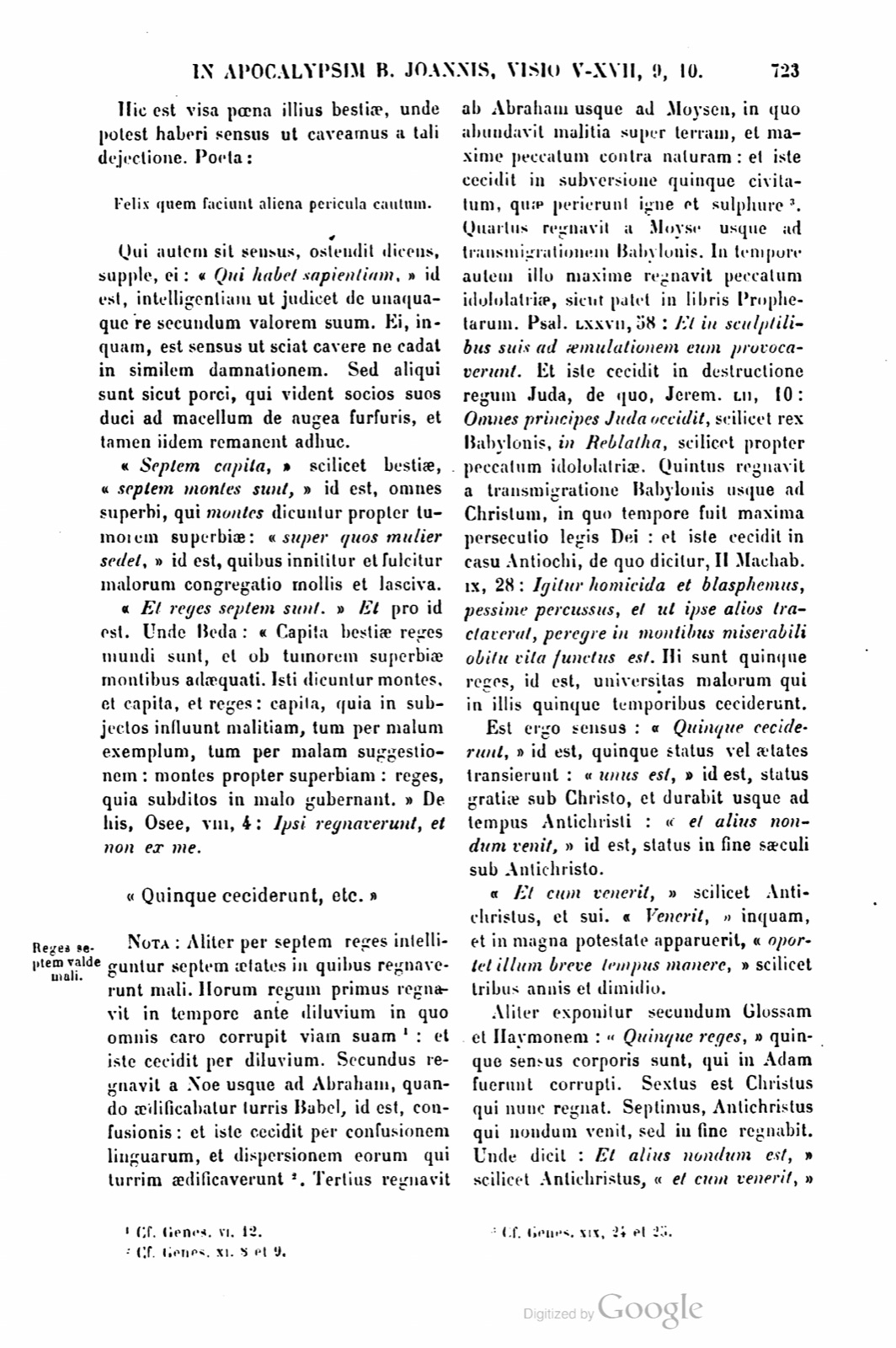
scilicet in sua potestate magna, "oportet illum breve tempus manere," ut prius. Matth. XXIV, 22: Nisi breviati fuissent dies illi, non fieret salva omnis caro.
11. "Et bestia, quae erat, et non est, et ipsa octava est, et de septem est, et in interitum vadit. 12. Et decem cornua quae vidisti, decem reges sunt, qui regnum nondum acceperunt: sed potestatem tamquam reges una hora accipient post bestiam. 13. Hi unum consilium habent, et virtutem et potestatem suam bestiae tradent. 14. Hi cum Agno pugnabunt, et Agnus vincet illos, quoniam Dominus dominorum est, et Rex regum: et qui cum illo sunt, vocati, electi et fideles."
Hic dicitur, quod Antichristus omnes in malitia superabit. Unde dicit: "Et bestia," id est, Antichristus bestialis, "quae erat." Hoc dicit pro tempore quo regnabit. "Et non est." Hoc dicitur pro tempore in quo destruetur, et quia ejus potestas cito finietur. "Et ipsa octava est," id est, super septem. Quasi diceret: Universitatem malorum transcendet in malitia. Job, XLI, 25: Ipse est rex super universos filios superbiae. "Et de septem est," id est, de universitate peccatorum, et propter similem naturam, et propter culpam, et poenam. "Et in interitum vadit," id est, in mortem aeternam. Matth. XXV, 41: Discedite a me, maledicti, in ignem aeternum, etc.
"Et decem cornua quae vidisti." [Marginal label: Romanum imperium tempore Antichristi dividetur.] Scilicet, in bestia, "decem reges sunt," quia regnum Romanum tempore Antichristi dividetur in decem regna, ut dicitur, Daniel. VII, 24: Porro decem cornua ipsius regni, decem reges erunt. Dicuntur autem cornua propter firmitatem, et irrationabilitatem. Item, quia adhaerebunt Antichristo, sicut cornua adhaerent capiti. Item, quia per eos pugnabit Antichristus contra Ecclesiam, sicut bestia pugnat cornibus suis. "Qui regnum nondum acceperunt," scilicet tempore Joannis. "Sed potestatem tamquam reges." Glossa: "Non vere reges, sed tyranni." "Una hora," scilicet tempore modico. Et hoc dicit ad consolationem fidelium, sicut dicit Haymo, scilicet tribus annis et dimidio: "accipient." Glossa, a capite suo, "post bestiam," id est, Antichristum, per imitationem: vel quia non habebunt tantam potestatem sicut ipse.
"Hi unum consilium habent," id est, unam occultam machinationem et voluntatem contra Christum, et pro Antichristo, "et virtutem," in se: "et potestatem suam," super alios, "bestiae tradent," id est, Antichristo, omnia ei attribuendo. Vel sic: "Hi unum consilium habent," quantum ad machinationem mali, "et virtutem," quantum ad simulationem boni, "et potestatem suam," quantum ad illationem mali, "bestiae tradent," id est, attribuent Antichristo.
"Hi cum Agno pugnabunt," id est, contra Agnum verbo, et opere. [Marginal label: Agnus vincet Antichristum.] "Et Agnus vincet illos," scilicet Antichristum et suos, refraenendo eorum audaciam et potentiam, ne tantum possint nocere, quantum vellent. Item, suis tribuendo patientiam. Vel, "Vincet illos," quando damnabit eos cum capite suo diabolo. Et dicit: "Agnus vincet illos," non leo, ut notetur modus vincendi, scilicet, per patientiam. "Quoniam Dominus dominorum est," ratione justorum, "et Rex regum," ratione misericordiae. "Et qui cum illo sunt," scilicet ei adhaerentes, "vocati," per praedicationem, vel inspirationem, "electi," per praedestinationem, "et fideles," per fidei confessionem et integritatem, vel per operationem, quia fides sine operibus mortua est 7: et, supple, vincent illos.
namely in his own great power, "he must remain a brief time," as before. Matthew 24:22: Unless those days had been shortened, no flesh would be saved.
11. "And the beast which was, and is not, even he is the eighth, and is of the seven, and goes into destruction. 12. And the ten horns which you saw are ten kings, who have not yet received a kingdom; but they will receive power as kings for one hour after the beast. 13. These have one counsel, and they will hand over their strength and their power to the beast. 14. These will fight with the Lamb, and the Lamb will conquer them, because he is Lord of lords and King of kings; and those who are with him are called, chosen, and faithful."
Here it is said that Antichrist will surpass all in malice. Hence he says: "And the beast," that is, the beastly Antichrist, "which was." He says this for the time in which he will reign. "And is not." This is said for the time in which he will be destroyed, and because his power will quickly come to an end. "And he is the eighth," that is, above the seven. As if he said: He will transcend the universality of the evil in malice. Job 41:25: He is king over all the children of pride. "And he is of the seven," that is, of the universality of sinners, both because of a similar nature, and because of guilt, and punishment. "And he goes into destruction," that is, into eternal death. Matthew 25:41: Depart from me, accursed ones, into eternal fire, etc.
"And the ten horns which you saw." [Marginal label: The Roman empire will be divided in the time of Antichrist.] Namely, in the beast, "are ten kings," because the Roman kingdom in the time of Antichrist will be divided into ten kingdoms, as is said, Daniel 7:24: The ten horns of that kingdom will be ten kings. They are called horns because of firmness and irrationality. Likewise, because they will adhere to Antichrist, as horns adhere to the head. Likewise, because through them Antichrist will fight against the Church, as a beast fights with its horns. "Who have not yet received a kingdom," namely in the time of John. "But power as kings." The Gloss: "Not truly kings, but tyrants." "One hour," namely for a brief time. And he says this for the consolation of the faithful, as Haymo says, namely for three years and a half: "they will receive." The Gloss says, from their head, "after the beast," that is, Antichrist, through imitation; or because they will not have as much power as he.
"These have one counsel," that is, one hidden contrivance and will against Christ and for Antichrist, "and strength," in themselves; "and their power," over others, "they will hand over to the beast," that is, to Antichrist, by attributing all things to him. Or thus: "These have one counsel," as to the contrivance of evil, "and strength," as to the simulation of good, "and their power," as to the bringing in of evil, "they will hand over to the beast," that is, they will attribute it to Antichrist.
"These will fight with the Lamb," that is, against the Lamb in word and deed. [Marginal label: The Lamb conquers Antichrist.] "And the Lamb will conquer them," namely Antichrist and his own, by restraining their boldness and power, lest they be able to harm as much as they wish. Likewise, by giving patience to his own. Or, "He will conquer them," when he will damn them with their head, the devil. And he says: "The Lamb will conquer them," not the lion, so that the manner of conquering may be marked, namely through patience. "Because he is Lord of lords," by reason of the just, "and King of kings," by reason of mercy. "And those who are with him," namely adhering to him, "called," through preaching or inspiration, "chosen," through predestination, "and faithful," through confession and integrity of faith, or through operation, because faith without works is dead 7; and, supply, they will conquer them.
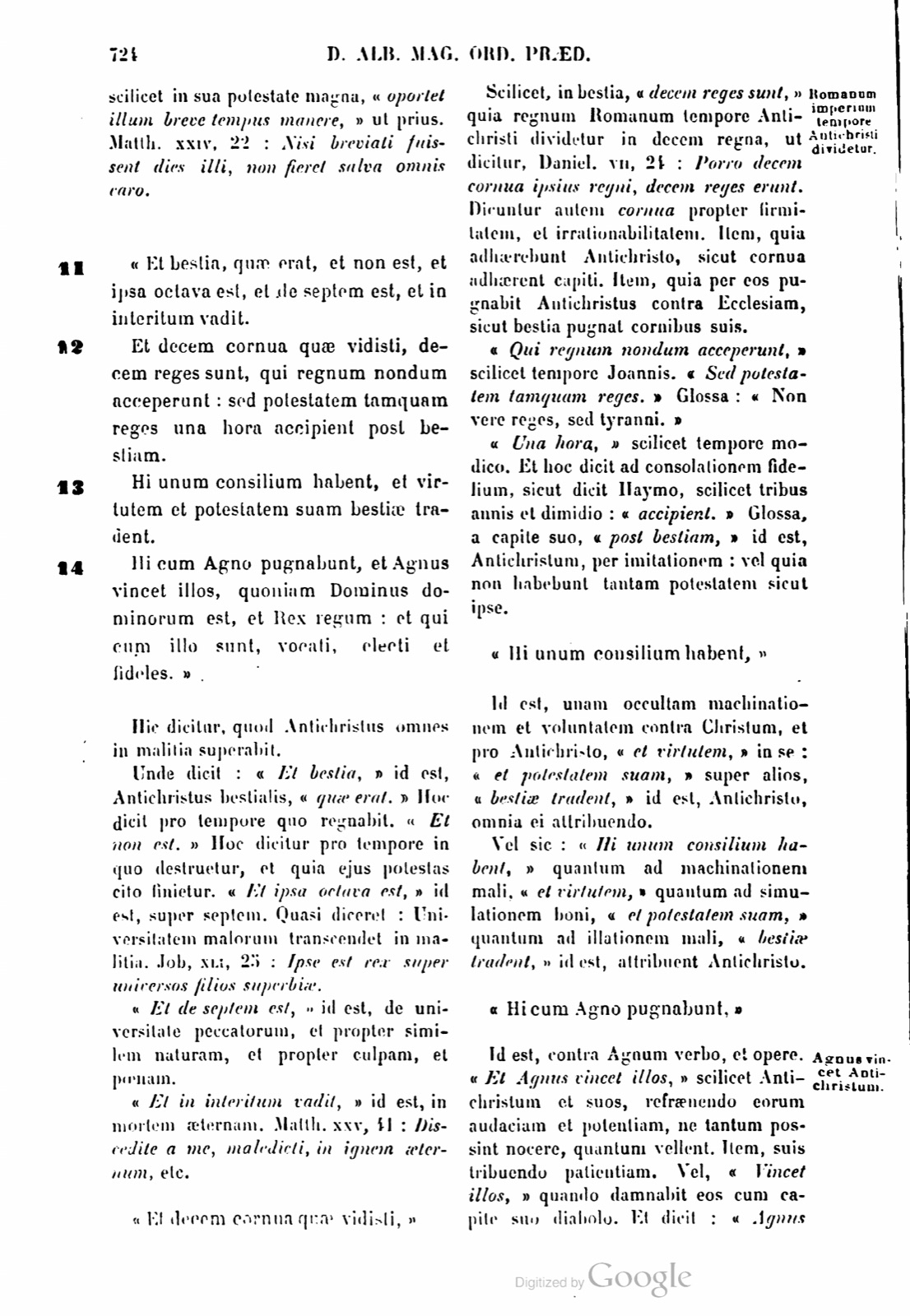
15. "Et dixit mihi: Aquae quas vidisti ubi meretrix sedet, populi sunt, et gentes, et linguae."
Haec est quarta pars, in qua ponitur significatio aquarum super quas meretrix visa est sedere. Et dicuntur hic duo. Primo, quid aquae illae significent. Secundo, ostenditur damnatio eorum qui ei adhaerent, ibi, v. 16: "Et decem cornua." Dicit ergo: "Et dixit mihi," scilicet Angelus: "Aquas 8 quas vidisti," id est, aquae. Ponitur casus pro casu, sicut ibi: Et sermonem quem audistis 9. "Ubi meretrix." Glossa, Antichristus, vel malorum congregatio, "sedet," id est, quiescit, id est, quietam vitam possidet, "populi sunt," quoad illos qui legem habuerunt. Vel, "Populi," quoad diversas civitates, "et gentes," quoad diversas nationes, "et linguae," quoad diversa idiomata. Vel, "Gentes," quoad illos qui sine lege scripta sunt, "et linguae," quoad utrosque. Quasi dicat: Ex omnium gentium diversitate mali subjecti Antichristo intelliguntur.
16. "Et decem cornua quae vidisti in bestia, hi odient fornicariam, et desolatam facient illam et nudam, et carnes ejus manducabunt, et ipsam igni concremabunt. 17. Deus enim dedit in corda eorum ut faciant quod placitum est illi, ut dent regnum suum bestiae, donec consummentur verba Dei. 18. Et mulier quam vidisti, est civitas magna, quae habet regnum super reges terrae."
[Marginal label: Damnatio eorum qui Antichristum sequentur.] Hic ostenditur damnatio eorum qui adhaerent Antichristo. Et dicuntur tria. Primo, eorum demeritum. Secundo, poena eorum, ibi, "Et carnes ejus manducabunt." Tertio, justum Dei judicium, ibi, v. 17: "Deus enim dedit, etc." Dicit ergo: "Et decem cornua," id est, universi reprobi qui impugnant Ecclesiam servantem legis decalogum, "quae vidisti in bestia," id est, qui adhaerent Antichristo, "hi odient fornicariam," id est, Antichristum, vel impiorum congregationem quae cum diabolo fornicata est. [Marginal label: Antichristus dicitur fornicarius.] Vel, "Fornicariam," id est, seipsos fornicantes, etsi non affectu, tamen effectu: quia facient mala opera propter quae punientur ac si se odirent. Psal. X, 6: Qui diligit iniquitatem, odit animam suam. "Et desolatam facient illam," id est, seipsos ducent in desperationem, cum Antichristum damnatum viderint, "et nudam," propter carentiam vestimenti, fidei. Vel, "Desolatam," propter privationem necessariae rei, "et nudam," propter privationem omnis honesti. Vel, "Desolatam," id est, sine consolatione prius habita in honoribus, "et nudam," propter privationem temporalium, quia sine divitiis temporalibus.
15. "And he said to me: The waters which you saw where the harlot sits are peoples and nations and tongues."
This is the fourth part, in which the meaning of the waters upon which the harlot was seen to sit is set down. And two things are said here. First, what those waters signify. Secondly, the damnation of those who adhere to her is shown, there at verse 16: "And the ten horns." Therefore he says: "And he said to me," namely the Angel: "The waters 8 which you saw," that is, waters. One case is put for another, as there: And the word which you heard 9. "Where the harlot." The Gloss says, Antichrist, or the congregation of the evil, "sits," that is, rests, that is, possesses a quiet life, "are peoples," as to those who had the law. Or, "peoples," as to diverse cities, "and nations," as to diverse nations, "and tongues," as to diverse idioms. Or, "nations," as to those who are without written law, "and tongues," as to both. As if he said: From the diversity of all nations are understood the evil subject to Antichrist.
16. "And the ten horns which you saw in the beast, these will hate the harlot, and will make her desolate and naked, and will eat her flesh, and will burn her with fire. 17. For God has put it into their hearts to do what is pleasing to him, that they give their kingdom to the beast, until the words of God are consummated. 18. And the woman whom you saw is the great city, which has a kingdom over the kings of the earth."
[Marginal label: The damnation of those who will follow Antichrist.] Here the damnation of those who adhere to Antichrist is shown. And three things are said. First, their demerit. Secondly, their punishment, there, "And they will eat her flesh." Thirdly, the just judgment of God, there at verse 17: "For God has put, etc." Therefore he says: "And the ten horns," that is, all the reprobate who attack the Church keeping the decalogue of the law, "which you saw in the beast," that is, who adhere to Antichrist, "these will hate the harlot," that is, Antichrist, or the congregation of the impious which has fornicated with the devil. [Marginal label: Antichrist is called a fornicator.] Or, "the harlot," that is, themselves fornicating, even if not in affection, nevertheless in effect, because they will do evil works for which they will be punished as if they hated themselves. Psalm 10:6: He who loves iniquity hates his own soul. "And they will make her desolate," that is, they will lead themselves into desperation when they have seen Antichrist damned, "and naked," because of the lack of clothing, namely faith. Or, "desolate," because of privation of a necessary thing, "and naked," because of privation of everything honorable. Or, "desolate," that is, without the consolation previously had in honors, "and naked," because of privation of temporal things, because without temporal riches.
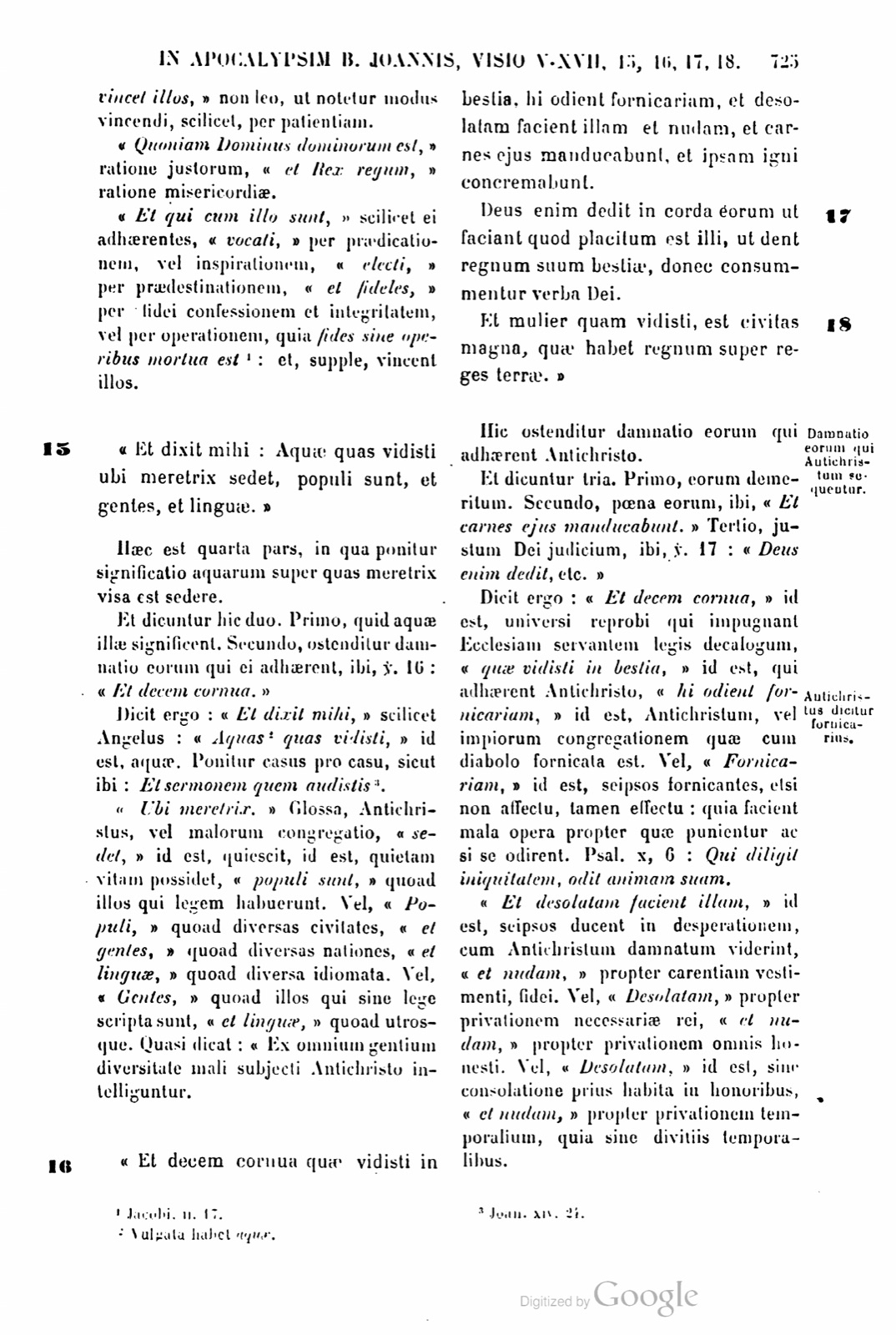
"Et carnes ejus," scilicet meretricis, "manducabunt," scilicet reprobi, hoc est, seipsos: quia poenam suarum carnium sustinebunt. Manducabunt carnem suam aeterno supplicio traditi: ex carnalibus enim delectationibus remorsum conscientiae patiuntur, et poenas inferni sustinebunt. "Et ipsam," id est, seipsos, "igni concremabunt," scilicet voluntarie se in ignem praecipitando, et suis peccatis ignem ascendendo. Isa. L, 13: Ambulate in lumine ignis vestri, et in flammis quas succendistis. "Deus enim dedit," id est, promisit, "in corda eorum," id est, in voluntates eorum, "ut faciant quod placitum est illi," scilicet mulieri meretrici, vel bestiae. Et sicut Haymo dicit, hic praecedentibus peccatis hominum, permittit Deus eos facere unde amplius offendant. Ad Roman. I, 28: Tradidit illos in reprobum sensum, ut faciant ea quae non conveniunt. "Ut dent regnum suum bestiae," id est, Antichristum concedant et consentiant regnare super se. Vel, "Bestiae," id est, diabolo, scilicet ut se a diabolo regi permittant. "Donec consummentur verba Dei," id est, donec impleantur opere, id est, quae dicta sunt ante de poena malorum, et gloria bonorum. Vel, "Verba Dei," dicit ordinationem Dei de impletione numeri electorum. Usque ad illud enim tempus permittentur mali regnare cum bonis, sicut palea cum grano: sed completo numero electorum, boni recondentur in horreum, et palea comburetur 10.
"Et mulier quam vidisti, est civitas magna," id est, signat congregationem omnium malorum: quae dicitur mulier propter mollitiem et foecunditatem in malo. "Civitas," quia multos comprehendit, "magna," propter superbiam, et enormitatem sceleris: "quae habet regnum," id est, potestatem, et dominium, "super reges terrae," quia omnes ei servient, vel fere omnes. Haymo: "Maxima malorum multitudo in regibus et hujus saeculi principibus in superbiam elevatur."
Hic sunt dubitabilia.
[Marginal label: Dub. 1.] Primo super illo verbo v. 4: "Habens poculum aureum in manu sua." CONTRA. Jerem. LI, 7: Calix aureus Babylon in manu Domini, inebrians omnem terram. Si ergo in manu Domini: non ergo in manu meretricis. RESPONSIO. Aliter est in manu Domini, aliter in manu meretricis. In manu Domini sunt temporalia: quia illa dat cui vult, et quando vult. In manu meretricis: quia laborat ut illa habeat totis viribus. Vel, in manu Domini sunt temporalia quantum ad usum: in manu meretricis quantum ad abusum.
"And her flesh," namely the flesh of the harlot, "they will eat," namely the reprobate; that is, themselves, because they will endure the punishment of their own flesh. They will eat their own flesh, handed over to eternal punishment; for from carnal delights they suffer the remorse of conscience and will endure the punishments of hell. "And her," that is, themselves, "they will burn with fire," namely by voluntarily casting themselves into fire, and by ascending into fire through their sins. Isaiah 50:13: Walk in the light of your fire, and in the flames which you have kindled. "For God has put," that is, has promised, "into their hearts," that is, into their wills, "that they do what is pleasing to him," namely to the harlot woman, or to the beast. And as Haymo says, here, with the sins of men going before, God permits them to do that by which they offend more. Romans 1:28: He handed them over to a reprobate sense, that they might do those things which are not fitting. "That they give their kingdom to the beast," that is, concede and consent that Antichrist reign over them. Or, "to the beast," that is, to the devil, namely that they permit themselves to be ruled by the devil. "Until the words of God are consummated," that is, until they are fulfilled in deed, that is, the things said before about the punishment of the evil and the glory of the good. Or, "the words of God" means the ordination of God concerning the fulfillment of the number of the elect. For until that time the evil will be permitted to reign with the good, as chaff with grain; but when the number of the elect has been completed, the good will be stored in the barn and the chaff will be burned 10.
"And the woman whom you saw is the great city," that is, she signifies the congregation of all the evil; she is called a woman because of softness and fecundity in evil. "City," because she includes many, "great," because of pride and the enormity of crime; "which has a kingdom," that is, power and dominion, "over the kings of the earth," because all will serve her, or almost all. Haymo says: "The greatest multitude of the evil is lifted up into pride among kings and princes of this age."
Here there are matters to be doubted.
[Marginal label: Dub. 1.] First, on that word of verse 4: "Having a golden cup in her hand." ON THE CONTRARY. Jeremiah 51:7: Babylon is a golden cup in the hand of the Lord, making all the earth drunk. If therefore it is in the hand of the Lord, then not in the hand of the harlot. RESPONSE. It is in the hand of the Lord in one way, in the hand of the harlot in another. Temporal things are in the hand of the Lord, because he gives them to whom he wills and when he wills. They are in the hand of the harlot, because she labors with all her powers to have them. Or, temporal things are in the hand of the Lord as to use; in the hand of the harlot as to abuse.
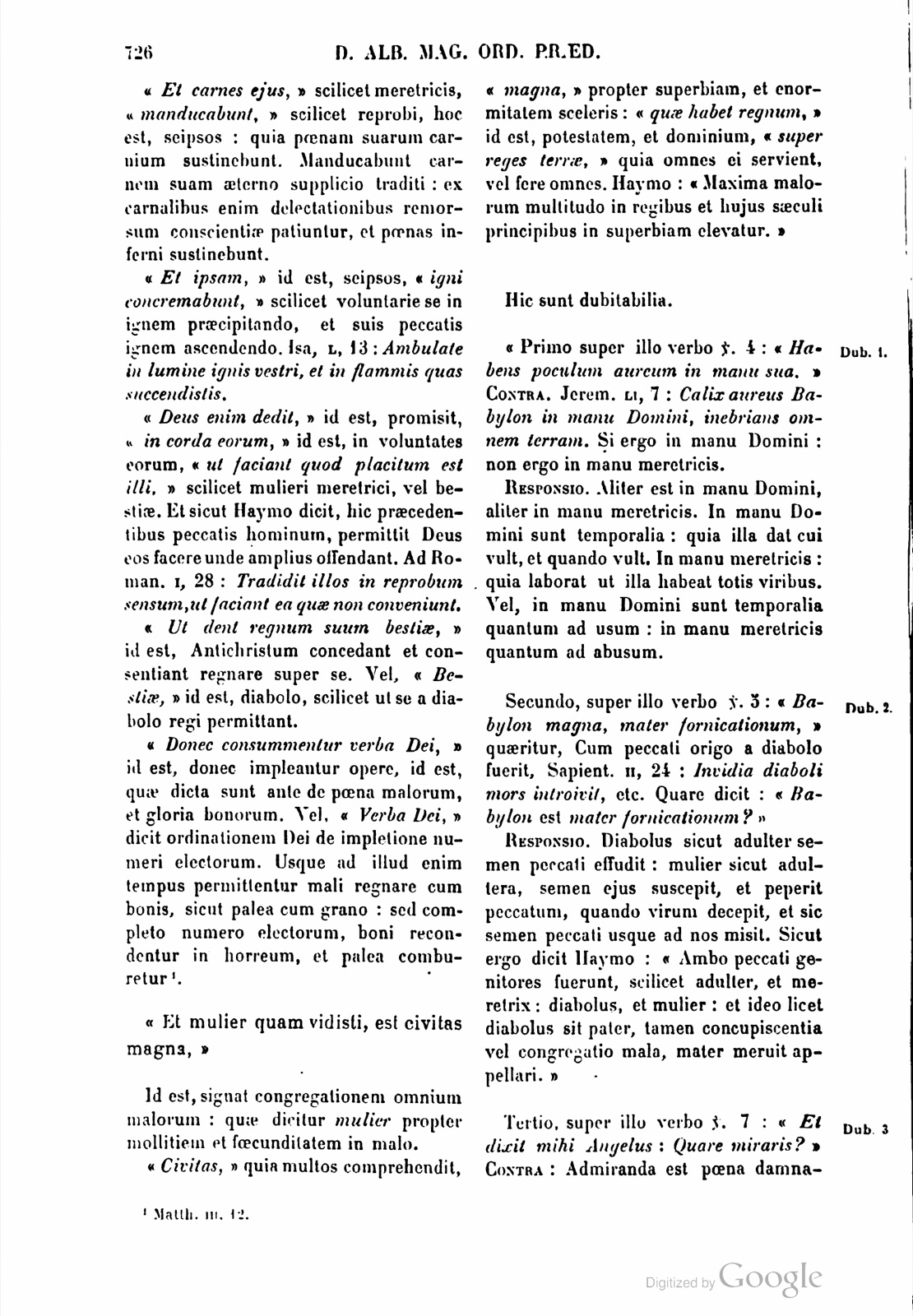
[Marginal label: Dub. 2.] Secundo, super illo verbo v. 5: "Babylon magna, mater fornicationum," quaeritur, Cum peccati origo a diabolo fuerit, Sapient. II, 24: Invidia diaboli mors introivit, etc. Quare dicit: "Babylon est mater fornicationum?" RESPONSIO. Diabolus sicut adulter semen peccati effudit: mulier sicut adultera, semen ejus suscepit, et peperit peccatum, quando virum decepit, et sic semen peccati usque ad nos misit. Sicut ergo dicit Haymo: "Ambo peccati genitores fuerunt, scilicet adulter, et meretrix: diabolus, et mulier: et ideo licet diabolus sit pater, tamen concupiscentia vel congregatio mala, mater meruit appellari."
[Marginal label: Dub. 3.] Tertio, super illo verbo v. 7: "Et dixit mihi Angelus: Quare miraris?" CONTRA: Admiranda est poena damnatorum, cum sit maxima: ergo male reprehendit eum de admiratione tantae poenae. RESPONSIO. Poena reproborum dupliciter potest considerari. Aut in quantum juste inflicta, et sic non est admiranda. Aut in quantum voluntarie merita, et sic admiranda. Casus enim in culpam voluntarius quo postea cadunt in poenam peccatores, admirandus est: et ideo, Thren. IV, 2. Filii Sion inclyti, et amicti auro primo, quomodo computati sunt in vasa testea? Admiratur hic casum in culpam.
[Marginal label: Dub. 4.] Quarto, super illo verbo v. 16: "Et decem cornua quae vidisti in bestia, hi odient fornicariam." CONTRA: Decem cornua sunt idem quod ipsa meretrix, id est, omne corpus malorum: ergo si decem cornua odiunt meretricem, odiunt seipsos. [Marginal label: Odium duplex.] RESPONSIO. Duplex est odium: affectus, et effectus: affectu non odiunt seipsos, sed effectu: nam ipsi faciunt opera propter quae punientur, ac si odio se haberent. Psal. X, 6. Qui diligit iniquitatem, odit animam suam. Vel sic: Haymo: "Odient fornicariam. Hoc dicitur quia mali se invicem odio habent, dum alius alium videt ascendere ad locum altiorem." Vel, dicendum secundum Haymonem, quod cum viderint se damnatos, odient seipsos, quia peccaverunt, et quod post peccatum poenitentiam non egerunt: quod intelligendum est, non quia odiant culpam per se, sed in comparatione ad poenam inflictam pro culpa.
[Marginal label: Dub. 5.] Quinto super illo verbo v. 17: "Ut faciant quod placitum est illi," id est, Deo, ut dicit Gilbertus qui fuit expositor Apocalypsis. CONTRA: Constat, quod est malum: ergo Deo non placet. RESPONSIO. Numquam placet Deo malum ut fiat, sed ut puniatur, cum factum est. Non placet Deo propter se, sed propter conveniens, id est, utilitatem bonorum quam elicit ex malitia eorum, id est malorum.
[Marginal label: Dub. 2.] Secondly, on that word of verse 5: "Babylon the great, mother of fornications," it is asked: Since the origin of sin was from the devil, Wisdom 2:24: By the envy of the devil death entered, etc., why does he say: "Babylon is the mother of fornications?" RESPONSE. The devil, like an adulterer, poured forth the seed of sin; the woman, like an adulteress, received his seed and bore sin when she deceived the man, and thus she sent the seed of sin all the way to us. Therefore, as Haymo says: "Both were begetters of sin, namely adulterer and harlot: the devil and the woman; and therefore, although the devil is the father, nevertheless concupiscence, or the evil congregation, deserved to be called mother."
[Marginal label: Dub. 3.] Thirdly, on that word of verse 7: "And the Angel said to me: Why do you marvel?" ON THE CONTRARY: The punishment of the damned, since it is greatest, is to be marveled at; therefore he wrongly rebukes him concerning admiration of so great a punishment. RESPONSE. The punishment of the reprobate can be considered in two ways. Either insofar as it is justly inflicted, and thus it is not to be marveled at. Or insofar as it is voluntarily merited, and thus it is to be marveled at. For the voluntary fall into guilt by which sinners later fall into punishment is to be marveled at; and therefore, Lamentations 4:2: The renowned sons of Zion, and clothed with first gold, how have they been counted as earthen vessels? He marvels here at the fall into guilt.
[Marginal label: Dub. 4.] Fourthly, on that word of verse 16: "And the ten horns which you saw in the beast, these will hate the harlot." ON THE CONTRARY: The ten horns are the same as the harlot herself, that is, the whole body of the evil; therefore if the ten horns hate the harlot, they hate themselves. [Marginal label: Hatred is twofold.] RESPONSE. Hatred is twofold: of affection and of effect. In affection they do not hate themselves, but in effect they do, for they do works for which they are punished, as if they had themselves in hatred. Psalm 10:6: He who loves iniquity hates his own soul. Or thus, Haymo says: "They will hate the harlot. This is said because the evil have hatred for one another, when one sees another ascend to a higher place." Or, it must be said according to Haymo that, when they have seen themselves damned, they will hate themselves because they sinned and because after sin they did not do penance; this must be understood not because they hate guilt in itself, but in comparison with the punishment inflicted for guilt.
[Marginal label: Dub. 5.] Fifthly, on that word of verse 17: "That they do what is pleasing to him," that is, to God, as Gilbert, who was an expositor of the Apocalypse, says. ON THE CONTRARY: It is certain that it is evil; therefore it is not pleasing to God. RESPONSE. It is never pleasing to God that evil be done, but that it be punished when it has been done. It is not pleasing to God for its own sake, but because of what is fitting, that is, the utility of the good which he draws out from their malice, that is, from the malice of the evil.
Notes
- 1 Timothy 6:15; below, 19:16. (I ad Timoth. VI, 15; Infra, XIX, 16.) ↩
- These words 'to me' are not in the text of the Vulgate, but are supplied. (Haec verba ad me non sunt in textu Vulgatae, sed subaudiuntur.) ↩
- Wisdom 2:21. (Sapient. II, 21.) ↩
- Compare Genesis 6:12. (Cf. Genes. VI, 12.) ↩
- Compare Genesis 11:8 and 9. (Cf. Genes. XI, 8 et 9.) ↩
- Compare Genesis 19:24 and 25. (Cf. Genes. XIX, 24 et 25.) ↩
- James 2:17. (Jacobi, II, 17.) ↩
- The Vulgate has 'waters.' (Vulgata habet aquae.) ↩
- John 12:21. (Joan. XII, 21.) ↩
- Matthew 3:12. (Matth. III, 12.) ↩
If a page does not appear, its photograph has not been uploaded yet.