Works › Commentary on the Apocalypse of Blessed John
Volume 38 · pp. 700–704
End of Chapter XV and Chapter XVI Lemma
A marker with ≈ is an approximate page boundary, placed by measure of the text; the page photographs remain the authority. In the paired views, clicking a page marker brings that page into view.
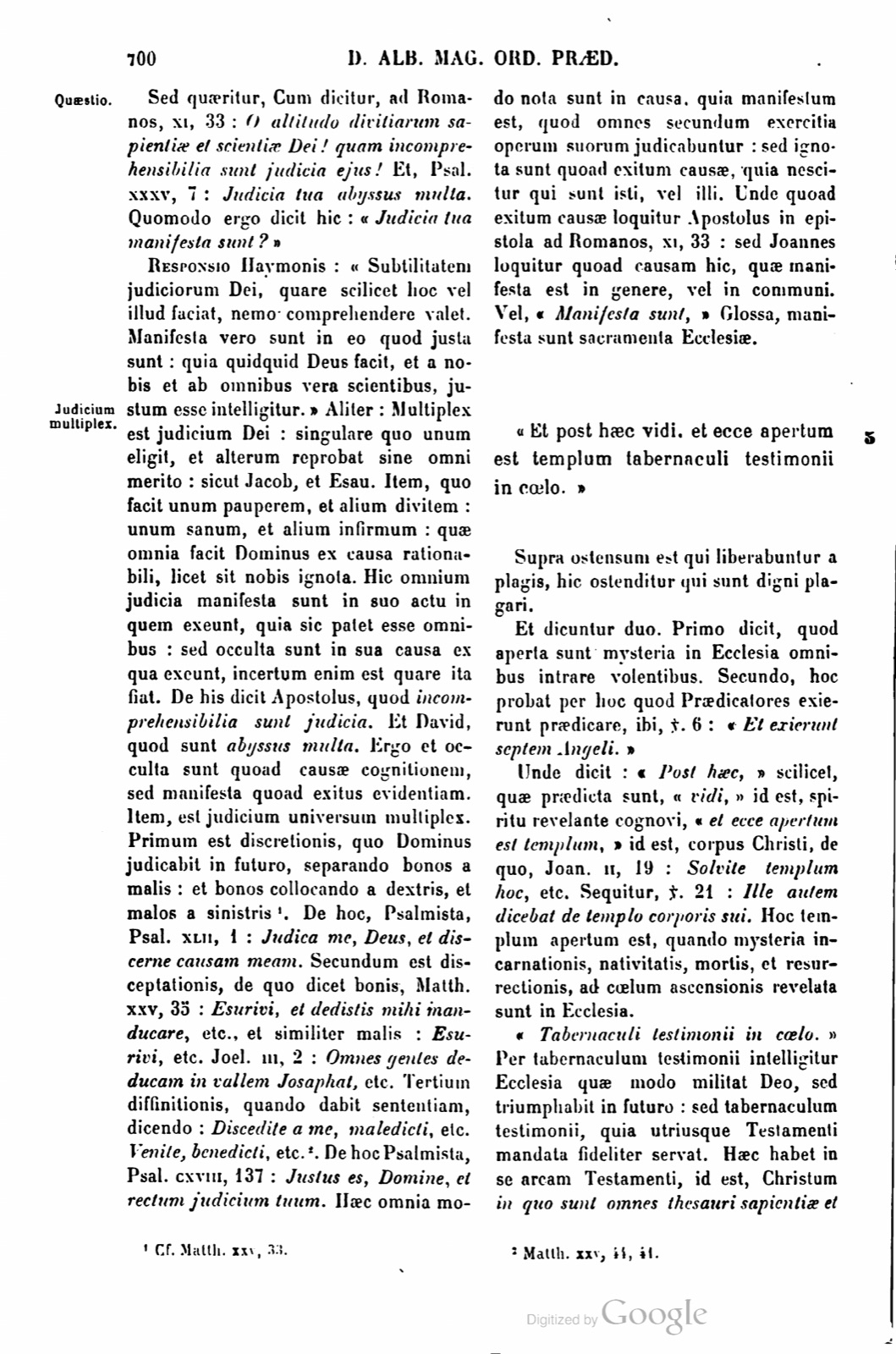
[Marginal label: Quaestio.] Sed quaeritur, Cum dicitur, ad Romanos, XI, 33: O altitudo divitiarum sapientiae et scientiae Dei! quam incomprehensibilia sunt judicia ejus! Et, Psal. XXXV, 7: Judicia tua abyssus multa. Quomodo ergo dicit hic: "Judicia tua manifesta sunt?" RESPONSIO Haymonis: "Subtilitatem judiciorum Dei, quare scilicet hoc vel illud faciat, nemo comprehendere valet. Manifesta vero sunt in eo quod justa sunt: quia quidquid Deus facit, et a nobis et ab omnibus vera scientibus, justum esse intelligitur." Aliter: [Marginal label: Judicium multiplex.] Multiplex est judicium Dei: singulare quo unum eligit, et alterum reprobat sine omni merito: sicut Jacob, et Esau. Item, quo facit unum pauperem, et alium divitem: unum sanum, et alium infirmum: quae omnia facit Dominus ex causa rationabili, licet sit nobis ignota. Hic omnium judicia manifesta sunt in suo actu in quem exeunt, quia sic patet esse omnibus: sed occulta sunt in sua causa ex qua exeunt, incertum enim est quare ita fiat. De his dicit Apostolus, quod incomprehensibilia sunt judicia. Et David, quod sunt abyssus multa. Ergo et occulta sunt quoad causae cognitionem, sed manifesta quoad exitus evidentiam. Item, est judicium universum multiplex. Primum est discretionis, quo Dominus judicabit in futuro, separando bonos a malis: et bonos collocando a dextris, et malos a sinistris 1. De hoc, Psalmista, Psal. XLII, 1: Judica me, Deus, et discerne causam meam. Secundum est disceptationis, de quo dicet bonis, Matth. XXV, 35: Esurivi, et dedistis mihi manducare, etc., et similiter malis: Esurivi, etc. Joel, III, 2: Omnes gentes deducam in vallem Josaphat, etc. Tertium diffinitionis, quando dabit sententiam, dicendo: Discedite a me, maledicti, etc. Venite, benedicti, etc. 2. De hoc Psalmista, Psal. CXVIII, 137: Justus es, Domine, et rectum judicium tuum. Haec omnia modo nota sunt in causa, quia manifestum est, quod omnes secundum exercitia operum suorum judicabuntur: sed ignota sunt quoad exitum causae, quia nescitur qui sunt isti, vel illi. Unde quoad exitum causae loquitur Apostolus in epistola ad Romanos, XI, 33: sed Joannes loquitur quoad causam hic, quae manifesta est in genere, vel in communi. Vel, "Manifesta sunt," Glossa, manifesta sunt sacramenta Ecclesiae.
5. "Et post haec vidi, et ecce apertum est templum tabernaculi testimonii in coelo."
Supra ostensum est qui liberabuntur a plagis, hic ostenditur qui sunt digni plagari. Et dicuntur duo. Primo dicit, quod aperta sunt mysteria in Ecclesia omnibus intrare volentibus. Secundo, hoc probat per hoc quod Praedicatores exierunt praedicare, ibi, v. 6: "Et exierunt septem Angeli." Unde dicit: "Post haec," scilicet, quae praedicta sunt, "vidi," id est, spiritu revelante cognovi, "et ecce apertum est templum," id est, corpus Christi, de quo, Joan. II, 19: Solvite templum hoc, etc. Sequitur, v. 21: Ille autem dicebat de templo corporis sui. Hoc templum apertum est, quando mysteria incarnationis, nativitatis, mortis, et resurrectionis, ad coelum ascensionis revelata sunt in Ecclesia. "Tabernaculi testimonii in coelo." Per tabernaculum testimonii intelligitur Ecclesia quae modo militat Deo, sed triumphabit in futuro: sed tabernaculum testimonii, quia utriusque Testamenti mandata fideliter servat. Haec habet in se arcam Testamenti, id est, Christum in quo sunt omnes thesauri sapientiae et scientiae absconditi 3: et urnam, id est, corpus Christi in quo est panis vivus qui de coelo descendit 4: et virgam Aaron, in signum potestatis faciendi miracula et sacerdotii spiritualis: quae in coelo dicitur esse ratione conversationis. Ad Philip. III, 21: Nostra conversatio in coelis est. Est ergo sensus: "Et post haec vidi," visione spirituali, "et ecce apertum est templum," id est, sacramenta Christi revelata sunt: "templum" dico "tabernaculi testimonii," id est, Ecclesiae militantis, quae continet testimonia utriusque Testamenti, "in coelo," quia conversatione est coelestis.
[Marginal label: Question.] But it is asked: Since it is said, Romans 11:33: O the depth of the riches of the wisdom and knowledge of God! how incomprehensible are his judgments! And Psalm 35:7: Your judgments are a great abyss. How then does he say here: "Your judgments are manifest"? RESPONSE of Haymo: "No one is able to comprehend the subtlety of God's judgments, namely why he does this or that. But they are manifest in this, that they are just; because whatever God does is understood to be just both by us and by all who know true things." In another way: [Marginal label: Judgment is manifold.] The judgment of God is manifold: singular, by which he chooses one and reprobates another without any merit, as Jacob and Esau. Likewise, by which he makes one poor and another rich, one healthy and another sick. All these things the Lord does from a rational cause, although it is unknown to us. Here the judgments of all are manifest in their act into which they come forth, because thus it is clear to all; but they are hidden in their cause from which they come forth, for it is uncertain why it happens so. About these the Apostle says that the judgments are incomprehensible, and David says that they are a great abyss. Therefore they are both hidden as to knowledge of the cause, but manifest as to evidence of the outcome. Likewise, universal judgment is manifold. The first is of discretion, by which the Lord will judge in the future by separating the good from the evil, placing the good on the right and the evil on the left 1. Concerning this, the Psalmist says, Psalm 42:1: Judge me, O God, and distinguish my cause. The second is of disputation, concerning which he will say to the good, Matthew 25:35: I was hungry and you gave me to eat, etc., and similarly to the evil: I was hungry, etc. Joel 3:2: I will lead all nations into the valley of Josaphat, etc. The third is of definition, when he will give sentence, saying: Depart from me, accursed ones, etc.; Come, blessed ones, etc. 2. Concerning this the Psalmist says, Psalm 118:137: You are just, Lord, and your judgment is right. All these things are now known in their cause, because it is manifest that all will be judged according to the exercises of their works; but they are unknown as to the outcome of the cause, because it is not known who these or those are. Hence the Apostle in the epistle to the Romans 11:33 speaks as to the outcome of the cause, but John speaks here as to the cause, which is manifest in kind or in common. Or, "They are manifest," the Gloss says, means the sacraments of the Church are manifest.
5. "And after these things I saw, and behold the temple of the tabernacle of testimony was opened in heaven."
Above it has been shown who will be freed from the plagues; here it is shown who are worthy to be plagued. And two things are said. First he says that the mysteries have been opened in the Church to all who wish to enter. Secondly, he proves this by the fact that the Preachers went out to preach, there at verse 6: "And seven Angels went out." Hence he says: "After these things," namely the things said before, "I saw," that is, I knew by the Spirit revealing, "and behold the temple was opened," that is, the body of Christ, concerning which John 2:19 says: Destroy this temple, etc. There follows, verse 21: But he was speaking of the temple of his body. This temple was opened when the mysteries of the incarnation, birth, death, resurrection, and ascension into heaven were revealed in the Church. "Of the tabernacle of testimony in heaven." By the tabernacle of testimony is understood the Church which now serves God as a soldier, but will triumph in the future; and it is the tabernacle of testimony because it faithfully keeps the commandments of both Testaments. It has in itself the ark of the Testament, that is, Christ, in whom all the treasures of wisdom and knowledge are hidden 3; and the urn, that is, the body of Christ in which there is the living bread that came down from heaven 4; and the rod of Aaron, as a sign of the power of doing miracles and of spiritual priesthood. This is said to be in heaven by reason of its manner of life. Philippians 3:21: Our conversation is in heaven. Therefore the sense is: "And after these things I saw," in spiritual vision, "and behold the temple was opened," that is, the sacraments of Christ were revealed. I call it the "temple of the tabernacle of testimony," that is, of the militant Church, which contains the testimonies of both Testaments, "in heaven," because it is heavenly in its manner of life.
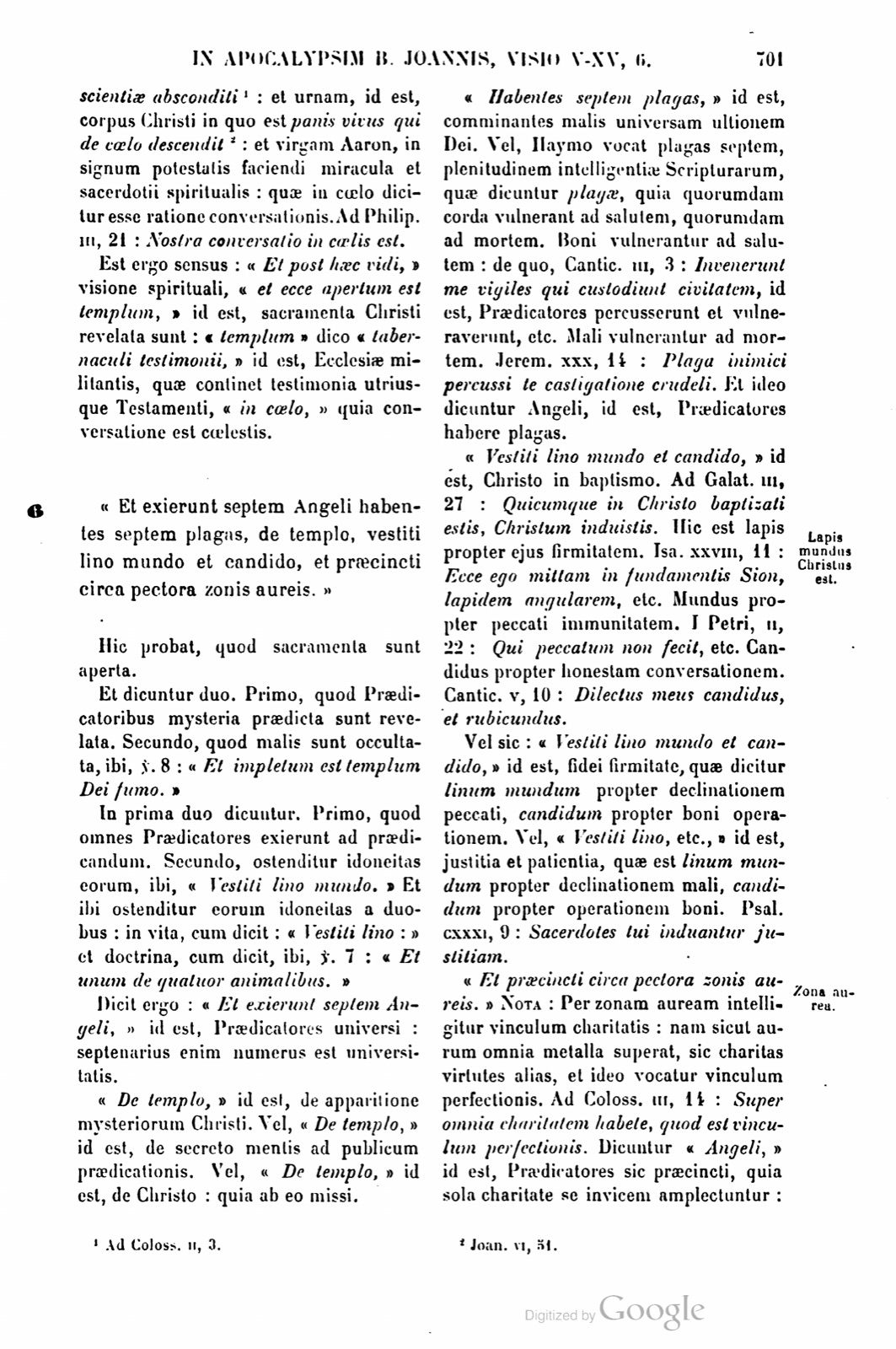
6. "Et exierunt septem Angeli habentes septem plagas, de templo, vestiti lino mundo et candido, et praecincti circa pectora zonis aureis."
Hic probat, quod sacramenta sunt aperta. Et dicuntur duo. Primo, quod Praedicatoribus mysteria praedicta sunt revelata. Secundo, quod malis sunt occultata, ibi, v. 8: "Et impletum est templum Dei fumo." In prima duo dicuntur. Primo, quod omnes Praedicatores exierunt ad praedicandum. Secundo, ostenditur idoneitas eorum, ibi, "Vestiti lino mundo." Et ibi ostenditur eorum idoneitas a duobus: in vita, cum dicit: "Vestiti lino:" et doctrina, cum dicit, ibi, v. 7: "Et unum de quatuor animalibus." Dicit ergo: "Et exierunt septem Angeli," id est, Praedicatores universi: septenarius enim numerus est universitatis. "De templo," id est, de apparitione mysteriorum Christi. Vel, "De templo," id est, de secreto mentis ad publicum praedicationis. Vel, "De templo," id est, de Christo: quia ab eo missi. "Habentes septem plagas," id est, comminantes malis universam ultionem Dei. Vel, Haymo vocat plagas septem, plenitudinem intelligentiae Scripturarum, quae dicuntur plagae, quia quorumdam corda vulnerant ad salutem, quorumdam ad mortem. Boni vulnerantur ad salutem: de quo, Cantic. I, 3: Invenerunt me vigiles qui custodiunt civitatem, id est, Praedicatores percusserunt et vulneraverunt, etc. Mali vulnerantur ad mortem. Jerem. XXX, 14: Plaga inimici percussi te castigatione crudeli. Et ideo dicuntur Angeli, id est, Praedicatores habere plagas. "Vestiti lino mundo et candido," id est, Christo in baptismo. Ad Galat. III, 27: Quicumque in Christo baptizati estis, Christum induistis. [Marginal label: Lapis mundus est.] Hic est lapis propter ejus firmitatem. Isa. XXVIII, 11: Ecce ego mittam in fundamentis Sion, lapidem angularem, etc. Mundus propter peccati immunitatem. I Petri, II, 22: Qui peccatum non fecit, etc. Candidus propter honestam conversationem. Cantic. V, 10: Dilectus meus candidus, et rubicundus. Vel sic: "Vestiti lino mundo et candido," id est, fidei firmitate, quae dicitur linum mundum propter declinationem peccati, candidum propter boni operationem. Vel, "Vestiti lino, etc.," id est, justitia et patientia, quae est linum mundum propter declinationem mali, candidum propter operationem boni. Psal. CXXXI, 9: Sacerdotes tui induantur justitiam. [Marginal label: Zona aurea.] "Et praecincti circa pectora zonis aureis." NOTA: Per zonam auream intelligitur vinculum charitatis: nam sicut aurum omnia metalla superat, sic charitas virtutes alias, et ideo vocatur vinculum perfectionis. Ad Coloss. III, 14: Super omnia charitatem habete, quod est vinculum perfectionis. Dicuntur "Angeli," id est, Praedicatores sic praecincti, quia sola charitate se invicem amplectuntur: et quia carnales cogitationes et immundae ab eis refraenantur. Ergo sensus est: "Et praecincti zonis aureis circa pectora," id est, charitate per quam simul connectuntur, et cogitationes immundae restringuntur. Et dicuntur praecincti, in signum quod praedicatores et Praelati debent esse ministri Dei. Nam accingimur pugnaturi, succingimur ituri, praecingimur ministraturi. Unde, Luc. XII, 35: Sint lumbi vestri praecincti, etc. Et in hoc quod dicit: "Praecincti circa pectora," notatur, quod non solum debent restringere lumbos suae carnis, sed etiam cogitationis.
6. "And the seven Angels went out, having the seven plagues, from the temple, clothed in clean and white linen and girded around their breasts with golden girdles."
Here he proves that the sacraments are open. And two things are said. First, that the aforesaid mysteries have been revealed to the Preachers. Secondly, that they have been hidden from the evil, there at verse 8: "And the temple of God was filled with smoke." In the first two things are said. First, that all Preachers went out to preach. Secondly, their fitness is shown, there, "Clothed in clean linen." And there their fitness is shown from two things: in life, when he says, "Clothed in linen," and in doctrine, when he says, there at verse 7, "And one of the four living creatures." Therefore he says: "And seven Angels went out," that is, all Preachers; for the number seven is the number of universality. "From the temple," that is, from the appearing of the mysteries of Christ. Or, "From the temple," that is, from the secret of the mind to the public work of preaching. Or, "From the temple," that is, from Christ, because they were sent by him. "Having seven plagues," that is, threatening the evil with the whole vengeance of God. Or Haymo calls the seven plagues the fullness of understanding of the Scriptures, which are called plagues because they wound the hearts of some to salvation and of others to death. The good are wounded to salvation; concerning this, Song of Songs 1:3: The watchmen who guard the city found me, that is, the Preachers struck and wounded, etc. The evil are wounded to death. Jeremiah 30:14: I struck you with the plague of an enemy, with cruel chastisement. And therefore Angels, that is, Preachers, are said to have plagues. "Clothed in clean and white linen," that is, in Christ in baptism. Galatians 3:27: As many of you as have been baptized in Christ have put on Christ. [Marginal label: He is a clean stone.] He is a stone because of his firmness. Isaiah 28:11: Behold, I will send in the foundations of Sion a cornerstone, etc. Clean because of immunity from sin. 1 Peter 2:22: Who did no sin, etc. White because of honorable conduct. Song of Songs 5:10: My beloved is white and ruddy. Or thus: "Clothed in clean and white linen," that is, in the firmness of faith, which is called clean linen because of the declining of sin, white because of the operation of good. Or, "Clothed in linen, etc.," that is, with justice and patience, which is clean linen because of the declining of evil, white because of the operation of good. Psalm 131:9: Let your priests be clothed with justice. [Marginal label: Golden girdle.] "And girded around the breasts with golden girdles." NOTE: By the golden girdle is understood the bond of charity, for as gold surpasses all metals, so charity surpasses the other virtues, and therefore it is called the bond of perfection. Colossians 3:14: Above all things have charity, which is the bond of perfection. The "Angels," that is, the Preachers, are said to be thus girded because by charity alone they embrace one another, and because carnal and unclean thoughts are restrained by them. Therefore the sense is: "And girded with golden girdles around the breasts," that is, with charity by which they are joined together, and unclean thoughts are restrained. And they are called girded as a sign that preachers and prelates ought to be ministers of God. For we gird ourselves when about to fight, we belt ourselves when about to go, we gird ourselves before when about to minister. Hence Luke 12:35: Let your loins be girded, etc. And in this, that he says "girded around the breasts," it is marked that they ought to restrain not only the loins of their flesh, but also of thought.
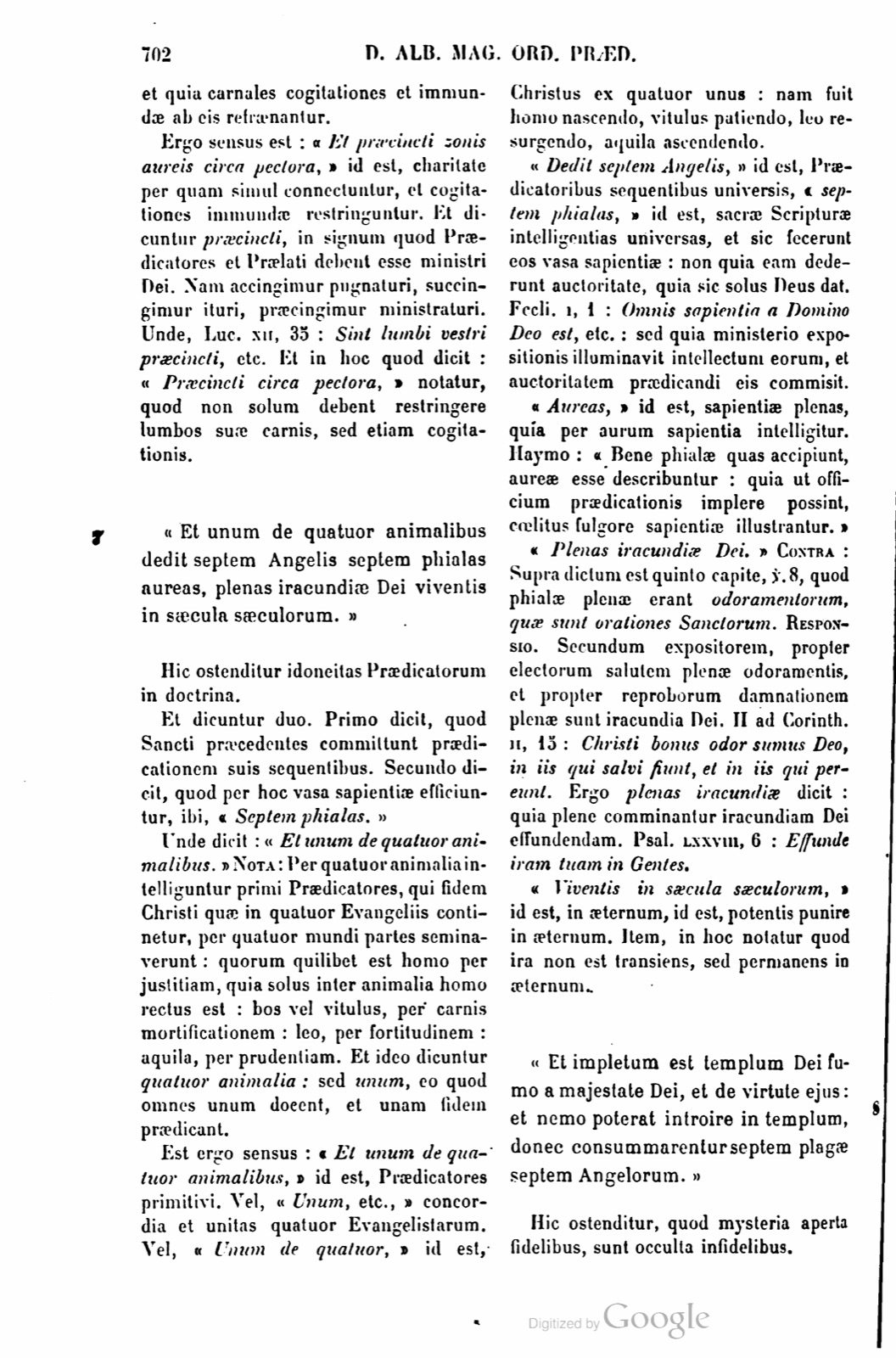
7. "Et unum de quatuor animalibus dedit septem Angelis septem phialas aureas, plenas iracundiae Dei viventis in saecula saeculorum."
Hic ostenditur idoneitas Praedicatorum in doctrina. Et dicuntur duo. Primo dicit, quod Sancti praecedentes committunt praedicationem suis sequentibus. Secundo dicit, quod per hoc vasa sapientiae efficiuntur, ibi, "Septem phialas." Unde dicit: "Et unum de quatuor animalibus." NOTA: Per quatuor animalia intelliguntur primi Praedicatores, qui fidem Christi quae in quatuor Evangeliis continetur, per quatuor mundi partes seminaverunt: quorum quilibet est homo per justitiam, quia solus inter animalia homo rectus est: bos vel vitulus, per carnis mortificationem: leo, per fortitudinem: aquila, per prudentiam. Et ideo dicuntur quatuor animalia: sed unum, eo quod omnes unum docent, et unam fidem praedicant. Est ergo sensus: "Et unum de quatuor animalibus," id est, Praedicatores primitivi. Vel, "Unum, etc.," concordia et unitas quatuor Evangelistarum. Vel, "Unum de quatuor," id est, Christus ex quatuor unus: nam fuit homo nascendo, vitulus patiendo, leo resurgendo, aquila ascendendo. "Dedit septem Angelis," id est, Praedicatoribus sequentibus universis, "septem phialas," id est, sacrae Scripturae intelligentias universas, et sic fecerunt eos vasa sapientiae: non quia eam dederunt auctoritate, quia sic solus Deus dat. Eccli. I, 1: Omnis sapientia a Domino Deo est, etc.: sed quia ministerio expositionis illuminavit intellectum eorum, et auctoritatem praedicandi eis commisit. "Aureas," id est, sapientiae plenas, quia per aurum sapientia intelligitur. Haymo: "Bene phialae quas accipiunt, aureae esse describuntur: quia ut officium praedicationis implere possint, coelitus fulgore sapientiae illustrantur." "Plenas iracundiae Dei." CONTRA: Supra dictum est quinto capite, v. 8, quod phialae plenae erant odoramentorum, quae sunt orationes Sanctorum. RESPONSIO. Secundum expositorem, propter electorum salutem plenae odoramentis, et propter reproborum damnationem plenae sunt iracundia Dei. II ad Corinth. II, 15: Christi bonus odor sumus Deo, in iis qui salvi fiunt, et in iis qui pereunt. Ergo plenas iracundiae dicit: quia plene comminantur iracundiam Dei effundendam. Psal. LXXVIII, 6: Effunde iram tuam in Gentes. "Viventis in saecula saeculorum," id est, in aeternum, id est, potentis punire in aeternum. Item, in hoc notatur quod ira non est transiens, sed permanens in aeternum.
8. "Et impletum est templum Dei fumo a majestate Dei, et de virtute ejus: et nemo poterat introire in templum, donec consummarentur septem plagae septem Angelorum."
7. "And one of the four living creatures gave to the seven Angels seven golden bowls, full of the wrath of God who lives forever and ever."
Here the fitness of the Preachers in doctrine is shown. And two things are said. First he says that the preceding Saints commit preaching to those following them. Secondly he says that through this they are made vessels of wisdom, there, "seven bowls." Hence he says: "And one of the four living creatures." NOTE: By the four living creatures are understood the first Preachers, who sowed the faith of Christ, which is contained in the four Gospels, through the four parts of the world. Each of them is a man through justice, because among animals only man is upright; an ox or calf through mortification of the flesh; a lion through fortitude; an eagle through prudence. And therefore they are called four living creatures, but one because all teach one thing and preach one faith. Therefore the sense is: "And one of the four living creatures," that is, the primitive Preachers. Or, "One, etc.," means the concord and unity of the four Evangelists. Or, "One of the four," that is, Christ, one from the four; for he was man by being born, calf by suffering, lion by rising, eagle by ascending. "Gave to the seven Angels," that is, to all the following Preachers, "seven bowls," that is, all the understandings of Sacred Scripture, and thus they made them vessels of wisdom; not because they gave it by authority, because thus God alone gives. Ecclesiasticus 1:1: All wisdom is from the Lord God, etc.; but because by the ministry of exposition he enlightened their understanding and committed to them the authority of preaching. "Golden," that is, full of wisdom, because wisdom is understood by gold. Haymo: "The bowls which they receive are well described as golden, because in order that they may be able to fulfill the office of preaching, they are illuminated from heaven with the splendor of wisdom." "Full of the wrath of God." ON THE CONTRARY: Above in the fifth chapter, verse 8, it was said that the bowls were full of fragrances, which are the prayers of the Saints. RESPONSE. According to the expositor, for the salvation of the elect they are full of fragrances, and for the damnation of the reprobate they are full of the wrath of God. 2 Corinthians 2:15: We are the good odor of Christ to God, in those who are saved and in those who perish. Therefore he says they are full of wrath because they fully threaten the wrath of God to be poured out. Psalm 78:6: Pour out your wrath upon the nations. "Of him who lives forever and ever," that is, eternally, that is, of him who is able to punish eternally. Likewise, in this it is marked that wrath is not passing, but remaining eternally.
8. "And the temple of God was filled with smoke from the majesty of God and from his power; and no one was able to enter into the temple until the seven plagues of the seven Angels were consummated."
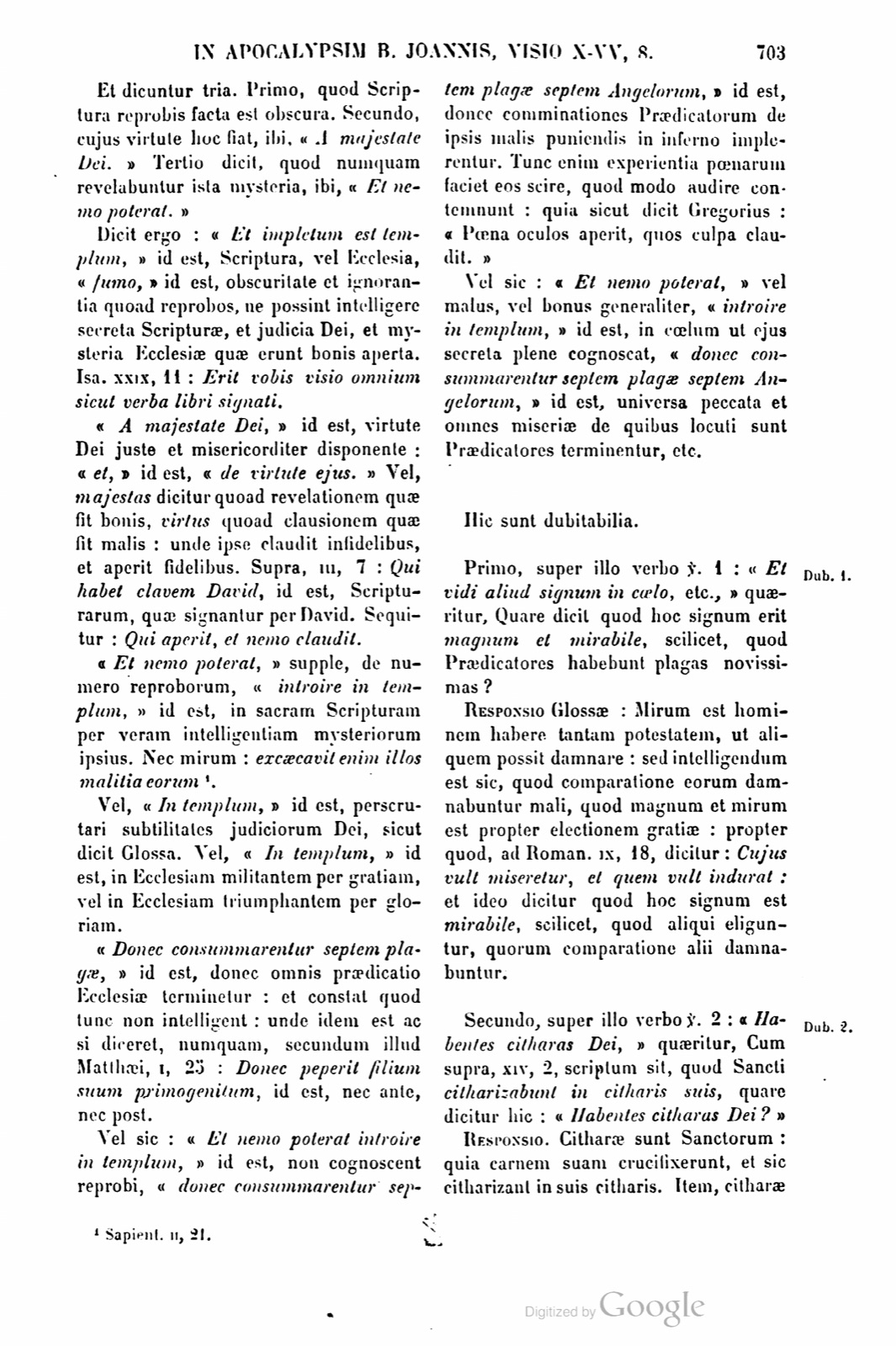
Hic ostenditur, quod mysteria aperta sunt occulta infidelibus. Et dicuntur tria. Primo, quod Scriptura reprobis facta est obscura. Secundo, cujus virtute hoc fiat, ibi, "A majestate Dei." Tertio dicit, quod numquam revelabuntur ista mysteria, ibi, "Et nemo poterat." Dicit ergo: "Et impletum est templum," id est, Scriptura, vel Ecclesia, "fumo," id est, obscuritate et ignorantia quoad reprobos, ne possint intelligere secreta Scripturae, et judicia Dei, et mysteria Ecclesiae quae erunt bonis aperta. Isa. XXIX, 11: Erit vobis visio omnium sicut verba libri signati. "A majestate Dei," id est, virtute Dei juste et misericorditer disponente: "et," id est, "de virtute ejus." Vel, majestas dicitur quoad revelationem quae fit bonis, virtus quoad clausionem quae fit malis: unde ipse claudit infidelibus, et aperit fidelibus. Supra, III, 7: Qui habet clavem David, id est, Scripturarum, quae signantur per David. Sequitur: Qui aperit, et nemo claudit. "Et nemo poterat," supple, de numero reproborum, "introire in templum," id est, in sacram Scripturam per veram intelligentiam mysteriorum ipsius. Nec mirum: excaecavit enim illos malitia eorum 5. Vel, "In templum," id est, perscrutari subtilitates judiciorum Dei, sicut dicit Glossa. Vel, "In templum," id est, in Ecclesiam militantem per gratiam, vel in Ecclesiam triumphantem per gloriam. "Donec consummarentur septem plagae," id est, donec omnis praedicatio Ecclesiae terminetur: et constat quod tunc non intelligent: unde idem est ac si diceret, numquam, secundum illud Matthaei, I, 23: Donec peperit filium suum primogenitum, id est, nec ante, nec post. Vel sic: "Et nemo poterat introire in templum," id est, non cognoscent reprobi, "donec consummarentur septem plagae septem Angelorum," id est, donec comminationes Praedicatorum de ipsis malis puniendis in inferno implerentur. Tunc enim experientia poenarum faciet eos scire, quod modo audire contemnunt: quia sicut dicit Gregorius: "Poena oculos aperit, quos culpa claudit." Vel sic: "Et nemo poterat," vel malus, vel bonus generaliter, "introire in templum," id est, in coelum ut ejus secreta plene cognoscat, "donec consummarentur septem plagae septem Angelorum," id est, universa peccata et omnes miseriae de quibus locuti sunt Praedicatores terminentur, etc.
Hic sunt dubitabilia.
[Marginal label: Dub. 1.] Primo, super illo verbo v. 1: "Et vidi aliud signum in coelo, etc.," quaeritur, Quare dicit quod hoc signum erit magnum et mirabile, scilicet, quod Praedicatores habebunt plagas novissimas? RESPONSIO Glossae: Mirum est hominem habere tantam potestatem, ut aliquem possit damnare: sed intelligendum est sic, quod comparatione eorum damnabuntur mali, quod magnum et mirum est propter electionem gratiae: propter quod, ad Roman. IX, 18, dicitur: Cujus vult miseretur, et quem vult indurat: et ideo dicitur quod hoc signum est mirabile, scilicet, quod aliqui eliguntur, quorum comparatione alii damnabuntur.
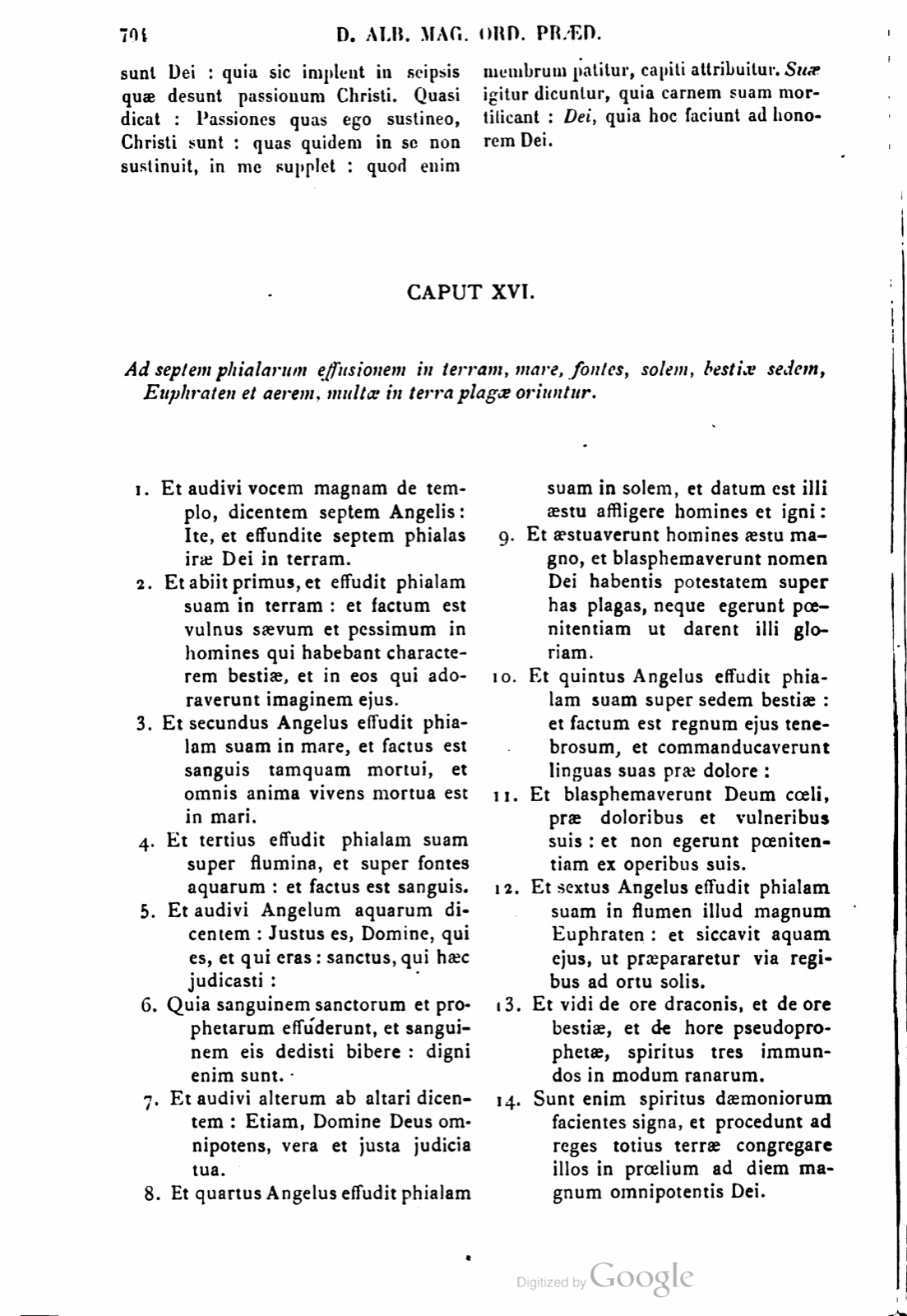
[Marginal label: Dub. 2.] Secundo, super illo verbo v. 2: "Habentes citharas Dei," quaeritur, Cum supra, XIV, 2, scriptum sit, quod Sancti citharizabunt in citharis suis, quare dicitur hic: "Habentes citharas Dei?" RESPONSIO. Citharae sunt Sanctorum: quia carnem suam crucifixerunt, et sic citharizant in suis citharis. Item, citharae sunt Dei: quia sic implent in seipsis quae desunt passionum Christi. Quasi dicat: Passiones quas ego sustineo, Christi sunt: quas quidem in se non sustinuit, in me supplet: quod enim membrum patitur, capiti attribuitur. Suae igitur dicuntur, quia carnem suam mortificant: Dei, quia hoc faciunt ad honorem Dei.
Here it is shown that the mysteries that are open are hidden from unbelievers. And three things are said. First, that Scripture has been made obscure to the reprobate. Secondly, by whose power this happens, there, "From the majesty of God." Thirdly he says that those mysteries will never be revealed, there, "And no one was able." Therefore he says: "And the temple was filled," that is, Scripture or the Church, "with smoke," that is, with obscurity and ignorance as regards the reprobate, lest they be able to understand the secrets of Scripture, and the judgments of God, and the mysteries of the Church, which will be open to the good. Isaiah 29:11: The vision of all things will be to you like the words of a sealed book. "From the majesty of God," that is, by the power of God disposing justly and mercifully; "and," that is, "from his power." Or, majesty is said with respect to the revelation that is made to the good, power with respect to the closing that is made to the evil; hence he himself closes to unbelievers and opens to the faithful. Above, 3:7: He who has the key of David, that is, of the Scriptures, which are signified by David. There follows: He opens, and no one closes. "And no one was able," supply, from the number of the reprobate, "to enter into the temple," that is, into Sacred Scripture through true understanding of its mysteries. Nor is it surprising, for their malice blinded them 5. Or, "Into the temple," that is, to search into the subtleties of the judgments of God, as the Gloss says. Or, "Into the temple," that is, into the militant Church through grace, or into the triumphant Church through glory. "Until the seven plagues were consummated," that is, until the whole preaching of the Church is ended; and it is clear that then they will not understand. Hence it is the same as if he said, never, according to that saying of Matthew 1:23: Until she bore her firstborn son, that is, neither before nor after. Or thus: "And no one was able to enter into the temple," that is, the reprobate will not know, "until the seven plagues of the seven Angels were consummated," that is, until the threats of the Preachers concerning those very evil men to be punished in hell were fulfilled. For then the experience of punishments will make them know what now they disdain to hear, because, as Gregory says: "Punishment opens the eyes which guilt closes." Or thus: "And no one was able," whether evil or good generally, "to enter into the temple," that is, into heaven so as to know its secrets fully, "until the seven plagues of the seven Angels were consummated," that is, until all sins and all miseries about which the Preachers spoke are ended, etc.
Here are doubtful points.
[Marginal label: Doubt 1.] First, on that word of verse 1: "And I saw another sign in heaven, etc.," it is asked why he says that this sign will be great and marvelous, namely that the Preachers will have the last plagues. RESPONSE of the Gloss: It is marvelous for a man to have such great power that he can damn someone; but it must be understood thus, that by comparison with them the evil will be damned, which is great and marvelous because of the election of grace. Because of this Romans 9:18 says: He has mercy on whom he wills, and whom he wills he hardens; and therefore it is said that this sign is marvelous, namely that some are chosen, by comparison with whom others will be damned.
[Marginal label: Doubt 2.] Secondly, on that word of verse 2: "Having harps of God," it is asked: Since above, 14:2, it is written that the Saints will play harps on their own harps, why is it said here, "Having harps of God"? RESPONSE. The harps are of the Saints because they have crucified their flesh, and thus they play harps on their own harps. Likewise, the harps are of God because thus they fulfill in themselves what is lacking of the sufferings of Christ. As if he said: The sufferings which I sustain are Christ's; the sufferings which indeed he did not sustain in himself, he supplies in me; for what the member suffers is attributed to the head. Therefore they are called their own because they mortify their own flesh; they are called God's because they do this for the honor of God.
CAPUT XVI.
Ad septem phialarum effusionem in terram, mare, fontes, solem, bestiae sedem, Euphraten et aerem, multae in terra plagae oriuntur.
1. Et audivi vocem magnam de templo, dicentem septem Angelis: Ite, et effundite septem phialas irae Dei in terram. 2. Et abiit primus, et effudit phialam suam in terram: et factum est vulnus saevum et pessimum in homines qui habebant characterem bestiae, et in eos qui adoraverunt imaginem ejus. 3. Et secundus Angelus effudit phialam suam in mare, et factus est sanguis tamquam mortui, et omnis anima vivens mortua est in mari. 4. Et tertius effudit phialam suam super flumina, et super fontes aquarum: et factus est sanguis. 5. Et audivi Angelum aquarum dicentem: Justus es, Domine, qui es, et qui eras: sanctus, qui haec judicasti: 6. Quia sanguinem sanctorum et prophetarum effuderunt, et sanguinem eis dedisti bibere: digni enim sunt. 7. Et audivi alterum ab altari dicentem: Etiam, Domine Deus omnipotens, vera et justa judicia tua. 8. Et quartus Angelus effudit phialam suam in solem, et datum est illi aestu affligere homines et igni: 9. Et aestuaverunt homines aestu magno, et blasphemaverunt nomen Dei habentis potestatem super has plagas, neque egerunt poenitentiam ut darent illi gloriam. 10. Et quintus Angelus effudit phialam suam super sedem bestiae: et factum est regnum ejus tenebrosum, et commanducaverunt linguas suas prae dolore: 11. Et blasphemaverunt Deum coeli, prae doloribus et vulneribus suis: et non egerunt poenitentiam ex operibus suis. 12. Et sextus Angelus effudit phialam suam in flumen illud magnum Euphraten: et siccavit aquam ejus, ut praepararetur via regibus ad ortu solis. 13. Et vidi de ore draconis, et de ore bestiae, et de ore pseudoprophetae, spiritus tres immundos in modum ranarum. 14. Sunt enim spiritus daemoniorum facientes signa, et procedunt ad reges totius terrae congregare illos in praelium ad diem magnum omnipotentis Dei. 15. Ecce venio sicut fur 6. Beatus qui vigilat, et custodit vestimenta sua, ne nudus ambulet, et videant turpitudinem ejus. 16. Et congregabit illos in locum qui vocatur hebraice Armagedon. 17. Et septimus Angelus effudit phialam suam in aerem: et exivit vox magna de templo a throno, dicens: Factum est. 18. Et facta sunt fulgura, et voces, et tonitrua, et terraemotus factus est magnus, qualis numquam fuit ex quo homines fuerunt super terram, talis terraemotus, sic magnus. 19. Et facta est civitas magna in tres partes, et civitates gentium ceciderunt, et Babylon magna venit in memoriam ante Deum, dare illi calicem vini indignationis irae ejus. 20. Et omnis insula fugit, et montes non sunt inventi. 21. Et grando magna sicut talentum descendit de coelo in homines: et blasphemaverunt Deum homines propter plagam grandinis, quoniam magna facta est vehementer.
CHAPTER XVI.
At the pouring out of the seven bowls upon the earth, sea, fountains, sun, seat of the beast, Euphrates, and air, many plagues arise on the earth.
1. And I heard a great voice from the temple, saying to the seven Angels: Go, and pour out the seven bowls of the wrath of God onto the earth. 2. And the first went away and poured out his bowl onto the earth; and there was made a cruel and very evil wound on the men who had the character of the beast, and on those who adored its image. 3. And the second Angel poured out his bowl into the sea, and blood was made as of a dead man, and every living soul died in the sea. 4. And the third poured out his bowl upon the rivers and upon the fountains of waters; and blood was made. 5. And I heard the Angel of the waters saying: You are just, Lord, who are and who were; holy, who have judged these things; 6. because they poured out the blood of saints and prophets, and you have given them blood to drink; for they are worthy. 7. And I heard another from the altar saying: Yes, Lord God almighty, true and just are your judgments. 8. And the fourth Angel poured out his bowl upon the sun, and it was given to him to afflict men with heat and fire; 9. and men burned with great heat, and they blasphemed the name of God who has power over these plagues, and they did not do penance so that they might give him glory. 10. And the fifth Angel poured out his bowl upon the seat of the beast; and his kingdom became dark, and they chewed their tongues because of pain; 11. and they blasphemed the God of heaven because of their pains and wounds; and they did not do penance from their works. 12. And the sixth Angel poured out his bowl into that great river Euphrates; and he dried its water, that the way might be prepared for kings from the rising of the sun. 13. And I saw from the mouth of the dragon, and from the mouth of the beast, and from the mouth of the false prophet, three unclean spirits in the manner of frogs. 14. For they are spirits of demons making signs, and they go out to the kings of the whole earth to gather them for battle on the great day of almighty God. 15. Behold, I come like a thief 6. Blessed is he who watches and keeps his garments, lest he walk naked and they see his shame. 16. And he will gather them into the place which in Hebrew is called Armagedon. 17. And the seventh Angel poured out his bowl into the air; and a great voice went out from the temple from the throne, saying: It is done. 18. And lightnings and voices and thunders were made, and a great earthquake was made, such as never was since men were upon the earth, such an earthquake, so great. 19. And the great city was made into three parts, and the cities of the nations fell, and great Babylon came into remembrance before God, to give her the chalice of the wine of the indignation of his wrath. 20. And every island fled, and mountains were not found. 21. And great hail like a talent came down from heaven upon men; and men blasphemed God because of the plague of the hail, since it had become exceedingly great.
If a page does not appear, its photograph has not been uploaded yet.