Works › Commentary on the Apocalypse of Blessed John
Volume 38 · pp. 676–687
End of Chapter XIII and Opening of Chapter XIV
A marker with ≈ is an approximate page boundary, placed by measure of the text; the page photographs remain the authority. In the paired views, clicking a page marker brings that page into view.
et humanae. Item, faciet se vocari Antemos, id est, Christo contrarium: et Arnoyme, quia negabit Christum esse Deum, et affirmabit se esse Deum. Et per hunc numerum qui in praedictis nominibus continetur, volet ipse apparere Deus: sed sapientibus et cognoscentibus veritatem nominis, purus homo apparebit. Et ideo dicit: "Qui habet intellectum," id est, sensum et gratiam cognoscendi mysteria, "computet numerum bestiae," id est, litteras nominis ejus: "numerus enim hominis est," id est, patebit per litteras ipsam bestiam purum esse hominem, quamvis se dicat Deum. "Et numerus est sexcenti sexaginta sex," id est, litterae ejus talem numerum signant. Quasi dicat: Conjungat litteras quae talem numerum signant, et habebit nomen bestiae.
[Marginal label: Quaestio.] Hic est dubitatio. Quomodo videatur Deus per hunc numerum insipientibus, cum sapientibus appareat purus homo? RESPONSIO. In hoc numero sexcenti sexaginta sex triplex senarius invenitur, scilicet, senarius sex unitatum, id est, 6: senarius sex denariorum, scilicet, 60: senarius centenariorum scilicet, 600. Primus signat perfectionem naturae: quia in sex diebus sunt omnia operata. Secundus senarius, scilicet denariorum, signat perfectionem meritorum: in observatione enim decalogi consistit meritum: et in hoc quod sexies sumitur, signatur perfecta adimpletio decalogi: unde per sexaginta signatur perfectio meritorum. Tertius senarius significat perfectionem praemiorum: centum enim significat praemium quod debetur perfectis, nam fructus centesimus illis debetur. Quia igitur Antichristus habet hunc numerum, in quo signatur perfectio naturae, gratiae, et gloriae, quae triplex perfectio a solo Deo est: ideo insipientibus videbitur Deus esse. Sapientibus tamen per hunc numerum videbitur purus homo, quia totum per senarium scribitur et perficitur: in quo datur intelligi, quod ille cui hic numerus competit, pura creatura erit: nam senarius est numerus operationis creaturae: omnes enim creaturae sex diebus operatae sunt. Aliter dicunt alii, quod per senarium, cujus partes aliquotae totum perficiunt, nec ultra procedunt, nec citra remanent, signatur perfectio fidei cui nihil addendum vel detrahendum est, sed simpliciter tenendum sicut determinant Scripturae: et sicut senarii non sunt nisi tres partes aliquotae, sic non est fides nisi de tribus, scilicet, nisi de Trinitate personarum, aut dualitate naturarum in Christo, aut unitate essentiae trium personarum. Hic est prima perfectio et magna. Item, per sexaginta, qui componitur ex senario ducto in denarium, signatur perfectio operationis. Hic est secunda perfectio et major. Item, per centum signatur triplex perfectio, scilicet, fidei propter senarium, operationis propter denarium, adimpletionis consiliorum propter centum. Quia igitur Antichristus hanc triplicem perfectionem suis promittet, vel praemium quod debetur eis, ideo reputabitur ab eis Deus: a sapientibus vero homo purus. Quamvis enim per praedictos numeros diversae signantur perfectiones, tamen cum senarius sit numerus operationis, quia sex diebus omnes creaturae sunt operatae, ideo per ipsum tantum creatura et non creator signatur. Ideo tempore Antichristi qui per praedictos numeros describitur, apparebit purus homo sapientibus et in malitia perfectus.
and of the human. Likewise, he will cause himself to be called Antemos, that is, contrary to Christ; and Arnoyme, because he will deny that Christ is God and will affirm that he himself is God. And through this number which is contained in the aforesaid names, he himself will wish to appear to be God; but to the wise and to those knowing the truth of the name he will appear to be a mere man. And therefore he says: "He who has understanding," that is, sense and grace for knowing mysteries, "let him compute the number of the beast," that is, the letters of its name; "for it is the number of a man," that is, through the letters it will be clear that the beast itself is a mere man, although he says that he is God. "And the number is six hundred sixty-six," that is, its letters signify such a number. As if he said: Let him join the letters that signify such a number, and he will have the name of the beast.
[Marginal label: Question.] Here there is a doubt. How does he seem to the foolish to be God through this number, when to the wise he appears to be a mere man? RESPONSE. In this number six hundred sixty-six there is found a threefold six, namely, a six of six units, that is, 6; a six of six tens, namely 60; a six of hundreds, namely 600. The first signifies the perfection of nature, because in six days all things were made. The second six, namely of tens, signifies the perfection of merits; for merit consists in observance of the decalogue, and in the fact that it is taken six times, the perfect fulfillment of the decalogue is signified; hence through sixty the perfection of merits is signified. The third six signifies the perfection of rewards; for one hundred signifies the reward that is owed to the perfect, for the hundredfold fruit is owed to them. Therefore, because Antichrist has this number, in which the perfection of nature, grace, and glory is signified, which threefold perfection belongs to God alone, he will seem to the foolish to be God. Yet to the wise through this number he will seem to be a mere man, because the whole is written and completed through six; in this it is given to be understood that the one to whom this number belongs will be a mere creature, for six is the number of the operation of the creature: for all creatures were made in six days. Others say otherwise, that through six, whose aliquot parts complete the whole and neither go beyond nor remain short, there is signified the perfection of faith, to which nothing must be added and from which nothing must be taken away, but which must simply be held as the Scriptures determine; and just as there are only three aliquot parts of six, so faith is only concerning three things, namely, concerning the Trinity of persons, or the duality of natures in Christ, or the unity of the essence of the three persons. This is the first and great perfection. Likewise, through sixty, which is composed from six drawn into ten, the perfection of operation is signified. This is the second and greater perfection. Likewise, through one hundred a threefold perfection is signified, namely, of faith because of six, of operation because of ten, of fulfillment of counsels because of one hundred. Therefore, because Antichrist will promise this threefold perfection to his own, or the reward that is owed to them, he will be regarded by them as God; but by the wise as a mere man. For although through the aforesaid numbers diverse perfections are signified, nevertheless, since six is the number of operation, because in six days all creatures were made, therefore through it only creature and not creator is signified. Therefore in the time of Antichrist, who is described through the aforesaid numbers, he will appear to the wise as a mere man and perfect in malice.
Hic sunt dubitabilia.
[Marginal label: Dub. 1.] Primo, super illo verbo v. 2: "Et os ejus sicut os leonis, etc.," quaeritur, Cum supra dictum sit, quod bestia haberet septem cornua, quomodo hic dicitur habere unum os, et non septem ora? RESPONSIO. Septem sunt ejus capita non numero, sed significatione: unde idem sunt septem capita quod unum: signant enim omne corpus malorum. Vel dicitur: "Os ejus," singulariter, ad signandum quod omnes reprobi tunc loquentur ore suo, hoc est, ore diaboli, id est, ore uno, sicut omnes boni ore uno loquentur, id est, ore Spiritus sancti.
[Marginal label: Dub. 2.] Secundo, super illo verbo v. 4: "Et adoraverunt draconem. Glossa, diabolum, qui dedit potestatem bestiae." Glossa, ut faceret miracula, quaeritur, Aut homines credent eum habere potestatem a diabolo, aut a Deo: si a Deo, ergo adorabunt Deum, et non diabolum: si a diabolo, quomodo ergo sequentur eum? RESPONSIO. Multi scient Antichristum esse malum, et multi simplices non advertent, sed omnes sequentur eum, vel propter dona quae dabit, vel propter timorem mortis: et videntes ejus miracula, dicent: Benedictus qui dedit isti talem potestatem. Hic autem est diabolus, et ideo in communi adorabunt diabolum, non propria ratione.
[Marginal label: Dub. 3.] Tertio, super illo verbo v. 7: "Et est datum illi bellum facere cum sanctis, et vincere eos," quaerit Haymo: Si Dominus electos suos diligit, cur ita vehementer permittet illos affligi? RESPONDET: quia filii sunt, et paterna haereditate donandi, atque ideo dilecti. Unde scriptum est, ad Hebr. XII, 6: Flagellat omnem filium quem recipit. Et supra, III, 19: Ego quos amo, arguo et castigo.
[Marginal label: Dub. 4.] Quarto, super illo verbo v. 13: "Ut ignem faceret de coelo descendere," quaeritur, Quare potius commemorat miraculum ignis quam aliud? [Marginal label: Quare faciet miraculum in igne.] RESPONSIO Bedae: Miraculum ignis quasi maximum praetulit: ut quia Dominus Jesus, Spiritu sancto in igne veniente, virtutum gratiam dedit, ipse quoque suos quasi simili charismate, astutia fallente, decipiat.
[Marginal label: Dub. 5.] Quinto, super illo verbo v. 15: "Et datum est illi ut daret spiritum imagini bestiae, et ut loquatur," scilicet prophetando de futuris. CONTRA: Solus Deus potest dare spiritum prophetandi, id est, praevidendi, et praedicendi futura. RESPONSIO. Futura contingentia subjacent ordinationi divinae: et ideo talium notitiam solus Deus potest dare. Cum igitur prophetia sit talibus, solus Deus potest dare spiritum prophetandi. Quaedam vero sunt futura naturaliter, ut eclypsis lunae, vel solis: et talia potest praedicere daemon. Item, cum sit velocissimus, illud quod dictum est jam in una regione, vel factum, dicit cito post in alia, ubi videtur quasi futurum: et sic praedicit futura: aliter non, nisi revelarentur ei a superiori. Item, quandoque praedicunt futura ex quadam conjectura: propter quod frequenter accidit, quod mentiuntur.
[Marginal label: Dub. 6.] Item quaeritur, Utrum possit dare loqui variis linguis? RESPONSIO. Credo quod non: sed hoc faciet secundum visionem hominum solum. Vel ipse, cum sciat omnes Scripturas et omnia idiomata, ut dicit Damascenus 1, loquetur in eis, vel hoc faciet simulatorie, aut per fallaciam hujusmodi, et cum plures sint ejus sequaces et diversarum linguarum, faciet illos loqui, ac si linguis variis mirabiliter loquerentur.
Here there are doubtful points.
[Marginal label: Doubt 1.] First, concerning that word in verse 2, "And its mouth as the mouth of a lion, etc.," it is asked: since above it was said that the beast had seven horns, how is it said here to have one mouth and not seven mouths? RESPONSE. Its seven heads are not seven by number, but by signification; hence the seven heads are the same as one, for they signify the whole body of the evil. Or it says "its mouth" in the singular to signify that all the reprobate will then speak with his mouth, that is, with the mouth of the devil, that is, with one mouth, just as all the good will speak with one mouth, that is, with the mouth of the Holy Spirit.
[Marginal label: Doubt 2.] Secondly, concerning that word in verse 4, "And they adored the dragon. The Gloss: the devil, who gave authority to the beast." The Gloss says, so that it might do miracles. It is asked: Either men will believe that he has power from the devil or from God. If from God, therefore they will adore God and not the devil; if from the devil, how then will they follow him? RESPONSE. Many will know that Antichrist is evil, and many simple people will not notice; but all will follow him, either because of the gifts he will give, or because of fear of death; and seeing his miracles they will say: Blessed is he who gave such power to that man. But this one is the devil, and therefore in common they will adore the devil, not under his proper aspect.
[Marginal label: Doubt 3.] Thirdly, concerning that word in verse 7, "And it was given to it to make war with the saints and to conquer them," Haymo asks: If the Lord loves his elect, why will he permit them to be afflicted so violently? HE RESPONDS: because they are sons and to be given the paternal inheritance, and therefore beloved. Hence it is written in Hebrews 12:6: He scourges every son whom he receives. And above, 3:19: Those whom I love, I rebuke and chastise.
[Marginal label: Doubt 4.] Fourthly, concerning that word in verse 13, "So that it made fire come down from heaven," it is asked: Why does he mention the miracle of fire rather than another? [Marginal label: Why he will make a miracle in fire.] RESPONSE of Bede: He put forward the miracle of fire as if the greatest, so that, because the Lord Jesus, when the Holy Spirit came in fire, gave the grace of powers, that one also may deceive his own, as if by a similar charism, with deceitful craft.
[Marginal label: Doubt 5.] Fifthly, concerning that word in verse 15, "And it was given to it to give spirit to the image of the beast, and that it should speak," namely by prophesying about future things. ON THE CONTRARY: God alone can give the spirit of prophesying, that is, of foreseeing and foretelling future things. RESPONSE. Future contingents are subject to divine ordering, and therefore God alone can give knowledge of such things. Since therefore prophecy concerns such things, God alone can give the spirit of prophesying. But certain things are naturally future, such as an eclipse of the moon or of the sun, and such things a demon can foretell. Likewise, since he is very swift, what has already been said or done in one region he says soon afterward in another, where it seems as if it is future; and thus he foretells future things; not otherwise, unless they were revealed to him by a superior. Likewise, sometimes they predict future things from a certain conjecture, on account of which it frequently happens that they lie.
[Marginal label: Doubt 6.] Likewise it is asked whether he can give the ability to speak in various tongues. RESPONSE. I believe that he cannot; but he will do this only according to the vision of men. Or he himself, since he knows all the Scriptures and all idioms, as Damascene says 1, will speak in them, or he will do this by simulation or by a deceit of this sort; and since there will be many of his followers and of diverse languages, he will cause them to speak as if they were speaking marvelously in various tongues.
CAPUT XIV.
Virgines cum Agno cantantes ambulant, Angelo uno evangelium annuntiante, altero Babylonis lapsum, tertio vero cruciatum eorum qui bestiam adorarunt praedicante: porro duo habentes falces jubentur, ille messem, hic autem vineam terrae demetere.
1. Et vidi, et ecce Agnus stabat supra montem Sion, et cum eo centum quadraginta quatuor millia, habentes nomen ejus, et nomen Patris ejus scriptum in frontibus suis. 2. Et audivi vocem de coelo, tamquam vocem aquarum multarum, et tamquam vocem tonitrui magni: et vocem, quam audivi, sicut citharoedorum citharizantium in citharis suis. 3. Et cantabant quasi canticum novum ante sedem, et ante quatuor animalia et seniores: et nemo poterat dicere canticum, nisi illa centum quadraginta quatuor millia, qui empti sunt de terra. 4. Hi sunt qui cum mulieribus non sunt coinquinati, virgines enim sunt. Hi sequuntur Agnum quocumque ierit. Hi empti sunt ex hominibus primitiae Deo et Agno: 5. Et in ore eorum non est inventum mendacium, sine macula enim sunt ante thronum Dei. 6. Et vidi alterum Angelum volantem per medium coeli, habentem evangelium aeternum, ut evangelizaret sedentibus super terram, et super omnem gentem, et tribum, et linguam, et populum: 7. Dicens magna voce: Timete Dominum, et date illi honorem, quia venit hora judicii ejus: et adorate eum qui fecit coelum et terram, mare et fontes aquarum 2. 8. Et alius Angelus secutus est, dicens: Cecidit, cecidit Babylon illa magna, quae a vino irae fornicationis suae potavit omnes gentes 3. 9. Et tertius Angelus secutus est illos, dicens voce magna: Si quis adoraverit bestiam et imaginem ejus, et acceperit characterem in fronte sua, aut in manu sua, 10. Et hic bibet de vino irae Dei, quod mistum est mero in calice irae ipsius, et cruciabitur igne et sulphure in conspectu Angelorum sanctorum, et ante conspectum Agni: 11. Et fumus tormentorum eorum ascendet in saecula saeculorum: nec habent requiem die ac nocte qui adoraverunt bestiam et imaginem ejus, et si quis acceperit characterem nominis ejus. 12. Hic patientia sanctorum est, qui custodiunt mandata Dei et fidem Jesu. 13. Et audivi vocem de coelo, dicentem mihi: Scribe: Beati mortui qui in Domino moriuntur. Amodo jam dicit Spiritus ut requiescant a laboribus suis: opera enim illorum sequuntur illos. 14. Et vidi, et ecce nubem candidam: et super nubem sedentem similem Filio hominis, habentem in capite suo coronam auream, et in manu sua falcem acutam. 15. Et alius Angelus exivit de templo, clamans voce magna ad sedentem super nubem: Mitte falcem tuam et mete, quia venit hora ut metatur, quoniam aruit messis terrae 4. 16. Et misit qui sedebat super nubem falcem suam in terram, et demessa est terra. 17. Et alius Angelus exivit de templo quod est in coelo, habens et ipse falcem acutam. 18. Et alius Angelus exivit de altari, qui habebat potestatem supra ignem: et clamavit voce magna ad eum qui habebat falcem acutam, dicens: Mitte falcem tuam acutam, et vindemia botros vineae terrae, quoniam maturae sunt uvae ejus. 19. Et misit Angelus falcem suam acutam in terram, et vindemiavit vineam terrae, et misit in lacum irae Dei magnum: 20. Et calcatus est lacus extra civitatem, et exivit sanguis de lacu usque ad frenos equorum, per stadia mille sexcenta.
CHAPTER XIV.
The virgins walking and singing with the Lamb, one Angel announcing the gospel, another preaching the fall of Babylon, and a third preaching the torment of those who adored the beast; moreover two having sickles are commanded, the one to reap the harvest, but the other to gather the vineyard of the earth.
1. And I saw, and behold, the Lamb stood upon Mount Sion, and with him one hundred forty-four thousand, having his name and the name of his Father written on their foreheads. 2. And I heard a voice from heaven, like the voice of many waters, and like the voice of great thunder; and the voice which I heard was like that of harpists harping on their harps. 3. And they were singing as it were a new song before the throne and before the four animals and the elders; and no one was able to say the song except those one hundred forty-four thousand, who were bought from the earth. 4. These are they who were not defiled with women, for they are virgins. These follow the Lamb wherever he shall go. These were bought from men, firstfruits to God and to the Lamb. 5. And in their mouth no lie was found, for they are without spot before the throne of God. 6. And I saw another Angel flying through the midst of heaven, having the eternal gospel, that he might evangelize to those sitting upon the earth and over every nation and tribe and tongue and people. 7. Saying with a great voice: Fear the Lord and give him honor, because the hour of his judgment has come; and adore him who made heaven and earth, the sea and the fountains of waters 2. 8. And another Angel followed, saying: Fallen, fallen is that great Babylon, which from the wine of the wrath of her fornication made all nations drink 3. 9. And the third Angel followed them, saying with a great voice: If anyone adored the beast and its image and received the character on his forehead or on his hand, 10. this one also shall drink of the wine of God's wrath, which is mixed with pure wine in the chalice of his wrath, and he shall be tormented with fire and sulphur in the sight of the holy Angels and before the sight of the Lamb; 11. and the smoke of their torments shall ascend forever and ever; and they have no rest by day or by night, those who adored the beast and its image, and if anyone received the character of its name. 12. Here is the patience of the saints, who keep the commandments of God and the faith of Jesus. 13. And I heard a voice from heaven saying to me: Write: Blessed are the dead who die in the Lord. From now on, the Spirit now says that they may rest from their labors, for their works follow them. 14. And I saw, and behold, a white cloud; and upon the cloud one sitting like the Son of man, having on his head a golden crown and in his hand a sharp sickle. 15. And another Angel came out from the temple, crying with a great voice to the one sitting upon the cloud: Send your sickle and reap, because the hour has come for it to be reaped, since the harvest of the earth has dried 4. 16. And the one who sat upon the cloud sent his sickle onto the earth, and the earth was reaped. 17. And another Angel came out from the temple that is in heaven, himself also having a sharp sickle. 18. And another Angel came out from the altar, who had power over fire; and he cried with a great voice to the one who had the sharp sickle, saying: Send your sharp sickle and gather the clusters of the vineyard of the earth, since its grapes are ripe. 19. And the Angel sent his sharp sickle onto the earth and gathered the vineyard of the earth and sent it into the great winepress of the wrath of God. 20. And the winepress was trodden outside the city, and blood came out from the winepress up to the bridles of the horses, for one thousand six hundred stadia.
IN CAPUT XIV APOCALYPSIS ENARRATIO.
1. "Et vidi, et ecce Agnus stabat supra montem Sion, et cum eo centum quadraginta quatuor millia, habentes nomen ejus, et nomen Patris ejus scriptum in frontibus suis."
Supra descripsit Joannes familiam draconis, hoc est, Antichristum et ministros ejus, hic incipit agere de Agno et familia ejus quae opponuntur praedictis. Et dicuntur hic tria. Primo, Agni visio. Secundo, exercitus ejus descriptio, ibidem, "Et cum eo, etc." Tertio, praeconum advocatio, ibi, v. 6: "Et vidi alterum Angelum." Dicit ergo quid viderit. "Et vidi," id est, intellexi spiritu revelante, "et ecce Agnus." Hoc dicit quantum ad humanam naturam propter innocentiam vitae, et sacrificium, et immolationem. Jerem. XI, 19: Ego quasi agnus mansuetus qui, etc. "Stabat." Hoc dicit quantum ad divinitatem: nam si cecidit per humanitatem, semper stetit secundum divinitatem. Joan. I, 26: Medius vestrum stetit, scilicet, secundum deitatem, quem vos nescitis, occidentes eum secundum carnem. "Supra montem Sion." [Marginal label: Sion.] Sion interpretatur specula, et signat Ecclesiam, quae bona futura speculatur, et quae mala sunt cavenda denuntiat. Et dicitur stans, quasi semper juvare Ecclesiam paratus. Psal. II, 6: Ego autem constitutus sum rex ab eo, etc. "Montem," id est, Ecclesiam, quae mons dicitur in se, proficiendo. "Sion," id est, specula, aliis bonum exemplum dando. "Mons" bene operando, specula insidias diaboli praecavendo.
"Et cum eo centum quadraginta quatuor millia." Et ponitur hic numerus finitus pro infinito. Et sicut dicit Haymo, hic numerus signat eos qui sunt virgines mente et carne. Et primo describuntur ab aperta nominis Christi confessione, ibi, "Habentes nomen ejus." Secundo, a passionis Christi imitatione, ibi, v. 2: "Et audivi." Tertio, a perfecta mentis et corporis integritate, ibi, v. 3: "Et cantabant." Et primum pertinet ad praedicatores. Secundum ad martyres. Tertium ad virgines. Dicit ergo: "Et cum eo," scilicet, Agno, "centum quadraginta quatuor millia," sicut dicit Glossa, virgines in fide Trinitatis perfectos, ex quatuor partibus mundi electos signat. Si enim ternarius in quaternarium ducatur, vel e converso, redditur duodenarius qui ductus in seipsum facit centum quadraginta quatuor: nam duodecies duodecim millia faciunt centum quadraginta quatuor millia. Hoc addit ad signandum perfectionem. Quia ergo duodenarius est numerus abundans: ideo signat illos qui abundantem justitiam servant, sicut sunt virgines, martyres, et praedicantes. Virgines servant abundantem justitiam quoad spiritum proprium, martyres quoad Deum, praedicatores quoad proximum. Unde dicit: "Et cum eo," id est, cum Agno, ei conformes et similes. Ex hoc sequitur: ergo erant super Ecclesiam, quia Christus erat super eam. RESPONSIO. Christus est super Ecclesiam potentia et dignitate, Sancti vero majores sunt supra dignitate, non potestate. "Centum quadraginta quatuor millia," id est, Sancti perfectae justitiae in fide Trinitatis, ex quatuor mundi partibus collecti, sicut sunt Praedicatores, martyres, et virgines. "Habentes nomen ejus," id est, Christi, a quo Christiani. "Et nomen Patris ejus," a quo dicuntur dii, et filii Dei. Psal. LXXXI, 6: Ego dixi: Dii estis, etc. Et primo ponit nomen Christi: quia ad Patrem non possumus venire nisi per Christum. Joan. X, 9: Ego sum ostium. "Scriptum in frontibus suis," id est, confitentes illud ore et operibus manifeste. Et dicit scriptum, non fictum, vel pictum: quia sic posset tribulatorum aliquis deleri: sed scriptum, Glossa, indelebiliter. Aliter, per praedictos numeros signatur [Marginal label: Beatorum triplex vel quadruplex status.] triplex vel quadruplex status beatorum. Unde sensus est: "Et cum eo centum quadraginta quatuor millia," supple, stabant per conformitatem et ad custodiendum Ecclesiam. Per quadraginta, qui est poenitentium, signatur status incipientium: per quatuor signatur status proficientium et in quatuor virtutibus se exercitantium: per centum, qui est numerus perfectus, signatur status contemplantium. Hi omnes stabant cum Agno ad custodiam Ecclesiae, et parati ad bellandum, quasi acies ex opposito contra aciem diaboli. "Habentes nomen ejus," quia a Christo Christiani: vel rem nominis, id est, gratiae benedictionem. "Et nomen Patris ejus," id est, notitiam, vel rem nominis Patris per Dei filiationem, "scriptum in frontibus suis," id est, in suis cordibus. Vel, "Scriptum," per perseverantiam, "in frontibus suis," scilicet, per apertam confessionem.
EXPLANATION ON CHAPTER XIV OF THE APOCALYPSE.
1. "And I saw, and behold, the Lamb stood upon Mount Sion, and with him one hundred forty-four thousand, having his name and the name of his Father written on their foreheads."
Above John described the family of the dragon, that is, Antichrist and his ministers; here he begins to treat of the Lamb and his family, which are opposed to the aforesaid. And three things are said here. First, the vision of the Lamb. Secondly, the description of his army, in the same place, "and with him, etc." Thirdly, the calling of the heralds, there at verse 6: "And I saw another Angel." Therefore he says what he saw. "And I saw," that is, I understood with the Spirit revealing, "and behold the Lamb." He says this with respect to the human nature because of innocence of life, and sacrifice, and immolation. Jeremiah 11:19: I am like a gentle lamb which, etc. "Stood." He says this with respect to divinity; for even if he fell through humanity, he always stood according to divinity. John 1:26: In the midst of you stood, namely according to deity, one whom you do not know, killing him according to the flesh. "Upon Mount Sion." [Marginal label: Sion.] Sion is interpreted watchtower, and it signifies the Church, which watches for future goods and announces what evils are to be avoided. And he is said to stand, as if always prepared to help the Church. Psalm 2:6: But I have been appointed king by him, etc. "Mount," that is, the Church, which is called a mountain in itself by making progress. "Sion," that is, watchtower, by giving a good example to others. It is "mountain" by working well, watchtower by guarding beforehand against the snares of the devil.
"And with him one hundred forty-four thousand." And here a finite number is put for an infinite one. And as Haymo says, this number signifies those who are virgins in mind and flesh. And first they are described from open confession of the name of Christ, there, "having his name." Secondly, from imitation of the Passion of Christ, there at verse 2: "And I heard." Thirdly, from perfect integrity of mind and body, there at verse 3: "And they were singing." And the first belongs to preachers, the second to martyrs, the third to virgins. Therefore he says: "And with him," namely, with the Lamb, "one hundred forty-four thousand," as the Gloss says, signifies virgins perfect in the faith of the Trinity, chosen from the four parts of the world. For if three is led into four, or conversely, twelve is rendered, which led into itself makes one hundred forty-four; for twelve times twelve thousand makes one hundred forty-four thousand. He adds this to signify perfection. Therefore, because twelve is an abundant number, it signifies those who keep abundant justice, as virgins, martyrs, and preachers do. Virgins keep abundant justice with respect to their own spirit, martyrs with respect to God, preachers with respect to neighbor. Hence he says: "And with him," that is, with the Lamb, conformable and similar to him. From this it follows: therefore they were above the Church, because Christ was above it. RESPONSE. Christ is above the Church in power and dignity, but the greater Saints are above in dignity, not in power. "One hundred forty-four thousand," that is, Saints of perfect justice in faith of the Trinity, gathered from the four parts of the world, such as Preachers, martyrs, and virgins. "Having his name," that is, the name of Christ, from whom they are Christians. "And the name of his Father," from whom they are called gods and sons of God. Psalm 81:6: I said: You are gods, etc. And first he puts the name of Christ, because we cannot come to the Father except through Christ. John 10:9: I am the door. "Written on their foreheads," that is, confessing it manifestly by mouth and works. And he says written, not feigned or painted, because then someone of those undergoing tribulation could be erased; but written, the Gloss says, indelibly. Otherwise, through the aforesaid numbers there is signified [Marginal label: Threefold or fourfold state of the blessed.] the threefold or fourfold state of the blessed. Hence the sense is: "And with him one hundred forty-four thousand," supply, stood through conformity and for guarding the Church. Through forty, which belongs to penitents, the state of beginners is signified; through four, the state of those making progress and exercising themselves in the four virtues is signified; through one hundred, which is a perfect number, the state of those contemplating is signified. All these stood with the Lamb for the guard of the Church and ready for battle, as a battle-line set opposite against the battle-line of the devil. "Having his name," because from Christ they are Christians; or the reality of the name, that is, blessing of grace. "And the name of his Father," that is, knowledge, or the reality of the name of Father through filiation of God, "written on their foreheads," that is, in their hearts. Or, "written," through perseverance, "on their foreheads," namely, through open confession.
2. "Et audivi vocem de coelo, tamquam vocem aquarum multarum, et tamquam vocem tonitrui magni: et vocem quam audivi, sicut citharoedorum citharizantium in citharis suis."
Hic describuntur Sancti ab imitatione passionis Christi. Et dicuntur duo. Primo, ponitur admonitio Sanctorum exercitantium se ad imitationem Christi. Secundo, exprimitur modus admonitionis, ibi, "Et vocem quam audivi." In prima parte dicuntur duo. Primo, ponit admonitionem. Secundo, describit ipsam, ibi, "Tamquam vocem." Dicit ergo: "Et audivi." Glossa, Sanctorum admonitionem, "de coelo," id est, de Ecclesia, vel de viris perfectis et coelestibus ad imperfectos et minores procedentem: "tamquam vocem aquarum multarum," id est, procedentem de multitudine dulcium Scripturarum. Psal. CXVIII, 103: Quam dulcia, etc. [Marginal label: Vox aquarum.] Hic enim dicitur vox aquarum: quia multos Sanctos, id est, mundos facit. "Et tamquam vocem tonitrui magni," quia terret malos. Psal. CIII, 7: A voce tonitrui formidabunt. "Et vocem quam audivi," id est, vox quam audivi, supple, fuerat "sicut vox citharoedorum." [Marginal label: Cithara crux est.] NOTA: In cithara est lignum, et chordae, tamen diversimode tensae, unam reddunt melodiam. Per lignum signatur crux Christi, vel poenitentia. Caro Sanctorum intelligitur per chordas. Chordae igitur in hoc ligno extenduntur, quando corpora in poenitentia affliguntur. Sed istae chordae diversimode extenduntur: quia non omnes aequaliter poenitent, vel poenam patiuntur. Alius enim crucifigitur, alius decollatur, etc.: unum tamen reddunt sonum, propter unam fidem quam omnes confitentur. Est ergo sensus: "Sicut vox citharoedorum," id est, vox sanctorum martyrum, vel Praedicatorum, "citharizantium," id est, carnis mortificationem ostendentium, "in citharis suis," id est, in corporibus suis. Nam carnis mortificationem quam praedicant aliis, ostendunt in seipsis. I ad Corinth. IX, 27: Castigo corpus meum. Et nota, quod dicit: "In citharis suis:" in quo notat illos qui semper citharizant in alienis, vel praedicant semper aliis poenitentiam, et ipsi faciunt modicam aut nullam. Matth. XXIII, 4: Imponunt in humeros hominum onera gravia, etc.
2. "And I heard a voice from heaven, like the voice of many waters, and like the voice of great thunder; and the voice which I heard was like that of harpists harping on their harps."
Here the Saints are described from imitation of the Passion of Christ. And two things are said. First, there is set down the admonition of the Saints exercising themselves for imitation of Christ. Secondly, the manner of the admonition is expressed, there, "and the voice which I heard." In the first part two things are said. First, he sets down the admonition. Secondly, he describes it, there, "like the voice." Therefore he says: "And I heard." The Gloss: the admonition of the Saints, "from heaven," that is, from the Church, or proceeding from perfect and heavenly men to the imperfect and lesser; "like the voice of many waters," that is, proceeding from a multitude of sweet Scriptures. Psalm 118:103: How sweet, etc. [Marginal label: Voice of waters.] For here it is called the voice of waters because it makes many holy, that is, clean. "And like the voice of great thunder," because it terrifies the evil. Psalm 103:7: At the voice of your thunder they will fear. "And the voice which I heard," that is, the voice which I heard, supply, was "like the voice of harpists." [Marginal label: The harp is the cross.] NOTE: In a harp there is wood and strings, yet strings stretched in different ways render one melody. Through the wood the cross of Christ is signified, or penance. The flesh of the Saints is understood through the strings. Therefore the strings are stretched on this wood when bodies are afflicted in penance. But those strings are stretched in different ways, because not all do penance equally, or suffer punishment equally. For one is crucified, another is beheaded, etc.; nevertheless they render one sound because of the one faith which all confess. Therefore the sense is: "like the voice of harpists," that is, the voice of holy martyrs or Preachers, "harping," that is, showing mortification of the flesh, "on their harps," that is, in their bodies. For the mortification of the flesh which they preach to others, they show in themselves. 1 Corinthians 9:27: I chastise my body. And note that he says "on their own harps"; in this he marks those who always harp on others' harps, or always preach penance to others, and themselves do little or none. Matthew 23:4: They place heavy burdens on the shoulders of men, etc.
3. "Et cantabant quasi canticum novum ante sedem, et ante quatuor animalia et seniores."
Hic describuntur Sancti qui virginitatem servaverunt spiritualiter, quae consistit in mentis et corporis integritate. Et dicuntur tria. Primo, manifestatur gaudium quod habent virgines pro servata integritate. Secundo, ostenditur praerogativa virginum in exsultatione, ibi, "Et nemo poterat." Tertio, quod hoc gaudium adepti sunt passionis Christi virtute, ibi, "Qui empti sunt." Dicit ergo: "Et cantabant quasi canticum novum," id est, gratias agebant de integritate mentis et corporis: quod dicitur "canticum novum," quia est canticum Novi Testamenti. Matth. XIX, 12: Sunt eunuchi qui se castraverunt, etc. [Marginal labels: Canticum vetus. Canticum Novum.] Beda: "Vetus canticum erat: Beatae quae pariunt. Exod. XXIII, 26: Non erit infoecunda, neque sterilis in terra tua. Novum vero est: Lauda, sterilis, quae non paris 5." Nota, quod istud canticum dicitur quasi canticum novum: nam canticum novum est, quod inauditum est: auditur autem de multis virginibus: sed ante partum Virginis inauditum fuit, ut simul esset virginitas et foecunditas: et illa sola potuit cantare canticum novum, quae hanc meruit praerogativam habere, ut mater esset, et virginitatem non amitteret. Vel, "Quasi canticum novum," quia numquam veterascet, sed erit in perpetua novitate. Vel, "Quasi novum" dicitur, ut sic imperfectio quaedam usque ad glorificationem corporum in animabus sanctis intelligatur: sed tunc erit plene novum, quando erit glorificatio corporum. "Ante sedem Dei." In hoc notatur rectitudo intentionis. Quasi dicat: Non pro favore hominum ut hypocritae, sed ante sedem Dei, id est, in praesentia Angelorum, in quibus Deus sedet. Psal. CXXXVII, 1: In conspectu Angelorum, etc. "Et ante quatuor animalia," id est, Evangelistas, vel universos Evangelii Praedicatores: "et seniores," id est, judices, ut dicit Glossa. Vel, Patriarchas, et Apostolos, id est, Veteris et Novi Testamenti Patres. Et dicit, ante, non post: quia aequiparantur eis in quibus jam sedet.
"Et nemo poterat dicere canticum, nisi illa centum quadraginta quatuor millia." [Marginal label: Praerogativa virginum.] Hic ostenditur praerogativa virginum. Unde dicit: "Et nemo poterat dicere canticum," id est, gratias agere, vel gaudere de integritate mentis et corporis, "nisi illa centum quadraginta quatuor millia," id est, nisi illi virgines qui signantur per illa centum quadraginta quatuor millia. Beda: "Singulariter canticum cantare, est cum eo in perpetuum prae cunctis fidelibus de carnis incorruptione gaudere." Sed objicitur: quia videtur secundum hoc, quod beatus Petrus non fuerit major illis Sanctis, cum istud canticum cantare non possit: non enim virgo permansit. RESPONSIO. [Marginal label: Duplex est meritum.] Duplex est meritum: essentiale, et accidentale. Virgines enim quamvis excellant Petrum in virginitate, et sic in praemio quodam accidentali: non tamen simpliciter, quia ipse excellebat in aliis: unde virgines caeteris paribus ipsum excellerent, sed caetera paria non fuerunt. Unde Haymo: "Si Joannes Apostolus fuisset in cruce levatus, ut Petrus, utique excelleret eum: quia ille virgo, hic esset non virgo: unde virgines qui non fuerunt cum eo aequalis meriti, non praecellunt ipsum, licet cantent canticum illud."
3. "And they were singing as it were a new song before the throne and before the four animals and the elders."
Here are described the Saints who have spiritually preserved virginity, which consists in integrity of mind and body. And three things are said. First, the joy that virgins have for preserved integrity is manifested. Secondly, the prerogative of virgins in exultation is shown, there, "And no one was able." Thirdly, that they obtained this joy by the power of the Passion of Christ, there, "who were bought." Therefore he says: "And they were singing as it were a new song," that is, they were giving thanks for integrity of mind and body; this is called "a new song" because it is the song of the New Testament. Matthew 19:12: There are eunuchs who have castrated themselves, etc. [Marginal labels: Old song. New song.] Bede: "The old song was: Blessed are those who bear children. Exodus 23:26: There will not be one unfruitful or sterile in your land. But the new one is: Praise, O sterile one, who does not bear 5." Note that this song is called as it were a new song; for a new song is one that is unheard; but one hears of many virgins; yet before the birth-giving of the Virgin it was unheard that virginity and fecundity should be together; and she alone was able to sing a new song, who deserved to have this prerogative, that she should be a mother and should not lose virginity. Or, "as it were a new song," because it will never grow old, but will be in perpetual newness. Or, it is called "as it were new" so that a certain imperfection in holy souls may be understood until the glorification of bodies; but then it will be fully new, when there will be the glorification of bodies. "Before the throne of God." In this the rectitude of intention is marked. As if he said: Not for the favor of men like hypocrites, but before the throne of God, that is, in the presence of Angels, in whom God sits. Psalm 137:1: In the sight of the Angels, etc. "And before the four animals," that is, the Evangelists, or all the Preachers of the Gospel; "and the elders," that is, judges, as the Gloss says. Or, the Patriarchs and Apostles, that is, the Fathers of the Old and New Testament. And he says before, not after, because they are equated with those in whom he already sits.
"And no one was able to say the song except those one hundred forty-four thousand." [Marginal label: Prerogative of virgins.] Here the prerogative of virgins is shown. Hence he says: "And no one was able to say the song," that is, to give thanks or to rejoice concerning integrity of mind and body, "except those one hundred forty-four thousand," that is, except those virgins who are signified by those one hundred forty-four thousand. Bede: "To sing the song in a singular way is to rejoice with him forever before all the faithful concerning incorruption of the flesh." But it is objected that according to this blessed Peter seems not to have been greater than those Saints, since he cannot sing that song, for he did not remain a virgin. RESPONSE. [Marginal label: Merit is twofold.] Merit is twofold: essential and accidental. For although virgins excel Peter in virginity, and thus in a certain accidental reward, nevertheless they do not excel him simply, because he excelled in other things. Hence virgins would excel him if the other things were equal, but the other things were not equal. Hence Haymo says: "If John the Apostle had been lifted on the cross as Peter was, he would certainly excel him, because the former was a virgin and the latter would be not a virgin; hence virgins who were not of equal merit with him do not surpass him, although they sing that song."
"Qui empti sunt de terra." Hic dicit, quod virtute passionis pervenerunt ad gaudium istud. Unde dicit: "Qui," scilicet virgines, "empti sunt," scilicet, pretioso sanguine Christi, "de terra," id est, de infirmitate corporis sunt sursum elevati, ut in carne vivant praeter carnem. Ambrosius: "Supergreditur virginitas conditionem humanae naturae, per quam homines Angelis assimilantur: major enim victoria virginum est quam Angelorum: Angeli enim sine carne vivunt, virgines autem in carne triumphant."
4. "Hi sunt qui cum mulieribus non sunt coinquinati, virgines enim sunt. Hi sequuntur Agnum quocumque ierit. Hi empti sunt ex hominibus, primitiae Deo et Agno: 5. Et in ore eorum non est inventum mendacium, sine macula enim sunt ante thronum Dei."
Hic manifestatur virginitatis dignitas tripliciter. Primo, quoad incorruptionem carnis. Secundo, quoad incorruptionem oris, ibi, v. 5: "Et in ore eorum, etc." Tertio, quoad incorruptionem mentis, ibidem, "Sine macula sunt." [Marginal label: Virginitatis dignitas.] Dicit ergo: "Hi sunt," scilicet, virgines, "qui cum mulieribus non sunt coinquinati," turpi opere: "virgines enim sunt," scilicet mente. Haymo: "Non polluti cum mulieribus mente et corpore." "Hi sequuntur Agnum," id est, imitantur. Haymo: "Sequi Christum, est imitari ipsum." "Quocumque ierit," in quacumque via: sive enim vadat ad viam praeceptorum, hi sequuntur: sive ad viam consiliorum, hi sequuntur. Bernardus: "Sequuntur ad redemptionem, sicut omnes: sequuntur ad praecepta, sicut plures: sequuntur ad consilia, sicut pauci, quia pauci virginitatem servant." "Hi empti sunt," id est, quadam praerogativa ab aliis separati, sicut primitiae eliguntur ex fructibus, vel ex multo grege eligitur agnus. Unde, "Hi empti sunt ex hominibus." Non dicit simpliciter, empti: quia de caeteris meliores sunt electi. Ergo, "Hi empti sunt," scilicet, sanguine Christi sui, ad hoc ut essent "primitiae ex hominibus," id est, electi ex omnibus hominibus ad modum primitiarum, id est, ut tamquam primitiae offerentur "Deo," id est, Patri. Nota, quod dicit, empti, et non redempti. Nam illi proprie dicuntur empti, qui baptismalem innocentiam servaverunt: redempti vero, qui a peccatis per poenitentiam redierunt. De primo dicitur, I ad Corinth. VI, 20: Empti estis, etc. De secundis, I Petri, I, 18: Non corruptibilibus, etc. "Et Agno," id est, Filio. [Marginal label: Quaestio.] Sed quaeritur, Quare non dicit: Spiritui sancto, cum sit tribus honor unus? RESPONSIO. Spiritus sanctus est nexus et amor Patris et Filii: et ideo illis simul positis necessario intelligitur Spiritus sanctus.
"Who were bought from the earth." Here he says that by the power of the Passion they came to that joy. Hence he says: "Who," namely virgins, "were bought," namely by the precious blood of Christ, "from the earth," that is, they were lifted upward from the weakness of the body, so that they might live in the flesh beyond the flesh. Ambrose: "Virginity surpasses the condition of human nature, through which men are made like Angels; for the victory of virgins is greater than that of Angels: for Angels live without flesh, but virgins triumph in flesh."
4. "These are they who were not defiled with women, for they are virgins. These follow the Lamb wherever he shall go. These were bought from men, firstfruits to God and to the Lamb: 5. And in their mouth no lie was found, for they are without spot before the throne of God."
Here the dignity of virginity is manifested in three ways. First, with respect to incorruption of the flesh. Secondly, with respect to incorruption of the mouth, there at verse 5: "And in their mouth, etc." Thirdly, with respect to incorruption of the mind, in the same place, "they are without spot." [Marginal label: Dignity of virginity.] Therefore he says: "These are they," namely virgins, "who were not defiled with women," by a shameful work; "for they are virgins," namely in mind. Haymo: "Not polluted with women in mind and body." "These follow the Lamb," that is, they imitate him. Haymo: "To follow Christ is to imitate him." "Wherever he shall go," on whatever way: for whether he goes to the way of precepts, these follow; or to the way of counsels, these follow. Bernard: "They follow to redemption, as all do; they follow to precepts, as many do; they follow to counsels, as few do, because few keep virginity." "These were bought," that is, separated from others by a certain prerogative, as firstfruits are chosen from fruits, or a lamb is chosen from a large flock. Hence, "these were bought from men." He does not simply say bought, because the better ones are chosen from the others. Therefore, "these were bought," namely by the blood of Christ their own, for this, that they might be "firstfruits from men," that is, chosen from all men after the manner of firstfruits, that is, so that as firstfruits they might be offered "to God," that is, to the Father. Note that he says bought, and not redeemed. For those are properly called bought who preserved baptismal innocence; but redeemed are those who returned from sins through penance. Of the first it is said in 1 Corinthians 6:20: You have been bought, etc. Of the second, in 1 Peter 1:18: Not with corruptible things, etc. "And to the Lamb," that is, to the Son. [Marginal label: Question.] But it is asked: Why does he not say, to the Holy Spirit, since there is one honor for the three? RESPONSE. The Holy Spirit is the bond and love of the Father and the Son; and therefore, when those are placed together, the Holy Spirit is necessarily understood.
"Et in ore eorum non est inventum mendacium, etc." Hic commendantur virgines quantum ad incorruptionem oris. SED CONTRA: Psal. CXV, 11: Omnis homo mendax. RESPONSIO. Sicut dicit inferius, in his invenitur in quibus manet: in habentibus autem charitatem finaliter manet: quia, I Petri, IV, 8: Charitas operit multitudinem peccatorum. Aliter, Haymo: "Omnis homo quantum est de se, mendax est: in quantum est ex Deo, verax est." "Sine macula enim sunt ante thronum Dei," id est, ante Deum judicem: quod dicitur magis de eis quam de aliis, quia quamvis electi sint sine macula, comparatione tamen aliorum soli virgines carne et mente dicuntur sine macula.
6. "Et vidi alterum Angelum volantem per medium coeli."
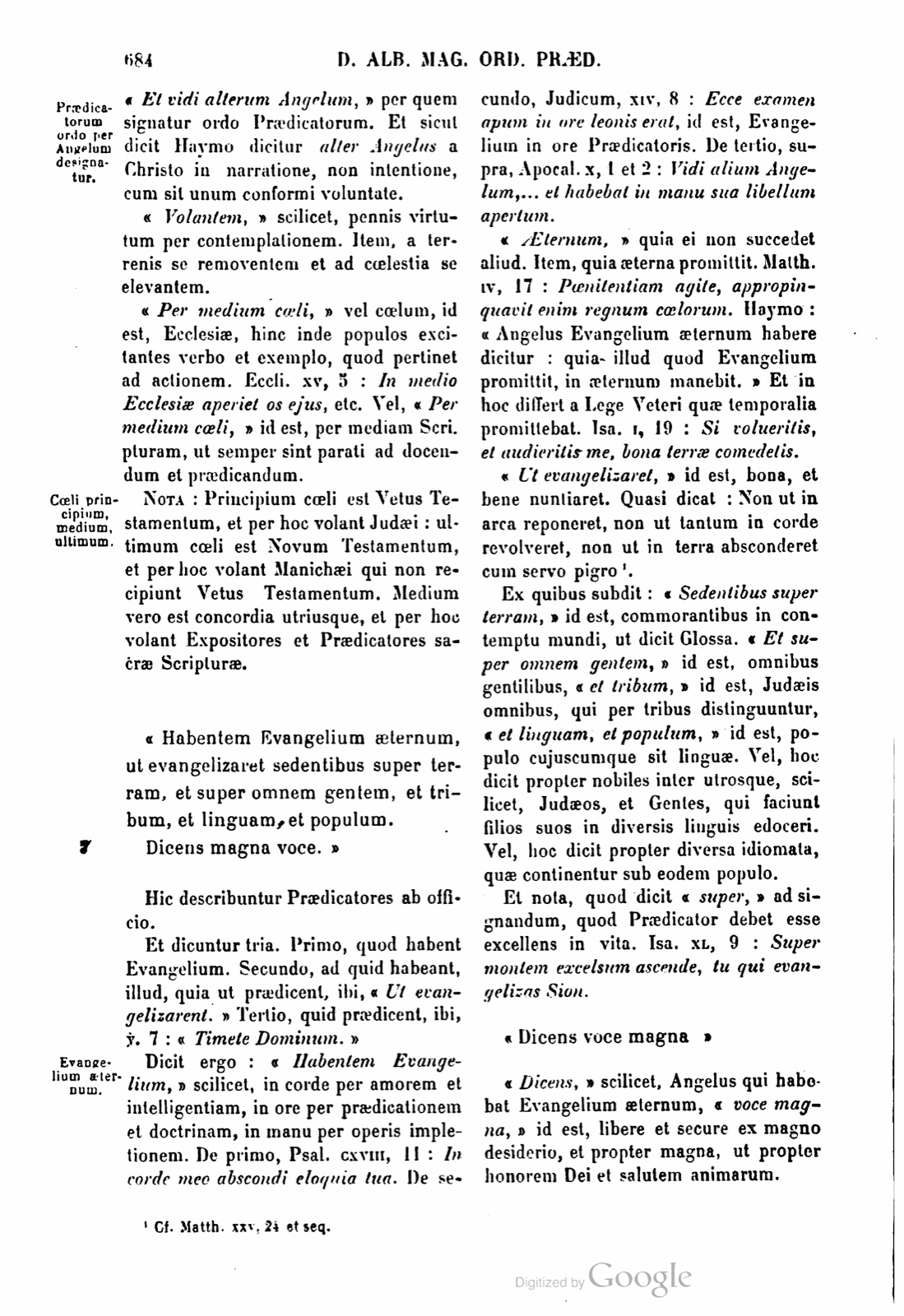
Supra descripsit exercitum Agni, hic introducuntur praecones vocantes ad partem Agni. Et dividitur haec pars in duas. In prima, ponitur praeconum clamor. In secunda, clamoris ratio, ibi, v. 14: "Et vidi, et ecce nubem candidam, etc." In prima dicuntur duo. Primo, introducuntur praecones revocantes a parte draconis. Secundo, vocantes ad partem Agni, ibi, v. 13: "Et audivi vocem." [Marginal label: Praecones draconis et Agni.] Quia vero praecones draconis clamaverunt tria, scilicet, ut bestia adoraretur, ut fieret imago bestiae, ut character ejus reciperetur: ideo contra haec tria triplex ordo Praedicatorum introducitur. Et dividitur haec pars in tres. Primi praedicant ne adoretur bestia: secundi, ne imago bestiae fiat, ibi, v. 8: "Et alius Angelus:" tertii, ne quis characterem bestiae recipiat, ibi, v. 9: "Et tertius Angelus." Primi describuntur primo a vita activa et contemplativa: secundo, ab officio et doctrina, ibi, "Habentem Evangelium aeternum." Dicit ergo: "Et vidi alterum Angelum." Glossa, id est, Praedicatores. NOTA: In hoc quod Angelus interpretatur missus, intelligitur ejus humilitas. Item, intelligitur missus ab aliquo, in quo est auctoritas. Hic quaeritur, Cum immediate missus Angelus sit introductus, videtur quod male dicat: "Et vidi alterum Angelum." RESPONSIO. Agnus de quo praedictum est, Angelus intelligitur ille de quo dicitur, Isa. IX, 6: Et vocabitur nomen ejus magni consilii Angelus, secundum aliam litteram. Hic enim vocatur Agnus propter sacrificium et vitae innocentiam, sed Angelus propter regni novam annuntiationem. Et ideo bene dicitur hic: [Marginal label: Praedicatorum ordo per Angelum designatur.] "Et vidi alterum Angelum," per quem signatur ordo Praedicatorum. Et sicut dicit Haymo dicitur alter Angelus a Christo in narratione, non intentione, cum sit unum conformi voluntate. "Volantem," scilicet, pennis virtutum per contemplationem. Item, a terrenis se removentem et ad coelestia se elevantem. "Per medium coeli," vel coelum, id est, Ecclesiae, hinc inde populos excitantes verbo et exemplo, quod pertinet ad actionem. Eccli. XV, 5: In medio Ecclesiae aperiet os ejus, etc. Vel, "Per medium coeli," id est, per mediam Scripturam, ut semper sint parati ad docendum et praedicandum. [Marginal labels: Coeli principium, medium, ultimum.] NOTA: Principium coeli est Vetus Testamentum, et per hoc volant Judaei: ultimum coeli est Novum Testamentum, et per hoc volant Manichaei qui non recipiunt Vetus Testamentum. Medium vero est concordia utriusque, et per hoc volant Expositores et Praedicatores sacrae Scripturae.
"And in their mouth no lie was found, etc." Here virgins are commended with respect to incorruption of the mouth. BUT ON THE CONTRARY: Psalm 115:11: Every man is a liar. RESPONSE. As he says below, it is found in those in whom it remains; but in those having charity, charity remains finally, because 1 Peter 4:8 says: Charity covers a multitude of sins. Otherwise, Haymo says: "Every man, as far as he is from himself, is a liar; insofar as he is from God, he is truthful." "For they are without spot before the throne of God," that is, before God the judge; this is said more of them than of others, because although the elect are without spot, nevertheless by comparison with others only virgins in flesh and mind are called without spot.
6. "And I saw another Angel flying through the midst of heaven."
Above he described the army of the Lamb; here the heralds calling to the party of the Lamb are introduced. And this part is divided into two. In the first, the cry of the heralds is set down. In the second, the reason for the cry, there at verse 14: "And I saw, and behold, a white cloud, etc." In the first two things are said. First, the heralds calling back from the party of the dragon are introduced. Secondly, those calling to the party of the Lamb, there at verse 13: "And I heard a voice." [Marginal label: Heralds of the dragon and of the Lamb.] But because the heralds of the dragon cried out three things, namely, that the beast be adored, that the image of the beast be made, that its character be received, therefore against these three things a threefold order of Preachers is introduced. And this part is divided into three. The first preach that the beast should not be adored; the second, that the image of the beast should not be made, there at verse 8: "And another Angel"; the third, that no one should receive the character of the beast, there at verse 9: "And the third Angel." The first are described first from active and contemplative life; secondly, from office and doctrine, there, "having the eternal Gospel." Therefore he says: "And I saw another Angel." The Gloss: that is, Preachers. NOTE: In the fact that Angel is interpreted sent, his humility is understood. Likewise, he is understood to have been sent by someone, in which there is authority. Here it is asked: since the one immediately sent has been introduced as an Angel, it seems that he speaks badly when he says: "And I saw another Angel." RESPONSE. The Lamb of whom it has been said before is understood as that Angel of whom Isaiah 9:6 says, according to another reading: And his name will be called the Angel of great counsel. For here he is called Lamb because of sacrifice and innocence of life, but Angel because of the new announcement of the kingdom. And therefore it is rightly said here: [Marginal label: The order of Preachers is designated through an Angel.] "And I saw another Angel," through whom the order of Preachers is signified. And as Haymo says, he is called another Angel from Christ in narration, not in intention, since he is one with him in conforming will. "Flying," namely, with the wings of virtues through contemplation. Likewise, removing himself from earthly things and raising himself to heavenly things. "Through the midst of heaven," or heaven, that is, of the Church, stirring peoples on both sides by word and example, which pertains to action. Ecclesiasticus 15:5: In the midst of the Church he will open his mouth, etc. Or, "through the midst of heaven," that is, through the middle of Scripture, so that they may always be prepared for teaching and preaching. [Marginal labels: Beginning, middle, and end of heaven.] NOTE: The beginning of heaven is the Old Testament, and through this the Jews fly; the end of heaven is the New Testament, and through this the Manichaeans fly, who do not receive the Old Testament. But the middle is the concord of both, and through this the Expositors and Preachers of Sacred Scripture fly.
"Habentem Evangelium aeternum, ut evangelizaret sedentibus super terram, et super omnem gentem, et tribum, et linguam, et populum. 7. Dicens magna voce." Hic describuntur Praedicatores ab officio. Et dicuntur tria. Primo, quod habent Evangelium. Secundo, ad quid habeant illud, quia ut praedicent, ibi, "Ut evangelizarent." Tertio, quid praedicent, ibi, v. 7: "Timete Dominum." [Marginal label: Evangelium aeternum.] Dicit ergo: "Habentem Evangelium," scilicet, in corde per amorem et intelligentiam, in ore per praedicationem et doctrinam, in manu per operis impletionem. De primo, Psal. CXVIII, 11: In corde meo abscondi eloquia tua. De secundo, Judicum, XIV, 8: Ecce examen apum in ore leonis erat, id est, Evangelium in ore Praedicatoris. De tertio, supra, Apocal. X, 1 et 2: Vidi alium Angelum, ... et habebat in manu sua libellum apertum. "Aeternum," quia ei non succedet aliud. Item, quia aeterna promittit. Matth. IV, 17: Poenitentiam agite, appropinquavit enim regnum coelorum. Haymo: "Angelus Evangelium aeternum habere dicitur: quia illud quod Evangelium promittit, in aeternum manebit." Et in hoc differt a Lege Veteri quae temporalia promittebat. Isa. I, 19: Si volueritis, et audieritis me, bona terrae comedetis. "Ut evangelizaret," id est, bona, et bene nuntiaret. Quasi dicat: Non ut in arca reponeret, non ut tantum in corde revolveret, non ut in terra absconderet cum servo pigro 6. Ex quibus subdit: "Sedentibus super terram," id est, commorantibus in contemptu mundi, ut dicit Glossa. "Et super omnem gentem," id est, omnibus gentilibus, "et tribum," id est, Judaeis omnibus, qui per tribus distinguuntur, "et linguam, et populum," id est, populo cujuscumque sit linguae. Vel, hoc dicit propter nobiles inter utrosque, scilicet, Judaeos, et Gentes, qui faciunt filios suos in diversis linguis edoceri. Vel, hoc dicit propter diversa idiomata, quae continentur sub eodem populo. Et nota, quod dicit "super," ad signandum, quod Praedicator debet esse excellens in vita. Isa. XL, 9: Super montem excelsum ascende, tu qui evangelizas Sion. "Dicens voce magna." "Dicens," scilicet, Angelus qui habebat Evangelium aeternum, "voce magna," id est, libere et secure ex magno desiderio, et propter magna, ut propter honorem Dei et salutem animarum.
"Timete Dominum, et date illi honorem, quia venit hora judicii ejus: et adorate eum qui fecit coelum et terram, mare et fontes aquarum."
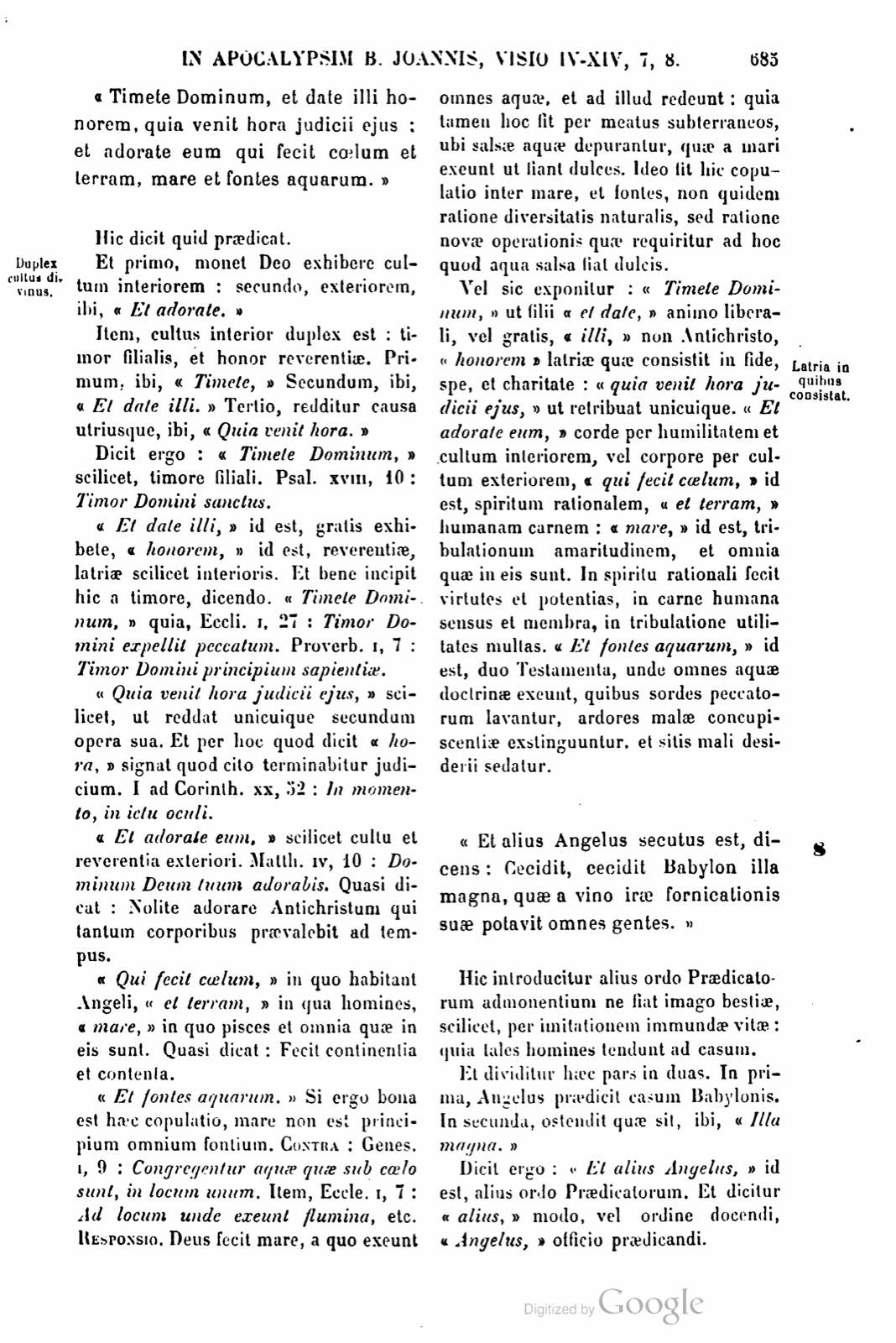
Hic dicit quid praedicat. [Marginal label: Duplex cultus divinus.] Et primo, monet Deo exhibere cultum interiorem: secundo, exteriorem, ibi, "Et adorate." Item, cultus interior duplex est: timor filialis, et honor reverentiae. Primum, ibi, "Timete," Secundum, ibi, "Et date illi." Tertio, redditur causa utriusque, ibi, "Quia venit hora." Dicit ergo: "Timete Dominum," scilicet, timore filiali. Psal. XVIII, 10: Timor Domini sanctus. "Et date illi," id est, gratis exhibete, "honorem," id est, reverentiae, latriae scilicet interioris. Et bene incipit hic a timore, dicendo. "Timete Dominum," quia, Eccli. I, 27: Timor Domini expellit peccatum. Proverb. I, 7: Timor Domini principium sapientiae. "Quia venit hora judicii ejus," scilicet, ut reddat unicuique secundum opera sua. Et per hoc quod dicit "hora," signat quod cito terminabitur judicium. I ad Corinth. XV, 52: In momento, in ictu oculi. "Et adorate eum," scilicet cultu et reverentia exteriori. Matth. IV, 10: Dominum Deum tuum adorabis. Quasi dicat: Nolite adorare Antichristum qui tantum corporibus praevalebit ad tempus. "Qui fecit coelum," in quo habitant Angeli, "et terram," in qua homines, "mare," in quo pisces et omnia quae in eis sunt. Quasi dicat: Fecit continentia et contenta. "Et fontes aquarum." Si ergo bona est haec copulatio, mare non est principium omnium fontium. CONTRA: Genes. I, 9: Congregentur aquae quae sub coelo sunt, in locum unum. Item, Eccle. I, 7: Ad locum unde exeunt flumina, etc. RESPONSIO. Deus fecit mare, a quo exeunt omnes aquae, et ad illud redeunt: quia tamen hoc fit per meatus subterraneos, ubi salsae aquae depurantur, quae a mari exeunt ut fiant dulces. Ideo fit hic copulatio inter mare, et fontes, non quidem ratione diversitatis naturalis, sed ratione novae operationis quae requiritur ad hoc quod aqua salsa fiat dulcis. Vel sic exponitur: "Timete Dominum," ut filii "et date," animo liberali, vel gratis, "illi," non Antichristo, "honorem" [Marginal label: In quibus consistat latria.] latriae quae consistit in fide, spe, et charitate: "quia venit hora judicii ejus," ut retribuat unicuique. "Et adorate eum," corde per humilitatem et cultum interiorem, vel corpore per cultum exteriorem, "qui fecit coelum," id est, spiritum rationalem, "et terram," humanam carnem: "mare," id est, tribulationum amaritudinem, et omnia quae in eis sunt. In spiritu rationali fecit virtutes et potentias, in carne humana sensus et membra, in tribulatione utilitates multas. "Et fontes aquarum," id est, duo Testamenta, unde omnes aquae doctrinae exeunt, quibus sordes peccatorum lavantur, ardores malae concupiscentiae exstinguuntur, et sitis mali desiderii sedatur.
"Having the eternal Gospel, that he might evangelize to those sitting upon the earth and over every nation and tribe and tongue and people. 7. Saying with a great voice." Here the Preachers are described from office. And three things are said. First, that they have the Gospel. Secondly, for what they have it, because in order that they may preach, there, "that they might evangelize." Thirdly, what they preach, there at verse 7: "Fear the Lord." [Marginal label: Eternal Gospel.] Therefore he says: "Having the Gospel," namely, in the heart through love and understanding, in the mouth through preaching and doctrine, in the hand through fulfillment of work. Concerning the first, Psalm 118:11: In my heart I hid your words. Concerning the second, Judges 14:8: Behold, a swarm of bees was in the mouth of the lion, that is, the Gospel in the mouth of the Preacher. Concerning the third, above, Apocalypse 10:1 and 2: I saw another Angel, ... and he had in his hand an open little book. "Eternal," because no other will succeed it. Likewise, because it promises eternal things. Matthew 4:17: Do penance, for the kingdom of heaven has approached. Haymo: "The Angel is said to have the eternal Gospel because that which the Gospel promises will remain forever." And in this it differs from the Old Law, which promised temporal things. Isaiah 1:19: If you are willing and hear me, you will eat the goods of the earth. "That he might evangelize," that is, announce good things and announce well. As if he said: Not that he might place it in a chest, not that he might only revolve it in the heart, not that he might hide it in the earth with the lazy servant 6. From these things he adds: "to those sitting upon the earth," that is, dwelling in contempt of the world, as the Gloss says. "And over every nation," that is, to all Gentiles, "and tribe," that is, to all Jews, who are distinguished by tribes, "and tongue and people," that is, to a people of whatever tongue it may be. Or he says this on account of the noble among both, namely, Jews and Gentiles, who cause their sons to be taught in diverse languages. Or he says this because of the diverse idioms that are contained under the same people. And note that he says "over," to signify that the Preacher ought to be excellent in life. Isaiah 40:9: Ascend upon a high mountain, you who evangelize Sion. "Saying with a great voice." "Saying," namely, the Angel who had the eternal Gospel, "with a great voice," that is, freely and securely from great desire, and because of great things, as because of the honor of God and the salvation of souls.
"Fear the Lord and give him honor, because the hour of his judgment has come; and adore him who made heaven and earth, the sea and the fountains of waters."
Here he says what he preaches. [Marginal label: Twofold divine worship.] And first, he admonishes them to show interior worship to God; secondly, exterior worship, there, "and adore." Likewise, interior worship is twofold: filial fear and the honor of reverence. The first is there, "Fear"; the second, there, "and give him." Thirdly, the cause of both is given, there, "because the hour has come." Therefore he says: "Fear the Lord," namely, with filial fear. Psalm 18:10: The fear of the Lord is holy. "And give him," that is, show freely, "honor," that is, of reverence, namely of interior latria. And he rightly begins here from fear, saying, "Fear the Lord," because Ecclesiasticus 1:27 says: The fear of the Lord drives out sin. Proverbs 1:7: The fear of the Lord is the beginning of wisdom. "Because the hour of his judgment has come," namely, that he may render to each one according to his works. And by the fact that he says "hour," he signifies that judgment will be quickly ended. 1 Corinthians 15:52: In a moment, in the twinkling of an eye. "And adore him," namely with exterior worship and reverence. Matthew 4:10: You shall adore the Lord your God. As if he said: Do not adore Antichrist, who will prevail only over bodies for a time. "Who made heaven," in which Angels dwell, "and earth," in which men dwell, "the sea," in which fish and all things that are in them dwell. As if he said: He made the containing things and the things contained. "And fountains of waters." If therefore this joining is good, the sea is not the principle of all fountains. ON THE CONTRARY: Genesis 1:9: Let the waters that are under heaven be gathered into one place. Likewise, Ecclesiastes 1:7: To the place whence rivers go out, etc. RESPONSE. God made the sea, from which all waters go out and to which they return; yet because this happens through underground passages, where salt waters that go out from the sea are cleansed so that they become sweet, therefore here a joining is made between sea and fountains, not indeed by reason of natural diversity, but by reason of the new operation that is required so that salt water may become sweet. Or it is explained thus: "Fear the Lord," as sons, "and give," with a liberal mind, or freely, "to him," not to Antichrist, "honor" [Marginal label: In what latria consists.] of latria, which consists in faith, hope, and charity: "because the hour of his judgment has come," so that he may repay each one. "And adore him," with the heart through humility and interior worship, or with the body through exterior worship, "who made heaven," that is, the rational spirit, "and earth," human flesh; "the sea," that is, the bitterness of tribulations, and all things that are in them. In the rational spirit he made virtues and powers; in human flesh, senses and members; in tribulation, many useful things. "And fountains of waters," that is, the two Testaments, from which all waters of doctrine go out, by which the stains of sins are washed, the heats of evil concupiscence are extinguished, and the thirst of evil desire is calmed.
8. "Et alius Angelus secutus est, dicens: Cecidit, cecidit Babylon illa magna, quae a vino irae fornicationis suae potavit omnes gentes."
Hic introducitur alius ordo Praedicatorum admonentium ne fiat imago bestiae, scilicet, per imitationem immundae vitae: quia tales homines tendunt ad casum. Et dividitur haec pars in duas. In prima, Angelus praedicit casum Babylonis. In secunda, ostendit quae sit, ibi, "Illa magna." Dicit ergo: "Et alius Angelus," id est, alius ordo Praedicatorum. Et dicitur "alius," modo, vel ordine docendi, "Angelus," officio praedicandi. "Secutus est" eum, scilicet, priorem. Glossa: "Because preachers succeed one another." "Dicens: Cecidit, cecidit Babylon," id est, malorum congregatio. Et dicit hic: "Cecidit," vel propter certitudinem, vel quia ipsi et gloria eorum cadent. Quod Angelus ruinam perfidae civitatis congeminando denuntiat, simul cum ipsis omnem eorum gloriam perituram demonstrat. Vel, ut Bernardus hic dicit: "Cecidit," propter casum in culpam in praesenti, et propter casum in poenam in futuro: quia primo cadunt per consensum peccati, secundo per opus: et ponitur praeteritum pro futuro ratione duplici, vel propter certitudinem prophetiae, vel quia ipsi propter superbiam dejecti sunt a Deo. Psal. LXXII, 18: Dejecisti eos, dum allevarentur." [Marginal label: Cecidit Babylon.] Est ergo sensus: "Cecidit, cecidit Babylon," id est, malorum universitas et malitia et iniquitas. Babylon interpretatur confusio, et signat illos qui vitam immundam ducunt, et maxime de quibus dicitur, ad Philip. III, 19: "Quorum Deus venter est: et gloria in confusione ipsorum, etc." "Illa magna," vitiorum enormitate, vel malorum multitudine. Eccli. I, 15: Stultorum infinitus est numerus. "Quae a vino irae fornicationis suae," id est, erroris sui diffusione, "potavit omnes Gentes," id est, gentiliter viventes. [Marginal label: Idolatria dicitur fornicatio, et vinum irae.] NOTA: Idololatria nominatur hic fornicatio. Psal. LXXII, 27: Perdidisti omnes qui fornicantur abs te: quae fornicatio vinum dicitur, quia inebriat ut intellectum auferat, quia facit servire creaturae, Creatore relicto: et vinum irae dicitur, quia ad iram et vindictam Deum provocat. Psal. CV, 29: In iram concitaverunt eum in collibus suis: et in sculptilibus suis ad aemulationem eum provocaverunt 7, id est, ad vindictam. Vel, "Vinum irae fornicationis" dicitur gloria temporalis, quae bibitur cum jucunditate: et ideo dicitur "vinum irae," quia iram Dei provocat: "fornicationis," quia facit fornicari a Deo: de qua, Jerem. LI, 7: Calix aureus Babylonis in manu Domini, inebrians omnem terram. De vino ejus biberunt omnes gentes. Vel, "Vinum irae fornicationis" dicitur quodlibet mortale quod mentem seducit et separat a Deo, ut fornicatio corporalis a sponso, et Deum provocat ad iram. Infra, Apocal. XVIII, 7: Quantum glorificavit se, et in deliciis fuit, etc.
8. "And another Angel followed, saying: Fallen, fallen is that great Babylon, which from the wine of the wrath of her fornication made all nations drink."
Here another order of Preachers is introduced, admonishing that the image of the beast should not be made, namely by imitation of an unclean life, because such men tend toward a fall. And this part is divided into two. In the first, the Angel foretells the fall of Babylon. In the second, he shows what Babylon is, there, "that great one." Therefore he says: "And another Angel," that is, another order of Preachers. And he is called "another" in manner or order of teaching, "Angel" by office of preaching. "He followed" him, namely the former one. The Gloss: "Because Preachers succeed one another." "Saying: Fallen, fallen is Babylon," that is, the congregation of the evil. And here he says "fallen," either because of certainty, or because they themselves and their glory will fall. Because the Angel announces by doubling it the ruin of the faithless city, he shows at the same time that all their glory will perish together with them. Or, as Bernard says here: "Fallen," because of the fall into guilt in the present, and because of the fall into punishment in the future; because first they fall through consent to sin, secondly through work; and the past is put for the future for a double reason, either because of the certainty of prophecy, or because they themselves because of pride have been cast down by God. Psalm 72:18: You cast them down when they were being lifted up." [Marginal label: Babylon has fallen.] Therefore the sense is: "Fallen, fallen is Babylon," that is, the universality of the evil and malice and iniquity. Babylon is interpreted confusion, and signifies those who lead an unclean life, and especially those of whom it is said in Philippians 3:19: "Whose God is the belly, and whose glory is in their confusion, etc." "That great one," by enormity of vices or by multitude of evils. Ecclesiasticus 1:15: The number of fools is infinite. "Which from the wine of the wrath of her fornication," that is, by the diffusion of her error, "made all nations drink," that is, those living in Gentile fashion. [Marginal label: Idolatry is called fornication and wine of wrath.] NOTE: Idolatry is named here fornication. Psalm 72:27: You have destroyed all who fornicate away from you; this fornication is called wine because it inebriates so that it takes away understanding, because it makes one serve the creature with the Creator left behind; and it is called wine of wrath because it provokes God to wrath and vengeance. Psalm 105:29: They stirred him to wrath on their hills, and in their graven images they provoked him to jealousy 7, that is, to vengeance. Or, "wine of the wrath of fornication" is called temporal glory, which is drunk with delight; and therefore it is called "wine of wrath," because it provokes the wrath of God; "of fornication," because it makes one fornicate from God; concerning which, Jeremiah 51:7 says: Babylon was a golden chalice in the hand of the Lord, inebriating all the earth. All nations drank of its wine. Or, "wine of the wrath of fornication" is called any mortal sin that seduces the mind and separates it from God, as bodily fornication separates from a spouse, and provokes God to wrath. Below, Apocalypse 18:7: As much as she glorified herself and was in delights, etc.
9. "Et tertius Angelus secutus est illos, dicens voce magna: Si quis adoraverit bestiam et imaginem ejus, et acceperit characterem in fronte sua, aut in manu sua, 10. Et hic bibet de vino irae Dei, quod mistum est mero in calice irae ipsius: et cruciabitur igne et sulphure in conspectu Angelorum sanctorum, et ante conspectum Agni: 11. Et fumus tormentorum eorum ascendet in saecula saeculorum: nec habent requiem die ac nocte qui adoraverunt bestiam et imaginem ejus, et si quis acceperit characterem nominis ejus."
Hic introducitur tertius Angelus, id est, tertius ordo Praedicatorum admonentium ne aliquis characterem bestiae accipiat. Et primo, comminatur omnibus qui bestiam adoraverunt. Secundo, quod propter haec Sancti mandatum Dei custodiunt, ibi, v. 12: "Hic patientia sanctorum est." In prima parte duo dicuntur. Primo, introducitur ordo Praedicatorum clamans. Secundo, dicitur quid clamat, ibi, "Si quis adoraverit." Dicit ergo: "Et tertius Angelus," id est, tertius ordo Praedicatorum, "secutus est illos," id est, duos praecedentes. Et dicitur tertius propter fidem Trinitatis quam praedicabit sicut alii. Vel etiam, tertius ordine temporis, non multitudine credulitatis, et significat iste Angelus ultimum ordinem Praedicatorum, qui quanto plus viderint, clamando monstrabunt. "Dicens voce magna," id est, magna praedicationis instantia. Vel, "Magna," id est, libera et secura: [Marginal label: Imago Antichristi.] "Si quis adoraverit bestiam," id est, Antichristum qui est bestia per crudelitatem, "et imaginem ejus," id est, Apostolos ejus, qui eum imitantur, et eum repraesentant factis et moribus. Vel sic: "Imaginem ejus," id est, statuam factam ad honorem ejus. Forte illi qui praesentes erunt, adorabunt eum. Alii qui erunt absentes, habebunt imaginem ejus quam adorabunt in honore ejus, sicut nos adoramus imaginem Crucifixi in honorem Christi. "Et acceperit characterem ejus," id est, fidem, "in fronte sua," scilicet, per apertam confessionem. Vel, [Marginal label: Character ejus.] "Characterem," ad litteram, id est, signum aliquod quod in ejus venerationem portabunt, et aperte confitebuntur se esse discipulos ejus. "Aut in manu sua," per puram operis exhibitionem.
9. "And the third Angel followed them, saying with a great voice: If anyone adored the beast and its image and received the character on his forehead or on his hand, 10. this one also shall drink of the wine of God's wrath, which is mixed with pure wine in the chalice of his wrath; and he shall be tormented with fire and sulphur in the sight of the holy Angels and before the sight of the Lamb; 11. and the smoke of their torments shall ascend forever and ever; and they have no rest by day or by night, those who adored the beast and its image, and if anyone received the character of its name."
Here the third Angel is introduced, that is, the third order of Preachers admonishing that no one should receive the character of the beast. And first he threatens all who adored the beast. Secondly, that because of these things the Saints keep the commandment of God, there at verse 12: "Here is the patience of the saints." In the first part two things are said. First, the order of Preachers crying out is introduced. Secondly, what it cries is said, there, "If anyone adored." Therefore he says: "And the third Angel," that is, the third order of Preachers, "followed them," that is, the two preceding ones. And it is called third because of the faith of the Trinity which it will preach like the others. Or also, third in order of time, not in multitude of credulity; and this Angel signifies the last order of Preachers, who, the more they have seen, the more by crying out they will show. "Saying with a great voice," that is, with great insistence of preaching. Or, "great," that is, free and secure: [Marginal label: Image of Antichrist.] "If anyone adored the beast," that is, Antichrist, who is a beast through cruelty, "and its image," that is, his apostles, who imitate him and represent him by deeds and morals. Or thus: "its image," that is, a statue made for his honor. Perhaps those who will be present will adore him. Others who will be absent will have his image, which they will adore in his honor, just as we adore the image of the Crucified in honor of Christ. "And received his character," that is, faith, "on his forehead," namely through open confession. Or, [Marginal label: His character.] "character," literally, that is, some sign which they will carry in veneration of him, and they will openly confess themselves to be his disciples. "Or on his hand," through pure exhibition of work.
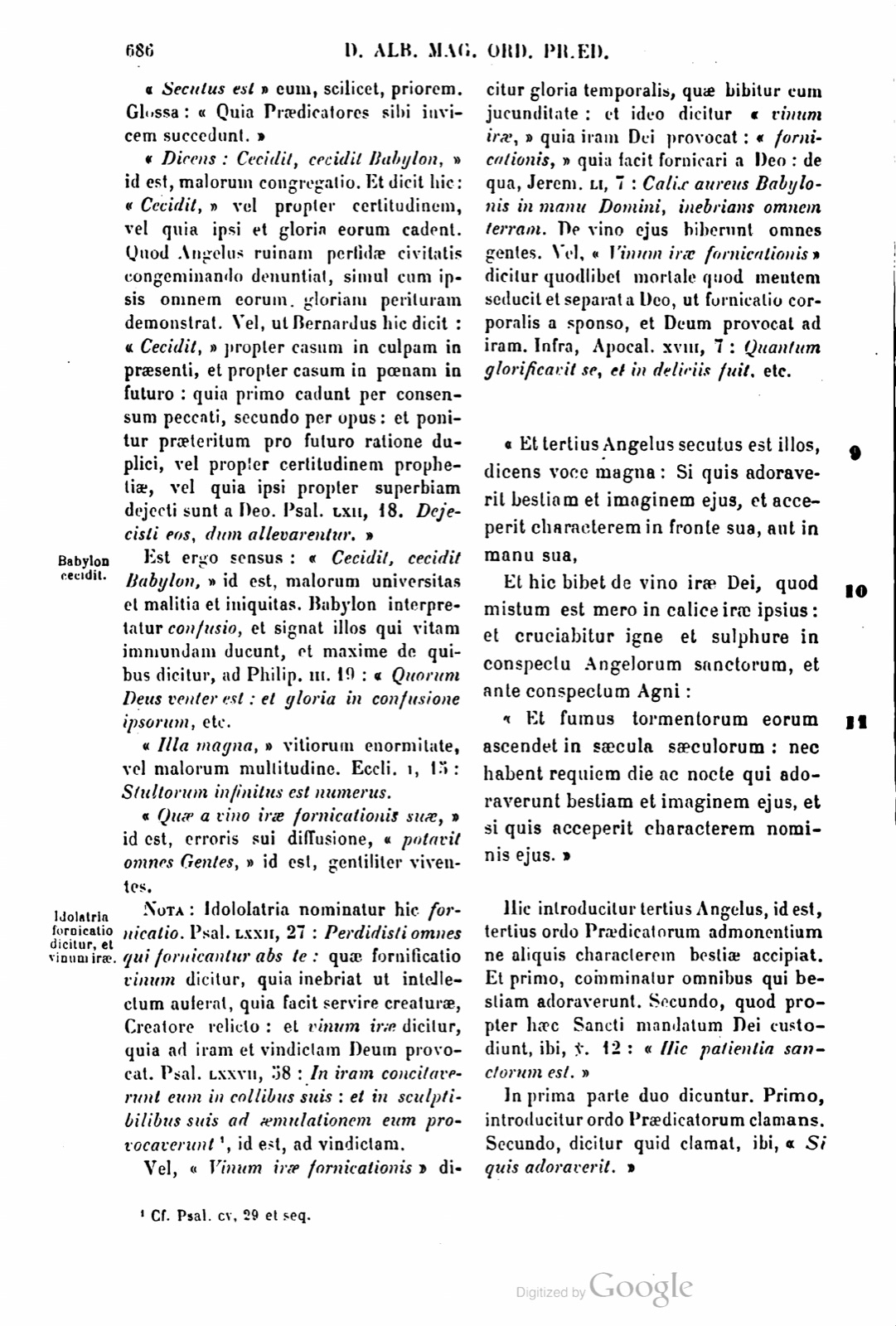
"Et hic bibet de vino irae Dei, etc." Hic comminatur eis aeternam damnationem. Unde: "Et hic bibet de vino irae Dei," id est, de damnatione aeterna, "quod mistum est mero," id est, aliqua temporali jucunditate in praesenti, id est, in poena flagellationum, quam facit Deus ad correctionem: "in calice irae ipsius," id est, in vindicta quam quasi iratus propinat. [Marginal label: Calix ejus.] In hoc calice duo sunt: Unum quod est purum, aliud quod est impurum, quod est faex. Unde cum dicit: "Quod mistum est mero," patet, quod sumitur pro parte impura. Est ergo sensus: "Si quis adoraverit, etc., et hic bibet de vino irae Dei," id est, de faece vini, quae est in calice ipsius. Quasi dicat: Damnabitur in inferno, ubi habebit abundanter tribulationem et poenam. "Quod mistum est mero," id est, quae poena et tribulatio admixta est modo, "in calice irae ipsius," id est, in vindicta praesenti quam Dominus quasi iratus infligit. Psal. LXXIV, 9: Calix in manu Domini, vini meri plenus misto. "Et cruciabitur" igne, id est, ardore, "et sulphure," id est, foetore. Hoc dicit, quia in omni peccato est fervor libidinis vel improbae voluntatis. Item, "Sulphure," quia omne peccatum suum habet foetorem: quia statim post peccatum anima sentit remorsum. "In conspectu Angelorum sanctorum." Hic dicitur quod poena erit manifesta in conspectu omnium Angelorum, id est, videntibus omnibus Angelis: nec solum intelliguntur hic Angeli, sed omnes electi secundum Bedam. "Et ante conspectum Agni," id est, tanto terrore terrebuntur, ut videatur Deus omnipotens semper illis praesens esse, eisque iram vindictae suae semper infligere. "Et fumus tormentorum eorum," quae erunt diversa et multa, "ascendet in saecula saeculorum," id est, sine fine perseverabit, ut dicit Glossa. Ubi enim fumus semper ascendet, ibi ignis numquam deficiet. Isa. XXXIV, 10: In sempiternum ascendet fumus ejus: a generatione in generationem desolabitur, etc. Et per hoc quod dicit, ascendet, notatur, non quod ascendet in coelum, sed quia erit in notitia Sanctorum. "Nec habent requiem." Hic dicit, quod continua erit poena: posset enim esse aeterna, et tamen non continuari, sicut tertiarius dicitur semper habere febrem, quia semper habet causam febris, non tamen continue calens: sic non
"And this one shall drink of the wine of the wrath of God, etc." Here he threatens them with eternal damnation. Hence: "And this one shall drink of the wine of the wrath of God," that is, of eternal damnation, "which is mixed with pure wine," that is, with some temporal pleasantness in the present, that is, in the punishment of scourges which God makes for correction; "in the chalice of his wrath," that is, in the vengeance which, as if angry, he presents to drink. [Marginal label: His chalice.] In this chalice there are two things: one which is pure, another which is impure, which is dregs. Hence when he says, "which is mixed with pure wine," it is clear that it is taken for the impure part. Therefore the sense is: "If anyone adored, etc., and this one shall drink of the wine of the wrath of God," that is, of the dregs of the wine, which is in his chalice. As if he said: He will be damned in hell, where he will have tribulation and punishment abundantly. "Which is mixed with pure wine," that is, this punishment and tribulation is now mixed, "in the chalice of his wrath," that is, in the present vengeance which the Lord, as if angry, inflicts. Psalm 74:9: A chalice is in the hand of the Lord, full of unmixed wine mixed. "And he shall be tormented" with fire, that is, with burning, "and sulphur," that is, with stench. He says this because in every sin there is the heat of lust or of a perverse will. Likewise, "with sulphur," because every sin has its own stench; because immediately after sin the soul feels remorse. "In the sight of the holy Angels." Here it is said that the punishment will be manifest in the sight of all Angels, that is, with all Angels seeing; nor are only Angels understood here, but all the elect according to Bede. "And before the sight of the Lamb," that is, they will be terrified by such great terror that almighty God will seem always to be present to them and always to inflict on them the wrath of his vengeance. "And the smoke of their torments," which will be diverse and many, "shall ascend forever and ever," that is, will persevere without end, as the Gloss says. For where smoke will always ascend, there fire will never fail. Isaiah 34:10: Its smoke shall ascend forever; from generation to generation it will be desolate, etc. And by the fact that he says "ascend," it is marked, not that it will ascend into heaven, but that it will be in the knowledge of the Saints. "And they have no rest." Here he says that the punishment will be continuous; for it could be eternal and nevertheless not be continued, just as a tertian is said always to have a fever, because he always has the cause of fever, yet is not continuously hot: thus not
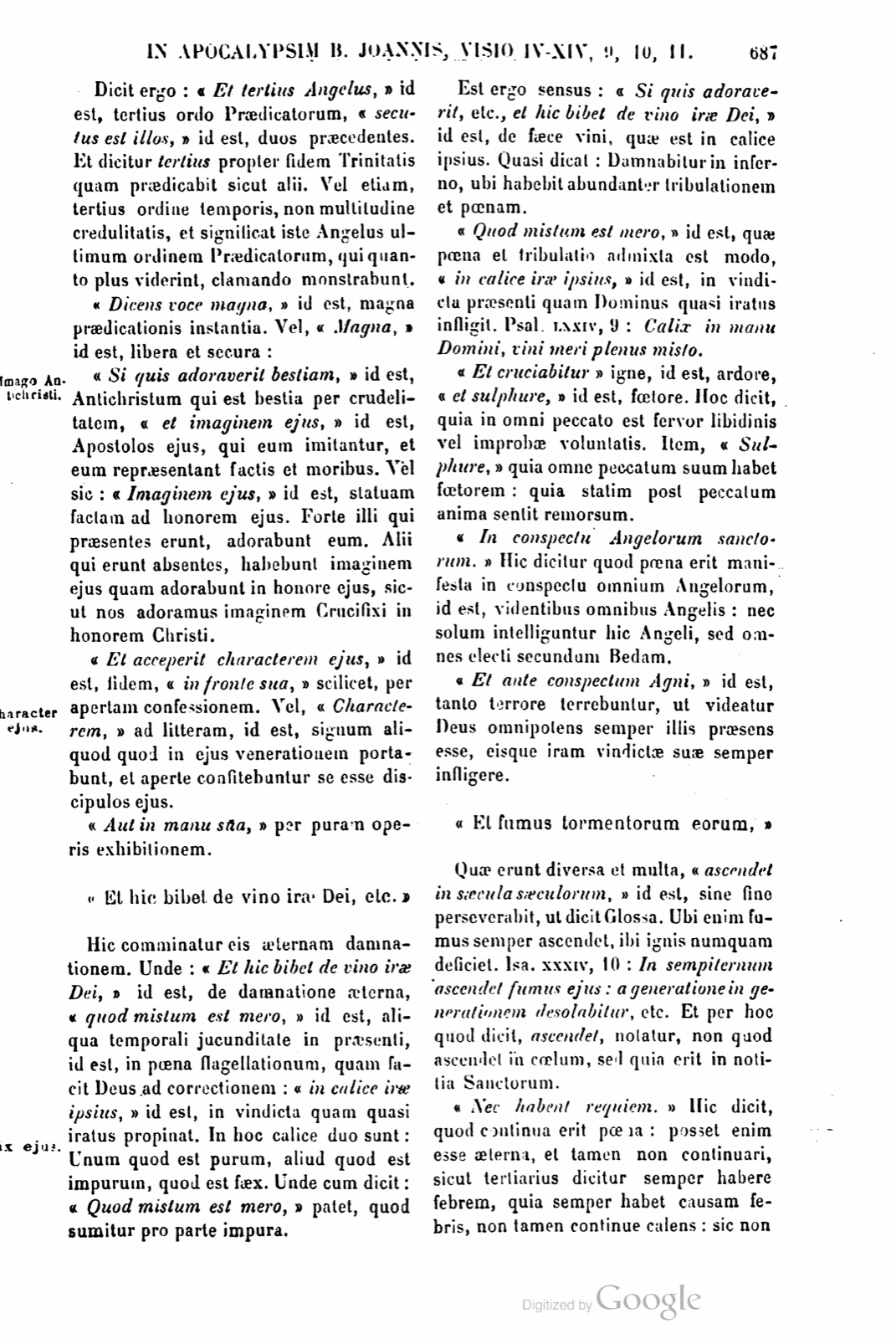
Notes
- Saint John Damascene, Book IV On the Orthodox Faith, chapter 18. (S. J. Damascenus, Lib. IV de Fide orthodoxa, cap. 18.) ↩
- Psalm 145:6; Acts 14:14. (Psal. CXLV, 6; Act. XIV, 14.) ↩
- Isaiah 21:9; Jeremiah 51:8. (Isa. XXI, 9; Jerem. LI, 8.) ↩
- Joel 3:13; Matthew 13:39. (Joel III, 13; Matth. XIII, 39.) ↩
- Isaiah 54:1. (Isa. LIV, 1.) ↩
- Compare Matthew 25:24 and following. (Cf. Matth. XXV, 24 et seq.) ↩
- Compare Psalm 105:29 and following. (Cf. Psal. CV, 29 et seq.) ↩
If a page does not appear, its photograph has not been uploaded yet.