Works › Commentary on the Apocalypse of Blessed John
Volume 38 · pp. 621–626
Chapter IX: sixth trumpet and doubts
A marker with ≈ is an approximate page boundary, placed by measure of the text; the page photographs remain the authority. In the paired views, clicking a page marker brings that page into view.
ante oculos Dei, » sicut filius ante patrem cui complacet. Matth. XVII, 5: Hic est Filius meus dilectus, etc., ut advocatus ante judicem. I Joannis II, 1: Advocatum habemus apud Patrem, etc.
« Dicentem sexto Angelo, »
Id est, Praedicatoribus universis qui futuri sunt tempore Antichristi, « qui habebat tubam, » id est, praedicandi et docendi auctoritatem: « Solve, » id est, annuntia esse solvendos, « quatuor Angelos, » id est, daemones qui dicuntur Angeli, id est, missi, qui mittuntur a Deo ad probationem bonorum, et a diabolo principe eorum, et sua propria voluntate ad damnationem malorum. Et dicuntur quatuor, sicut dicit Haymo, propter quatuor regna principalia quibus opponuntur, scilicet Assyriorum, Medorum, Macedonum, Romanorum. Vel, propter quadruplicem tentandi modum. Tentatio enim aut est gravis et occulta; aut gravis et manifesta; aut levis et occulta; aut levis et manifesta.
« Qui alligati sunt, » scilicet, divina potentia, « in flumine magno Euphrate, » id est, in malignorum hominum cordibus. Euphrates enim, ut dicit Beda, fluvius est Babylonis, et in hoc loco potentiam saecularem signat, in qua diabolus dicitur alligatus, quia ne quantum velit noceat divina potentia refraenatur. Haymo: « In principibus hujus saeculi maxime diabolus habitat, et regnat. » Et bene significantur per Euphraten qui est fluvius impetuosus, et profundus, currens per Babyloniam, et interpretatur humus, vel pulverulentus, vel fructifer, aut crescens. Et potentes sunt fluvius, id est, fluidi: quia decurrunt per luxuriam ad mare inferni: magnus, propter personarum magnitudinem: profundus, propter astutiam: impetuosus, propter furorem et iracundiam: currunt per saeculum per avaritiam in humo et pulvere, id est, carnis deliciis, ut temporalibus divitiis crescentes.
« Et soluti sunt quatuor Angeli, etc. »
« Et soluti sunt, » id est, solventur tempore statuto et praefinito a Deo, « quatuor Angeli, » scilicet, daemones, « qui parati erant, » malitia et diligenti astutia, « in horam, et diem, et mensem, et annum. » Sicut dicit Haymo, per horam intelligitur dimidius annus. Per alia tria intelliguntur tres anni quibus persecutio Antichristi durabit. Daniel. XII, 6: Usquequo finis horum mirabilium? et respondetur, V. 7: Quia in tempus, et tempora, et dimidium temporis, scilicet, durabit persecutio Antichristi. Et per tempus unus annus intelligitur, et per duo tempora duo anni, per dimidium temporis dimidius annus. Vel per hoc, ut dicit Glossa, processus illius persecutionis notatur. Per horam signatur initium, per diem processus, per mensem profectus, per annum multiplicatio. Unde in primo erit gravis, in secundo gravior, in tertio gravissima, et in fine omnino desaeviet, ut vix ab aliquo possit sustineri. Infra, XII, 12: Vae terrae et mari, quia descendit diabolus ad vos, habens iram magnam, sciens quod modicum tempus habet.
Est ergo sensus: « Qui parati erant in horam, etc., » id est, in omni parte temporis affligere continue et sine interpolatione, sicut non invenitur interpolatio inter partes diei, mensis et anni. Et dicuntur parati, ut etiam nos parare studeamus, et imparati non inveniamur. Matth. XXIV, 44: Ideo et vos estote parati.
« Ut occiderent. » Quasi dicat: Ad hoc erant parati, ut occiderent prius morte culpae, et postea morte gehennae.
“before the eyes of God,” as a son before a father to whom he is pleasing. Matthew XVII, 5: This is my beloved Son, etc.; as an advocate before a judge. 1 John II, 1: We have an advocate with the Father, etc.
“Saying to the sixth Angel,”
That is, to all the Preachers who will exist in the time of Antichrist, “who had the trumpet,” that is, the authority of preaching and teaching: “Loose,” that is, announce that “the four Angels” are to be loosed, that is, the demons who are called Angels, that is, the sent ones, who are sent by God for the testing of the good, and by the devil, their prince, and by their own will, for the damnation of the evil. And they are called four, as Haymo says, because of the four principal kingdoms to which they are opposed, namely of the Assyrians, Medes, Macedonians, and Romans. Or, because of the fourfold mode of tempting. For temptation is either grave and hidden, or grave and manifest, or light and hidden, or light and manifest.
“Who are bound,” namely by divine power, “in the great river Euphrates,” that is, in the hearts of malignant human beings. For Euphrates, as Bede says, is the river of Babylon, and in this place signifies secular power, in which the devil is said to be bound, because he is restrained by divine power so that he may not harm as much as he wishes. Haymo says: “The devil especially dwells and reigns in the princes of this age.” And they are rightly signified by Euphrates, which is an impetuous and deep river, running through Babylonia, and is interpreted ground, or dusty, or fruitful, or increasing. And the powerful are a river, that is, fluid, because they run down through lust to the sea of hell: great, because of the greatness of persons; deep, because of cunning; impetuous, because of fury and anger; they run through the age by avarice in ground and dust, that is, in the delights of the flesh, as those increasing in temporal riches.
“And the four Angels were loosed, etc.”
“And they were loosed,” that is, they will be loosed at the time appointed and preestablished by God, “the four Angels,” namely demons, “who had been prepared,” by malice and careful cunning, “for the hour and day and month and year.” As Haymo says, by the hour half a year is understood. By the other three are understood the three years during which the persecution of Antichrist will last. Daniel XII, 6: How long until the end of these wonders? and it is answered, V. 7: Because for a time, and times, and half a time, namely, the persecution of Antichrist will last. And by a time one year is understood, by two times two years, and by half a time half a year. Or by this, as the Gloss says, the course of that persecution is noted. By the hour the beginning is signified, by the day the course, by the month the progress, by the year the multiplication. Hence in the first it will be grave, in the second more grave, in the third most grave, and at the end it will rage utterly, so that it can scarcely be endured by anyone. Below, XII, 12: Woe to the earth and sea, because the devil has descended to you, having great wrath, knowing that he has a little time.
Therefore the sense is: “Who had been prepared for the hour, etc.,” that is, to afflict in every part of time continuously and without interruption, just as no interruption is found between the parts of day, month, and year. And they are called prepared so that we also may be eager to prepare, and may not be found unprepared. Matthew XXIV, 44: Therefore you also be ready.
“To kill.” As if he were saying: They were prepared for this, to kill first by the death of guilt, and afterward by the death of Gehenna.
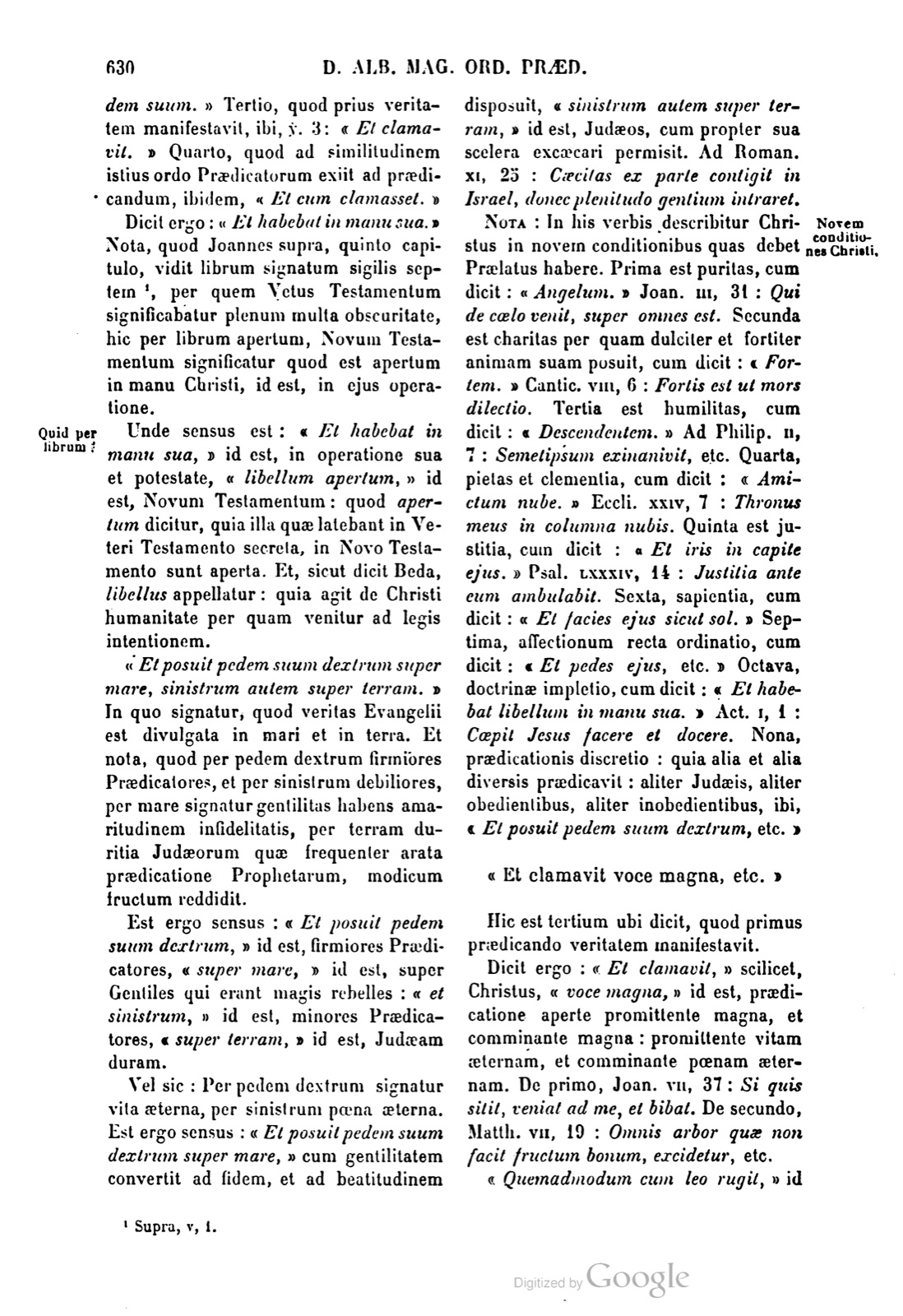
« Tertiam partem hominum, » id est, omnes reprobos. Prima pars hominum sunt innocentes, secunda poenitentes, tertia reprobi. Vel, prima pars activi, secunda contemplativi, tertia reprobi.
Est ergo sensus: « Ut occiderent, » ut prius, « tertiam partem hominum, » hoc est, illos qui recedunt a binario innocentiae et poenitentiae: vel activae vitae et contemplativae, de qua, supra, VIII, 7: Et tertia pars terrae combusta est.
16. « Et numerus equestris exercitus vicies millies dena millia: et audivi numerum eorum.
17. Et ita vidi equos in visione. »
Hic est secunda pars quae est de visione equitum et equorum.
Et dicuntur hic quatuor. Primo, ponitur numerus equitum. Secundo, dicit se vidisse equos eorum, ibi, V. 17: « Et ita vidi equos. » Tertio, describit equites eorum, ibidem, « Et qui sedebant. » Quarto, describit equos eorum, et capita equorum, ibidem, « Et capita equorum, etc. »
Dicit ergo: « Et numerus equestris exercitus. » Nota: Hic secundum Haymonem, numerus ponitur reproborum, et similiter Sanctorum: et primo numerus malorum, secundo bonorum. Unde dicit: « Et numerus equestris exercitus, » id est, malorum, « vicies millies, » id est, viginti millia: qui vicies dicuntur, quia praedicatores diaboli erunt transgressores decalogi. Mille dicuntur, quia perseverabunt in transgressione tali.
« Dena millia, » supple, erat numerus equitum Dei, hoc est, bonorum. Psal. LXVII, 18: Currus Dei decem millibus multiplex, etc. Et boni per decem millia signantur, quia in observantia decalogi et bono perseverant.
Hic quaeritur secundum istam expositionem, Quare prius ponit numerum malorum quam bonorum? Item, Quare malos signat per adverbia, bonos per nomina? Item, Quare exercitus malorum et bonorum designantur per numerum significantem, et non per numerum numerantem?
Responsio. Ad primum dicendum, quod numerum malorum ponit primo, deinde bonorum propter tria. Primo, ne visa multitudine malorum Sancti desperent. Secundo, ut consolentur boni: quia boni per malos Angelos conservabuntur, et arctabuntur mali. Tertio, ne possit aliquis praesumere de viribus suis, dicens se stabilem fuisse in bonis suis: et ideo post malorum multitudinem ostenditur multitudo bonorum, etsi non tanta quanta malorum.
Ad secundum dicendum, quod hoc signat quod malum non stat per se, sed convalescit in bono, ut malum culpae in actione, malum reatus in anima.
Ad tertium dicendum, quod ponitur hic numerus significans, et non numerus numerans: quia finitus numerus ponitur hic pro infinito: unde iste numerus vicies millies non numerat exercitum Angelorum sive daemonum, sed tantum signat quod plures sunt quam per hunc numerum exprimantur.
Sed adhuc restat, Quare numerus signans ponatur hic, et non numerans? Cujus causa est, quia cum liber iste sit revelatio facta ad aedificationem Ecclesiae: et numerus numerans non est ad aedificationem, sed numerus signans, quia per hunc signatur quales sunt illi et isti, quod non fieret per numerum numerantem.
Nota: Cum sint novem ordines Angelorum, ad decimum qui cecidit, dena millia referuntur. Per millies vero qui est numerus multiplex, daemonum multitudo signatur. Per vicies vero quod bis decem continet, ostendit decimum ordinem daemonum de malis hominibus duplicatum. Nihil ergo aliud est secundum hos, « vicies millies dena millia equestris exercitus, » nisi quod decimus ordo ex daemonibus et malis hominibus duplicatus, infinitus existit, qui contra Ecclesiam tempore Antichristi pugnabunt.
“The third part of human beings,” that is, all the reprobate. The first part of human beings are the innocent, the second the penitents, the third the reprobate. Or, the first part are the active, the second the contemplative, the third the reprobate.
Therefore the sense is: “To kill,” as before, “the third part of human beings,” that is, those who withdraw from the pair of innocence and penance; or from the active life and the contemplative life, concerning which, above, VIII, 7: And the third part of the earth was burned up.
16. “And the number of the mounted army was twenty thousand times ten thousand; and I heard their number.
17. And thus I saw the horses in the vision.”
This is the second part, which concerns the vision of the riders and horses.
And four things are said here. First, the number of the riders is set down. Second, he says that he saw their horses, there, V. 17: “And thus I saw the horses.” Third, he describes their riders, in the same place, “And those who sat.” Fourth, he describes their horses and the heads of the horses, in the same place, “And the heads of the horses, etc.”
Therefore he says: “And the number of the mounted army.” Note: Here according to Haymo, the number of the reprobate is set down, and likewise of the Saints: first the number of the evil, second of the good. Hence he says: “And the number of the mounted army,” that is, of the evil, “twenty thousand times,” that is, twenty thousands: they are called twenty because the preachers of the devil will be transgressors of the decalogue. They are called thousands because they will persevere in such transgression.
“Ten thousands,” supply, was the number of the riders of God, that is, of the good. Psalm LXVII, 18: The chariot of God is manifold by ten thousands, etc. And the good are signified by ten thousands because they persevere in the observance of the decalogue and in the good.
Here it is asked according to this exposition: Why does he set down the number of the evil before that of the good? Likewise, why does he signify the evil by adverbs, the good by nouns? Likewise, why are the army of the evil and the army of the good designated by a signifying number and not by a numbering number?
Response. To the first it must be said that he sets down the number of the evil first, then of the good, for three reasons. First, lest the Saints despair when the multitude of the evil has been seen. Second, so that the good may be consoled, because the good will be preserved through evil Angels, and the evil will be constrained. Third, lest anyone be able to presume upon his own strength, saying that he had been stable in his goods; and therefore after the multitude of the evil the multitude of the good is shown, even if not so great as that of the evil.
To the second it must be said that this signifies that evil does not stand through itself, but grows strong in the good, as the evil of guilt in an action, the evil of liability in the soul.
To the third it must be said that here a signifying number is set down, and not a numbering number, because a finite number is set down here for an infinite one; hence that number “twenty thousand times” does not number the army of Angels or demons, but only signifies that there are more than are expressed by this number.
But it still remains: Why is a signifying number set down here, and not a numbering number? The cause of this is that, since this book is a revelation made for the building up of the Church, a numbering number is not for building up, but a signifying number is, because through it is signified what kind those and these are; this would not happen through a numbering number.
Note: Since there are nine orders of Angels, the ten thousands are referred to the tenth, which fell. But by “thousands,” which is a multiple number, the multitude of demons is signified. By “twenty,” which contains ten twice, he shows the tenth order of demons doubled from evil human beings. Therefore according to these, “twenty thousand times ten thousand of the mounted army” is nothing other than that the tenth order, doubled from demons and evil human beings, exists as infinite; they will fight against the Church in the time of Antichrist.
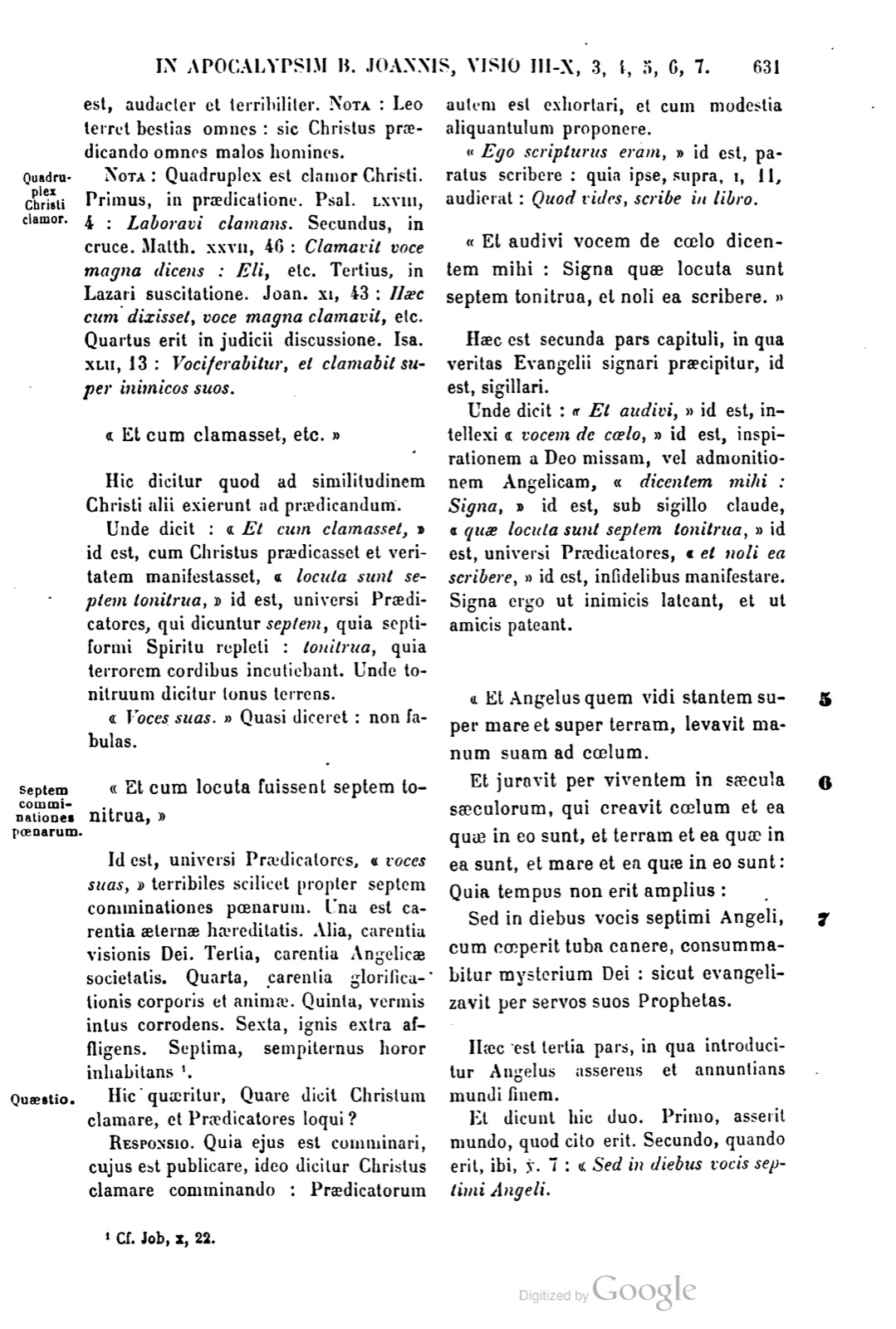
Alii dicunt, quod per utrumque numerum tantum boni signantur. Et dicunt, quod per numerum bonorum hic positum intelligitur numerus malorum: quia malum non potest esse nisi in bono. Per vicies millies intelliguntur Sancti Novi Testamenti, qui decalogum servant ad litteram: et secundum spiritualem intelligentiam in vicenario perfecta justitia. Per dena millia signantur Sancti Veteris Testamenti qui legem ad litteram observabant. Et quoniam contra utrosque bellum habuit diabolus, propter hoc per hos numeros intelliguntur exercitus daemonum et equitum et equorum. Equi enim sunt mali homines, equites sunt daemones.
Unde dicit: « Et numerus equestris exercitus, » scilicet, daemonum et suorum equorum, « vicies millies, » id est, signatus per hos numeros non praecise numeratus. Unde ponitur finitum pro infinito. Et sic e contrario numerus equestris exercitus Dei tam hominum quam Angelorum, « dena millia, » id est, signatus per hos numeros.
« Et audivi numerum eorum, »
Id est, intellexi quid ille numerus signaret, vel quod plures essent mali quam boni.
« Et ita vidi equos in visione, »
Scilicet, sicuti vidi numerum equitum, ita intellexi numerum equorum. Et per equos intelliguntur praedicatores errorum super quos ascendunt daemones, sicut, Exod. XV, 1, dicitur: Equum et ascensorem dejecit in mare.
Vel sic: « Et ita vidi equos in visione, » id est, sicut equites intendunt ad destruendam Ecclesiam: sic vidi equos, id est, malos praedicatores tendere ad destructionem Ecclesiae. Nam equi et equites ad idem tendunt, sed dicuntur equi per equites a quibus ducuntur. Sic Antichristiani per daemones ducti contra Ecclesiam pugnabunt.
« Et qui sedebant super eos habebant loricas igneas, et hyacinthinas, et sulphureas. »
Hic describit daemones qui sunt equites a poena quam sustinent, et ad quam trahunt suos sequaces.
Et primo dicitur, quod poena eorum est indissolubilis: quod signatur, cum dicitur: « Loricas. » Secundo, quod est ardens: « Igneas. » Tertio, quod excaecans: « Hyacinthinas. » Quarto, quod foetens: « Sulphureas. »
Dicit ergo: « Et qui sedebant, » id est, daemones malis praesidentes, « super eos, » id est, praedicatores falsos, « habebant loricas, » id est, poenas et tormenta quae hamata et confirmata sunt sic, quod nulla prece possunt dissolvi. In quo notatur, quod poena eorum est indissolubilis.
« Igneas, » id est, ardentes, et inexstinguibiles. Isa. LXVI, 24: Ignis eorum non exstinguetur.
« Et hyacinthinas, » id est, excaecantes. Haymo: « Hyacinthinas posuit pro eo quod est fumeas. » Ex igne enim fumus egreditur. Glossa: « Lapidis fumidi coloris. » In inferno enim erit ignis inexstinguibilis, et fumus qui malos excaecabit ne lumen verum videre possint.
« Et sulphureas, » id est, foetidas.
Vel sic de praedicatoribus Antichristi: « Et habebant loricas, » id est, sententias infurcatas per perplexam astutiam, « igneas, » per ardentem invidiam, vel iracundiam, « sulphureas, » id est, foetentes per infamiam, « et hyacinthinas, » per caelestis justitiae simulationem. Nam hyacinthus habet similitudinem caeli, et significat vitam caelestem. Angelus autem satanae se transfigurat in Angelum lucis 1. Et per haec tria signatur triplex persecutio, quae tunc erit in malis respectu bonorum: fervor irae in principibus et persecutoribus, simulatio sanctitatis in praedicatoribus, foetor doctrinae in perversis Doctoribus et Praelatis.
Others say that by both numbers only the good are signified. And they say that by the number of the good set down here the number of the evil is understood, because evil cannot exist except in the good. By “twenty thousand times” are understood the Saints of the New Testament, who keep the decalogue literally, and, according to spiritual understanding, perfect justice in the number twenty. By “ten thousands” are signified the Saints of the Old Testament, who observed the law literally. And because the devil had war against both, on account of this through these numbers are understood the armies of demons, and of riders, and of horses. For the horses are evil human beings, the riders are demons.
Hence he says: “And the number of the mounted army,” namely of demons and their horses, was “twenty thousand times,” that is, signified through these numbers, not precisely numbered. Hence the finite is set down for the infinite. And thus, conversely, the number of the mounted army of God, both of human beings and of Angels, was “ten thousands,” that is, signified through these numbers.
“And I heard their number,”
That is, I understood what that number signified, or that the evil were more numerous than the good.
“And thus I saw the horses in the vision,”
Namely, just as I saw the number of the riders, so I understood the number of the horses. And by horses are understood the preachers of errors over whom demons mount, as it is said in Exodus XV, 1: Horse and rider he cast into the sea.
Or thus: “And thus I saw the horses in the vision,” that is, as the riders intend to destroy the Church, so I saw the horses, that is, evil preachers, tending to the destruction of the Church. For horses and riders tend to the same thing, but they are called horses because of the riders by whom they are led. So the Antichristians, led by demons, will fight against the Church.
“And those who sat upon them had breastplates of fire, and of hyacinth, and of sulphur.”
Here he describes the demons who are the riders, from the punishment that they sustain and to which they draw their followers.
And first it is said that their punishment is indissoluble; this is signified when he says, “breastplates.” Second, that it is burning: “of fire.” Third, that it is blinding: “of hyacinth.” Fourth, that it is foul-smelling: “of sulphur.”
Therefore he says: “And those who sat,” that is, the demons presiding over the evil, “upon them,” that is, upon the false preachers, “had breastplates,” that is, punishments and torments that are so hooked and confirmed that they can be dissolved by no prayer. In this it is noted that their punishment is indissoluble.
“Of fire,” that is, burning and inextinguishable. Isaiah LXVI, 24: Their fire will not be extinguished.
“And of hyacinth,” that is, blinding. Haymo says: “He set down hyacinthine for what is smoky.” For from fire smoke goes forth. The Gloss says: “Of a smoky-colored stone.” For in hell there will be inextinguishable fire and smoke that will blind the evil so that they cannot see the true light.
“And of sulphur,” that is, foul-smelling.
Or thus concerning the preachers of Antichrist: “And they had breastplates,” that is, forked opinions through tangled cunning, “of fire,” through burning envy or anger, “of sulphur,” that is, foul-smelling through infamy, “and of hyacinth,” through the simulation of heavenly justice. For hyacinth has the likeness of heaven and signifies heavenly life. But the angel of Satan transfigures himself into an Angel of light 1. And through these three things is signified the threefold persecution that will then be in the evil with respect to the good: the heat of wrath in princes and persecutors, the simulation of holiness in preachers, the stench of doctrine in perverse Doctors and Prelates.
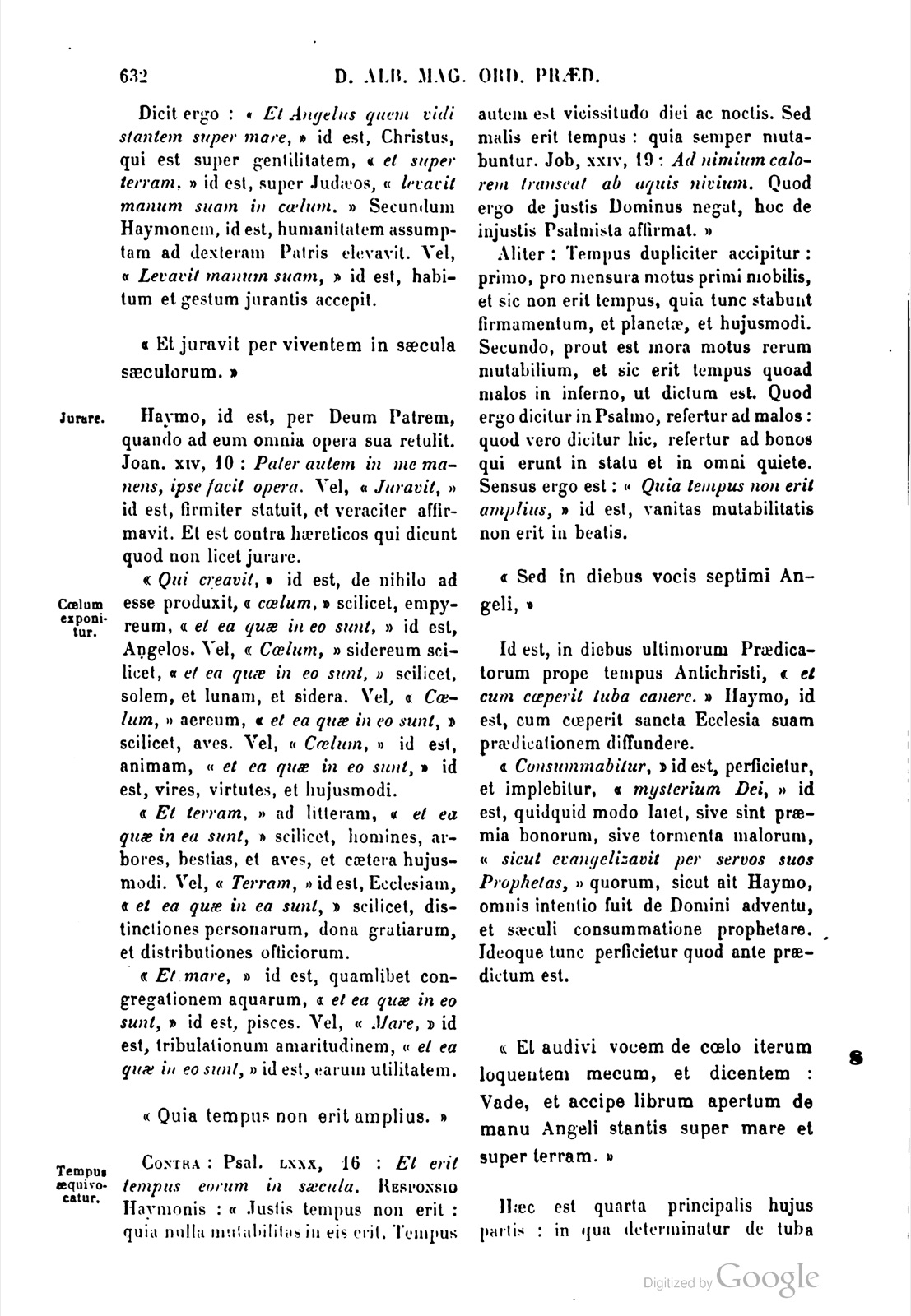
« Et capita equorum erant tamquam capita leonum: et de ore eorum procedit ignis, et fumus, et sulphur.
18. Et ab his tribus plagis occisa est tertia pars hominum, de igne, et de fumo, et sulphure, quae procedebant de ore ipsorum. »
Hic describuntur equi daemonum, scilicet, ipsi haeretici.
Et dicuntur hic quinque. Primo, quod majores eorum erunt fortes ad contritionem infirmorum. Secundo, qualis erit doctrina eorum, ibi, « Et de ore eorum. » Tertio, effectus doctrinae eorum, ibi, V. 18: « Et ab his tribus. » Quarto, hoc probat, ibi, V. 19: « Potestas enim equorum. » Quinto, quod aliqui non suscipient doctrinam eorum, ibi, V. 20: « Et caeteri homines. »
Dicit ergo: « Et capita equorum, » scilicet, haeresiarchae, et majores inter eos, « erant tamquam capita leonum, » id est, fortes ad conterendum infirmos, et foetentes ad inficiendum eos. Nota: In leone notatur superbiae crudelitas, et aperta malitia. Contra sanctos autem armabuntur superbia, et aperta malitia, et crudelitate magna.
« Et de ore eorum, » id est, de aperta praedicatione eorum, « procedit, » supple, « ignis: » et ita erit ardens: « et fumus: » et sic erit excaecans: « et sulphur: » et sic foetens. Vel, « Ignis, » id est, fervor irae persequentis, « et fumus, » simulationis, « et sulphur, » foetentis eruditionis. Vel, « Ignis » avaritiae, « et fumus » superbiae, « et sulphur » luxuriae.
« Et ab his tribus plagis occisa est tertia pars hominum, etc. »
« Et ab his tribus plagis, » scilicet, igne, fumo, et sulphure, « occisa est tertia pars hominum. » Quasi dicat: Perversorum hominum dogmatibus seducti mortis supplicium incurrunt. Et dicit: « Tertia pars hominum, » quia quidam incipient agere poenitentiam et implebunt, quibus debetur gloria. Alii incipient, sed non implebunt praeventi morte, tamen cum gratia. Tertii qui nec incipient, nec implebunt, quibus debetur poena aeterna. Vel, prima pars hominum est qui confitebuntur actu Christum, secunda illorum qui habitu, tertia illorum qui aperte negabunt. Occisa est, inquam, tertia pars hominum his plagis, et « de igne. » Et pro id est de igne. « Et de fumo, et sulphure. » Et repetitio expressio est malitiae et efficaciae eorum praedicationis.
« Quae procedebant de ore ipsorum. » Vide supra.
19. « Potestas enim equorum in ore eorum est, et in caudis eorum: nam caudae eorum similes serpentibus, habentes capita, et in his nocent. »
Supra dixit, quod per praedicationem haereticorum occidetur tertia pars hominum, hic probat, quod hoc erit per praedicationem eorum.
Et dicuntur duo in quibus consistit eorum potestas. Primo enim dicit, quod hanc potestatem habent in praedicatione aperta: secundo, in occulta, ibi, « Et in caudis. »
Et ibi dicuntur duo. Primo dicit, quod occulta praedicatione nocent. Secundo, ponit hujus causam, ibi, « Nam caudae eorum. »
Continua ita: Per praedicationem haereticorum occidetur tertia pars hominum: « potestas enim equorum, » id est, falsorum praedicatorum, « in ore eorum est. » Glossa: id est, mala praedicatione. Per os enim intelligitur mala aperta praedicatio.
“And the heads of the horses were like the heads of lions; and from their mouth proceeds fire and smoke and sulphur.
18. And by these three plagues the third part of human beings was killed, by the fire and by the smoke and by the sulphur that proceeded from their mouths.”
Here the horses of the demons are described, namely the heretics themselves.
And five things are said here. First, that their greater ones will be strong for the crushing of the weak. Second, what kind their doctrine will be, there, “And from their mouth.” Third, the effect of their doctrine, there, V. 18: “And by these three.” Fourth, he proves this, there, V. 19: “For the power of the horses.” Fifth, that some will not receive their doctrine, there, V. 20: “And the rest of the human beings.”
Therefore he says: “And the heads of the horses,” namely the heresiarchs and the greater ones among them, “were like the heads of lions,” that is, strong for crushing the weak and foul-smelling for infecting them. Note: In the lion the cruelty of pride and open malice is noted. But against the saints they will be armed with pride and open malice and great cruelty.
“And from their mouth,” that is, from their open preaching, “proceeds,” supply, “fire,” and thus it will be burning; “and smoke,” and thus it will be blinding; “and sulphur,” and thus foul-smelling. Or, “fire,” that is, the heat of persecuting anger; “and smoke,” of simulation; “and sulphur,” of foul-smelling instruction. Or, “fire” of avarice, “and smoke” of pride, “and sulphur” of lust.
“And by these three plagues the third part of human beings was killed, etc.”
“And by these three plagues,” namely fire, smoke, and sulphur, “the third part of human beings was killed.” As if he were saying: Those seduced by the dogmas of perverse human beings incur the punishment of death. And he says, “the third part of human beings,” because some will begin to do penance and will complete it, to whom glory is owed. Others will begin, but will not complete it, being forestalled by death, yet with grace. The third are those who will neither begin nor complete it, to whom eternal punishment is owed. Or, the first part of human beings is those who will confess Christ in act, the second of those who will confess him in habit, the third of those who will openly deny him. The third part of human beings, I say, was killed by these plagues, and “by fire.” And “by” stands for by fire. “And by smoke and sulphur.” And the repetition is an expression of the malice and efficacy of their preaching.
“Which proceeded from their mouth.” See above.
19. “For the power of the horses is in their mouth and in their tails; for their tails are like serpents, having heads, and with these they harm.”
Above he said that through the preaching of heretics the third part of human beings will be killed; here he proves that this will happen through their preaching.
And two things are said, in which their power consists. First he says that they have this power in open preaching; second, in hidden preaching, there, “And in their tails.”
And there two things are said. First he says that they harm by hidden preaching. Second, he sets down the cause of this, there, “For their tails.”
Continue thus: Through the preaching of heretics the third part of human beings will be killed; “for the power of the horses,” that is, of false preachers, “is in their mouth.” The Gloss says: that is, in evil preaching. For by the mouth evil open preaching is understood.
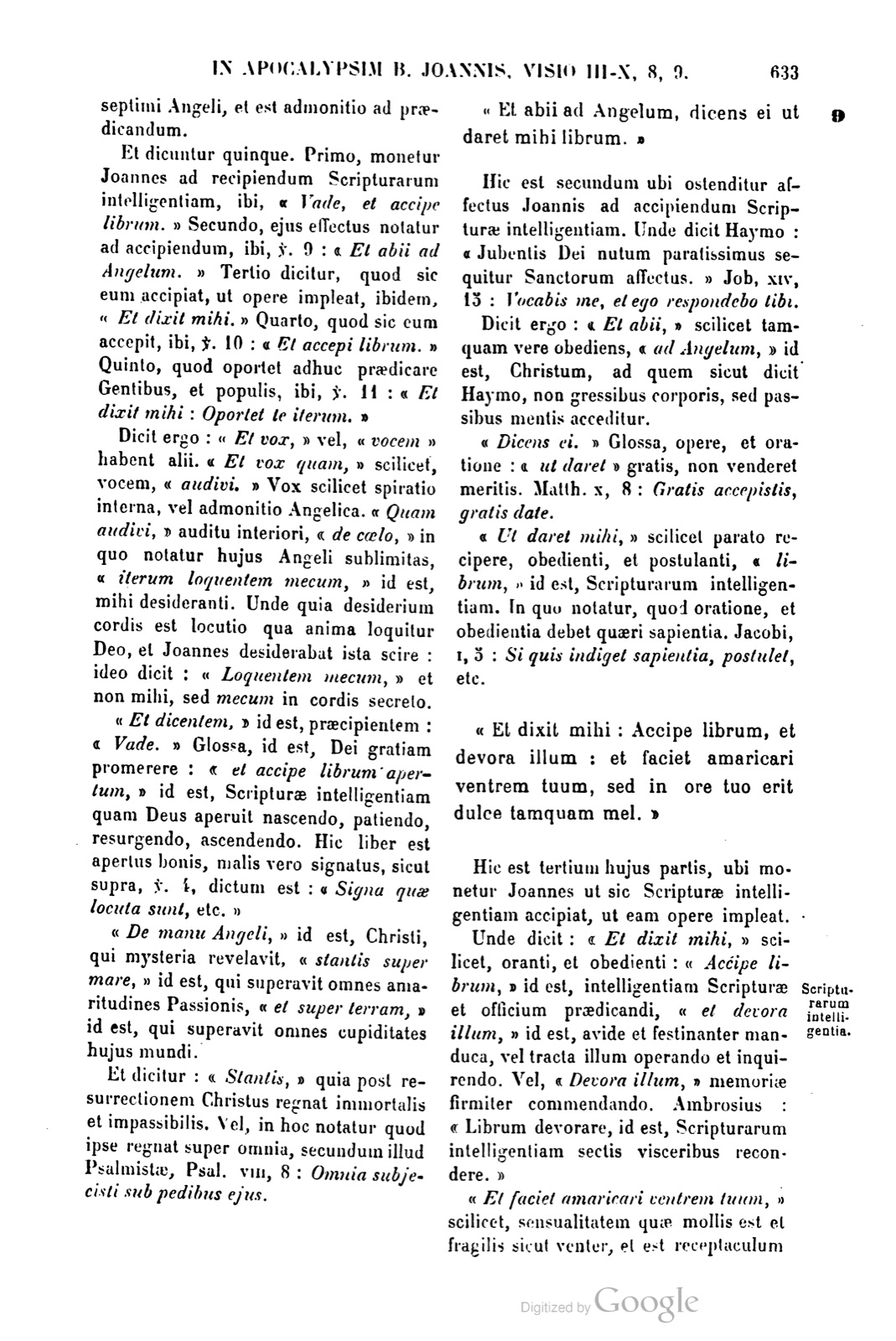
« Et in caudis eorum. » Nota: Per caudas quae turpitudinem tegunt, intelligitur occulta praedicatio mali, quae tegitur colore verborum. In ore ergo et in caudis est potestas eorum: quia quosdam corrumpunt aperte malum praedicando, quosdam vero occulte praedicando.
« Nam caudae eorum, » id est, sub verborum blanditiis latens mali praedicatio, sicut latet sub cauda turpitudo, « similes sunt serpentibus. » Glossa: « Qui facie blandiuntur, et occulte immittunt venenum. »
« Habentes capita, » id est, principes qui praesunt ministris, « et in his nocent, » id est, auctoritate et violentia eorum. Beda: « Principum patrocinia amplius nocent, quam si solo verbo suaderent. »
Aliter sic: « Potestas enim equorum in ore eorum est. » Nota: Per os intelligitur rationum inductio, per caudas bonorum temporalium largitio: et per ista duo multos decipient, scilicet, per rationum inductiones, et per munerum largitiones: et ideo dicit: « Potestas equorum in ore eorum est, » id est, in rationum inductione, « et in caudis eorum, » id est, in munerum largitione: « nam caudae eorum, » id est, temporalia, « similes sunt serpentibus, » quia in fine venenum infundunt. Moraliter per os equorum signatur adulatio, per caudam luxuria: in quibus multum consistit diaboli potestas et ministrorum ejus. Et bene dicuntur caudae similes serpentibus: quia luxuria in principio habet voluptatem, et in fine mortis punctionem.
20. « Et caeteri homines qui non sunt occisi in his plagis, neque poenitentiam egerunt de operibus manuum suarum, ut non adorarent daemonia et simulacra aurea, et argentea, et aerea, et lapidea, et lignea, quae neque videre possunt, neque audire, neque ambulare,
21. Et non egerunt poenitentiam ab homicidiis suis, neque a veneficiis suis, neque a fornicatione sua, neque a furtis suis. »
Supra dictum est, quod recipiens haereticorum doctrinam et Antichristi, damnabuntur, hic ostendit, quod etiam impoenitentes peribunt: et ponit hic multa genera peccatorum, scilicet, idololatriam, homicidium, luxuriam, et furtum.
Dicit ergo: « Et caeteri homines, » id est, infideles qui sunt ab Ecclesia separati numero et merito, « qui non sunt occisi his plagis, » id est, non sunt seducti ab haereticis, « neque poenitentiam egerunt de operibus manuum suarum, » scilicet, malis, « ut non adorarent daemonia, » scilicet, post poenitentiam. Vel, « Ut non, » id est, quoniam non adoraverunt daemonia. « Et simulacra aurea, et argentea, et aerea, et lapidea, et lignea. » Psal. CXIII, 6: Aures habent, et non audient. Item, ibidem, V. 4: Simulacra Gentium argentum et aurum, etc.: quae, supple, simulacra, « neque videre possunt. » Psal. CXIII, 5: Oculos habent, et non videbunt. « Neque audire, neque ambulare. » Psal. CXIII, 6: « Aures habent, et non audient, etc. »
« Et non egerunt poenitentiam ab homicidiis suis, »
Scilicet, quibus multos ad litteram occidebant aperte, « neque a veneficiis suis, » quibus interficiebant occulte, « neque a fornicatione sua, » id est, ab immunditia carnis quacumque, « neque a furtis suis, » scilicet, commissis a se. Quasi diceret: Omnes qui poenitentiam non egerunt, peribunt. Infra, XX, 15: Qui non inventus est in libro vitae scriptus, missus est in stagnum ignis.
“And in their tails.” Note: By tails, which cover ugliness, is understood hidden preaching of evil, which is covered by the color of words. Therefore their power is in the mouth and in the tails, because they corrupt some by openly preaching evil, but others by preaching secretly.
“For their tails,” that is, preaching of evil hidden under blandishments of words, as ugliness is hidden under a tail, “are like serpents.” The Gloss says: “They flatter with the face and secretly inject poison.”
“Having heads,” that is, princes who preside over ministers, “and with these they harm,” that is, by their authority and violence. Bede says: “The protections of princes harm more than if they persuaded by word alone.”
Otherwise thus: “For the power of the horses is in their mouth.” Note: By the mouth is understood the bringing in of arguments; by the tails the giving of temporal goods; and through these two they will deceive many, namely through the bringing in of arguments and through the giving of gifts. And therefore he says: “The power of the horses is in their mouth,” that is, in the bringing in of arguments, “and in their tails,” that is, in the giving of gifts; “for their tails,” that is, temporal things, “are like serpents,” because in the end they pour in poison. Morally, by the mouth of the horses flattery is signified, by the tail lust; the power of the devil and of his ministers consists much in these. And the tails are rightly said to be like serpents, because lust has pleasure at the beginning and the sting of death at the end.
20. “And the rest of the human beings who were not killed in these plagues did not do penance for the works of their hands, so that they should not adore demons and images of gold and silver and bronze and stone and wood, which can neither see nor hear nor walk,
21. And they did not do penance for their murders, nor for their sorceries, nor for their fornication, nor for their thefts.”
Above it was said that those receiving the doctrine of heretics and of Antichrist will be damned; here he shows that the impenitent also will perish; and here he sets down many kinds of sins, namely idolatry, murder, lust, and theft.
Therefore he says: “And the rest of the human beings,” that is, unbelievers who are separated from the Church in number and in merit, “who were not killed by these plagues,” that is, were not seduced by heretics, “nor did penance for the works of their hands,” namely evil works, “so that they should not adore demons,” namely after penance. Or, “so that not,” that is, because they did not adore demons. “And images of gold, and silver, and bronze, and stone, and wood.” Psalm CXIII, 6: They have ears and will not hear. Likewise, in the same place, V. 4: The idols of the Gentiles are silver and gold, etc.; which, supply, images, “cannot see.” Psalm CXIII, 5: They have eyes and will not see. “Nor hear, nor walk.” Psalm CXIII, 6: “They have ears and will not hear, etc.”
“And they did not do penance for their murders,”
Namely, by which they openly killed many literally, “nor for their sorceries,” by which they killed secretly, “nor for their fornication,” that is, for any uncleanness of flesh whatever, “nor for their thefts,” namely committed by themselves. As if he were saying: All who did not do penance will perish. Below, XX, 15: Whoever was not found written in the book of life was cast into the lake of fire.
Moraliter: Daemon sciens interpretatur. Daemonium ergo aureum potest dici Theologia, quae in splendore et valore superat omnes alias scientias sicut aurum alia metalla. Item, daemonium argenteum legalis scientia, et aliae lucrativae. Daemonium aereum sermocinalis scientia: quia plus aliis scientiis resonat, ut logica, et hujusmodi. Lapideum naturalis scientia quae est immutabilis, nec subjacet nobis, ut dicit Philosophus. Ligneum, moralis scientia, quae sicut lignum formari potest. Qui ergo omnes istas scientias sine modo, sine fide debito addiscunt, daemoniaci sunt, et adorant daemonia. Unde Bernardus: « Student quidam ut sciant, et est curiositas: quidam ut sciantur, et est vanitas: alii ut ditentur, et est cupiditas: alii ut aedificentur, et est prudentia: alii ut aedificent et est charitas. »
Hic sunt dubitabilia.
Primo super illo verbo V. 4: « Ne laederent faenum terrae, neque omne viride, » quaeritur, Cum faenum inter omnia virentia possit computari, cur omne viride a faeno distinxit?
Responsio Expositoris: Faenum non humanis, sed animalium congruit cibis: multa enim virentia inveniuntur in quibus homines delectantur, sicut in cibo. Unde per faenum quo pascuntur animalia, simplices et incipientes intelliguntur, qui sunt in Ecclesia, et non possunt accipere solidum cibum, sed velut animalia litterarum superficie delectantur. Per faenum igitur intelliguntur incipientes, per viride proficientes: nec ad litteram debet sumi.
Secundo, super illo verbo V. 11: « Et habebant super se regem. » Glossa: « Diabolum dominantem terrenis. » Contra: Augustinus: « Ille solus qui creavit, rector est omnium creaturarum et gubernator: » ergo diabolus non est rector vel rex.
Responsio. Antiquus hostis sic dicitur rex perversorum hominum, non quod ipse creavit eos aut regat, sed quod juste Deo permittente tyrannidem dominationis super eos exerceat quos sibi per peccatum servos addicit: ut qui experiri nolunt gratiam liberationis, sentiant dominium exterminatoris.
Tertio, quaeritur super illo verbo V. 17: « Et capita equorum erant tamquam capita leonum, etc. » Cum idem hic per equos quod supra per locustas significatur, et supra dixerit locustas habere facies hominum, quare dicit hic equos habere capita leonum?
Responsio secundum Bedam, quod haeretici saepe aliquid humanitatis ostendunt, ideo dicuntur locustae habere facies hominum: quia vero tempore Antichristi crudelitatem exercebunt, ideo dicuntur equi habere capita leonum.
Quarto, super illo verbo V. 21: « Ab homicidiis suis, neque a veneficiis suis, neque a fornicatione sua, » quaeritur, Quare ponit fornicationem in singulari, cum caetera ponat in plurali?
Responsio. Plus dicit in singulari, quam in plurali: quia sic dicit nomen speciei quae omnibus convenit: per hoc enim plures innuit perire per fornicationem, quam per caetera peccata. Unde, Augustinus in libro de Singularitate clericorum: « Quantos leones domuit una infirmitas misera, delicata, quae cum sit vilis et misera, de magnis efficit praedam. » Loquitur de fornicatione.
Morally: Demon is interpreted knowing. Therefore a golden demon can be called Theology, which in splendor and value surpasses all other sciences as gold surpasses other metals. Likewise, a silver demon is legal science and other lucrative sciences. A bronze demon is sermocinal science, because it resounds more than other sciences, as logic and the like. A stone demon is natural science, which is unchangeable and is not subject to us, as the Philosopher says. A wooden demon is moral science, which can be formed like wood. Therefore those who learn all these sciences without measure, without due faith, are demonic and adore demons. Hence Bernard says: “Some study so that they may know, and it is curiosity; some so that they may be known, and it is vanity; others so that they may be enriched, and it is cupidity; others so that they may be built up, and it is prudence; others so that they may build up, and it is charity.”
Here there are doubtful points.
First, on that word, V. 4: “That they should not hurt the hay of the earth, nor any green thing,” it is asked: Since hay can be counted among all green things, why did he distinguish every green thing from hay?
Response of the Expositor: Hay is suitable not for human foods, but for the foods of animals; for many green things are found in which human beings take delight, as in food. Hence by the hay on which animals feed, the simple and beginners are understood, who are in the Church and cannot receive solid food, but like animals delight in the surface of the letters. Therefore by hay beginners are understood, by the green thing those making progress; nor should it be taken literally.
Second, on that word, V. 11: “And they had over themselves a king.” The Gloss says: “The devil ruling over earthly persons.” On the contrary, Augustine says: “He alone who created is the ruler and governor of all creatures”; therefore the devil is not ruler or king.
Response. The ancient enemy is called king of perverse human beings in this way: not because he created them or rules them, but because, with God justly permitting, he exercises the tyranny of domination over those whom he subjects to himself as servants through sin, so that those who do not wish to experience the grace of liberation may feel the dominion of the exterminator.
Third, it is asked on that word, V. 17: “And the heads of the horses were like the heads of lions, etc.” Since the same thing is signified here by horses as above by locusts, and above he said that the locusts had faces of human beings, why does he say here that the horses have heads of lions?
Response according to Bede: because heretics often show something of humanity, therefore the locusts are said to have faces of human beings; but because in the time of Antichrist they will exercise cruelty, therefore the horses are said to have heads of lions.
Fourth, on that word, V. 21: “For their murders, nor for their sorceries, nor for their fornication,” it is asked: Why does he set down fornication in the singular, when he sets down the others in the plural?
Response. He says more in the singular than in the plural, because in this way he says the name of the species that belongs to all; for by this he suggests that more perish through fornication than through the other sins. Hence Augustine in the book On the Singularity of Clerics says: “How many lions has one miserable, delicate weakness tamed, which, though it is vile and miserable, makes prey from the great.” He is speaking of fornication.
Notes
- 2 Corinthians XI, 14. (II ad Corinth. XI, 14.) ↩
If a page does not appear, its photograph has not been uploaded yet.