Works › Commentary on the Apocalypse of Blessed John
Volume 38 · pp. 617–620
Chapter IX: description of the locusts and the first woe
A marker with ≈ is an approximate page boundary, placed by measure of the text; the page photographs remain the authority. In the paired views, clicking a page marker brings that page into view.
6. « Et in diebus illis quaerent homines mortem, et non invenient eam: et desiderabunt mori, et fugiet mors ab eis. »
Hic est quartum ubi ostendit, quod tam gravis erit persecutio, quod homines desiderabunt mori, quod erit, sicut dicit Beda, miseram vitam cita morte finiri volentes. Vel, sicut dicit Haymo, boni desiderabunt mori, et esse cum Christo 1.
Unde dicit: « Et in diebus illis, » in quibus alii cadent per hypocrisim, alii per haeresim, alii per violentiam, alii per fraudem, « quaerent homines mortem, » scilicet, corporalem. Glossa: timentes lapsum: quia desiderabunt mori, nimia tribulatione pressi, et taedio vivendi affecti. Sicut Elias, III Regum XIX, 4, petivit animae suae ut moreretur.
« Et non invenient eam, » Glossa: ut probatiores reddantur, vel etiam propter minores, ne de morte eorum scandalizati desperent, absque consolatoribus remanentes.
« Et desiderabunt mori. » Quasi dicat: Non quocumque modo quaerent, sed magno desiderio. Jerem. VII, 3: Eligent magis mortem quam vitam.
« Et fugiet mors ab illis, » ne grex Domini deseratur inter dentes luporum. Beda: « Sicut Cyprianus sub Deciana persecutione conquestus: Volentibus, inquit, mori, non permittebatur occidi. »
7. « Et similitudines locustarum, similes equis paratis in praelium: et super capita earum tamquam coronae similes auro. »
Supra tetigit concessam potestatem haereticis, hic describit eos multis modis.
Et dicuntur tria. Primo, describuntur a conditionibus quae pertinent ad operationem mali. Secundo, a conditionibus quae pertinent ad declinationem boni, ibi, V. 9: « Et habebant loricas. » Tertio, dicitur in quo habebant potestatem nocendi, ibi, V. 10: « Et potestas earum. »
In prima parte dicuntur tria. Primo, ponitur desiderium nocendi. Secundo, ponitur causa, ibi, « Et super capita earum. » Tertio, modus et forma, ibi, « Et facies eorum. »
Dicit ergo: « Et similitudines locustarum, » id est, haereticorum et praedicatorum Antichristi: qui sicut et locustae faciunt saltum per superbiam, et cadunt per avaritiam, debiliter stant per luxuriam. Et est argumentum hic, quod visio fuit imaginaria, supple, erant « similes equis paratis in praelium, » id est, ad praelium, quasi cum impetu currentes, et sine discretione in depressionem electorum. Unde Haymo: « Equis comparantur haeretici, propter eorum velocem ubique discursum. » Item Beda: « Sicut equi non propria ratione, sed impetu praesidentis aguntur in praelium: ita mali Doctores daemonico acti spiritu Ecclesiam impugnabunt. »
« Et super capita earum, » id est, super doctores haereticorum, « tamquam coronae, » id est, victoriae de oppressione justorum. Et dicit: « Tamquam, » quia non erunt verae coronae, sed tantum in eorum opinione. « Similes auro. » Haymo: « Quia ipsi se sicut victores simulabunt, et remuneratione dignos, ac si essent Sancti qui per aurum intelliguntur. » Vel sic: « Super capita earum, » id est, mentibus earum: mens enim caput est: « tamquam coronae, » id est, retributiones aeternae, « similes auro, » scilicet verae sapientiae. Quasi dicat: Coronas suas doctoribus suis attribuunt, et sibi praemia aeterna de eo quod per falsam sapientiam Ecclesiam impugnarunt.
6. “And in those days human beings will seek death and will not find it; and they will desire to die, and death will flee from them.”
This is the fourth point, where he shows that the persecution will be so grave that human beings will desire to die; this will be, as Bede says, their wishing a wretched life to be ended by a swift death. Or, as Haymo says, the good will desire to die and to be with Christ 1.
Hence he says: “And in those days,” in which some will fall through hypocrisy, others through heresy, others through violence, others through fraud, “human beings will seek death,” namely bodily death. The Gloss says: fearing a fall, because they will desire to die, pressed by excessive tribulation and affected by weariness of living. As Elijah, 3 Kings XIX, 4, asked for his soul that he might die.
“And they will not find it,” the Gloss says: so that they may be rendered more tested, or also on account of the lesser ones, lest, scandalized by their death, they despair and remain without consolers.
“And they will desire to die.” As if he were saying: They will not seek in just any way, but with great desire. Jeremiah VII, 3: They will choose death rather than life.
“And death will flee from them,” lest the flock of the Lord be deserted among the teeth of wolves. Bede says: “As Cyprian complained under the Decian persecution: Those who wished to die, he says, were not permitted to be killed.”
7. “And the likenesses of the locusts were like horses prepared for battle; and upon their heads were as it were crowns like gold.”
Above he touched upon the power granted to heretics; here he describes them in many ways.
And three things are said. First, they are described from conditions that pertain to the operation of evil. Second, from conditions that pertain to the declining of good, there, V. 9: “And they had breastplates.” Third, it is said in what they had the power of harming, there, V. 10: “And their power.”
In the first part three things are said. First, the desire to harm is set down. Second, the cause is set down, there, “And upon their heads.” Third, the manner and form, there, “And their faces.”
Therefore he says: “And the likenesses of the locusts,” that is, of heretics and the preachers of Antichrist, who, like locusts, make a leap through pride, and fall through avarice, and stand weakly through lust. And here there is an argument that the vision was imaginary; supply, they were “like horses prepared for battle,” that is, for battle, as if running with force and without discretion to the crushing of the elect. Hence Haymo says: “Heretics are compared to horses because of their swift running about everywhere.” Likewise Bede says: “As horses are driven into battle not by their own reason but by the impulse of the one presiding, so evil Doctors, driven by a demonic spirit, will attack the Church.”
“And upon their heads,” that is, upon the teachers of heretics, “as it were crowns,” that is, victories from the oppression of the just. And he says, “as it were,” because they will not be true crowns, but only in their opinion. “Like gold.” Haymo says: “Because they will pretend that they themselves are like victors and worthy of reward, as if they were Saints, who are understood by gold.” Or thus: “Upon their heads,” that is, upon their minds, for the mind is the head; “as it were crowns,” that is, eternal recompenses, “like gold,” namely of true wisdom. As if he were saying: They attribute their crowns to their teachers and eternal rewards to themselves from the fact that they attacked the Church through false wisdom.
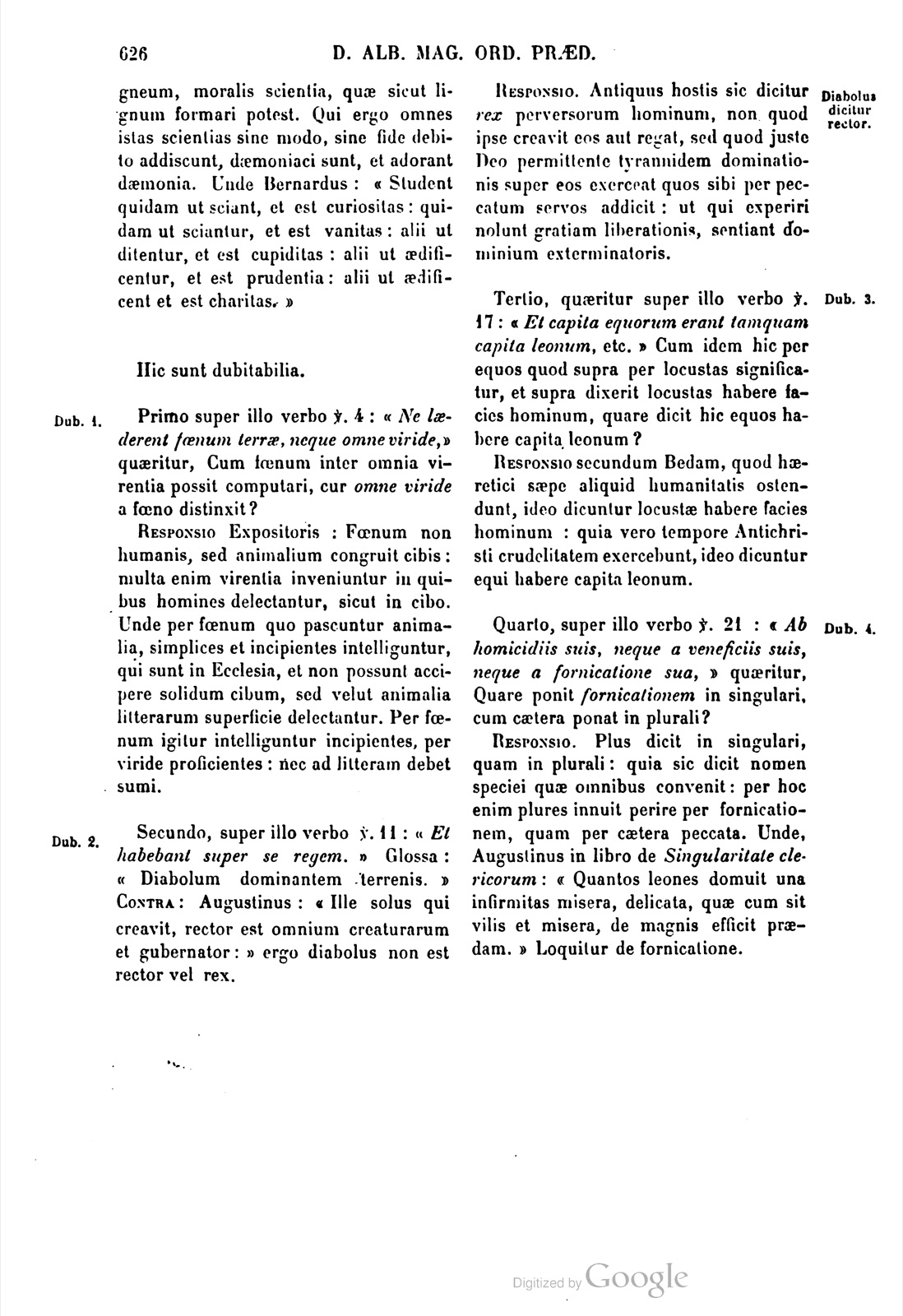
Vel, « Similes auro, » id est, Apostolis, quibus suos doctores aequiparabunt.
« Et facies earum tamquam facies hominum.
8. Et habebant capillos sicut capillos mulierum, et dentes earum sicut dentes leonum erant. »
Hic notatur modus nocendi.
Et dicuntur tria. Primo dicit, quod praetendunt aliquid bonum. Secundo, signatur latens malum, ibi, V. 8: « Et habebant capillos. » Tertio, tangitur apertum malum, ibi, « Et dentes earum. » Vel, primo tangitur boni apparentia, secundo latens malitia, tertio aperta saevitia.
Dicit ergo: « Et facies earum; » id est, haereticorum, qui signantur per locustas, « sicut facies hominum. » Nota: In facie hominis sunt quatuor: os, nasus, oculi, et mansuetudo: per quae signantur modestia, intelligentia, discretio, et eloquentia. Et sic apparebunt discreti, intelligentes, et eloquentes.
« Et habebant capillos sicut capillos mulierum. »
In hoc innuitur occulta malitia eorum. Nota: Capilli turpitudinem colli tegunt: sic isti mala sua abscondunt. Item, molles et flexibiles sunt: sic isti vitam mollem ducunt, et sunt vertibiles ad omne malum. Ad terram dependent: sic isti temporalia quaerunt. In capillis ergo mulierum intelligitur mollis vita, in hoc quod dependent avaritia, in hoc quod collum tegunt fallacia eorum.
« Et dentes earum. » Hic ostenditur eorum aperta malitia. Nota: Dentes earum hic dicuntur doctores eorum et expositores, qui praeparant panem mendacii, ut trajiciant multos in corpus Antichristi. « Sicut dentes leonum, » propter apertam saevitiam quam in Sanctos exercebunt. Sensus ergo est: Non solum laedent per ostensionem boni, et occultationem mali: sed etiam aperte saevient.
Unde dicit: « Et dentes earum, » id est, doctores haereticorum, « sicut dentes leonum erant, » scilicet, devorantes et Sanctos laniantes sine omni contradictione. Job XXIX, 17: Conterebam molas iniqui, et de dentibus illius, etc. Item, dentes leonum foetorem emittunt: sic haeretici foetorem malae famae.
Or, “like gold,” that is, like the Apostles, to whom they will make their own teachers equal.
“And their faces were like the faces of human beings.
8. And they had hair like the hair of women, and their teeth were like the teeth of lions.”
Here the manner of harming is noted.
And three things are said. First he says that they put forward something good. Second, a hidden evil is signified, there, V. 8: “And they had hair.” Third, an open evil is touched upon, there, “And their teeth.” Or, first the appearance of good is touched upon, second hidden malice, third open savagery.
Therefore he says: “And their faces,” that is, of the heretics who are signified by locusts, were “like the faces of human beings.” Note: In the face of a human being there are four things: mouth, nose, eyes, and gentleness; through these are signified modesty, understanding, discretion, and eloquence. And thus they will appear discreet, understanding, and eloquent.
“And they had hair like the hair of women.”
In this their hidden malice is suggested. Note: Hair covers the ugliness of the neck; so these persons hide their evils. Likewise, hairs are soft and flexible; so these persons lead a soft life and are turnable toward every evil. They hang down toward the earth; so these persons seek temporal things. Therefore in the hairs of women there is understood a soft life; in this, that they hang down, avarice; in this, that they cover the neck, their deceit.
“And their teeth.” Here their open malice is shown. Note: Their teeth are here called their doctors and expositors, who prepare the bread of falsehood so that they may pass many into the body of Antichrist. “Like the teeth of lions,” because of the open savagery that they will exercise against the Saints. Therefore the sense is: They will not only harm through the showing of good and the hiding of evil, but they will also rage openly.
Hence he says: “And their teeth,” that is, the doctors of heretics, “were like the teeth of lions,” namely devouring and tearing the Saints without any opposition. Job XXIX, 17: I broke the grinders of the unjust, and from his teeth, etc. Likewise, the teeth of lions emit a stench; so heretics emit the stench of an evil reputation.
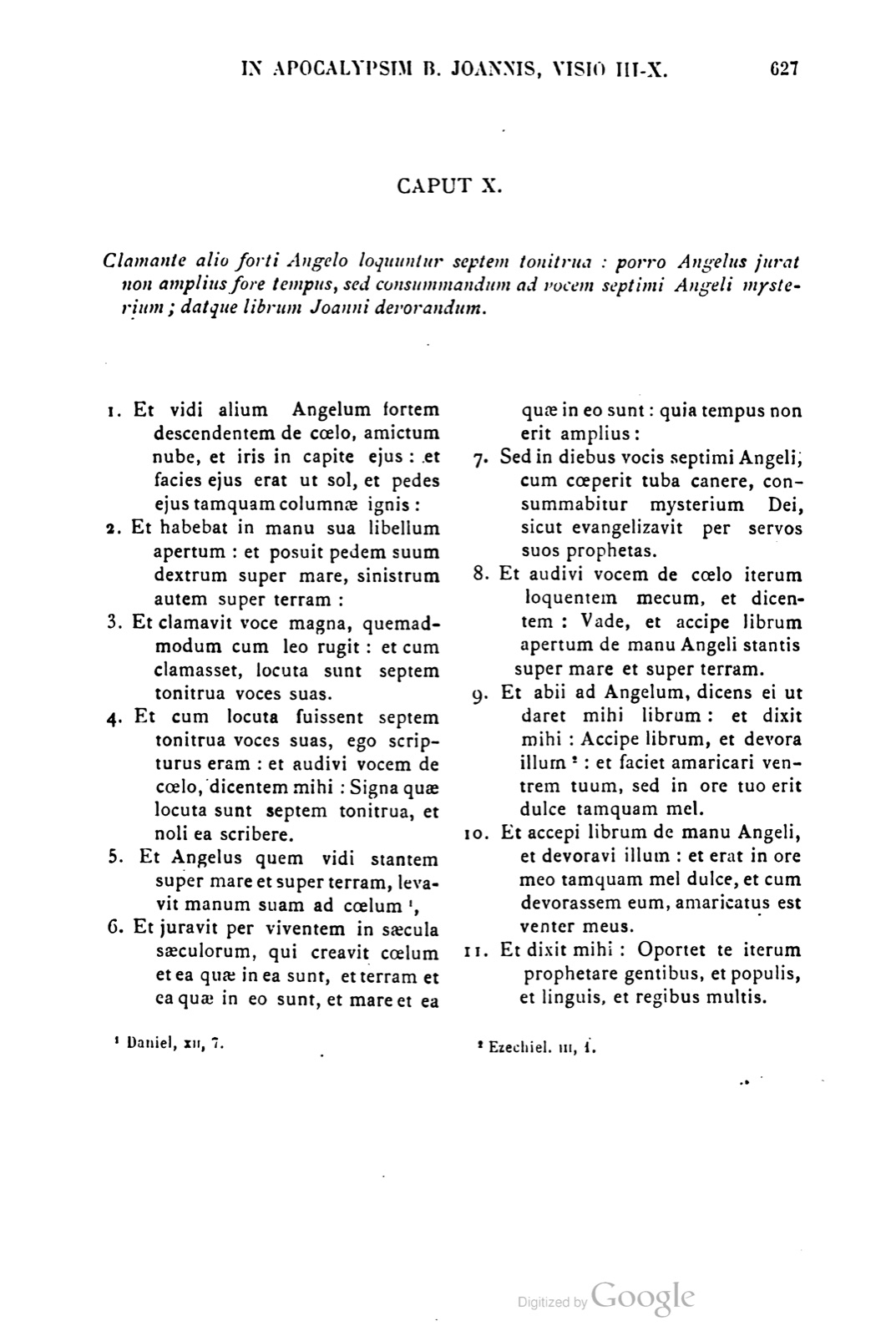
Tria ergo dicuntur habere praedicatores Antichristi: faciem hominis, quia dicent se omnia facere secundum discretionem: capillos mulierum, quia trahent alios ad vitam mollem et dissolutam: dentes leonum, quia aperte et crudeliter desaevient. Et per primum simulant bonum, per secundum dissimulant malum, per tertium aperte desaeeviunt.
« Et habebant loricas sicut loricas ferreas. »
Hic ponuntur conditiones quae pertinent ad declinationem boni.
Et dicuntur tria. Primo, contra veritatem cordis obduratio. Secundo, ipsius mali defensio, ibi, « Et vox alarum. » Tertio, per potentiam principum Ecclesiae impugnatio, ibi, V. 10: « Et habebunt caudas. »
Dicit ergo: « Et habebant loricas, » id est, corda sententiis deceptoriis munita, « sicut loricas ferreas » per duritiei pertinacitatem, et mentis obstinationem.
« Et vox alarum earum sicut vox curruum equorum multorum currentium in bellum:
10. Et habebant caudas similes scorpionum, et aculei erant in caudis earum: et potestas earum nocere hominibus mensibus quinque:
11. Et habebant super se regem angelum abyssi, cui nomen hebraice Abaddon, graece autem Apollyon, latine habens nomen Exterminans.
12. Vae unum abiit, et ecce veniunt adhuc duo vae post haec. »
Hic ostenditur declinatio per hoc quod errorem suum defendunt.
Unde dicit: « Et vox alarum earum, » id est, sonus et tumultus verborum quae dicuntur ab haereticis, sive rationes eorum quibus quasi ab alis elevantur, ut justi et sapientes reputentur. Haec, inquam, vox est « sicut vox equorum multorum currentium in bellum. » Nota: Multitudo curruum venientium ad bellum diversis stridoribus nuntiat quod adversarius properat, et confusus est eorum sonus qui est equorum hinnitus, hominum tumultus, tamen est eorum connexio ad bellum. Sic haeretici inter se discordes, diversis haeresibus contra veritatem pugnant unanimiter, et defendunt suum errorem: de quibus, II ad Timoth. III, 8: Hi resistunt veritati, homines corrupti mente, reprobi circa fidem. Et sic notantur saevitiae eorum irrationabiles, et impetuosae.
« Et habebant caudas similes scorpionum, etc. »
« Et habebant, » scilicet ad declinationem boni, et defensionem mali, « caudas, » id est, potentiam in temporalibus quae posteriora sunt et per caudam signantur. Hi sunt principes saeculares, per quos haeretici Ecclesiam impugnant. Unde ait: « Et habebant caudas, » id est, principes saeculares « similes scorpionum, » supple, caudis. Quia sicut scorpio cauda nocet quae est posterior pars: ita et istae caudae, scilicet, principes saeculi per posteriora nocent, id est, per poenam temporalem. Vel hoc dicit, quia blandiendo in facie, et muneribus seducent.
Therefore the preachers of Antichrist are said to have three things: the face of a human being, because they will say that they do all things according to discretion; the hair of women, because they will draw others to a soft and dissolute life; the teeth of lions, because openly and cruelly they will rage. And through the first they simulate good, through the second they dissimulate evil, through the third they openly rage.
“And they had breastplates like iron breastplates.”
Here are set down the conditions that pertain to the declining of good.
And three things are said. First, hardness of heart against truth. Second, the defense of evil itself, there, “And the sound of the wings.” Third, an attack upon the Church through the power of princes, there, V. 10: “And they will have tails.”
Therefore he says: “And they had breastplates,” that is, hearts fortified with deceitful opinions, “like iron breastplates” through the pertinacity of hardness and the obstinacy of mind.
“And the sound of their wings was like the sound of chariots of many horses running into battle:
10. And they had tails like scorpions, and there were stings in their tails; and their power was to harm human beings for five months:
11. And over themselves they had as king the angel of the abyss, whose name in Hebrew is Abaddon, but in Greek Apollyon, having in Latin the name Exterminans.
12. One woe has gone away, and behold, two woes still come after these things.”
Here the declining is shown by the fact that they defend their error.
Hence he says: “And the sound of their wings,” that is, the sound and tumult of the words that are spoken by heretics, or their arguments by which, as if by wings, they are lifted up so that they may be judged just and wise. This voice, I say, is “like the sound of many horses running into battle.” Note: A multitude of chariots coming to battle announces by diverse screeches that the adversary is hastening, and their sound is confused, consisting of the neighing of horses and the tumult of human beings; yet they have a joining together for battle. So heretics, discordant among themselves, fight unanimously against truth with diverse heresies and defend their error; concerning them, 2 Timothy III, 8: These resist the truth, human beings corrupted in mind, reprobate concerning faith. And thus their irrational and impetuous savageries are noted.
“And they had tails like scorpions, etc.”
“And they had,” namely for the declining of good and the defense of evil, “tails,” that is, power in temporal things, which are posterior and are signified by the tail. These are secular princes, through whom heretics attack the Church. Hence he says: “And they had tails,” that is, secular princes, “like scorpions,” supply, tails. Because as the scorpion harms by the tail, which is the posterior part, so also those tails, namely the princes of the age, harm through posterior things, that is, through temporal punishment. Or he says this because they will seduce by flattering in the face and with gifts.
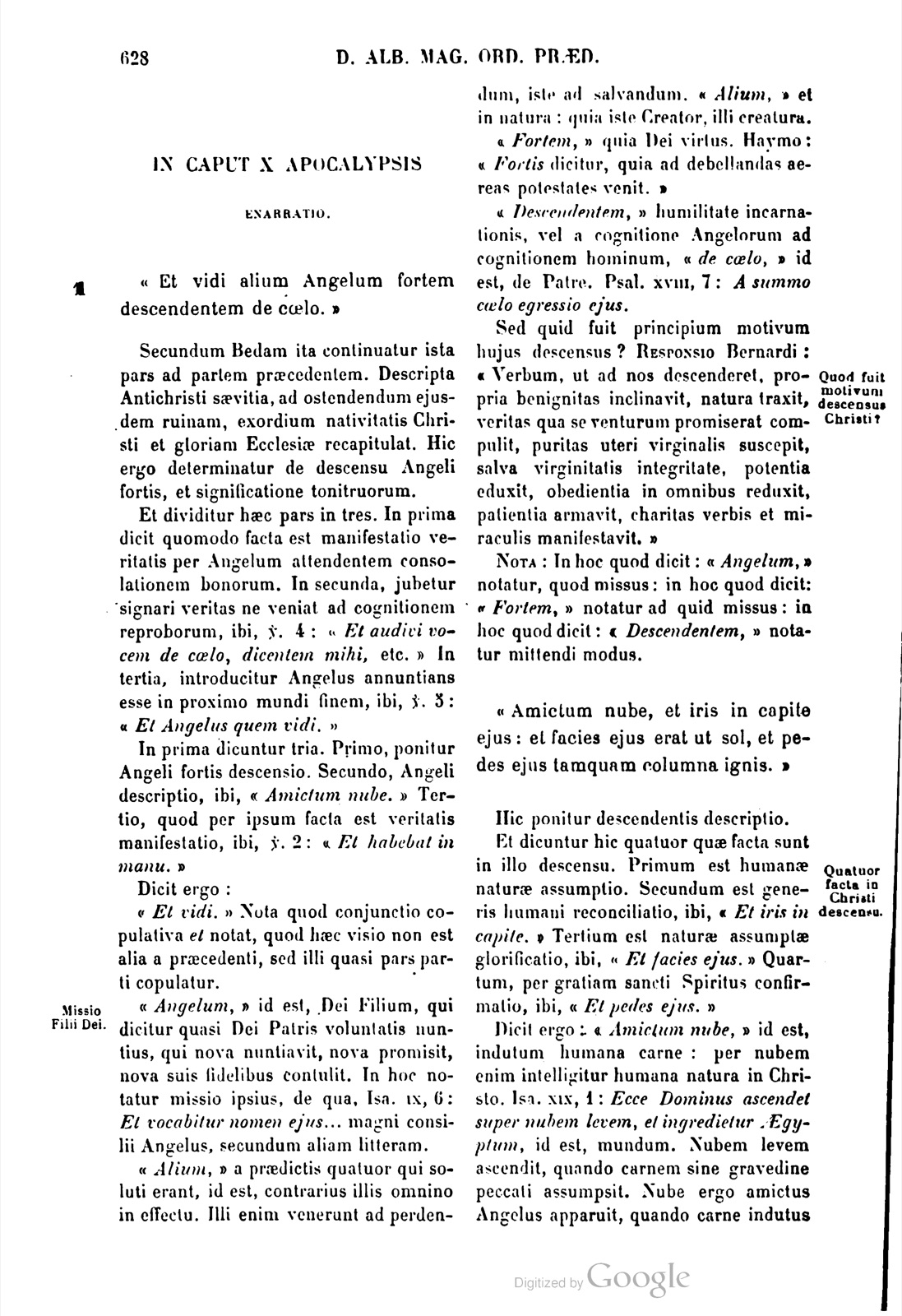
« Et aculei erant in caudis earum, » id est, peccatum quod est aculeus mortis: in quo signat illos principes plenos esse peccatis. Vel, aculei sunt astutae argutiae, et blasphemiae, quibus Sanctos pungunt, si quo modo possent eos movere, et via veritatis facere deviare: vel tormenta quae bonis inferent.
« Et potestas earum, » id est, locustarum, hoc est, praedicatorum Antichristi, « nocere hominibus mensibus quinque. »
Contra: Supra dictum est, ne occiderent eos, etc.
Responsio secundum Haymonem: « Hic dicitur de malis, ibi loquitur de bonis: malos enim interficiunt, istos cruciant, sed non occidunt. » Unde sensus est: « Nocere hominibus, » id est, nocendi carnalibus qui humum sapiunt, « mensibus quinque. » Haymo: « Quamdiu quinque sensus corporis subsistunt. »
« Et habebant super se regem, »
Id est, diabolum dominantem, qui est rex super omnes filios superbiae 2.
« Angelum abyssi, » id est, diabolum, qui dicitur abyssi, quia sine bysso et candore omnis boni.
« Cui nomen hebraice Abaddon. » Haymo et Hieronymus dicunt, quod debet dici Laabadon, et interpretatur exterminans. Laabadon autem hebraicum est, et interpretatur judicans.
« Graece autem Apollyon, et latine habens nomen Exterminans, » et est idem quod Laabadon. Ex quibus patet, quod non debet ibi esse Abaddon.
Hic quaeritur, Quare diabolus nominatur istis tribus linguis, scilicet hebraica, graeca, et latina?
Responsio. Ut in omni lingua ejus versutia intellecta facilius vitetur. Item, quia per illum hominem damnatum, scilicet Antichristum conabitur usurpare sibi nomen Christi, quod fuit scriptum tribus linguis. Joan. XIX, 20: Erat scriptum hebraice, graece, et latine. Et nota, quod in omni lingua nomen diaboli sonat exterminans: quia de omnibus aliquos exterminat, id est, extra terminos Catholicae fidei ponit in terra exterminii, id est, in infernum. Quia vero terminus et finis creaturae rationalis est beatitudo: ideo dicitur recte exterminans, qui animam rationalem extra hunc terminum ponere nititur. Sapient. III, 20: Ab iniquo thoro semen exterminabitur, id est, ibit in infernum.
« Vae unum abiit, etc. »
« Vae unum abiit, » id est, una tribulatio in narratione quinti Angeli praecessit. « Et ecce veniunt adhuc duo vae, » id est, duae tribulationes quae continentur sub tuba sexti et septimi Angeli, « post haec » quae dicta sunt. Vel, « duo vae, » scilicet, quae ventura sunt tempore Antichristi in die judicii.
“And there were stings in their tails,” that is, sin, which is the sting of death; in this he signifies that those princes are full of sins. Or, the stings are cunning arguments and blasphemies by which they prick the Saints, if in some way they could move them and make them turn aside from the way of truth; or the torments that they will inflict on the good.
“And their power,” that is, of the locusts, that is, of the preachers of Antichrist, was “to harm human beings for five months.”
On the contrary: Above it was said that they should not kill them, etc.
Response according to Haymo: “Here it is said concerning the evil; there he speaks concerning the good. For they kill the evil, but they torment these persons and do not kill them.” Hence the sense is: “To harm human beings,” that is, the power of harming carnal persons who savor the ground, “for five months.” Haymo says: “As long as the five senses of the body subsist.”
“And they had over themselves a king,”
That is, the devil ruling, who is king over all the sons of pride 2.
“The angel of the abyss,” that is, the devil, who is said to be of the abyss because he is without byssus and the whiteness of every good.
“Whose name in Hebrew is Abaddon.” Haymo and Jerome say that it ought to be said Laabadon, and it is interpreted exterminating. But Laabadon is Hebrew, and is interpreted judging.
“But in Greek Apollyon, and in Latin having the name Exterminans,” and it is the same as Laabadon. From these things it is clear that Abaddon ought not to be there.
Here it is asked: Why is the devil named in these three languages, namely Hebrew, Greek, and Latin?
Response. So that his cunning, once understood in every language, may more easily be avoided. Likewise, because through that damned man, namely Antichrist, he will try to usurp to himself the name of Christ, which was written in three languages. John XIX, 20: It was written in Hebrew, Greek, and Latin. And note that in every language the devil’s name sounds as exterminating, because from all peoples he exterminates some, that is, places them outside the boundaries of the Catholic faith in the land of extermination, that is, into hell. But because the boundary and end of the rational creature is beatitude, therefore he is rightly called exterminating, who strives to place the rational soul outside this boundary. Wisdom III, 20: From an unjust bed the seed will be exterminated, that is, it will go into hell.
“One woe has gone away, etc.”
“One woe has gone away,” that is, one tribulation has preceded in the narration of the fifth Angel. “And behold, two woes still come,” that is, two tribulations that are contained under the trumpet of the sixth and seventh Angel, “after these things” that have been said. Or, “two woes,” namely those that are to come in the time of Antichrist on the day of judgment.
If a page does not appear, its photograph has not been uploaded yet.