Works › Commentary on the Apocalypse of Blessed John
Volume 38 · pp. 611–613
Chapter IX: lemma and opening of the exposition
A marker with ≈ is an approximate page boundary, placed by measure of the text; the page photographs remain the authority. In the paired views, clicking a page marker brings that page into view.
CAPUT IX.
Quinto Angelo tuba canente, stella cadit, et locustae a fumo putei egressae describuntur, quae homines crucient: sexto vero Angelo canente, solvuntur quatuor Angeli, qui ingenti equestri exercitu tertiam hominum partem occidant.
1. Et quintus Angelus tuba cecinit: et vidi stellam de caelo cecidisse in terram, et data est ei clavis putei abyssi.
2. Et aperuit puteum abyssi: et ascendit fumus putei sicut fumus fornacis magnae: et obscuratus est sol et aer de fumo putei:
3. Et de fumo putei exierunt locustae in terram: et data est illis potestas, sicut habent potestatem scorpiones terrae:
4. Et praeceptum est illis ne laederent faenum terrae, neque omne viride, neque omnem arborem, nisi tantum homines qui non habent signum Dei in frontibus suis:
5. Et datum est illis ne occiderent eos, sed ut cruciarent mensibus quinque: et cruciatus eorum, ut cruciatus scorpii cum percutit hominem.
6. Et in diebus illis quaerent homines mortem, et non invenient eam: et desiderabunt mori, et fugiet mors ab eis 1.
7. Et similitudines locustarum, similes equis paratis in praelium 2: et super capita earum tamquam coronae similes auro, et facies earum tamquam facies hominum.
8. Et habebant capillos sicut capillos mulierum, et dentes earum sicut dentes leonum erant:
9. Et habebant loricas sicut loricas ferreas, et vox alarum earum sicut vox curruum equorum multorum currentium in bellum:
10. Et habebant caudas similes scorpionum, et aculei erant in caudis earum: et potestas earum nocere hominibus mensibus quinque:
11. Et habebant super se regem angelum abyssi, cui nomen hebraice Abaddon, graece autem Apollyon, latine habens nomen Exterminans.
12. Vae unum abiit, et ecce veniunt adhuc duo vae post haec.
13. Et sextus Angelus tuba cecinit: et audivi vocem unam ex quatuor cornibus altaris aurei quod est ante oculos Dei,
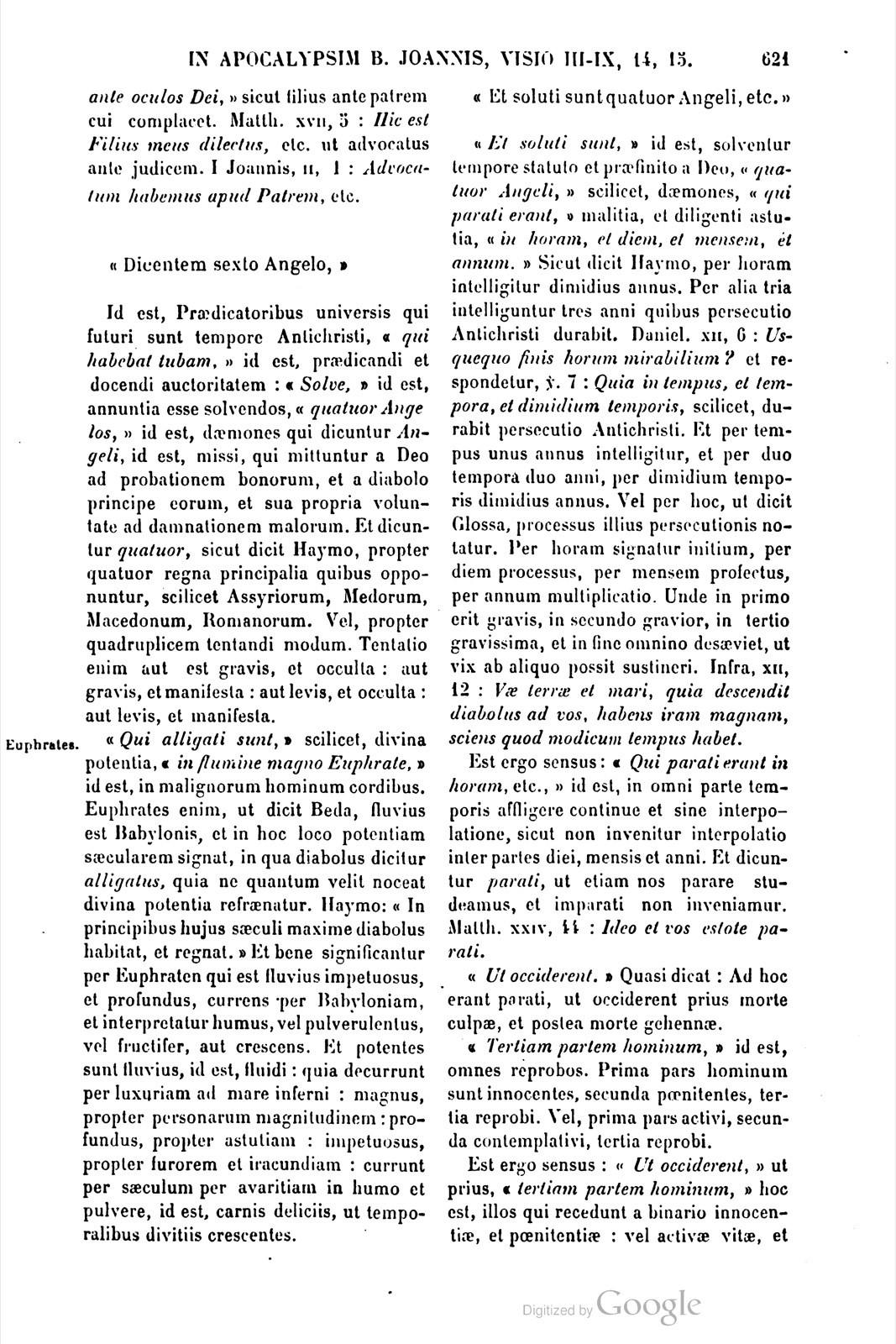
14. Dicentem sexto Angelo qui habebat tubam: Solve quatuor Angelos qui alligati sunt in flumine magno Euphrate.
15. Et soluti sunt quatuor Angeli, qui parati erant in horam, et diem et mensem, et annum, ut occiderent tertiam partem hominum.
CHAPTER IX.
When the fifth Angel sounds the trumpet, a star falls, and locusts that have gone forth from the smoke of the pit are described, which torment human beings; but when the sixth Angel sounds, four Angels are loosed, who with a huge mounted army kill the third part of human beings.
1. And the fifth Angel sounded the trumpet; and I saw a star that had fallen from heaven upon the earth, and the key of the pit of the abyss was given to him.
2. And he opened the pit of the abyss; and the smoke of the pit ascended like the smoke of a great furnace; and the sun and the air were darkened by the smoke of the pit.
3. And from the smoke of the pit locusts went forth upon the earth; and power was given to them, as the scorpions of the earth have power.
4. And it was commanded them that they should not hurt the hay of the earth, nor any green thing, nor any tree, but only those human beings who do not have the sign of God on their foreheads.
5. And it was given to them that they should not kill them, but that they should torment them for five months; and their torment was like the torment of a scorpion when it strikes a human being.
6. And in those days human beings will seek death and will not find it; and they will desire to die, and death will flee from them 1.
7. And the likenesses of the locusts were like horses prepared for battle 2; and upon their heads were as it were crowns like gold, and their faces were like the faces of human beings.
8. And they had hair like the hair of women, and their teeth were like the teeth of lions.
9. And they had breastplates like iron breastplates, and the sound of their wings was like the sound of chariots of many horses running into battle.
10. And they had tails like scorpions, and there were stings in their tails; and their power was to harm human beings for five months.
11. And over themselves they had as king the angel of the abyss, whose name in Hebrew is Abaddon, but in Greek Apollyon, having in Latin the name Exterminans.
12. One woe has gone away, and behold, two woes still come after these things.
13. And the sixth Angel sounded the trumpet; and I heard one voice from the four horns of the golden altar that is before the eyes of God,
14. Saying to the sixth Angel who had the trumpet: Loose the four Angels who are bound in the great river Euphrates.
15. And the four Angels were loosed, who had been prepared for the hour, and the day and month and year, to kill the third part of human beings.
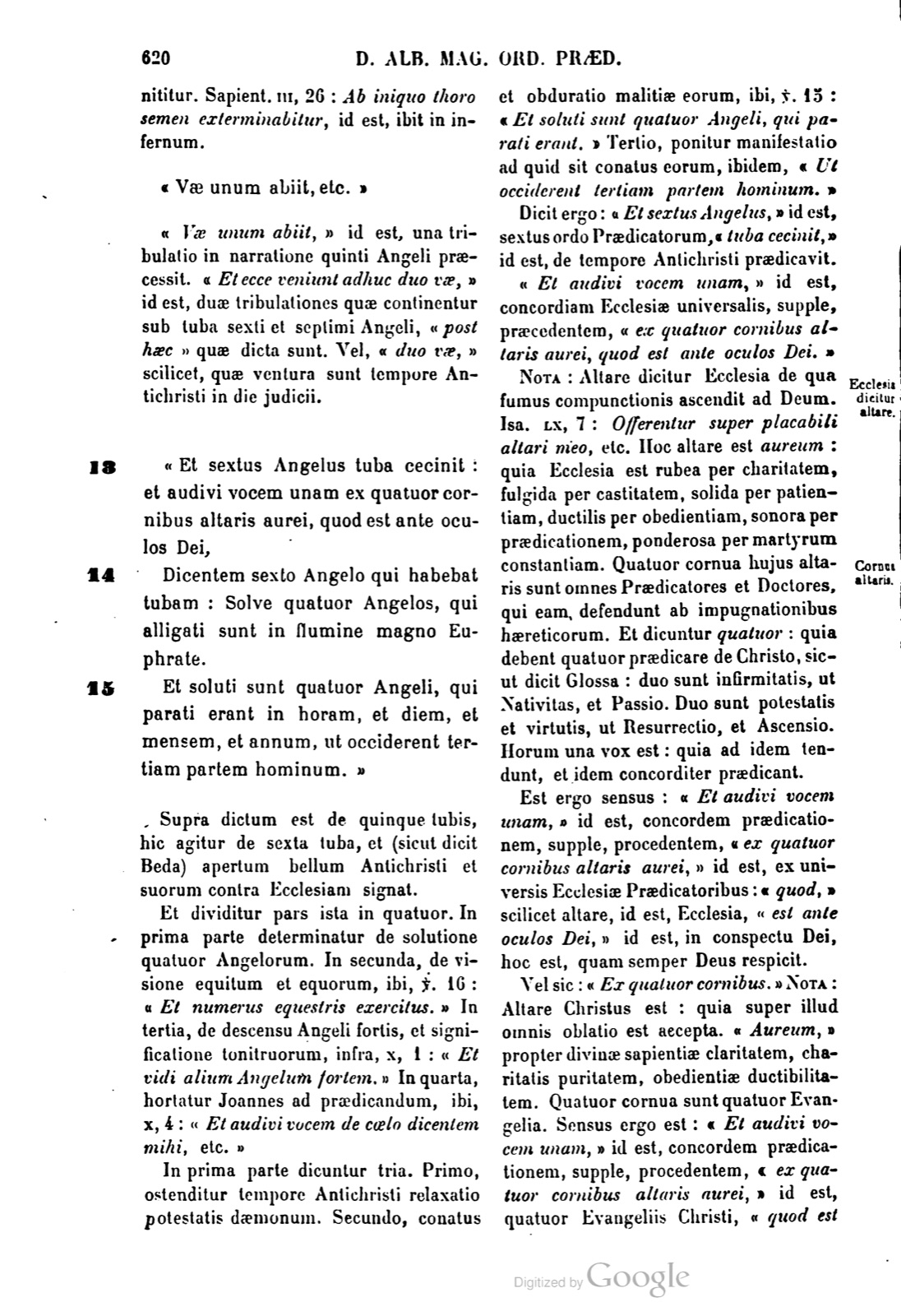
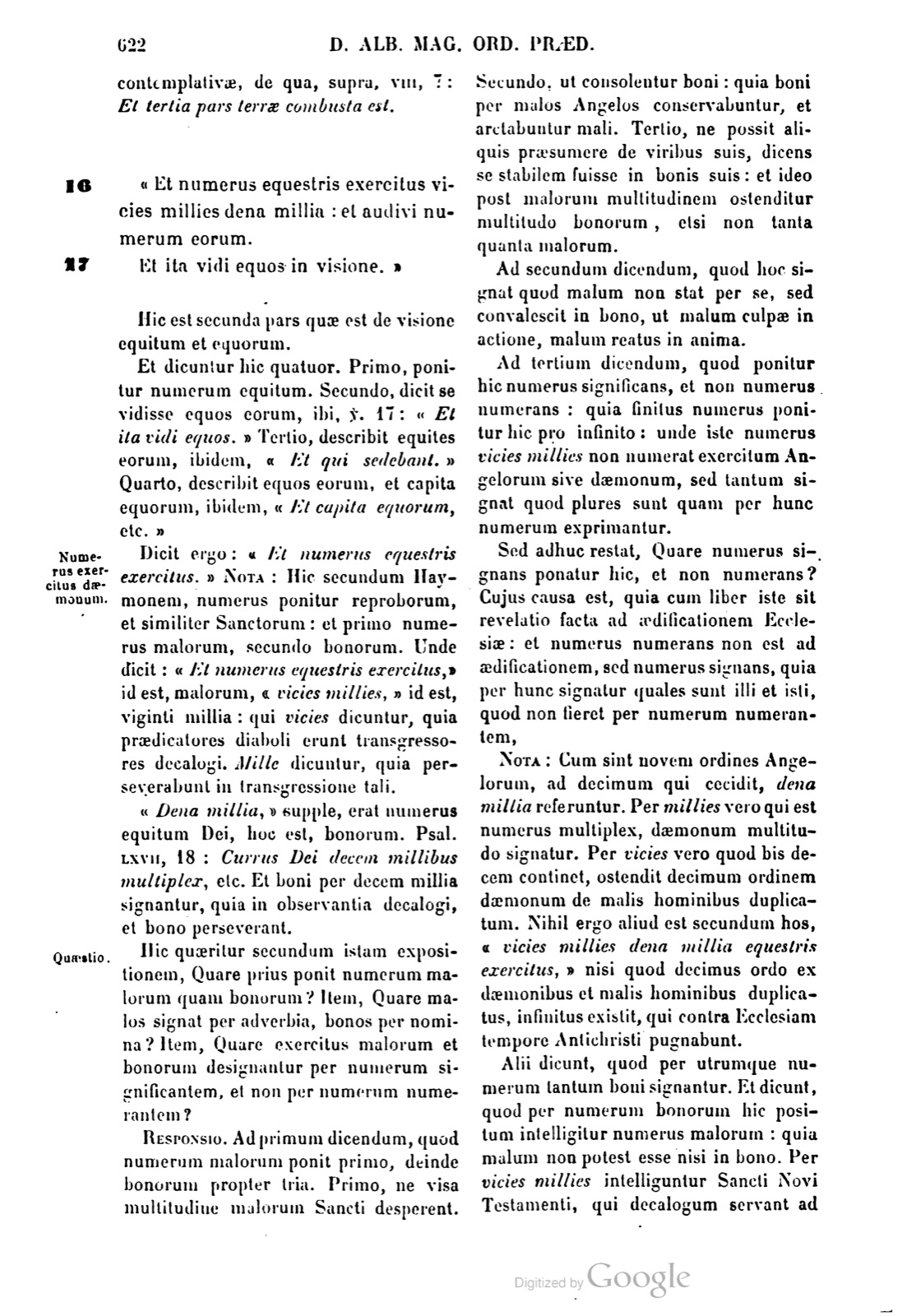
16. Et numerus equestris exercitus vicies millies dena millia: et audivi numerum eorum.
17. Et ita vidi equos in visione: et qui sedebant super eos habebant loricas igneas, et hyacinthinas, et sulphureas: et capita equorum erant tamquam capita leonum: et de ore eorum procedit ignis, et fumus, et sulphur.
18. Et ab his tribus plagis occisa est tertia pars hominum, de igne, et de fumo, et sulphure, quae procedebant de ore ipsorum.
19. Potestas enim equorum in ore eorum est, et in caudis eorum: nam caudae eorum similes serpentibus, habentes capita, et in his nocent.
20. Et caeteri homines qui non sunt occisi in his plagis, neque poenitentiam egerunt de operibus manuum suarum, ut non adorarent daemonia, et simulacra aurea, et argentea, et aerea, et lapidea, et lignea, quae neque videre possunt, neque audire, neque ambulare,
21. Et non egerunt poenitentiam ab homicidiis suis, neque a veneficiis suis, neque a fornicatione sua, neque a furtis suis.
IN CAPUT IX APOCALYPSIS ENARRATIO.
1. « Et quintus Angelus tuba cecinit: et vidi stellam de caelo cecidisse in terram, et data est ei clavis putei abyssi. »
Supra actum est de quatuor tubis, hic agitur de quinta, quae (sicut dicit Beda) majorem infestationem haereticorum signat tempore Antichristi praecurrentium.
Et dicuntur hic quatuor. Primo, sub figura locustarum ostendit haereticorum generationem. Secundo, ponit illis concessam potestatem, ibi, V. 3: « Et data est illis. » Tertio, subdit eorum multiplicem descriptionem, ibi, V. 7: « Et similitudines. » Quarto, dicit diabolum esse eorum rectorem, ibi, V. 11: « Et habebant super se. »
In prima parte ubi ostenduntur haereticorum genera, dicuntur quatuor. Primo, dicit se vidisse diabolum de caelo cadentem. Secundo, ostendit ei super haereticos datam potestatem, ibi, « Et data est ei clavis. » Tertio, haeresum ipsarum apertionem, ibi, V. 2: « Et aperuit puteum. » Quarto, subdit illius apertionis efficaciam, ibidem, « Et ascendit fumus putei. »
Dicit ergo:
« Et quintus Angelus, » id est, quintus ordo Praedicatorum: quintus, dico, ordine narrationis, et ordine temporis: « tuba cecinit, » id est, aperte praedicavit, et incepit praemunire, ut se ad praelium praepararent.
16. And the number of the mounted army was twenty thousand times ten thousand; and I heard their number.
17. And thus I saw the horses in the vision; and those who sat upon them had breastplates of fire and hyacinth and sulphur; and the heads of the horses were like the heads of lions; and from their mouth proceeds fire and smoke and sulphur.
18. And by these three plagues the third part of human beings was killed, by the fire and by the smoke and by the sulphur that proceeded from their mouths.
19. For the power of the horses is in their mouth and in their tails; for their tails are like serpents, having heads, and with these they harm.
20. And the rest of the human beings who were not killed in these plagues did not do penance for the works of their hands, so that they should not adore demons and images of gold and silver and bronze and stone and wood, which can neither see nor hear nor walk,
21. And they did not do penance for their murders, nor for their sorceries, nor for their fornication, nor for their thefts.
ON CHAPTER IX OF THE APOCALYPSE, EXPOSITION.
1. “And the fifth Angel sounded the trumpet; and I saw a star that had fallen from heaven upon the earth, and the key of the pit of the abyss was given to him.”
Above there has been treatment of the four trumpets; here there is treatment of the fifth, which, as Bede says, signifies the greater infestation by heretics preceding the time of Antichrist.
And four things are said here. First, under the figure of locusts he shows the generation of heretics. Second, he sets down the power granted to them, there, V. 3: “And it was given to them.” Third, he adds their manifold description, there, V. 7: “And the likenesses.” Fourth, he says that the devil is their ruler, there, V. 11: “And they had over themselves.”
In the first part, where the kinds of heretics are shown, four things are said. First, he says that he saw the devil falling from heaven. Second, he shows that power over heretics was given to him, there, “And a key was given to him.” Third, the opening of the heresies themselves, there, V. 2: “And he opened the pit.” Fourth, he adds the efficacy of that opening, in the same place, “And the smoke of the pit ascended.”
Therefore he says:
“And the fifth Angel,” that is, the fifth order of Preachers; fifth, I say, in the order of narration and in the order of time; “sounded the trumpet,” that is, preached openly and began to forewarn them to prepare themselves for battle.
« Et vidi, » id est, oculo mentis intellexi, « stellam, » diabolum, qui dicitur stella propter primae conditionis originem. Vel, quia, sicut dicit Haymo, se transfigurat in Angelum lucis.
« De caelo, » id est, de societate Angelorum et « de caelo » empyreo ubi creatus fuit, « cecidisse, » scilicet, propter peccatum superbiae. Isa. XIV, 12: Quomodo cecidisti de caelo, Lucifer, etc.
« In terram, » id est, in eos qui terrena diligunt, et sapiunt. Vel, « in terram, » id est, in hunc caliginosum aerem, qui quasi carcer deputatus est eis usque ad diem judicii ad hominum probationem. Ad Ephes. VI, 12: Non est nobis colluctatio, etc. Dicitur etiam « de caelo cadere, » id est, de Ecclesia, de qua, sicut dicit Haymo, quotidie cadit, quando nati fonte baptismatis regenerantur, et renuntiant diabolo, et pompis ejus.
« Et data est ei clavis, » id est, potestas dominandi haereticis, vel omnibus malis: vel potestas nocendi.
« Putei abyssi, » id est, haereticorum qui dicuntur puteus abyssi propter profunditatem astutiae, et tenebras suae malitiae. Genes. I, 2: Et tenebrae erant super faciem abyssi, id est, cordis tenebrosi. Abyssus enim dicitur sine bysso, id est, candore, vel lumine.
Vel, « Puteus » propter profunditatem malitiae, « abyssus, » propter tenebrositatem conscientiae: carent enim illius lumine qui est vera lux. Joan. VIII, 12: Ego sum lux mundi. Et quia hoc lumen non habent haeretici, ideo signantur nomine abyssi. Job XXVIII, 14: Abyssus dicit: Non est in me, etc., scilicet, sapientia Dei.
Item, « Puteus » signat profunditatem malitiae, in quem cum peccator cadit, contemnit. Proverb. XVIII, 3: Impius cum in profundum venerit peccatorum, contemnit. Ergo diabolo data est clavis putei abyssi, id est, malorum, ut eum clauderet ad gratiam, et aperiret ad culpam.
2. « Et aperuit puteum abyssi, et ascendit fumus putei sicut fumus fornacis magnae. »
“And I saw,” that is, I understood with the eye of the mind, “a star,” the devil, who is called a star because of the origin of his first condition. Or, because, as Haymo says, he transfigures himself into an Angel of light.
“From heaven,” that is, from the fellowship of the Angels and from the empyrean heaven where he was created, “to have fallen,” namely because of the sin of pride. Isaiah XIV, 12: How have you fallen from heaven, Lucifer, etc.
“Upon the earth,” that is, into those who love and savor earthly things. Or, “upon the earth,” that is, into this darksome air, which has been assigned to them as a kind of prison until the day of judgment for the testing of human beings. Ephesians VI, 12: Our wrestling is not, etc. He is also said “to fall from heaven,” that is, from the Church, from which, as Haymo says, he falls daily, when those born from the font of baptism are regenerated and renounce the devil and his pomps.
“And a key was given to him,” that is, power of ruling over heretics, or over all evil persons; or the power of harming.
“Of the pit of the abyss,” that is, of heretics, who are called the pit of the abyss because of the depth of their cunning and the darkness of their malice. Genesis I, 2: And darknesses were over the face of the abyss, that is, of the darkened heart. For abyss is said as without byssus, that is, whiteness or light.
Or, “pit” because of the depth of malice, “abyss” because of the darkness of conscience; for they lack the light of him who is the true light. John VIII, 12: I am the light of the world. And because heretics do not have this light, therefore they are signified by the name abyss. Job XXVIII, 14: The abyss says: It is not in me, etc., namely the wisdom of God.
Likewise, “pit” signifies the depth of malice, into which when a sinner falls, he shows contempt. Proverbs XVIII, 3: When the wicked has come into the depth of sins, he contemns. Therefore the key of the pit of the abyss, that is, of evil persons, was given to the devil, so that he might close him to grace and open him to guilt.
2. “And he opened the pit of the abyss, and the smoke of the pit ascended like the smoke of a great furnace.”
If a page does not appear, its photograph has not been uploaded yet.