Works › Commentary on the Apocalypse of Blessed John
Volume 38 · pp. 599–601
Chapter VIII: lemma and the seventh seal
A marker with ≈ is an approximate page boundary, placed by measure of the text; the page photographs remain the authority. In the paired views, clicking a page marker brings that page into view.
VISIO TERTIA.
CAPUT VIII.
Aperto septimo sigillo, septem Angeli cum tubis ostenduntur: effusoque in terram igne altaris ab alio Angelo, fiunt variae tempestates: similiter quatuor Angelis tuba canentibus, producuntur variae plagae adversus homines.
1. Et cum aperuisset sigillum septimum, factum est silentium in caelo, quasi media hora.
2. Et vidi septem Angelos stantes in conspectu Dei, et datae sunt illis septem tubae.
3. Et alius Angelus venit, et stetit ante altare, habens thuribulum aureum: et data sunt illi incensa multa, ut daret de orationibus sanctorum omnium super altare aureum quod est ante thronum Dei.
4. Et ascendit fumus incensorum de orationibus sanctorum de manu Angeli coram Deo.
5. Et accepit Angelus thuribulum, et implevit illud de igne altaris, et misit in terram: et facta sunt tonitrua, et voces, et fulgura, et terraemotus magnus.
6. Et septem Angeli qui habebant septem tubas, praeparaverunt se ut tuba canerent.
7. Et primus Angelus tuba cecinit: et facta est grando, et ignis, mista in sanguine, et missum est in terram, et tertia pars terrae combusta est, et tertia pars arborum concremata est, et omne faenum viride combustum est.
8. Et secundus Angelus tuba cecinit: et tamquam mons magnus igne ardens missus est in mare, et facta est tertia pars maris sanguis.
9. Et mortua est tertia pars creaturae eorum quae habebant animas in mari, et tertia pars navium interiit.
10. Et tertius Angelus tuba cecinit: et cecidit de caelo stella magna, ardens tamquam facula, et cecidit in tertiam partem fluminum, et in fontes aquarum.
11. Et nomen stellae dicitur Absinthium: et facta est tertia pars aquarum in absinthium, et multi hominum mortui sunt de aquis, quia amarae factae sunt.
12. Et quartus Angelus tuba cecinit: et percussa est tertia pars solis, et tertia pars lunae, et tertia pars stellarum, ita ut obscuraretur tertia pars eorum, et diei non luceret pars tertia, et noctis similiter.
THE THIRD VISION.
CHAPTER VIII.
When the seventh seal has been opened, seven Angels with trumpets are shown; and when the fire of the altar has been poured upon the earth by another Angel, various storms occur; likewise, when four Angels sound the trumpet, various plagues against human beings are produced.
1. And when he had opened the seventh seal, silence was made in heaven, as it were for half an hour.
2. And I saw seven Angels standing in the sight of God, and seven trumpets were given to them.
3. And another Angel came and stood before the altar, having a golden thurible; and many incenses were given to him, that he might give from the prayers of all the saints upon the golden altar that is before the throne of God.
4. And the smoke of the incenses from the prayers of the saints ascended from the hand of the Angel before God.
5. And the Angel took the thurible and filled it from the fire of the altar and cast it upon the earth; and there were thunders and voices and flashes of lightning and a great earthquake.
6. And the seven Angels who had the seven trumpets prepared themselves to sound the trumpet.
7. And the first Angel sounded the trumpet; and hail and fire were made, mixed in blood, and it was cast upon the earth; and the third part of the earth was burned up, and the third part of the trees was burned up, and all green hay was burned up.
8. And the second Angel sounded the trumpet; and as it were a great mountain burning with fire was cast into the sea, and the third part of the sea became blood.
9. And the third part of the creatures that had souls in the sea died, and the third part of the ships perished.
10. And the third Angel sounded the trumpet; and a great star fell from heaven, burning like a torch, and it fell upon the third part of the rivers and upon the fountains of waters.
11. And the name of the star is called Wormwood; and the third part of the waters became wormwood, and many human beings died from the waters, because they had been made bitter.
12. And the fourth Angel sounded the trumpet; and the third part of the sun was struck, and the third part of the moon, and the third part of the stars, so that the third part of them was darkened, and the third part of the day did not shine, and similarly of the night.
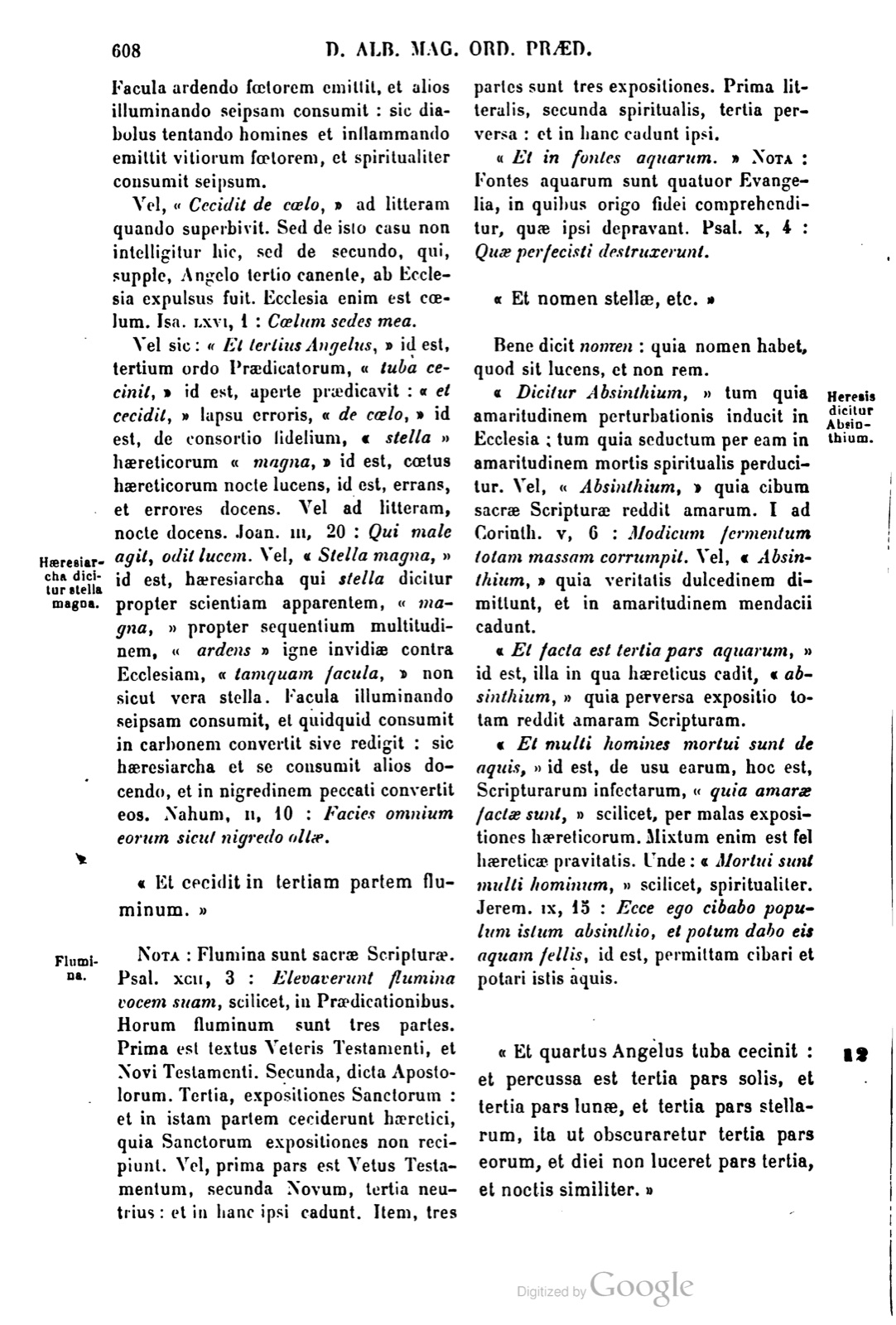
13. Et vidi, et audivi vocem unius aquilae volantis per medium caeli, dicentis voce magna: Vae, vae, vae habitantibus in terra de caeteris vocibus trium Angelorum, qui erant tuba canituri.
IN CAPUT VIII APOCALYPSIS
ENARRATIO.
1. « Et cum aperuisset sigillum septimum, factum est silentium in caelo, quasi media hora. »
Hic determinatur apertio sigilli septimi, qua manifestatur status Ecclesiae post tempus Antichristi, scilicet, quando dabitur pax Ecclesiae, sed parum durabit. Unde quia hic status quasi clausus latebat in Scriptura, hic ostenditur: ideo dicitur sigillum septimum aperiri.
Unde dicit: « Et cum aperuisset sigillum septimum, » id est, futurum Ecclesiae statum post mortem Antichristi manifestasset, « factum est silentium, » id est, pax, et tranquillitas, « in caelo, » id est, in Ecclesia. Tunc enim licebit Sanctis praedicare libere, nec aliquis adstringet eos, nec impugnabit.
« Quasi media hora, » id est, per modicum tempus, quia cito veniet Dominus ad judicandum. Unde Beda: « Post interitum Antichristi requies aliquantula futura creditur in Ecclesia. »
2. « Et vidi septem Angelos stantes in conspectu Dei, et datae sunt illis septem tubae. »
Supra posuit duas visiones. Hic ponit tertiam in qua, secundum Bedam, sub specie septem Angelorum tuba canentium septem eventus Ecclesiae describuntur.
Et dividitur haec pars in tres partes. In prima videntur septem Angeli quibus datae sunt septem tubae. In secunda, determinatur a quo sunt datae, ibi, V. 3: « Et alius Angelus. » In tertia officium ad quod sunt datae, ibi, V. 6: « Et septem Angeli. »
Dicit ergo: « Et vidi, » scilicet, in visione spirituali, « septem Angelos, » id est, Praedicatores universos, qui dicuntur Angeli, quia aeterna bona nobis annuntiant: de quibus, Isa. XXXIII, 7: Angeli pacis amare flebunt. Item, quia nobis ministrant. Ad Hebr. I, 14: Omnes sunt administratorii, etc. Item, quia debent esse spirituales, et non carnales. Psal. CIII, 4: Qui facis Angelos suos spiritus. Item, quia debent esse contemplatione caelestes. Matth. XVIII, 10: Angeli eorum in caelis semper vident faciem Patris. Et dicuntur esse septem propter septem vitiorum eradicationem, et septem virtutum plantationem. Vel, quia septiformi Spiritu sunt repleti. Vel, quia praeponuntur credentium universitati.
13. And I saw and heard the voice of one eagle flying through the midst of heaven, saying with a great voice: Woe, woe, woe to those dwelling on the earth from the remaining voices of the three Angels who were about to sound the trumpet.
ON CHAPTER VIII OF THE APOCALYPSE
EXPOSITION.
1. “And when he had opened the seventh seal, silence was made in heaven, as it were for half an hour.”
Here the opening of the seventh seal is determined, by which the state of the Church after the time of Antichrist is manifested, namely when peace will be given to the Church, but it will last a little. Hence, because this state lay hidden in Scripture as though closed, it is shown here; therefore the seventh seal is said to be opened.
Hence he says: “And when he had opened the seventh seal,” that is, had manifested the future state of the Church after the death of Antichrist, “silence was made,” that is, peace and tranquility, “in heaven,” that is, in the Church. For then it will be lawful for the Saints to preach freely, and no one will bind them or attack them.
“As it were for half an hour,” that is, for a little time, because the Lord will quickly come to judge. Hence Bede says: “After the destruction of Antichrist, a brief rest is believed to be future in the Church.”
2. “And I saw seven Angels standing in the sight of God, and seven trumpets were given to them.”
Above he set down two visions. Here he sets down the third, in which, according to Bede, under the form of seven Angels sounding the trumpet, seven events of the Church are described.
And this part is divided into three parts. In the first are seen the seven Angels to whom seven trumpets were given. In the second it is determined by whom they were given, there, V. 3: “And another Angel.” In the third, the office for which they were given, there, V. 6: “And the seven Angels.”
Therefore he says: “And I saw,” namely in spiritual vision, “seven Angels,” that is, all Preachers, who are called Angels because they announce eternal goods to us; concerning them, Isaiah XXXIII, 7: The Angels of peace will weep bitterly. Likewise, because they minister to us. Hebrews I, 14: All are ministering spirits, etc. Likewise, because they ought to be spiritual and not carnal. Psalm CIII, 4: You make your Angels spirits. Likewise, because they ought to be heavenly by contemplation. Matthew XVIII, 10: Their Angels in heaven always see the face of the Father. And they are said to be seven because of the eradication of the seven vices and the planting of the seven virtues. Or, because they are filled with the sevenfold Spirit. Or, because they are set over the universality of believers.
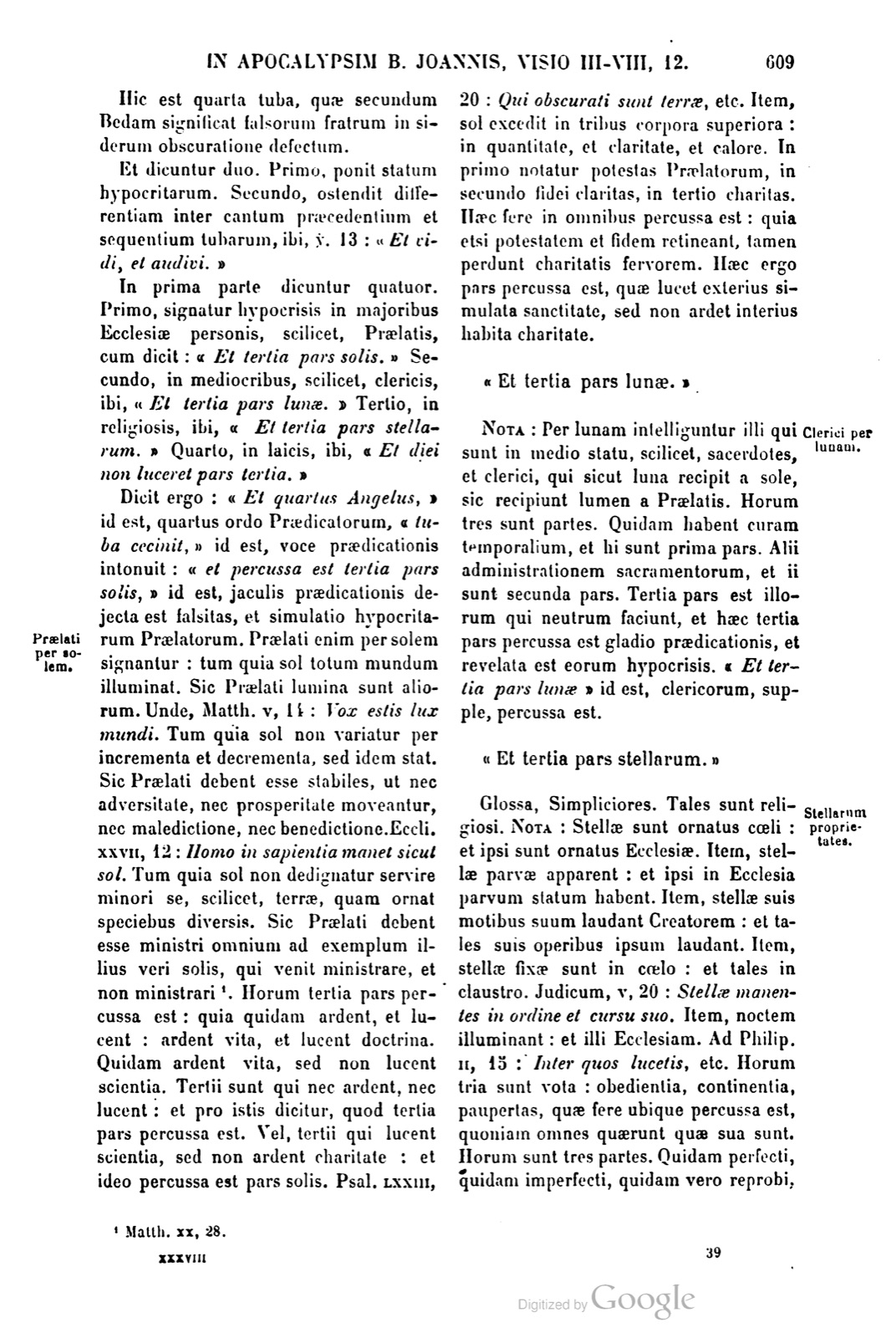
« Stantes, » id est, paratos ad divinum obsequium, vel ad obediendum. Psal. V, 5: Mane adstabo tibi. Item, « Stantes, » id est, paratos ad eundum. Joan. XV, 16: Posui vos ut eatis. Item, « Stantes, » dirigendo intentionem suam ad Deum. Item, « Stantes, » id est, paratos ad praedicandum, sicut Dominus stans praedicavit turbis 1.
« In conspectu Dei, » per contemplationem. Vel, quia a Deo adspiciuntur, et Angelis sanctis. Psal. XLIX, 8: Holocausta autem tua in conspectu meo sunt semper. Vel, « In conspectu Dei, » ut a Deo videantur, non ab hominibus solum.
« Et datae sunt illis septem tubae, » id est, officium praedicandi. Hae dicuntur datae, quia nemo debet praedicare nisi missus. Ad Roman. X, 15: Quomodo praedicabunt nisi mittantur? Item, « tubae, » scilicet, in quibus peccata dimittuntur, quarum usus erat in Jubileo 2. Item, in quibus munitiones mundi destruuntur, quae signantur in muris Jericho corruentibus ad clangorem tubarum 3. Et dicuntur septem propter septiformem gratiam Spiritus sancti per quem Scriptura est reserata quam praedicant. Vel, quia septem munitiones mundi dissipant, vel praedicant, quae sunt tales, sui amor, amor mundi, amor honoris, ignorantia, consuetudo prava, sui status incertitudo, praesumptio. Et, sicut dicit Hieronymus ad Heliodorum, facile rumpit haec omnia vincula amor Christi, et timor gehennae.
“Standing,” that is, ready for divine service, or for obeying. Psalm V, 5: In the morning I will stand before you. Likewise, “standing,” that is, ready to go. John XV, 16: I have appointed you that you should go. Likewise, “standing,” by directing their intention to God. Likewise, “standing,” that is, ready to preach, as the Lord preached to the crowds while standing 1.
“In the sight of God,” through contemplation. Or, because they are looked upon by God and by the holy Angels. Psalm XLIX, 8: But your holocausts are always in my sight. Or, “in the sight of God,” so that they may be seen by God, not by human beings alone.
“And seven trumpets were given to them,” that is, the office of preaching. These are said to have been given because no one ought to preach unless sent. Romans X, 15: How will they preach unless they are sent? Likewise, “trumpets,” namely those in which sins are forgiven, whose use was in the Jubilee 2. Likewise, those in which the fortifications of the world are destroyed, which are signified in the walls of Jericho falling at the sound of trumpets 3. And they are called seven because of the sevenfold grace of the Holy Spirit through whom Scripture, which they preach, has been unlocked. Or, because they scatter or preach against the seven fortifications of the world, which are these: love of self, love of the world, love of honor, ignorance, depraved custom, uncertainty of one’s state, and presumption. And, as Jerome says to Heliodorus, the love of Christ and the fear of Gehenna easily break all these chains.
If a page does not appear, its photograph has not been uploaded yet.