Works › Commentary on the Apocalypse of Blessed John
Volume 38 · pp. 573–576
Chapter VI: lemma and opening of the first seal
A marker with ≈ is an approximate page boundary, placed by measure of the text; the page photographs remain the authority. In the paired views, clicking a page marker brings that page into view.
CAPUT VI.
Apertis quatuor sigillis, varii adversus terram sequuntur effectus: quinto vero aperto, animae martyrum petunt accelerari judicium: ad sexti autem apertionem ostenduntur signa futuri judicii.
1. Et vidi quod aperuisset Agnus unum de septem sigillis: et audivi unum de quatuor animalibus dicens, tamquam vocem tonitrui: Veni, et vide.
2. Et vidi: et ecce equus albus, et qui sedebat super illum habebat arcum, et data est ei corona, et exivit vincens ut vinceret.
3. Et cum aperuisset sigillum secundum, audivi secundum animal dicens: Veni, et vide.
4. Et exivit alius equus rufus: et qui sedebat super illum, datum est ei ut sumeret pacem de terra, et ut invicem se interficiant: et datus est ei gladius magnus.
5. Et cum aperuisset sigillum tertium, audivi tertium animal dicens: Veni, et vide. Et ecce equus niger: et qui sedebat super illum habebat stateram in manu sua.
6. Et audivi tamquam vocem in medio quatuor animalium dicentium: Bilibris tritici denario, et tres bilibres hordei denario: et vinum et oleum ne laeseris.
7. Et cum aperuisset sigillum quartum, audivi vocem quarti animalis dicentis: Veni, et vide.
8. Et ecce equus pallidus: et qui sedebat super eum nomen illi Mors, et infernus sequebatur eum: et data est illi potestas super quatuor partes terrae interficere gladio, fame, et morte, et bestiis terrae.
9. Et cum aperuisset sigillum quintum, vidi subtus altare animas interfectorum propter verbum Dei, et propter testimonium quod habebant:
10. Et clamabant voce magna, dicentes: Usquequo, Domine (sanctus et verus), non judicas, et non vindicas sanguinem nostrum de iis qui habitant in terra?
11. Et datae sunt illis singulae stolae albae: et dictum est illis ut requiescerent adhuc tempus modicum, donec compleantur conservi eorum et fratres eorum, qui interficiendi sunt sicut et illi.
12. Et vidi cum aperuisset sigillum sextum: et ecce terraemotus magnus factus est, et sol factus est niger tamquam saccus cilicinus, et luna tota facta est sicut sanguis,
13. Et stellae de caelo ceciderunt super terram, sicut ficus emittit grossos suos cum a vento magno movetur.
14. Et caelum recessit sicut liber involutus: et omnis mons, et insulae de locis suis motae sunt:
15. Et reges terrae, et principes, et tribuni, et divites, et fortes, et omnis servus, et liber, absconderunt se in speluncis, et in petris montium:
CHAPTER VI.
When the four seals have been opened, various effects against the earth follow; but when the fifth is opened, the souls of the martyrs ask that judgment be hastened; and at the opening of the sixth, the signs of the future judgment are shown.
1. And I saw that the Lamb had opened one of the seven seals; and I heard one of the four living creatures saying, as it were with a voice of thunder: Come, and see.
2. And I saw: and behold, a white horse, and the one who sat upon it had a bow, and a crown was given to him, and he went out conquering that he might conquer.
3. And when he had opened the second seal, I heard the second living creature saying: Come, and see.
4. And another horse went out, red; and to the one who sat upon it, it was given that he should take peace from the earth, and that they should kill one another; and a great sword was given to him.
5. And when he had opened the third seal, I heard the third living creature saying: Come, and see. And behold, a black horse; and the one who sat upon it had a balance in his hand.
6. And I heard, as it were, a voice in the midst of the four living creatures saying: A measure of wheat for a denarius, and three measures of barley for a denarius; and do not harm the wine and oil.
7. And when he had opened the fourth seal, I heard the voice of the fourth living creature saying: Come, and see.
8. And behold, a pale horse; and the name of the one who sat upon it was Death, and hell followed him; and power was given to him over the four parts of the earth to kill with sword, famine, death, and the beasts of the earth.
9. And when he had opened the fifth seal, I saw beneath the altar the souls of those slain because of the word of God and because of the testimony which they had.
10. And they cried with a great voice, saying: How long, O Lord, holy and true, do you not judge, and do you not vindicate our blood from those who dwell on the earth?
11. And single white robes were given to them; and it was said to them that they should rest yet a little time, until their fellow-servants and their brothers should be completed, who are to be killed as they also were.
12. And I saw when he had opened the sixth seal: and behold, a great earthquake was made, and the sun became black as a haircloth sack, and the whole moon became like blood.
13. And the stars from heaven fell upon the earth, as a fig tree casts its unripe figs when it is moved by a great wind.
14. And heaven withdrew like a rolled-up book; and every mountain and the islands were moved from their places.
15. And the kings of the earth, and princes, and tribunes, and the rich, and the strong, and every slave and free man hid themselves in caves and in the rocks of mountains.
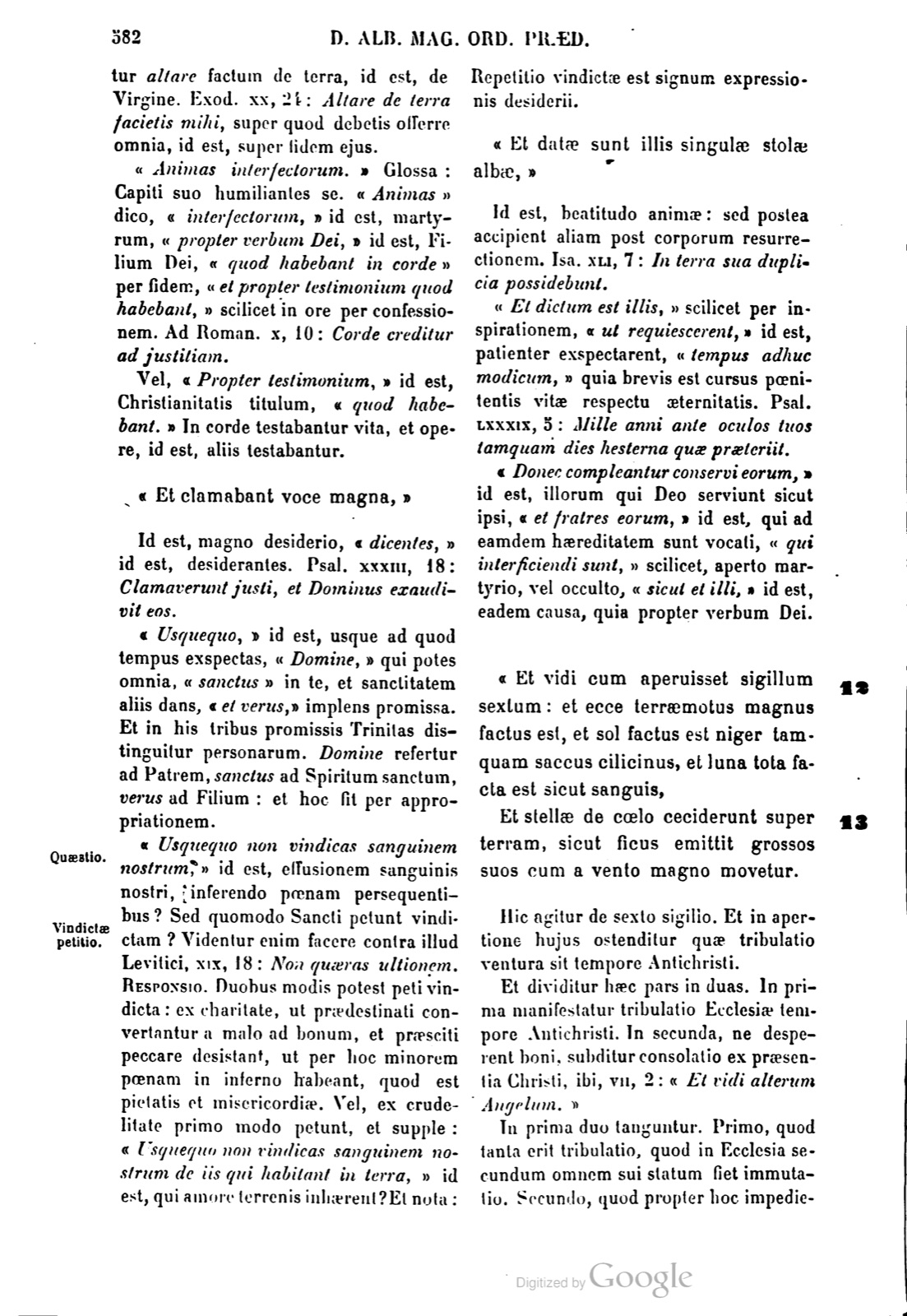
16. Et dicunt montibus et petris: Cadite super nos 1, et abscondite nos a facie sedentis super thronum, et ab ira Agni:
17. Quoniam venit dies magnus irae ipsorum, et quis poterit stare?
IN CAPUT VI APOCALYPSIS
ENARRATIO.
1. « Et vidi quod aperuisset Agnus unum de septem sigillis: et audivi unum de quatuor animalibus dicens, tamquam vocem tonitrui: Veni, et vide. »
Sicut dictum fuit in principio quarti capituli, hic est quarta pars secundae visionis, in qua agitur de consequentibus apertionem Libri, hoc est, de apertione septem sigillorum. Et continet haec pars duo capita, scilicet, sextum, et septimum. Et dividitur haec pars in septem partes secundum numerum septem sigillorum. Et sic distinguuntur secundum Bedam. Nam in primo sigillo ostenditur status primitivae Ecclesiae. In tribus sequentibus, bellum contra Ecclesiam triforme. In quinto, triumphantium in hoc bello gloria. In sexto, persecutio tempore Antichristi ventura. In septimo, quietis aeternae initium. Ubi signentur partes patet.
In prima parte in qua agitur de apertione primi sigilli, dicit tria. Primo vidit Agnum unum de septem sigillis aperientem. Secundo, se dicit audisse vocem ipsum excitantem, ibidem, V. 1: « Et audivi unum. » Tertio, exprimit suam visionem, ibi, V. 2: « Et ecce equus albus. »
Dicit ergo: « Et vidi, » scilicet, oculo interiori intellexi, « quod aperuisset, » id est, revelasset: quia sicut dicit Glossa, apertio sigilli apertio est sacramenti: « Agnus, » id est, Christus qui est sapientia Patris: et ideo pertinet ad ipsum revelatio sacramentorum: « unum de septem sigillis, » id est, statum Ecclesiae primitivae Ecclesiae Patribus innotescere fecit, qui erat sigillatus in Scriptura, id est, absconditus sub figuris: quod fecit Christus, dum Spiritum sanctum misit discipulis, qui eos doceret omnia, et quae ventura erant annuntiaret. Joan. XVI, 13: Cum venerit ille Spiritus veritatis, docebit vos omnem veritatem. Vel, « Unum de septem sigillis » appellatur declaratio Resurrectionis.
« Et audivi, » supple, auditu interiori, « unum de quatuor animalibus, » id est, Marcum qui specialius agit de Christi resurrectione, et ideo primus est in ista visione. Sed contra: Glossa dicit: « Unum de quatuor animalibus, » id est, Joannem. Responsio. Glossa dicit hoc, quia Joannes altius de Christi divinitate tractavit cujus virtute resurrexit, de qua resurrectione Marcus apertius scripsit.
16. And they say to the mountains and rocks: Fall upon us 1, and hide us from the face of the one sitting upon the throne, and from the wrath of the Lamb.
17. For the great day of their wrath has come, and who will be able to stand?
ON CHAPTER VI OF THE APOCALYPSE
EXPOSITION.
1. “And I saw that the Lamb had opened one of the seven seals; and I heard one of the four living creatures saying, as it were with a voice of thunder: Come, and see.”
As was said at the beginning of the fourth chapter, here is the fourth part of the second vision, in which the things consequent upon the opening of the Book are treated, that is, the opening of the seven seals. And this part contains two chapters, namely the sixth and the seventh. And this part is divided into seven parts according to the number of the seven seals. And thus they are distinguished according to Bede. For in the first seal the state of the primitive Church is shown. In the three following, the threefold war against the Church. In the fifth, the glory of those triumphing in this war. In the sixth, the persecution to come in the time of Antichrist. In the seventh, the beginning of eternal rest. Where the parts are signified is plain.
In the first part, in which the opening of the first seal is treated, he says three things. First, he saw the Lamb opening one of the seven seals. Second, he says that he heard a voice stirring him, in the same place, V. 1: “And I heard one.” Third, he expresses his vision, there, V. 2: “And behold, a white horse.”
Therefore he says: “And I saw,” namely, I understood with the interior eye, “that he had opened,” that is, revealed, because, as the Gloss says, the opening of the seal is the opening of the sacrament; “the Lamb,” that is, Christ, who is the wisdom of the Father; and therefore the revelation of the sacraments belongs to him; “one of the seven seals,” that is, he made known to the Fathers of the Church the state of the primitive Church, which was sealed in Scripture, that is, hidden under figures. Christ did this when he sent the Holy Spirit to the disciples, who would teach them all things and announce the things that were to come. John XVI, 13: When that Spirit of truth comes, he will teach you all truth. Or, “one of the seven seals” is called the declaration of the Resurrection.
“And I heard,” supply: with interior hearing, “one of the four living creatures,” that is, Mark, who treats more specially of Christ’s resurrection, and therefore is first in this vision. But on the contrary: the Gloss says: “One of the four living creatures,” that is, John. Response. The Gloss says this because John treated more highly of Christ’s divinity, by whose power he rose again, concerning which resurrection Mark wrote more openly.
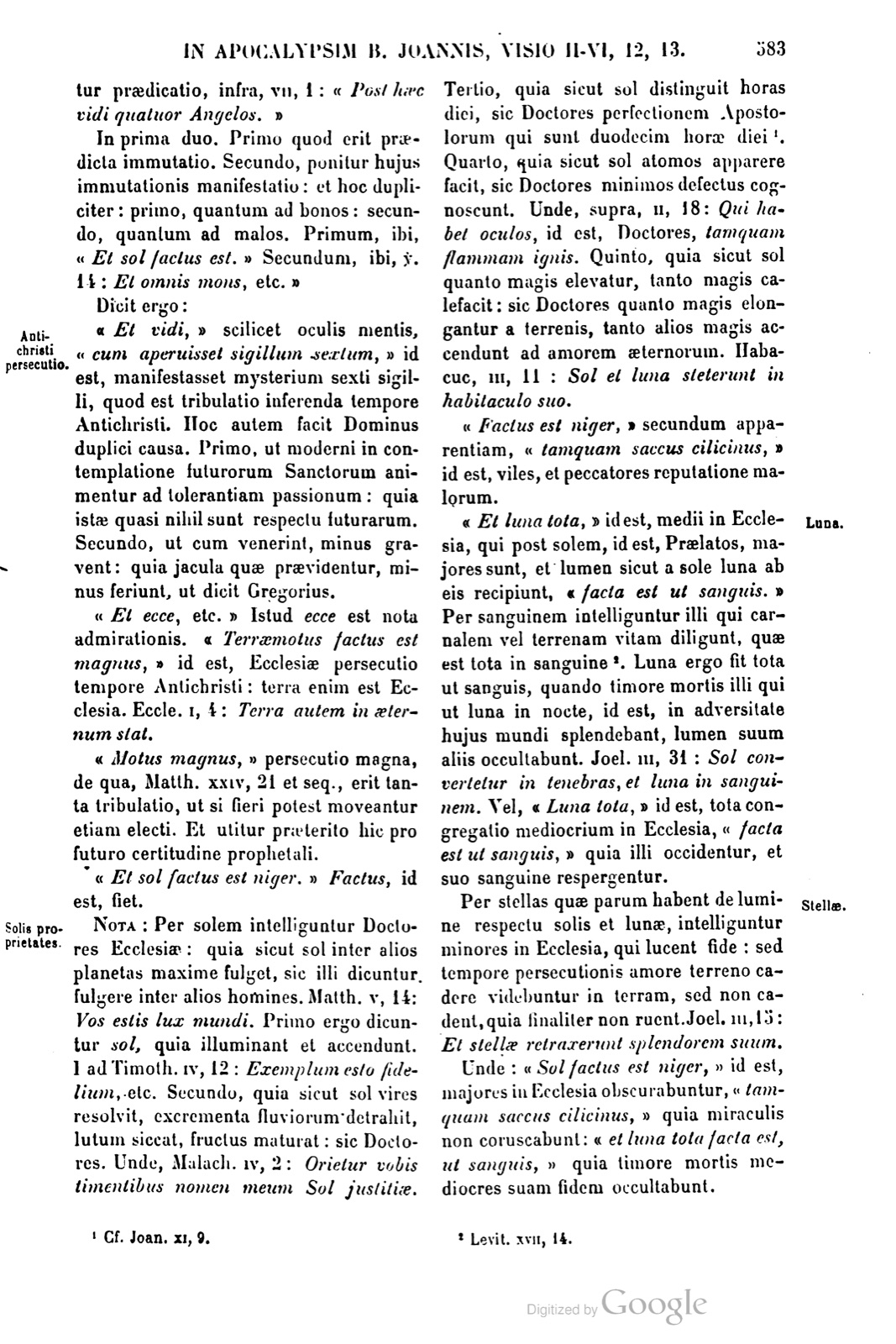
« Tamquam vocem tonitrui, » id est, vocem evidentem, terribilem, et mirabilem: quod dicitur, quia Apostoli terribiliter, et evidenter, et cum miraculorum coruscatione in modum tonitrui praedicaverunt. Act. II, 7: Stupebant autem omnes, et mirabantur, dicentes: Nonne ecce omnes isti qui loquuntur, etc.
« Dicens: Veni, » attendendo, « et vide, » intelligendo. « Veni » a figuris eas relinquendo, « et vide » veritatem manifestam. « Veni » per amorem, « et vide » per fidem. Psal. XLIV, 11: Audi, filia, et vide: audi quae praedicta sunt, et vide quae completa sunt.
2. « Et vidi: et ecce equus albus, et qui sedebat super illum habebat arcum, et data est ei corona, et exivit vincens ut vinceret. »
Hic ostendit quae viderit, et dicuntur tria. Primo, dicit Christum Ecclesiae praesidentem: « Et ecce equus albus. » Secundo, dicit ipsum gerere contra impios sacrae doctrinae armaturam: « Et habebat arcum. » Tertio, quia victor gerit coronam: « Et data est ei corona. »
Dicit ergo: « Et vidi, » supple, sicut dixerat, « et ecce equus albus, » secundum Bedam, id est, Ecclesia in baptismo abluta. Psal. L, 9: Lavabis me, et super nivem dealbabor. Vel, « Equus albus, » id est, Praedicatorum primorum coetus, qui dicuntur equus propter fortitudinem, audaciam, et hinnitum praedicationis. Job, XXXIX, 19: Numquid praebebis equo fortitudinem, aut circumdabis collo ejus hinnitum? Item, propter currendi velocitatem. Habacuc, I, 8: Leviores pardis equi ejus. Item, propter patientiam. Psal. XCI, 15, 16: Bene patientes erunt ut annuntient. Dicuntur etiam albus, propter gratiam baptismalem qua sunt abluti. Item, propter majorem claritatem cognitionis. Albedo enim inter omnes colores plus participat de lumine, et ipsi plus de lumine cognitionis habuerunt. Matth. V, 14: Vos estis lux mundi.
« Et qui sedebat super illum, » id est, Christus qui est dux et rector eorum, « habebat arcum, » id est, sacram Scripturam quae arcus dicitur, quia castrum Domini, id est, Ecclesiam defendit, et inimicos ejus occidit, si tamen manu teneatur, id est, opere.
Nota: Arcus fit ex duobus: ex chorda, et ligno duro, et chorda lignum flectit. Lignum durum Vetus Testamentum est: chorda flectens Novum Testamentum. Nova enim lege Veteris Testamenti duritia emollitur. De hoc, Genes. IX, 13: Arcum meum ponam in nubibus, id est, in praedicatoribus qui sunt elevati per contemplationem, aquosi per compunctionem, lucidi per bonam conversationem, pluentes et terram foecundantes per praedicationem. Iste arcus tot habet sagittas, quot eloquia. Hunc arcum Christus habebat, quia ipsum acceperat de dextera sedentis in throno.
“As it were a voice of thunder,” that is, a clear, terrible, and wonderful voice; this is said because the Apostles preached terribly and clearly and with the flashing of miracles in the manner of thunder. Acts II, 7: But all were astonished and marveled, saying: Are not all these who speak, etc.
“Saying: Come,” by attending, “and see,” by understanding. “Come” from figures by leaving them behind, “and see” the manifest truth. “Come” through love, “and see” through faith. Psalm XLIV, 11: Hear, daughter, and see; hear the things that were foretold, and see the things that have been fulfilled.
2. “And I saw: and behold, a white horse, and the one who sat upon it had a bow, and a crown was given to him, and he went out conquering that he might conquer.”
Here he shows what he saw, and three things are said. First, he says that Christ presides over the Church: “And behold, a white horse.” Second, he says that he bears against the impious the armor of sacred doctrine: “And he had a bow.” Third, because the victor bears a crown: “And a crown was given to him.”
Therefore he says: “And I saw,” supply, as he had said, “and behold, a white horse,” according to Bede, that is, the Church washed in baptism. Psalm L, 9: You will wash me, and I shall be made whiter than snow. Or, “a white horse,” that is, the company of the first Preachers, who are called a horse because of strength, boldness, and the neighing of preaching. Job XXXIX, 19: Will you give strength to the horse, or surround his neck with neighing? Likewise, because of swiftness in running. Habakkuk I, 8: His horses are swifter than leopards. Likewise, because of patience. Psalm XCI, 15-16: They will be well enduring, that they may announce. They are also called white because of the baptismal grace by which they were washed. Likewise, because of the greater brightness of knowledge. For whiteness among all colors participates more in light, and they had more of the light of knowledge. Matthew V, 14: You are the light of the world.
“And the one who sat upon it,” that is, Christ, who is their leader and ruler, “had a bow,” that is, sacred Scripture, which is called a bow because it defends the stronghold of the Lord, that is, the Church, and kills its enemies, if nevertheless it is held in the hand, that is, in work.
Note: A bow is made from two things, from a string and hard wood, and the string bends the wood. The hard wood is the Old Testament; the bending string is the New Testament, for by the new law the hardness of the Old Testament is softened. Concerning this, Genesis IX, 13: I will set my bow in the clouds, that is, in preachers who are raised by contemplation, watery by compunction, bright by good conduct, raining and making the earth fruitful by preaching. This bow has as many arrows as utterances. Christ had this bow because he had received it from the right hand of the one sitting on the throne.
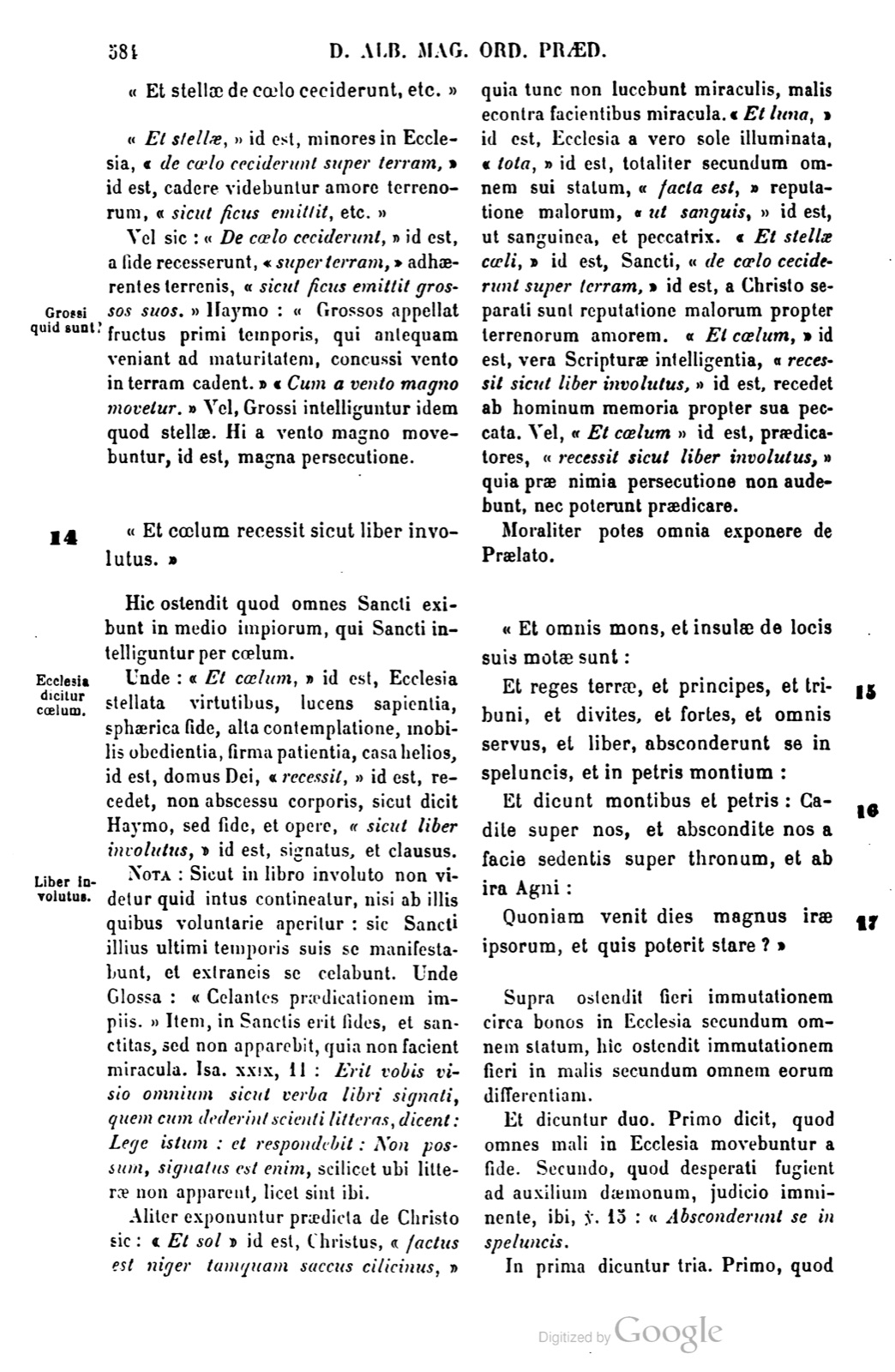
« Et data est ei, » id est, Christo, « corona, » multitudo fidelium qui ei adhaeserunt ut corona capiti. Isa. LXII, 3: Et eris corona gloriae, et diadema regni in manu Dei tui. Vel, « Corona » fuit caro Christi, qua divinitas fuit vestita, ut caput corona. Caput coronam portat, et corona caput vestit: sic divinitas portat humanitatem, et humanitas vestit divinitatem. Cantic. III, 11: Egredimini et videte, filiae Sion, regem Salomonem in diademate quo coronavit illum mater sua, id est, Virgo beata, in die desponsationis illius, id est, incarnationis, quando humanitas est desponsata divinitati.
« Et exivit vincens ut vinceret. »
« Et exivit, » scilicet a Patre in uterum, et de utero in mundum. Vel, « Exivit » de angustia Judaeae, « vincens, » scilicet paucos de Judaeis convertendo ad fidem, « ut vinceret, » scilicet in Gentibus per Apostolorum praedicationem convertendo eos ad fidem. Vel sic: « Exivit, » scilicet de utero in mundum, « vincens » naturam: quia in uterum clausum introivit, et clauso exivit: « ut vinceret, » scilicet, diabolum per humilitatem, carnem per virginitatem, mundum per paupertatem.
« Et data est ei corona. » Glossa, potestas quae sic dicitur propter aeternitatem. Daniel. VII, 14: Potestas ejus potestas aeterna. « Et exivit » a Patre in mundum, « vincens » diabolum in se, « ut vinceret, » scilicet in membris suis. Et sic notatur duplex Christi victoria qua vicit diabolum in se per suam Passionem. Sapient. X, 12: Certamen forte dedit illi ut vinceret, et sciret quoniam omnium potentior est sapientia. Alia qua vincit quotidie in membris suis, de qua, Luc. XXI, 15: Dabo vobis os et sapientiam, cui non poterunt resistere et contradicere omnes adversarii vestri.
Vel, « Data est ei corona, » ad litteram spinea, « et exivit, » scilicet, de Jerusalem, « vincens » Judaeos et Pilatum per patientiam, « ut vinceret » diabolum, et mortem.
“And there was given to him,” that is, to Christ, “a crown,” the multitude of the faithful who adhered to him as a crown to a head. Isaiah LXII, 3: And you shall be a crown of glory and a diadem of the kingdom in the hand of your God. Or, the “crown” was the flesh of Christ, with which the divinity was clothed as a head with a crown. The head carries the crown, and the crown clothes the head; so divinity carries humanity, and humanity clothes divinity. Canticle III, 11: Go forth and see, daughters of Zion, King Solomon in the diadem with which his mother crowned him, that is, the blessed Virgin, on the day of his betrothal, that is, of the incarnation, when humanity was betrothed to divinity.
“And he went out conquering that he might conquer.”
“And he went out,” namely from the Father into the womb, and from the womb into the world. Or, “he went out” from the narrowness of Judea, “conquering,” namely by converting a few of the Jews to the faith, “that he might conquer,” namely among the Gentiles by converting them to the faith through the preaching of the Apostles. Or thus: “He went out,” namely from the womb into the world, “conquering” nature, because he entered a closed womb and went out when it was closed; “that he might conquer,” namely the devil by humility, the flesh by virginity, the world by poverty.
“And a crown was given to him.” The Gloss says: power, which is so called because of eternity. Daniel VII, 14: His power is eternal power. “And he went out” from the Father into the world, “conquering” the devil in himself, “that he might conquer,” namely in his members. And thus Christ’s twofold victory is marked: one by which he conquered the devil in himself through his Passion, Wisdom X, 12: He gave him a strong contest that he might conquer and know that wisdom is more powerful than all things; the other by which he daily conquers in his members, concerning which, Luke XXI, 15: I will give you mouth and wisdom, which all your adversaries will not be able to resist and contradict.
Or, “A crown was given to him,” literally a thorny one, “and he went out,” namely from Jerusalem, “conquering” the Jews and Pilate by patience, “that he might conquer” the devil and death.
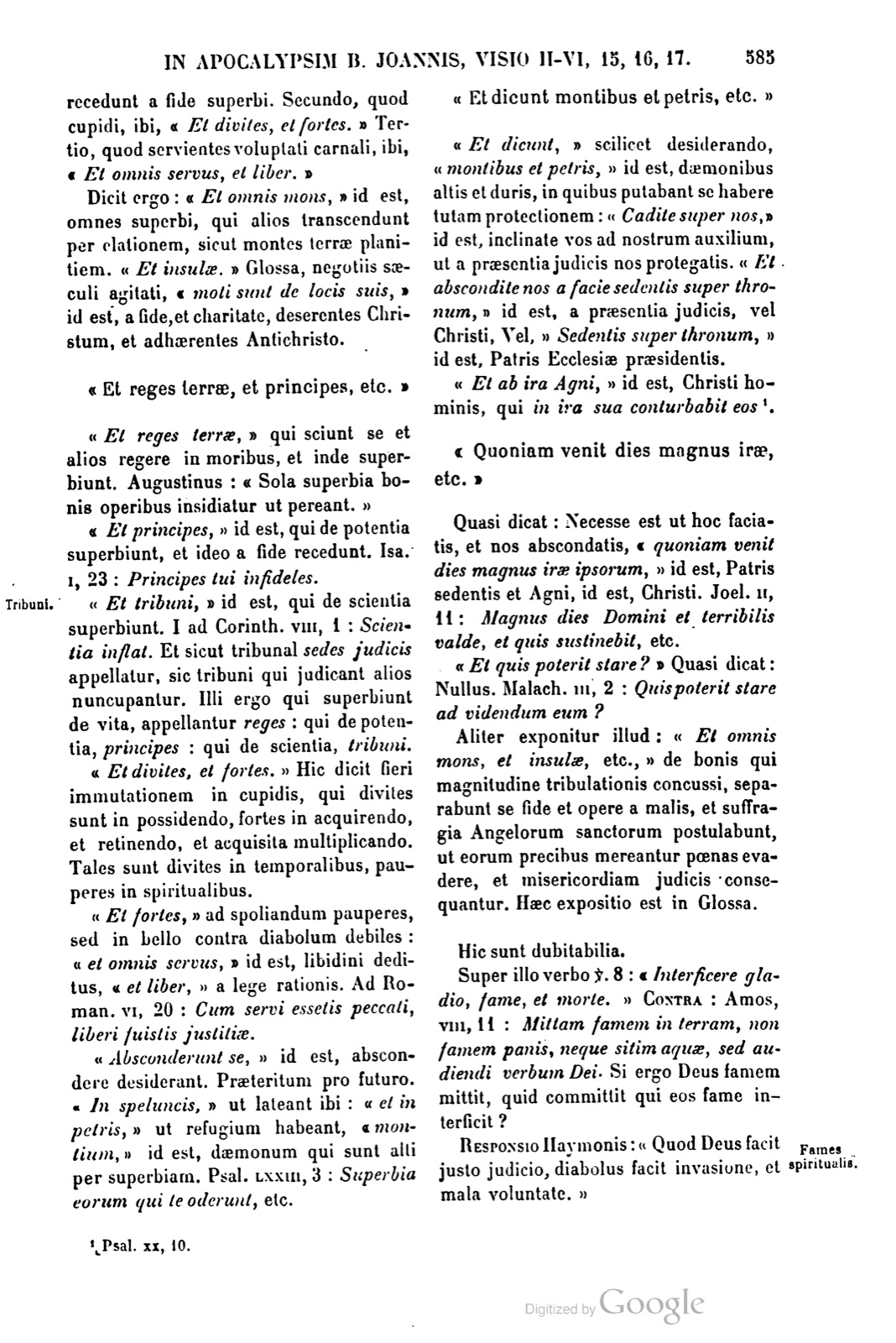
Notes
- Isaiah II, 19; Hosea X, 8; Luke XXIII, 30. (Isa. II, 19; Osee, X, 8; Luc. XXIII, 30.) ↩
If a page does not appear, its photograph has not been uploaded yet.