Works › Commentary on the Apocalypse of Blessed John
Volume 38 · pp. 566–568
Chapter V: human thanksgiving for the opening of the book
A marker with ≈ is an approximate page boundary, placed by measure of the text; the page photographs remain the authority. In the paired views, clicking a page marker brings that page into view.
8. « Et cum aperuisset Librum, quatuor animalia et viginti quatuor seniores ceciderunt coram Agno, habentes singuli citharas, et phialas aureas plenas odoramentorum, quae sunt orationes Sanctorum: 9. Et cantabant canticum novum, dicentes: Dignus es, Domine, accipere Librum, et aperire signacula ejus, quoniam occisus es, et redemisti nos Deo in sanguine tuo, ex omni tribu, et lingua, et populo, et natione: 10. Et fecisti nos Deo nostro regnum, et sacerdotes, et regnabimus super terram. »
Hic est tertium ubi ponitur gratiarum actio pro apertione Libri. Et dicuntur hic tria. Primo, inducuntur homines agentes gratias: secundo, auctoritate potentes, ibi, V. 11: « Et vidi. » Tertio, omnes simul Angeli, et homines gratias referentes, ibi, V. 13: « Omnes audivi dicentes. »
In prima duo tanguntur. Primo, ponitur gratiarum actio quam exhibent homines in Christi imitatione: secundo, quam ei reddunt laudis decantatio, ibi, V. 9: « Et cantabant. » In prima quatuor: primo, humiliatio: secundo, carnis mortificatio, ibi, « Habentes singuli. » Tertio, amoris latitudo, ibi, « Et phialas. » Quarto, pro inimicis oratio, ibi, « Plenas odoramentorum. »
Dicit ergo: « Et cum aperuisset Librum, » id est, complesset opere quae longe ante de Deo dicta fuerunt. Vel, « Cum aperuisset Librum, » id est, legis mysteria manifestasset, vel dispositionem Dei de redemptione humani generis implesset. « Quatuor animalia, » id est, omnes Praedicatores: « et viginti quatuor seniores, » id est, omnes judices Veteris et Novi Testamenti, et omnes fideles in operibus misericordiae se exercentes secundum regulam quatuor Evangelistarum, « ceciderunt coram Agno, » scilicet de se humilia sentientes. Haymo: « Cadunt, id est, de se humilia sentiunt. » Et dicit: « Coram Agno, » id est, ad honorem Agni, vel in ejus beneplacito.
« Habentes singuli citharas, » id est, mortificationes carnis quae per citharam intelliguntur. In cithara enim est lignum, et chordae: et per lignum crux Christi, per chordas caro Sanctorum signatur. Chordae ergo tenduntur in ligno, quando sancti Christi crucem et passionem imitantur, crucifigentes carnem suam cum vitiis et concupiscentiis 1. Vel, chordae sunt membra singula corporis: quae sicut corruerunt per diversa peccata, ita debent tendi in poenitentia. Ad Roman. VI, 19: Sicut exhibuistis membra vestra, etc. Et dicit: « Singuli, » ad signandum quod unusquisque debet sibi congruam accipere poenitentiam. Luc. IX, 23: Si quis vult post me venire, etc.
« Et phialas. » Phialae sunt latae et lucidae, et signant corda sanctorum quae sunt lucida per munditiam, dilatata per charitatem: aureae sunt per scientiam caelestem. De primo, Proverb. XXII, 11: Qui diligit cordis munditiam, etc. De secundo, Psal. CXVIII, 32: Viam mandatorum tuorum cucurri, etc. De tertio, ad Ephes. III, 19: Scire etiam supereminentem scientiae charitatem Dei.
8. “And when he had opened the Book, the four living creatures and the twenty-four elders fell down before the Lamb, each one having harps and golden bowls full of fragrances, which are the prayers of the Saints; 9. And they were singing a new canticle, saying: Worthy are you, O Lord, to receive the Book and to open its seals, since you were slain, and you redeemed us to God in your blood, from every tribe and tongue and people and nation; 10. And you have made us a kingdom and priests to our God, and we shall reign upon the earth.”
Here is the third place, where thanksgiving for the opening of the Book is set down. And three things are said here. First, human beings giving thanks are introduced; second, those powerful in authority, there, V. 11: “And I saw.” Third, all together, Angels and human beings giving thanks, there, V. 13: “I heard all saying.”
In the first two things are touched upon. First, the thanksgiving which human beings display in imitation of Christ is set down; second, the singing of praise which they render to him, there, V. 9: “And they were singing.” In the first there are four: first, humiliation; second, mortification of the flesh, there, “each having.” Third, breadth of love, there, “and bowls.” Fourth, prayer for enemies, there, “full of fragrances.”
Therefore he says: “And when he had opened the Book,” that is, had fulfilled in work the things that long before had been said of God. Or, “when he had opened the Book,” that is, had manifested the mysteries of the law, or fulfilled the disposition of God concerning the redemption of the human race. “The four living creatures,” that is, all Preachers; “and the twenty-four elders,” that is, all judges of the Old and New Testament, and all the faithful exercising themselves in works of mercy according to the rule of the four Evangelists, “fell down before the Lamb,” namely, thinking humble things about themselves. Haymo says: “They fall, that is, they think humble things about themselves.” And he says: “Before the Lamb,” that is, for the honor of the Lamb, or in his good pleasure.
“Each having harps,” that is, mortifications of the flesh, which are understood through the harp. For in the harp there is wood and strings; and by the wood the cross of Christ is signified, by the strings the flesh of the Saints. Therefore the strings are stretched on the wood when the saints imitate Christ’s cross and passion, crucifying their flesh with vices and concupiscences 1. Or, the strings are the individual members of the body; as they have collapsed through diverse sins, so they must be stretched in penitence. Romans VI, 19: As you have presented your members, etc. And he says: “Each one,” to signify that each person must receive a penitence fitting for himself. Luke IX, 23: If anyone wishes to come after me, etc.
“And bowls.” Bowls are broad and bright, and signify the hearts of the saints, which are bright through cleanness and broadened through charity; they are golden through heavenly knowledge. Concerning the first, Proverbs XXII, 11: He who loves cleanness of heart, etc. Concerning the second, Psalm CXVIII, 32: I have run the way of your commandments, etc. Concerning the third, to the Ephesians III, 19: Also to know the charity of God surpassing knowledge.
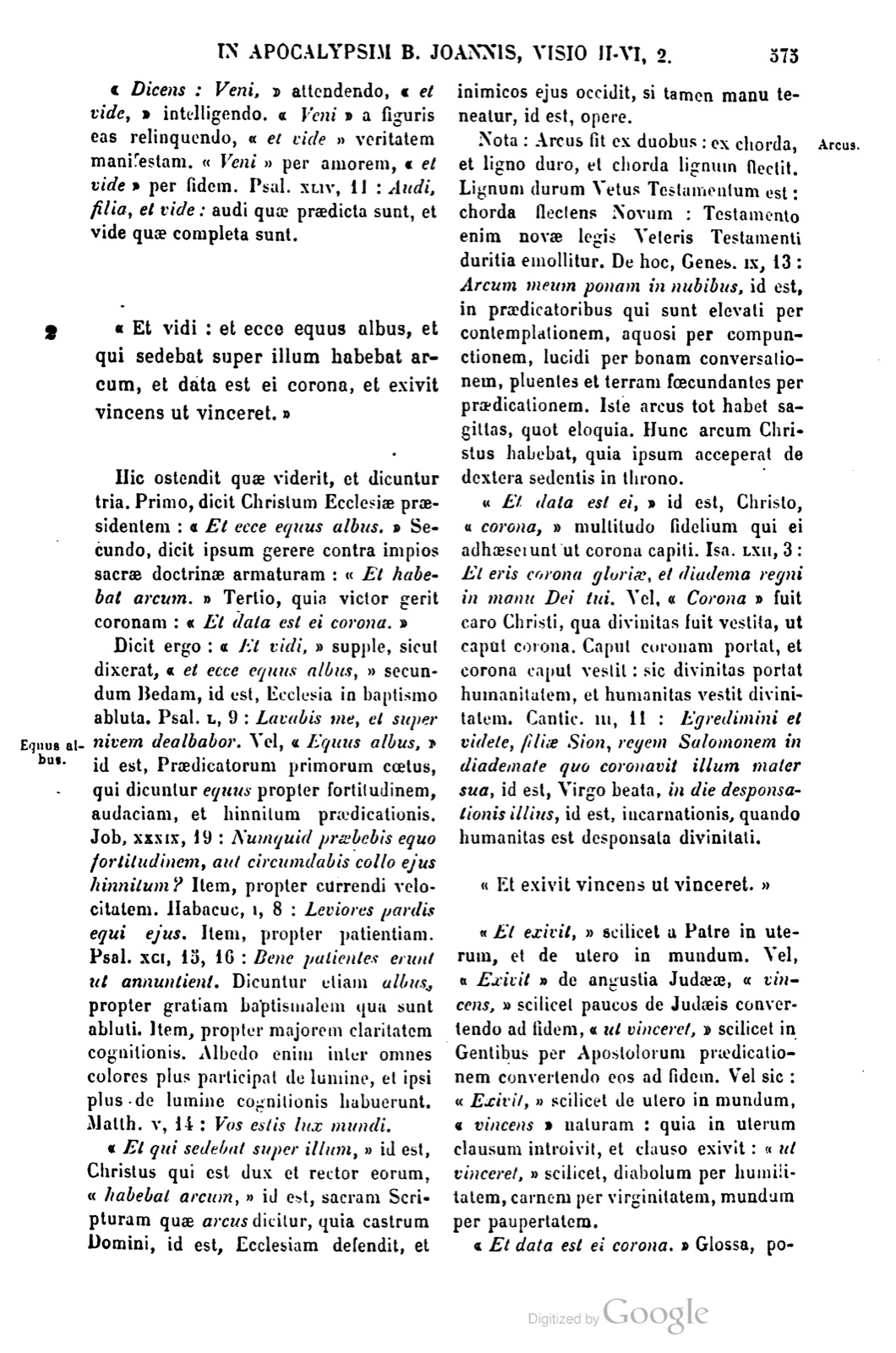
Nota, quod prius ponit citharas, quam phialas: quia prius est assumere poenitentiam, quam habere charitatis latitudinem, quae consistit praecipue in dilectione inimicorum, et oratione pro ipsis. Unde sequitur: « Plenas odoramentorum, quae, » scilicet odoramenta, « sunt orationes Sanctorum. » Et bene comparatur oratio odori: quia sicut odor in aere circumquaque se diffundit, sic orationes Sanctorum ad omnes se extendunt. I ad Timoth. II, 1: Obsecro igitur primum omnium fieri obsecrationes, orationes, postulationes, gratiarum actiones, pro omnibus hominibus. Item, odor quanto intensior, tanto diffusior: sic oratio, sicut dicit Gregorius, quanto devotior, tanto communior et fructuosior. Item, sicut odoramentum ascendit ad caput: sic et oratio munda usque ad Christum qui est caput. Psal. CXL, 2: Dirigatur oratio mea. Nota: Munda est oratio si praecesserit cithara, id est, carnis mortificatio.
« Et cantabant canticum novum, dicentes, etc. »
« Et cantabant, » scilicet, Sancti Deum laudando, et desiderium suum in contemplatione elevando, et per considerationem suae fragilitatis se deprimendo. Nota: Cantus est regularis modulatio vocis secundum elevationem, et depressionem. Unus cantus iste fuit elevatio desiderii in consideratione beneficiorum Dei, et depressio ex consideratione propriae indignitatis.
« Canticum novum, » id est, Novum Testamentum, sicut dicit Haymo: in quo novae res continentur, scilicet, incarnatio Christi, mors, resurrectio, ascensio, etc. Item, « Novum » dicitur, quia in ipso sub gemino praecepto dilectionis, tota lex comprehenditur et Prophetae. Joan. XIII, 34: Mandatum novum do vobis, etc. Item, « Novum, » quia de humani generis innovatione. Psal. XCV, 1: Cantate Domino canticum novum. Item, « Novum, » quia de nova annuntiatione. Isa. XLII, 9: Nova quoque ego annuntio. Jerem. XXXI, 22: Creavit Dominus novum super terram.
« Dicentes, » scilicet, corde, ore, et opere: « Dignus es, Domine. » Glossa: Quia immunis a peccato. « Accipere Librum, » id est, divinam dispositionem adimplere de humani generis redemptione, « et aperire signacula ejus, » id est, adimplere quae de te sunt dicta. « Accipere Librum, » in incarnatione, « et aperire signacula ejus, » per exsecutionem in opere, scilicet, in Passione.
« Quoniam occisus es, » scilicet, justus pro injustis, « et redemisti nos, » non te, et hoc a servitute diaboli cui per peccatum eramus obligati in primis parentibus. Isa. LII, 3: Gratis venumdati estis, et sine argento redimemini. « Deo, » id est, ut essemus Dei qui prius fuimus diaboli. Et dicit: « Redemisti, » id est, iterum emisti. Nota: Deus hominem fecit: et ne videretur hoc parum, omnibus eum praefecit, quando omnes creaturas pro eo habendo ei subjecit, sed etiam redemit pretio sanguinis sui. I ad Corinth. VI, 20: Empti enim estis pretio magno. Psal. CXXIX, 7: Copiosa apud eum redemptio. Nota: Redemit a tribus: a diaboli servitute sicut dicitur hic. Item, a vana conversatione. I Petri, I, 18: Non corruptibilibus auro, vel argento, etc. Item, a morte. Osee, XIII, 14: De morte redimam eos.
Note that he sets down harps before bowls, because it is earlier to assume penitence than to have the breadth of charity, which consists especially in love of enemies and prayer for them. Hence there follows: “full of fragrances, which,” namely the fragrances, “are the prayers of the Saints.” And prayer is well compared to fragrance, because as fragrance diffuses itself all around in the air, so the prayers of the Saints extend themselves to all. 1 Timothy II, 1: Therefore I ask first of all that supplications, prayers, petitions, and thanksgivings be made for all human beings. Likewise, the more intense a fragrance is, the more diffusive it is; so prayer, as Gregory says, the more devout it is, the more common and fruitful. Likewise, as fragrance ascends to the head, so also pure prayer ascends all the way to Christ, who is the head. Psalm CXL, 2: Let my prayer be directed. Note: Prayer is pure if the harp has preceded, that is, mortification of the flesh.
“And they were singing a new canticle, saying, etc.”
“And they were singing,” namely the Saints, by praising God, and by raising their desire in contemplation, and by lowering themselves through consideration of their own frailty. Note: Singing is a regular modulation of the voice according to elevation and depression. This one song was an elevation of desire in consideration of the benefits of God, and a depression from consideration of one’s own unworthiness.
“A new canticle,” that is, the New Testament, as Haymo says, in which new realities are contained, namely, the incarnation of Christ, death, resurrection, ascension, etc. Likewise, it is called “new” because in it the whole Law and the Prophets are comprehended under the twin commandment of love. John XIII, 34: I give you a new commandment, etc. Likewise, “new,” because it is about the renewal of the human race. Psalm XCV, 1: Sing to the Lord a new canticle. Likewise, “new,” because it is about a new announcement. Isaiah XLII, 9: I also announce new things. Jeremiah XXXI, 22: The Lord has created a new thing upon the earth.
“Saying,” namely with heart, mouth, and work: “Worthy are you, O Lord.” The Gloss says: Because he is free from sin. “To receive the Book,” that is, to fulfill the divine disposition concerning the redemption of the human race, “and to open its seals,” that is, to fulfill the things that are said about you. “To receive the Book,” in the incarnation, “and to open its seals,” through execution in work, namely, in the Passion.
“Because you were slain,” namely, the just for the unjust, “and you redeemed us,” not yourself, and this from the servitude of the devil to whom we were bound through sin in our first parents. Isaiah LII, 3: You were sold for nothing, and without silver you shall be redeemed. “To God,” that is, so that we would belong to God, we who first belonged to the devil. And he says: “You redeemed,” that is, you bought again. Note: God made man; and lest this seem little, he placed him over all, when he subjected all creatures to him to have for himself, but he also redeemed him at the price of his blood. 1 Corinthians VI, 20: For you were bought with a great price. Psalm CXXIX, 7: With him is plentiful redemption. Note: He redeemed from three things: from the servitude of the devil, as is said here; likewise, from vain conduct. 1 Peter I, 18: Not with corruptible gold or silver, etc. Likewise, from death. Hosea XIII, 14: From death I will redeem them.
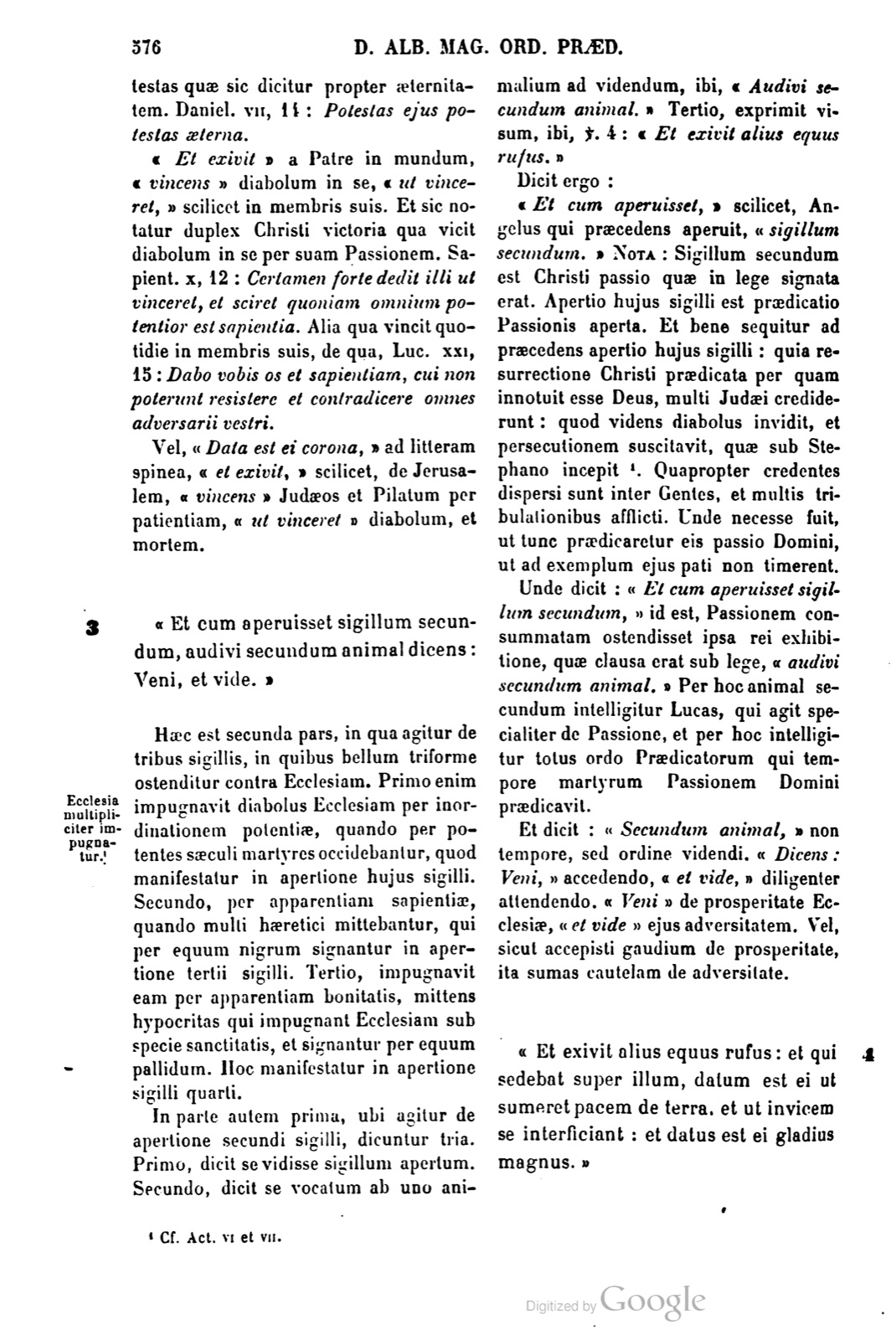
« In sanguine tuo, » scilicet, quem pro nobis fudisti. Sed quare non dicit, per sanguinem, sed in sanguine? Responsio. Omnes sunt redempti per sanguinem Christi quoad sufficientiam, sed soli boni quoad efficientiam, quae tangitur, cum dicit: « In sanguine tuo, » id est, in fide et imitatione sanguinis Passionis Christi.
« Ex omni tribu, » id est, ex omni ordine hominum: quia sicut dicit Haymo, tribus dicitur a tribus ordinibus qui erant in populo Judaeorum, scilicet, sacerdotes, milites, et agricolae. Vel, tribus filiis Noe, ex quibus disseminatum est totum genus humanum super terram. Unde sensus est: « Ex omni tribu, » id est, ex trina generatione filiorum Noe.
« Et lingua, » quia cum sint septuaginta linguae, ex omnibus his sunt aliqui ad fidem conversi: « et populo, » quia in singulis linguis multi sunt populi, ut populus Romanus et Lombardus sunt unius linguae: « et natione, » quia in populo multae sunt nationes. Ex his igitur dicitur nos redemisse: quia ex omnibus veniunt aliqui ad fidem. Vel, potest dici, quod per tribum et linguam intelligit Judaeos, per tribum majores, per linguam minores, per nationem et populum Gentiles: et per primum, majores, et per secundum minores de plebe.
« Et fecisti nos Deo nostro regnum, etc. »
« Et fecisti nos, » scilicet, redemptos, « Deo nostro regnum, » id est, tales in quibus Deus regnat per gratiam in praesenti, et in futuro per gloriam: « et sacerdotes, » id est, ut nos ipsos spiritualiter Deo offeramus per poenitentiam. Psal. L, 19: Sacrificium Deo spiritus contribulatus. Et, Job, XIII, 14: Et animam meam porto in manibus meis, id est, vitam meam offero.
« Et regnabimus, » dum ista facimus, « super terram, » id est, super terrenitatem, hoc est, quidquid terrenum est in nobis et malum subjiciemus, id est, motus carnales spiritu domabimus, ut tandem super terram viventium regnemus.
Hic quaeritur, Quare non dicit hic: fecisti nos reges, sed regnum? Item, Quare non dicit, sacerdotium, sed sacerdotes? Responsio. Quia quod nos regimus, hoc a Deo habemus: unde non sumus reges, nisi quia regnum Dei sumus: sed quod sumus sacerdotes, id est, Deo nos offerentes, hoc magis est a nobis, quia a libero arbitrio praeparante et cooperante.
“In your blood,” namely, which you poured out for us. But why does he not say “through blood,” but “in blood”? Response. All are redeemed through the blood of Christ with respect to sufficiency, but only the good with respect to efficacy, which is touched upon when he says: “In your blood,” that is, in faith in and imitation of the blood of Christ’s Passion.
“From every tribe,” that is, from every order of human beings, because, as Haymo says, tribe is so called from the three orders which were in the people of the Jews, namely priests, soldiers, and farmers. Or, from the three sons of Noah, from whom the whole human race was scattered over the earth. Hence the sense is: “From every tribe,” that is, from the threefold generation of the sons of Noah.
“And tongue,” because, although there are seventy tongues, from all of these some have been converted to the faith; “and people,” because in individual tongues there are many peoples, as the Roman people and the Lombard people are of one tongue; “and nation,” because in a people there are many nations. Therefore he is said to have redeemed us from these, because from all of them some come to the faith. Or, it can be said that by tribe and tongue he understands the Jews, by tribe the greater ones, by tongue the lesser; and by nation and people the Gentiles, and by the first the greater, by the second the lesser from the common people.
“And you have made us a kingdom to our God, etc.”
“And you have made us,” namely the redeemed, “a kingdom to our God,” that is, such ones in whom God reigns through grace in the present, and in the future through glory; “and priests,” that is, so that we may spiritually offer ourselves to God through penitence. Psalm L, 19: A sacrifice to God is a troubled spirit. And Job XIII, 14: And I carry my soul in my hands, that is, I offer my life.
“And we shall reign,” while we do these things, “upon the earth,” that is, over earthliness, that is, we shall subject whatever is earthly and evil in us, that is, we shall tame fleshly motions by the spirit, so that at last we may reign upon the land of the living.
Here it is asked: Why does he not say here, You have made us kings, but a kingdom? Likewise, why does he not say priesthood, but priests? Response. Because the fact that we rule, we have from God; hence we are not kings except because we are the kingdom of God. But the fact that we are priests, that is, offering ourselves to God, this is more from us, because from free choice preparing and cooperating.
Notes
- Galatians V, 24. (Ad Galat. V, 24.) ↩
If a page does not appear, its photograph has not been uploaded yet.