Works › Commentary on the Apocalypse of Blessed John
Volume 38 · pp. 561–563
Chapter V: lemma continuation and the sealed book
A marker with ≈ is an approximate page boundary, placed by measure of the text; the page photographs remain the authority. In the paired views, clicking a page marker brings that page into view.
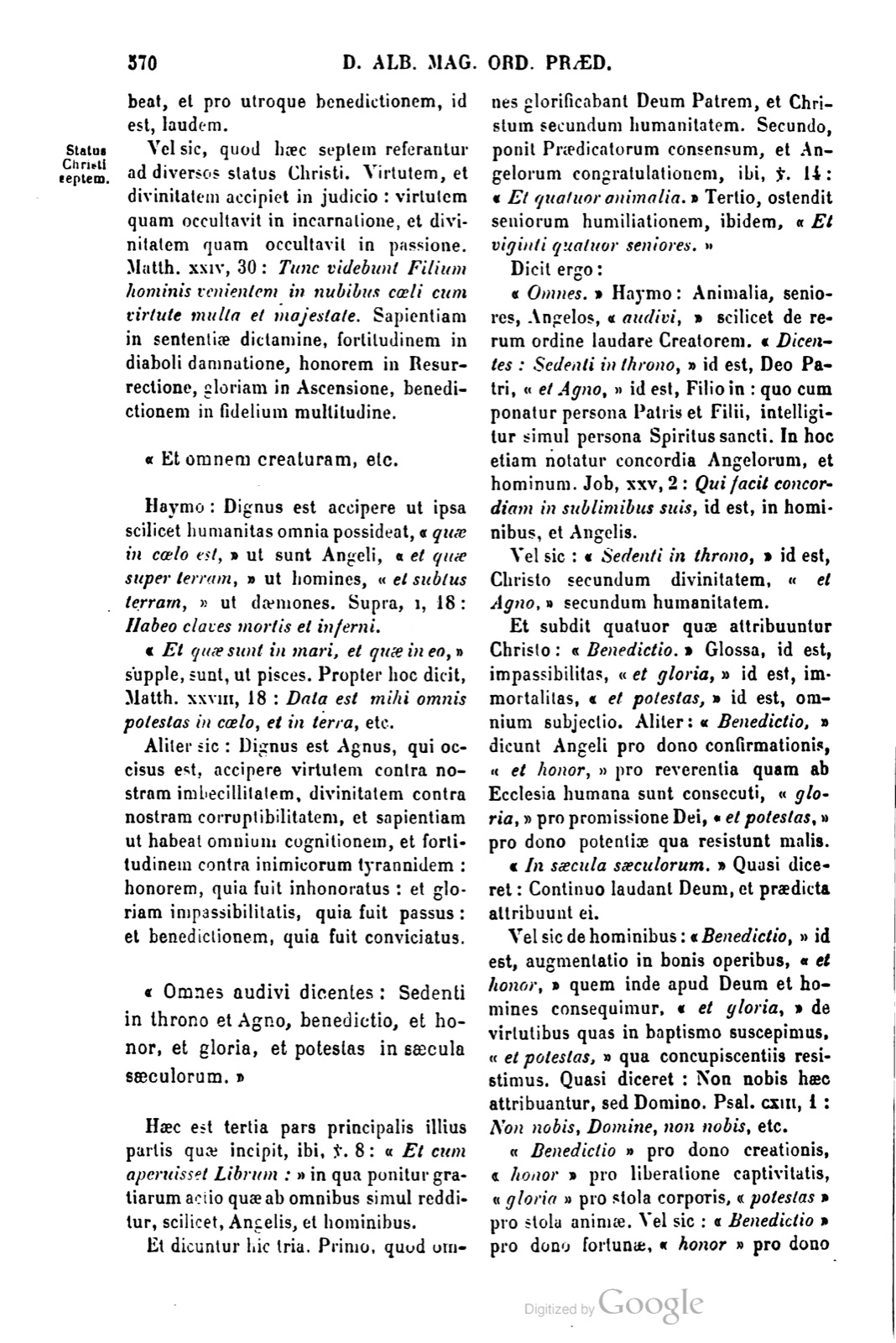
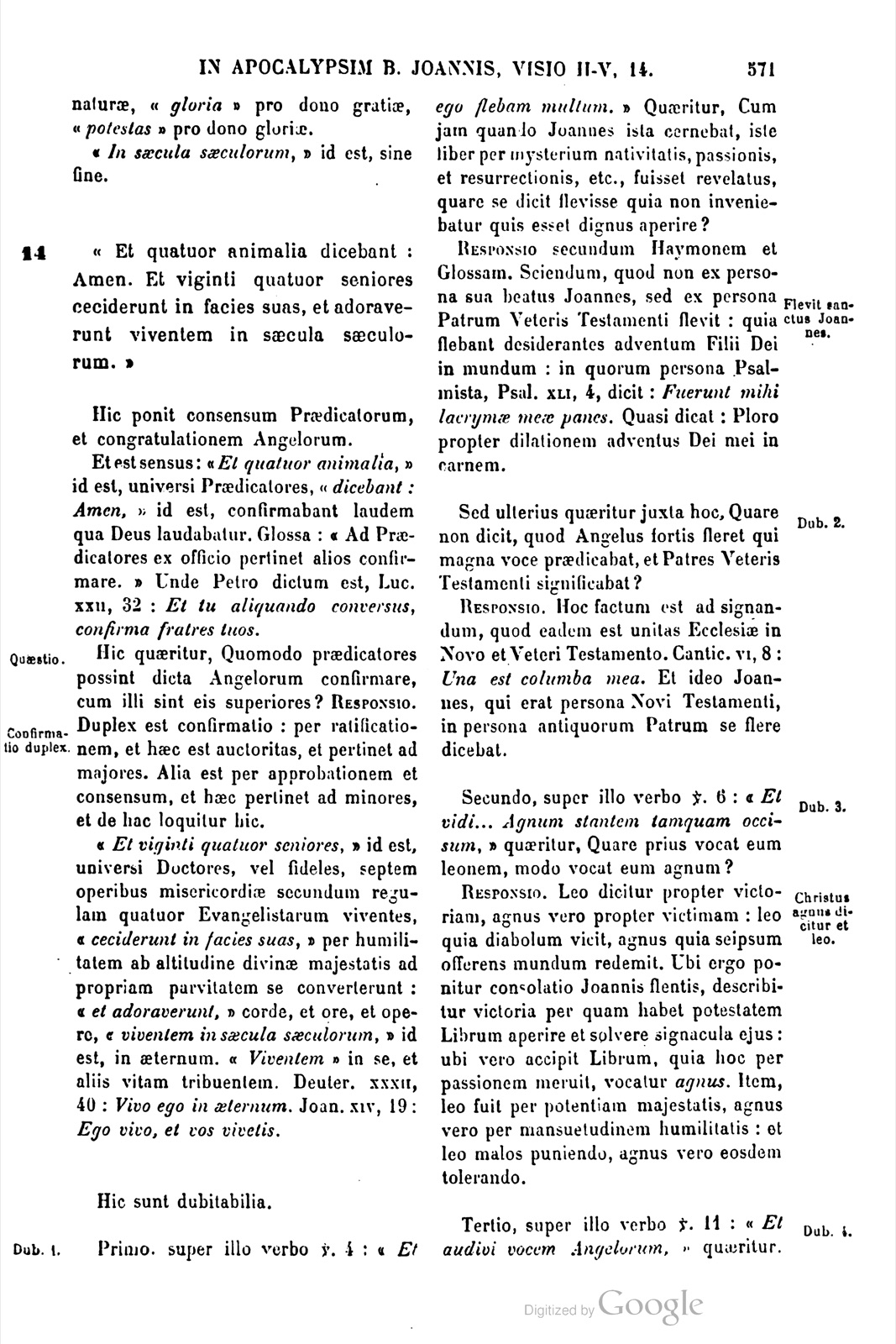
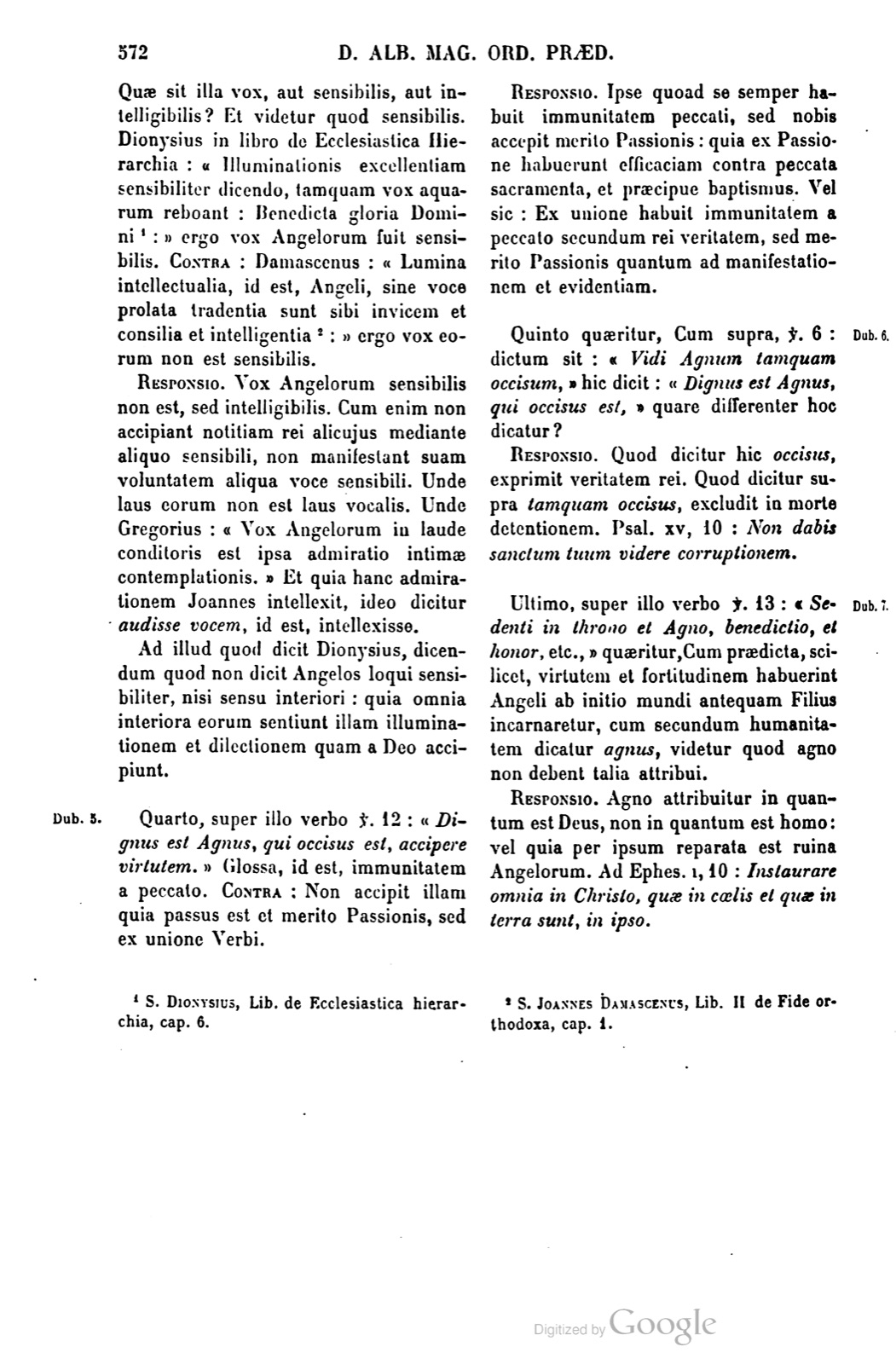
est, et super terram, et sub terra, et quae sunt in mari, et quae in eo, omnes audivi dicentes: Sedenti in throno et Agno, benedictio, et honor, et gloria, et potestas in saecula saeculorum.
14. Et quatuor animalia dicebant: Amen. Et viginti quatuor seniores ceciderunt in facies suas, et adoraverunt viventem in saecula saeculorum.
IN CAPUT V APOCALYPSIS
ENARRATIO.
« Et vidi in dextera sedentis supra thronum, Librum, scriptum intus et foris, signatum sigillis septem. »
Supra actum est de sedente in throno et ornatu ejus, hic agitur de Libro quem nemo poterat aperire nisi Agnus. Et dividitur hoc capitulum in quinque partes. In prima parte videtur primo Liber signatus in dextera sedentis. Secundo, ponitur de apertione quaestio Angeli, V. 2: « Et vidi Angelum. » Tertio, dicit quod non est inventus quis dignus aperire, ibi, V. 3: « Et nemo poterat. » Quarto, ponitur fletus Joannis pro hac re, ibi, V. 4: « Et ego flebam. » Quinto, ponitur consolatio facta a seniore, ibi, V. 5: « Et unus de senioribus. »
In prima ergo parte ostenditur divina dispositio de redemptione humani generis: in secunda, desiderium antiquorum Patrum de impletione illius dispositionis: in tertia, afflictio de dilatione illius impletionis: in quarta, flentium consolatio: in quinta, praedictae dispositionis adimpletio.
Dicit ergo: « Et vidi. » Nota: In praecedenti capitulo dixit, V. 1: « Post haec vidi: » in quo significabatur, quod visio ibidem incipiens erat alia a praecedente per dictionem ordinem importantem: sed hic per conjunctionem signatur, quod ista visio non est alia a praecedenti, sed est pars illius quae in quarto capitulo incipit.
Unde dicit: « Et vidi in dextera sedentis supra thronum, » id est, in dextera Patris quae est Filius. Psal. CXVII, 16: Dextera Domini fecit virtutem. « Librum scriptum intus, » quantum ad Novum Testamentum, « et foris, » quantum ad Vetus. Nota: Vetus Testamentum dicitur scriptum foris, quia juxta litteram foris apparebat: Novum scriptum intus, quia juxta sensum mysticum novum continebat. Ezechiel. I, 16: Rota erat in medio rotae.
Vel sic: « Vidi in dextera sedentis, » id est, Christi qui Ecclesiae praesidet, « Librum, » scilicet sacram Scripturam, quam tenet in dextera, quia bonum spirituale promittit, « scriptum intus, » quantum ad Vetus Testamentum ubi mysterium nostrae redemptionis latet, « et foris, » quantum ad Novum Testamentum ubi apparet. Vel, « Scriptum intus, » ne secreta malis aperiantur, « et foris, » ut bonis propalentur.
« Signatum sigillis septem, » de quibus determinatur infra, capp. VI et VII. « Septem. » Vel, hoc dicitur secundum Bedam: quia vel latentium mysteriorum plenitudine tectus, vel Spiritus septiformis dispositione conscriptus. Vel, « Septem sigilla » sunt genera obscuritatum. Primum est profunditas sententiarum. Eccli. I, 2: Altitudinem caeli, et latitudinem terrae, et profundum abyssi, id est, Scripturae, quis dimensus est? Secundum, multiplicitas intelligentiarum: Hieronymus: « In verbis singulis multae latent intelligentiae. » Tertium, velamen sententiarum. II ad Corinth. III, 15: Usque in hodiernum diem cum legitur Moyses, velamen positum est super cor eorum. Quartum est incomprehensibilitas rerum. Ad Roman. XI, 33: Quam incomprehensibilia sunt judicia ejus! Quintum, obscuritas mysteriorum. Isa. XXIV, 16: Secretum meum mihi. Sextum, dulcedo tropologiarum. Psal. XXX, 20: Quam magna multitudo dulcedinis tuae, Domine, etc.! Septimum, infallibilis veritas eorum quae dicuntur. Matth. XXIV, 35: Caelum et terra transibunt, etc.
is, and upon earth, and beneath the earth, and the things which are in the sea, and the things which are in it, I heard all saying: To the one sitting on the throne and to the Lamb be blessing, and honor, and glory, and power unto ages of ages.
14. And the four living creatures said: Amen. And the twenty-four elders fell down upon their faces and adored the one living unto ages of ages.
ON CHAPTER V OF THE APOCALYPSE
EXPOSITION.
“And I saw in the right hand of the one sitting upon the throne a Book, written within and without, sealed with seven seals.”
Above there has been treatment of the one sitting on the throne and of his adornment; here there is treatment of the Book which no one could open except the Lamb. And this chapter is divided into five parts. In the first part, first the Book sealed in the right hand of the one sitting is seen. Second, the Angel’s question about the opening is set down, V. 2: “And I saw an Angel.” Third, he says that no one worthy to open it was found, there, V. 3: “And no one was able.” Fourth, John’s weeping over this matter is set down, there, V. 4: “And I was weeping.” Fifth, the consolation made by an elder is set down, there, V. 5: “And one of the elders.”
Therefore in the first part the divine disposition concerning the redemption of the human race is shown; in the second, the desire of the ancient Fathers for the fulfillment of that disposition; in the third, the affliction over the delay of that fulfillment; in the fourth, the consolation of those weeping; in the fifth, the fulfillment of the aforesaid disposition.
Therefore he says: “And I saw.” Note: In the preceding chapter he said, V. 1: “After these things I saw,” by which it was signified that the vision beginning there was another than the preceding by a word importing order; but here by the conjunction it is signified that this vision is not another than the preceding, but is part of that which begins in the fourth chapter.
Hence he says: “And I saw in the right hand of the one sitting upon the throne,” that is, in the right hand of the Father, which is the Son. Psalm CXVII, 16: The right hand of the Lord has wrought strength. “A Book written within,” with respect to the New Testament, “and without,” with respect to the Old. Note: The Old Testament is called written without, because according to the letter it appeared without; the New is written within, because according to the mystical sense it contained new things. Ezekiel I, 16: A wheel was in the midst of a wheel.
Or thus: “I saw in the right hand of the one sitting,” that is, of Christ who presides over the Church, “a Book,” namely sacred Scripture, which he holds in his right hand, because he promises spiritual good; “written within,” with respect to the Old Testament, where the mystery of our redemption lies hidden; “and without,” with respect to the New Testament, where it appears. Or, “written within,” lest secrets be opened to the wicked, “and without,” that they may be disclosed to the good.
“Sealed with seven seals,” concerning which there is determination below, chapters VI and VII. “Seven.” Or this is said according to Bede, because it is either covered by the fullness of hidden mysteries, or written by the disposition of the sevenfold Spirit. Or, the “seven seals” are kinds of obscurities. The first is the depth of sentences. Ecclesiasticus I, 2: Who has measured the height of heaven, and the breadth of the earth, and the depth of the abyss, that is, of Scripture? Second, the multiplicity of understandings; Jerome says: “In single words many understandings lie hidden.” Third, the veil of the sentences. 2 Corinthians III, 15: Even to this day, when Moses is read, a veil is placed upon their heart. Fourth is the incomprehensibility of the realities. Romans XI, 33: How incomprehensible are his judgments! Fifth, the obscurity of mysteries. Isaiah XXIV, 16: My secret to myself. Sixth, the sweetness of tropologies. Psalm XXX, 20: How great is the multitude of your sweetness, O Lord, etc.! Seventh, the infallible truth of the things that are said. Matthew XXIV, 35: Heaven and earth shall pass away, etc.
Item, liber iste dicitur Christus. Psal. CXXXVIII, 16: In libro tuo omnes scribentur: qui dicitur scriptus intus sapientia increata, foris sapientia creata: scriptus intus in anima litteris virtutum, et foris in corpore vulneribus lateris, pedum, et manuum. Psal. XXI, 17: Foderunt manus meas et pedes meos, etc. Septem signacula sunt septem opera nostrae redemptionis, scilicet, Incarnatio, Nativitas, Passio, Resurrectio, Ascensio, Spiritus sancti missio, Adventus ad judicium.
2. « Et vidi Angelum fortem, praedicantem voce magna: Quis est dignus aperire Librum, et solvere signacula ejus? 3. Et nemo poterat neque in caelo, neque in terra, neque subtus terram aperire Librum, neque respicere illum. 4. Et ego flebam multum, quoniam nemo dignus inventus est aperire Librum, nec videre eum. »
Haec est secunda pars hujus capituli, in qua ponitur quaestio Angeli quaerentis: Quis erit dignus aperire Librum? Unde dicit: « Et vidi, » id est, spiritualiter intellexi, « Angelum, » id est, sanctos Patres, Doctores, et Praedicatores Veteris Testamenti, qui dicuntur Angelus singulariter propter concordiae et fidei unitatem, « fortem, » propter exspectationis longanimitatem, « praedicantem, » id est, anxie inquirentem, et aliis etiam nuntiantem. Anxio affectu inquirebat qui dicebat, Isa. LXIV, 1: Utinam dirumperes caelos, et descenderes.
« Voce magna, » id est, magno desiderio et affectu: « Quis est dignus aperire Librum, » id est, Veteris legis explanare obscuritatem, in qua continetur promissio de redemptione humani generis? Quasi diceret: Nullus est dignus aperire Librum.
Nota: Multiplex est liber: Dei praescientia. Exod. XXXII, 31 et 32: Aut dimitte eis hanc noxam, aut si non facis, dele me de Libro tuo. Christus. Psal. CXXXVIII, 16: In libro tuo omnes scribentur. Vitae. Ad Philip. IV, 3: Quorum nomina sunt in libro vitae. Naturae. Eccli. XXIV, 32: Haec omnia liber vitae. Poenae. Nahum, I, 1: Onus Ninive: Liber visionis. Picturae. Isa. XXXIV, 4: Complicabuntur sicut liber caeli. Scripturae. Zachar. V, 2: Vidi, et ecce volumen volans. Eucharistiae. Isa. XXIX, 11: Cum dederint scienti litteras librum, dicent ei: Lege istum: et respondebit: Non possum, signatus enim est. Inexplicabile enim est, quod Christus sit sub tam parva specie in altari.
Likewise, this book is called Christ. Psalm CXXXVIII, 16: In your book all shall be written; he is said to be written within by uncreated wisdom, without by created wisdom; written within in the soul by the letters of virtues, and without in the body by the wounds of his side, feet, and hands. Psalm XXI, 17: They have dug my hands and my feet, etc. The seven seals are the seven works of our redemption, namely, Incarnation, Nativity, Passion, Resurrection, Ascension, the sending of the Holy Spirit, and the Coming to judgment.
2. “And I saw a strong Angel proclaiming with a great voice: Who is worthy to open the Book and loose its seals? 3. And no one was able, neither in heaven, nor on earth, nor beneath the earth, to open the Book or to look upon it. 4. And I was weeping much, because no one worthy was found to open the Book, nor to see it.”
This is the second part of this chapter, in which is set down the question of the Angel asking: Who will be worthy to open the Book? Hence he says: “And I saw,” that is, I understood spiritually, “an Angel,” that is, the holy Fathers, Doctors, and Preachers of the Old Testament, who are called Angel in the singular because of the unity of concord and faith; “strong,” because of the long-suffering of expectation; “proclaiming,” that is, anxiously inquiring, and also announcing to others. With anxious affection he was inquiring who said, Isaiah LXIV, 1: Would that you would break open the heavens and come down.
“With a great voice,” that is, with great desire and affection: “Who is worthy to open the Book,” that is, to explain the obscurity of the Old Law, in which is contained the promise concerning the redemption of the human race? As if he were saying: No one is worthy to open the Book.
Note: There is a manifold book: the foreknowledge of God. Exodus XXXII, 31 and 32: Either forgive them this fault, or, if you do not, blot me out of your Book. Christ. Psalm CXXXVIII, 16: In your book all shall be written. Of life. Philippians IV, 3: Whose names are in the book of life. Of nature. Ecclesiasticus XXIV, 32: All these things are the book of life. Of punishment. Nahum I, 1: The burden of Nineveh: the book of the vision. Of painting. Isaiah XXXIV, 4: The heavens shall be folded up like a book. Of Scripture. Zechariah V, 2: I saw, and behold, a flying scroll. Of the Eucharist. Isaiah XXIX, 11: When they have given a book’s letters to one who knows, they will say to him: Read this; and he will answer: I cannot, for it is sealed. For it is inexplicable that Christ should be under so small a species on the altar.
Vel, « Quis est dignus aperire Librum, » id est, divinam dispositionem implere, « et solvere septem signacula ejus, » id est, legis mysteria manifestare?
Hic objicitur: Videtur ordo praeposterus: nam prius sunt signacula solvenda, postea liber aperiendus. Responsio. Sic dicitur, quia Christus quod dispositum erat a Patre in se implevit, quod est Librum aperire: tamen postea per praedicationem suam et Apostolorum factam adimpletionem manifestavit, quod est solvere sigilla. Vel sic: Librum aperuit, id est, sacram Scripturam Veteris Testamenti in se complevit, quando factus est homo: post Resurrectionem sigilla reseravit, quando aperuit discipulis sensum, ut intelligerent Scripturas 1.
« Et nemo poterat, neque in caelo, neque in terra, etc. »
« Et nemo poterat, » id est, nulla creatura rationalis, « neque in caelo, » quia nec Angelus, « neque in terra, » quia nec homo vivens in corpore, « neque subtus terram, » quia nec anima exuta a corpore, « aperire Librum, » id est, divinam dispositionem implere, hoc est, genus humanum redimere, « neque respicere illum. » Glossa, id est, generationem Salvatoris perfecte intelligere.
Hic quaeritur, Cum supra dixerit: « Et vidi in dextera sedentis supra thronum, Librum, etc., » quomodo ergo dicit hic, quod nemo poterat Librum respicere? Responsio Haymonis est, quod respicere hic accipitur pro comprehendere. Unde dicit, quod nemo Angelorum, vel hominum comprehendere potest quomodo ille incircumscriptus spiritus intra uterum Virginis matris sit animatus.
« Et ego flebam multum, quoniam nemo dignus inventus est, etc. »
« Nemo dignus inventus est, » quia omnes erant inquinati. Ad Ephes. II, 3: Omnes eramus natura filii irae. « Aperire Librum, » id est Scripturam implere, quae promittebat redemptionem fiendam per Christum. Vel, « Aperire Librum, » id est, redimere genus humanum: « nec videre illum, » id est, perfecte intelligere: nondum enim plenitudo temporis venerat in quo debebat Liber aperiri. Daniel. XII, 4: Tu, Daniel, claude sermones, et signa librum, etc.
Or, “Who is worthy to open the Book,” that is, to fulfill the divine disposition, “and to loose its seven seals,” that is, to manifest the mysteries of the law?
Here it is objected: The order seems reversed, for first the seals must be loosed, afterward the book opened. The response: It is said thus because Christ fulfilled in himself what had been disposed by the Father, which is to open the Book; yet afterward through his preaching and that of the Apostles he manifested the fulfillment made, which is to loose the seals. Or thus: He opened the Book, that is, he fulfilled sacred Scripture of the Old Testament in himself when he was made man; after the Resurrection he unsealed the seals when he opened the understanding of the disciples so that they might understand the Scriptures 1.
“And no one was able, neither in heaven, nor on earth, etc.”
“And no one was able,” that is, no rational creature, “neither in heaven,” because not even an Angel, “nor on earth,” because not even a human being living in the body, “nor beneath the earth,” because not even a soul stripped of the body, “to open the Book,” that is, to fulfill the divine disposition, that is, to redeem the human race, “nor to look upon it.” The Gloss says: that is, perfectly to understand the generation of the Savior.
Here it is asked: Since above he said, “And I saw in the right hand of the one sitting upon the throne a Book, etc.,” how therefore does he say here that no one could look upon the Book? The response of Haymo is that “to look upon” is taken here for to comprehend. Hence he says that no one of Angels or human beings can comprehend how that uncircumscribed spirit was animated within the womb of the Virgin mother.
“And I was weeping much, because no one worthy was found, etc.”
“No one worthy was found,” because all were stained. To the Ephesians II, 3: We were all by nature children of wrath. “To open the Book,” that is, to fulfill Scripture, which promised the redemption to be accomplished through Christ. Or, “to open the Book,” that is, to redeem the human race; “nor to see it,” that is, to understand perfectly; for the fullness of time had not yet come in which the Book had to be opened. Daniel XII, 4: You, Daniel, close the words and seal the book, etc.
Notes
- Luke XXIV, 45. (Luc. XXIV, 45.) ↩
If a page does not appear, its photograph has not been uploaded yet.