Works › Commentary on the Apocalypse of Blessed John
Volume 38 · pp. 557–560
Chapter IV exposition: praise of the living creatures, adoration of the elders, doubts
A marker with ≈ is an approximate page boundary, placed by measure of the text; the page photographs remain the authority. In the paired views, clicking a page marker brings that page into view.
« Et requiem non habebant die ac nocte, dicentia: Sanctus, sanctus, sanctus Dominus Deus omnipotens, qui erat, et qui est, et qui venturus est. »
Hic ostenditur quod officium habebant animalia respectu Dei, et dicitur quod erant concinentia laudem Dei. Hoc consistit in tribus: in professione Trinitatis et unitatis quae sunt Dei in se: in creaturarum productione, ibi, « Qui est, et qui erat: » in meritorum retributione, ibi, « Et qui venturus est. »
Unde dicit: « Et requiem non habebant, » id est, non cessabant: ecce laudis continuitas. Unde sequitur: « Die ac nocte, » id est, continue. Vel, « Die ac nocte. » Quasi dicat: Nec in prosperis, nec in adversis cessant a laude Dei. Psal. XXXIII, 2: Benedicam Dominum in omni tempore: semper laus ejus, etc.
« Dicentia, » corde, ore, et opere: corde per fidem, ore per confessionem, opere per approbationem: « Sanctus, sanctus, sanctus. » In hoc intelligitur personarum Trinitas in verborum iteratione.
Nota, quod septem modis invenitur personarum Trinitas in Scriptura. Primo significatione. Matth. XXVIII, 19: In nomine Patris, et Filii, et Spiritus sancti. Secundo, consignificatione. Nam ubi nos habemus, Deus, Hebraei habent, Eloim, quod est nominativus pluralis hujus singularis, El. Tertio, suppositione, cum dicitur: Deus genuit Deum. Proverb. VIII, 25: Ante colles ego parturiebar. Quarto, appropriatione. Genes. I, 1: In principio creavit Deus caelum et terram. Ly Deus Patri, principium Filio appropriatur. Quinto, verborum iteratione. Sic hic: Sanctus, sanctus, sanctus. Et, Isa. VI, 3. Sexto, verborum ordine. Psal. LXVI, 7 et 8: Benedicat nos Deus, Deus noster, benedicat nos Deus, etc. Septimo, connotatione in actu missionis. Ad Galat. IV, 4: Misit Deus Filium suum, etc. Octavo, apparitione. Genes. XVIII, 2, ubi apparuerunt Abrahae tres viri.
Et nota, quod sanctus idem est quod agios, id est, sine terra: terra vero subjecta est omni elemento: ergo sanctus, scilicet, Pater qui est sine terra, est sine subjectione: ipse enim praeest omnibus creaturis aeternitate, aliis personis auctoritate. Item, terra est obscura: et ideo sanctus dicitur, id est, sine terra, hoc est, sine obscuritate ignorantiae quoad Filium, qui est virtus et sapientia Dei Patris 1. Item, terra frigida est et arida. Tunc ergo sanctus dicitur, id est, sine terra, hoc est, sine frigiditate iniquitatis et duritia malitiae: et hoc dicit quoad Spiritum sanctum, cui appropriatur benignitas et bonitas. Sapient. I, 6: Benignus est spiritus sapientiae, etc.: ergo sanctus Pater, sanctus Filius, sanctus Spiritus sanctus. Ecce personarum Trinitas.
“And they had no rest day and night, saying: Holy, holy, holy, Lord God almighty, who was, and who is, and who is to come.”
Here it is shown what office the living creatures had with respect to God, and it is said that they were singing together the praise of God. This consists in three things: in the profession of the Trinity and of the unity which belong to God in himself; in the production of creatures, there, “Who is, and who was”; in the repayment of merits, there, “And who is to come.”
Hence he says: “And they had no rest,” that is, they did not cease; behold the continuity of praise. Hence it follows: “day and night,” that is, continually. Or, “day and night.” As if he were saying: Neither in prosperities nor in adversities do they cease from the praise of God. Psalm XXXIII, 2: I will bless the Lord at every time; his praise always, etc.
“Saying,” with heart, mouth, and work: with heart through faith, with mouth through confession, with work through approval: “Holy, holy, holy.” In this the Trinity of persons is understood in the repetition of the words.
Note that the Trinity of persons is found in Scripture in seven ways. First, by signification. Matthew XXVIII, 19: In the name of the Father, and of the Son, and of the Holy Spirit. Second, by consignification. For where we have “God,” the Hebrews have Eloim, which is the nominative plural of this singular, El. Third, by supposition, when it is said: God begot God. Proverbs VIII, 25: Before the hills I was being brought forth. Fourth, by appropriation. Genesis I, 1: In the beginning God created heaven and earth. The word God is appropriated to the Father, beginning to the Son. Fifth, by repetition of words. Thus here: Holy, holy, holy. And Isaiah VI, 3. Sixth, by order of words. Psalm LXVI, 7 and 8: May God bless us, our God; may God bless us, etc. Seventh, by connotation in the act of mission. To the Galatians IV, 4: God sent his Son, etc. Eighth, by apparition. Genesis XVIII, 2, where three men appeared to Abraham.
And note that holy is the same as agios, that is, without earth; but earth is subject to every element. Therefore holy, namely the Father who is without earth, is without subjection; for he is over all creatures by eternity, and over the other persons by authority. Likewise, earth is obscure; and therefore he is called holy, that is, without earth, that is, without obscurity of ignorance with respect to the Son, who is the power and wisdom of God the Father 1. Likewise, earth is cold and dry. Then therefore holy is said, that is, without earth, that is, without the coldness of iniquity and the hardness of malice; and he says this with respect to the Holy Spirit, to whom kindness and goodness are appropriated. Wisdom I, 6: Benign is the spirit of wisdom, etc.; therefore holy is the Father, holy is the Son, holy is the Holy Spirit. Behold the Trinity of persons.
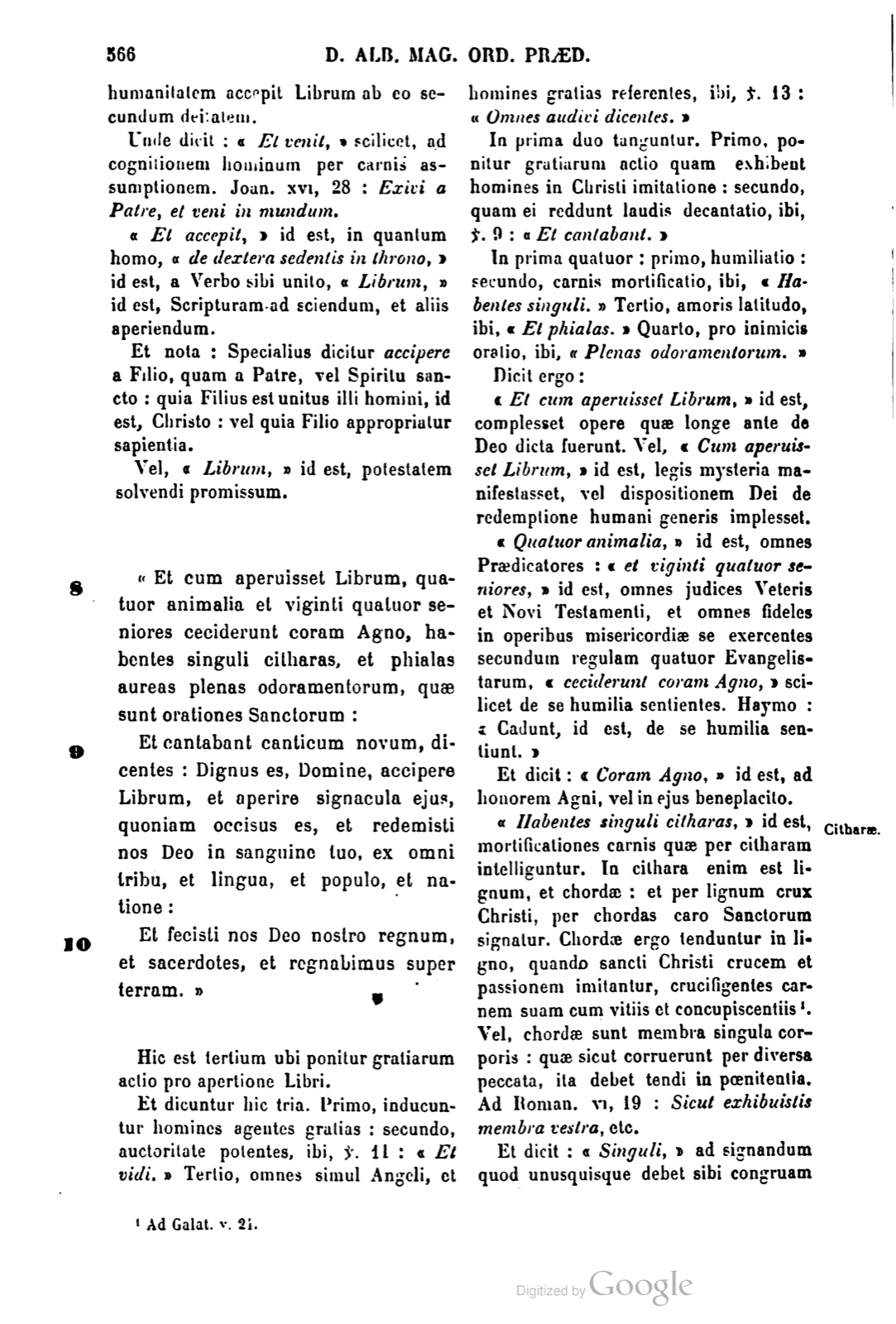
« Dominus Deus omnipotens. » Ecce essentiae unitas in eo quod ad singularem numerum redit: « Dominus, » potestate, « Deus, » creatione, « omnipotens, » conservatione. Vel sic: « Dominus » metuendus, « Deus » colendus et honorandus, « omnipotens » invocandus.
« Qui erat. » Haymo: « Ante saecula. »
« Qui est » immutabilis. « Et qui venturus est, » ad judicium reddere unicuique secundum opera sua.
9. « Et cum darent illa animalia gloriam, et honorem, et benedictionem sedenti super thronum, viventi in saecula saeculorum, 10. Procidebant viginti quatuor seniores ante sedentem in throno, et adorabant viventem in saecula saeculorum, et mittebant coronas suas ante thronum, dicentes: 11. Dignus es, Domine Deus noster, accipere gloriam, et honorem, et virtutem, quia tu creasti omnia, et propter voluntatem tuam erant et creata sunt. »
Hic ostendit qualiter se habent viginti quatuor seniores ad sedentem in throno, audita voce animalium: et ostendit hic humiliationem Sanctorum.
Unde dicit: « Et cum darent, » id est, attribuerent, vel dandam esse profiterentur, « illa » quatuor « animalia, » id est, quatuor Evangelistae, vel Sancti perfecti, et Praedicatores, qui dicuntur animalia: quia in suis Evangeliis, vel scriptis ad virtutes nos animant.
« Gloriam » Patri dabant pro creatione, « honorem » Filio pro recreatione, « et benedictionem » Spiritui sancto pro promissa glorificatione. Vel, « Gloriam » fidei suae, sicut dicit Glossa, « honorem » operationis, « et benedictionem » supernae remunerationis, « sedenti super thronum, » id est, Christo Ecclesiae praesidenti, vel Deo qui in Sanctis quiescit, et pacem tribuit pectoris, temporis, et aeternitatis: « et viventi in saecula saeculorum » id est, aeternaliter, licet mortuus fuerit temporaliter.
“Lord God almighty.” Behold the unity of essence in the fact that it returns to the singular number: “Lord,” by power; “God,” by creation; “almighty,” by conservation. Or thus: “Lord” to be feared, “God” to be worshiped and honored, “almighty” to be invoked.
“Who was.” Haymo says: “Before the ages.”
“Who is,” immutable. “And who is to come,” for judgment, to render to each one according to his works.
9. “And when those living creatures gave glory, and honor, and blessing to the one sitting upon the throne, living unto ages of ages, 10. The twenty-four elders fell down before the one sitting on the throne, and adored the one living unto ages of ages, and cast their crowns before the throne, saying: 11. Worthy are you, O Lord our God, to receive glory, and honor, and power, because you created all things, and because of your will they were and were created.”
Here he shows how the twenty-four elders comport themselves toward the one sitting on the throne, when the voice of the living creatures has been heard; and here he shows the humiliation of the Saints.
Hence he says: “And when they gave,” that is, attributed, or professed that it ought to be given, “those” four “living creatures,” that is, the four Evangelists, or the perfect Saints and Preachers, who are called living creatures because in their Gospels or writings they animate us toward virtues.
They gave “glory” to the Father for creation, “honor” to the Son for re-creation, “and blessing” to the Holy Spirit for the promised glorification. Or, “glory” of their faith, as the Gloss says; “honor” of work; “and blessing” of heavenly reward; “to the one sitting upon the throne,” that is, to Christ presiding over the Church, or to God who rests in the Saints and grants peace of breast, of time, and of eternity; “and living unto ages of ages,” that is, eternally, although he died temporally.
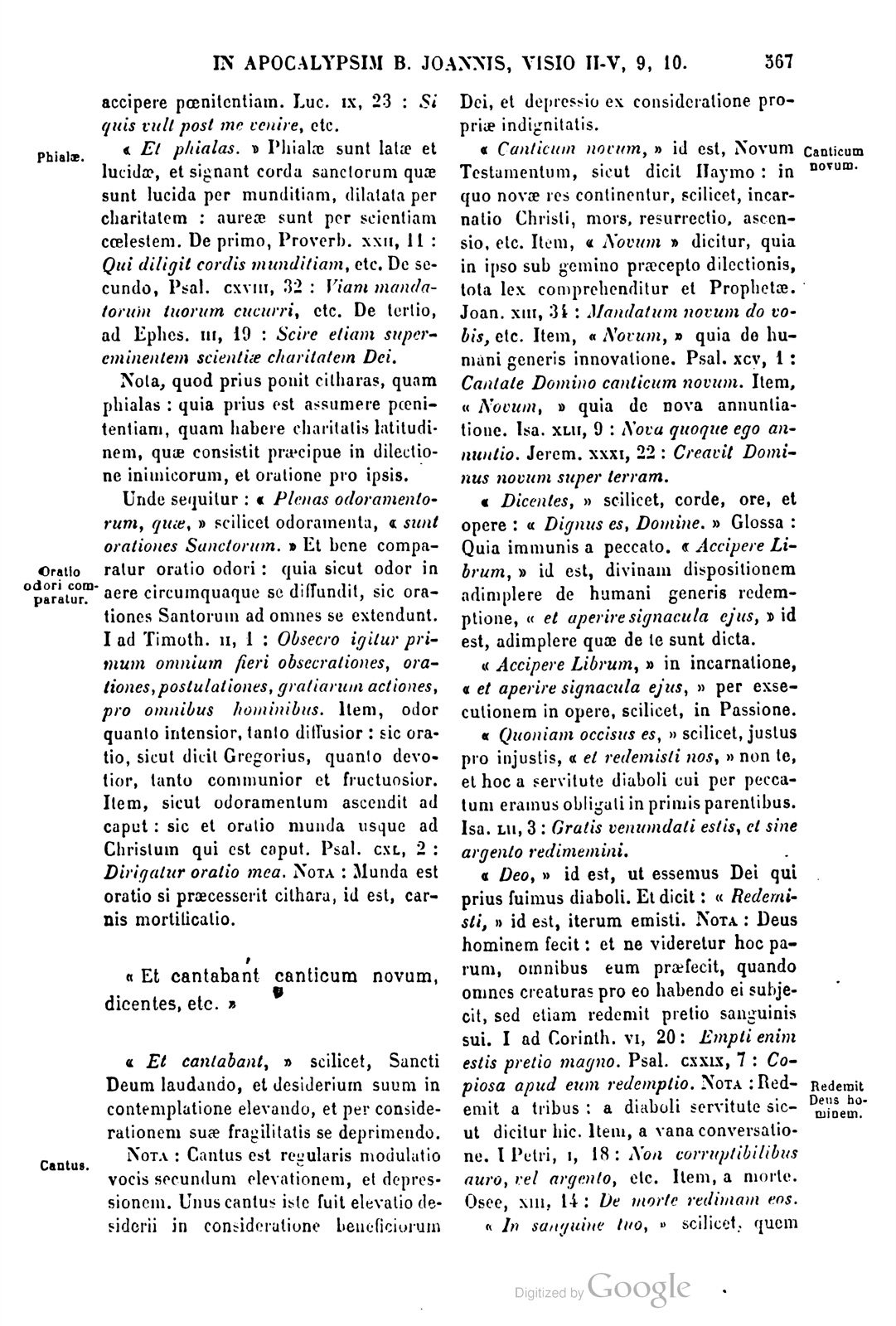
« Procidebant viginti quatuor seniores. »
Quasi dicat: Cum talem praedicarent, « viginti quatuor seniores, » id est, omnes Patres Veteris et Novi Testamenti, « procidebant, » id est, seipsos humiliabant, « ante sedentem in throno, » quasi comparatione ipsius nihil se reputando, « et adorabant, » reverentiam debitam exhibendo, « viventem in saecula saeculorum, » id est, aeternaliter: « et mittebant coronas suas, » id est, victorias quae de diabolo, carne, mundo, et peccato habuerant, ei attribuebant. Gregorius: « Coronas suas ante thronum Dei mittere, est certaminum suorum victorias non sibi tribuere, sed actori: ut ad illum referant gloriam laudis, a quo se sciunt vires accepisse certaminis. »
« Ante thronum, dicentes. »
Et quoniam non solum se debet homo humiliare ad Deum laudandum ad quem pertinent tria praedicta, scilicet, procidere, adorare, et coronas suas mittere: sed etiam confiteri ore, quod creditur corde: ideo subditur: « Dignus es, Domine Deus noster, etc. »
« Dignus es, » scilicet, omni dignitate congrui et condigni, « Domine, » creator, « Deus, » recreator, « noster, » remunerator. Vel, « Domine, » mala puniens, « Deus, » bona faciens, « noster, » te et tua nobis tribuens, « accipere gloriam, » tertia die resurgendo, « et honorem, » in caelum ascendendo et ad dexteram Patris sedendo, « et virtutem, » omnia subjiciendo. Matth. XXVIII, 18: Data est mihi omnis potestas, etc.
Vel sic: « Dignus es » accipere, scilicet a creaturis, « gloriam, » id est, laudem cordis, « et virtutem, » id est, laudem operis.
Nota: Modus humiliandi se consistit in quatuor. Primo, ut ante Deum procidamus reverentiam exhibendo, adoremus ipsi serviendo, mittamus coronas, etc., bona omnia ad ipsum referendo, gratias referamus nostram fragilitatem cognoscendo. Et haec quatuor tanguntur in praemissis: procidebant, mittebant, adorabant, dicentes, etc.
« Quia tu creasti omnia, »
Id est, de non esse produxisti: et ideo referenda sunt ad te omnia, ut sic ad locum unde exeunt flumina, revertantur ut iterum fluant 2.
“The twenty-four elders fell down.”
As if he were saying: When they preached such a one, “the twenty-four elders,” that is, all the Fathers of the Old and New Testament, “fell down,” that is, humbled themselves, “before the one sitting on the throne,” as if reckoning themselves nothing in comparison with him; “and they adored,” by exhibiting due reverence, “the one living unto ages of ages,” that is, eternally; “and they cast their crowns,” that is, the victories which they had over the devil, the flesh, the world, and sin, they attributed to him. Gregory says: “To cast their crowns before the throne of God is not to attribute to themselves the victories of their contests, but to the author, so that they refer the glory of praise to him from whom they know that they have received the strength of the contest.”
“Before the throne, saying.”
And because a human being must not only humble himself in order to praise God, to which the three aforesaid things belong, namely, to fall down, to adore, and to cast down his crowns, but also confess with the mouth what is believed in the heart, therefore there is added: “Worthy are you, O Lord our God, etc.”
“Worthy are you,” namely, with every dignity of fittingness and worthiness, “O Lord,” creator, “God,” re-creator, “our,” rewarder. Or, “Lord,” punishing evils, “God,” doing good things, “our,” bestowing yourself and your things upon us; “to receive glory,” by rising on the third day; “and honor,” by ascending into heaven and sitting at the right hand of the Father; “and power,” by subjecting all things. Matthew XXVIII, 18: All power has been given to me, etc.
Or thus: “You are worthy” to receive, namely from creatures, “glory,” that is, praise of the heart, “and power,” that is, praise of work.
Note: The manner of humbling oneself consists in four things. First, that we fall down before God by exhibiting reverence, adore him by serving him, cast down crowns, etc., by referring all good things to him, and give thanks by knowing our frailty. And these four things are touched upon in the preceding: they fell down, they cast down, they adored, saying, etc.
“Because you created all things,”
That is, you brought them forth from non-being; and therefore all things must be referred to you, so that they may return to the place from which the rivers go out, in order that they may flow again 2.
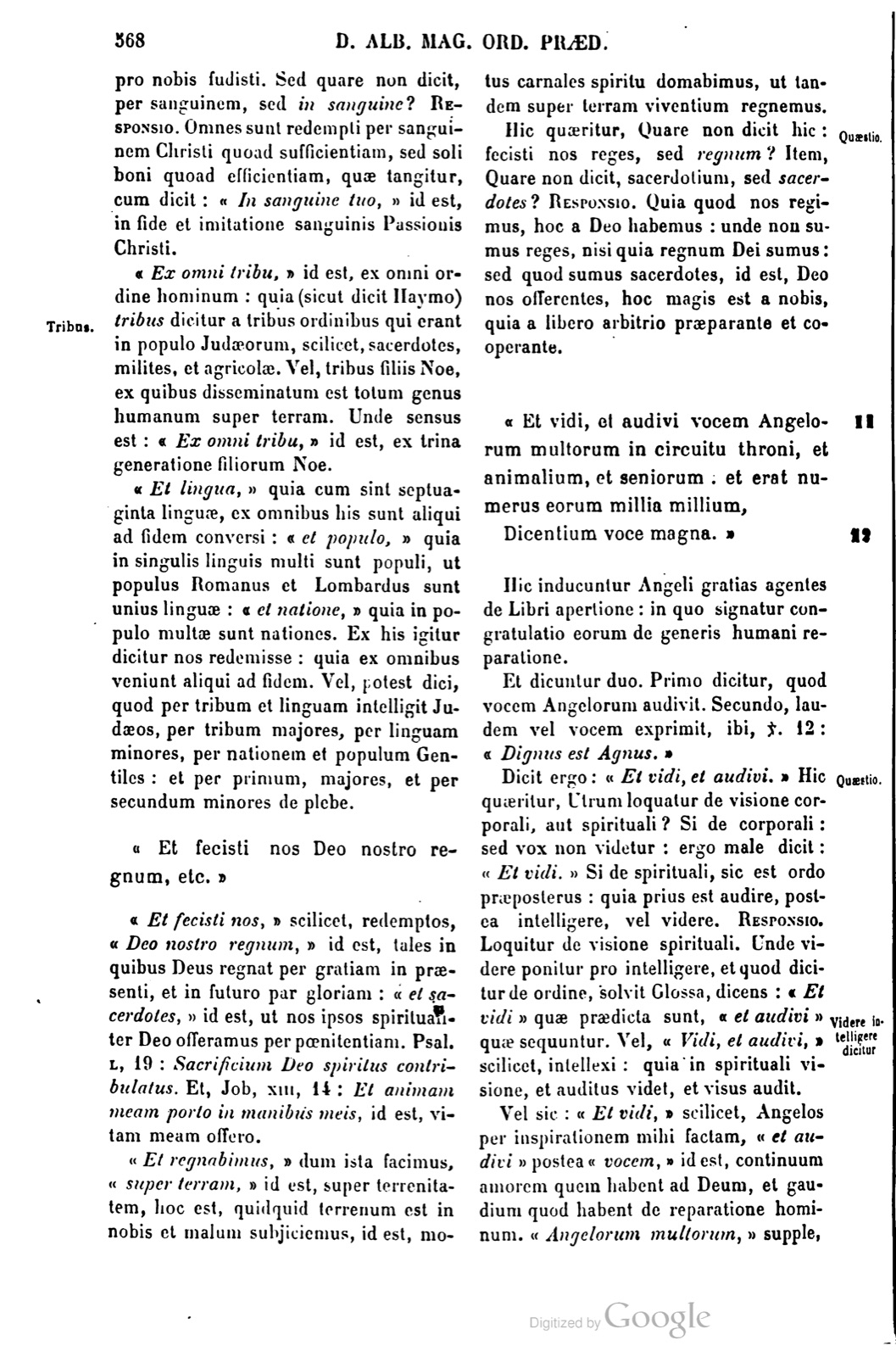
« Et propter voluntatem tuam, » id est juxta, vel secundum voluntatem tuam, « erant, » scilicet, praedestinatione, vel in sapientia, sicut in arte: sicut domus prius est in mente artificis, quam fiat in opere. « Et creata sunt, » scilicet, in tempore. Quasi dicat: Qui prius erant in artificis voluntate sine tempore, creata sunt in propria existentia in tempore. Joan. I, 3 et 4: Quod factum est, in ipso vita erat.
Hic sunt dubitabilia.
Primo, super illo verbo V. 1: « Post haec vidi, et ecce ostium apertum, etc. » Contra: Beda: « De scriptis Ecclesiae operibus quae et qualis futura esset recapitulat eadem dicturus: » ergo male dicit: « Post haec. »
Responsio. Non refertur ordo iste ad rem sub figuris ostensam, sed ad figurarum visionem: quia sub aliis figuris modo videt statum Ecclesiae, quam prius viderat, et quantum ad hoc dicit: « Post haec vidi, etc. »
Secundo quaeritur, Cum Prophetae Veteris Testamenti prophetias suas descripserint per reges, annos, et menses, et dies: quare iste non facit sic?
Responsio Haymonis: Iste novus Propheta tempus suae prophetiae numquam descripsit per tempora, sed tantum unius diei Dominicae mentionem facit: per quod datur intelligi, quod hanc prophetiam una die tantum vidit.
Tertio, Quaeritur super illo verbo V. 7: « Et animal primum simile leoni. » Cum Ezechiel primo ponit hominem, secundo leonem, tertio vitulum, quarto aquilam, quare Joannes primo ponit leonem, secundo vitulum, tertio hominem, quarto aquilam?
Responsio secundum Haymonem: Ezechiel primo ponit hominem servans historiae ordinem: quoniam prius natus est Christus ut homo, deinde praedicavit et terribilem vocem emisit ut leo, deinde passus est ut vitulus, postmodum ascendit ad caelos ut aquila. Joannes vero primo ponit leonem: quia Christus jam surrexit a mortuis, et fundamentum Christianae fidei maxime innititur Resurrectioni Christi quae omnia jam Joannes viderat impleta: ideo primo ponit istud animal, scilicet, leonem, per quod signatur resurrectio Christi. Quamvis ergo prius fuit ut homo et vitulus in ordine naturae, fuit tamen prius ut leo in virtute.
“And because of your will,” that is, according to or in accordance with your will, “they were,” namely by predestination, or in wisdom, as in art, as a house is in the mind of the craftsman before it comes to be in the work. “And they were created,” namely in time. As if he were saying: Those things which first were in the will of the craftsman without time were created in their own existence in time. John I, 3 and 4: What was made, in him was life.
Here there are doubtful points.
First, concerning that word V. 1: “After these things I saw, and behold, a door opened, etc.” On the contrary: Bede says: “He recapitulates concerning the written works of the Church, what sort it was and what sort it was going to be, about to say the same things”; therefore he says badly: “After these things.”
Response. This order is not referred to the thing shown under figures, but to the vision of the figures, because now under other figures he sees the state of the Church which he had seen before, and with respect to this he says: “After these things I saw, etc.”
Second it is asked: Since the Prophets of the Old Testament described their prophecies by kings, years, months, and days, why does this man not do so?
Response of Haymo: This new Prophet never described the time of his prophecy by times, but makes mention only of one Lord’s Day; by this it is given to be understood that he saw this prophecy in only one day.
Third, it is asked concerning that word V. 7: “And the first living creature was like a lion.” Since Ezekiel first places the man, second the lion, third the calf, and fourth the eagle, why does John first place the lion, second the calf, third the man, fourth the eagle?
Response according to Haymo: Ezekiel first places the man, preserving the order of the history, since Christ was first born as man, then preached and gave out a terrible voice as lion, then suffered as calf, and afterward ascended to heaven as eagle. But John first places the lion because Christ has now risen from the dead, and the foundation of the Christian faith rests most of all upon the Resurrection of Christ, all of which John had now seen fulfilled; therefore first he places that living creature, namely the lion, through which the resurrection of Christ is signified. Therefore although he was first as man and calf in the order of nature, nevertheless he was first as lion in power.
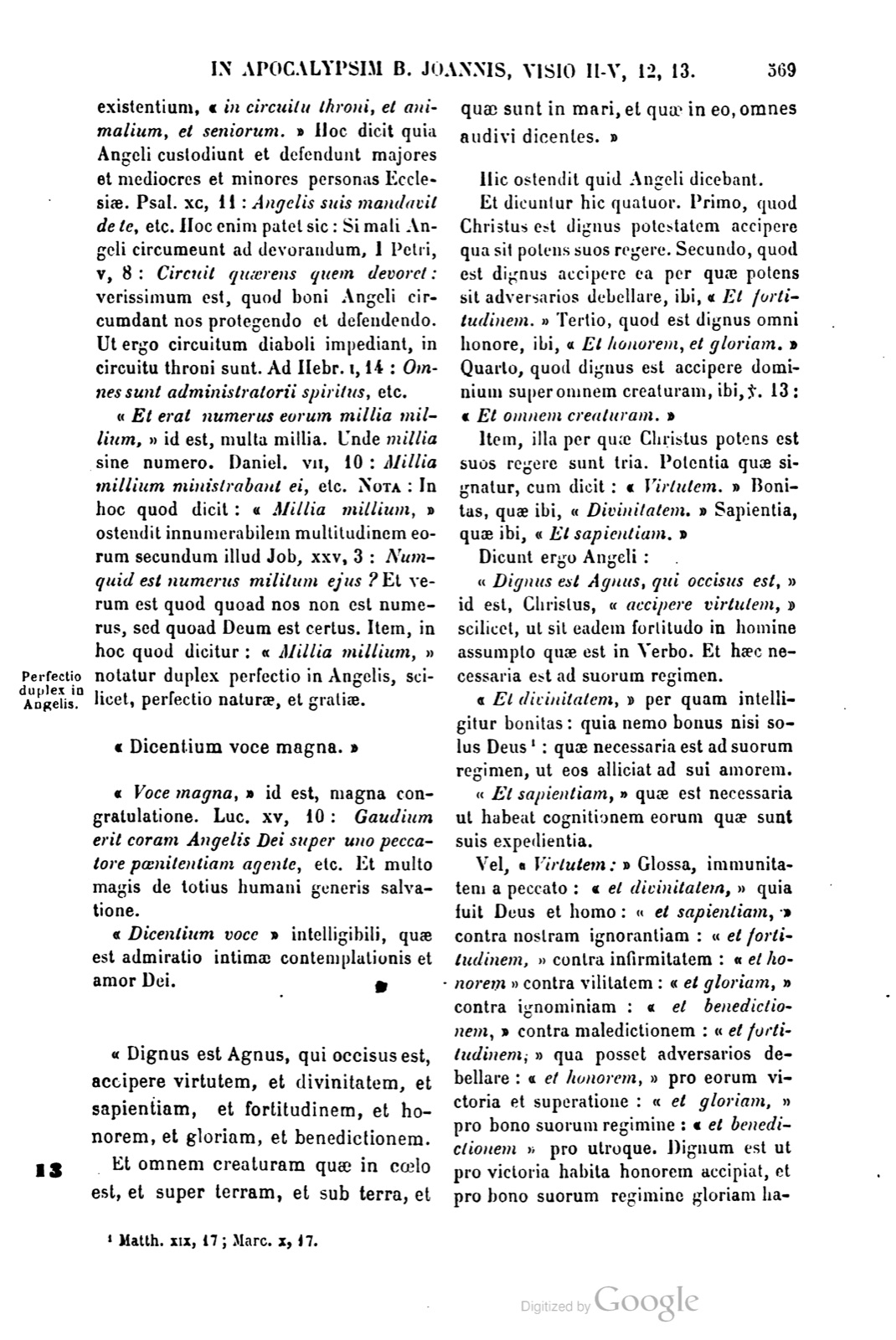
If a page does not appear, its photograph has not been uploaded yet.