Volume 37 · pp. 532–533
Chapter IX. Contemplation in God, insofar as it is to be placed before all other exercises.
A marker with ≈ is an approximate page boundary, placed by measure of the text; the page photographs remain the authority. In the paired views, clicking a page marker brings that page into view.
Caput IX. Contemplatio in Deo, quatenus omnibus aliis exercitiis est praeponenda.
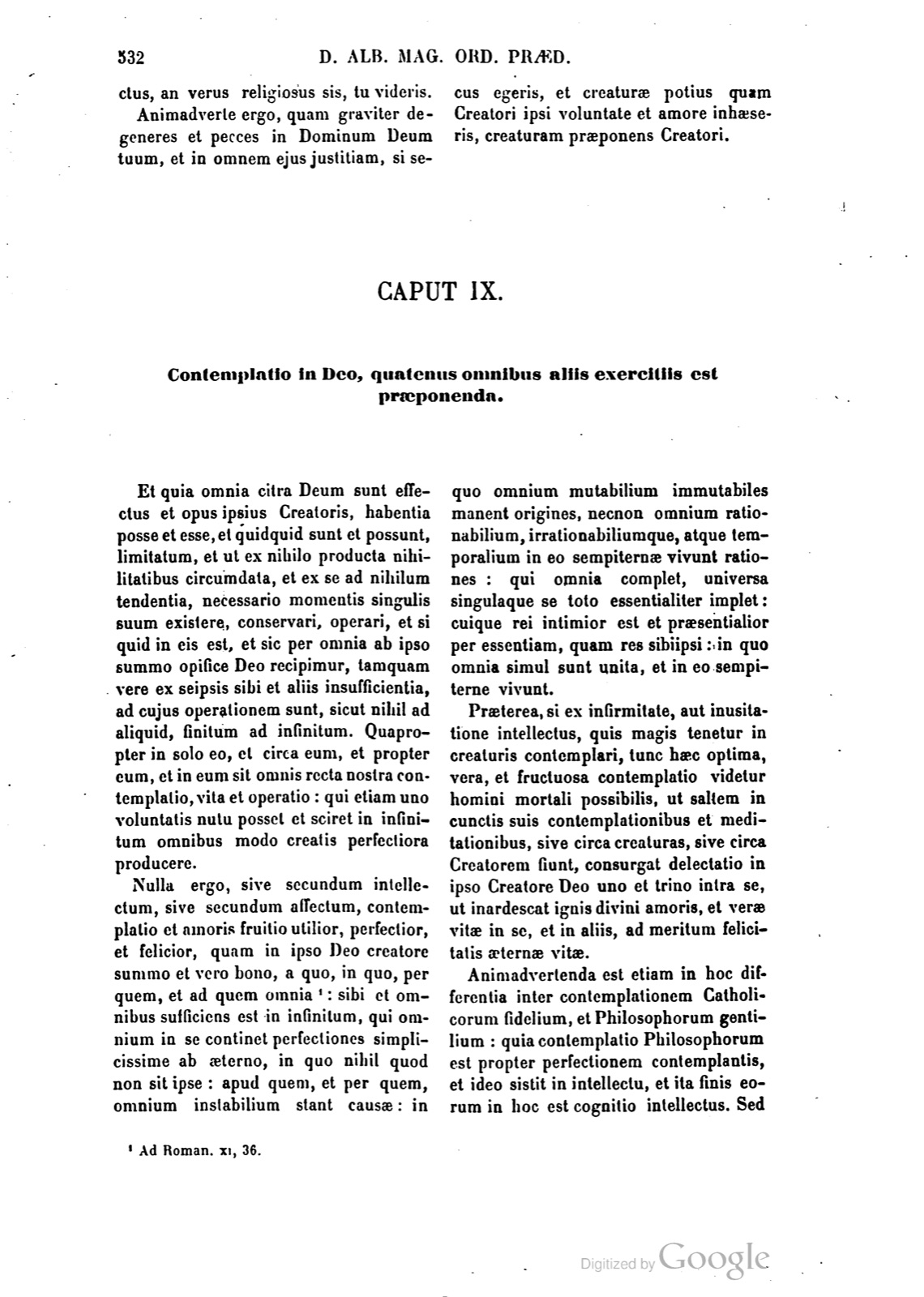
Et quia omnia citra Deum sunt effectus et opus ipsius Creatoris, habentia posse et esse, et quidquid sunt et possunt, limitatum, et ut ex nihilo producta nihilitatibus circumdata, et ex se ad nihilum tendentia, necessario momentis singulis suum existere, conservari, operari, et si quid in eis est, et sic per omnia ab ipso summo opifice Deo recipiunt, tamquam vere ex seipsis sibi et aliis insufficientia, ad cujus operationem sunt, sicut nihil ad aliquid, finitum ad infinitum. Quapropter in solo eo, et circa eum, et propter eum, et in eum sit omnis recta nostra contemplatio, vita et operatio: qui etiam uno voluntatis nutu posset et sciret in infinitum omnibus modo creatis perfectiora producere.
Nulla ergo, sive secundum intellectum, sive secundum affectum, contemplatio et amoris fruitio utilior, perfectior, et felicior, quam in ipso Deo creatore summo et vero bono, a quo, in quo, per quem, et ad quem omnia 1: sibi et omnibus sufficiens est in infinitum, qui omnium in se continet perfectiones simplicissime ab aeterno, in quo nihil quod est non sit ipse: apud quem, et per quem, omnium instabilium stant causae: in quo omnium mutabilium immutabiles manent origines, necnon omnium rationabilium, irrationaliumque, atque temporalium in eo sempiternae vivunt rationes: qui omnia complet, universa singulaque se toto essentialiter implet: cuique rei intimior est et praesentialior per essentiam, quam res sibiipsi: in quo omnia simul sunt unita, et in eo sempiterne vivunt.
Praeterea, si ex infirmitate, aut inusitatione intellectus, quis magis tenetur in creaturis contemplari, tunc haec optima, vera, et fructuosa contemplatio videtur homini mortali possibilis, ut saltem in cunctis suis contemplationibus et meditationibus, sive circa creaturas, sive circa Creatorem fiunt, consurgat delectatio in ipso Creatore Deo uno et trino intra se, ut inardescat ignis divini amoris, et verae vitae in se, et in aliis, ad meritum felicitatis aeternae vitae.
Animadvertenda est etiam in hoc differentia inter contemplationem Catholicorum fidelium, et Philosophorum gentilium: quia contemplatio Philosophorum propter perfectionem contemplantis, et ideo sistit in intellectu, et ita finis eorum in hoc est cognitio intellectus. Sed contemplatio Sanctorum, quae est Catholicorum, est propter amorem ipsius, scilicet contemplati Dei: idcirco non sistit in fine ultimo in intellectu per cognitionem, sed transit ad affectum per amorem. Unde Sancti in contemplatione sua habent amorem Dei tamquam principaliter intentum, quia felicius est etiam Dominum Jesum Christum cognoscere, et habere spiritualiter per gratiam, quam sine gratia corporaliter, vel etiam essentialiter.
Chapter IX. Contemplation in God, insofar as it is to be placed before all other exercises.
And because all things short of God are the effect and work of the Creator himself, having power and being, and whatever they are and can do, limited; and because, as produced from nothing, surrounded by nothingnesses, and tending from themselves to nothing, they necessarily receive, at each moment, from the highest craftsman God himself, their existence, preservation, operation, and whatever is in them, and thus through all things, as truly insufficient from themselves for themselves and for others; and in relation to his operation they are as nothing to something, as finite to infinite. Wherefore let all our right contemplation, life, and operation be in him alone, and around him, and because of him, and into him; he also by one nod of his will could and would know how to produce more perfect things, infinitely, than all things now created.
Therefore no contemplation and enjoyment of love, whether according to intellect or according to affection, is more useful, more perfect, and happier than in God himself, the creator, the highest and true good, from whom, in whom, through whom, and to whom are all things 1. He is sufficient for himself and for all things unto infinity; he contains in himself the perfections of all things most simply from eternity; in him there is nothing that is which is not he himself. With him and through him the causes of all unstable things stand; in him the immutable origins of all mutable things remain, and also in him the everlasting reasons of all rational and irrational and temporal things live. He completes all things; with his whole self he essentially fills the universe and each single thing; he is more inward and more present to each thing through essence than the thing is to itself. In him all things are at once united, and in him they live everlastingly.
Furthermore, if from infirmity or lack of habituation of the intellect someone is held more to contemplate among creatures, then this seems the best, true, and fruitful contemplation possible to mortal man: that at least in all his contemplations and meditations, whether they take place around creatures or around the Creator, delight should rise up within him in the Creator himself, God one and three, so that the fire of divine love and of true life may blaze up in himself and in others, unto the merit of the happiness of eternal life.
The difference in this also must be noticed between the contemplation of Catholic faithful and that of gentile philosophers: because the contemplation of philosophers is on account of the perfection of the contemplator, and therefore it stops in the intellect, and thus their end in this is the knowledge of the intellect. But the contemplation of the saints, which is that of Catholics, is on account of love of the one himself, namely of God contemplated. Therefore it does not stop at the ultimate end in the intellect through knowledge, but passes over to affection through love. Hence the saints in their contemplation have the love of God as what is principally intended, because it is happier also to know the Lord Jesus Christ and to have him spiritually through grace than to have him corporally without grace, or even essentially.
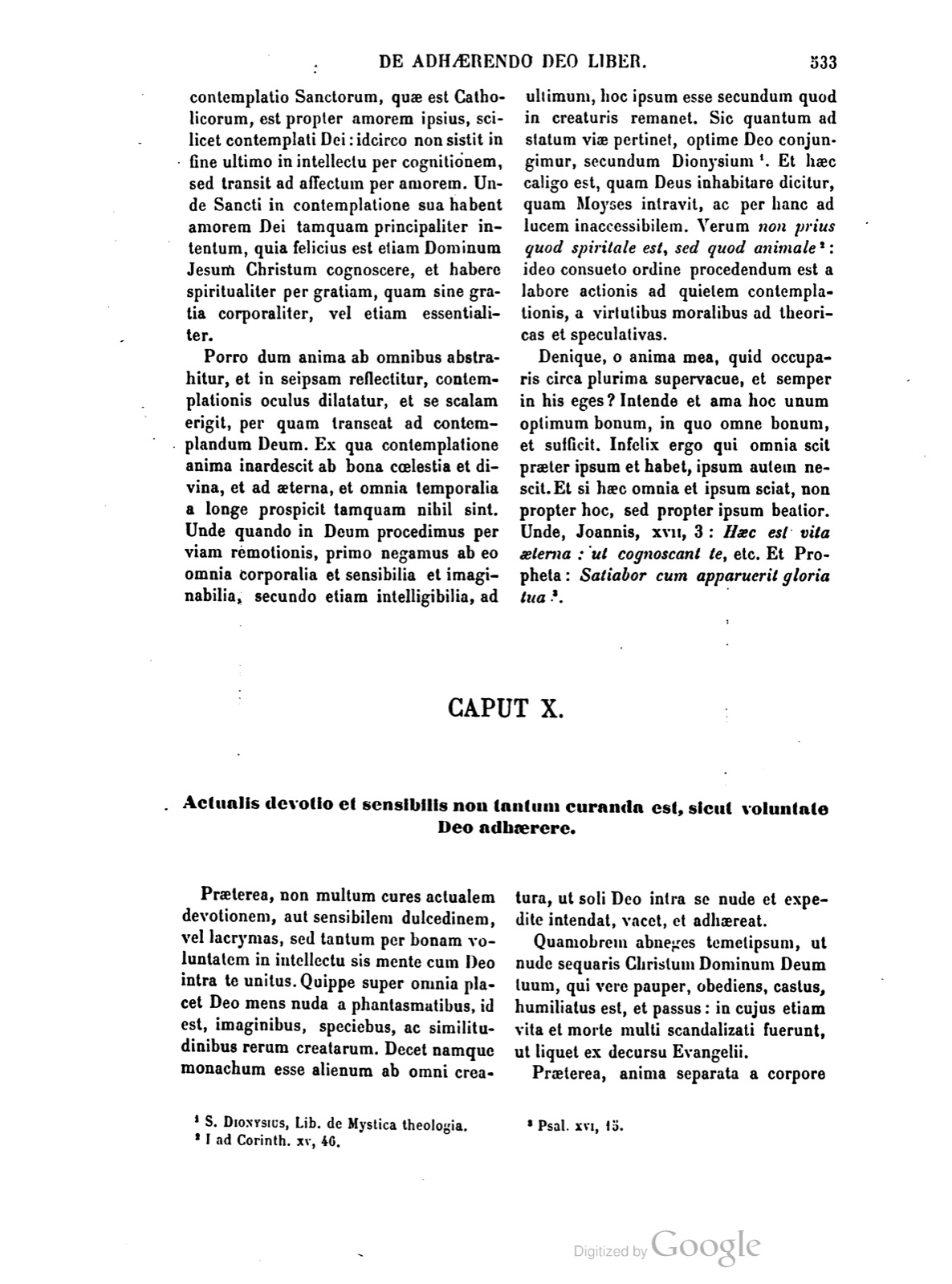
Porro dum anima ab omnibus abstrahitur, et in seipsam reflectitur, contemplationis oculus dilatatur, et se scalam erigit, per quam transeat ad contemplandum Deum. Ex qua contemplatione anima inardescit ad bona coelestia et divina, et ad aeterna, et omnia temporalia a longe prospicit tamquam nihil sint. Unde quando in Deum procedimus per viam remotionis, primo negamus ab eo omnia corporalia et sensibilia et imaginabilia, secundo etiam intelligibilia, ad ultimum, hoc ipsum esse secundum quod in creaturis remanet. Sic quantum ad statum viae pertinet, optime Deo conjungimur, secundum Dionysium 2. Et haec caligo est, quam Deus inhabitare dicitur, quam Moyses intravit, ac per hanc ad lucem inaccessibilem. Verum non prius quod spiritale est, sed quod animale 3: ideo consueto ordine procedendum est a labore actionis ad quietem contemplationis, a virtutibus moralibus ad theoricas et speculativas.
Denique, o anima mea, quid ocuparis circa plurima supervacue, et semper in his eges? Intende et ama hoc unum optimum bonum, in quo omne bonum, et sufficit. Infelix ergo qui omnia scit praeter ipsum et habet, ipsum autem nescit. Et si haec omnia et ipsum sciat, non propter hoc, sed propter ipsum beatior. Unde, Joannis, XVII, 3: Haec est vita aeterna: ut cognoscant te, etc. Et Propheta: Satiabor cum apparuerit gloria tua 4.
Moreover, while the soul is withdrawn from all things and reflected into itself, the eye of contemplation is enlarged, and it raises itself as a ladder, through which it may pass to contemplating God. From this contemplation the soul is inflamed toward heavenly and divine goods and toward eternal things, and it looks from afar upon all temporal things as if they were nothing. Hence, when we proceed into God by the way of removal, first we deny of him all bodily and sensible and imaginable things; second, even intelligible things; at the last, this very being according to which it remains in creatures. Thus, as far as the state of the way is concerned, we are joined best to God, according to Dionysius 2. And this is the darkness which God is said to inhabit, which Moses entered, and through this into inaccessible light. But not first that which is spiritual, but that which is animal 3; therefore by the customary order one must proceed from the labor of action to the quiet of contemplation, from moral virtues to theoretical and speculative ones.
Finally, O my soul, why are you occupied needlessly around many things, and always needy in them? Attend to and love this one best good, in which is every good, and it suffices. Therefore unhappy is he who knows and possesses all things except him, but does not know him. And if he knows all these things and him, he is happier not on account of this, but on account of him. Hence, John 17:3: This is eternal life: that they may know you, and so forth. And the Prophet: I shall be satisfied when your glory appears 4.
If a page does not appear, its photograph has not been uploaded yet.