Volume 37 · pp. 529–530
Chapter VII. How the heart is to be gathered back within itself?
A marker with ≈ is an approximate page boundary, placed by measure of the text; the page photographs remain the authority. In the paired views, clicking a page marker brings that page into view.
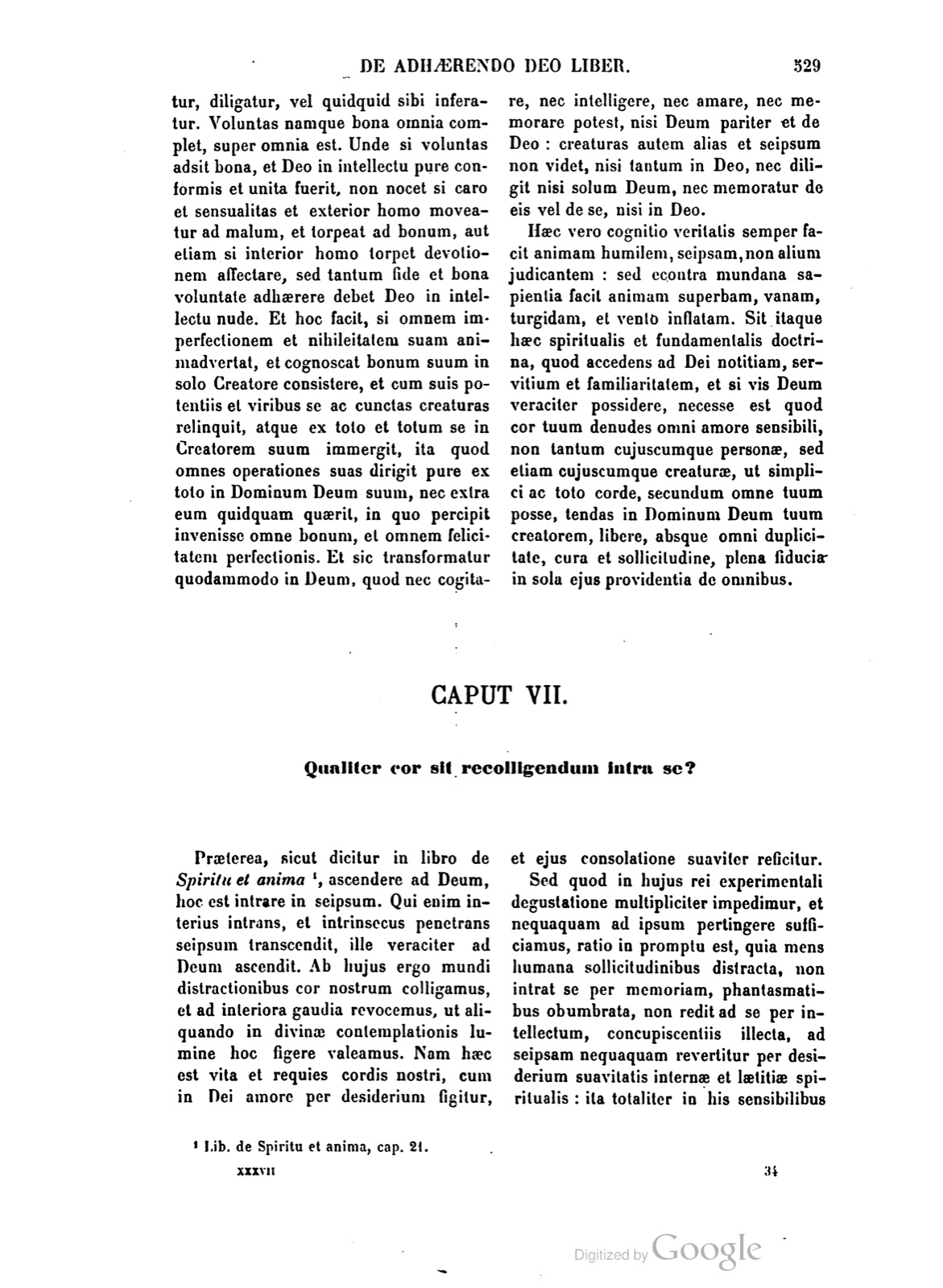
Caput VII. Qualiter cor sit recolligendum intra se?
Praeterea, sicut dicitur in libro de Spiritu et anima 1, ascendere ad Deum, hoc est intrare in seipsum. Qui enim interius intrans, et intrinsecus penetrans seipsum transcendit, ille veraciter ad Deum ascendit. Ab hujus ergo mundi distractionibus cor nostrum colligamus, et ad interiora gaudia revocemus, ut aliquando in divinae contemplationis lumine hoc figere valeamus. Nam haec est vita et requies cordis nostri, cum in Dei amore per desiderium figitur, et ejus consolatione suaviter reficitur.
Sed quod in hujus rei experimentali degustatione multipliciter impedimur, et nequaquam ad ipsum pertingere sufficiamus, ratio in promptu est, quia mens humana sollicitudinibus distracta, non intrat se per memoriam, phantasmatibus obumbrata, non redit ad se per intellectum, concupiscentiis illecta, ad seipsam nequaquam revertitur per desiderium suavitatis internae et laetitiae spiritualis: ita totaliter in his sensibilibus et praesentibus jacens, non potest ad se tamquam ad imaginem Dei intrare.
Oportet ergo et necesse est, ut cum humilitatis reverentia ac fiducia nimia mens elevet se supra se et omne creatum per abnegationem omnium, et ut dicat intra se: Quem ex omnibus, et prae omnibus, et super omnia quaero, diligo, appeto, et desidero, non est sensibilis neque imaginabilis, sed super omne sensibile et intelligibile: nullo umquam sensu est perceptibilis, sed pleno desiderio totus desiderabilis: non insuper est figurabilis, sed intimo affectu perfectissime appetibilis: non est aestimabilis, sed mundo corde totus affectibilis, quia super omnia amabilis et delectabilis, infinitaeque bonitatis et perfectionis. Et tunc fertur in mentis caliginem, et altius intra se elevatur, et profundius ingreditur.
Et hic modus ascendendi usque ad aenigmaticum contuitum sanctissimae Trinitatis in unitate, unitatis in Trinitate, in Jesu Christo, tanto est ardentior, quanto vis ascendens illi est intimior: et tanto fructuosior, quanto affectu proximior. Quippe in spiritualibus illa sunt superiora quae intimiora, quoad experientias spirituales.
Chapter VII. How the heart is to be gathered back within itself?
Moreover, as is said in the book On Spirit and Soul 1, to ascend to God is to enter into oneself. For he who, entering inwardly and penetrating within, transcends himself, truly ascends to God. Therefore let us gather our heart from the distractions of this world, and call it back to interior joys, so that at some time we may be able to fix this in the light of divine contemplation. For this is the life and rest of our heart, when it is fixed in the love of God through desire, and is sweetly refreshed by his consolation.
But that in the experiential tasting of this thing we are impeded in many ways, and are by no means sufficient to reach him, the reason is ready at hand: because the human mind, distracted by solicitudes, does not enter itself through memory; overshadowed by phantasms, it does not return to itself through intellect; enticed by concupiscences, it by no means returns to itself through desire for inward sweetness and spiritual gladness. Thus, lying totally among these sensible and present things, it cannot enter into itself as into the image of God.
Therefore it is fitting and necessary that with the reverence of humility and very great trust the mind lift itself above itself and every created thing through the denial of all things, and that it say within itself: He whom I seek, love, desire, and long for out of all things, before all things, and above all things, is not sensible nor imaginable, but above every sensible and intelligible thing; he is never perceptible by any sense, but is wholly desirable with full desire; he is moreover not formable in figure, but is most perfectly desirable by inward affection; he is not estimable, but is wholly affectible by a clean heart, because he is lovable and delightful above all things, and of infinite goodness and perfection. And then it is borne into the darkness of the mind, and is lifted higher within itself, and enters more deeply.
And this mode of ascending, up to the enigmatic beholding of the most holy Trinity in unity, and of unity in Trinity, in Jesus Christ, is the more ardent insofar as the ascending power is more inward to him; and the more fruitful insofar as it is nearer by affection. Indeed, in spiritual things those things are higher which are more inward, with respect to spiritual experiences.
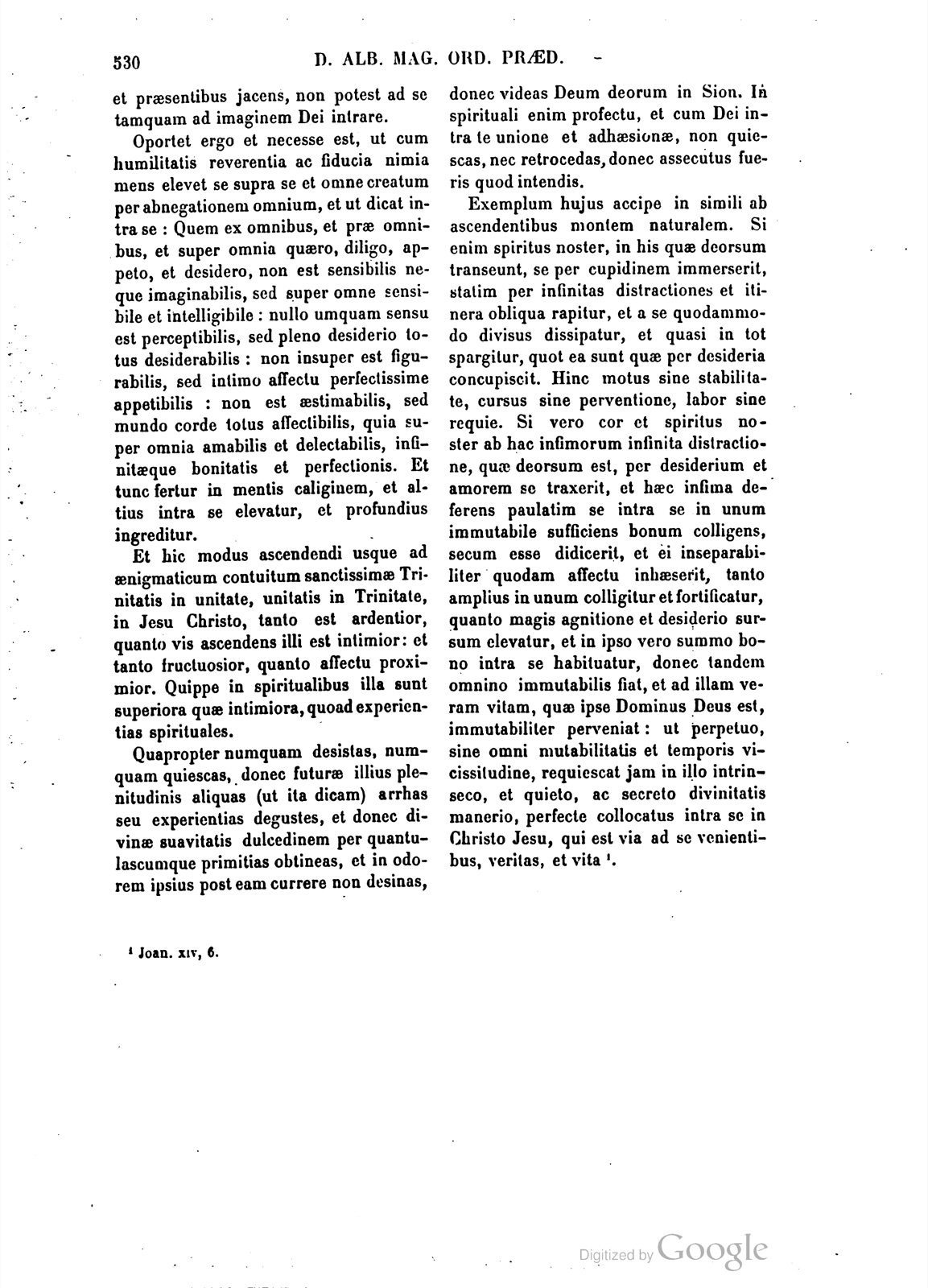
Quapropter numquam desistas, numquam quiescas, donec futurae illius plenitudinis aliquas (ut ita dicam) arrhas seu experientias degustes, et donec divinae suavitatis dulcedinem per quantulascumque primitias obtineas, et in odorem ipsius post eam currere non desinas, donec videas Deum deorum in Sion. In spirituali enim profectu, et cum Dei intra te unione et adhaesione, non quiescas, nec retrocedas, donec assecutus fueris quod intendis.
Exemplum hujus accipe in simili ab ascendentibus montem naturalem. Si enim spiritus noster, in his quae deorsum transeunt, se per cupidinem immerserit, statim per infinitas distractiones et itinera obliqua rapitur, et a se quodammodo divisus dissipatur, et quasi in tot spargitur, quot ea sunt quae per desideria concupiscit. Hinc motus sine stabilitate, cursus sine perventione, labor sine requie. Si vero cor et spiritus noster ab hac infimorum infinita distractione, quae deorsum est, per desiderium et amorem se traxerit, et haec infima deferens paulatim se intra se in unum immutabile sufficiens bonum colligens, secum esse didicerit, et ei inseparabiliter quodam affectu inhaeserit, tanto amplius in unum colligitur et fortificatur, quanto magis agnitione et desiderio sursum elevatur, et in ipso vero summo bono intra se habituatur, donec tandem omnino immutabilis fiat, et ad illam veram vitam, quae ipse Dominus Deus est, immutabiliter perveniat: ut perpetuo, sine omni mutabilitatis et temporis vicissitudine, requiescat jam in illo intrinseco, et quieto, ac secreto divinitatis manerio, perfecte collocatus intra se in Christo Jesu, qui est via ad se venientibus, veritas, et vita 2.
Wherefore never desist, never rest, until you taste some pledges, as I may say, or experiences of that future fullness, and until you obtain the sweetness of divine suavity through however small first-fruits, and do not cease to run after it in the fragrance of him, until you see the God of gods in Sion. For in spiritual progress, and with God's union and adherence within you, do not rest, nor go back, until you have attained what you intend.
Take an example of this in a likeness from those ascending a natural mountain. For if our spirit has immersed itself by desire in these things that pass below, at once it is snatched through infinite distractions and crooked paths, and, divided from itself in a certain manner, is dissipated, and is scattered as if into as many things as there are things that it covets through desires. Hence there is motion without stability, running without arrival, labor without rest. But if our heart and spirit has drawn itself by desire and love from this infinite distraction of lowest things, which is downward, and, carrying these lowest things away, gradually gathering itself within itself into one immutable sufficient good, has learned to be with itself, and has adhered to him inseparably by a certain affection, then it is gathered and strengthened so much more into one, the more it is lifted upward by recognition and desire, and is habituated within itself in the true highest good itself, until at last it becomes wholly immutable and arrives immutably at that true life, which is the Lord God himself; so that perpetually, without every vicissitude of mutability and time, it may now rest in that inward, quiet, and secret dwelling of divinity, perfectly placed within itself in Christ Jesus, who is the way for those coming to him, the truth, and the life 2.
If a page does not appear, its photograph has not been uploaded yet.