Volume 37 · pp. 525–526
Chapter IV. How human operation ought to be in the intellect alone, and not in the senses?
A marker with ≈ is an approximate page boundary, placed by measure of the text; the page photographs remain the authority. In the paired views, clicking a page marker brings that page into view.
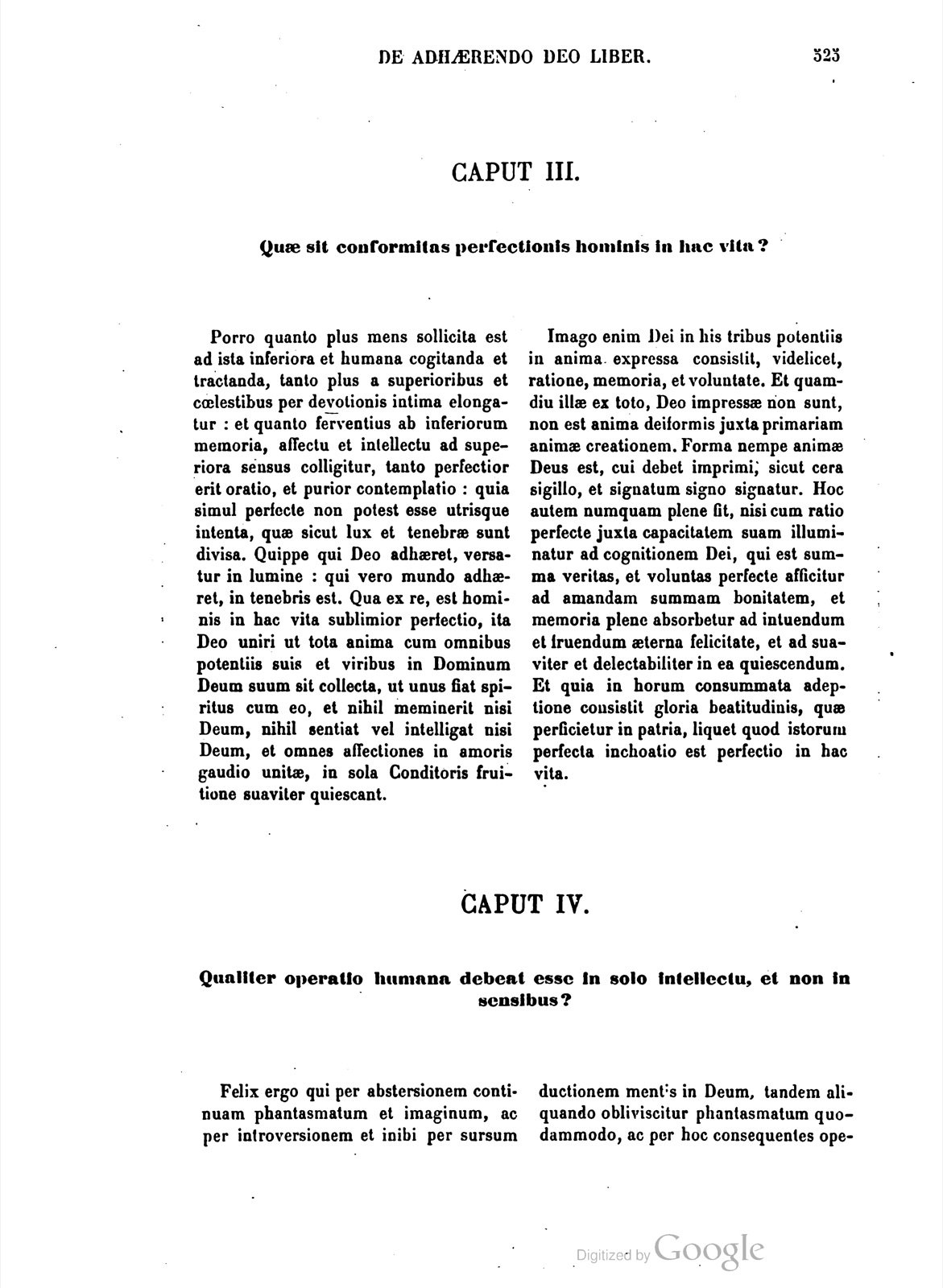
Caput IV. Qualiter operatio humana debeat esse in solo intellectu, et non in sensibus?
Felix ergo qui per abstersionem continuam phantasmatum et imaginum, ac per introversionem et inibi per sursum ductionem mentis in Deum, tandem aliquando obliviscitur phantasmatum quodammodo, ac per hoc consequenter operatur interius nudo ac simplici ac puro intellectu et affectu circa objectum simplicissimum Deum. Omnia igitur phantasmata, species, imagines, ac formas rerum omnium citra Deum a mente rejicias, ut in solo nudo intellectu et affectu ac voluntate tuum pendeat exercitium circa Deum intra te.
Nempe finis omnium exercitiorum hic est, scilicet intendere et quiescere in Domino Deo intra te per purissimum intellectum, et devotissimum affectum sine phantasmatibus et implicationibus. Hujusmodi autem exercitium non fit in organis carneis, et sensibus exterioribus, sed per quod quis homo est: homo vero quis est intellectu et affectu. Et idcirco quamdiu homo cum phantasmatibus et sensibus ludit, et eis insistit, videtur nondum exisse motus et limites bestialitatis suae, hoc est, illius quod cum bestiis habet commune. Quia illae per phantasmata et per tales sensitivas seu sensibiles species cognoscunt et afficiuntur, et non aliter, eo quod altiorem vim animae non habeant. Secus est de homine, secundum intellectum et affectum et liberum arbitrium, ad Dei imaginem et similitudinem creato, quibus debet Deo immediate, pure et nude imprimi, et uniri, firmiterque inhaerere.
Quamobrem diabolus diligentissime et maxime conatur impedire illud exercitium, quantum potest, ex quo est quodammodo praeambulum et initium vitae aeternae, invidens super hoc homini. Idcirco nititur semper mentem hominis alienare a Domino Deo, nunc per istas, nunc per illas tentationes seu passiones, nunc sollicitudine superflua et cura indiscreta, nunc turbatione, et conversatione dissoluta, curiositateque irrationali: nunc per studia librorum subtilium, colloquia aliena, rumores et novitatem: nunc per aspera, nunc per contraria, etc. Quae tamen etsi nonnumquam levia et tamquam nulla videantur peccata, tamen magna sunt impedimenta hujus sancti exercitii et operis. Et ideo, etiamsi utilia et necessaria visa fuerint, sive magna sive parva, ut noxia et perniciosa illico sunt rejicienda penitus, et a sensibus propellenda.
Chapter IV. How human operation ought to be in the intellect alone, and not in the senses?
Happy, therefore, is he who, through the continual wiping away of phantasms and images, and through inward turning and there through the upward leading of the mind into God, at last sometimes forgets phantasms in a certain manner, and through this consequently works inwardly with bare, simple, and pure intellect and affection around the most simple object, God. Therefore cast away from the mind all phantasms, species, images, and forms of all things short of God, so that your exercise concerning God within you may depend on the bare intellect alone, and affection, and will.
Indeed, the end of all exercises is this, namely to attend and rest in the Lord God within you through the purest intellect and the most devout affection, without phantasms and entanglements. But an exercise of this kind does not take place in fleshly organs and exterior senses, but through that by which someone is a man; but someone is a man by intellect and affection. And for that reason, as long as a man plays with phantasms and senses, and dwells upon them, he seems not yet to have gone out beyond the motions and limits of his beastliness, that is, of that which he has in common with beasts. For they know and are affected through phantasms and through such sensitive or sensible species, and not otherwise, because they do not have a higher power of soul. It is otherwise concerning man, created according to intellect and affection and free choice to the image and likeness of God; by these he ought to be impressed immediately, purely, and nakedly upon God, and to be united and firmly adhere to him.
For this reason the devil most diligently and greatly strives to impede that exercise as much as he can, since it is in a certain manner the preamble and beginning of eternal life, envying man in this matter. Therefore he always attempts to estrange the mind of man from the Lord God, now through these temptations or passions, now through those, now by superfluous solicitude and indiscreet care, now by disturbance, dissolute conversation, and irrational curiosity; now through studies of subtle books, alien conversations, rumors and novelty; now through harsh things, now through contrary things, and so forth. Yet although these sometimes seem light and as though no sins, nevertheless they are great impediments of this holy exercise and work. And therefore, even if they have seemed useful and necessary, whether great or small, they are immediately to be utterly rejected as harmful and destructive, and driven away from the senses.
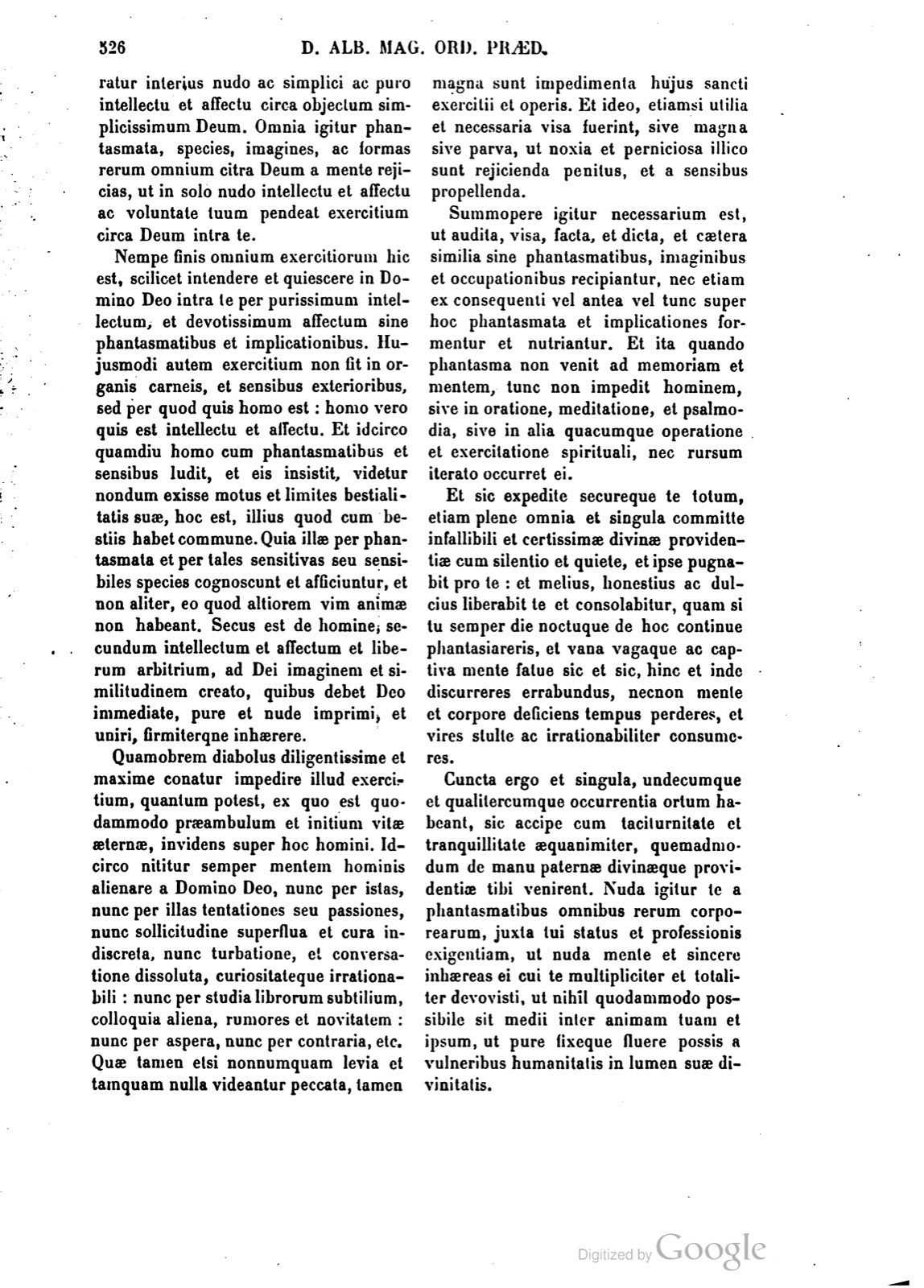
Summopere igitur necessarium est, ut audita, visa, facta, et dicta, et caetera similia sine phantasmatibus, imaginibus et occupationibus recipiantur, nec etiam ex consequenti vel antea vel tunc super hoc phantasmata et implicationes formentur et nutriantur. Et ita quando phantasma non venit ad memoriam et mentem, tunc non impedit hominem, sive in oratione, meditatione, et psalmodia, sive in alia quacumque operatione et exercitatione spirituali, nec rursum iterato occurret ei.
Et sic expedite secureque te totum, etiam plene omnia et singula committe infallibili et certissimae divinae providentiae cum silentio et quiete, et ipse pugnabit pro te: et melius, honestius ac dulcius liberabit te et consolabitur, quam si tu semper die noctuque de hoc continue phantasiareris, et vana vagaque ac captiva mente fatue sic et sic, hinc et inde discurreres errabundus, necnon mente et corpore deficiens tempus perderes, et vires stulte ac irrationabiliter consumeres.
Cuncta ergo et singula, undecumque et qualitercumque occurrentia ortum habeant, sic accipe cum taciturnitate et tranquillitate aequanimiter, quemadmodum de manu paternae divinaeque providentiae tibi venirent. Nuda igitur te a phantasmatibus omnibus rerum corporearum, juxta tui status et professionis exigentiam, ut nuda mente et sincere inhaereas ei cui te multipliciter et totaliter devovisti, ut nihil quodammodo possibile sit medii inter animam tuam et ipsum, ut pure fixeque fluere possis a vulneribus humanitatis in lumen suae divinitatis.
Therefore it is most greatly necessary that things heard, seen, done, and said, and other similar things, be received without phantasms, images, and occupations, nor also consequently, or before, or then, should phantasms and entanglements be formed and nourished concerning this. And thus, when a phantasm does not come to memory and mind, then it does not impede a man, whether in prayer, meditation, and psalmody, or in any other operation and spiritual exercise whatever, nor again will it repeatedly occur to him.
And thus, readily and securely, commit your whole self, even fully all things each and all, to the infallible and most certain divine providence with silence and quiet; and he himself will fight for you. And he will liberate and console you better, more honorably, and more sweetly than if you always by day and night were continually imagining about this, and with a vain, wandering, and captive mind were foolishly running about in error this way and that, here and there, and also, failing in mind and body, were losing time and consuming your powers foolishly and irrationally.
Therefore receive all things, each and all, from wherever and however the things occurring may have their origin, thus with silence and tranquility and with equanimity, as if they came to you from the hand of fatherly and divine providence. Therefore strip yourself of all phantasms of bodily things, according to the requirement of your state and profession, so that with bare mind and sincerely you may adhere to him to whom you have devoted yourself in many ways and totally, so that, in some manner, no middle thing can be possible between your soul and him, so that purely and fixedly you may be able to flow from the wounds of the humanity into the light of his divinity.
If a page does not appear, its photograph has not been uploaded yet.