Volume 37 · pp. 523–524
Chapter I. On the ultimate and highest perfection of man, insofar as it is possible in this life.
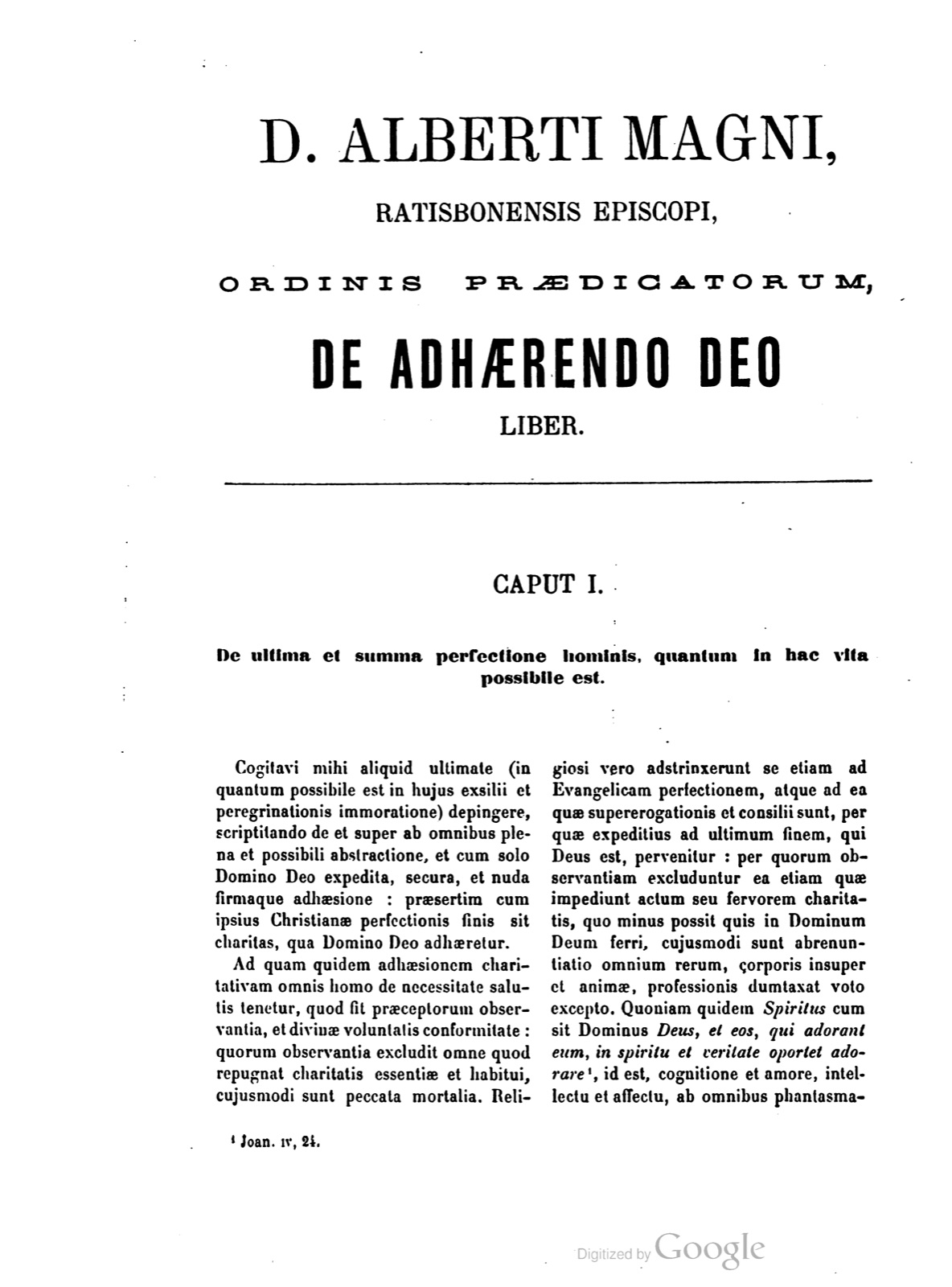
D. Alberti Magni, Ratisbonensis Episcopi, Ordinis Praedicatorum, De adhaerendo Deo liber.
Caput I. De ultima et summa perfectione hominis, quantum in hac vita possibile est.
Cogitavi mihi aliquid ultimate (in quantum possibile est in hujus exsilii et peregrinationis immoratione) depingere, scriptitando de et super ab omnibus plena et possibili abstractione, et cum solo Domino Deo expedita, secura, et nuda firmaque adhaesione: praesertim cum ipsius Christianae perfectionis finis sit charitas, qua Domino Deo adhaeretur.
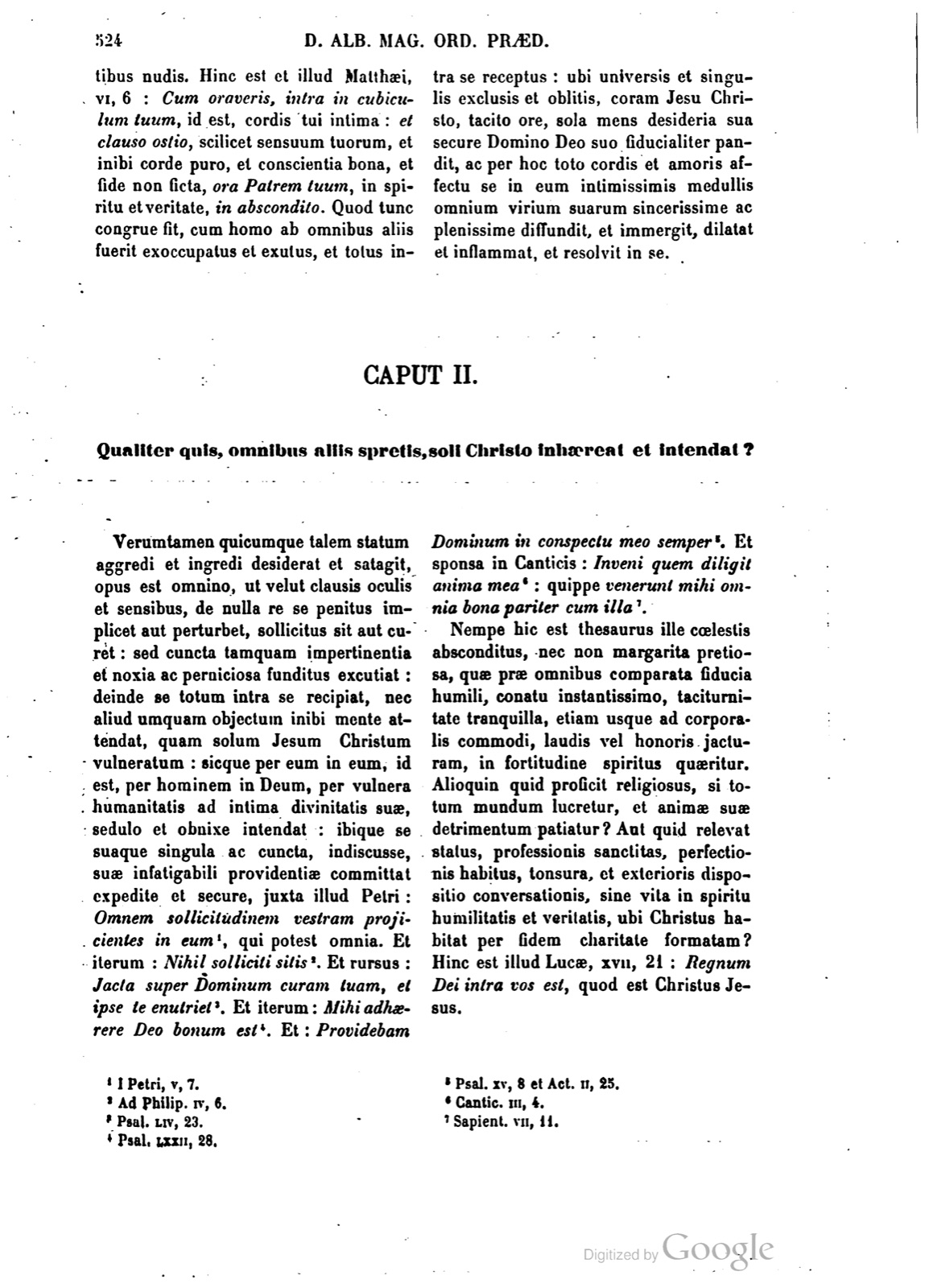
Ad quam quidem adhaesionem charitativam omnis homo de necessitate salutis tenetur, quod fit praeceptorum observantia, et divinae voluntatis conformitate: quorum observantia excludit omne quod repugnat charitatis essentiae et habitui, cujusmodi sunt peccata mortalia. Religiosi vero adstrinxerunt se etiam ad Evangelicam perfectionem, atque ad ea quae supererogationis et consilii sunt, per quae expeditius ad ultimum finem, qui Deus est, pervenitur: per quorum observantiam excluduntur ea etiam quae impediunt actum seu fervorem charitatis, quo minus possit quis in Dominum Deum ferri, cujusmodi sunt abrenuntiatio omnium rerum, corporis insuper et animae, professionis dumtaxat voto excepto. Quoniam quidem Spiritus cum sit Dominus Deus, et eos, qui adorant eum, in spiritu et veritate oportet adorare 1, id est, cognitione et amore, intellectu et affectu, ab omnibus phantasmatibus nudis. Hinc est et illud Matthaei, VI, 6: Cum oraveris, intra in cubiculum tuum, id est, cordis tui intima: et clauso ostio, scilicet sensuum tuorum, et inibi corde puro, et conscientia bona, et fide non ficta, ora Patrem tuum, in spiritu et veritate, in abscondito. Quod tunc congrue fit, cum homo ab omnibus aliis fuerit exoccupatus et exutus, et totus intra se receptus: ubi universis et singulis exclusis et oblitis, coram Jesu Christo, tacito ore, sola mens desideria sua secure Domino Deo suo fiducialiter pandit, ac per hoc toto cordis et amoris affectu se in eum intimissimis medullis omnium virium suarum sincerissime ac plenissime diffundit, et immergit, dilatat et inflammat, et resolvit in se.
Of D. Albert the Great, Bishop of Regensburg, of the Order of Preachers, the book On Adhering to God.
Chapter I. On the ultimate and highest perfection of man, insofar as it is possible in this life.
I have thought to depict for myself something ultimate, insofar as it is possible in the dwelling of this exile and pilgrimage, by writing concerning and upon a full and possible abstraction from all things, and concerning an unencumbered, secure, bare, and firm adherence with the Lord God alone, especially since the end of Christian perfection itself is charity, by which one adheres to the Lord God.
Indeed, every man is bound, by necessity of salvation, to that charitable adherence; this comes about by observance of the precepts and by conformity to the divine will. Observance of these excludes everything that is opposed to the essence and habit of charity, of which sort are mortal sins. But religious have bound themselves also to evangelical perfection, and to those things that are of supererogation and counsel, through which one arrives more readily at the ultimate end, which is God. Through observance of these there are excluded also those things that impede the act or fervor of charity, so that one may be carried less toward the Lord God; of this sort are the renunciation of all things, and moreover of body and soul, except only by the vow of profession. For since the Spirit is the Lord God, and those who adore him must adore in spirit and truth 1, that is, in knowledge and love, in intellect and affection, bare of all phantasms. Hence also there is that saying of Matthew 6:6: When you shall pray, enter into your chamber, that is, into the innermost parts of your heart; and with the door closed, namely the door of your senses, and there with a pure heart, a good conscience, and faith not feigned, pray to your Father, in spirit and truth, in secret. This is fittingly done then, when a man has been cleared and stripped of all other things, and wholly received back within himself. There, with all and each thing excluded and forgotten, before Jesus Christ, with silent mouth, the mind alone securely and trustingly lays open its desires to the Lord its God, and through this, with the whole affection of heart and love, it most sincerely and most fully pours itself into him in the inmost marrow of all its powers, and immerses, enlarges, inflames, and dissolves itself in him.
Notes
- John 4:24. (Joan. IV, 24.) ↩
If a page does not appear, its photograph has not been uploaded yet.