Works › Sermons for the Seasons of the Year
Volume 13 · pp. 301–304
Sermon LXXVIII continuation and conclusion
A marker with ≈ is an approximate page boundary, placed by measure of the text; the page photographs remain the authority. In the paired views, clicking a page marker brings that page into view.
II.
De secundo nota, quod per quinque panes hordeaceos et duos pisces septem intelliguntur, quæ Dominus propter salutem nostram fecit in mundo: per quæ etiam non tantum quinque millia hominum, imo incomparabiliter plus quam decies centena millia hominum refecit et satiavit in hoc mundo. Et bene panes isti dicuntur hordeacei fuisse. Hordeum quippe acutas et pungitivas habet aristas. Ita certe et Jesus graves pœnalitatum secundum humanam naturam patiebatur aculeos, quando hos panes administrabat huic mundo.
Primus panis fuit secundum carnem mundi ingressio. Secundus fuit multi laboris in mundo perpessio. Tertius fuit salutaris prædicatio. Quartus fuit fidelis oratio. Quintus fuit in cruce sui corporis immolatio. Duo pisces sunt consolatoria Resurrectio, et dulcis in cœlum Ascensio. In istis quinque panibus et duobus piscibus totus mundus sufficientissimam invenit refectionem. De istis panibus dicit Eccli. xxxi, 28: Splendidum in panibus benedicent labia multorum. Vere enim labia universorum debent benedicere Jesum, qui se per pietatem valde splendidum ostendit in exhibitione panum istorum.
Primus igitur panis quem Dominus dedit huic mundo, fuit mundi hujus corporalis ingressio. Nativitas enim Jesu mirabiliter reficit et consolatur quemlibet Christianum. In nativitate itaque panis ille Angelorum, qui decoctus fuerat igne Spiritus sancti in clibano virginalis uteri, repositus fuit in præsepio: et hoc in Bethlehem, quæ domus panis interpretatur, ut videlicet quis famelicus accurreret et vesceretur ex eo. Tria denique circa Christi nativitatem specialiter sunt intuenda, videlicet eximia humilitas, multa paupertas, et ingens asperitas.
1. Nonne fuit eximia humilitas, quod nativitatem suam celebrari voluit in stabulo, cum nasci poterat, si voluisset, in imperiali palatio? Confundantur ergo qui litigant de excelsioribus locis habendis in choro, vel in Ecclesiis!
2. Nonne etiam multa paupertas fuit ibi, ubi Virgo cum peperisset Filium suum primogenitum, pannis eum involvit vilibus, ut dicit Glossa, et sic in præsepium eum reclinavit? Confundantur ergo qui tam solliciti sunt, ut pretiosis ac delicatis pannis corpus suum vestiant, cito a vermibus in tumulo corrodendum!
3. Ingens etiam asperitas accurrit ad nativitatem Christi. Corpus enim Christi tenerrimum vilibus pannis, et forsitan etiam duris involvitur, et sic super fænum minus molle tam tenerrimo corpori reponitur. Octavo etiam die circumciditur, quæ circumcisio fuit parvulo non parvum martyrium. Erubescant igitur qui corpori suo cito in cinerem reversuro, tantum præparant commodum, ut etiam molles culcitras reputent sibi nimis esse duras!
II.
On the second note that by the five barley loaves and the two fishes are understood seven things that the Lord did in the world for our salvation; through these also he refreshed and satisfied not only five thousand men, but rather incomparably more than ten times a hundred thousand men in this world. And these loaves are well said to have been of barley. For barley has sharp and piercing ears. Thus certainly Jesus also was suffering, according to his human nature, the heavy goads of penalties, when he administered these loaves to this world.
The first loaf was the entrance into the world according to the flesh. The second was the endurance of much labor in the world. The third was salvific preaching. The fourth was faithful prayer. The fifth was the immolation of his body on the cross. The two fishes are the consoling Resurrection and the sweet Ascension into heaven. In these five loaves and two fishes the whole world has found a most sufficient refreshment. Concerning these loaves Ecclesiasticus 31:28 says: The lips of many will bless the splendid one in breads. For truly the lips of all ought to bless Jesus, who through piety showed himself very splendid in the offering of these loaves.
Therefore the first loaf that the Lord gave to this world was the bodily entrance into this world. For the Nativity of Jesus wonderfully refreshes and consoles every Christian. And so in the Nativity that bread of Angels, which had been baked by the fire of the Holy Spirit in the oven of the virginal womb, was placed in the manger, and this in Bethlehem, which is interpreted house of bread, so that, namely, some hungry person might run to it and feed from it. Finally, three things are especially to be considered around the Nativity of Christ, namely excellent humility, great poverty, and immense harshness.
1. Was it not excellent humility that he wished his birth to be celebrated in a stable, when he could have been born, if he had wished, in an imperial palace? Therefore let those be confounded who quarrel about having higher places in the choir or in the churches!
2. Was there not also great poverty there, where, when the Virgin had given birth to her firstborn Son, she wrapped him in cheap cloths, as the Gloss says, and thus laid him down in the manger? Therefore let those be confounded who are so anxious that they clothe their body in precious and delicate cloths, a body soon to be gnawed by worms in the tomb!
3. Immense harshness also met the Nativity of Christ. For the very tender body of Christ is wrapped in cheap cloths, and perhaps even hard ones, and thus is placed upon hay too little soft for so tender a body. On the eighth day also he is circumcised, and that circumcision was no small martyrdom for the little one. Therefore let those blush who prepare so much comfort for their body, soon to return into ashes, that they also reckon soft mattresses to be too hard for themselves!
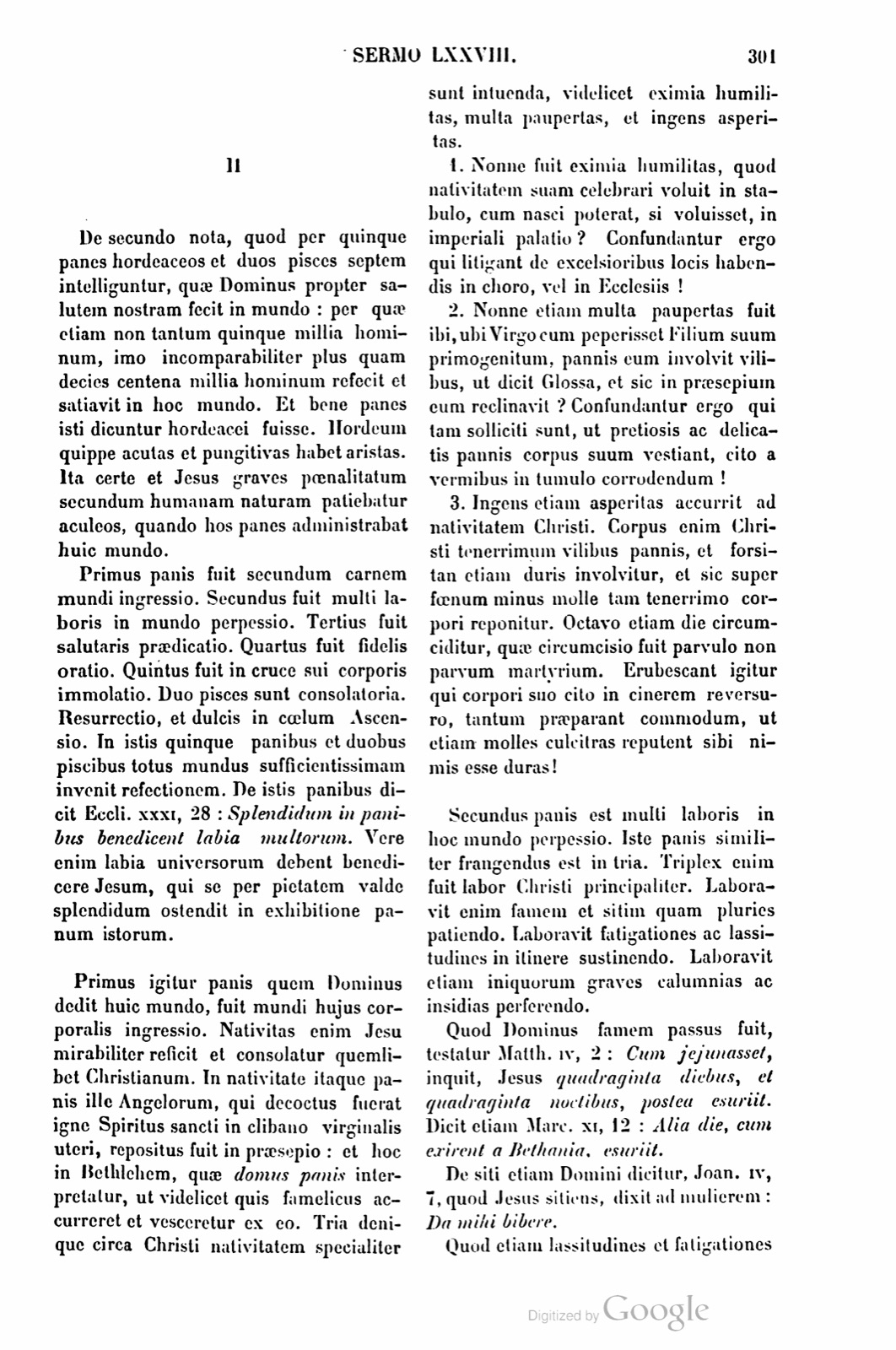
Secundus panis est multi laboris in hoc mundo perpessio. Iste panis similiter frangendus est in tria. Triplex enim fuit labor Christi principaliter. Laboravit enim famem et sitim quam pluries patiendo. Laboravit fatigationes ac lassitudines in itinere sustinendo. Laboravit etiam iniquorum graves calumnias ac insidias perferendo.
Quod Dominus famem passus fuit, testatur Matth. iv, 2: Cum jejunasset, inquit, Jesus quadraginta diebus, et quadraginta noctibus, postea esuriit. Dicit etiam Marc. xi, 12: Alia die, cum exirent a Bethania, esuriit.
De siti etiam Domini dicitur, Joan. iv, 7, quod Jesus sitiens, dixit ad mulierem: Da mihi bibere.
Quod etiam lassitudines et fatigationes in itinere sustinuisset, dicitur Joan. iv, 6: Jesus fatigatus ex itinere, sedebat sic supra fontem. Ipse etiam dicit in Psal. lxi, 5: Cucurri in siti.
Dominus etiam pertulit graves insidias ac calumnias Judæorum. Ipsi enim observabant eum, et tentabant, et sæpe capere laborabant. Unde dicit Luc. xx, 20: Sacerdotes et Scribæ observantes insidiatores miserunt, qui se justos simularent, ut caperent eum in sermone, et traderent eum principatui et potestati præsidis.
Omnes ergo qui fame et siti cruciantur, et qui in itinere fatigantur, nec non et qui per malitias hominum perturbantur, si panem istum masticaverint, sine dubio in suis laboribus confortabuntur.
Tertius panis est salutaris prædicatio. Unde dicit Luc. viii, 1: Iter faciebat Jesus per civitates et castella, prædicans et evangelizans regnum Dei. Dicit etiam Matth. iv, 23: Circuibat Jesus totam Galilæam, docens in synagogis eorum, et prædicans Evangelium regni: et sanans omnem languorem, et omnem infirmitatem in populo. Prædicatio vero Domini licet multiplex fuerit, maxime tamen consistit in quatuor. Et hæc sunt quatuor frusta panis hujus.
Docebat enim homines a peccatis recedere. Item, docuit eos caste, pie, et juste vivere. Docuit etiam eos regnum Dei appetere, nec non et inferni supplicia fugere.
1. De primo dicit Matth. iv, 17: Cœpit Jesus prædicare, et dicere: Pœnitentiam agite: appropinquavit enim regnum cælorum. Ille vero a peccatis recedit, qui pœnitentiam agit. «Pœnitere enim est, «ut ait Augustinus, anteacta deflere, et «deflenda non committere.»
2. Secundo docuit nos caste et pie vivere. De castitate dicit, Matth. v, 27 et 28: Audistis quia dictum est antiquis: Non mœchaberis. Ego autem dico vobis: quia omnis qui viderit mulierem ad concupiscendum eam, jam mœchatus est eam in corde suo. Dicit etiam Dominus, Luc. xii, 35: Sint lumbi vestri præcincti, per continentiam videlicet, et castitatem. De justitia dicit, Luc. vi, 31 et 33: Prout vultis ut faciant vobis homines, et vos facite illis similiter. De pietate, ibidem: Diligite inimicos vestros: benefacite, et mutuum date, nihil inde sperantes: et erit merces vestra multa, et eritis filii Altissimi, quia ipse benignus est super ingratos et malos.
The second loaf is the endurance of much labor in this world. This loaf likewise must be broken into three pieces. For the labor of Christ was principally threefold. For he labored by suffering hunger and thirst many times. He labored by enduring wearinesses and fatigues on the journey. He labored also by bearing the grave calumnies and snares of the wicked.
That the Lord suffered hunger, Matthew 4:2 testifies: When Jesus had fasted, it says, forty days and forty nights, afterward he was hungry. Mark 11:12 also says: On another day, when they were going out from Bethany, he was hungry.
Concerning the Lord's thirst also it is said, John 4:7, that Jesus, thirsting, said to the woman: Give me to drink.
That he also endured wearinesses and fatigues on the journey is said in John 4:6: Jesus, wearied from the journey, sat thus upon the fountain. He himself also says in Psalm 61:5: I ran in thirst.
The Lord also bore the grave snares and calumnies of the Jews. For they were watching him, and tempting him, and often were laboring to catch him. Hence Luke 20:20 says: The priests and Scribes, watching, sent spies who would pretend themselves just, so that they might catch him in speech and hand him over to the authority and power of the governor.
Therefore all who are tormented by hunger and thirst, and who are wearied on a journey, and also those who are disturbed by the malices of human beings, if they have chewed this loaf, without doubt will be strengthened in their labors.
The third loaf is salvific preaching. Hence Luke 8:1 says: Jesus was making a journey through cities and towns, preaching and evangelizing the kingdom of God. Matthew 4:23 also says: Jesus was going around all Galilee, teaching in their synagogues and preaching the Gospel of the kingdom, and healing every disease and every infirmity among the people. But although the preaching of the Lord was manifold, nevertheless it consists especially in four things. And these are the four pieces of this loaf.
For he was teaching human beings to withdraw from sins. Likewise, he taught them to live chastely, piously, and justly. He also taught them to desire the kingdom of God, and also to flee the punishments of hell.
1. Concerning the first Matthew 4:17 says: Jesus began to preach and to say: Do penance; for the kingdom of heaven has drawn near. But the one who does penance withdraws from sins. For to repent is, as Augustine says, to weep over things done before and not to commit things that must be wept over.
2. Secondly, he taught us to live chastely and piously. Concerning chastity Matthew 5:27 and 28 says: You have heard that it was said to the ancients: You shall not commit adultery. But I say to you that everyone who has seen a woman for the purpose of lusting after her has already committed adultery with her in his heart. The Lord also says, Luke 12:35: Let your loins be girded, namely through continence and chastity. Concerning justice Luke 6:31 and 33 says: As you wish that human beings should do to you, you also do similarly to them. Concerning piety, in the same place: Love your enemies; do good, and lend, hoping for nothing from it, and your reward will be great, and you will be sons of the Most High, because he himself is kind toward the ungrateful and the evil.
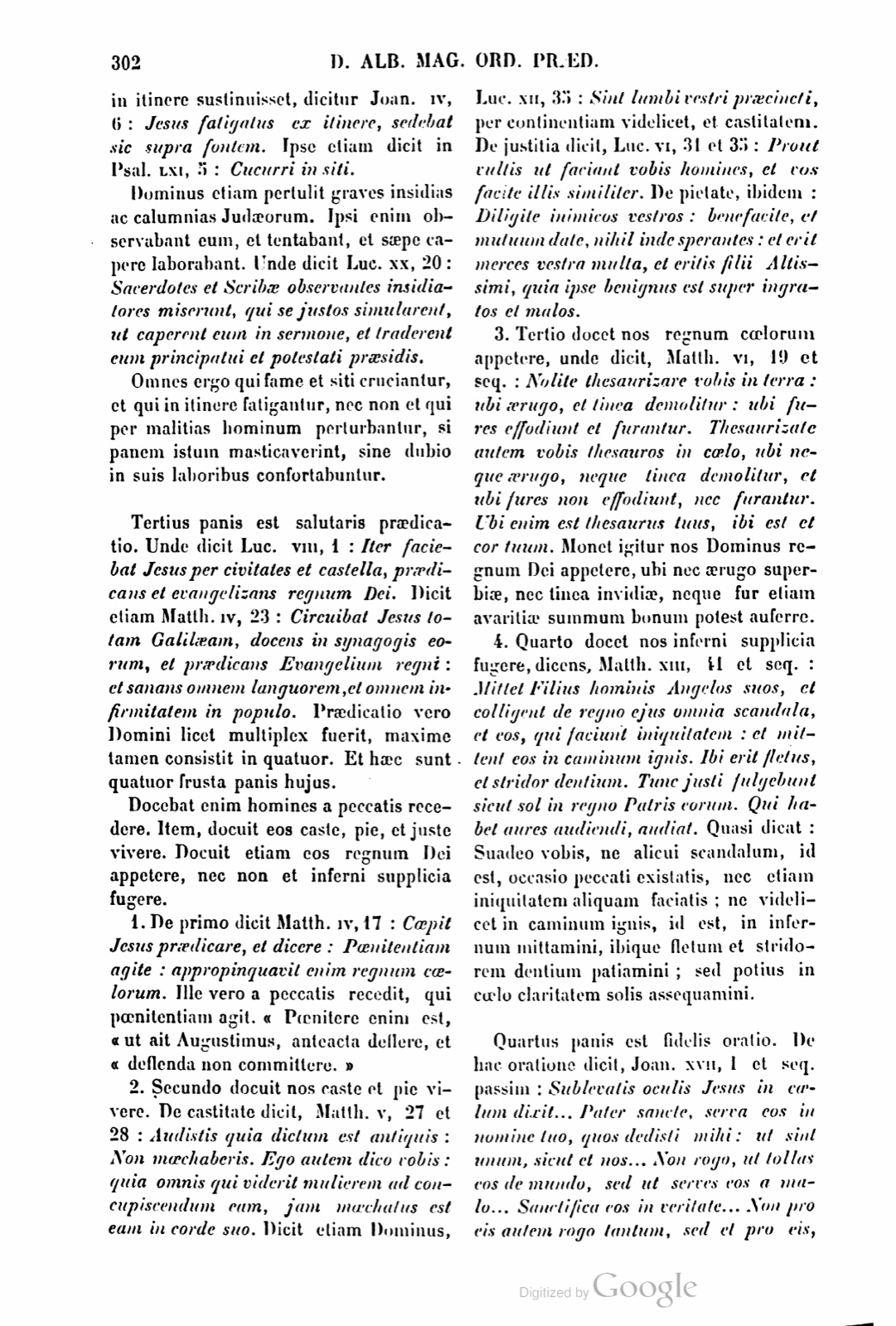
3. Tertio docet nos regnum cælorum appetere, unde dicit, Matth. vi, 19 et seq.: Nolite thesaurizare vobis in terra: ubi ærugo, et tinea demolitur: ubi fures effodiunt et furantur. Thesaurizate autem vobis thesauros in cælo, ubi neque ærugo, neque tinea demolitur, et ubi fures non effodiunt, nec furantur. Ubi enim est thesaurus tuus, ibi est et cor tuum. Monet igitur nos Dominus regnum Dei appetere, ubi nec ærugo superbiæ, nec tinea invidiæ, neque fur etiam avaritiæ summum bonum potest auferre.
4. Quarto docet nos inferni supplicia fugere, dicens, Matth. xiii, 41 et seq.: Mittet Filius hominis Angelos suos, et colligent de regno ejus omnia scandala, et eos, qui faciunt iniquitatem: et mittent eos in caminum ignis. Ibi erit fletus, et stridor dentium. Tunc justi fulgebunt sicut sol in regno Patris eorum. Qui habet aures audiendi, audiat. Quasi dicat: Suadeo vobis, ne alicui scandalum, id est, occasio peccati existatis, nec etiam iniquitatem aliquam faciatis; ne videlicet in caminum ignis, id est, in infernum mittamini, ibique fletum et stridorem dentium patiamini; sed potius in cælo claritatem solis assequamini.
Quartus panis est fidelis oratio. De hac oratione dicit, Joan. xvii, 1 et seq. passim: Sublevatis oculis Jesus in cœlum dixit... Pater sancte, serva eos in nomine tuo, quos dedisti mihi: ut sint unum, sicut et nos... Non rogo, ut tollas eos de mundo, sed ut serves eos a malo... Sanctifica eos in veritate... Non pro eis autem rogo tantum, sed et pro eis, qui credituri sunt per verbum eorum in me. Ut omnes unum sint, sicut tu Pater in me, et ego in te, ut et ipsi in nobis unum sint... Pater, quos dedisti mihi, volo ut ubi sum ego, et illi sint mecum, ut videant claritatem meam, quam dedisti mihi.
Nota, quod quatuor petit hic Jesus orans ad Patrem suum. Primum est, ut in unitate charitatis et fidei congregemur, ut videlicet sit una fides nobis, et unum cor in Domino. Secundum est, ut ab omni malo conservemur. Tertium est, ut in bono proficiamus. Quartum est, ut suam claritatem videamus. Quis non confitebitur, et non consolabitur ex hoc, quod Dominus tam fideliter pro Christianis suis orat? Vere confortatorius est panis iste.
Quintus panis est ipsius Christi in ara crucis immolatio. Iste etiam frangendus est in tria frusta. Considerare quippe debemus in Jesu in ara crucis immolationem summam, patientiam miram, benevolentiam et imitabilem sapientiam.
3. Thirdly, he teaches us to desire the kingdom of heaven; hence he says, Matthew 6:19 and following: Do not treasure up for yourselves on earth, where rust and moth destroy, where thieves dig through and steal. But treasure up for yourselves treasures in heaven, where neither rust nor moth destroys, and where thieves do not dig through nor steal. For where your treasure is, there also is your heart. Therefore the Lord admonishes us to desire the kingdom of God, where neither the rust of pride, nor the moth of envy, nor even the thief of avarice can take away the highest good.
4. Fourthly, he teaches us to flee the punishments of hell, saying, Matthew 13:41 and following: The Son of Man will send his Angels, and they will gather from his kingdom all scandals and those who work iniquity; and they will send them into the furnace of fire. There will be weeping and gnashing of teeth. Then the just will shine like the sun in the kingdom of their Father. Let the one who has ears for hearing hear. As if he were saying: I persuade you not to be for anyone a scandal, that is, an occasion of sin, nor also to do any iniquity, so that, namely, you may not be sent into the furnace of fire, that is, into hell, and there suffer weeping and gnashing of teeth, but rather may obtain in heaven the brightness of the sun.
The fourth loaf is faithful prayer. Concerning this prayer John 17:1 and following, throughout, says: With eyes lifted up, Jesus said into heaven... Holy Father, keep in your name those whom you have given me, that they may be one, just as we also are... I do not ask that you take them from the world, but that you keep them from evil... Sanctify them in truth... And I ask not only for them, but also for those who are going to believe through their word in me. That they all may be one, as you, Father, are in me and I am in you, so that they also may be one in us... Father, those whom you have given me, I will that where I am, they also may be with me, so that they may see my brightness, which you have given me.
Note that here Jesus, praying to his Father, asks for four things. The first is that we may be gathered in unity of charity and faith, so that, namely, there may be one faith for us and one heart in the Lord. The second is that we may be preserved from every evil. The third is that we may make progress in good. The fourth is that we may see his brightness. Who will not confess, and will not be consoled from this, that the Lord so faithfully prays for his Christians? Truly this loaf is strengthening.
The fifth loaf is the immolation of Christ himself on the altar of the cross. This also must be broken into three pieces. For we ought to consider in Jesus, in the immolation on the altar of the cross, highest patience, wondrous benevolence, and imitable wisdom.
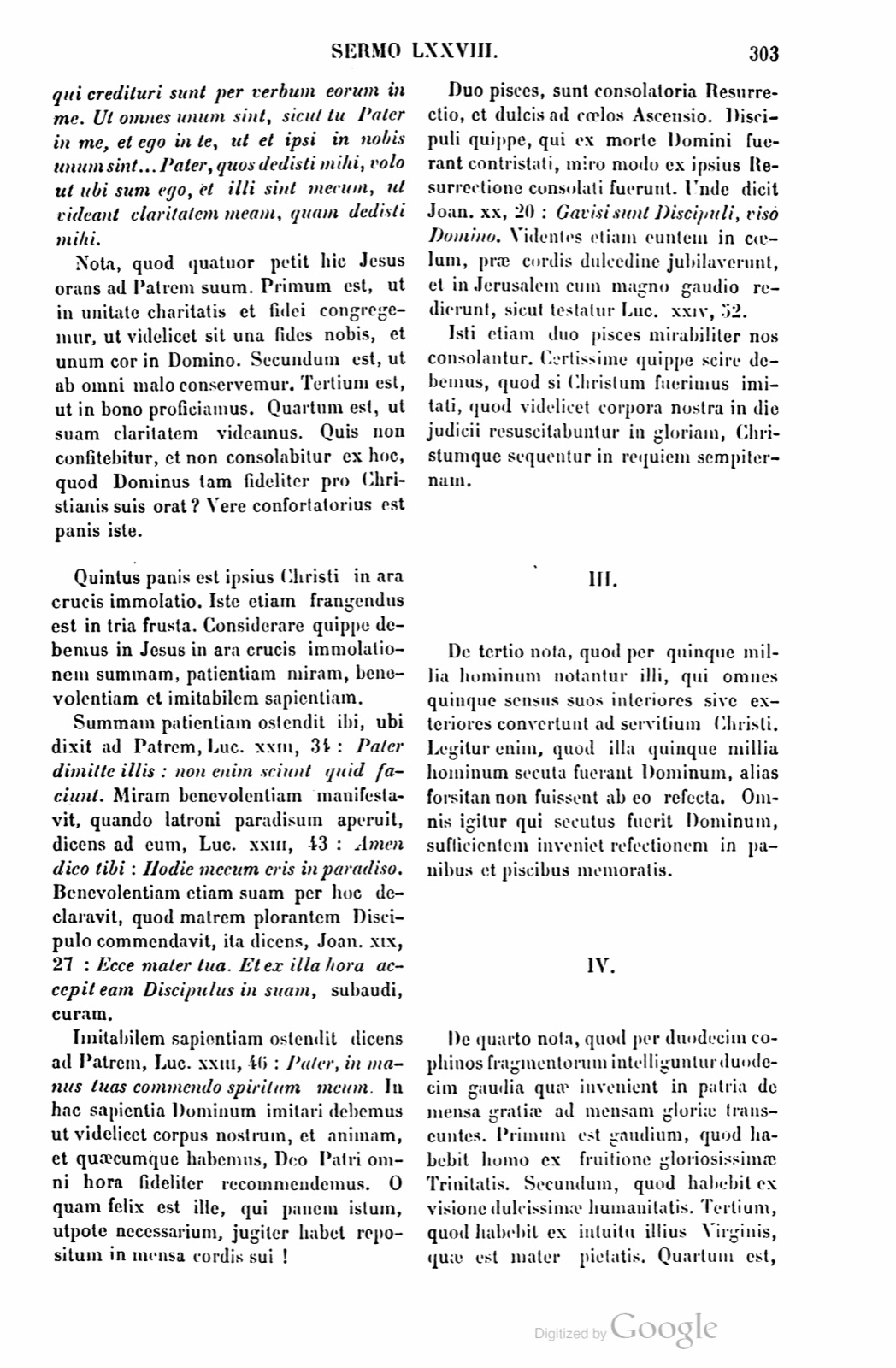
Summam patientiam ostendit ibi, ubi dixit ad Patrem, Luc. xxiii, 34: Pater dimitte illis: non enim sciunt quid faciunt. Miram benevolentiam manifestavit, quando latroni paradisum aperuit, dicens ad eum, Luc. xxiii, 43: Amen dico tibi: Hodie mecum eris in paradiso. Benevolentiam etiam suam per hoc declaravit, quod matrem plorantem Discipulo commendavit, ita dicens, Joan. xix, 27: Ecce mater tua. Et ex illa hora accepit eam Discipulus in suam, subaudi, curam.
Imitabilem sapientiam ostendit dicens ad Patrem, Luc. xxiii, 46: Pater, in manus tuas commendo spiritum meum. In hac sapientia Dominum imitari debemus ut videlicet corpus nostrum, et animam, et quæcumque habemus, Deo Patri omni hora fideliter recommendemus. O quam felix est ille, qui panem istum, utpote necessarium, jugiter habet repositum in mensa cordis sui!
Duo pisces, sunt consolatoria Resurrectio, et dulcis ad cælos Ascensio. Discipuli quippe, qui ex morte Domini fuerant contristati, miro modo ex ipsius Resurrectione consolati fuerunt. Unde dicit Joan. xx, 20: Gavisi sunt Discipuli, viso Domino. Videntes etiam euntem in cœlum, præ cordis dulcedine jubilaverunt, et in Jerusalem cum magno gaudio redierunt, sicut testatur Luc. xxiv, 52.
Isti etiam duo pisces mirabiliter nos consolantur. Certissime quippe scire debemus, quod si Christum fuerimus imitati, quod videlicet corpora nostra in die judicii resuscitabuntur in gloriam, Christumque sequentur in requiem sempiternam.
III.
De tertio nota, quod per quinque millia hominum notantur illi, qui omnes quinque sensus suos interiores sive exteriores convertunt ad servitium Christi. Legitur enim, quod illa quinque millia hominum secuta fuerant Dominum, alias forsitan non fuissent ab eo refecta. Omnis igitur qui secutus fuerit Dominum, sufficientem inveniet refectionem in panibus et piscibus memoratis.
IV.
De quarto nota, quod per duodecim cophinos fragmentorum intelliguntur duodecim gaudia quæ invenient in patria de mensa gratiæ ad mensam gloriæ transeuntes. Primum est gaudium, quod habebit homo ex fruitione gloriosissimæ Trinitatis. Secundum, quod habebit ex visione dulcissimæ humanitatis. Tertium, quod habebit ex intuitu illius Virginis, quæ est mater pietatis. Quartum est, quod dabitur homini in animæ suæ beatificatione. Quintum est, quod additur ei in corporis glorificatione. Alia septem gaudia sunt, quæ habebit et assequetur homo ex societate Angelorum, Patriarcharum, Prophetarum, Apostolorum, Martyrum, Confessorum, et Virginum.
Rogate ergo Dominum, ut sic per eum sustentemur in terris, ut ad ipsum mereamur pertingere in cælis. Quod nobis præstare, etc.
He showed highest patience there, where he said to the Father, Luke 23:34: Father, forgive them, for they do not know what they are doing. He manifested wondrous benevolence when he opened paradise to the robber, saying to him, Luke 23:43: Amen I say to you: Today you will be with me in paradise. He also declared his benevolence by this, that he entrusted his weeping mother to the Disciple, saying thus, John 19:27: Behold your mother. And from that hour the Disciple received her into his own, understand, care.
He showed imitable wisdom by saying to the Father, Luke 23:46: Father, into your hands I commend my spirit. In this wisdom we ought to imitate the Lord, so that, namely, our body and soul and whatever things we have, we may faithfully recommit to God the Father at every hour. O how happy is the one who continually has this loaf, as necessary, placed back upon the table of his heart!
The two fishes are the consoling Resurrection and the sweet Ascension to the heavens. For the Disciples, who had been saddened by the death of the Lord, were consoled in a wondrous way by his Resurrection itself. Hence John 20:20 says: The Disciples rejoiced, the Lord having been seen. Also, seeing him going into heaven, they rejoiced with jubilation because of the sweetness of their heart, and returned into Jerusalem with great joy, as Luke 24:52 testifies.
These two fishes also console us wonderfully. For we ought most certainly to know that if we have imitated Christ, namely that our bodies on the day of judgment will be raised up into glory and will follow Christ into everlasting rest.
III.
On the third note that by the five thousand men are marked those who turn all their five senses, interior or exterior, to the service of Christ. For it is read that those five thousand men had followed the Lord; otherwise perhaps they would not have been refreshed by him. Therefore everyone who has followed the Lord will find sufficient refreshment in the loaves and fishes mentioned.
IV.
On the fourth note that by the twelve baskets of fragments are understood the twelve joys that those passing in the homeland from the table of grace to the table of glory will find. The first is the joy that a human being will have from enjoyment of the most glorious Trinity. The second is that which he will have from vision of the sweetest humanity. The third is that which he will have from the sight of that Virgin who is the mother of piety. The fourth is that which will be given to a human being in the beatification of his soul. The fifth is that which is added to him in the glorification of the body. The other seven joys are those that the human being will have and attain from the society of Angels, Patriarchs, Prophets, Apostles, Martyrs, Confessors, and Virgins.
Therefore pray to the Lord that we may be sustained by him on earth in such a way that we may deserve to reach him in heaven. May he grant this to us, and so forth.

If a page does not appear, its photograph has not been uploaded yet.