Works › Sermons for the Seasons of the Year
Volume 13 · pp. 285–288
Sermon LXXIV. On the Twentieth Sunday After Trinity
A marker with ≈ is an approximate page boundary, placed by measure of the text; the page photographs remain the authority. In the paired views, clicking a page marker brings that page into view.
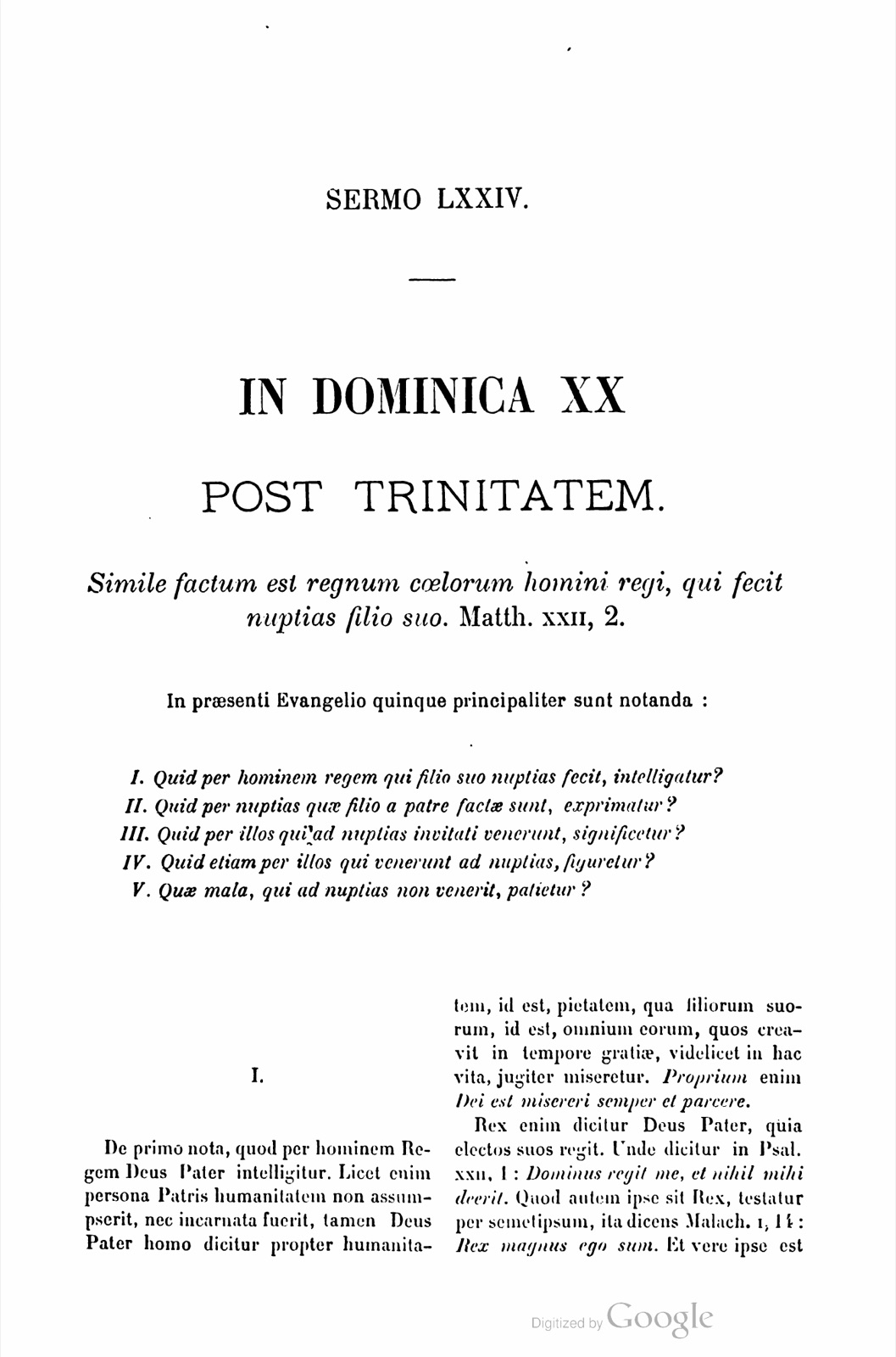
SERMO LXXIV.
IN DOMINICA XX POST TRINITATEM.
Simile factum est regnum caelorum homini regi, qui fecit nuptias filio suo. Matth. XXII, 2.
In praesenti Evangelio quinque principaliter sunt notanda:
I. Quid per hominem regem qui filio suo nuptias fecit, intelligatur? II. Quid per nuptias quae filio a patre factae sunt, exprimatur? III. Quid per illos qui ad nuptias invitati venerunt, significetur? IV. Quid etiam per illos qui venerunt ad nuptias, figuretur? V. Quae mala, qui ad nuptias non venerit, patietur?
I.
De primo nota, quod per hominem Regem Deus Pater intelligitur. Licet enim persona Patris humanitatem non assumpserit, nec incarnata fuerit, tamen Deus Pater homo dicitur propter humanitatem, id est, pietatem, qua filiorum suorum, id est, omnium eorum, quos creavit in tempore gratiae, videlicet in hac vita, jugiter miseretur. Proprium enim Dei est misereri semper et parcere.
Rex enim dicitur Deus Pater, quia electos suos regit. Unde dicitur in Psal. XXII, 1: Dominus regit me, et nihil mihi deerit. Quod autem ipse sit Rex, testatur per semetipsum, ita dicens Malach. I, 14: Rex magnus ego sum. Et vere ipse est Rex magnus: quod etiam Nabuchodonosor testatur, Daniel. II, 47, et III, 100, et IV, 31 et 32, ita dicens et scribens: Vere Deus caeli Deus deorum est, et Dominus regum.... Regnum ejus regnum sempiternum.... Potestas ejus potestas sempiterna.... Juxta voluntatem suam facit tam in virtutibus caeli quam in habitatoribus terrae: et non est qui resistat manui ejus, et dicat ei: Quare hoc fecisti?
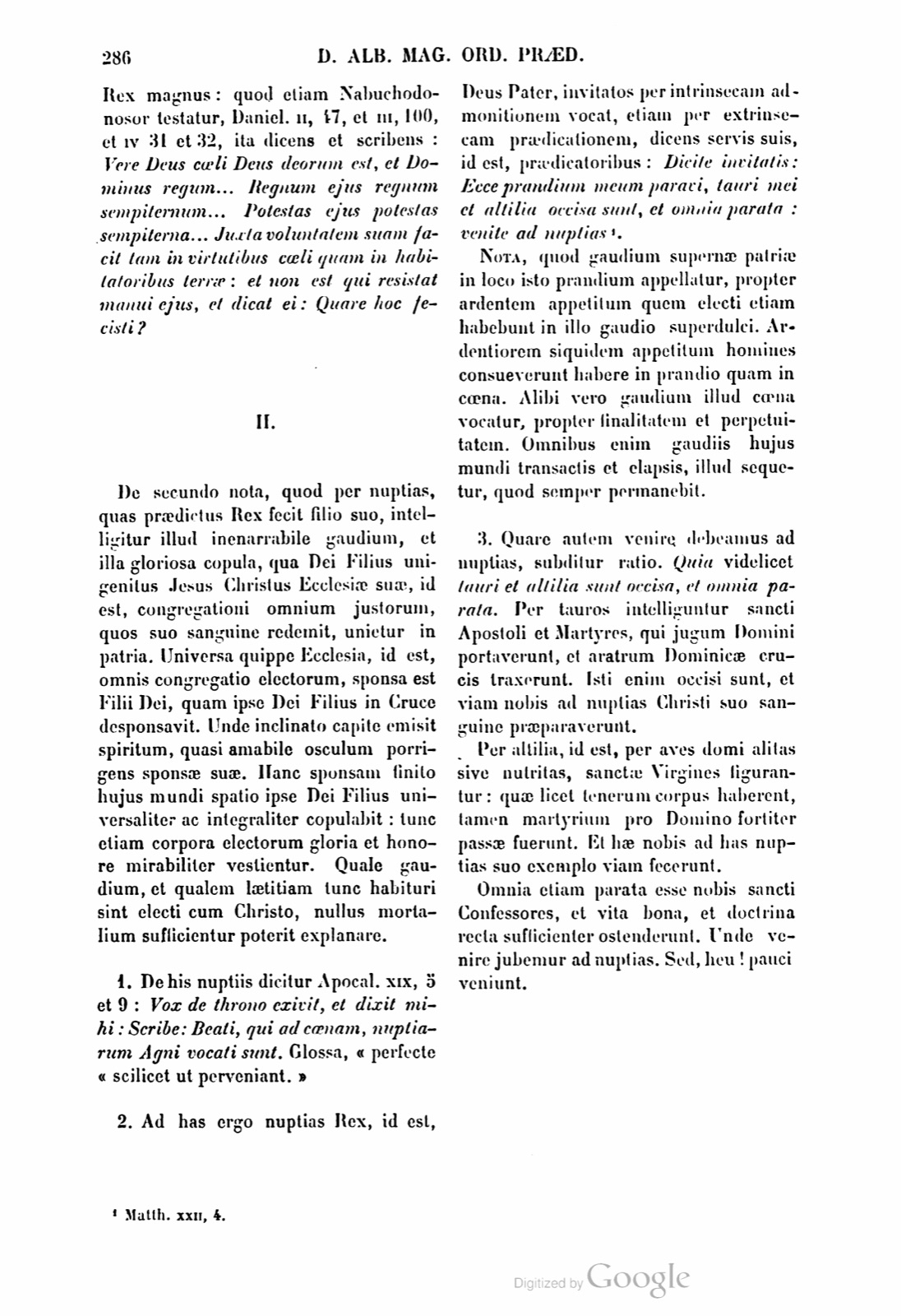
II.
De secundo nota, quod per nuptias, quas praedictus Rex fecit filio suo, intelligitur illud inenarrabile gaudium, et illa gloriosa copula, qua Dei Filius unigenitus Jesus Christus Ecclesiae suae, id est, congregationi omnium justorum, quos suo sanguine redemit, unietur in patria. Universa quippe Ecclesia, id est, omnis congregatio electorum, sponsa est Filii Dei, quam ipse Dei Filius in Cruce desponsavit. Unde inclinato capite emisit spiritum, quasi amabile osculum porrigens sponsae suae. Hanc sponsam finito hujus mundi spatio ipse Dei Filius universaliter ac integraliter copulabit: tunc etiam corpora electorum gloria et honore mirabiliter vestientur. Quale gaudium, et qualem laetitiam tunc habituri sint electi cum Christo, nullus mortalium sufficienter poterit explanare.
SERMON LXXIV.
ON THE TWENTIETH SUNDAY AFTER TRINITY.
The kingdom of heaven was made like a man, a king, who made nuptials for his son. Matthew XXII, 2.
In the present Gospel five things are principally to be noted:
I. What is understood by the man, the king, who made nuptials for his son? II. What is expressed by the nuptials which were made for the son by the father? III. What is signified by those who, invited to the nuptials, came? IV. What also is figured by those who came to the nuptials? V. What evils will he suffer who has not come to the nuptials?
I.
Concerning the first, note that by the man, the King, God the Father is understood. For although the person of the Father did not assume humanity and was not incarnate, nevertheless God the Father is called man because of humanity, that is, piety, by which he continually has mercy on his children, that is, on all those whom he created in the time of grace, namely in this life. For it is proper to God always to have mercy and to spare.
For God the Father is called King because he rules his elect. Hence it is said in Psalm XXII, 1: The Lord rules me, and nothing will be lacking to me. But that he himself is King, he testifies through himself, saying thus in Malachi I, 14: I am a great King. And truly he is a great King; Nabuchodonosor also testifies this, Daniel II, 47, and III, 100, and IV, 31 and 32, saying and writing thus: Truly the God of heaven is God of gods and Lord of kings.... His kingdom is an everlasting kingdom.... His power is an everlasting power.... According to his will he does both among the powers of heaven and among the inhabitants of earth; and there is no one who resists his hand and says to him: Why have you done this?
II.
Concerning the second, note that by the nuptials which the aforesaid King made for his son is understood that ineffable joy and that glorious union by which the only-begotten Son of God, Jesus Christ, will be united in the homeland to his Church, that is, to the congregation of all the just whom he redeemed by his blood. For the whole Church, that is, the entire congregation of the elect, is the bride of the Son of God, whom the Son of God himself betrothed on the Cross. Hence, bowing his head, he gave up his spirit, as if offering a lovable kiss to his bride. At the end of the span of this world, the Son of God himself will universally and integrally join this bride to himself; then also the bodies of the elect will be wonderfully clothed with glory and honor. What joy and what gladness the elect will then have with Christ, no mortal will be able sufficiently to explain.
1. De his nuptiis dicitur Apocal. XIX, 5 et 9: Vox de throno exivit, et dixit mihi: Scribe: Beati, qui ad coenam, nuptiarum Agni vocati sunt. Glossa, "perfecte scilicet ut perveniant."
2. Ad has ergo nuptias Rex, id est, Deus Pater, invitatos per intrinsecam admonitionem vocat, etiam per extrinsecam praedicationem, dicens servis suis, id est, praedicatoribus: Dicite invitatis: Ecce prandium meum paravi, tauri mei et altilia occisa sunt, et omnia parata: venite ad nuptias 1.
NOTA, quod gaudium supernae patriae in loco isto prandium appellatur, propter ardentem appetitum quem electi etiam habebunt in illo gaudio superdulci. Ardentiorem siquidem appetitum homines consueverunt habere in prandio quam in coena. Alibi vero gaudium illud caena vocatur, propter finalitatem et perpetuitatem. Omnibus enim gaudiis hujus mundi transactis et elapsis, illud sequetur, quod semper permanebit.
3. Quare autem venire debeamus ad nuptias, subditur ratio. Quia videlicet tauri et altilia sunt occisa, et omnia parata. Per tauros intelliguntur sancti Apostoli et Martyres, qui jugum Domini portaverunt, et aratrum Dominicae crucis traxerunt. Isti enim occisi sunt, et viam nobis ad nuptias Christi suo sanguine praeparaverunt.
Per altilia, id est, per aves domi alitas sive nutritas, sanctae Virgines figurantur: quae licet tenerum corpus haberent, tamen martyrium pro Domino fortiter passae fuerunt. Et hae nobis ad has nuptias suo exemplo viam fecerunt.
Omnia etiam parata esse nobis sancti Confessores, et vita bona, et doctrina recta sufficienter ostenderunt. Unde venire jubemur ad nuptias. Sed, heu! pauci veniunt.
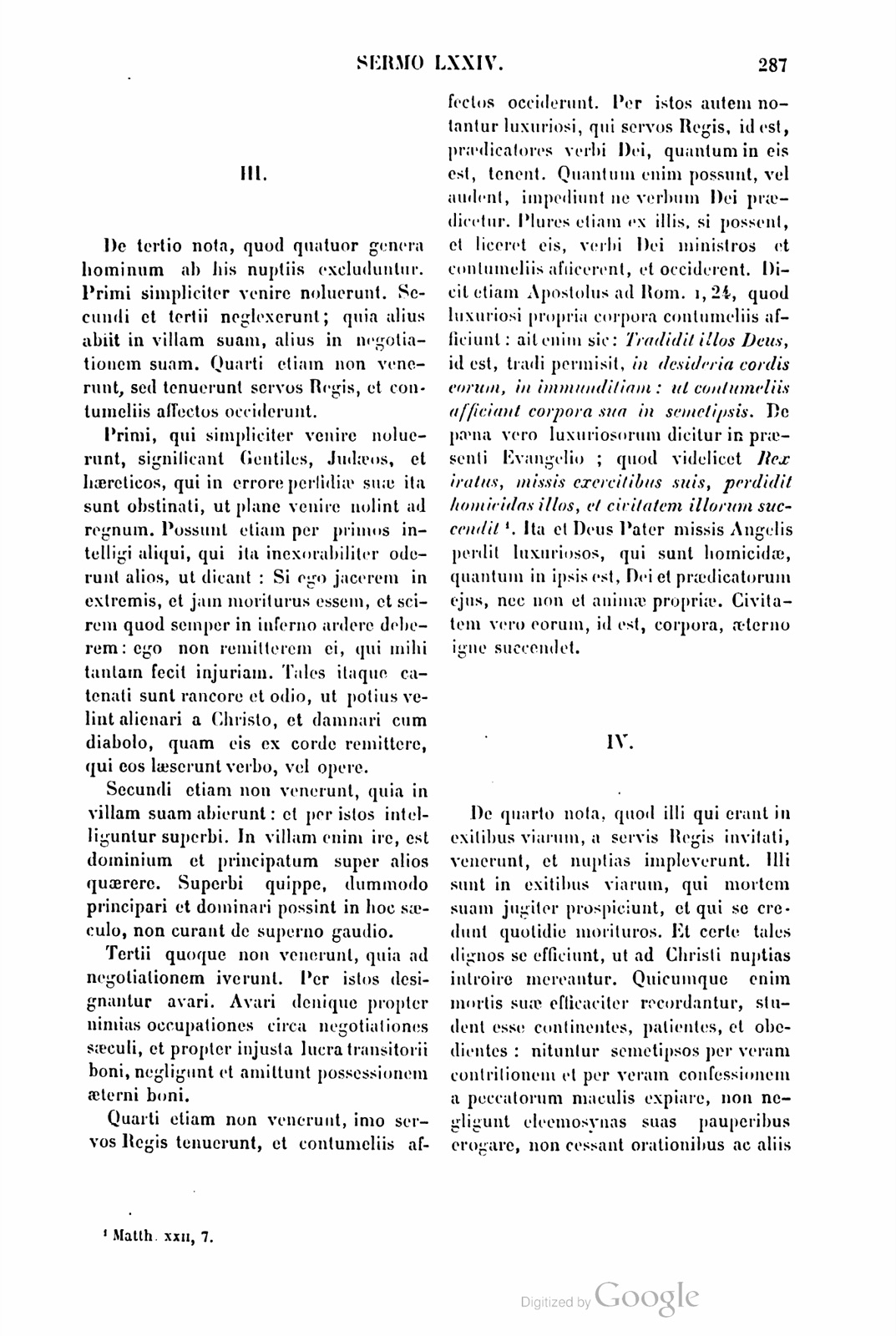
III.
De tertio nota, quod quatuor genera hominum ab his nuptiis excluduntur. Primi simpliciter venire noluerunt. Secundi et tertii neglexerunt; quia alius abiit in villam suam, alius in negotiationem suam. Quarti etiam non venerunt, sed tenuerunt servos Regis, et contumeliis affectos occiderunt.
1. Concerning these nuptials it is said in Revelation XIX, 5 and 9: A voice came out from the throne and said to me: Write: Blessed are those who are called to the supper of the nuptials of the Lamb. The Gloss says, "namely, perfectly, so that they may come."
2. Therefore to these nuptials the King, that is, God the Father, calls those invited through inward admonition, also through outward preaching, saying to his servants, that is, to preachers: Say to those invited: Behold, I have prepared my lunch, my bulls and fatlings have been killed, and all things are ready; come to the nuptials 1.
NOTE that the joy of the heavenly homeland in this place is called lunch because of the burning appetite that the elect will also have in that most sweet joy. Indeed human beings are accustomed to have a more burning appetite at lunch than at supper. But elsewhere that joy is called supper because of finality and perpetuity. For when all the joys of this world have passed through and slipped away, that will follow which will always remain.
3. But why we ought to come to the nuptials, the reason is added: because namely the bulls and fatlings have been killed and all things are ready. By bulls are understood the holy Apostles and Martyrs, who carried the yoke of the Lord and drew the plow of the Lord's cross. For they were killed and by their blood prepared the way for us to the nuptials of Christ.
By fatlings, that is, by birds raised or nourished at home, holy Virgins are figured, who, although they had a tender body, nevertheless suffered martyrdom bravely for the Lord. And they made for us, by their example, the way to these nuptials.
The holy Confessors also sufficiently showed that all things were prepared for us, by good life and right doctrine. Hence we are ordered to come to the nuptials. But alas, few come.
III.
Concerning the third, note that four kinds of human beings are excluded from these nuptials. The first simply refused to come. The second and third neglected it, because one went away to his farm, another to his business. The fourth also did not come, but seized the servants of the King and, after afflicting them with insults, killed them.
Primi, qui simpliciter venire noluerunt, significant Gentiles, Judaeos, et haereticos, qui in errore perfidiae suae ita sunt obstinati, ut plane venire nolint ad regnum. Possunt etiam per primos intelligi aliqui, qui ita inexorabiliter oderunt alios, ut dicant: Si ego jacerem in extremis, et jam moriturus essem, et scirem quod semper in inferno ardere deberem: ego non remitterem ei, qui mihi tantam fecit injuriam. Tales itaque catenati sunt rancore et odio, ut potius velint alienari a Christo, et damnari cum diabolo, quam eis ex corde remittere, qui eos laeserunt verbo, vel opere.
Secundi etiam non venerunt, quia in villam suam abierunt: et per istos intelliguntur superbi. In villam enim ire, est dominium et principatum super alios quaerere. Superbi quippe, dummodo principari et dominari possint in hoc saeculo, non curant de superno gaudio.
Tertii quoque non venerunt, quia ad negotiationem iverunt. Per istos designantur avari. Avari denique propter nimias occupationes circa negotiationes saeculi, et propter injusta lucra transitorii boni, negligunt et amittunt possessionem aeterni boni.
Quarti etiam non venerunt, imo servos Regis tenuerunt, et contumeliis affectos occiderunt. Per istos autem notantur luxuriosi, qui servos Regis, id est, praedicatores verbi Dei, quantum in eis est, tenent. Quantum enim possunt, vel audent, impediunt ne verbum Dei praedicetur. Plures etiam ex illis, si possent, et liceret eis, verbi Dei ministros et contumeliis afficerent, et occiderent. Dicit etiam Apostolus ad Rom. I, 24, quod luxuriosi propria corpora contumeliis afficiunt: ait enim sic: Tradidit illos Deus, id est, tradi permisit, in desideria cordis eorum, in immunditiam: ut contumeliis afficiant corpora sua in semetipsis. De paena vero luxuriosorum dicitur in praesenti Evangelio; quod videlicet Rex iratus, missis exercitibus suis, perdidit homicidas illos, et civitatem illorum succendit 2. Ita et Deus Pater missis Angelis perdit luxuriosos, qui sunt homicidae, quantum in ipsis est, Dei et praedicatorum ejus, nec non et animae propriae. Civitatem vero eorum, id est, corpora, aeterno igne succendet.
The first, who simply refused to come, signify Gentiles, Jews, and heretics, who are so obstinate in the error of their faithlessness that they plainly do not wish to come to the kingdom. By the first can also be understood some who hate others so inexorably that they say: If I were lying at the point of death and now about to die, and knew that I ought always to burn in hell, I would not forgive him who did so great an injury to me. Therefore such persons are so chained with rancor and hatred that they would rather be alienated from Christ and be damned with the devil than forgive from the heart those who have harmed them by word or work.
The second also did not come, because they went away to their farm; and by them the proud are understood. For to go to a farm is to seek dominion and rule over others. For the proud, provided that they can rule and dominate in this age, do not care about heavenly joy.
The third likewise did not come, because they went to business. By them the avaricious are designated. For the avaricious, because of excessive occupations around the businesses of the age and because of unjust profits of transitory good, neglect and lose the possession of eternal good.
The fourth also did not come; indeed they seized the servants of the King and, after afflicting them with insults, killed them. But by these are noted the lustful, who, so far as is in them, hold the servants of the King, that is, the preachers of the word of God. For as much as they can or dare, they prevent the word of God from being preached. Many also from them, if they could and it were permitted to them, would both afflict with insults and kill the ministers of the word of God. The Apostle also says at Romans I, 24 that the lustful afflict their own bodies with insults; for he speaks thus: God handed them over, that is, permitted them to be handed over, to the desires of their heart, into uncleanness, so that they may afflict their bodies with insults in themselves. But concerning the punishment of the lustful it is said in the present Gospel that, namely, the King, angry, having sent his armies, destroyed those murderers and burned their city 2. Thus also God the Father, having sent Angels, destroys the lustful, who are murderers, as far as it is in them, of God and of his preachers, and also of their own soul. But their city, that is, their bodies, he will burn with eternal fire.
IV.
De quarto nota, quod illi qui erant in exitibus viarum, a servis Regis invitati, venerunt, et nuptias impleverunt. Illi sunt in exitibus viarum, qui mortem suam jugiter prospiciunt, et qui se credunt quotidie morituros. Et certe tales dignos se efficiunt, ut ad Christi nuptias introire mereantur. Quicumque enim mortis suae efficaciter recordantur, student esse continentes, patientes, et obedientes: nituntur semetipsos per veram contritionem et per veram confessionem a peccatorum maculis expiare, non negligunt eleemosynas suas pauperibus erogare, non cessant orationibus ac aliis bonis operibus invigilare: videlicet ut cum ex corpore migraverint, ad Christi nuptias alacriter recipiantur: quia vestem nuptialem, id est, bona opera secum attulerunt.
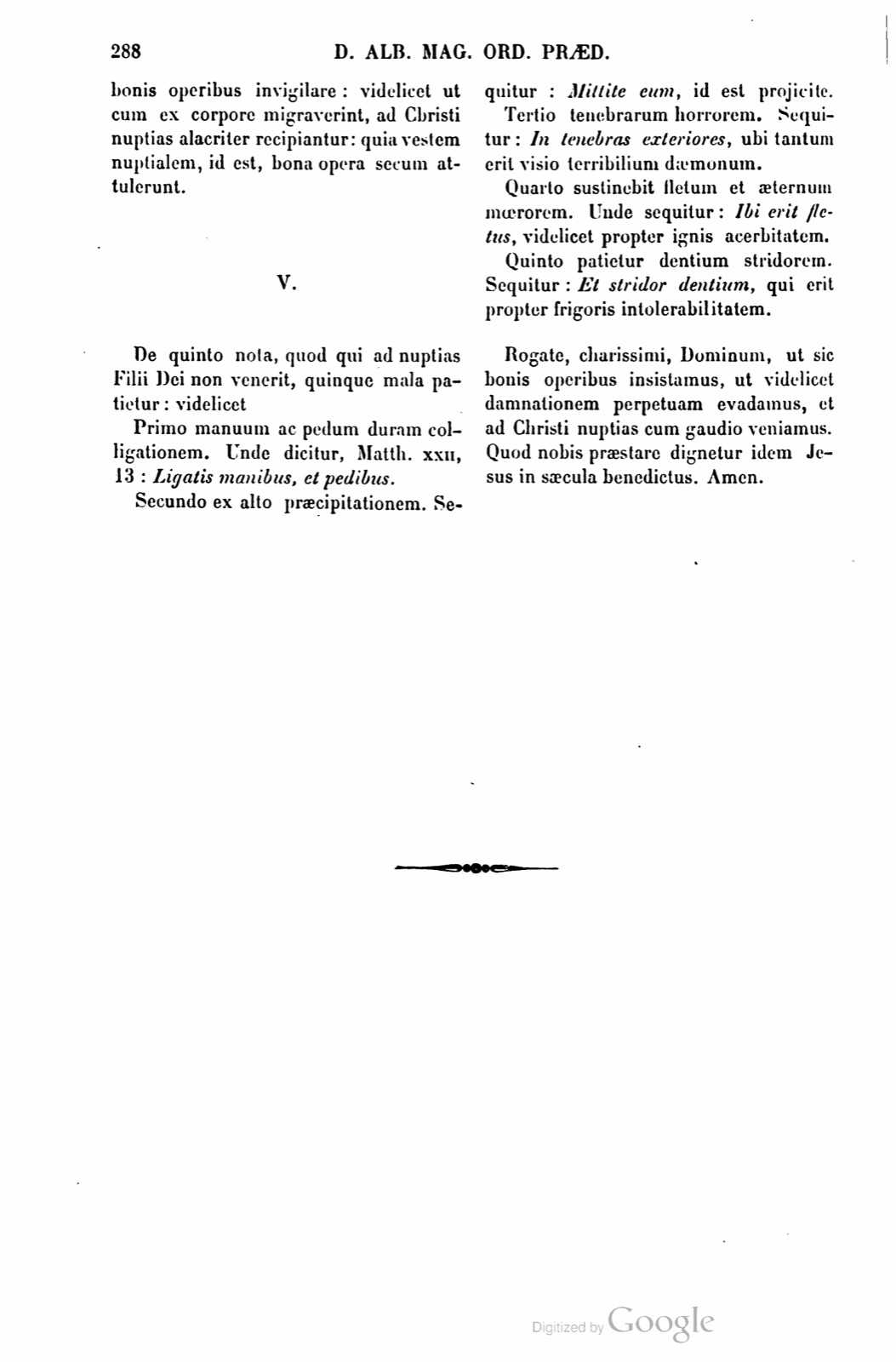
V.
De quinto nota, quod qui ad nuptias Filii Dei non venerit, quinque mala patietur: videlicet
Primo manuum ac pedum duram colligationem. Unde dicitur, Matth. XXII, 13: Ligatis manibus, et pedibus.
Secundo ex alto praecipitationem. Sequitur: Mittite eum, id est projicite.
Tertio tenebrarum horrorem. Sequitur: In tenebras exteriores, ubi tantum erit visio terribilium daemonum.
Quarto sustinebit fletum et aeternum maerorem. Unde sequitur: Ibi erit fletus, videlicet propter ignis acerbitatem.
Quinto patietur dentium stridorem. Sequitur: Et stridor dentium, qui erit propter frigoris intolerabilitatem.
Rogate, charissimi, Dominum, ut sic bonis operibus insistamus, ut videlicet damnationem perpetuam evadamus, et ad Christi nuptias cum gaudio veniamus. Quod nobis praestare dignetur idem Jesus in saecula benedictus. Amen.
IV.
Concerning the fourth, note that those who were at the exits of the roads, invited by the servants of the King, came and filled the nuptials. Those are at the exits of the roads who continually look toward their death and who believe themselves to die daily. And certainly such persons make themselves worthy to deserve to enter the nuptials of Christ. For whoever effectively remember their death study to be continent, patient, and obedient; they strive to cleanse themselves from the stains of sins through true contrition and true confession; they do not neglect to distribute their alms to the poor; they do not cease to watch over prayers and other good works, namely so that when they have migrated from the body, they may be received eagerly to the nuptials of Christ, because they brought with them the wedding garment, that is, good works.
V.
Concerning the fifth, note that he who has not come to the nuptials of the Son of God will suffer five evils, namely:
First, the hard binding together of hands and feet. Hence it is said, Matthew XXII, 13: Having bound his hands and feet.
Second, precipitation from on high. It follows: Send him, that is, cast him out.
Third, the horror of darknesses. It follows: Into the exterior darknesses, where there will be only the sight of terrible demons.
Fourth, he will sustain weeping and eternal sorrow. Hence it follows: There will be weeping there, namely because of the harshness of the fire.
Fifth, he will suffer gnashing of teeth. It follows: And gnashing of teeth, which will be because of the intolerability of cold.
Ask the Lord, dearest ones, that we may so apply ourselves to good works, namely that we may evade perpetual damnation and come with joy to the nuptials of Christ. May the same Jesus, blessed forever, deign to grant this to us. Amen.
If a page does not appear, its photograph has not been uploaded yet.