Works › Sermons for the Seasons of the Year
Volume 13 · pp. 225–228
Sermon LVIII. On the Fourth Sunday After Trinity
A marker with ≈ is an approximate page boundary, placed by measure of the text; the page photographs remain the authority. In the paired views, clicking a page marker brings that page into view.
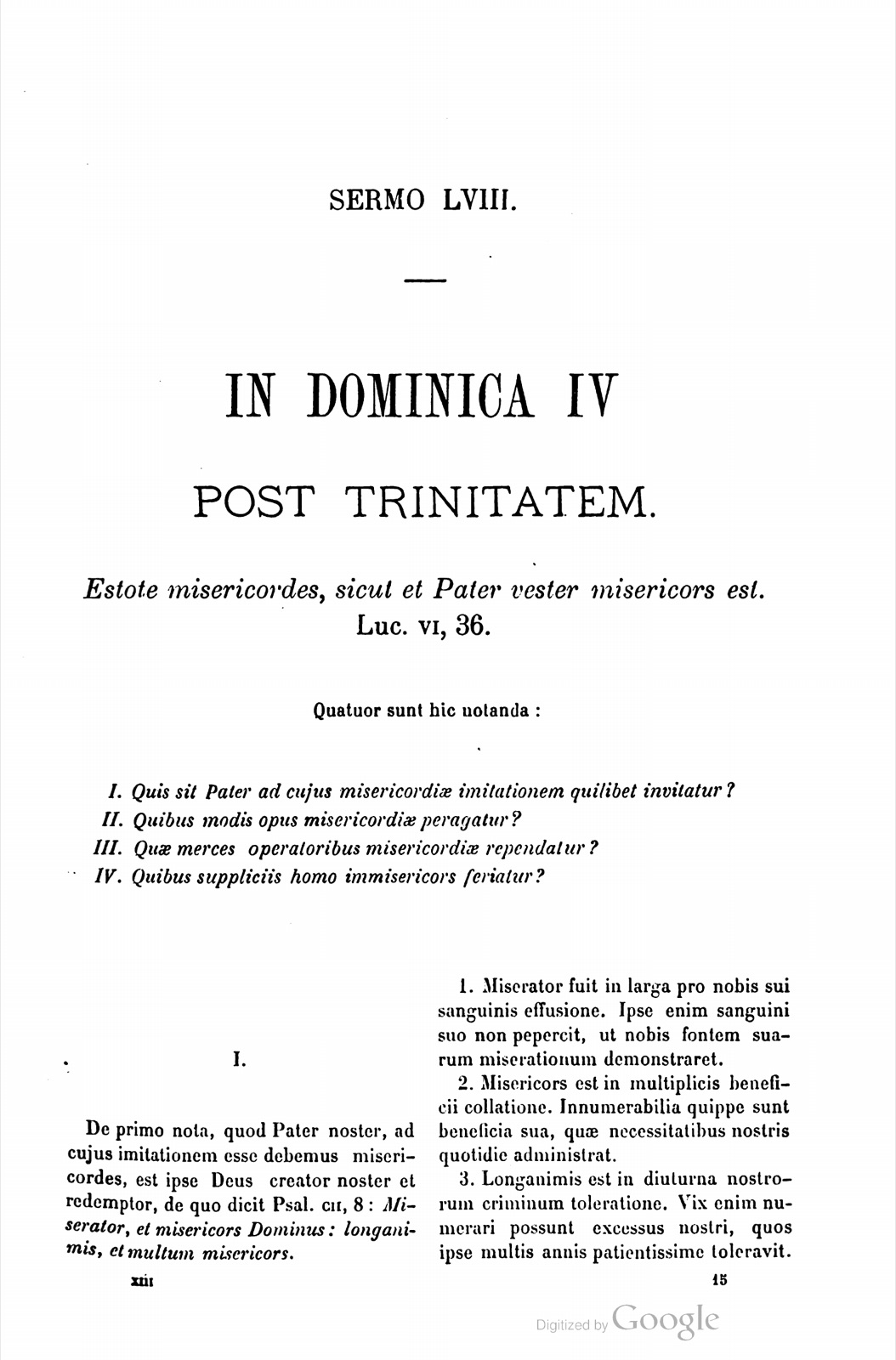
SERMO LVIII.
IN DOMINICA IV POST TRINITATEM.
Estote misericordes, sicut et Pater vester misericors est. Luc. VI, 36.
Quatuor sunt hic notanda:
I. Quis sit Pater ad cujus misericordiae imitationem quilibet invitatur? II. Quibus modis opus misericordiae peragatur? III. Quae merces operatoribus misericordiae rependatur? IV. Quibus suppliciis homo immisericors feriatur?
I.
De primo nota, quod Pater noster, ad cujus imitationem esse debemus misericordes, est ipse Deus creator noster et redemptor, de quo dicit Psal. CII, 8: Miserator, et misericors Dominus: longanimis, et multum misericors.
1. Miserator fuit in larga pro nobis sui sanguinis effusione. Ipse enim sanguini suo non pepercit, ut nobis fontem suarum miserationum demonstraret.
2. Misericors est in multiplicis beneficii collatione. Innumerabilia quippe sunt beneficia sua, quae necessitatibus nostris quotidie administrat.
3. Longanimis est in diuturna nostrorum criminum toleratione. Vix enim numerari possunt excessus nostri, quos ipse multis annis patientissime toleravit.
4. Multum misericors est in clementi poenitentium susceptione. Clementissime quippe recipit peccatores, dummodo vere poenitere velint.
II.
De secundo nota, quod ad minus quatuordecim sunt opera misericordiae: quorum septem corporalia, et septem corporalia.
Primum opus verae misericordiae spirituale, est devote orare pro adversantibus. Unde Dominus dicit, Matth. V, 44 et 45: Orate pro persequentibus, et calumniantibus vos: ut sitis filii Patris vestri, qui in caelis est. Qui vero devote vult pro inimicis orare, non debet contra eos judicium Domini et condemnationem aeterni supplicii postulare. Propter hoc dicit Dominus in hodierno Evangelio (Luc. VI, 37): Nolite judicare, id est, contra malefactores vestros Dei judicium postulare: et non judicabimini, id est, judicio Dei non subjiciemini. Nolite condemnare, id est, inimicis vestris condemnationem optare, et non condemnabimini, id est, aeternam condemnationem non patiemini.
SERMON LVIII.
ON THE FOURTH SUNDAY AFTER TRINITY.
Be merciful, just as your Father also is merciful. Luke VI, 36.
Four things are to be noted here:
I. Who is the Father to the imitation of whose mercy anyone is invited? II. In what ways is a work of mercy performed? III. What reward is repaid to workers of mercy? IV. With what punishments is a merciless man struck?
I.
Concerning the first, note that our Father, in imitation of whom we ought to be merciful, is God himself, our creator and redeemer, of whom Psalm CII, 8 says: Compassionate and merciful is the Lord: long-suffering and very merciful.
1. He was compassionate in the generous pouring out of his blood for us. For he did not spare his blood, so that he might show to us the fountain of his compassions.
2. He is merciful in the bestowal of manifold benefit. For innumerable are his benefits, which he administers daily to our necessities.
3. He is long-suffering in the long-lasting toleration of our crimes. For our excesses which he himself has tolerated most patiently for many years can scarcely be numbered.
4. He is very merciful in the clement receiving of penitents. For most clemently he receives sinners, provided that they wish truly to do penance.
II.
Concerning the second, note that at least fourteen are the works of mercy, of which seven are corporal and seven are corporal.
The first spiritual work of true mercy is to pray devoutly for those opposing us. Hence the Lord says, Matthew V, 44 and 45: Pray for those persecuting and calumniating you, that you may be sons of your Father, who is in heaven. But he who wishes devoutly to pray for enemies ought not to ask against them the judgment of the Lord and the condemnation of eternal punishment. Because of this the Lord says in today's Gospel (Luke VI, 37): Do not judge, that is, do not ask God's judgment against your evildoers, and you will not be judged, that is, you will not be subjected to God's judgment. Do not condemn, that is, do not wish condemnation for your enemies, and you will not be condemned, that is, you will not suffer eternal condemnation.
Secundum, ex corde dimittere injuriantibus. Unde dicit Dominus in hodierno Evangelio (Luc. VI, 37): Dimittite et dimittemini. Augustinus: "Multa sunt genera eleemosynarum, sed ea nihil est majus, quam cum ex corde dimittimus, quod in nos quisque peccaverit." Hinc etiam dicitur in Matth. XVIII, 21 et 22: Accedens Petrus ad Jesum dixit: Domine, quoties peccabit in me frater meus, et dimittam ei? usque septies? Dicit illi Jesus: Non dico tibi usque septies: sed usque septuagies septies. Glossa: "Septuagies septies, id est, toties quoties ille peccare potest in die," id est, quadringentis et nonaginta vicibus.
Tertium est, fideliter instruere nescientes. Et nota quod patres antiqui fidelissimi erant in instructione filiorum suorum: ita et nunc patres et matres tenentur instruere filios suos, sive sint carnales, sive sint spirituales. Unde Augustinus: "Vos ante omnia tam viros quam mulieres, qui filios in baptismo suscepistis, moneo ut vos cognoscatis apud Deum fide jussores exstitisse pro illis, quos nisi estis de sacro fonte suscipere. Ideoque eos semper admonete, ut castitatem custodiant, justitiam diligant, charitatem habeant: ante omnia symbolum et orationem Dominicam et vos ipsi tenete, et illis quos accepistis de fonte, ostendite."
Quartum est, ferire ac corripere delinquentes. Unde Proverb. XIII, 24: Qui parcit virgae, odit filium suum: qui autem diligit illum, instanter erudit. Item, Proverb. XXII, 15: Stultitia colligata est in corde pueri, et virga disciplinae fugabit eam. Item, Proverb. XXIII, 13 et 14: Noli subtrahere a puero disciplinam: si enim percusseris eum virga, non morietur. Tu virga percuties eum: et animam ejus de inferno liberabis.
Quintum est, patienter ferre ferientes ac laedentes. Unde Dominus in Luc. XXI, 16 et seq., monet ad patientiam, ita dicens: Trademini a parentibus, et fratribus, et cognatis, et amicis et morte afficient ex vobis: et eritis odio omnibus propter nomen meum. Sequitur: In patientia vestra possidebitis animas vestras. Glossa: "Patientia radix et custos est omnium virtutum." Vera autem patientia est aliena mala aequanimiter tolerare, et contra eum qui mala irrogat nullo dolore moveri. Item Apost. ad Heb. X, 34: Rapinam bonorum vestrorum cum gaudio suscepistis, cognoscentes vos habere meliorem et manentem substantiam.
The second is to forgive from the heart those injuring us. Hence the Lord says in today's Gospel (Luke VI, 37): Forgive and you will be forgiven. Augustine: "There are many kinds of alms, but nothing is greater than this, when from the heart we forgive what anyone has sinned against us." Hence it is also said in Matthew XVIII, 21 and 22: Peter approaching Jesus said: Lord, how often will my brother sin against me, and shall I forgive him? up to seven times? Jesus says to him: I do not say to you up to seven times, but up to seventy times seven. The Gloss: "Seventy times seven, that is, as often as he can sin in a day," that is, four hundred and ninety times.
The third is faithfully to instruct the ignorant. And note that the ancient fathers were most faithful in the instruction of their sons; so also now fathers and mothers are bound to instruct their sons, whether they are carnal or spiritual. Hence Augustine: "Before all things I admonish you, both men and women, who have received children in baptism, that you know yourselves to have stood as sureties before God for those whom you received from the sacred font. Therefore always admonish them to keep chastity, to love justice, to have charity; before all things both you yourselves hold the creed and the Lord's prayer, and show them to those whom you have received from the font."
The fourth is to strike and correct delinquents. Hence Proverbs XIII, 24: He who spares the rod hates his son; but he who loves him instructs him urgently. Likewise Proverbs XXII, 15: Foolishness is bound together in the heart of a boy, and the rod of discipline will drive it away. Likewise Proverbs XXIII, 13 and 14: Do not withdraw discipline from a boy; for if you strike him with a rod, he will not die. You will strike him with a rod and will free his soul from hell.
The fifth is patiently to endure those striking and harming us. Hence the Lord in Luke XXI, 16 and following admonishes to patience, saying thus: You will be handed over by parents and brothers and relatives and friends, and some of you they will put to death; and you will be hated by all because of my name. It follows: In your patience you will possess your souls. The Gloss: "Patience is the root and guardian of all virtues." But true patience is to tolerate another's evils calmly and to be moved by no pain against him who inflicts evils. Likewise the Apostle to the Hebrews X, 34: You received the seizure of your goods with joy, knowing that you have a better and lasting substance.
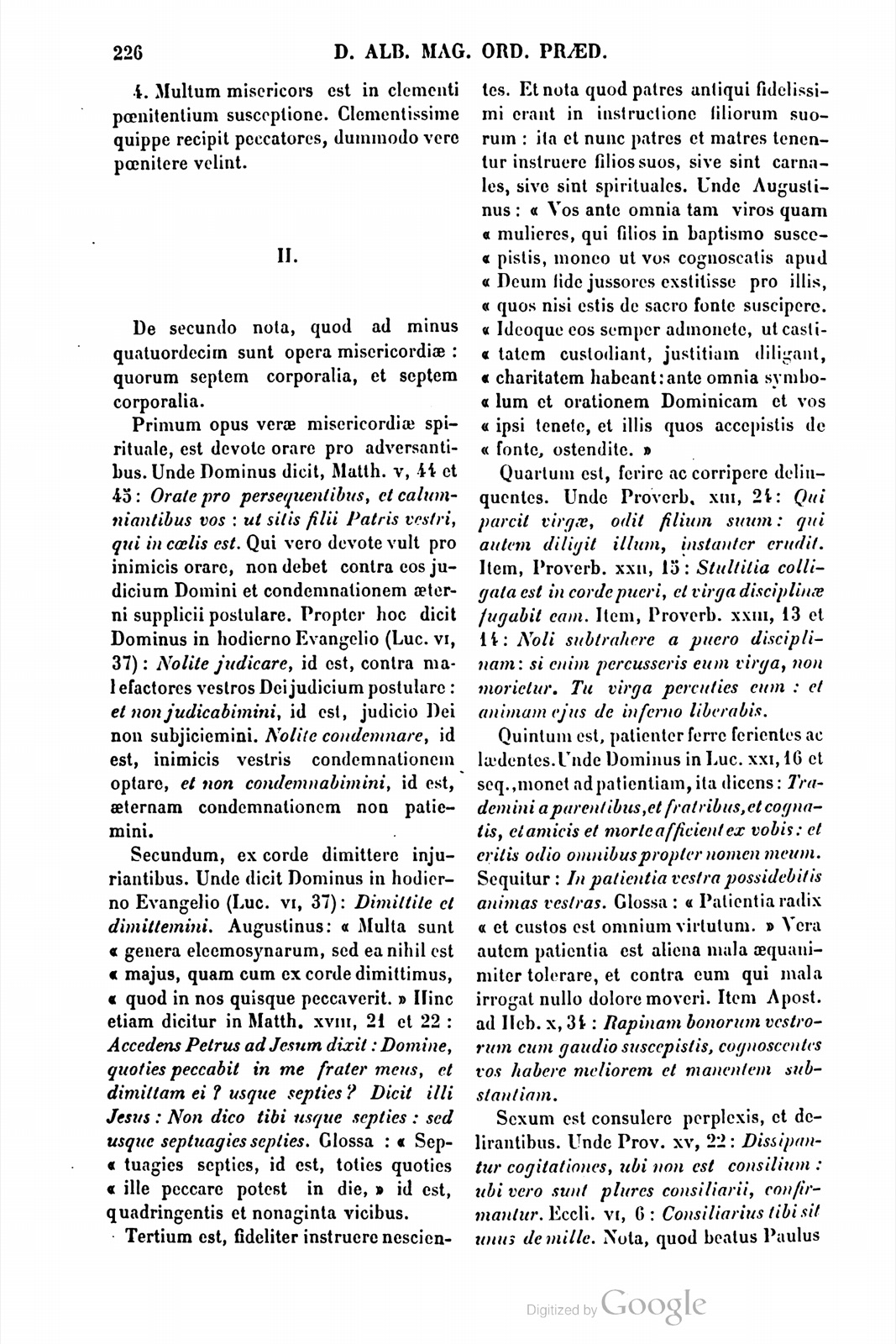
Sexum est consulere perplexis, et delirantibus. Unde Prov. XV, 22: Dissipantur cogitationes, ubi non est consilium: ubi vero sunt plures consiliarii, confirmantur. Eccli. VI, 6: Consiliarius tibi sit unus de mille. Nota, quod beatus Paulus bonus est consiliarius, qui ita dicit I ad Corinth. VII, 25: De virginibus praeceptum Domini non habeo: consilium autem do. Glossa, "a spiritu sancto mihi inspiratum." Do, inquam, consilium non nubendi, sed continendi. Mali igitur consiliarii sunt, qui virginitatem ac alia multa bona dissuadent hominibus. De istis consiliariis dicit Eccli. XXXVII, 9: A malo scilicet consiliario serva animam tuam.
Septimum misericordiae opus spirituale, est consolationes afferre maestis ac plorantibus. Unde dicit Job de seipso, XXIX, 13 et 23: Benedictio perituri super me veniebat, et cor viduae consolatus sum. Cumque sederem quasi rex, circumstante me exercitu: eram tamen maerentium consolator. Haec septem spiritualia opera misericordiae notantur in hoc versu:
Oro, remitto, docens, ferio, fero, consulo, solor.
Sunt et alia septem corporalia opera misericordiae, videlicet, Infirmos visitare, Sitientes potare, Esurientes cibare, Captivos redimere, Nudos vestire, Peregrinos in hospitium colligere, et Mortuos sepelire. Prima sex Dominus commendat, Matth. XXV, 35 et 36, ubi dicit: Esurivi, et dedistis mihi manducare: sitivi, et dedistis mihi bibere: hospes eram, et collegistis me: nudus et cooperuistis me: infirmus et visitastis me: in carcere eram, et venistis ad me. De septimo Tobias commendatur. Haec septem notantur in hoc versu:
The sixth is to counsel the perplexed and delirious. Hence Proverbs XV, 22: Thoughts are scattered where there is no counsel; but where there are many counselors, they are confirmed. Ecclesiasticus VI, 6: Let one of a thousand be your counselor. Note that blessed Paul is a good counselor, who says thus in I Corinthians VII, 25: Concerning virgins I do not have a command of the Lord, but I give counsel. The Gloss: "inspired to me by the Holy Spirit." I give, I say, counsel not of marrying, but of containing oneself. Therefore evil counselors are those who dissuade men from virginity and many other goods. Concerning those counselors Ecclesiasticus XXXVII, 9 says: Guard your soul from an evil counselor.
The seventh spiritual work of mercy is to bring consolations to the sad and weeping. Hence Job says concerning himself, XXIX, 13 and 23: The blessing of the one about to perish came upon me, and I consoled the heart of the widow. And when I sat like a king, with the army standing around me, nevertheless I was a consoler of mourners. These seven spiritual works of mercy are noted in this verse:
I pray, I forgive, teaching, I strike, I endure, I counsel, I console.
There are also seven other corporal works of mercy, namely, to visit the sick, to give drink to the thirsty, to feed the hungry, to redeem captives, to clothe the naked, to gather pilgrims into hospitality, and to bury the dead. The Lord commends the first six, Matthew XXV, 35 and 36, where he says: I hungered, and you gave me to eat; I thirsted, and you gave me to drink; I was a guest, and you gathered me in; naked, and you covered me; infirm, and you visited me; I was in prison, and you came to me. Concerning the seventh Tobias is commended. These seven are noted in this verse:
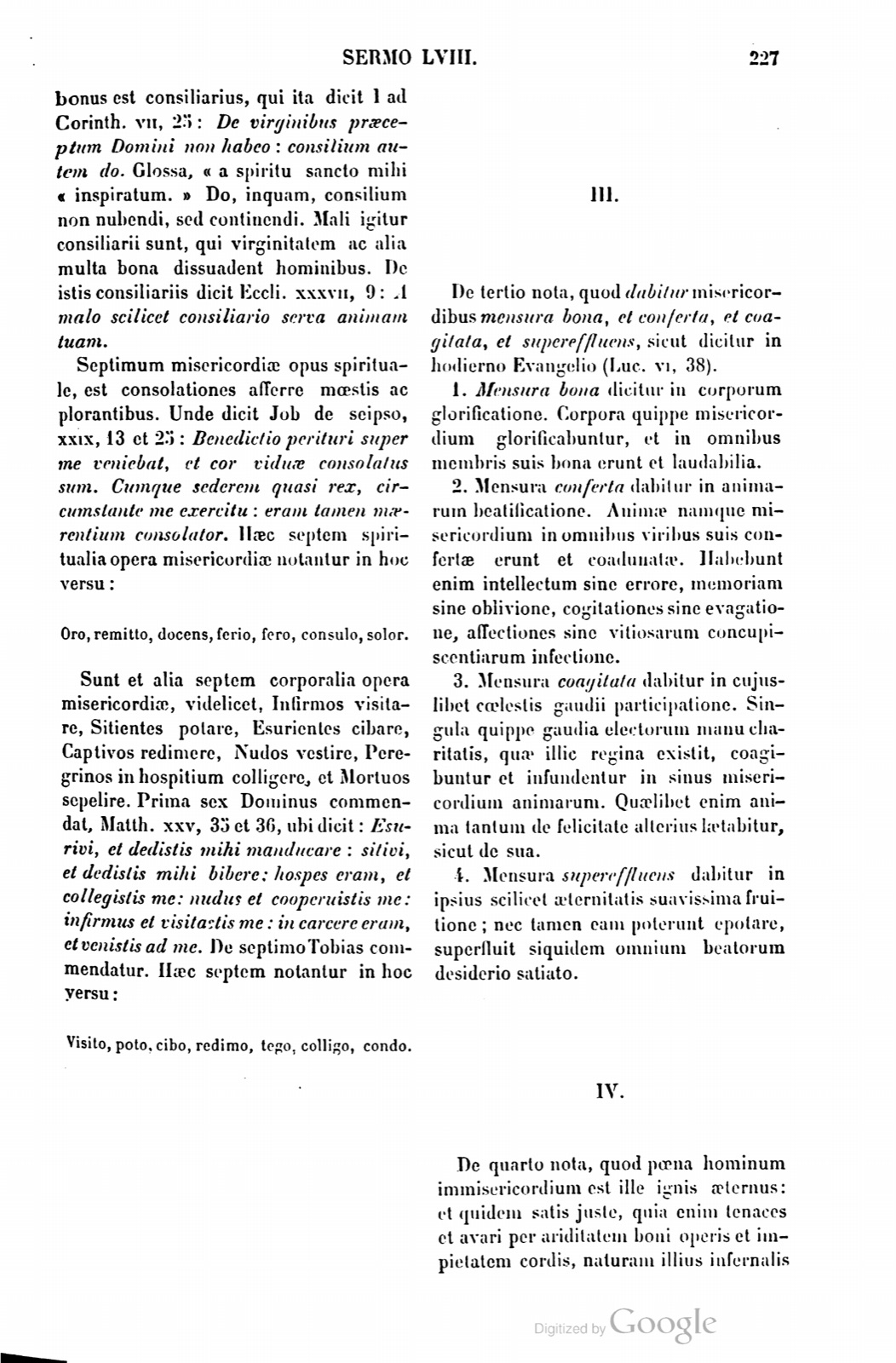
Visito, poto, cibo, redimo, tego, colligo, condo.
III.
De tertio nota, quod dabitur misericordibus mensura bona, et conferta, et coagitata, et supereffluens, sicut dicitur in hodierno Evangelio (Luc. VI, 38).
1. Mensura bona dicitur in corporum glorificatione. Corpora quippe misericordium glorificabuntur, et in omnibus membris suis bona erunt et laudabilia.
2. Mensura conferta dabitur in animarum beatificatione. Animae namque misericordium in omnibus viribus suis confertae erunt et coadunatae. Habebunt enim intellectum sine errore, memoriam sine oblivione, cogitationes sine evagatione, affectiones sine vitiosarum concupiscentiarum infectione.
3. Mensura coagitata dabitur in cujuslibet caelestis gaudii participatione. Singula quippe gaudia electorum manu charitatis, quae illic regina existit, coagituntur et infundentur in sinus misericordium animarum. Quaelibet enim anima tantum de felicitate alterius laetabitur, sicut de sua.
4. Mensura supereffluens dabitur in ipsius scilicet aeternitatis suavissima fruitione; nec tamen eam poterunt epotare, superfluit siquidem omnium beatorum desiderio satiato.
IV.
De quarto nota, quod poena hominum immisericordium est ille ignis aeternus: et quidem satis juste, quia enim tenaces et avari per ariditatem boni operis et impietatem cordis, naturam illius infernalis ignis induerunt, qui aridus et impius esse dignoscitur: dignum est ut in aeterno igne perpetuo crucientur.
Charissimi rogate Dominum, ut sic nunc opera pietatis exerceamus, ut cum electis aeterna praemia capiamus. Amen.
I visit, give drink, feed, redeem, cover, gather, bury.
III.
Concerning the third, note that to the merciful will be given a good measure, and packed together, and shaken together, and overflowing, as is said in today's Gospel (Luke VI, 38).
1. A good measure is said to be in the glorification of bodies. For the bodies of the merciful will be glorified, and in all their members they will be good and praiseworthy.
2. A packed-together measure will be given in the beatification of souls. For the souls of the merciful will be packed together and united in all their powers. For they will have understanding without error, memory without forgetfulness, thoughts without wandering, affections without infection of vicious concupiscences.
3. A shaken-together measure will be given in the participation of each heavenly joy. For the individual joys of the elect will be shaken together by the hand of charity, which exists there as queen, and poured into the laps of merciful souls. For any soul will rejoice as much concerning the happiness of another as concerning its own.
4. An overflowing measure will be given in the sweetest enjoyment, namely of eternity itself; nevertheless they will not be able to drink it up, since it overflows with the desire of all the blessed having been satisfied.
IV.
Concerning the fourth, note that the punishment of merciless men is that eternal fire; and indeed quite justly, because the tenacious and avaricious, through aridity of good work and impiety of heart, have put on the nature of that infernal fire, which is known to be arid and impious; it is fitting that they be tormented perpetually in eternal fire.
Dearest ones, pray to the Lord that we may so exercise works of piety now, that with the elect we may receive eternal rewards. Amen.

If a page does not appear, its photograph has not been uploaded yet.