Works › Sermons for the Seasons of the Year
Volume 13 · pp. 215–216
Sermon LV. On the First Sunday After Trinity, Opening
A marker with ≈ is an approximate page boundary, placed by measure of the text; the page photographs remain the authority. In the paired views, clicking a page marker brings that page into view.
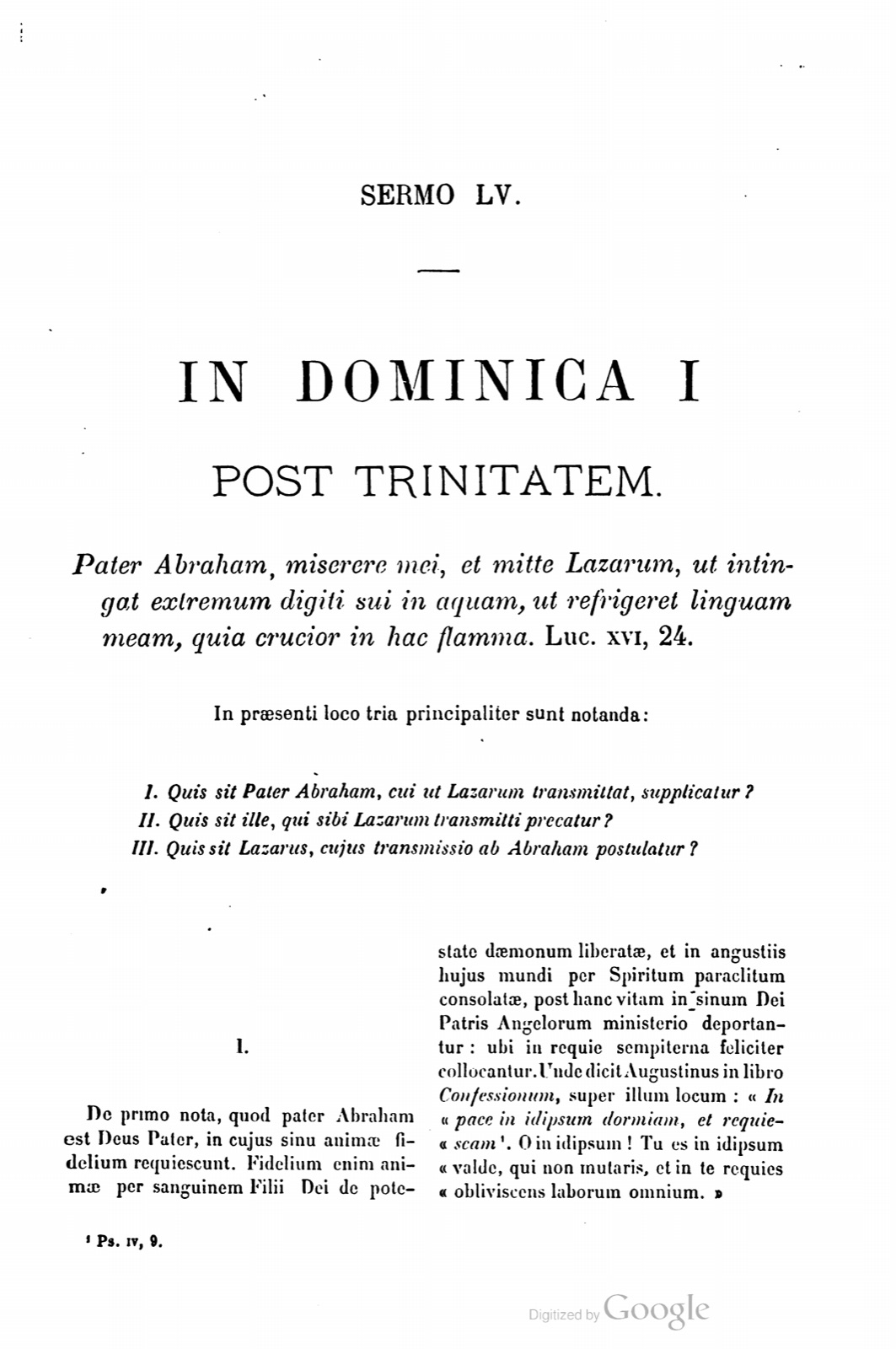
SERMO LV.
IN DOMINICA I POST TRINITATEM.
Pater Abraham, miserere mei, et mitte Lazarum, ut intingat extremum digiti sui in aquam, ut refrigeret linguam meam, quia crucior in hac flamma. Luc. XVI, 24.
In praesenti loco tria principaliter sunt notanda:
I. Quis sit Pater Abraham, cui ut Lazarum transmittat, supplicatur? II. Quis sit ille, qui sibi Lazarum transmitti precatur? III. Quis sit Lazarus, cujus transmissio ab Abraham postulatur?
I.
De primo nota, quod pater Abraham est Deus Pater, in cujus sinu animae fidelium requiescunt. Fidelium enim animae per sanguinem Filii Dei de potestate daemonum liberatae, et in angustiis hujus mundi per Spiritum paraclitum consolatae, post hanc vitam in sinum Dei Patris Angelorum ministerio deportantur: ubi in requie sempiterna feliciter collocantur. Unde dicit Augustinus in libro Confessionum, super illum locum: "In pace in idipsum dormiam, et requiescam 1. O in idipsum! Tu es in idipsum valde, qui non mutaris, et in te requies obliviscens laborum omnium."
II.
De secundo nota, quod ille qui olim dives fuerat, sed modo ad magnam inopiam devenerat, Lazarum sibi transmitti rogavit. Tria vero circa divitem istum sunt notanda. Primum est, quae fuerit ejus felicitas. Secundum etiam, quae fuerit iniquitas. Tertium, quae nunc sit ejus infelicitas.
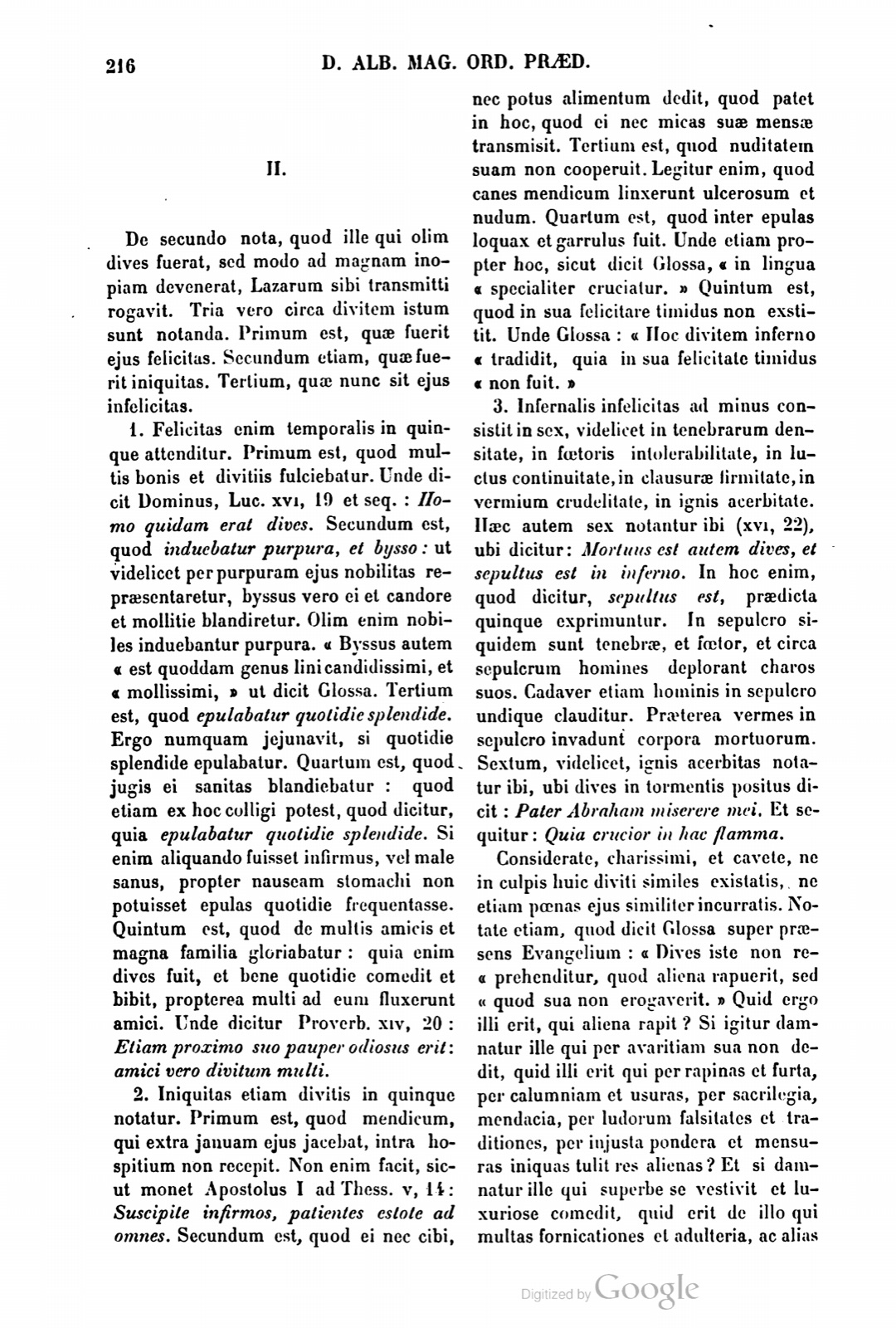
1. Felicitas enim temporalis in quinque attenditur. Primum est, quod multis bonis et divitiis fulciebatur. Unde dicit Dominus, Luc. XVI, 19 et seq.: Homo quidam erat dives. Secundum est, quod induebatur purpura, et bysso: ut videlicet per purpuram ejus nobilitas repraesentaretur, byssus vero ei et candore et mollitie blandiretur. Olim enim nobiles induebantur purpura. "Byssus autem est quoddam genus lini candidissimi, et mollissimi," ut dicit Glossa. Tertium est, quod epulabatur quotidie splendide. Ergo numquam jejunavit, si quotidie splendide epulabatur. Quartum est, quod jugis ei sanitas blandiebatur: quod etiam ex hoc colligi potest, quod dicitur, quia epulabatur quotidie splendide. Si enim aliquando fuisset infirmus, vel male sanus, propter nauseam stomachi non potuisset epulas quotidie frequentasse. Quintum est, quod de multis amicis et magna familia gloriabatur: quia enim dives fuit, et bene quotidie comedit et bibit, propterea multi ad eum fluxerunt amici. Unde dicitur Proverb. XIV, 20: Etiam proximo suo pauper odiosus erit: amici vero divitum multi.
SERMON LV.
ON THE FIRST SUNDAY AFTER TRINITY.
Father Abraham, have mercy on me and send Lazarus, that he may dip the tip of his finger in water, so that he may cool my tongue, because I am tormented in this flame. Luke XVI, 24.
In the present place three things are chiefly to be noted:
I. Who is Father Abraham, to whom supplication is made that he transmit Lazarus? II. Who is that one who prays that Lazarus be transmitted to him? III. Who is Lazarus, whose transmission from Abraham is requested?
I.
Concerning the first, note that father Abraham is God the Father, in whose bosom the souls of the faithful rest. For the souls of the faithful, freed by the blood of the Son of God from the power of demons, and consoled in the distresses of this world by the Spirit, the Paraclete, after this life are carried by the ministry of Angels into the bosom of God the Father, where they are happily placed in everlasting rest. Hence Augustine says in the book of Confessions, on that place: "In peace unto the selfsame I will sleep and rest 1. O in the selfsame! You are greatly in the selfsame, who are not changed, and in you is rest forgetting all labors."
II.
Concerning the second, note that he who formerly had been rich, but now had come to great want, asked that Lazarus be transmitted to him. Three things are to be noted concerning that rich man. The first is what his happiness had been. The second also, what his wickedness had been. The third, what his unhappiness now is.
1. For temporal happiness is attended to in five things. The first is that he was supported by many goods and riches. Hence the Lord says, Luke XVI, 19 and following: There was a certain rich man. The second is that he was clothed in purple and byssus, so that namely by the purple his nobility might be represented, but byssus might flatter him both with whiteness and softness. For once nobles were clothed in purple. "But byssus is a certain kind of very white and very soft linen," as the Gloss says. The third is that he feasted splendidly every day. Therefore he never fasted, if he feasted splendidly every day. The fourth is that continual health flattered him; this can also be gathered from this, that it is said that he feasted splendidly every day. For if he had ever been infirm or unwell, because of nausea of the stomach he could not have frequented feasts daily. The fifth is that he gloried in many friends and a great household, because since he was rich and ate and drank well daily, for this reason many friends flowed to him. Hence it is said in Proverbs XIV, 20: The poor man will be hateful even to his neighbor, but the friends of the rich are many.
2. Iniquitas etiam divitis in quinque notatur. Primum est, quod mendicum, qui extra januam ejus jacebat, intra hospitium non recepit. Non enim facit, sicut monet Apostolus I ad Thess. V, 14: Suscipite infirmos, patientes estote ad omnes. Secundum est, quod ei nec cibi, nec potus alimentum dedit, quod patet in hoc, quod ei nec micas suae mensae transmisit. Tertium est, quod nuditatem suam non cooperuit. Legitur enim, quod canes mendicum linxerunt ulcerosum et nudum. Quartum est, quod inter epulas loquax et garrulus fuit. Unde etiam propter hoc, sicut dicit Glossa, "in lingua specialiter cruciatur." Quintum est, quod in sua felicitate timidus non exstitit. Unde Glossa: "Hoc divitem inferno tradidit, quia in sua felicitate timidus non fuit."
3. Infernalis infelicitas ad minus consistit in sex, videlicet in tenebrarum densitate, in foetoris intolerabilitate, in luctus continuitate, in clausurae firmitate, in vermium crudelitate, in ignis acerbitate. Haec autem sex notantur ibi (XVI, 22), ubi dicitur: Mortuus est autem dives, et sepultus est in inferno. In hoc enim, quod dicitur, sepultus est, praedicta quinque exprimuntur. In sepulcro siquidem sunt tenebrae, et foetor, et circa sepulcrum homines deplorant charos suos. Cadaver etiam hominis in sepulcro undique clauditur. Praeterea vermes in sepulcro invadunt corpora mortuorum. Sextum, videlicet, ignis acerbitas notatur ibi, ubi dives in tormentis positus dicit: Pater Abraham miserere mei. Et sequitur: Quia crucior in hac flamma.
Considerate, charissimi, et cavete, ne in culpis huic diviti similes existatis, ne etiam poenas ejus similiter incurratis. Notate etiam, quod dicit Glossa super praesens Evangelium: "Dives iste non reprehenditur, quod aliena rapuerit, sed quod sua non erogaverit." Quid ergo illi erit, qui aliena rapit? Si igitur damnatur ille qui per avaritiam sua non dedit, quid illi erit qui per rapinas et furta, per calumniam et usuras, per sacrilegia, mendacia, per ludorum falsitates et traditiones, per injusta pondera et mensuras iniquas tulit res alienas? Et si damnatur ille qui superbe se vestivit et luxuriose comedit, quid erit de illo qui multas fornicationes et adulteria, ac alias
2. The wickedness of the rich man is also noted in five things. The first is that he did not receive into hospitality the beggar who was lying outside his gate. For he does not do as the Apostle admonishes in I Thessalonians V, 14: Receive the weak; be patient toward all. The second is that he gave him nourishment neither of food nor of drink, which is clear in this, that he did not even send him crumbs from his table. The third is that he did not cover his nakedness. For it is read that dogs licked the beggar, ulcerous and naked. The fourth is that among the feasts he was talkative and garrulous. Hence also because of this, as the Gloss says, "he is especially tormented in the tongue." The fifth is that in his happiness he did not become timid. Hence the Gloss: "This handed the rich man over to hell, because in his happiness he was not timid."
3. Infernal unhappiness consists in at least six things, namely in the density of darknesses, in the intolerability of stench, in the continuity of mourning, in the firmness of enclosure, in the cruelty of worms, in the bitterness of fire. But these six are noted there (XVI, 22), where it is said: But the rich man died and was buried in hell. For in this, that it is said, he was buried, the aforesaid five things are expressed. Indeed in a sepulcher there are darknesses and stench, and around a sepulcher men lament their dear ones. The corpse of a man also is shut in on all sides in a sepulcher. Moreover worms in a sepulcher attack the bodies of the dead. The sixth, namely the bitterness of fire, is noted there, where the rich man, placed in torments, says: Father Abraham, have mercy on me. And it follows: Because I am tormented in this flame.
Consider, dearest ones, and beware lest in faults you exist similar to this rich man, lest you also similarly incur his punishments. Note also what the Gloss says on the present Gospel: "That rich man is not reproved because he stole another's things, but because he did not distribute his own." What therefore will be for him who steals another's things? Therefore if that one is damned who through avarice did not give his own, what will be for him who through robberies and thefts, through calumny and usuries, through sacrileges, lies, through falsities and betrayals of games, through unjust weights and iniquitous measures, took others' things? And if that one is damned who proudly clothed himself and luxuriously ate, what will there be concerning him who committed many fornications and adulteries, and other
Notes
- Psalm IV, 9. (Ps. IV, 9.) ↩
If a page does not appear, its photograph has not been uploaded yet.