Works › Sermons for the Seasons of the Year
Volume 13 · pp. 209–211
Sermon LIII. On Tuesday After Pentecost
A marker with ≈ is an approximate page boundary, placed by measure of the text; the page photographs remain the authority. In the paired views, clicking a page marker brings that page into view.
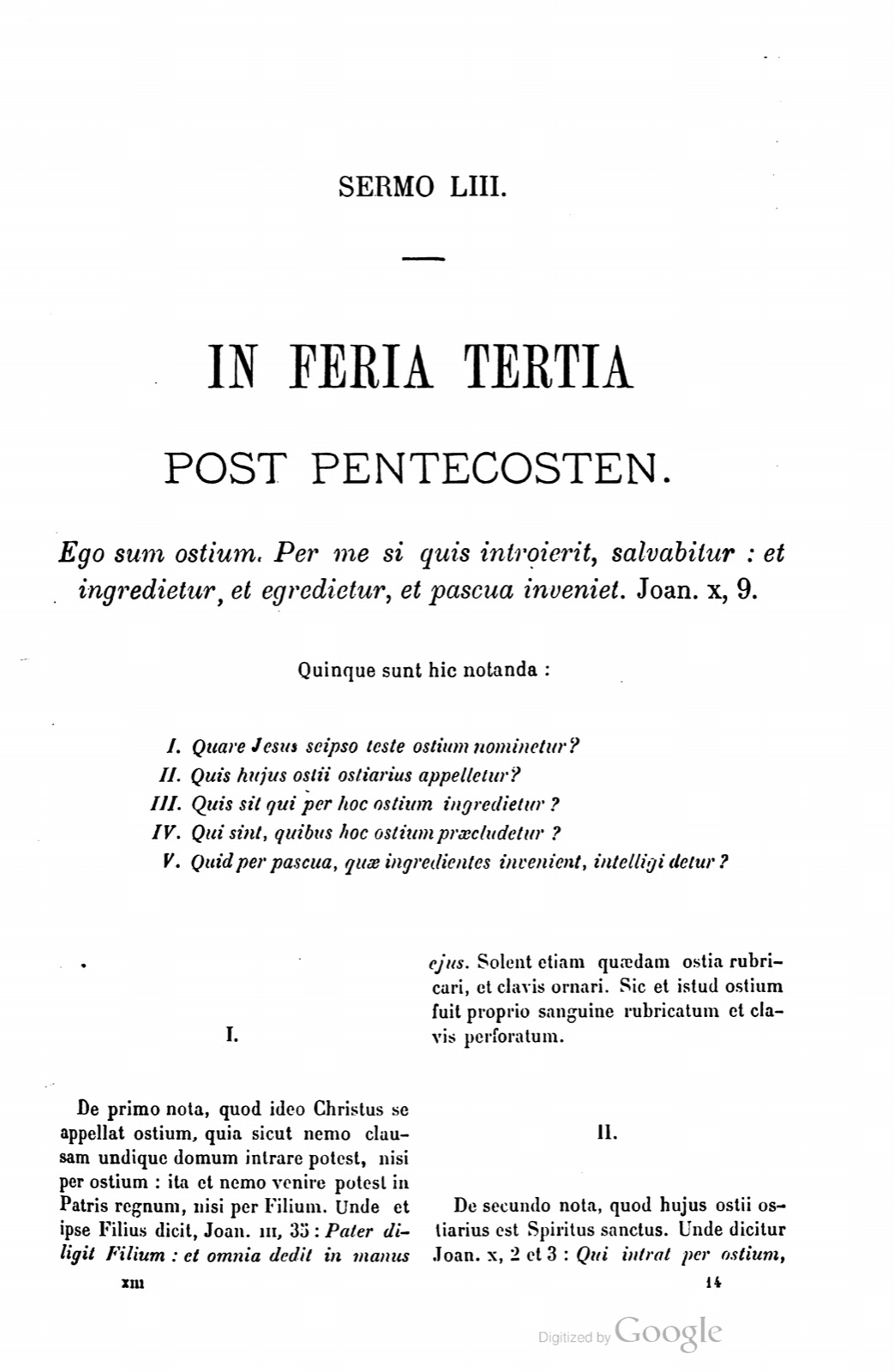
SERMO LIII.
IN FERIA TERTIA POST PENTECOSTEN.
Ego sum ostium. Per me si quis introierit, salvabitur: et ingredietur, et egredietur, et pascua inveniet. Joan. X, 9.
Quinque sunt hic notanda:
I. Quare Jesus seipso teste ostium nominetur? II. Quis hujus ostii ostiarius appelletur? III. Quis sit qui per hoc ostium ingredietur? IV. Qui sint, quibus hoc ostium praecludetur? V. Quid per pascua, quae ingredientes invenient, intelligi detur?
I.
De primo nota, quod ideo Christus se appellat ostium, quia sicut nemo clausam undique domum intrare potest, nisi per ostium: ita et nemo venire potest in Patris regnum, nisi per Filium. Unde et ipse Filius dicit, Joan. III, 35: Pater diligit Filium: et omnia dedit in manus ejus. Solent etiam quaedam ostia rubricari, et clavis ornari. Sic et istud ostium fuit proprio sanguine rubricatum et clavis perforatum.
II.
De secundo nota, quod hujus ostii ostiarius est Spiritus sanctus. Unde dicitur Joan. X, 2 et 3: Qui intrat per ostium, pastor est ovium. Huic ostiarius aperit. Glossa: "Spiritus sanctus, qui docet omnem veritatem." Bonum est ergo, quod quilibet hujus ostiarii familiaritatem acquirat, ut cum venerit, ipso intromittente, in caelestes delicias admittatur.
III.
De tertio nota, quod qui sint, qui ostium hoc ingredientur, dicitur in Isa. XXXIII, 15 et 16: Qui ambulat in justitiis, et loquitur veritatem, qui projicit avaritiam ex calumnia, et excutit manus suas ab omni munere, qui obturat aures suas ne audiat sanguinem, et claudit oculos suos ne videat malum. Iste in excelsis habitabit.
SERMON LIII.
ON TUESDAY AFTER PENTECOST.
I am the door. Through me if anyone shall enter, he will be saved, and he will go in and go out and will find pastures. John X, 9.
Five things are to be noted here:
I. Why, with Jesus himself as witness, is he named the door? II. Who is called the doorkeeper of this door? III. Who is he who will enter through this door? IV. Who are those to whom this door will be closed? V. What is given to be understood by the pastures which those entering will find?
I.
Concerning the first, note that Christ calls himself the door for this reason, because just as no one can enter a house closed on every side except through a door, so also no one can come into the kingdom of the Father except through the Son. Hence the Son himself also says, John III, 35: The Father loves the Son, and he has given all things into his hands. Certain doors also are accustomed to be made red and adorned with nails. So also that door was made red with its own blood and perforated with nails.
II.
Concerning the second, note that the doorkeeper of this door is the Holy Spirit. Hence it is said in John X, 2 and 3: He who enters through the door is the shepherd of the sheep. To this one the doorkeeper opens. The Gloss: "The Holy Spirit, who teaches every truth." Therefore it is good that each person acquire familiarity with this doorkeeper, so that when he has come, with that one introducing him, he may be admitted into heavenly delights.
III.
Concerning the third, note that who they are who will enter this door is said in Isaiah XXXIII, 15 and 16: He who walks in justices and speaks truth, who casts away avarice from calumny and shakes his hands free from every gift, who stops his ears lest he hear blood, and closes his eyes lest he see evil. This one will dwell in high places.
1. Qui ambulat in justitiis. In justitiis enim dicit pluraliter, quia quilibet homo, cujuscumque sit dignitatis, vel ordinis, aut officii, oportet ut justitiam comitem habeat, et per hanc salvetur. Justitia vero est, unicuique reddere et dimittere quod suum est.
2. Et sequitur veritatem, quia perdentur omnes, qui loquuntur mendacium 1.
3. Qui projicit avaritiam ex calumnia, id est, nullum propter avaritiam calumniatur. Calumnia vero est falsum crimen intendere.
4. Et excutit manus sua ab omni munere. Hic ad minus quatuor prohibentur, videlicet simonia, crimen hujus qui accipit munus a corde, ab ore, et manu. Prohibetur etiam hic usura, et justi judicii, ac linguae in advocatione venditio.
5. Qui obturat aures suas ne audiat sanguinem. Hic jubetur, ne detractio audiatur. Detractores enim fraudant sanguinem animarum proximorum suorum. Sanguis animae est bona fama, quae per detractionem effunditur.
6. Et claudit oculos suos ne videat malum. Malum hic appellatur mulier fornicaria, sive quaecumque foemina, quae per libidinosam concupiscentiam etiam adspicitur. Malum dicitur omne id quod nocet animae, utpote insania et vanitas hujus mundi, qualiscumque sit illa.
7. Iste in excelsis habitabit. Quasi diceret: Qui supradicta observaverit, ille caelestis regni januam ingredietur.
IV.
De quarto nota, quod illis praedictum ostium praecluditur, qui tanguntur Apocal. XXI, 8: Timidis, et incredulis, et exsecratis, et homicidis, et fornicatoribus, et veneficis, et idololatris, et omnibus mendacibus, pars illorum erit in stagno ardenti et sulphure: quod est mors secunda.
1. He who walks in justices. For he says in justices in the plural, because any man, of whatever dignity or order or office he may be, must have justice as a companion and be saved through it. But justice is to render and leave to each one what is his own.
2. And he follows truth, because all who speak falsehood will perish 1.
3. Who casts away avarice from calumny, that is, he calumniates no one because of avarice. But calumny is to bring a false accusation.
4. And he shakes his hands free from every gift. Here at least four things are prohibited, namely simony, the crime of this man who receives a gift from the heart, from the mouth, and from the hand. Usury is also prohibited here, and the sale of just judgment and of the tongue in advocacy.
5. Who stops his ears lest he hear blood. Here it is commanded that detraction not be heard. For detractors defraud the blood of the souls of their neighbors. The blood of the soul is good reputation, which is poured out through detraction.
6. And he closes his eyes lest he see evil. Here evil is called a fornicating woman, or any woman whatever, who is even looked at through lustful concupiscence. Evil is called everything that harms the soul, such as madness and vanity of this world, whatever it may be.
7. This one will dwell in high places. As though he said: He who will have observed the things said above will enter the gate of the heavenly kingdom.
IV.
Concerning the fourth, note that the aforesaid door is closed to those who are touched upon in Apocalypse XXI, 8: To the timid and unbelieving and accursed and murderers and fornicators and poisoners and idolaters and all liars, their portion will be in the pool burning with fire and sulphur, which is the second death.
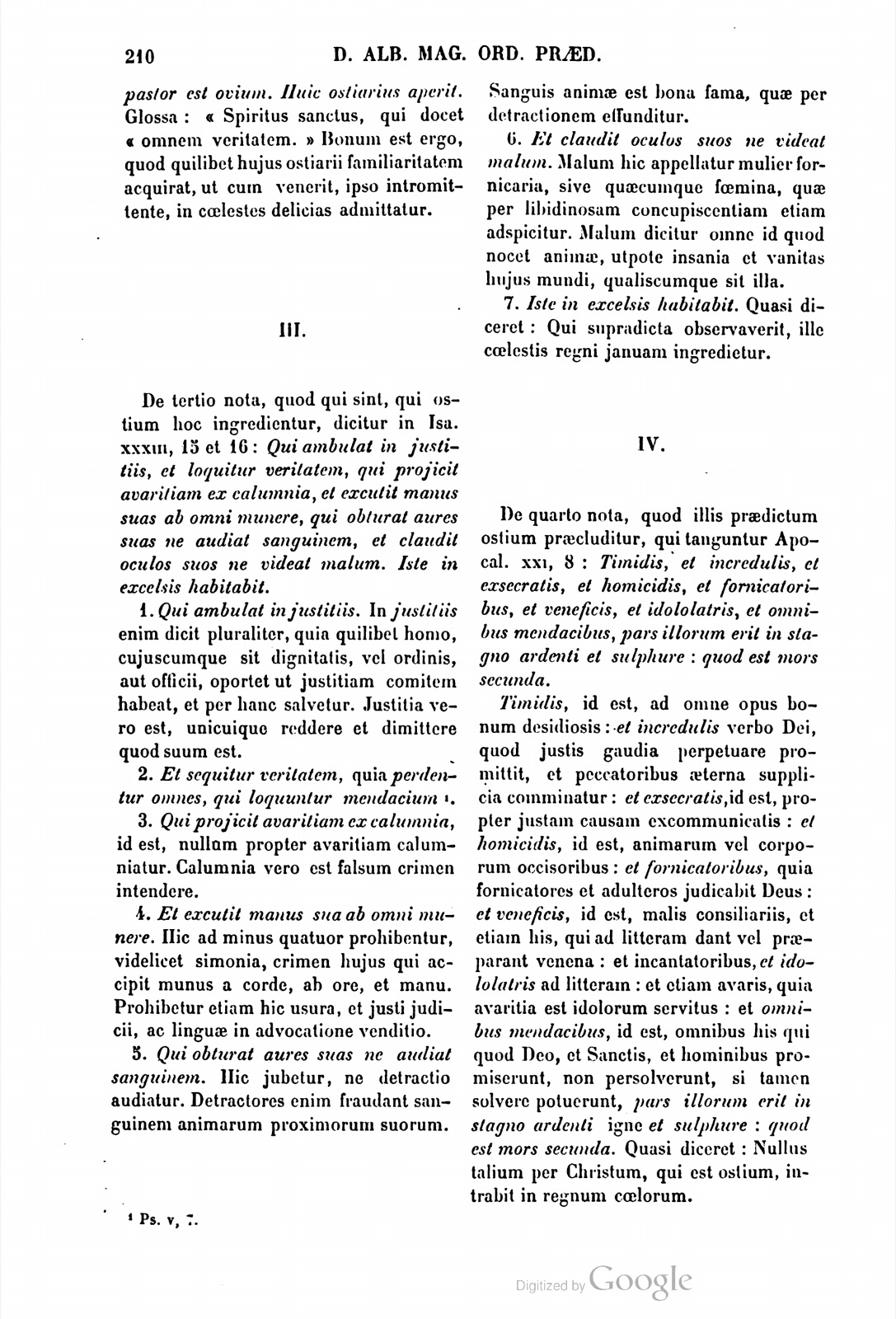
Timidis, id est, ad omne opus bonum desidiosis: et incredulis verbo Dei, quod justis gaudia perpetuare promittit, et peccatoribus aeterna supplicia comminatur: et exsecratis, id est, propter justam causam excommunicatis: et homicidis, id est, animarum vel corporum occisoribus: et fornicatoribus, quia fornicatores et adulteros judicabit Deus: et veneficis, id est, malis consiliariis, et etiam his, qui ad litteram dant vel praeparant venena: et incantatoribus, et idololatris ad litteram: et etiam avaris, quia avaritia est idolorum servitus: et omnibus mendacibus, id est, omnibus his qui quod Deo, et Sanctis, et hominibus promiserunt, non persolverunt, si tamen solvere potuerunt, pars illorum erit in stagno ardenti igne et sulphure: quod est mors secunda. Quasi diceret: Nullus talium per Christum, qui est ostium, intrabit in regnum caelorum.
V.
De quinto nota, quod per pascua intelliguntur gaudia, quae habebuntur ex contemplatione sanctae Trinitatis, et ex delectione illius beatae societatis. Qui enim illuc pervenerit, ingredietur ad contemplationem sanctae Trinitatis, et egredietur ad condelectationem illius beatae societatis, et pascua inveniet utrobique.
Rogate ergo Dominum, ut et nos mediante hoc ostio Jesu Christo, illis ingredientibus et egredientibus aggregari mereamur: Amen.
To the timid, that is, to those slothful for every good work; and to the unbelieving toward the word of God, which promises perpetual joys to the just and threatens eternal punishments to sinners; and to the accursed, that is, to those excommunicated for a just cause; and to murderers, that is, killers of souls or bodies; and to fornicators, because God will judge fornicators and adulterers; and to poisoners, that is, evil counselors, and also those who literally give or prepare poisons; and to enchanters and idolaters literally; and also to the avaricious, because avarice is the service of idols; and to all liars, that is, to all those who did not pay what they promised to God and the Saints and men, if however they were able to pay it, their portion will be in the pool burning with fire and sulphur, which is the second death. As though he said: None of such persons through Christ, who is the door, will enter into the kingdom of heaven.
V.
Concerning the fifth, note that by pastures are understood the joys which will be had from contemplation of the holy Trinity and from delight in that blessed society. For he who will have reached that place will go in to the contemplation of the holy Trinity and go out to shared delight in that blessed society, and will find pastures in both.
Therefore pray to the Lord that we too, by means of this door, Jesus Christ, may deserve to be gathered to those going in and going out. Amen.

Notes
- Psalm V, 7. (Ps. V, 7.) ↩
If a page does not appear, its photograph has not been uploaded yet.