Works › Sermons for the Seasons of the Year
Volume 13 · pp. 187–189
Sermon XLVI. On the Ascension of the Lord
A marker with ≈ is an approximate page boundary, placed by measure of the text; the page photographs remain the authority. In the paired views, clicking a page marker brings that page into view.
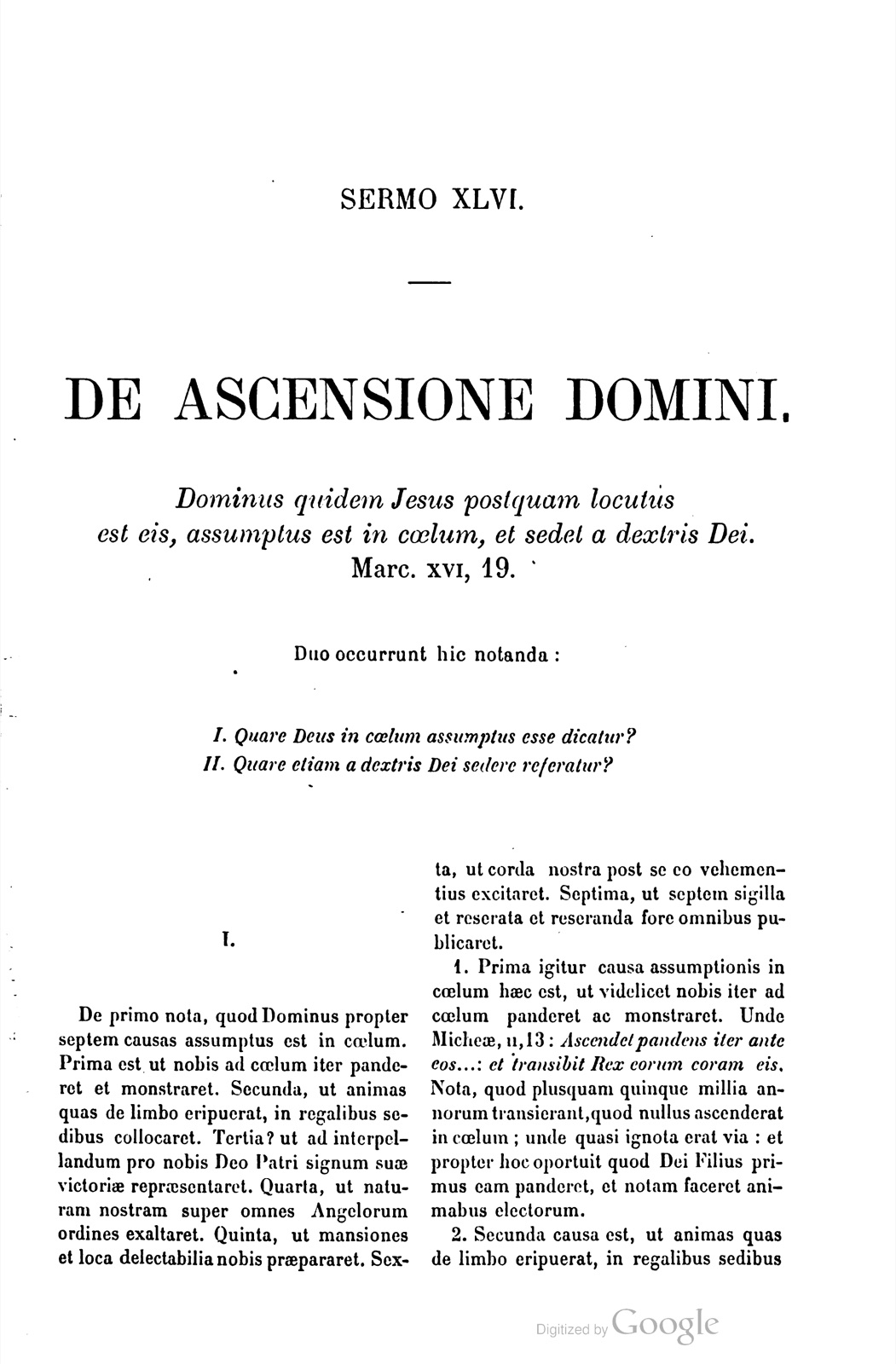
SERMO XLVI.
DE ASCENSIONE DOMINI,
Dominus quidem Jesus postquam locutus est eis, assumptus est in caelum, et sedet a dextris Dei. Marc. XVI, 19.
Duo occurrunt hic notanda:
I. Quare Deus in caelum assumptus esse dicatur? II. Quare etiam a dextris Dei sedere referatur?
I.
De primo nota, quod Dominus propter septem causas assumptus est in caelum. Prima est ut nobis ad caelum iter panderet et monstraret. Secunda, ut animas quas de limbo eripuerat, in regalibus sedibus collocaret. Tertia? ut ad interpellandum pro nobis Deo Patri signum suae victoriae repraesentaret. Quarta, ut naturam nostram super omnes Angelorum ordines exaltaret. Quinta, ut mansiones et loca delectabilia nobis praepararet. Sexta, ut corda nostra post se eo vehementius excitaret. Septima, ut septem sigilla et reserata et reseranda fore omnibus publicaret.
1. Prima igitur causa assumptionis in caelum haec est, ut videlicet nobis iter ad caelum panderet ac monstraret. Unde Micheae, II, 13: Ascendet pandens iter ante eos...: et transibit Rex eorum coram eis. Nota, quod plusquam quinque millia annorum transierant, quod nullus ascenderat in caelum; unde quasi ignota erat via: et propter hoc oportuit quod Dei Filius primus eam panderet, et notam faceret animabus electorum.
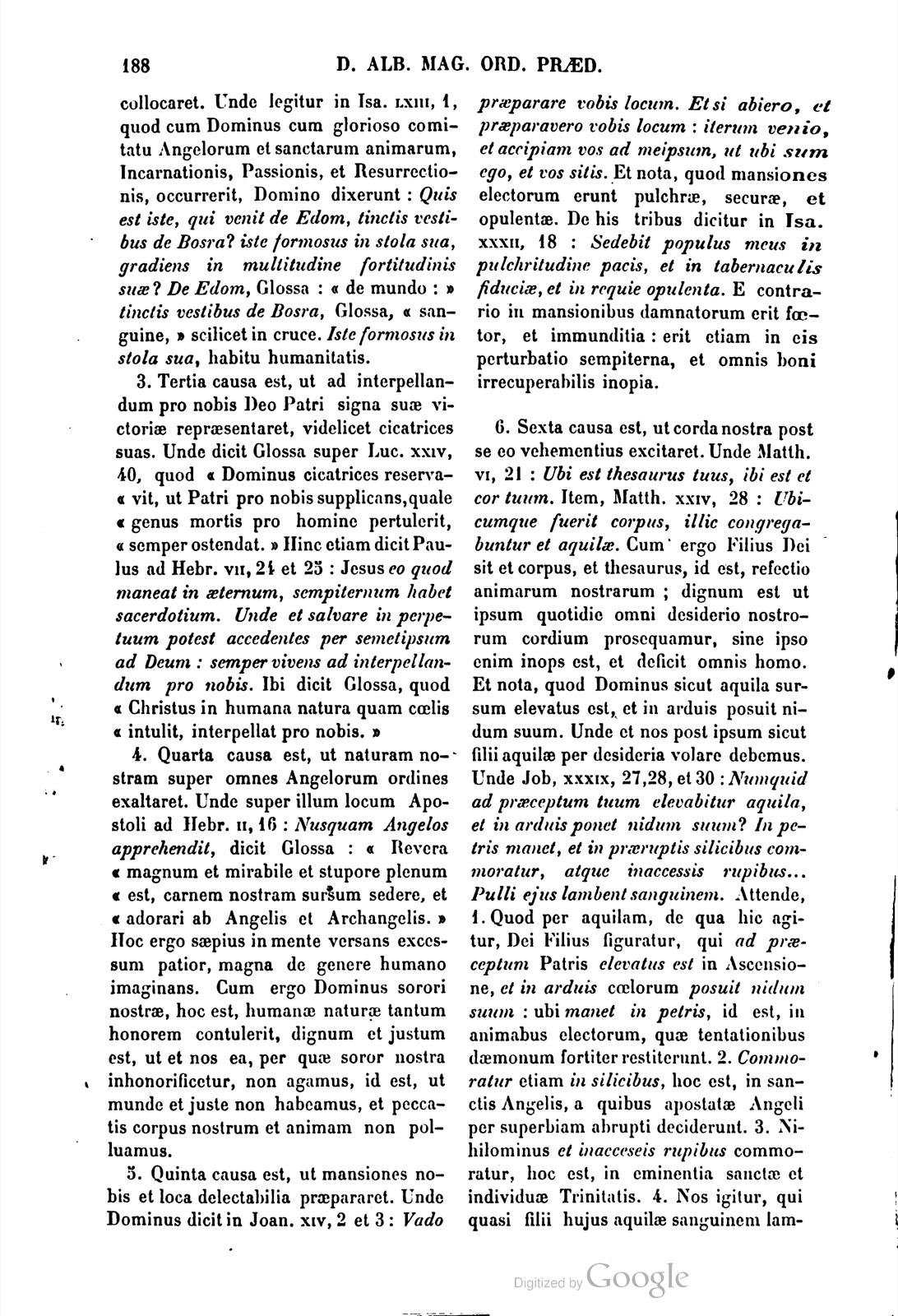
2. Secunda causa est, ut animas quas de limbo eripuerat, in regalibus sedibus collocaret. Unde legitur in Isa. LXII, 1, quod cum Dominus cum glorioso comitatu Angelorum et sanctarum animarum, Incarnationis, Passionis, et Resurrectionis, occurrerit, Domino dixerunt: Quis est iste, qui venit de Edom, tinctis vestibus de Bosra? iste formosus in stola sua, gradiens in multitudine fortitudinis suae? De Edom, Glossa: "de mundo:" tinctis vestibus de Bosra, Glossa, "sanguine," scilicet in cruce. Iste formosus in stola sua, habitu humanitatis.
3. Tertia causa est, ut ad interpellandum pro nobis Deo Patri signa suae victoriae repraesentaret, videlicet cicatrices suas. Unde dicit Glossa super Luc. XXIV, 40, quod "Dominus cicatrices reservavit, ut Patri pro nobis supplicans, quale genus mortis pro homine pertulerit, semper ostendat." Hinc etiam dicit Paulus ad Hebr. VII, 24 et 25: Jesus eo quod maneat in aeternum, sempiternum habet sacerdotium. Unde et salvare in perpetuum potest accedentes per semetipsum ad Deum: semper vivens ad interpellandum pro nobis. Ibi dicit Glossa, quod "Christus in humana natura quam caelis intulit, interpellat pro nobis."
SERMON XLVI.
ON THE ASCENSION OF THE LORD,
The Lord Jesus indeed, after he had spoken to them, was taken up into heaven and sits at the right hand of God. Mark XVI, 19.
Two things here occur to be noted:
I. Why God is said to have been taken up into heaven? II. Why he is also reported to sit at the right hand of God?
I.
Concerning the first, note that the Lord was taken up into heaven for seven causes. The first is that he might open and show to us the road to heaven. The second, that he might place in royal seats the souls which he had snatched from limbo. The third? that for interceding for us he might represent to God the Father the sign of his victory. The fourth, that he might exalt our nature above all orders of Angels. The fifth, that he might prepare mansions and delightful places for us. The sixth, that he might stir up our hearts after himself the more vehemently. The seventh, that he might make public to all the seven seals both already unsealed and to be unsealed.
1. Therefore the first cause of the assumption into heaven is this, namely that he might open and show to us the way to heaven. Hence Micah II, 13: He will ascend, opening the way before them... and their King will pass before them. Note that more than five thousand years had passed in which no one had ascended into heaven; hence the way was as if unknown, and because of this it was necessary that the Son of God first open it and make it known to the souls of the elect.
2. The second cause is that he might place in royal seats the souls which he had snatched from limbo. Hence it is read in Isaiah LXII, 1, that when the Lord with the glorious company of Angels and holy souls, of the Incarnation, Passion, and Resurrection, had met, they said to the Lord: Who is this who comes from Edom, with dyed garments from Bosra? this one beautiful in his robe, walking in the multitude of his strength? Concerning Edom, the Gloss says: "from the world;" with dyed garments from Bosra, the Gloss says, "with blood," namely on the cross. This one beautiful in his robe, in the clothing of humanity.
3. The third cause is that for interceding for us he might represent to God the Father the signs of his victory, namely his scars. Hence the Gloss says on Luke XXIV, 40, that "the Lord reserved the scars, so that, supplicating the Father for us, he may always show what kind of death he endured for man." Hence Paul also says to the Hebrews VII, 24 and 25: Jesus, because he remains forever, has an everlasting priesthood. Hence he can also save forever those approaching God through himself, always living to intercede for us. There the Gloss says that "Christ intercedes for us in the human nature which he carried into the heavens."
4. Quarta causa est, ut naturam nostram super omnes Angelorum ordines exaltaret. Unde super illum locum Apostoli ad Hebr. II, 16: Nusquam Angelos apprehendit, dicit Glossa: "Revera magnum et mirabile et stupore plenum est, carnem nostram sursum sedere, et adorari ab Angelis et Archangelis." Hoc ergo saepius in mente versans excessum patior, magna de genere humano imaginans. Cum ergo Dominus sorori nostrae, hoc est, humanae naturae tantum honorem contulerit, dignum et justum est, ut et nos ea, per quae soror nostra inhonorificetur, non agamus, id est, ut munde et juste non habeamus, et peccatis corpus nostrum et animam non polluamus.
5. Quinta causa est, ut mansiones nobis et loca delectabilia praepararet. Unde Dominus dicit in Joan. XIV, 2 et 3: Vado praeparare vobis locum. Et si abiero, et praeparavero vobis locum: iterum venio, et accipiam vos ad meipsum, ut ubi sum ego, et vos sitis. Et nota, quod mansiones electorum erunt pulchrae, securae, et opulentae. De his tribus dicitur in Isa. XXXII, 18: Sedebit populus meus in pulchritudine pacis, et in tabernaculis fiduciae, et in requie opulenta. E contrario in mansionibus damnatorum erit foetor, et immunditia: erit etiam in eis perturbatio sempiterna, et omnis boni irrecuperabilis inopia.
6. Sexta causa est, ut corda nostra post se eo vehementius excitaret. Unde Matth. VI, 21: Ubi est thesaurus tuus, ibi est et cor tuum. Item, Matth. XXIV, 28: Ubicumque fuerit corpus, illic congregabuntur et aquilae. Cum ergo Filius Dei sit et corpus, et thesaurus, id est, refectio animarum nostrarum; dignum est ut ipsum quotidie omni desiderio nostrorum cordium prosequamur, sine ipso enim inops est, et deficit omnis homo. Et nota, quod Dominus sicut aquila sursum elevatus est, et in arduis posuit nidum suum. Unde et nos post ipsum sicut filii aquilae per desideria volare debemus. Unde Job, XXXIX, 27, 28, et 30: Numquid ad praeceptum tuum elevabitur aquila, et in arduis ponet nidum suum? In petris manet, et in praeruptis silicibus commoratur, atque inaccessis rupibus... Pulli ejus lambent sanguinem. Attende, 1. Quod per aquilam, de qua hic agitur, Dei Filius figuratur, qui ad praeceptum Patris elevatus est in Ascensione, et in arduis caelorum posuit nidum suum: ubi manet in petris, id est, in animabus electorum, quae tentationibus daemonum fortiter restiterunt. 2. Commoratur etiam in silicibus, hoc est, in sanctis Angelis, a quibus apostatae Angeli per superbiam abrupti deciderunt. 3. Nihilominus et inaccessis rupibus commoratur, hoc est, in eminentia sanctae et individuae Trinitatis. 4. Nos igitur, qui quasi filii hujus aquilae sanguinem lambimus Jesu, post hanc aquilam elevari debemus.
4. The fourth cause is that he might exalt our nature above all orders of Angels. Hence on that place of the Apostle to the Hebrews II, 16: Nowhere did he take hold of Angels, the Gloss says: "Truly it is great and marvelous and full of wonder, that our flesh sits above and is adored by Angels and Archangels." Therefore, turning this over rather often in my mind, I suffer excess, imagining great things about the human race. Therefore since the Lord has conferred so great an honor on our sister, that is, on human nature, it is worthy and just that we too should not do those things through which our sister is dishonored, that is, that we should not behave uncleanly and unjustly, and should not pollute our body and soul with sins.
5. The fifth cause is that he might prepare mansions and delightful places for us. Hence the Lord says in John XIV, 2 and 3: I go to prepare a place for you. And if I shall have gone and prepared a place for you, I come again and will receive you to myself, so that where I am, you also may be. And note that the mansions of the elect will be beautiful, secure, and wealthy. Concerning these three things it is said in Isaiah XXXII, 18: My people will sit in the beauty of peace, and in tabernacles of trust, and in opulent rest. On the contrary, in the mansions of the damned there will be stench and uncleanness; there will also be in them everlasting disturbance and irrecoverable lack of every good.
6. The sixth cause is that he might stir up our hearts after himself the more vehemently. Hence Matthew VI, 21: Where your treasure is, there also is your heart. Likewise Matthew XXIV, 28: Wherever the body will have been, there the eagles will be gathered. Therefore since the Son of God is both body and treasure, that is, the refreshment of our souls, it is worthy that we should follow him daily with every desire of our hearts; for without him every man is needy and fails. And note that the Lord has been lifted on high like an eagle and has set his nest in high places. Hence we also ought to fly after him through desires like sons of the eagle. Hence Job XXXIX, 27, 28, and 30: Surely at your command the eagle will be lifted up, and will set its nest in high places? It remains on rocks, and stays on steep flints and inaccessible crags... Its young will lick blood. Attend: 1. That by the eagle of which this is treated here, the Son of God is figured, who was lifted up in the Ascension at the command of the Father, and set his nest in the heights of the heavens, where he remains on rocks, that is, in the souls of the elect, which have strongly resisted the temptations of demons. 2. He also stays on flints, that is, in the holy Angels, from whom the apostate Angels, broken off through pride, fell down. 3. Nevertheless he also stays on inaccessible crags, that is, in the eminence of the holy and undivided Trinity. 4. We therefore, who like sons of this eagle lick the blood of Jesus, ought to be lifted up after this eagle.
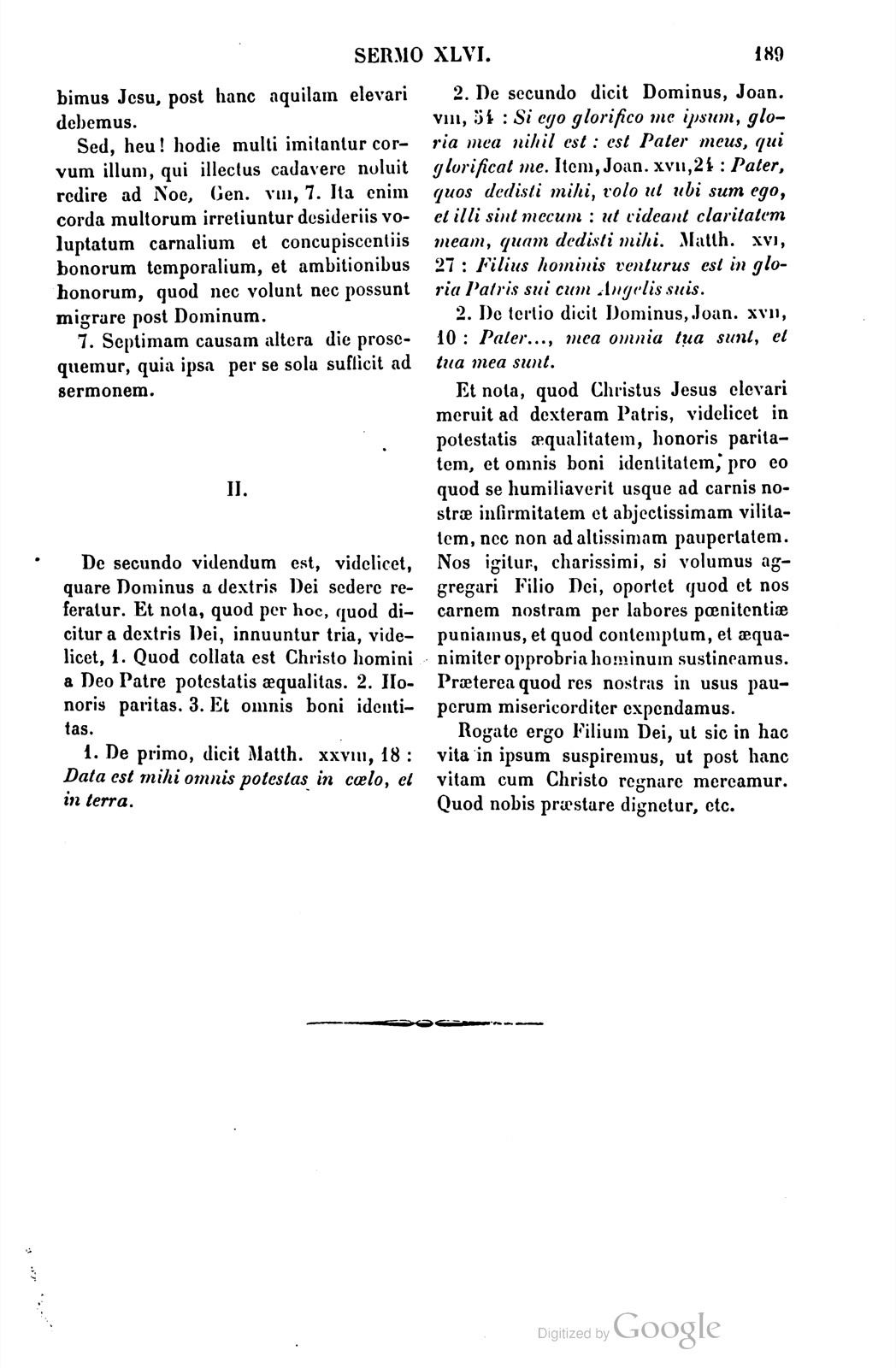
Sed, heu! hodie multi imitantur corvum illum, qui illectus cadavere noluit redire ad Noe, Gen. VIII, 7. Ita enim corda multorum irretiuntur desideriis voluptatum carnalium et concupiscentiis bonorum temporalium, et ambitionibus honorum, quod nec volunt nec possunt migrare post Dominum.
7. Septimam causam altera die prosequemur, quia ipsa per se sola sufficit ad sermonem.
II.
De secundo videndum est, videlicet, quare Dominus a dextris Dei sedere referatur. Et nota, quod per hoc, quod dicitur a dextris Dei, innuuntur tria, videlicet, 1. Quod collata est Christo homini a Deo Patre potestatis aequalitas. 2. Honoris paritas. 3. Et omnis boni identitas.
1. De primo, dicit Matth. XXVIII, 18: Data est mihi omnis potestas in caelo, et in terra.
2. De secundo dicit Dominus, Joan. VIII, 54: Si ego glorifico me ipsum, gloria mea nihil est: est Pater meus, qui glorificat me. Item, Joan. XVII, 24: Pater, quos dedisti mihi, volo ut ubi sum ego, et illi sint mecum: ut videant claritatem meam, quam dedisti mihi. Matth. XVI, 27: Filius hominis venturus est in gloria Patris sui cum Angelis suis.
2. De tertio dicit Dominus, Joan. XVII, 10: Pater..., mea omnia tua sunt, et tua mea sunt.
Et nota, quod Christus Jesus elevari meruit ad dexteram Patris, videlicet in potestatis aequalitatem, honoris paritatem, et omnis boni identitatem, pro eo quod se humiliaverit usque ad carnis nostrae infirmitatem et abjectissimam vilitatem, nec non ad altissimam paupertatem. Nos igitur, charissimi, si volumus aggregari Filio Dei, oportet quod et nos carnem nostram per labores poenitentiae puniamus, et quod contemptum, et aequanimiter opprobria hominum sustineamus. Praeterea quod res nostras in usus pauperum misericorditer expendamus.
Rogate ergo Filium Dei, ut sic in hac vita in ipsum suspiremus, ut post hanc vitam cum Christo regnare mereamur. Quod nobis praestare dignetur, etc.
But alas! today many imitate that raven which, enticed by a corpse, refused to return to Noah, Genesis VIII, 7. For the hearts of many are so entangled by desires of carnal pleasures and concupiscences of temporal goods and ambitions of honors, that they neither wish nor are able to migrate after the Lord.
7. We shall pursue the seventh cause another day, because it alone by itself suffices for a sermon.
II.
Concerning the second, it must be seen, namely why the Lord is reported to sit at the right hand of God. And note that by this, that he is said to be at the right hand of God, three things are suggested, namely 1. That equality of power has been conferred on Christ as man by God the Father. 2. Parity of honor. 3. And identity of every good.
1. Concerning the first, Matthew XXVIII, 18 says: All power has been given to me in heaven and on earth.
2. Concerning the second the Lord says, John VIII, 54: If I glorify myself, my glory is nothing: it is my Father who glorifies me. Likewise John XVII, 24: Father, those whom you have given me, I wish that where I am, they also may be with me, that they may see my brightness, which you have given me. Matthew XVI, 27: The Son of Man is going to come in the glory of his Father with his Angels.
2. Concerning the third the Lord says, John XVII, 10: Father..., all my things are yours, and yours are mine.
And note that Christ Jesus deserved to be raised to the right hand of the Father, namely into equality of power, parity of honor, and identity of every good, for this, that he humbled himself even to the infirmity of our flesh and most abject vileness, and also to deepest poverty. Therefore we, dearest ones, if we wish to be gathered to the Son of God, must also punish our flesh through the labors of penance, and must endure contempt and the reproaches of men calmly. Moreover we must mercifully spend our goods for the uses of the poor.
Therefore pray to the Son of God that in this life we may so sigh toward him that after this life we may deserve to reign with Christ. May he deign to grant this to us, etc.
If a page does not appear, its photograph has not been uploaded yet.