Works › Sermons for the Seasons of the Year
Volume 13 · pp. 181–183
Sermon XLIV. In the Litanies
A marker with ≈ is an approximate page boundary, placed by measure of the text; the page photographs remain the authority. In the paired views, clicking a page marker brings that page into view.
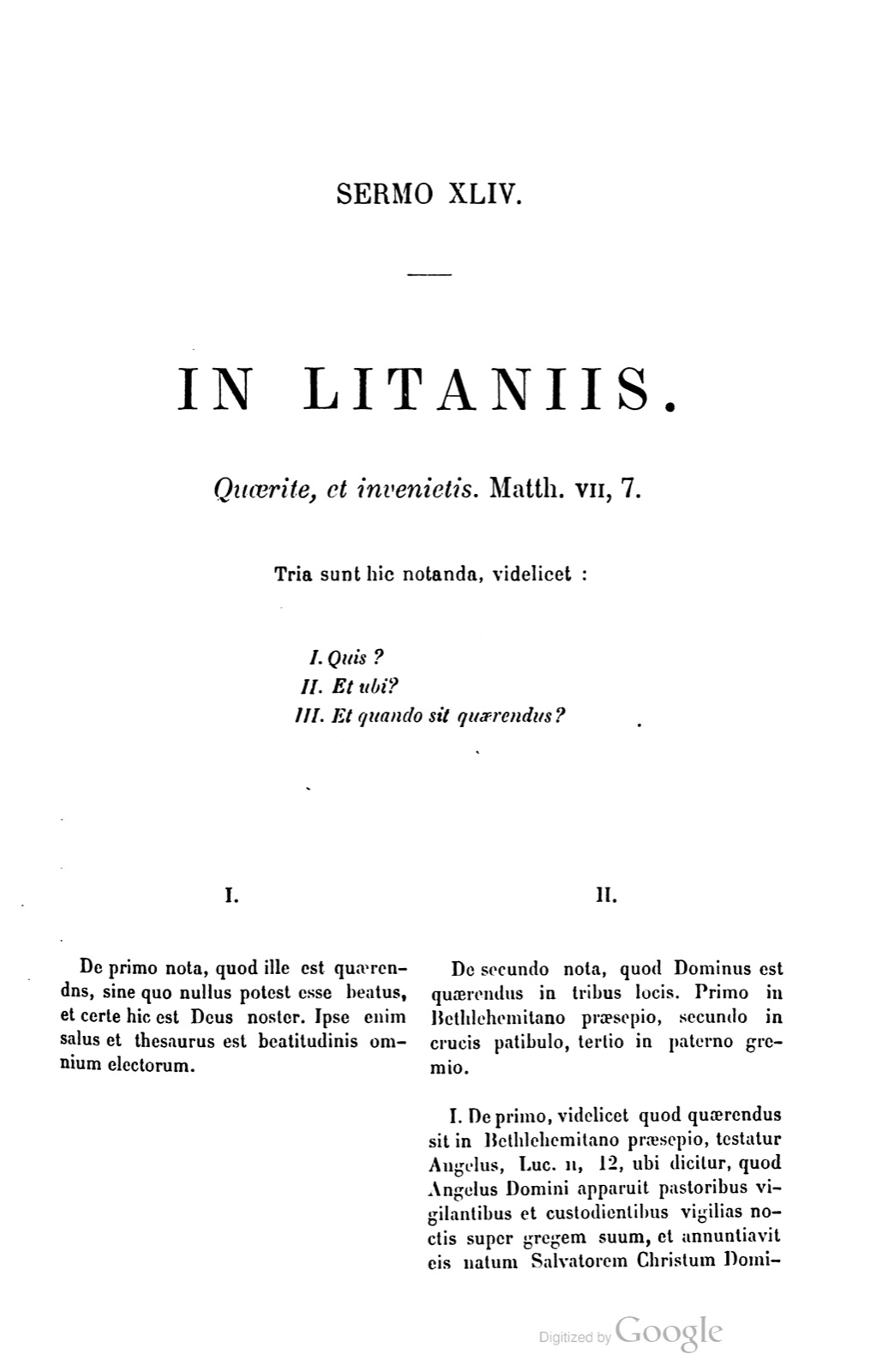
SERMO XLIV.
IN LITANIIS.
Quaerite, et invenietis. Matth. VII, 7.
Tria sunt hic notanda, videlicet:
I. Quis? II. Et ubi? III. Et quando sit quaerendus?
I.
De primo nota, quod ille est quaerendus, sine quo nullus potest esse beatus, et certe hic est Deus noster. Ipse enim salus et thesaurus est beatitudinis omnium electorum.
II.
De secundo nota, quod Dominus est quaerendus in tribus locis. Primo in Bethlehemitano praesepio, secundo in crucis patibulo, tertio in paterno gremio.
I. De primo, videlicet quod quaerendus sit in Bethlehemitano praesepio, testatur Angelus, Luc. II, 12, ubi dicitur, quod Angelus Domini apparuit pastoribus vigilantibus et custodientibus vigilias noctis super gregem suum, et annuntiavit eis natum Salvatorem Christum Dominum, et subjunxit: Et hoc vobis signum: Invenietis infantem pannis involutum, et positum in praesepio. Nota igitur, quod Dominus primo quaerendus est in praesepio, ubi cum et pastores et reges quaesierunt jacens in paupertate, in vilitate, in asperitate; ut videlicet fallaces divitiae respuantur, ut honores transitorii contemnantur, ut carnis deliciae fugiantur. Redde singula singulis.
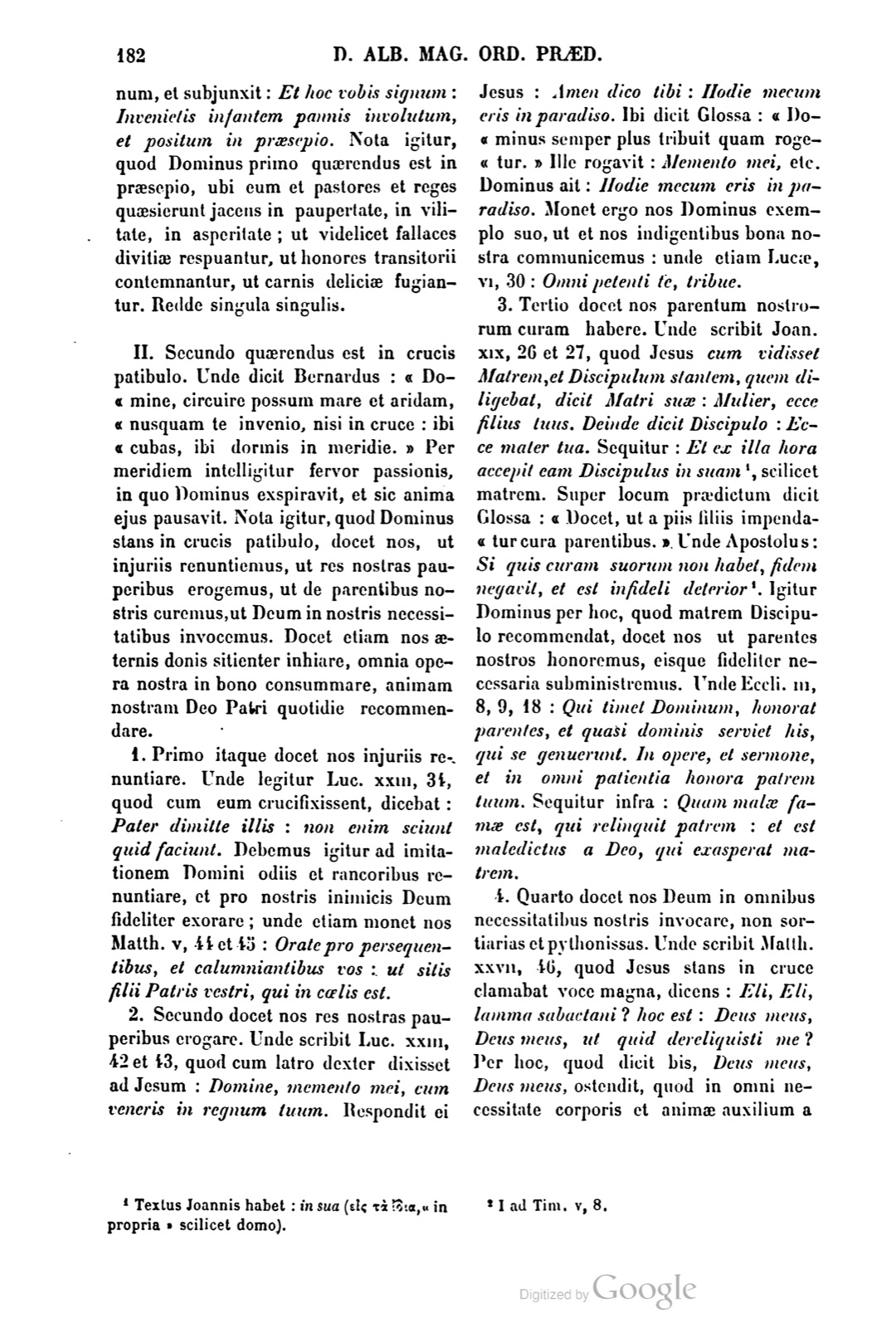
II. Secundo quaerendus est in crucis patibulo. Unde dicit Bernardus: "Domine, circuire possum mare et aridam, nusquam te invenio, nisi in cruce: ibi cubas, ibi dormis in meridie." Per meridiem intelligitur fervor passionis, in quo Dominus exspiravit, et sic anima ejus pausavit. Nota igitur, quod Dominus stans in crucis patibulo, docet nos, ut injuriis renuntiemus, ut res nostras pauperibus erogemus, ut de parentibus nostris curemus, ut Deum in nostris necessitatibus invocemus. Docet etiam nos aeternis donis sitienter inhiare, omnia opera nostra in bono consummare, animam nostram Deo Patri quotidie recommendare.
1. Primo itaque docet nos injuriis renuntiare. Unde legitur Luc. XXIII, 34, quod cum eum crucifixissent, dicebat: Pater dimitte illis: non enim sciunt quid faciunt. Debemus igitur ad imitationem Domini odiis et rancoribus renuntiare, et pro nostris inimicis Deum fideliter exorare; unde etiam monet nos Matth. V, 44 et 45: Orate pro persequentibus, et calumniantibus vos: ut sitis filii Patris vestri, qui in caelis est.
2. Secundo docet nos res nostras pauperibus erogare. Unde scribit Luc. XXIII, 42 et 43, quod cum latro dexter dixisset ad Jesum: Domine, memento mei, cum veneris in regnum tuum. Respondit ei Jesus: Amen dico tibi: Hodie mecum eris in paradiso. Ibi dicit Glossa: "Dominus semper plus tribuit quam rogetur." Ille rogavit: Memento mei, etc. Dominus ait: Hodie mecum eris in paradiso. Monet ergo nos Dominus exemplo suo, ut et nos indigentibus bona nostra communicemus: unde etiam Lucae, VI, 30: Omni petenti te, tribue.
SERMON XLIV.
IN THE LITANIES.
Seek, and you shall find. Matthew VII, 7.
Three things are to be noted here, namely:
I. Who? II. And where? III. And when he is to be sought?
I.
Concerning the first, note that he is to be sought without whom no one can be blessed, and certainly this is our God. For he himself is the salvation and treasure of the blessedness of all the elect.
II.
Concerning the second, note that the Lord is to be sought in three places. First in the Bethlehemite manger, second on the gibbet of the cross, third in the paternal bosom.
I. Concerning the first, namely that he is to be sought in the Bethlehemite manger, the Angel testifies, Luke II, 12, where it is said that the Angel of the Lord appeared to the shepherds keeping watch and guarding the watches of the night over their flock, and announced to them that the Savior Christ the Lord had been born, and added: And this is the sign for you: You shall find the infant wrapped in swaddling cloths and placed in the manger. Therefore note that the Lord first is to be sought in the manger, where both shepherds and kings sought him lying in poverty, in vileness, in roughness, so that indeed deceitful riches may be rejected, so that transitory honors may be contemned, so that the delights of the flesh may be fled. Render each thing to each.
II. Second, he is to be sought on the gibbet of the cross. Hence Bernard says: "Lord, I can go around sea and dry land; nowhere do I find you, except on the cross: there you lie, there you sleep at midday." By midday is understood the heat of the passion, in which the Lord breathed forth his spirit, and thus his soul rested. Therefore note that the Lord standing on the gibbet of the cross teaches us to renounce injuries, to distribute our goods to the poor, to care for our parents, to invoke God in our necessities. He also teaches us thirstingly to long for eternal gifts, to consummate all our works in the good, and daily to commend our soul to God the Father.
1. First therefore he teaches us to renounce injuries. Hence it is read in Luke XXIII, 34, that when they had crucified him, he was saying: Father, forgive them, for they do not know what they are doing. Therefore we ought, in imitation of the Lord, to renounce hatreds and rancors, and faithfully to pray to God for our enemies; hence he also admonishes us, Matthew V, 44 and 45: Pray for those persecuting and calumniating you, that you may be sons of your Father, who is in heaven.
2. Second, he teaches us to distribute our goods to the poor. Hence Luke XXIII, 42 and 43 writes that when the right-hand thief had said to Jesus: Lord, remember me when you come into your kingdom. Jesus answered him: Amen I say to you: Today you will be with me in paradise. There the Gloss says: "The Lord always grants more than he is asked." That man asked: Remember me, etc. The Lord says: Today you will be with me in paradise. Therefore the Lord admonishes us by his example that we too should communicate our goods to the needy; hence also Luke VI, 30: To everyone asking you, give.
3. Tertio docet nos parentum nostrorum curam habere. Unde scribit Joan. XIX, 26 et 27, quod Jesus cum vidisset Matrem, et Discipulum stantem, quem diligebat, dicit Matri suae: Mulier, ecce filius tuus. Deinde dicit Discipulo: Ecce mater tua. Sequitur: Et ex illa hora accepit eam Discipulus in suam 1, scilicet matrem. Super locum praedictum dicit Glossa: "Docet, ut a piis filiis impendatur cura parentibus." Unde Apostolus: Si quis curam suorum non habet, fidem negavit, et est infideli deterior 2. Igitur Dominus per hoc, quod matrem Discipulo recommendat, docet nos ut parentes nostros honoremus, eisque fideliter necessaria subministremus. Unde Eccli. III, 8, 9, 18: Qui timet Dominum, honorat parentes, et quasi dominis serviet his, qui se genuerunt. In opere, et sermone, et in omni patientia honora patrem tuum. Sequitur infra: Quam malae famae est, qui relinquit patrem: et est maledictus a Deo, qui exasperat matrem.
4. Quarto docet nos Deum in omnibus necessitatibus nostris invocare, non sortiarias et pythonissas. Unde scribit Matth. XXVII, 46, quod Jesus stans in cruce clamabat voce magna, dicens: Eli, Eli, lamma sabactani? hoc est: Deus meus, Deus meus, ut quid dereliquisti me? Per hoc, quod dicit bis, Deus meus, Deus meus, ostendit, quod in omni necessitate corporis et animae auxilium a Deo debemus implorare. Contra quod faciunt, qui in infirmitatibus suis confidentiam habent in detestabilibus benedictionibus et praestigiis mulierum.
5. Quinto docet nos aeternis bonis sitienter inhiare. Unde scribit Joan. XIX, 28, quod Dominus stans in cruce, dixit: Sitio. Dicit etiam Matth. XXVII, 34, quod dederunt ei vinum bibere cum felle mistum. Et cum gustasset, noluit bibere. Nota igitur quod Dominus, licet in corpore magnam sitim pateretur, multo tamen majorem in anima patiebatur. Ipse enim sitiebat salutem totius generis humani. Bonum igitur est, ut et nos sitiamus ad Dominum Deum nostrum, apud quem semper salvi erimus, et bene. Unde dicitur in Psal. XLI, 3: Sitivit anima mea ad Deum fortem vivum: quando veniam et apparebo ante faciem Dei?
3. Third, he teaches us to have care of our parents. Hence John XIX, 26 and 27 writes that when Jesus had seen his Mother and the Disciple standing, whom he loved, he says to his Mother: Woman, behold your son. Then he says to the Disciple: Behold your mother. It follows: And from that hour the Disciple received her into his own 1, that is, as mother. On the aforesaid place the Gloss says: "He teaches that care should be expended upon parents by dutiful sons." Hence the Apostle: If anyone does not have care of his own, he has denied the faith and is worse than an unbeliever 2. Therefore by this, that the Lord commends his mother to the Disciple, he teaches us that we should honor our parents and faithfully provide them with necessary things. Hence Ecclesiasticus III, 8, 9, 18: He who fears the Lord honors his parents and will serve those who begot him as lords. In deed and word, and in all patience, honor your father. It follows below: Of how evil a reputation is he who leaves his father; and he is cursed by God who exasperates his mother.
4. Fourth, he teaches us to invoke God in all our necessities, not sorceresses and pythonesses. Hence Matthew XXVII, 46 writes that Jesus, standing on the cross, cried with a great voice, saying: Eli, Eli, lamma sabactani? that is: My God, my God, why have you forsaken me? By this, that he says twice, My God, my God, he shows that in every necessity of body and soul we ought to implore help from God. Against this act those who in their illnesses have confidence in the detestable blessings and illusions of women.
5. Fifth, he teaches us thirstingly to long for eternal goods. Hence John XIX, 28 writes that the Lord, standing on the cross, said: I thirst. Matthew XXVII, 34 also says that they gave him wine to drink mixed with gall. And when he had tasted it, he did not wish to drink. Therefore note that the Lord, although he suffered great thirst in his body, nevertheless suffered a much greater thirst in his soul. For he himself thirsted for the salvation of the whole human race. Therefore it is good that we too thirst toward the Lord our God, with whom we shall always be saved and well. Hence it is said in Psalm XLI, 3: My soul thirsted for the strong living God: when shall I come and appear before the face of God?
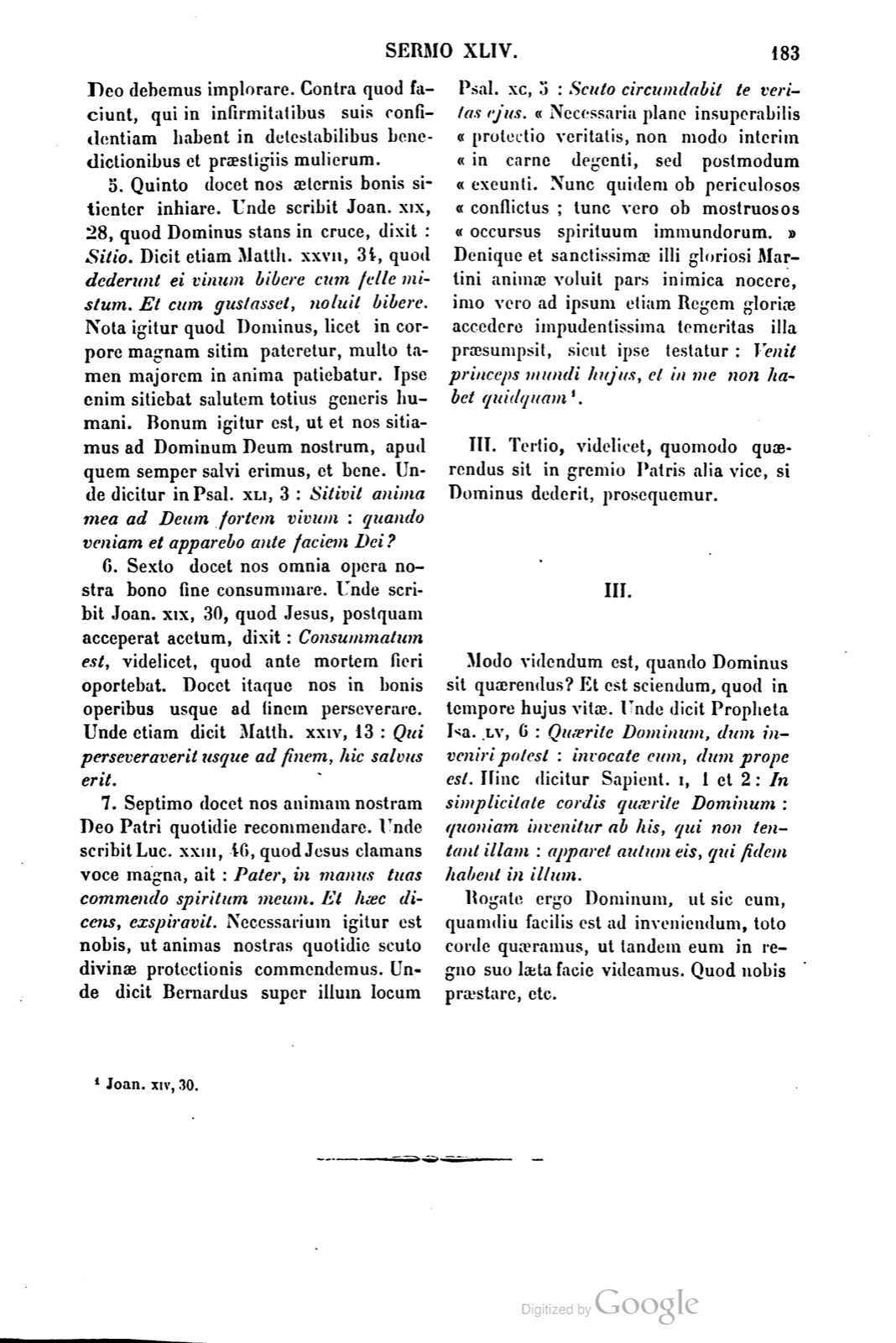
6. Sexto docet nos omnia opera nostra bono fine consummare. Unde scribit Joan. XIX, 30, quod Jesus, postquam acceperat acetum, dixit: Consummatum est, videlicet, quod ante mortem fieri oportebat. Docet itaque nos in bonis operibus usque ad finem perseverare. Unde etiam dicit Matth. XXIV, 13: Qui perseveraverit usque ad finem, hic salvus erit.
7. Septimo docet nos animam nostram Deo Patri quotidie recommendare. Unde scribit Luc. XXIII, 46, quod Jesus clamans voce magna, ait: Pater, in manus tuas commendo spiritum meum. Et haec dicens, exspiravit. Necessarium igitur est nobis, ut animas nostras quotidie scuto divinae protectionis commendemus. Unde dicit Bernardus super illum locum Psal. XC, 5: Scuto circumdabit te veritas ejus. "Necessaria plane insuperabilis protectio veritatis, non modo interim in carne degenti, sed postmodum exeunti. Nunc quidem ob periculosos conflictus; tunc vero ob mostruosos occursus spirituum immundorum." Denique et sanctissimae illi gloriosi Martini animae voluit pars inimica nocere, imo vero ad ipsum etiam Regem gloriae accedere impudentissima temeritas illa praesumpsit, sicut ipse testatur: Venit princeps mundi hujus, et in me non habet quidquam 3.
III. Tertio, videlicet, quomodo quaerendus sit in gremio Patris alia vice, si Dominus dederit, prosequemur.
III.
Modo videndum est, quando Dominus sit quaerendus? Et est sciendum, quod in tempore hujus vitae. Unde dicit Propheta Isa. LV, 6: Quaerite Dominum, dum inveniri potest: invocate eum, dum prope est. Hinc dicitur Sapient. I, 1 et 2: In simplicitate cordis quaerite Dominum: quoniam invenitur ab his, qui non tentant illam: apparet autum eis, qui fidem habent in illum.
Rogate ergo Dominum, ut sic eum, quamdiu facilis est ad inveniendum, toto corde quaeramus, ut tandem eum in regno suo laeta facie videamus. Quod nobis praestare, etc.
6. Sixth, he teaches us to consummate all our works with a good end. Hence John XIX, 30 writes that Jesus, after he had received the vinegar, said: It has been consummated, namely, what had to be done before death. And so he teaches us to persevere in good works up to the end. Hence he also says, Matthew XXIV, 13: He who will have persevered to the end, this one will be saved.
7. Seventh, he teaches us daily to commend our soul to God the Father. Hence Luke XXIII, 46 writes that Jesus, crying with a great voice, said: Father, into your hands I commend my spirit. And saying these things, he breathed forth his spirit. Therefore it is necessary for us that we daily commend our souls to the shield of divine protection. Hence Bernard says on that place, Psalm XC, 5: His truth will surround you with a shield. "Plainly necessary is the unconquerable protection of truth, not only for the one dwelling meanwhile in the flesh, but afterward for the one going out. Now indeed because of dangerous conflicts; then truly because of monstrous encounters of unclean spirits." Finally the hostile part also wished to harm that most holy soul of glorious Martin; indeed that most shameless rashness even presumed to approach the King of glory himself, as he himself testifies: The prince of this world comes, and in me he has not anything 3.
III. Third, namely how he is to be sought in the bosom of the Father, we shall pursue another time, if the Lord shall give it.
III.
Now it must be seen when the Lord is to be sought. And it is to be known that it is in the time of this life. Hence the Prophet says, Isaiah LV, 6: Seek the Lord while he can be found; invoke him while he is near. Hence it is said in Wisdom I, 1 and 2: Seek the Lord in simplicity of heart, because he is found by those who do not test that one; but he appears to those who have faith in him.
Therefore pray to the Lord that we may seek him with the whole heart, while he is easy to find, so that at last we may see him in his kingdom with a joyful face. May he grant this to us, etc.
If a page does not appear, its photograph has not been uploaded yet.