Works › Sermons for the Seasons of the Year
Volume 13 · pp. 164–167
Sermon XXXIX. On the Second Sunday After Easter
A marker with ≈ is an approximate page boundary, placed by measure of the text; the page photographs remain the authority. In the paired views, clicking a page marker brings that page into view.
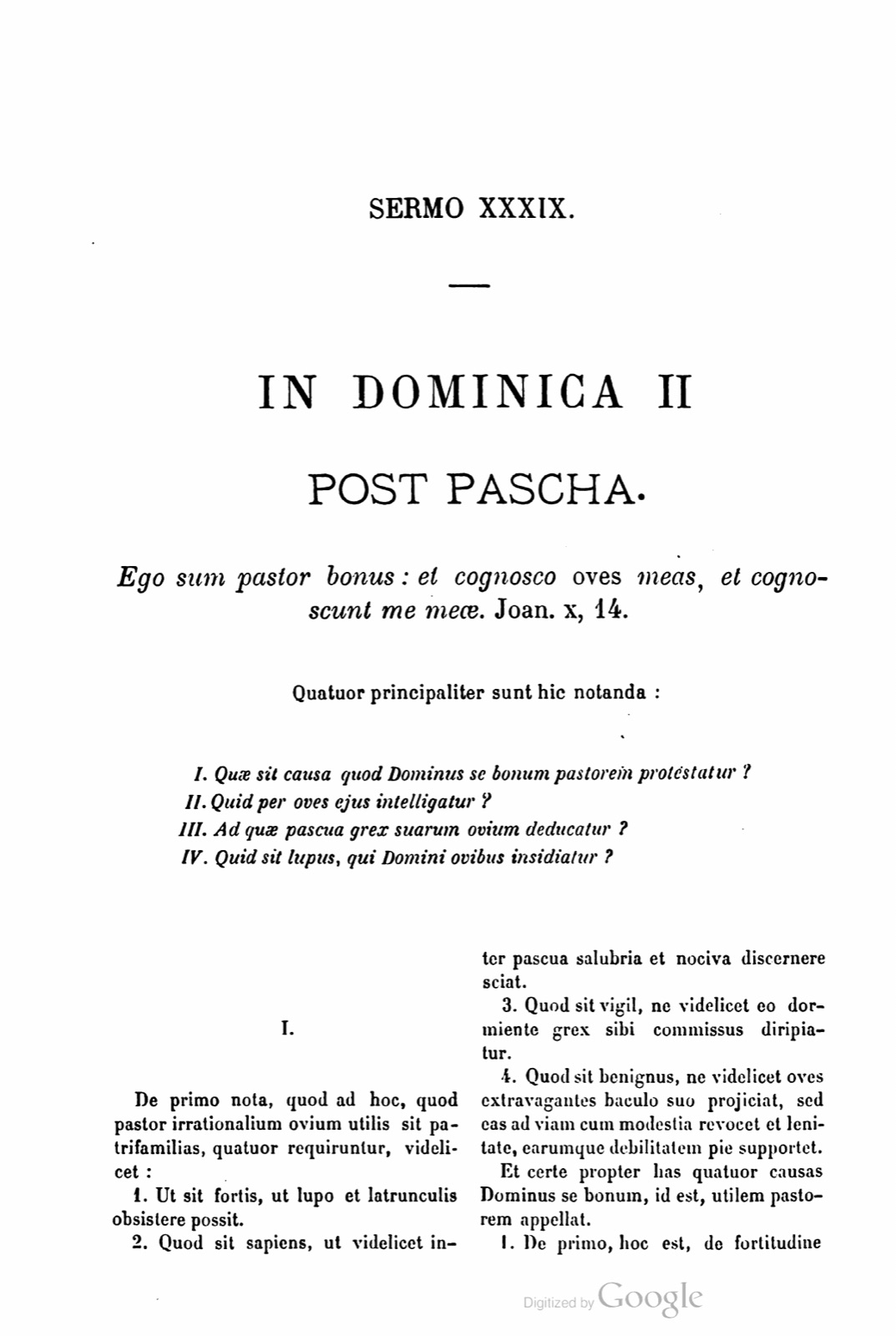
SERMO XXXIX. IN DOMINICA II POST PASCHA.
Ego sum pastor bonus: et cognosco oves meas, et cognoscunt me meæ. Joan. x, 14.
Quatuor principaliter sunt hic notanda: I. Quæ sit causa quod Dominus se bonum pastorem protestatur? II. Quid per oves ejus intelligatur? III. Ad quæ pascua grex suarum ovium deducatur? IV. Quid sit lupus, qui Domini ovibus insidiatur?
I. De primo nota, quod ad hoc, quod pastor irrationalium ovium utilis sit patrifamilias, quatuor requiruntur, videlicet: 1. Ut sit fortis, ut lupo et latrunculis obsistere possit. 2. Quod sit sapiens, ut videlicet inter pascua salubria et nociva discernere sciat. 3. Quod sit vigil, ne videlicet eo dormiente grex sibi commissus diripiatur. 4. Quod sit benignus, ne videlicet oves extravagantes baculo suo projiciat, sed eas ad viam cum modestia revocet et lenitate, earumque debilitatem pie supportet. Et certe propter has quatuor causas Dominus se bonum, id est, utilem pastorem appellat.
1. De primo, hoc est, de fortitudine pastoris hujus dicit Job ix, 4: Sapiens corde est, et fortis robore: quis resistit ei, et pacem habuit? Si fortitudo quæritur, robustissimus est. Iste est ille David manu fortis, qui contra Goliath, hoc est, diabolum, cum baculo sanctæ crucis procedens, pro castris Israel singulare certamen iniit, eumque triplici lapide, hoc est, innocentia cordis, oris, et operis in cruce moriens prostravit et occidit. Iste est pastor bonus, qui quotidie contra dæmones assistit pro ovibus suis, pugnatque pro eis. Unde dicit Isa. lxiii, 1: Ego, qui loquor justitiam, et propugnator sum ad salvandum.
2. De secundo, hoc est, de sapientia pastoris hujus dicit Eccli. i, 1 et 5: Omnis sapientia a Domino Deo est, et cum illo fuit semper, et est ante ævum... Fons sapientiæ verbum Dei in excelsis. Verbum Dei, id est, Filius Dei. 1. Iste ergo pastor, cujus sapientiæ non est numerus, ostendit quæ pascua salubria sint ovibus suis, et quæ nociva. 2. Docet enim verbo et exemplo, perniciosa esse Christianis pascua divitiarum, deliciarum, et bonorum, et quod salubria sint pascua paupertatis, asperitatis, ac humilitatis. 3. Unde et ipse apud Bethlehem in diversorio natus elegit paupertatem, asperitatem ac vilitatem. 4. Eadem etiam pati voluit in loco Calvariæ apud stratam publicam. 5. Hæc autem fecit propterea, ut secus vias prædictas pascua quærerent oves Domini. Unde Augustinus in libro de Catechizandis rudibus: «Omnia bona terrena contempsit homo factus Christus Dominus, ut contemnenda monstraret: et omnia terrena mala sustinuit quæ sustinenda præcipiebat, ut neque in illis quæreretur felicitas, neque in istis infelicitas timeretur.»
SERMON XXXIX. ON THE SECOND SUNDAY AFTER EASTER.
I am the good shepherd; and I know my sheep, and my own know me. John 10:14.
Four things are principally to be noted here: I. What is the cause that the Lord declares himself a good shepherd? II. What is understood by his sheep? III. To what pastures is the flock of his sheep led? IV. What is the wolf that lies in wait for the Lord's sheep?
I. On the first, note that for this, that a shepherd of irrational sheep be useful to the head of a household, four things are required, namely: 1. That he be strong, so that he can withstand the wolf and robbers. 2. That he be wise, so that he knows how to discern between wholesome and harmful pastures. 3. That he be watchful, lest while he is sleeping the flock committed to him be torn apart. 4. That he be kind, lest he cast out wandering sheep with his staff, but recall them to the way with moderation and gentleness and piously support their weakness. And certainly because of these four causes the Lord calls himself a good, that is, useful shepherd.
1. Concerning the first, that is, concerning the strength of this shepherd, Job 9:4 says: He is wise in heart and strong in might; who has resisted him and had peace? If strength is sought, he is the most robust. He is that David strong in hand who, proceeding against Goliath, that is, the devil, with the staff of the holy cross, entered single combat for the camp of Israel, and with a threefold stone, that is, with innocence of heart, mouth, and work, dying on the cross, threw him down and killed him. He is the good shepherd who daily stands against the demons for his sheep and fights for them. Hence Isaiah 63:1 says: I who speak justice, and am a defender unto saving.
2. Concerning the second, that is, concerning the wisdom of this shepherd, Ecclesiasticus 1:1 and 5 says: All wisdom is from the Lord God, and was with him always, and is before the age... The fountain of wisdom is the Word of God on high. The Word of God, that is, the Son of God. 1. Therefore this shepherd, whose wisdom has no number, shows which pastures are wholesome for his sheep and which are harmful. 2. For by word and example he teaches that the pastures of riches, delights, and honors are pernicious for Christians, and that the pastures of poverty, roughness, and humility are wholesome. 3. Hence he himself, born at Bethlehem in a lodging place, chose poverty, roughness, and lowliness. 4. He also willed to suffer the same things in the place of Calvary beside the public road. 5. But he did these things so that the sheep of the Lord might seek pastures along the aforesaid ways. Hence Augustine in the book On Catechizing the Uninstructed says: Christ the Lord, made human, despised all earthly goods, so that he might show that they should be despised; and he sustained all earthly evils that he was teaching should be sustained, so that happiness would neither be sought in the former nor unhappiness feared in the latter.
3. De tertio, videlicet quod vigil sit Dominus. 1. Dicitur in Psal. cxx, 4: Non dormitabit neque dormiet, qui custodit Israel. 2. Unde et ipse de se dicit, Isa. xxi, 8: Super speculam Domini ego sum, stans jugiter per diem; et super custodiam meam ego sum, stans totis noctibus. 3. Licet ergo ipse vigilet, salutem nostram custodiens; docet tamen et nos vigilare pro salute nostræ. Unde dicit Matth. xxvi, 41: Vigilate, et orate ut non intretis in tentationem. Item, Marci xiii, 33 et 37: Videte, vigilate et orate... Quod autem vobis dico, omnibus dico: Vigilate.
4. De quarto, videlicet quod sit patiens et benignus, dicitur in Psal. cxliv, 9: Suavis Dominus universis: et miserationes ejus super omnia opera ejus. Item, Isa. xl, 11: Sicut pastor gregem suum pascet: in brachio suo congregabit agnos, et in sinu suo levabit, fætas ipse portabit. Patiens igitur est in peccatorum nostrorum diurna dissimulatione. Benignus est in multimoda beneficiorum collatione. Ipse enim quod perierat, requisivit, carnem induendo et in mundum veniendo, quod abjectum fuit, reduxit, pro nobis ascendendo, et in brachia crucis oviculas suas colligendo, et postea in ascensione animas quas de limbo eripuerat, in cælum revehendo: quod fractum fuerat, alligat per veram satisfactionem: ipse enim quasi verus Samaritanus purgat vulnera peccatorum, infundens vinum acerrimæ contritionis, et superfundens oleum internæ consolationis, et sic alligat vulnera panniculis præceptorum: quod infirmum est, consolidat per adjutricis gratiæ transmissionem: quod forte et pingue est, custodit per Angelicam protectionem. De prædictis dicit Ezechiel xxxiv, 16: Quod perierat requiram, et quod abjectum erat reducam, et quod confractum fuerat alligabo, et quod infirmum fuerat consolidabo, et quod pingue et forte custodiam.
3. On the third, namely that the Lord is watchful: 1. It is said in Psalm 120:4: He who guards Israel will neither slumber nor sleep. 2. Hence he also says of himself in Isaiah 21:8: I am upon the watchtower of the Lord, standing continually by day; and I am upon my guard, standing through whole nights. 3. Although therefore he himself watches, guarding our salvation, nevertheless he teaches us also to watch for our salvation. Hence he says in Matthew 26:41: Watch and pray that you may not enter into temptation. Likewise in Mark 13:33 and 37: See, watch and pray... But what I say to you, I say to all: Watch.
4. On the fourth, namely that he is patient and kind, it is said in Psalm 144:9: The Lord is sweet to all, and his mercies are over all his works. Likewise Isaiah 40:11 says: Like a shepherd he will feed his flock; in his arm he will gather the lambs, and in his bosom he will lift them up; the pregnant he himself will carry. Therefore he is patient in the daily overlooking of our sins. He is kind in the manifold bestowal of benefits. For he himself sought what had perished by putting on flesh and coming into the world; he brought back what had been cast away by ascending for us and gathering his little sheep into the arms of the cross, and afterward, in the ascension, carrying back into heaven the souls that he had snatched from limbo. What had been broken he binds through true satisfaction; for he, like the true Samaritan, cleanses the wounds of sinners, pouring in the wine of sharpest contrition and pouring over it the oil of inward consolation, and thus he binds the wounds with the small cloths of the precepts. What is weak he strengthens through the sending of assisting grace. What is strong and fat he guards through angelic protection. Concerning the aforesaid things Ezekiel 34:16 says: What had perished I will seek, and what had been cast away I will bring back, and what had been broken I will bind, and what had been weak I will strengthen, and what is fat and strong I will guard.
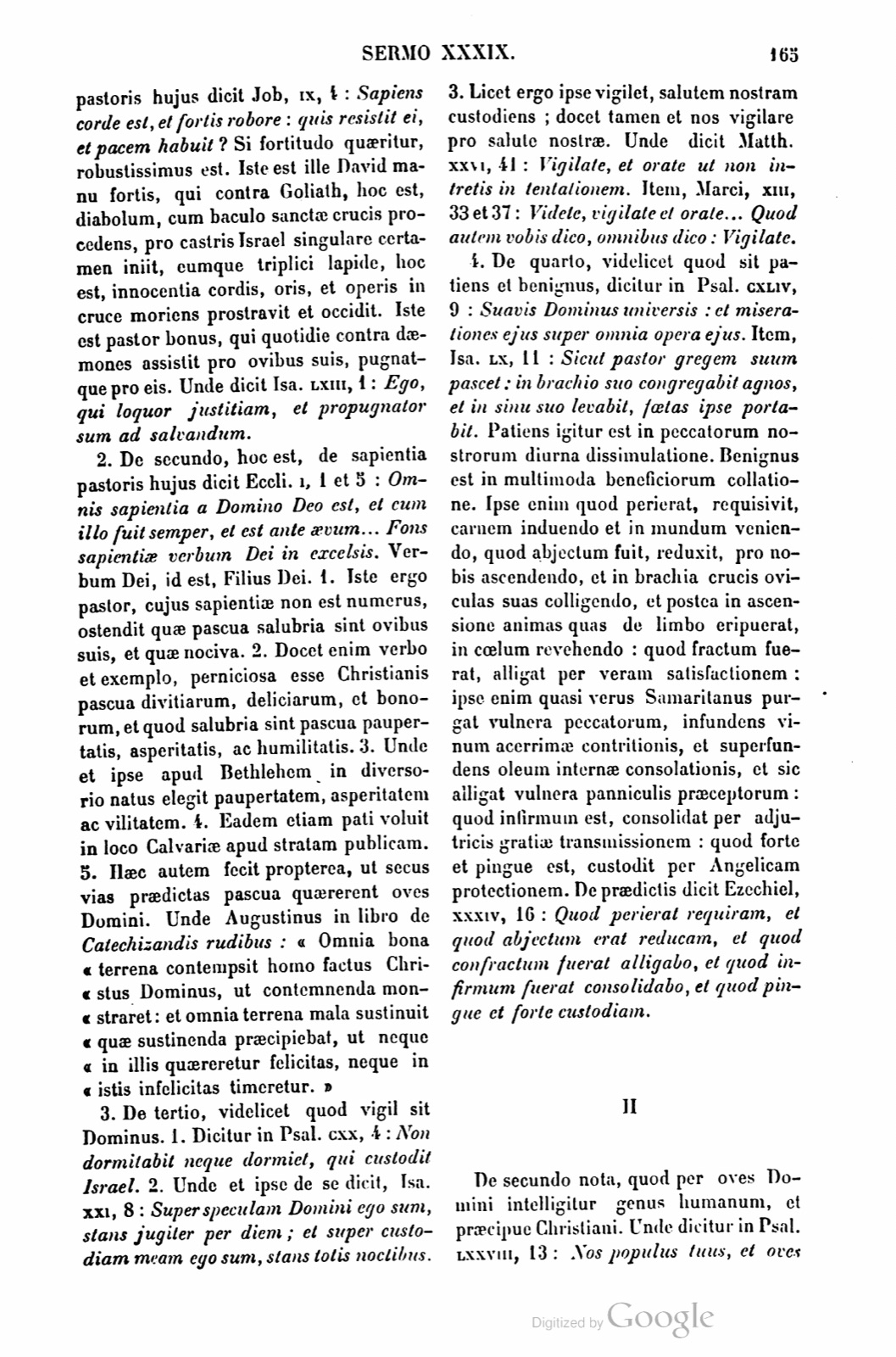
II. De secundo nota, quod per oves Domini intelligitur genus humanum, et præcipue Christiani. Unde dicitur in Psal. lxxvii, 13: Nos populus tuus, et oves pascuæ tuæ. Dicit etiam I Pet. ii, 25: Eratis sicut oves errantes, sed conversi estis nunc ad pastorem et episcopum animarum vestrarum. Debet igitur quilibet ovem imitari in ungulæ fissione, et in ruminatione, in munditia et in obedientia, simplicitate et lenitate, et multiplici utilitate, et in compassionis conjunctione.
Primum igitur est, quod sicut ovis ungulam findere debemus per discretionem boni et mali, ut videlicet, sicut dicitur in Psal. xxxvi, 27: Declina a malo, et fac bonum.
Secundum est, quod et nos sicut oves ruminare debemus per jugem recordationem omnium beneficiorum Dei. Omnia enim beneficia, quæ contulit nobis Dominus, sive sint corporalia, sive spiritualia, jugiter in fauces memoriæ revocare debemus, et de singulis Domino gratias agere. Inhonestum enim et inurbanum est, quod sicut porci beneficia Domini devoremus, et de eis Domino gratias non agamus. Unde quotidie canitur: «Benedicamus Domino.»
Tertium est, quod a sordibus luxuriæ ovium imitatione nobis cavere debemus. Oves enim invitissime inquinant pedes suos. Unde II ad Cor. vii, 1: Mundemus nos ab omni inquinamento carnis et spiritus, perficientes sanctificationem in timore Dei.
Quartum est, quod sicut oves obediunt suo pastori; ita et quilibet Christianus debet obedire Deo, et etiam Sacerdoti suo in omnibus, quæ sunt secundum Deum. Unde ad Philip. ii, 12: Charissimi mei sicut semper obedistis... cum metu et tremore vestram salutem operamini.
Quintum est, quod sicut oves simplices esse debemus, omnem dolum nequitiæ contemnentes. Unde I Pet. ii, 21 et 22: Christus passus est pro nobis, vobis relinquens exemplum, ut sequamini vestigia ejus. Qui peccatum non fecit, nec inventus est dolus in ore ejus. Item, ad Philip. ii, 14 et 15: Omnia facite sine murmurationibus... et sitis simplices filii Dei.
II. On the second, note that by the sheep of the Lord the human race is understood, and especially Christians. Hence it is said in Psalm 77:13: We are your people and the sheep of your pasture. 1 Peter 2:25 also says: You were like wandering sheep, but now you have been converted to the shepherd and bishop of your souls. Therefore everyone ought to imitate a sheep in the cleaving of the hoof, in rumination, in cleanness and obedience, simplicity and gentleness, manifold usefulness, and in the union of compassion.
The first, therefore, is that we ought to cleave the hoof like a sheep through discretion of good and evil, namely so that, as is said in Psalm 36:27, we may decline from evil and do good.
The second is that we too, like sheep, ought to ruminate through continual remembrance of all God's benefits. For all the benefits that the Lord has conferred upon us, whether they are bodily or spiritual, we ought continually to recall into the jaws of memory and to give thanks to the Lord for each one. For it is indecent and uncivil that we devour the Lord's benefits like pigs and not give thanks to the Lord for them. Hence daily it is sung: Let us bless the Lord.
The third is that we ought to beware of the filths of luxury by imitation of sheep. For sheep very unwillingly soil their feet. Hence 2 Corinthians 7:1 says: Let us cleanse ourselves from every defilement of flesh and spirit, perfecting sanctification in the fear of God.
The fourth is that, just as sheep obey their shepherd, so also every Christian ought to obey God and also his Priest in all things that are according to God. Hence Philippians 2:12 says: My dearest ones, as you have always obeyed... with fear and trembling work out your salvation.
The fifth is that, like sheep, we ought to be simple, despising every deceit of wickedness. Hence 1 Peter 2:21 and 22 says: Christ suffered for us, leaving you an example, that you may follow his footsteps. He committed no sin, nor was deceit found in his mouth. Likewise Philippians 2:14 and 15 says: Do all things without murmurings... and be simple children of God.
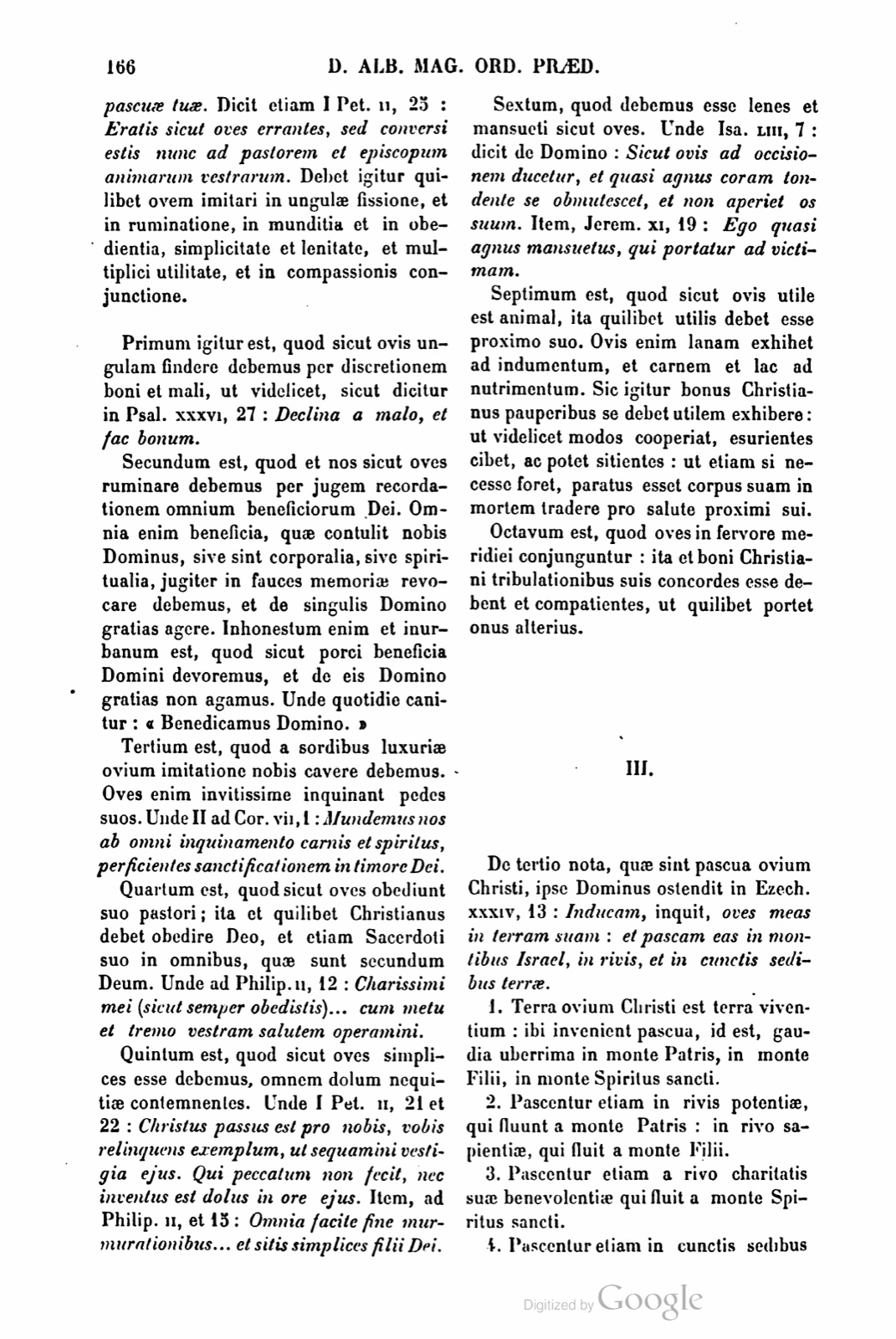
Sextum, quod debemus esse lenes et mansueti sicut oves. Unde Isa. liii, 7: dicit de Domino: Sicut ovis ad occisionem ducetur, et quasi agnus coram tondente se obmutescet, et non aperiet os suum. Item, Jerem. xi, 19: Ego quasi agnus mansuetus, qui portatur ad victimam.
Septimum est, quod sicut ovis utile est animal, ita quilibet utilis debet esse proximo suo. Ovis enim lanam exhibet ad indumentum, et carnem et lac ad nutrimentum. Sic igitur bonus Christianus pauperibus se debet utilem exhibere: ut videlicet nudos cooperiat, esurientes cibet, ac potet sitientes: ut etiam si necesse foret, paratus esset corpus suum in mortem tradere pro salute proximi sui.
Octavum est, quod oves in fervore meridiei conjunguntur: ita et boni Christiani tribulationibus suis concordes esse debent et compatientes, ut quilibet portet onus alterius.
III. De tertio nota, quæ sint pascua ovium Christi, ipse Dominus ostendit in Ezech. xxxiv, 13: Inducam, inquit, oves meas in terram suam: et pascam eas in montibus Israel, in rivis, et in cunctis sedibus terræ.
1. Terra ovium Christi est terra viventium: ibi invenient pascua, id est, gaudia uberrima in monte Patris, in monte Filii, in monte Spiritus sancti.
2. Pascentur etiam in rivis potentiæ, qui fluunt a monte Patris: in rivo sapientiæ, qui fluit a monte Filii.
3. Pascentur etiam a rivo charitatis suæ benevolentiæ qui fluit a monte Spiritus sancti.
4. Pascentur etiam in cunctis sedibus illius terræ, hoc est, in sede cujuslibet Angeli, et Archangeli, et in cunctis sedibus Virtutum, Potestatum, Principatuum, Dominationum, Thronorum, Cherubin, et Seraphin. Specialia gaudia in sede cujuslibet Patriarchæ et Prophetæ, Apostoli, Martyris, Confessoris, Virginis, Viduæ ac Conjugati spiritualia gaudia reperient. Quæ gaudia nobis præstare dignetur, qui cum Deo Patre et Spiritu sancto vivit et regnat Deus, per omnia sæcula sæculorum. Amen 1.
The sixth is that we ought to be gentle and meek like sheep. Hence Isaiah 53:7 says of the Lord: Like a sheep he will be led to slaughter, and like a lamb before the one shearing it he will be silent, and he will not open his mouth. Likewise Jeremiah 11:19 says: I was like a meek lamb that is carried to the victim.
The seventh is that, just as a sheep is a useful animal, so any person ought to be useful to his neighbor. For a sheep furnishes wool for clothing, and flesh and milk for nourishment. Thus therefore a good Christian ought to show himself useful to the poor, namely so that he may cover the naked, feed the hungry, and give drink to the thirsty, and also so that, if it were necessary, he would be ready to hand over his own body to death for the salvation of his neighbor.
The eighth is that sheep are joined together in the heat of midday; so also good Christians ought to be in agreement and compassionate in their tribulations, so that each bears the burden of the other.
III. On the third, note what the pastures of Christ's sheep are: the Lord himself shows it in Ezekiel 34:13: I will bring, he says, my sheep into their land; and I will feed them on the mountains of Israel, by the streams, and in all the dwelling places of the land.
1. The land of Christ's sheep is the land of the living; there they will find pastures, that is, most abundant joys, on the mountain of the Father, on the mountain of the Son, on the mountain of the Holy Spirit.
2. They will also be fed by the streams of power that flow from the mountain of the Father, and in the stream of wisdom that flows from the mountain of the Son.
3. They will also be fed from the stream of the charity of his benevolence that flows from the mountain of the Holy Spirit.
4. They will also be fed in all the seats of that land, that is, in the seat of any Angel and Archangel, and in all the seats of the Virtues, Powers, Principalities, Dominations, Thrones, Cherubim, and Seraphim. They will find special joys, spiritual joys, in the seat of any Patriarch and Prophet, Apostle, Martyr, Confessor, Virgin, Widow, and married person. May he grant us those joys, who with God the Father and the Holy Spirit lives and reigns, God, through all ages of ages. Amen 1.

Notes
- The exposition of the fourth member of the division of the theme placed above is lacking, namely, What is the wolf that lies in wait for the Lord’s sheep? (Deest expositio quarti membri divisionis thematis supra positi, scilicet, Quis sit lupus, qui Domini ovibus insidiatur?) ↩
If a page does not appear, its photograph has not been uploaded yet.