Works › Sermons for the Seasons of the Year
Volume 13 · pp. 158–160
Sermon XXXVII. Again on Easter Day
A marker with ≈ is an approximate page boundary, placed by measure of the text; the page photographs remain the authority. In the paired views, clicking a page marker brings that page into view.
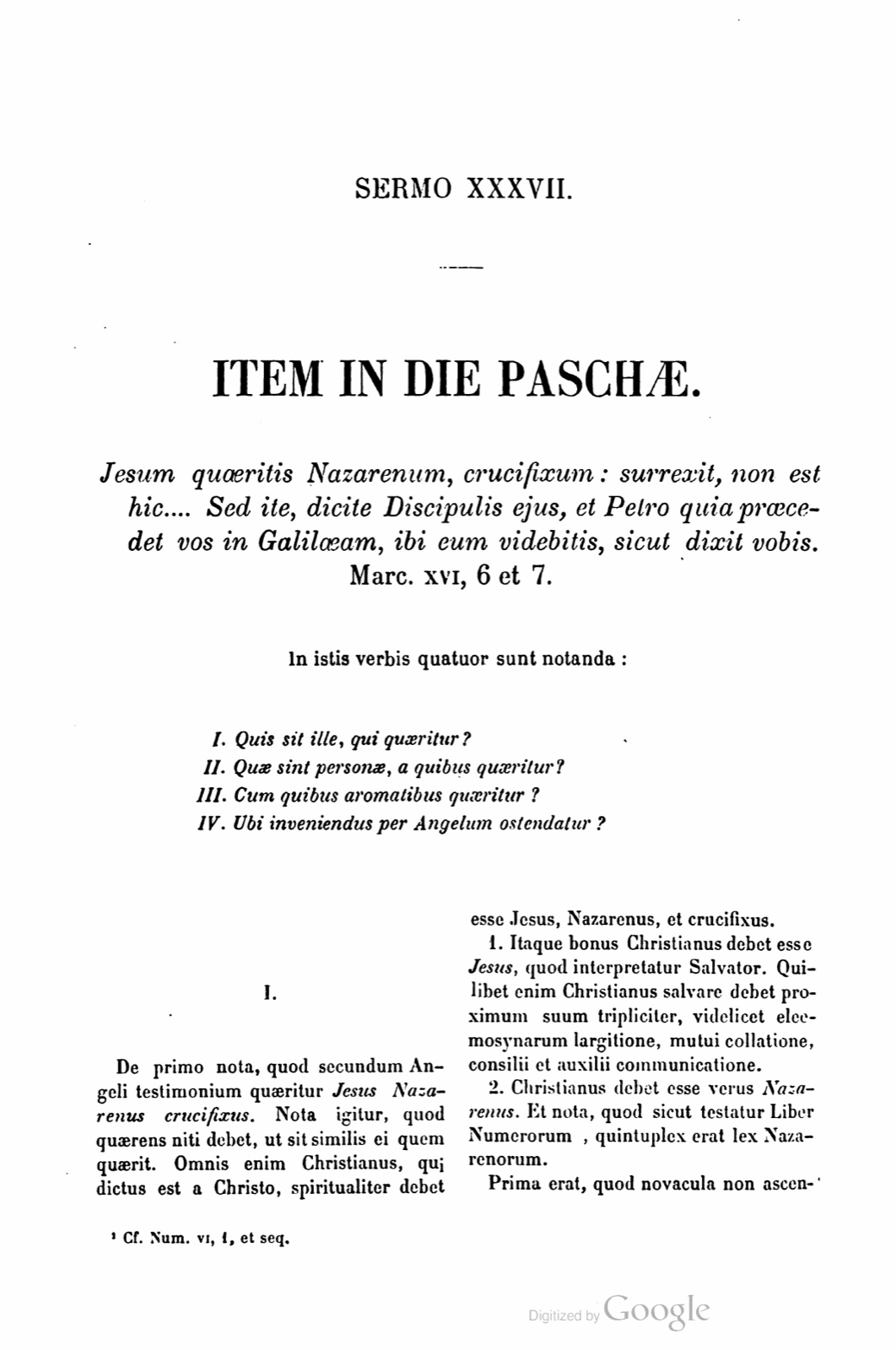
SERMO XXXVII. ITEM IN DIE PASCHÆ.
Jesum quæritis Nazarenum, crucifixum: surrexit, non est hic.... Sed ite, dicite Discipulis ejus, et Petro quia præcedet vos in Galilæam, ibi eum videbitis, sicut dixit vobis. Marc. xvi, 6 et 7.
In istis verbis quatuor sunt notanda: I. Quis sit ille, qui quæritur? II. Quæ sint personæ, a quibus quæritur? III. Cum quibus aromatibus quæritur? IV. Ubi inveniendus per Angelum ostendatur?
I. De primo nota, quod secundum Angeli testimonium quæritur Jesus Nazarenus crucifixus. Nota igitur, quod quærens niti debet, ut sit similis ei quem quærit. Omnis enim Christianus, qui dictus est a Christo, spiritualiter debet esse Jesus, Nazarenus, et crucifixus.
1. Itaque bonus Christianus debet esse Jesus, quod interpretatur Salvator. Quilibet enim Christianus salvare debet proximum suum tripliciter, videlicet eleemosynarum largitione, mutui collatione, consilii et auxilii communicatione.
2. Christianus debet esse verus Nazarenus. Et nota, quod sicut testatur Liber Numerorum 1, quintuplex erat lex Nazarenorum. Prima erat, quod novacula non ascendebat super capita eorum: per novaculam accipitur dolus et malitia. Cavere ergo debet Christianus, ne sicut novacula acuta faciat dolum 2, et ne per malitiam et nequitiam gratiam Spiritus septiformis præcidat a capite mentis suæ. Qui enim amiserit gratiam Spiritus sancti, amisit capillos, id est, ornatum animæ suæ.
Secunda erat, quod quidquid inebriare poterat, non bibebant. In quo innuitur quod ab ebrietate cavere debet quilibet Christianus: Contra ebrietatem dicit Eccli. xxxi, 30 et 31: Multos exterminavit vinum... Vinum corda superborum arguet in ebrietate potatum. Ibi dicit Glossa: «Ebrietas multos subvertit, quæ sensum minuit, iram excitat, libidinem inflammat, animi secreta revelat.»
Tertia fuit, quod quicquid de vinea erat, non comedebant: in quo significatur, quod quilibet Christianus fugere debet fornicationem et luxuriam. Luxuria enim uva est, quæ crescit in vinea Sodomorum 3: et certe uva eorum uva erit fellis, et botri amarissimi. Malitia quippe unius horæ, in inferno videlicet, oblivionem facit luxuriæ maximæ: sicut ait Eccli. xi, 29.
SERMON XXXVII. AGAIN ON EASTER DAY.
You seek Jesus of Nazareth, the crucified: he has risen, he is not here.... But go, tell his Disciples and Peter that he goes before you into Galilee; there you will see him, as he told you. Mark 16:6 and 7.
In these words four things are to be noted: I. Who is he who is sought? II. What are the persons by whom he is sought? III. With what aromatic spices is he sought? IV. Where is he shown by the Angel as to be found?
I. On the first, note that according to the testimony of the Angel, Jesus of Nazareth, the crucified, is sought. Therefore note that the one seeking ought to strive to be like him whom he seeks. For every Christian, who is named from Christ, spiritually ought to be Jesus, a Nazarene, and crucified.
1. And so a good Christian ought to be Jesus, which is interpreted Savior. For any Christian ought to save his neighbor in three ways, namely by the giving of alms, by the granting of a loan, and by the communication of counsel and help.
2. A Christian ought to be a true Nazarene. And note that, as the Book of Numbers testifies 1, the law of the Nazarenes was fivefold. The first was that a razor did not go up over their heads: by the razor deceit and malice are understood. Therefore the Christian ought to beware lest, like a sharp razor, he make deceit 2, and lest through malice and wickedness he cut off the grace of the sevenfold Spirit from the head of his mind. For one who has lost the grace of the Holy Spirit has lost the hairs, that is, the adornment of his soul.
The second was that they did not drink anything that could make one drunk. In this it is intimated that every Christian ought to beware of drunkenness. Against drunkenness Ecclesiasticus 31:30 and 31 says: Wine has destroyed many... Wine drunk in intoxication will accuse the hearts of the proud. There the Gloss says: Drunkenness overturns many; it lessens sense, stirs up anger, inflames lust, and reveals the secrets of the soul.
The third was that they did not eat anything from the vine. In this it is signified that every Christian ought to flee fornication and luxury. For luxury is the grape that grows in the vine of the Sodomites 3; and certainly their grape will be a grape of gall, and their clusters most bitter. Indeed the malice of one hour, namely in hell, causes forgetfulness of the greatest luxury, as Ecclesiasticus 11:29 says.
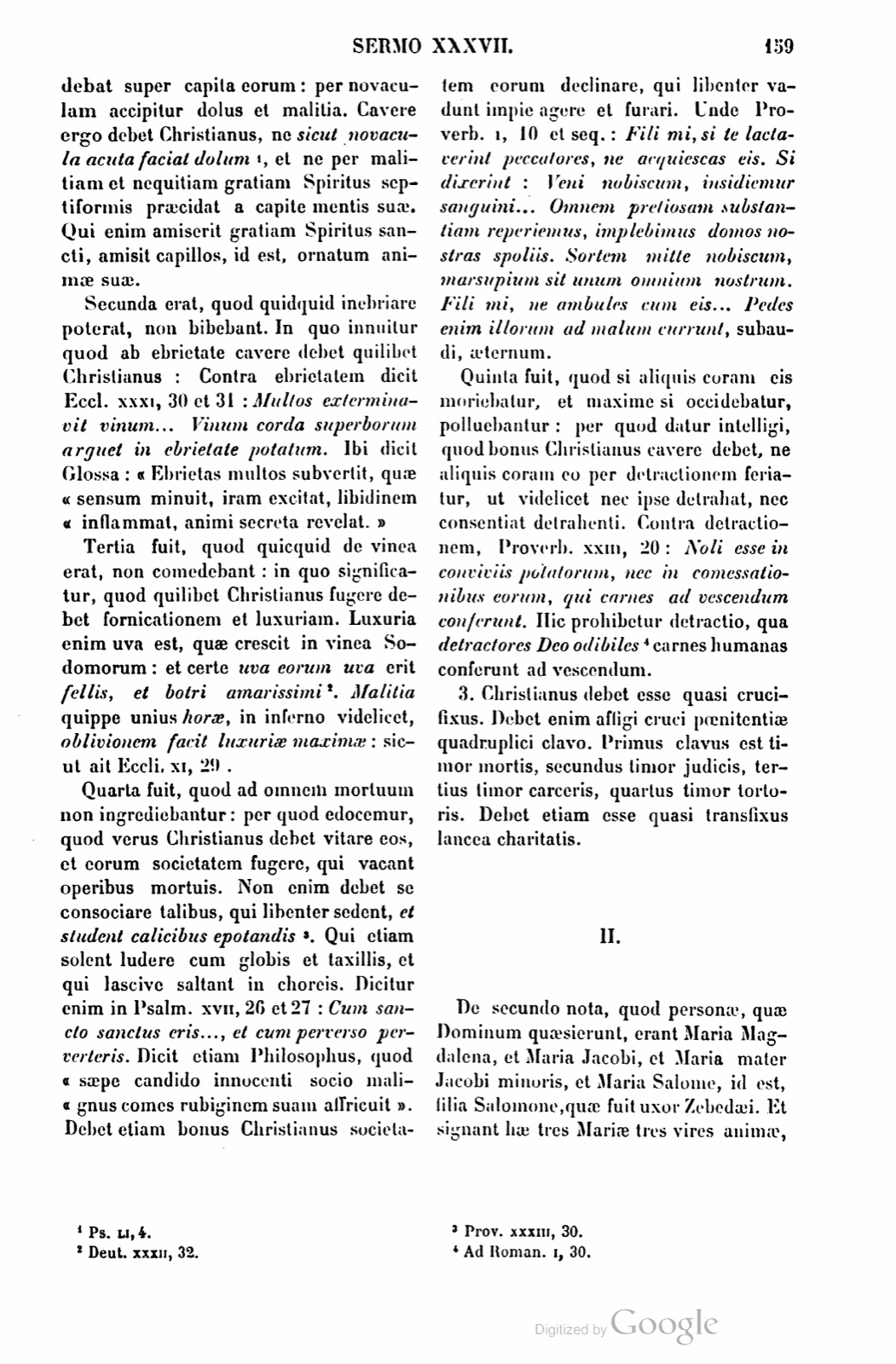
Quarta fuit, quod ad omnem mortuum non ingrediebantur: per quod edocemur, quod verus Christianus debet vitare eos, et eorum societatem fugere, qui vacant operibus mortuis. Non enim debet se consociare talibus, qui libenter sedent, et student calicibus epotandis 4. Qui etiam solent ludere cum globis et taxillis, et qui lascive saltant in choreis. Dicitur enim in Psalm. xvii, 26 et 27: Cum sancto sanctus eris..., et cum perverso perverteris. Dicit etiam Philosophus, quod «sæpe candido innocenti socio malignus comes rubiginem suam affricuit.» Debet etiam bonus Christianus societatem eorum declinare, qui libenter vadunt impie agere et furari. Unde Proverb. i, 10 et seq.: Fili mi, si te lactaverint peccatores, ne acquiescas eis. Si dixerint: Veni nobiscum, insidiemur sanguini... Omnem pretiosam substantiam reperiemus, implebimus domos nostras spoliis. Sortem mitte nobiscum, marsupium sit unum omnium nostrum. Fili mi, ne ambules cum eis... Pedes enim illorum ad malum currunt, subaudi, æternum.
Quinta fuit, quod si aliquis coram eis moriebatur, et maxime si occidebatur, polluebantur: per quod datur intelligi, quod bonus Christianus cavere debet, ne aliquis coram eo per detractionem feriatur, ut videlicet nec ipse detrahat, nec consentiat detrahenti. Contra detractionem, Proverb. xxiii, 20: Noli esse in conviviis potatorum, nec in comessationibus eorum, qui carnes ad vescendum conferunt. Hic prohibetur detractio, qua detractores Deo odibiles 5 carnes humanas conferunt ad vescendum.
3. Christianus debet esse quasi crucifixus. Debet enim affigi cruci pænitentiæ quadruplici clavo. Primus clavus est timor mortis, secundus timor judicis, tertius timor carceris, quartus timor tortoris. Debet etiam esse quasi transfixus lancea charitatis.
II. De secundo nota, quod personæ, quæ Dominum quæsierunt, erant Maria Magdalena, et Maria Jacobi, et Maria mater Jacobi minoris, et Maria Salome, id est, filia Salomone, quæ fuit uxor Zebedæi. Et signant hæ tres Mariæ tres vires animæ, per quas anima Deum quærit. Maria Magdalena, quæ interpretatur Domina in turri, significat vim rationabilem. Anima enim in ratione sedens, quasi in turri eminenti ex ipsa prospicit omnes insidias inimici. Maria Jacobi, quæ interpretatur Domina luctatrix, exprimit vim irascibilem, per quam anima vanis et immundis peccati illecebris sive delectationibus irascitur, easque abjicit et conculcat. Maria Salome, quæ interpretatur Domina pacifica, figurat vim concupiscibilem, per quam anima pacem veram, quæ exsuperat omnem sensum 6, hoc est, summum bonum vehementer concupiscit, et quærit.
The fourth was that they did not go in to any dead person. Through this we are taught that a true Christian ought to avoid those, and flee their society, who are occupied with dead works. For he ought not to associate himself with such persons who gladly sit and apply themselves to draining cups 4, who also are accustomed to play with balls and dice, and who dance wantonly in dances. For it is said in Psalm 17:26 and 27: With the holy you will be holy..., and with the perverse you will be perverted. The Philosopher also says that often a malignant companion has rubbed his rust upon a white innocent companion. A good Christian also ought to avoid the society of those who gladly go to act impiously and steal. Hence Proverbs 1:10 and following: My son, if sinners entice you, do not consent to them. If they say: Come with us, let us lie in wait for blood... We shall find every precious substance; we shall fill our houses with spoils. Cast your lot with us; let there be one purse for us all. My son, do not walk with them... For their feet run to evil, understand, eternal evil.
The fifth was that if anyone died before them, and especially if he was killed, they were polluted. Through this it is given to be understood that a good Christian ought to beware lest someone before him be struck by detraction, namely so that he neither detract nor consent to one detracting. Against detraction, Proverbs 23:20 says: Do not be in the banquets of drinkers, nor in the feasts of those who bring together meats for eating. Here detraction is prohibited, by which detractors, hateful to God 5, bring together human flesh for eating.
3. A Christian ought to be as if crucified. For he ought to be fastened to the cross of penance by a fourfold nail. The first nail is fear of death, the second fear of the judge, the third fear of prison, the fourth fear of the torturer. He ought also to be as if pierced through by the lance of charity.
II. On the second, note that the persons who sought the Lord were Mary Magdalene, and Mary of James, and Mary the mother of James the Less, and Mary Salome, that is, the daughter of Salome, who was the wife of Zebedee. And these three Marys signify the three powers of the soul through which the soul seeks God. Mary Magdalene, which is interpreted Lady in the tower, signifies the rational power. For the soul sitting in reason, as if in a lofty tower, from it looks out upon all the ambushes of the enemy. Mary of James, which is interpreted Lady wrestler, expresses the irascible power, through which the soul is angry at the vain and unclean enticements or delights of sin and casts them away and tramples them. Mary Salome, which is interpreted Lady peaceful, figures the concupiscible power, through which the soul vehemently desires and seeks true peace, which surpasses every sense 6, that is, the highest good.
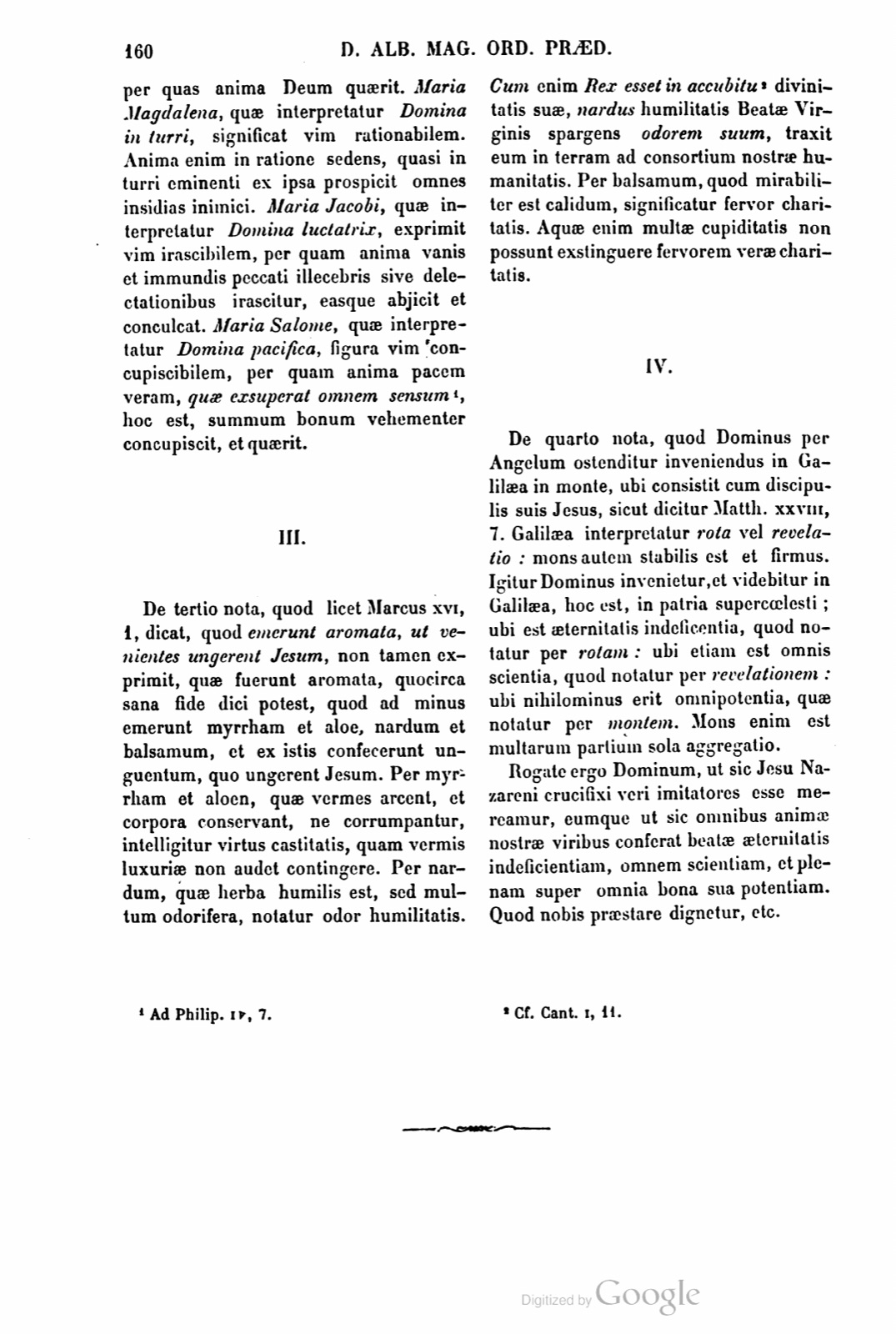
III. De tertio nota, quod licet Marcus xvi, 1, dicat, quod emerunt aromata, ut venientes ungerent Jesum, non tamen exprimit, quæ fuerunt aromata, quocirca sana fide dici potest, quod ad minus emerunt myrrham et aloe, nardum et balsamum, et ex istis confecerunt unguentum, quo ungerent Jesum. Per myrrham et aloen, quæ vermes arcent, et corpora conservant, ne corrumpantur, intelligitur virtus castitatis, quam vermis luxuriæ non audet contingere. Per nardum, quæ herba humilis est, sed multum odorifera, notatur odor humilitatis. Cum enim Rex esset in accubitu 7 divinitatis suæ, nardus humilitatis Beatæ Virginis spargens odorem suum, traxit eum in terram ad consortium nostræ humanitatis. Per balsamum, quod mirabiliter est calidum, significatur fervor charitatis. Aquæ enim multæ cupiditatis non possunt exstinguere fervorem veræ charitatis.
IV. De quarto nota, quod Dominus per Angelum ostenditur inveniendus in Galilæa in monte, ubi consistit cum discipulis suis Jesus, sicut dicitur Matth. xxviii, 7. Galilæa interpretatur rota vel revelatio: mons autem stabilis est et firmus. Igitur Dominus invenietur, et videbitur in Galilæa, hoc est, in patria supercœlesti; ubi est æternitatis indeficentia, quod notatur per rotam: ubi etiam est omnis scientia, quod notatur per revelationem: ubi nihilominus erit omnipotentia, quæ notatur per montem. Mons enim est multarum partium sola aggregatio.
Rogate ergo Dominum, ut sic Jesu Nazareni crucifixi veri imitatores esse mereamur, eumque ut sic omnibus animæ nostræ viribus conferat beatæ æternitatis indeficientiam, omnem scientiam, et plenam super omnia bona sua potentiam. Quod nobis præstare dignetur, etc.
III. On the third, note that although Mark 16:1 says that they bought aromatic spices so that, coming, they might anoint Jesus, nevertheless it does not express what the aromatic spices were. Therefore with sound faith it can be said that at least they bought myrrh and aloe, nard and balsam, and from these they made an ointment with which they might anoint Jesus. By myrrh and aloe, which keep worms away and preserve bodies so that they are not corrupted, is understood the virtue of chastity, which the worm of luxury does not dare to touch. By nard, which is a humble herb but very fragrant, is noted the odor of humility. For when the King was in the couch 7 of his divinity, the nard of the humility of the Blessed Virgin, spreading its odor, drew him down to earth to the fellowship of our humanity. By balsam, which is wonderfully warm, is signified the fervor of charity. For many waters of cupidity cannot extinguish the fervor of true charity.
IV. On the fourth, note that the Lord is shown by the Angel as to be found in Galilee on the mountain, where Jesus remains with his disciples, as is said in Matthew 28:7. Galilee is interpreted wheel or revelation; but a mountain is stable and firm. Therefore the Lord will be found and seen in Galilee, that is, in the supercelestial homeland, where there is the unfailingness of eternity, which is noted by the wheel; where also there is all knowledge, which is noted by revelation; where likewise there will be omnipotence, which is noted by the mountain. For a mountain is a single aggregation of many parts.
Therefore pray to the Lord that we may deserve thus to be true imitators of Jesus of Nazareth, the crucified, and that he may thus confer on all the powers of our soul the unfailingness of blessed eternity, all knowledge, and full power over all his goods. May he deign to grant this to us, and so forth.
If a page does not appear, its photograph has not been uploaded yet.