Works › Sermons for the Seasons of the Year
Volume 13 · pp. 124–126
Sermon XXVII. On the First Sunday of Lent
A marker with ≈ is an approximate page boundary, placed by measure of the text; the page photographs remain the authority. In the paired views, clicking a page marker brings that page into view.
Sermo XXVII.
In Dominica I Quadragesimae.
Jesus ductus est in desertum a Spiritu. Matth. iv, 1.
Quatuor occurrunt hic notanda:
I. Quis per Jesum intelligatur? II. Quid per desertum exprimatur? III. Quare Jesus in desertum a spiritu ducatur? IV. Quid per ministerium Angelorum accipiatur?
I.
De primo nota, quod per Jesum quilibet Christianus, qui membrum Christi est, intelligitur. Sicut enim Christus primo in Jordane baptizatus fuit, et super ipsum baptizatum Spiritus sanctus in specie columbae descendit, et tertio quadraginta diebus, et quadraginta noctibus jejunavit: sic etiam Christianus ministerio Sacerdotis in fonte baptismatis emundatur. Postquam autem emundatus fuerit, templum et habitaculum Sancti Spiritus efficitur. Unde et toto tempore vitae a vitiis et concupiscentiis hujus mundi, quibus in baptismo renuntiavit, jejunare debet. Et bene per quadragenarium numerum omne tempus vitae nostrae accipitur. Per totam enim vitam nostram decalogum legis divinae quadriformiter amplecti debemus, et adimplere, videlicet dilectionem, locutionem, operationem. Quem enim aliquis sincere diligit, libenter de eo cogitat, et loquitur, et servit aut obsequitur ei.
II.
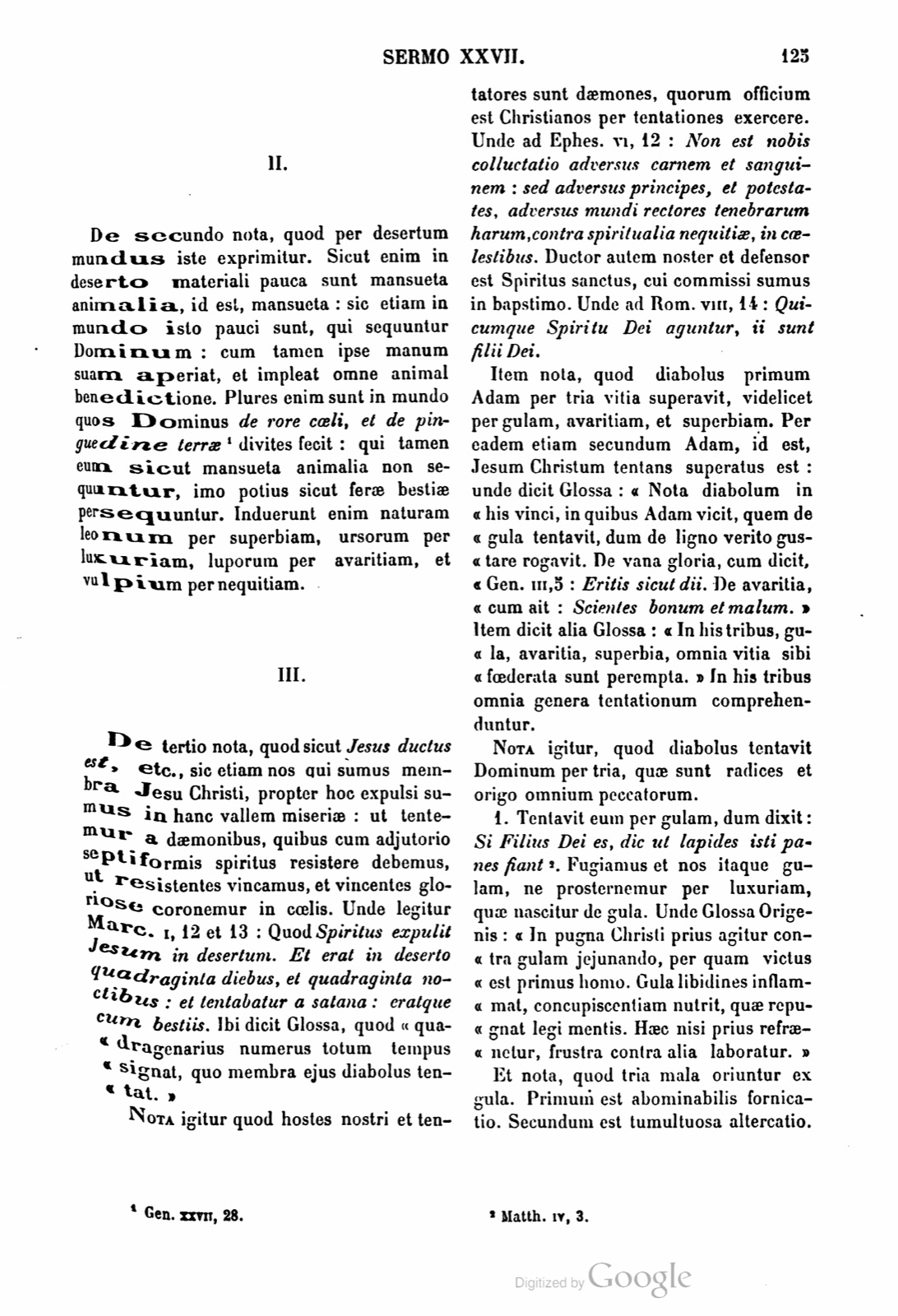
De secundo nota, quod per desertum mundus iste exprimitur. Sicut enim in deserto materiali pauca sunt mansueta animalia, id est, mansueta: sic etiam in mundo isto pauci sunt, qui sequuntur Dominum: cum tamen ipse manum suam aperiat, et impleat omne animal benedictione. Plures enim sunt in mundo quos Dominus de rore caeli, et de pinguedine terrae divites fecit: qui tamen eum sicut mansueta animalia non sequuntur, imo potius sicut ferae bestiae persequuntur. Induerunt enim naturam leonum per superbiam, ursorum per luxuriam, luporum per avaritiam, et vulpium per nequitiam.
III.
De tertio nota, quod sicut Jesus ductus est, etc., sic etiam nos qui sumus membra Jesu Christi, propter hoc expulsi sumus in hanc vallem miseriae: ut tentemur a daemonibus, quibus cum adjutorio septiformis spiritus resistere debemus, ut resistentes vincamus, et vincentes glorios coronemur in caelis. Unde legitur Marc. i, 12 et 13: Quod Spiritus expulit Jesum in desertum. Et erat in deserto quadraginta diebus, et quadraginta noctibus: et tentabatur a satana: eratque cum bestiis. Ibi dicit Glossa, quod "quadragenarius numerus totum tempus signat, quo membra ejus diabolus tentat."
Sermon XXVII.
On the First Sunday of Lent.
Jesus was led into the desert by the Spirit. Matthew 4:1.
Four things occur here to be noted:
I. Who is understood by Jesus? II. What is expressed by the desert? III. Why is Jesus led into the desert by the Spirit? IV. What is taken by the ministry of Angels?
I.
Concerning the first, note that by Jesus any Christian who is a member of Christ is understood. For just as Christ first was baptized in the Jordan, and the Holy Spirit descended upon him baptized in the appearance of a dove, and thirdly fasted forty days and forty nights, so also the Christian is cleansed by the ministry of the Priest in the font of baptism. But after he has been cleansed, he is made a temple and dwelling of the Holy Spirit. Hence through the whole time of life he ought to fast from the vices and desires of this world that he renounced in baptism. And well, by the number forty, the whole time of our life is taken. For through our whole life we ought to embrace and fulfill the decalogue of the divine law fourfold, namely by love, speech, and operation. For the one whom someone sincerely loves, he gladly thinks about him, speaks about him, and serves or obeys him.
II.
Concerning the second, note that by the desert this world is expressed. For just as in a material desert there are few tame animals, that is, gentle ones, so also in this world there are few who follow the Lord, although he opens his hand and fills every animal with blessing. For there are more in the world whom the Lord made rich from the dew of heaven and the fatness of the earth, who nevertheless do not follow him like tame animals, but rather persecute him like wild beasts. For they have put on the nature of lions through pride, of bears through luxury, of wolves through avarice, and of foxes through wickedness.
III.
Concerning the third, note that just as Jesus was led, etc., so also we who are members of Jesus Christ have been expelled into this valley of misery for this reason, that we may be tempted by demons, whom with the aid of the sevenfold Spirit we ought to resist, so that resisting we may conquer and, conquering, be gloriously crowned in heaven. Hence it is read in Mark 1:12 and 13 that the Spirit drove Jesus into the desert. And he was in the desert forty days and forty nights and was tempted by Satan and was with beasts. There the Gloss says that "the number forty signifies the whole time during which the devil tempts his members."

Nota igitur quod hostes nostri et tentatores sunt daemones, quorum officium est Christianos per tentationes exercere. Unde ad Ephes. vi, 12: Non est nobis colluctatio adversus carnem et sanguinem: sed adversus principes, et potestates, adversus mundi rectores tenebrarum harum, contra spiritualia nequitiae, in caelestibus. Ductor autem noster et defensor est Spiritus sanctus, cui commissi sumus in baptismio. Unde ad Rom. viii, 14: Quicumque Spiritu Dei aguntur, ii sunt filii Dei.
Item nota, quod diabolus primum Adam per tria vitia superavit, videlicet per gulam, avaritiam, et superbiam. Per eadem etiam secundum Adam, id est, Jesum Christum tentans superatus est: unde dicit Glossa: "Nota diabolum in his vinci, in quibus Adam vicit, quem de gula tentavit, dum de ligno vetito gustare rogavit. De vana gloria, cum dicit, Gen. iii, 5: Eritis sicut dii. De avaritia, cum ait: Scientes bonum et malum." Item dicit alia Glossa: "In his tribus, gula, avaritia, superbia, omnia vitia sibi foederata sunt perempta." In his tribus omnia genera tentationum comprehenduntur.
Nota igitur, quod diabolus tentavit Dominum per tria, quae sunt radices et origo omnium peccatorum.
1. Tentavit eum per gulam, dum dixit: Si Filius Dei es, dic ut lapides isti panes fiant 1. Fugiamus et nos itaque gulam, ne prosternemur per luxuriam, quae nascitur de gula. Unde Glossa Origenis: "In pugna Christi prius agitur contra gulam jejunando, per quam victus est primus homo. Gula libidines inflammat, concupiscentiam nutrit, quae repugnat legi mentis. Haec nisi prius refraenetur, frustra contra alia laboratur." Et nota, quod tria mala oriuntur ex gula. Primum est abominabilis fornicatio. Secundum est tumultuosa altercatio. Tertium secretorum revelatio. De primo nota, quod illi homines Sodomitae, qui nimium erant gulosi, effecti fuerunt abominabiliter luxuriosi. Unde Ezech. xvi, 49: Ecce haec fuit iniquitas Sodomae sororis tuae, superbia, saturitas panis et abundantia, et otium ipsius, et filiarum ejus. Item de primo et secundo, Proverb. xx, 1: Luxuriosa res, vinum, et tumultuosa ebrietas: quicumque his delectatur, non erit sapiens. De secundo, Proverb. xxiii, 29 et 30: Cui rixae? cui sine causa vulnera? Nonne his, qui commorantur in vino, et student calicibus epotandis? De tertio, Proverb. xxxi, 4: Nullum secretum est ubi regnat ebrietas.
Therefore note that our enemies and tempters are demons, whose office is to exercise Christians through temptations. Hence Ephesians 6:12: Our wrestling is not against flesh and blood, but against princes and powers, against the rulers of this darkness of the world, against spiritual wickedness in heavenly places. But our leader and defender is the Holy Spirit, to whom we were committed in baptism. Hence Romans 8:14: Whoever are led by the Spirit of God, these are sons of God.
Likewise note that the devil overcame the first Adam through three vices, namely gluttony, avarice, and pride. Through the same, tempting the second Adam, that is, Jesus Christ, he was overcome. Hence the Gloss says: "Note that the devil is conquered in those things in which he conquered Adam, whom he tempted about gluttony when he asked him to taste from the forbidden tree; about vainglory when he says, Genesis 3:5, You will be like gods; about avarice when he says, knowing good and evil." Another Gloss also says: "In these three, gluttony, avarice, and pride, all vices allied to themselves were destroyed." In these three all kinds of temptations are comprehended.
Therefore note that the devil tempted the Lord through three things, which are the roots and origin of all sins.
1. He tempted him through gluttony when he said: If you are the Son of God, say that these stones become breads 1. Let us therefore also flee gluttony, lest we be cast down through luxury, which is born from gluttony. Hence the Gloss of Origen says: "In the battle of Christ the first thing is done against gluttony by fasting, through which the first human being was conquered. Gluttony inflames lusts, nourishes desire, which fights against the law of the mind. Unless this is first restrained, labor against other things is in vain." And note that three evils arise from gluttony. The first is abominable fornication. The second is tumultuous altercation. The third is the revelation of secrets. Concerning the first, note that those Sodomite men, who were exceedingly gluttonous, were made abominably luxurious. Hence Ezekiel 16:49: Behold, this was the iniquity of Sodom your sister: pride, fullness of bread and abundance, and idleness of her and of her daughters. Likewise concerning the first and second, Proverbs 20:1: Wine is a luxurious thing and drunkenness tumultuous; whoever is delighted in these will not be wise. Concerning the second, Proverbs 23:29 and 30: For whom are quarrels? For whom wounds without cause? Is it not for those who tarry in wine and strive to empty cups? Concerning the third, Proverbs 31:4: There is no secret where drunkenness reigns.
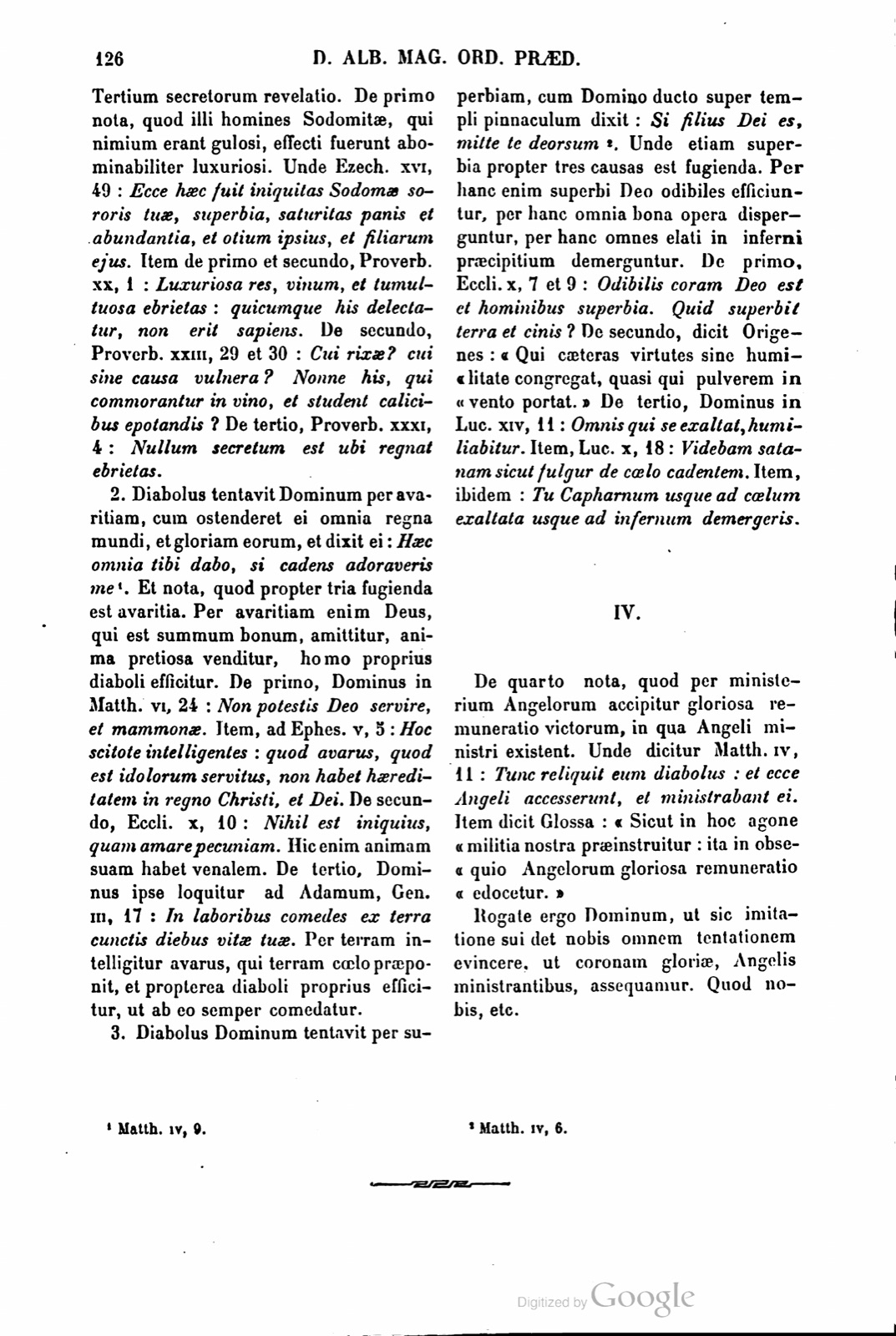
2. Diabolus tentavit Dominum per avaritiam, cum ostenderet ei omnia regna mundi, et gloriam eorum, et dixit ei: Haec omnia tibi dabo, si cadens adoraveris me 2. Et nota, quod propter tria fugienda est avaritia. Per avaritiam enim Deus, qui est summum bonum, amittitur, anima pretiosa venditur, homo proprius diaboli efficitur. De primo, Dominus in Matth. vi, 24: Non potestis Deo servire, et mammonae. Item, ad Ephes. v, 5: Hoc scitote intelligentes: quod avarus, quod est idolorum servitus, non habet haereditatem in regno Christi, et Dei. De secundo, Eccli. x, 10: Nihil est iniquius, quam amare pecuniam. Hic enim animam suam habet venalem. De tertio, Dominus ipse loquitur ad Adamum, Gen. iii, 17: In laboribus comedes ex terra cunctis diebus vitae tuae. Per terram intelligitur avarus, qui terram caelo praeponit, et propterea diaboli proprius efficitur, ut ab eo semper comedatur.
3. Diabolus Dominum tentavit per superbiam, cum Domino ducto super templi pinnaculum dixit: Si filius Dei es, mitte te deorsum 3. Unde etiam superbia propter tres causas est fugienda. Per hanc enim superbi Deo odibiles efficiuntur, per hanc omnia bona opera disperguntur, per hanc omnes elati in inferni praecipitium demerguntur. De primo, Eccli. x, 7 et 9: Odibilis coram Deo est et hominibus superbia. Quid superbit terra et cinis? De secundo, dicit Origenes: "Qui caeteras virtutes sine humilitate congregat, quasi qui pulverem in vento portat." De tertio, Dominus in Luc. xiv, 11: Omnis qui se exaltat, humiliabitur. Item, Luc. x, 18: Videbam satanam sicut fulgur de caelo cadentem. Item, ibidem: Tu Capharnum usque ad caelum exaltata usque ad infernum demergeris.
IV.
De quarto nota, quod per ministerium Angelorum accipitur gloriosa remuneratio victorum, in qua Angeli ministri existent. Unde dicitur Matth. iv, 11: Tunc reliquit eum diabolus: et ecce Angeli accesserunt, et ministrabant ei. Item dicit Glossa: "Sicut in hoc agone militia nostra praeinstruitur: ita in obsequio Angelorum gloriosa remuneratio edocetur."
Rogate ergo Dominum, ut sic imitatione sui det nobis omnem tentationem evincere, ut coronam gloriae, Angelis ministrantibus, assequamur. Quod nobis, etc.
2. The devil tempted the Lord through avarice when he showed him all the kingdoms of the world and their glory and said to him: All these things I will give you, if falling down you will adore me 2. And note that avarice is to be fled for three reasons. Through avarice God, who is the highest good, is lost; the precious soul is sold; a human being is made the devil's own. Concerning the first, the Lord says in Matthew 6:24: You cannot serve God and mammon. Likewise Ephesians 5:5: Know this understanding, that an avaricious person, which is servitude to idols, has no inheritance in the kingdom of Christ and of God. Concerning the second, Ecclesiasticus 10:10: Nothing is more iniquitous than to love money, for this one has his soul for sale. Concerning the third, the Lord himself speaks to Adam, Genesis 3:17: In labors you will eat from the earth all the days of your life. By earth is understood the avaricious person, who prefers earth to heaven and for that reason is made the devil's own, so that he is always eaten by him.
3. The devil tempted the Lord through pride when, after the Lord had been led onto the pinnacle of the temple, he said: If you are the Son of God, cast yourself down 3. Hence pride too is to be fled for three causes. Through it the proud are made hateful to God; through it all good works are scattered; through it all the lofty are sunk into the precipice of hell. Concerning the first, Ecclesiasticus 10:7 and 9: Pride is hateful before God and human beings. Why is earth and ash proud? Concerning the second, Origen says: "The one who gathers the other virtues without humility is like one who carries dust in the wind." Concerning the third, the Lord says in Luke 14:11: Everyone who exalts himself will be humbled. Likewise Luke 10:18: I saw Satan falling like lightning from heaven. Likewise in the same place: You, Capernaum, exalted up to heaven, will be sunk down to hell.
IV.
Concerning the fourth, note that by the ministry of Angels is taken the glorious reward of the victors, in which the Angels will be ministers. Hence it is said in Matthew 4:11: Then the devil left him, and behold Angels came and ministered to him. The Gloss also says: "As our warfare is pre-instructed in this struggle, so in the service of Angels the glorious reward is taught."
Therefore pray to the Lord that in imitation of himself he may grant us so to overcome every temptation that, with Angels ministering, we may attain the crown of glory. May he grant this to us, etc.
If a page does not appear, its photograph has not been uploaded yet.