Works › Sermons for the Seasons of the Year
Volume 13 · pp. 115–119
Sermon XXV. On the Same Day of Ashes
A marker with ≈ is an approximate page boundary, placed by measure of the text; the page photographs remain the authority. In the paired views, clicking a page marker brings that page into view.
Sermo XXV.
Eodem die Cinerum.
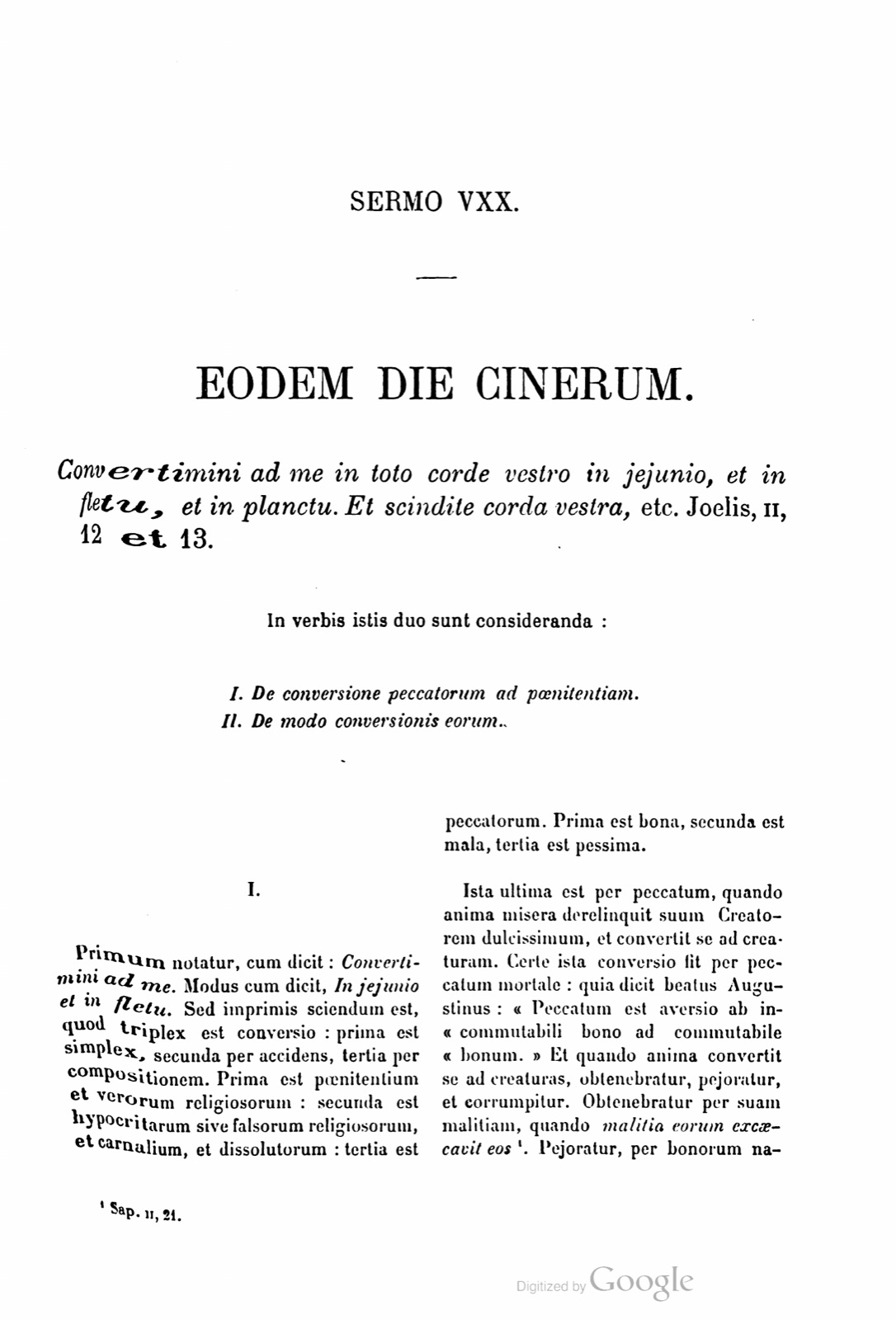
Convertimini ad me in toto corde vestro in jejunio, et in fletu, et in planctu. Et scindite corda vestra, etc. Joelis, ii, 12 et 13.
In verbis istis duo sunt consideranda:
I. De conversione peccatorum ad poenitentiam. II. De modo conversionis eorum.
I.
Primum notatur, cum dicit: Convertimini ad me. Modus cum dicit, In jejunio et in fletu. Sed imprimis sciendum est, quod triplex est conversio: prima est simplex, secunda per accidens, tertia per compositionem. Prima est poenitentium et verorum religiosorum: secunda est hypocritarum sive falsorum religiosorum, et carnalium, et dissolutorum: tertia est peccatorum. Prima est bona, secunda est mala, tertia est pessima.
Ista ultima est per peccatum, quando anima misera derelinquit suum Creatorem dulcissimum, et convertit se ad creaturam. Certe ista conversio fit per peccatum mortale: quia dicit beatus Augustinus: "Peccatum est aversio ab incommutabili bono ad commutabile bonum." Et quando anima convertit se ad creaturas, obtenebratur, pejoratur, et corrumpitur. Obtenebratur per suam malitiam, quando malitia eorum excaecavit eos 1. Pejoratur, per bonorum naturalium vulnerationem, quia per peccatum vulneratur anima in ratione, in memoria, et in intellectu. Corrumpitur, per bonorum gratuitorum exspoliationem. Unde Luc. x, 30: Homo quidam descendebat ab Jerusalem in Jericho, et incidit in latrones, id est, daemones, qui vulneraverunt eum in naturalibus, et spoliaverunt eum in gratuitis. Isti in fine avertuntur in infernum. Unde Psalmista: Convertantur peccatores in infernum, omnes gentes quae obliviscuntur Deum 2.
Secunda est particularis, sicut convertuntur religiosi dissoluti, carnales, et otiosi, qui non cessant domos circuire, sicut mulieres: de quibus dicit Apostolus I ad Timoth. v, 11 et 12: Adolescentiores viduas devita: quia primam fidem irritam fecerunt. Similiter et otiosi dicuntur circuire domos, non solum otiose, sed verbose, et curiose loquentes, quae non oportet. Isti sunt similes garrulae mulieri, de qua dicitur Proverb. vii, 10 et 11: Mulier... garrula et vaga, quietis impatiens, nec valens in domo consistere pedibus suis. Isti habent exterius habitum religionis, sed interius nullam habent religionem. De istis dicit Dominus, Jerem. ii, 27: Verterunt ad me tergum, et non faciem. Et ideo talibus dicit Jerem. iii, 14: Convertimini filii revertentes: quia ego vir vester: et assumam vos. Et hic: Convertimini ad me in toto corde vestro, non in parte.
Tertia conversio est simplex, et bona, et ista est, quando omnia nostra desideria et cogitationes ad Deum convertimus, et eum totis visceribus diligimus. De hac dicitur Joel. ii, 12: Convertimini ad me in toto corde vestro.
Sermon XXV.
On the Same Day of Ashes.
Be converted to me with your whole heart, in fasting and in weeping and in mourning. And rend your hearts, etc. Joel 2:12 and 13.
In these words two things are to be considered:
I. Concerning the conversion of sinners to penance. II. Concerning the manner of their conversion.
I.
The first is marked when he says: Be converted to me. The manner is marked when he says: In fasting and in weeping. But first it must be known that there is a threefold conversion: the first is simple, the second by accident, the third by composition. The first is of penitents and true religious; the second is of hypocrites or false religious, and of the carnal and dissolute; the third is of sinners. The first is good, the second is evil, the third is worst.
That last conversion is through sin, when the wretched soul abandons its sweetest Creator and turns itself to the creature. Certainly this conversion happens through mortal sin, because blessed Augustine says: "Sin is a turning away from the unchangeable good to a changeable good." And when the soul turns itself to creatures, it is darkened, worsened, and corrupted. It is darkened through its own malice, when their malice blinded them 1. It is worsened through the wounding of natural goods, because through sin the soul is wounded in reason, memory, and intellect. It is corrupted through the stripping away of gratuitous goods. Hence Luke 10:30: A certain man was going down from Jerusalem to Jericho and fell among robbers, that is, demons, who wounded him in natural goods and despoiled him in gratuitous goods. These in the end are turned away into hell. Hence the Psalmist: Let sinners be turned into hell, all the nations that forget God 2.
The second is particular, as dissolute, carnal, and idle religious are converted, who do not cease to go around houses like women. Concerning them the Apostle says in 1 Timothy 5:11 and 12: Avoid the younger widows, because they have made the first faith void. Likewise the idle are said to go around houses, not only idly, but wordily and curiously speaking things that are not fitting. These are like the talkative woman of whom Proverbs 7:10 and 11 says: A woman, talkative and wandering, impatient of quiet, and not able to remain in the house with her feet. These have outwardly the habit of religion, but inwardly they have no religion. Of these the Lord says, Jeremiah 2:27: They have turned their back to me and not their face. And therefore Jeremiah 3:14 says to such persons: Be converted, returning children, because I am your husband, and I will take you up. And here: Be converted to me with your whole heart, not in part.
The third conversion is simple and good, and it is when we turn all our desires and thoughts to God and love him with all our inward parts. Concerning this Joel 2:12 says: Be converted to me with your whole heart.
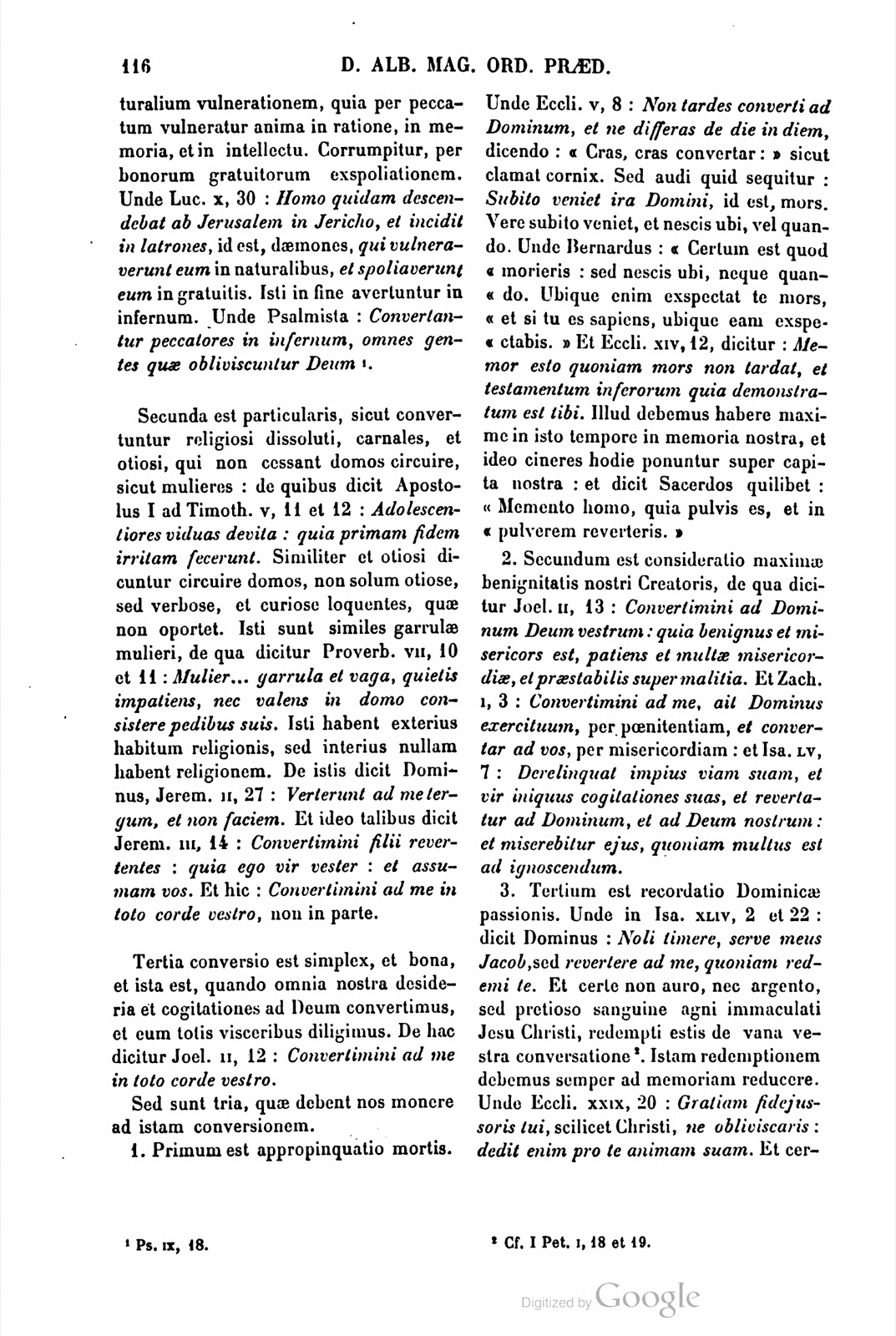
Sed sunt tria, quae debent nos monere ad istam conversionem.
1. Primum est appropinquatio mortis. Unde Eccli. v, 8: Non tardes converti ad Dominum, et ne differas de die in diem, dicendo: "Cras, cras convertar:" sicut clamat cornix. Sed audi quid sequitur: Subito veniet ira Domini, id est, mors. Vere subito veniet, et nescis ubi, vel quando. Unde Bernardus: "Certum est quod morieris: sed nescis ubi, neque quando. Ubique enim exspectat te mors, et si tu es sapiens, ubique eam exspectabis." Et Eccli. xiv, 12, dicitur: Memor esto quoniam mors non tardat, et testamentum inferorum quia demonstratum est tibi. Illud debemus habere maxime in isto tempore in memoria nostra, et ideo cineres hodie ponuntur super capita nostra: et dicit Sacerdos quilibet: "Memento homo, quia pulvis es, et in pulverem reverteris."
2. Secundum est consideratio maximae benignitatis nostri Creatoris, de qua dicitur Joel. ii, 13: Convertimini ad Dominum Deum vestrum: quia benignus et misericors est, patiens et multae misericordiae, et praestabilis super malitia. Et Zach. i, 3: Convertimini ad me, ait Dominus exercituum, per poenitentiam, et convertar ad vos, per misericordiam: et Isa. lv, 7: Derelinquat impius viam suam, et vir iniquus cogitationes suas, et revertatur ad Dominum, et ad Deum nostrum: et miserebitur ejus, quoniam multus est ad ignoscendum.
3. Tertium est recordatio Dominicae passionis. Unde in Isa. xliv, 2 et 22: dicit Dominus: Noli timere, serve meus Jacob, sed revertere ad me, quoniam redemi te. Et certe non auro, nec argento, sed pretioso sanguine agni immaculati Jesu Christi, redempti estis de vana vestra conversatione 3. Istam redemptionem debemus semper ad memoriam reducere. Unde Eccli. xxix, 20: Gratiam fidejussoris tui, scilicet Christi, ne obliviscaris: dedit enim pro te animam suam. Et certe sicut dicit Hieronymus: "Jesu bone, quantacumque propinat nobis praesens tribulatio mala; parva patimur, si recordamur quid biberit ad patibulum, qui nos invitat ad caelum dicens: Venite qui laboratis, et onerati estis: et ego reficiam vos" 4. Sed ipse conqueritur per David, dicens: Oblivioni datus sum, tamquam mortuus a corde 5. Certe ipsam Passionem non debemus oblivioni tradere, sed saepe ad memoriam reducere. Ista tria cito debent nos ad Deum convertere.
II.
Dicit ergo, Convertimini ad me, qui sum medicus, qui solo sermone sanat omnia. Unde Eccli. xliii, 24: Medicina omnium in festinatione nebulae. Et Sap. xvi, 12: Quod neque herba, neque malagma sanavit eos, sed tuus, Domine, sermo, qui sanat omnia. Ps. cvi, 20: Misit verbum suum, et sanavit eos, scilicet peccatores.
But there are three things that ought to admonish us to that conversion.
1. The first is the approach of death. Hence Ecclesiasticus 5:8: Do not delay to be converted to the Lord, and do not defer from day to day, saying, "Tomorrow, tomorrow I will be converted," as the crow cries. But hear what follows: Suddenly the wrath of the Lord will come, that is, death. Truly it will come suddenly, and you do not know where or when. Hence Bernard says: "It is certain that you will die, but you do not know where or when. Death awaits you everywhere, and if you are wise, you will await it everywhere." And Ecclesiasticus 14:12 says: Remember that death does not delay, and the testament of the lower regions has been shown to you. We ought especially to have this in our memory in this time, and therefore ashes are today placed upon our heads, and every Priest says: "Remember, human being, that you are dust, and into dust you will return."
2. The second is consideration of the greatest kindness of our Creator, concerning which Joel 2:13 says: Be converted to the Lord your God, because he is kind and merciful, patient and of much mercy, and able to prevail over malice. And Zechariah 1:3: Be converted to me, says the Lord of hosts, through penance, and I will be converted to you through mercy; and Isaiah 55:7: Let the impious abandon his way, and the iniquitous man his thoughts, and let him return to the Lord and to our God, and he will have mercy on him, because he is much in forgiving.
3. The third is remembrance of the Lord's passion. Hence in Isaiah 44:2 and 22 the Lord says: Do not fear, my servant Jacob, but return to me, because I have redeemed you. And certainly not with gold or silver, but with the precious blood of the immaculate lamb Jesus Christ, you were redeemed from your vain conversation 3. We ought always to bring this redemption back to memory. Hence Ecclesiasticus 29:20: Do not forget the grace of your surety, namely Christ, for he gave his soul for you. And certainly, as Jerome says: "Good Jesus, whatever evils present tribulation pours for us, we suffer small things if we remember what he drank on the gibbet, he who invites us to heaven saying, Come, you who labor and are burdened, and I will refresh you" 4. But he himself complains through David, saying: I have been given to forgetfulness, as one dead from the heart 5. Certainly we ought not hand over that Passion itself to forgetfulness, but often bring it back to memory. These three things ought quickly to convert us to God.
II.
Therefore he says: Be converted to me, who am the physician, who heals all things by word alone. Hence Ecclesiasticus 43:24: The medicine of all things is in the haste of a cloud. And Wisdom 16:12: Neither herb nor plaster healed them, but your word, O Lord, which heals all things. Psalm 106:20: He sent his word and healed them, namely sinners.
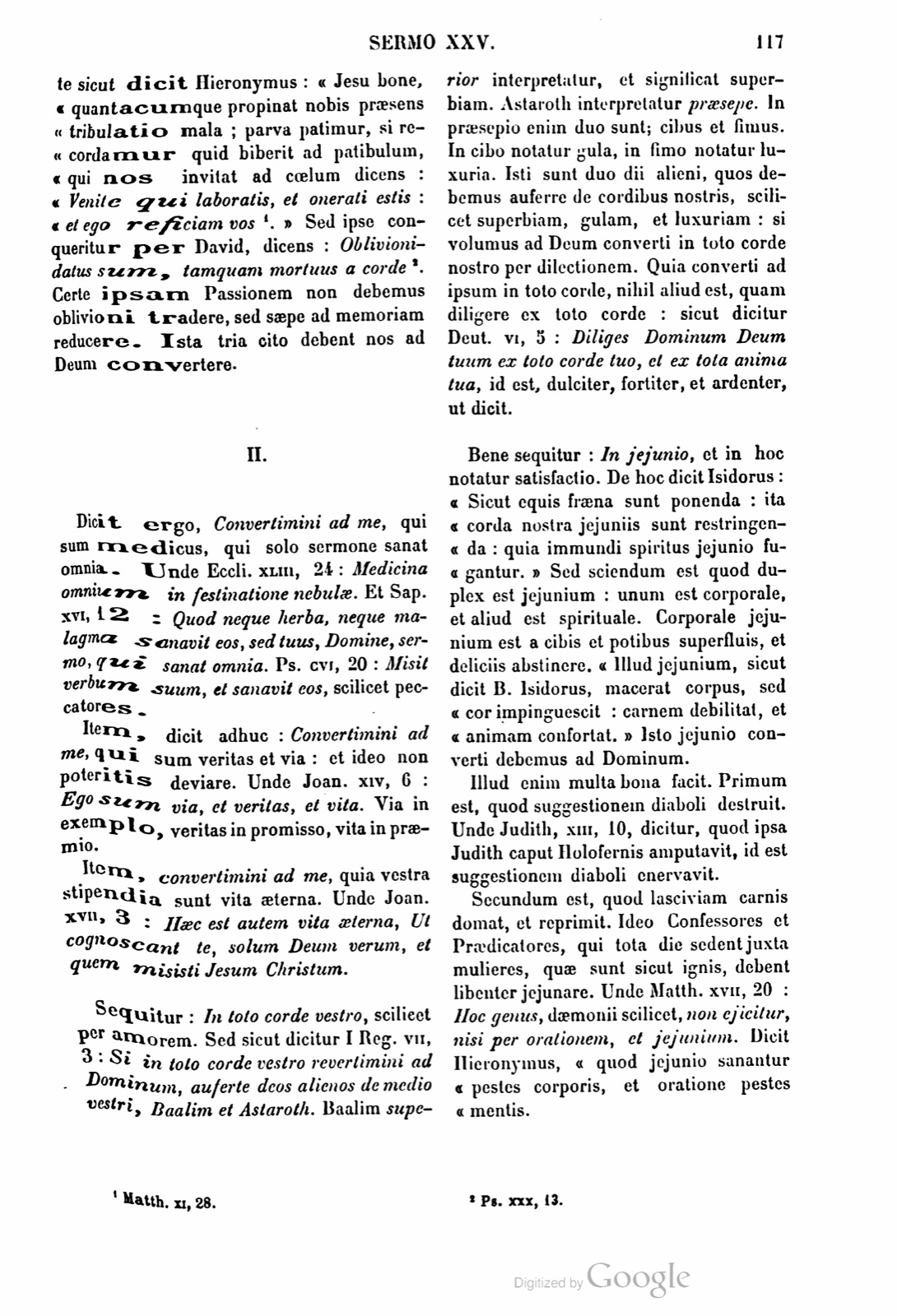
Item, dicit adhuc: Convertimini ad me, qui sum veritas et via: et ideo non poteritis deviare. Unde Joan. xiv, 6: Ego sum via, et veritas, et vita. Via in exemplo, veritas in promisso, vita in praemio.
Item, convertimini ad me, quia vestra stipendia sunt vita aeterna. Unde Joan. xvii, 3: Haec est autem vita aeterna, Ut cognoscant te, solum Deum verum, et quem misisti Jesum Christum.
Sequitur: In toto corde vestro, scilicet per amorem. Sed sicut dicitur I Reg. vii, 3: Si in toto corde vestro revertimini ad Dominum, auferte deos alienos de medio vestri, Baalim et Astaroth. Baalim superior interpretatur, et significat superbiam. Astaroth interpretatur praesepe. In praesepio enim duo sunt; cibus et fimus. In cibo notatur gula, in fimo notatur luxuria. Isti sunt duo dii alieni, quos debemus auferre de cordibus nostris, scilicet superbiam, gulam, et luxuriam: si volumus ad Deum converti in toto corde nostro per dilectionem. Quia converti ad ipsum in toto corde, nihil aliud est, quam diligere ex toto corde: sicut dicitur Deut. vi, 5: Diliges Dominum Deum tuum ex toto corde tuo, et ex tota anima tua, id est, dulciter, fortiter, et ardenter, ut dicit.
Bene sequitur: In jejunio, et in hoc notatur satisfactio. De hoc dicit Isidorus: "Sicut equis fraena sunt ponenda: ita corda nostra jejuniis sunt restringenda: quia immundi spiritus jejunio fugantur." Sed sciendum est quod duplex est jejunium: unum est corporale, et aliud est spirituale. Corporale jejunium est a cibis et potibus superfluis, et deliciis abstinere. "Illud jejunium, sicut dicit B. Isidorus, macerat corpus, sed cor impinguescit: carnem debilitat, et animam confortat." Isto jejunio converti debemus ad Dominum.
Illud enim multa bona facit. Primum est, quod suggestionem diaboli destruit. Unde Judith, xii, 10, dicitur, quod ipsa Judith caput Holofernis amputavit, id est suggestionem diaboli enervavit.
Secundum est, quod lasciviam carnis domat, et reprimit. Ideo Confessores et Praedicatores, qui tota die sedent juxta mulieres, quae sunt sicut ignis, debent libenter jejunare. Unde Matth. xvii, 20: Hoc genus, daemonii scilicet, non ejicitur, nisi per orationem, et jejunium. Dicit Hieronymus, "quod jejunio sanantur pestes corporis, et oratione pestes mentis."
Tertium est, quod poenam aeternam vitare facit, et ad misericordiam Dei facit peccatores pervenire. Unde Jonae, iii, dicitur, quod facto jejunio misertus est Dominus.
Likewise he still says: Be converted to me, who am truth and way, and therefore you will not be able to go astray. Hence John 14:6: I am the way and the truth and the life: way in example, truth in promise, life in reward.
Likewise, be converted to me, because your wages are eternal life. Hence John 17:3: But this is eternal life, that they know you, the only true God, and Jesus Christ whom you have sent.
It follows: With your whole heart, namely through love. But as is said in 1 Kings 7:3: If you return to the Lord with your whole heart, remove the strange gods from your midst, Baalim and Astaroth. Baalim is interpreted higher and signifies pride. Astaroth is interpreted manger. In a manger there are two things, food and dung. In food gluttony is marked; in dung luxury is marked. These are two alien gods that we ought to remove from our hearts, namely pride, gluttony, and luxury, if we wish to be converted to God with our whole heart through love. For to be converted to him with the whole heart is nothing other than to love from the whole heart, as is said in Deuteronomy 6:5: You shall love the Lord your God from your whole heart and from your whole soul, that is, sweetly, strongly, and ardently, as he says.
It fittingly follows: In fasting, and in this satisfaction is marked. Isidore says concerning this: "As bridles are to be put on horses, so our hearts are to be restrained by fasts, because unclean spirits are put to flight by fasting." But it must be known that fasting is twofold: one is bodily, and the other spiritual. Bodily fasting is to abstain from superfluous foods and drinks and delights. "That fasting," as blessed Isidore says, "makes the body lean, but the heart grows fat; it weakens the flesh and strengthens the soul." By this fasting we ought to be converted to the Lord.
For it does many goods. The first is that it destroys the devil's suggestion. Hence in Judith 12:10 it is said that Judith cut off the head of Holofernes, that is, weakened the devil's suggestion.
The second is that it tames and represses the wantonness of the flesh. Therefore Confessors and Preachers, who sit all day near women, who are like fire, ought gladly to fast. Hence Matthew 17:20: This kind, namely of demon, is not cast out except through prayer and fasting. Jerome says that "by fasting the plagues of the body are healed, and by prayer the plagues of the mind."
The third is that it makes one avoid eternal punishment and makes sinners come to the mercy of God. Hence in Jonah 3 it is said that after fasting had been done the Lord had mercy.
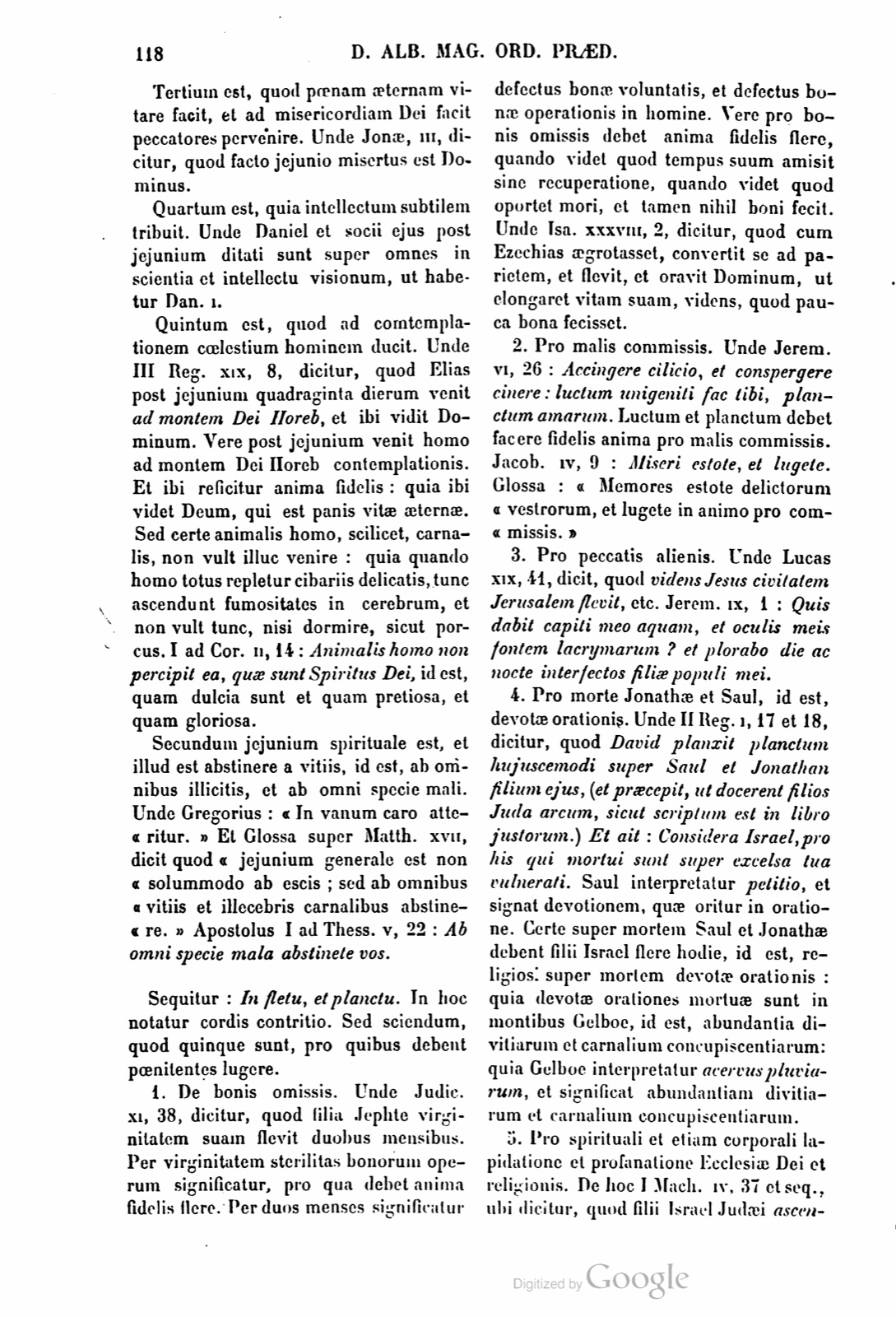
Quartum est, quia intellectum subtilem tribuit. Unde Daniel et socii ejus post jejunium ditati sunt super omnes in scientia et intellectu visionum, ut habetur Dan. i.
Quintum est, quod ad contemplationem caelestium hominem ducit. Unde III Reg. xix, 8, dicitur, quod Elias post jejunium quadraginta dierum venit ad montem Dei Horeb, et ibi vidit Dominum. Vere post jejunium venit homo ad montem Dei Horeb contemplationis. Et ibi reficitur anima fidelis: quia ibi videt Deum, qui est panis vitae aeternae. Sed certe animalis homo, scilicet, carnalis, non vult illuc venire: quia quando homo totus repletur cibariis delicatis, tunc ascendunt fumositates in cerebrum, et non vult tunc, nisi dormire, sicut porcus. I ad Cor. ii, 14: Animalis homo non percipit ea, quae sunt Spiritus Dei, id est, quam dulcia sunt et quam pretiosa, et quam gloriosa.
Secundum jejunium spirituale est, et illud est abstinere a vitiis, id est, ab omnibus illicitis, et ab omni specie mali. Unde Gregorius: "In vanum caro atteritur." Et Glossa super Matth. xvii, dicit quod "jejunium generale est non solummodo ab escis; sed ab omnibus vitiis et illecebris carnalibus abstinere." Apostolus I ad Thess. v, 22: Ab omni specie mala abstinete vos.
Sequitur: In fletu, et planctu. In hoc notatur cordis contritio. Sed sciendum, quod quinque sunt, pro quibus debent poenitentes lugere.
1. De bonis omissis. Unde Judic. xi, 38, dicitur, quod filia Jephte virginitatem suam flevit duobus mensibus. Per virginitatem sterilitas bonorum operum significatur, pro qua debet anima fidelis flere. Per duos menses significatur defectus bonae voluntatis, et defectus bonae operationis in homine. Vere pro bonis omissis debet anima fidelis flere, quando videt quod tempus suum amisit sine recuperatione, quando videt quod oportet mori, et tamen nihil boni fecit. Unde Isa. xxxviii, 2, dicitur, quod cum Ezechias aegrotasset, convertit se ad parietem, et flevit, et oravit Dominum, ut elongaret vitam suam, videns, quod pauca bona fecisset.
2. Pro malis commissis. Unde Jerem. vi, 26: Accingere cilicio, et conspergere cinere: luctum unigeniti fac tibi, planctum amarum. Luctum et planctum debet facere fidelis anima pro malis commissis. Jacob. iv, 9: Miseri estote, et lugete. Glossa: "Memores estote delictorum vestrorum, et lugete in animo pro commissis."
3. Pro peccatis alienis. Unde Lucas xix, 41, dicit, quod videns Jesus civitatem Jerusalem flevit, etc. Jerem. ix, 1: Quis dabit capiti meo aquam, et oculis meis fontem lacrymarum? et plorabo die ac nocte interfectos filiae populi mei.
The fourth is that it grants subtle understanding. Hence Daniel and his companions after fasting were enriched above all in knowledge and understanding of visions, as is contained in Daniel 1.
The fifth is that it leads a human being to contemplation of heavenly things. Hence in 3 Kings 19:8 it is said that Elijah after a fast of forty days came to the mountain of God, Horeb, and there saw the Lord. Truly after fasting a human being comes to the mountain of God, Horeb, of contemplation. And there the faithful soul is refreshed, because there it sees God, who is the bread of eternal life. But certainly the animal human being, that is, the carnal one, does not wish to come there, because when a human being is wholly filled with delicate foods, then fumes rise into the brain, and then he wishes only to sleep, like a swine. 1 Corinthians 2:14: The animal man does not perceive the things that are of the Spirit of God, that is, how sweet they are and how precious and how glorious.
The second fasting is spiritual, and that is to abstain from vices, that is, from all illicit things and from every appearance of evil. Hence Gregory says: "In vain is the flesh worn down." And the Gloss on Matthew 17 says that "general fasting is not only to abstain from foods, but from all vices and carnal enticements." The Apostle says in 1 Thessalonians 5:22: Abstain from every evil appearance.
It follows: In weeping and mourning. In this contrition of heart is marked. But it must be known that there are five things for which penitents ought to mourn.
1. For omitted goods. Hence Judges 11:38 says that the daughter of Jephthah wept over her virginity for two months. By virginity is signified the sterility of good works, over which the faithful soul ought to weep. By two months are signified the defect of good will and the defect of good operation in a human being. Truly the faithful soul ought to weep for omitted goods when it sees that it has lost its time without recovery, when it sees that it must die and nevertheless has done nothing good. Hence Isaiah 38:2 says that when Hezekiah had fallen sick, he turned himself to the wall and wept and prayed to the Lord that he would lengthen his life, seeing that he had done few goods.
2. For evils committed. Hence Jeremiah 6:26: Gird yourself with haircloth and sprinkle yourself with ashes; make for yourself the mourning of an only-begotten, bitter lamentation. The faithful soul ought to make mourning and lamentation for evils committed. James 4:9: Be miserable and mourn. The Gloss says: "Remember your transgressions and mourn in spirit for things committed."
3. For others' sins. Hence Luke 19:41 says that Jesus, seeing the city Jerusalem, wept, etc. Jeremiah 9:1: Who will give water to my head and a fountain of tears to my eyes, and I will weep day and night for the slain of the daughter of my people?
4. Pro morte Jonathae et Saul, id est, devotae orationis. Unde II Reg. i, 17 et 18, dicitur, quod David planxit planctum hujuscemodi super Saul et Jonathan filium ejus, et praecepit, ut docerent filios Juda arcum, sicut scriptum est in libro justorum. Et ait: Considera Israel, pro his qui mortui sunt super excelsa tua vulnerati. Saul interpretatur petitio, et signat devotionem, quae oritur in oratione. Certe super mortem Saul et Jonathae debent filii Israel flere hodie, id est, religiosi: super mortem devotae orationis: quia devotae orationes mortuae sunt in montibus Gelboe, id est, abundantia divitiarum et carnalium concupiscentiarum: quia Gelboe interpretatur acervus pluviarum, et significat abundantiam divitiarum et carnalium concupiscentiarum.
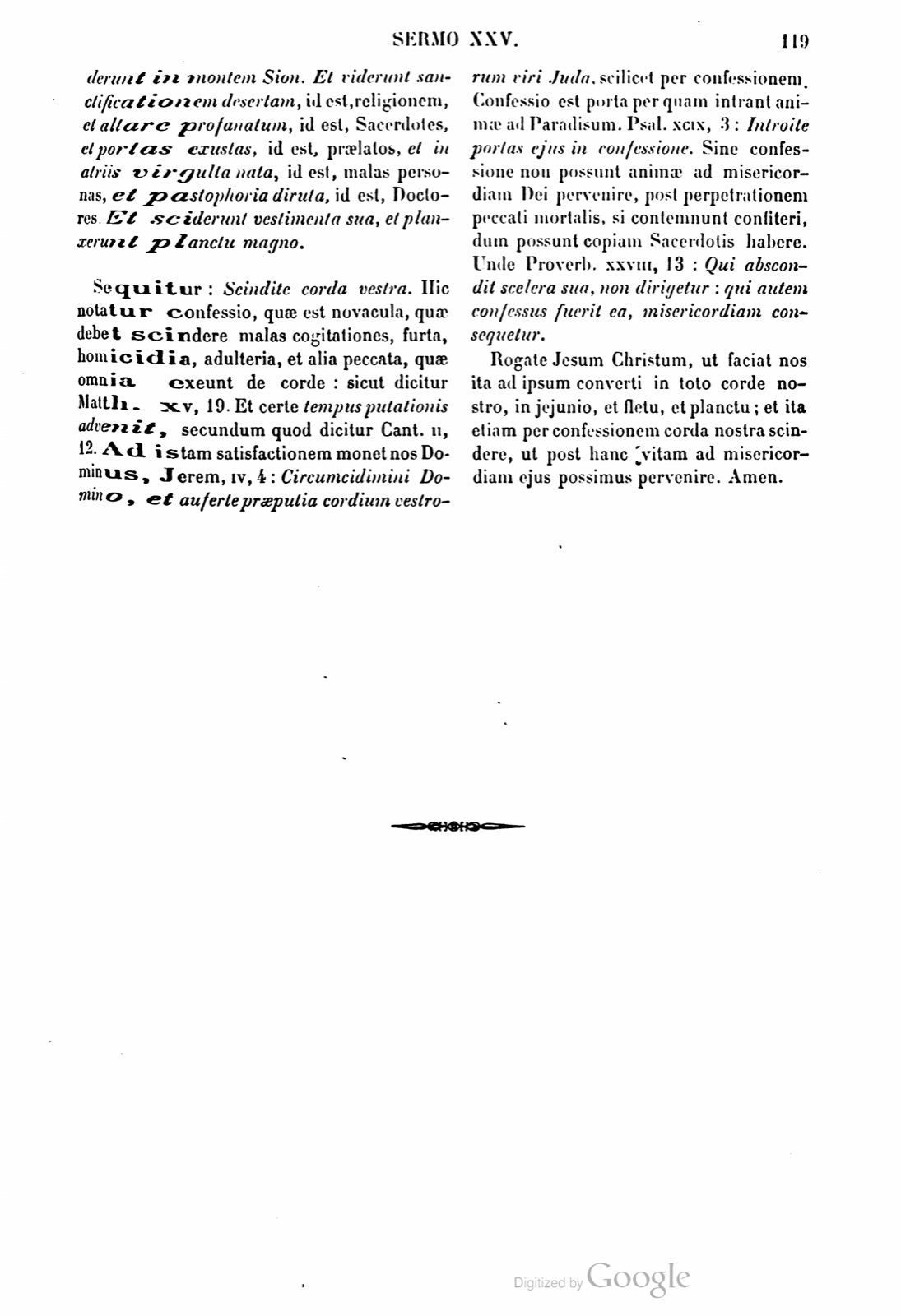
5. Pro spirituali et etiam corporali lapidatione et profanatione Ecclesiae Dei et religionis. De hoc I Mach. iv, 37 et seq., ubi dicitur, quod filii Israel Judaei ascenderunt in montem Sion. Et viderunt sanctificationem desertam, id est, religionem, et altare profanatum, id est, Sacerdotes, et portas exustas, id est, praelatos, et in atriis virgulta nata, id est, malas personas, et pastophoria diruta, id est, Doctores. Et sciderunt vestimenta sua, et planxerunt planctu magno.
Sequitur: Scindite corda vestra. Hic notatur confessio, quae est novacula, quae debet scindere malas cogitationes, furta, homicidia, adulteria, et alia peccata, quae omnia exeunt de corde: sicut dicitur Matth. xv, 19. Et certe tempus putationis advenit, secundum quod dicitur Cant. ii, 12. Ad istam satisfactionem monet nos Dominus, Jerem. iv, 4: Circumcidimini Domino, et auferte praeputia cordium vestrorum viri Juda, scilicet per confessionem. Confessio est porta per quam intrant animae ad Paradisum. Psal. xcix, 3: Introite in portas ejus in confessione. Sine confessione non possunt animae ad misericordiam Dei pervenire, post perpetrationem peccati mortalis, si contemnunt confiteri, dum possunt copiam Sacerdotis habere. Unde Proverb. xxviii, 13: Qui abscondit scelera sua, non dirigetur: qui autem confessus fuerit ea, misericordiam consequetur.
Rogate Jesum Christum, ut faciat nos ita ad ipsum converti in toto corde nostro, in jejunio, et fletu, et planctu; et ita etiam per confessionem corda nostra scindere, ut post hanc vitam ad misericordiam ejus possimus pervenire. Amen.
4. For the death of Jonathan and Saul, that is, of devout prayer. Hence in 2 Kings 1:17 and 18 it is said that David lamented this kind of lamentation over Saul and Jonathan his son, and commanded that they teach the sons of Judah the bow, as it is written in the book of the just. And he said: Consider, Israel, for these who have died wounded upon your high places. Saul is interpreted petition and signifies devotion, which arises in prayer. Certainly over the death of Saul and Jonathan the children of Israel ought to weep today, that is, religious, over the death of devout prayer, because devout prayers are dead on the mountains of Gilboa, that is, in abundance of riches and carnal desires, because Gilboa is interpreted heap of rains and signifies abundance of riches and carnal desires.
5. For the spiritual and also bodily stoning and profanation of the Church of God and of religion. Concerning this, in 1 Maccabees 4:37 and following, it is said that the Jewish children of Israel ascended into Mount Sion. And they saw the sanctuary deserted, that is, religion, and the altar profaned, that is, Priests, and the gates burned, that is, prelates, and shrubs born in the courts, that is, evil persons, and the priestly chambers demolished, that is, Doctors. And they tore their garments and mourned with great mourning.
It follows: Rend your hearts. Here confession is marked, which is the razor that ought to cut evil thoughts, thefts, homicides, adulteries, and other sins, all of which go forth from the heart, as is said in Matthew 15:19. And certainly the time of pruning has come, according to what is said in Song of Songs 2:12. The Lord admonishes us to this satisfaction, Jeremiah 4:4: Be circumcised to the Lord and take away the foreskins of your hearts, men of Judah, namely through confession. Confession is the gate through which souls enter into Paradise. Psalm 99:3: Enter his gates in confession. Without confession souls cannot come to the mercy of God after the perpetration of mortal sin, if they contemn to confess when they can have supply of a Priest. Hence Proverbs 28:13: He who hides his crimes will not be directed; but he who has confessed them will obtain mercy.
Pray Jesus Christ that he may make us be converted to him with our whole heart, in fasting and weeping and mourning, and also so rend our hearts through confession that after this life we may be able to come to his mercy. Amen.
If a page does not appear, its photograph has not been uploaded yet.