Works › Sermons for the Seasons of the Year
Volume 13 · pp. 73–75
Sermon XIV continuation and conclusion
A marker with ≈ is an approximate page boundary, placed by measure of the text; the page photographs remain the authority. In the paired views, clicking a page marker brings that page into view.
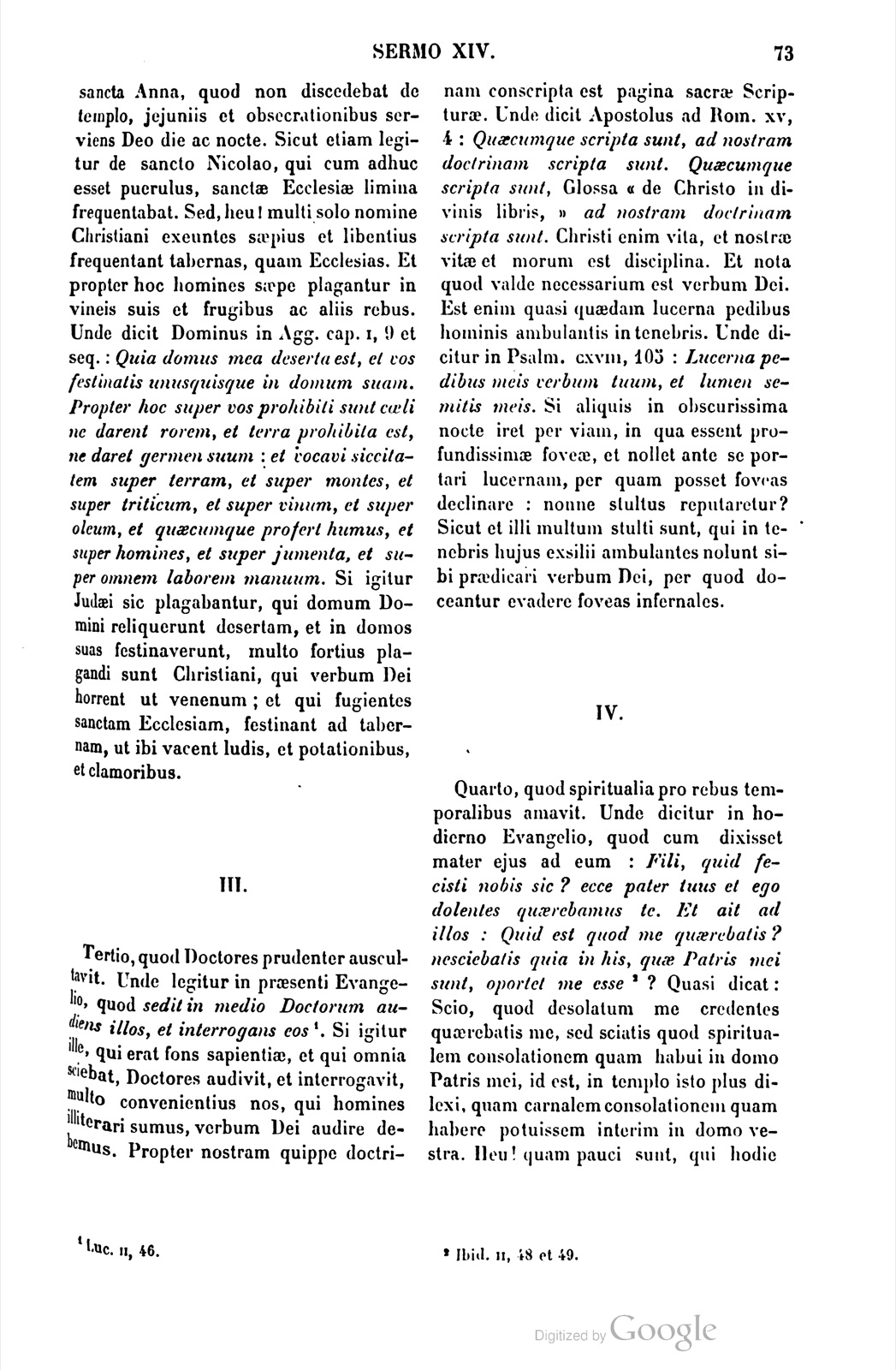
sancta Anna, quod non discedebat de templo, jejuniis et obsecrationibus serviens Deo die ac nocte. Sicut etiam legitur de sancto Nicolao, qui cum adhuc esset puerulus, sanctae Ecclesiae limina frequentabat. Sed, heu! multi solo nomine Christiani exeuntes saepius et libentius frequentant tabernas, quam Ecclesias. Et propter hoc homines saepe plagantur in vineis suis et frugibus ac aliis rebus. Unde dicit Dominus in Agg. cap. i, 9 et seq.: Quia domus mea deserta est, et vos festinatis unusquisque in domum suam. Propter hoc super vos prohibiti sunt caeli ne darent rorem, et terra prohibita est, ne daret germen suum: et vocavi siccitatem super terram, et super montes, et super triticum, et super vinum, et super oleum, et quaecumque profert humus, et super homines, et super jumenta, et super omnem laborem manuum. Si igitur Judaei sic plagabantur, qui domum Domini reliquerunt desertam, et in domos suas festinaverunt, multo fortius plagandi sunt Christiani, qui verbum Dei horrent ut venenum; et qui fugientes sanctam Ecclesiam, festinant ad tabernam, ut ibi vacent ludis, et potationibus, et clamoribus.
III.
Tertio, quod Doctores prudenter auscultavit. Unde legitur in praesenti Evangelio, quod sedit in medio Doctorum audiens illos, et interrogans eos 1. Si igitur ille, qui erat fons sapientiae, et qui omnia sciebat, Doctores audivit, et interrogavit, multo convenientius nos, qui homines illiterati sumus, verbum Dei audire debemus. Propter nostram quippe doctrinam conscripta est pagina sacrae Scripturae. Unde dicit Apostolus ad Rom. xv, 4: Quaecumque scripta sunt, ad nostram doctrinam scripta sunt. Quaecumque scripta sunt, Glossa "de Christo in divinis libris," ad nostram doctrinam scripta sunt. Christi enim vita, et nostrae vitae et morum est disciplina. Et nota quod valde necessarium est verbum Dei. Est enim quasi quaedam lucerna pedibus hominis ambulantis in tenebris. Unde dicitur in Psalm. cxviii, 105: Lucerna pedibus meis verbum tuum, et lumen semitis meis. Si aliquis in obscurissima nocte iret per viam, in qua essent profundissimae foveae, et nollet ante se portari lucernam, per quam posset foveas declinare: nonne stultus reputaretur? Sicut et illi multum stulti sunt, qui in tenebris hujus exsilii ambulantes nolunt sibi praedicari verbum Dei, per quod doceantur evadere foveas infernales.
IV.
Quarto, quod spiritualia pro rebus temporalibus amavit. Unde dicitur in hodierno Evangelio, quod cum dixisset mater ejus ad eum: Fili, quid fecisti nobis sic? ecce pater tuus et ego dolentes quaerebamus te. Et ait ad illos: Quid est quod me quaerebatis? nesciebatis quia in his, quae Patris mei sunt, oportet me esse 2? Quasi dicat: Scio, quod desolatum me credentes quaerebatis me, sed sciatis quod spiritualem consolationem quam habui in domo Patris mei, id est, in templo isto plus dilexi, quam carnalem consolationem quam habere potuissem interim in domo vestra. Heu! quam pauci sunt, qui hodie puerum Jesum imitentur in hac parte, ut videlicet plus diligant spiritualia quam temporalia. Plus enim litigant hodie clerici, laici, et monachi pro temporalibus defensandis, quam laborent pro animabus salvandis, quod tamen mirum est, cum spiritualia carnalibus sint praestantiora. Sicut anima corpore nobilior judicatur, ita quoque spiritualia meliora deberent quam corporalia reputari. Beatus Paulus temporalia stercora reputans, spiritualibus tota aviditate inhaesit. Unde dicit ad Philip. iii, 8 et 13: Propter Christum lucra omnia arbitror ut stercora...: et ea quae retro sunt obliviscens, ad ea quae priora sunt, extendens meipsum.
holy Anna, because she did not depart from the temple, serving God with fastings and prayers day and night. So also it is read about Saint Nicholas, who, when he was still a little boy, frequented the thresholds of holy Church. But alas, many Christians in name only, going out, more often and more gladly frequent taverns than churches. And because of this human beings are often struck in their vineyards and crops and other things. Hence the Lord says in Haggai 1:9 and following: Because my house is deserted, and you each hasten into your own house. On account of this the heavens over you were forbidden to give dew, and the earth was forbidden to give its shoot; and I called drought upon the earth and upon the mountains and upon wheat and wine and oil and whatever the soil brings forth, and upon human beings and beasts of burden and every labor of hands. If therefore the Jews who left the Lord's house deserted and hastened into their own houses were struck so, much more strongly Christians should be struck who dread the word of God as poison, and who, fleeing holy Church, hasten to the tavern, so that there they may be free for games and drinking and shouts.
III.
Thirdly, that he prudently listened to the Doctors. Hence it is read in the present Gospel that he sat in the midst of the Doctors, hearing them and asking them questions 1. If therefore he who was the fountain of wisdom and who knew all things heard the Doctors and asked them questions, much more fittingly we, who are unlearned human beings, ought to hear the word of God. For the page of Sacred Scripture was written for our instruction. Hence the Apostle says in Romans 15:4: Whatever things have been written have been written for our instruction. Whatever things have been written, the Gloss says, "about Christ in the divine books," have been written for our instruction. For the life of Christ is the discipline of our life and morals. And note that the word of God is very necessary. For it is like a certain lamp for the feet of a human being walking in darkness. Hence it is said in Psalm 118:105: Your word is a lamp to my feet and a light to my paths. If someone in a very dark night went along a road in which there were very deep pits, and did not want a lamp carried before him by which he could avoid the pits, would he not be reckoned foolish? So too those are very foolish who, walking in the darkness of this exile, do not wish the word of God to be preached to them, through which they may be taught to escape infernal pits.
IV.
Fourthly, that he loved spiritual things more than temporal things. Hence it is said in today's Gospel that when his mother had said to him: Son, why have you done this to us? behold, your father and I were seeking you sorrowing. And he said to them: Why were you seeking me? did you not know that I must be in the things that are my Father's 2? As if he were saying: I know that you sought me believing me desolate, but know that I loved the spiritual consolation that I had in my Father's house, that is, in this temple, more than the carnal consolation that meanwhile I could have had in your house. Alas, how few today imitate the boy Jesus in this part, namely so that they love spiritual things more than temporal things. For today clerics, laymen, and monks litigate more for defending temporal things than they labor for saving souls, which nevertheless is astonishing, since spiritual things are more excellent than carnal things. Just as the soul is judged nobler than the body, so spiritual things ought to be reckoned better than bodily things. Blessed Paul, reckoning temporal things as dung, clung to spiritual things with complete eagerness. Hence he says in Philippians 3:8 and 13: For Christ I reckon all gains as dung... and forgetting those things that are behind, I stretch myself to those things that are before.
V.
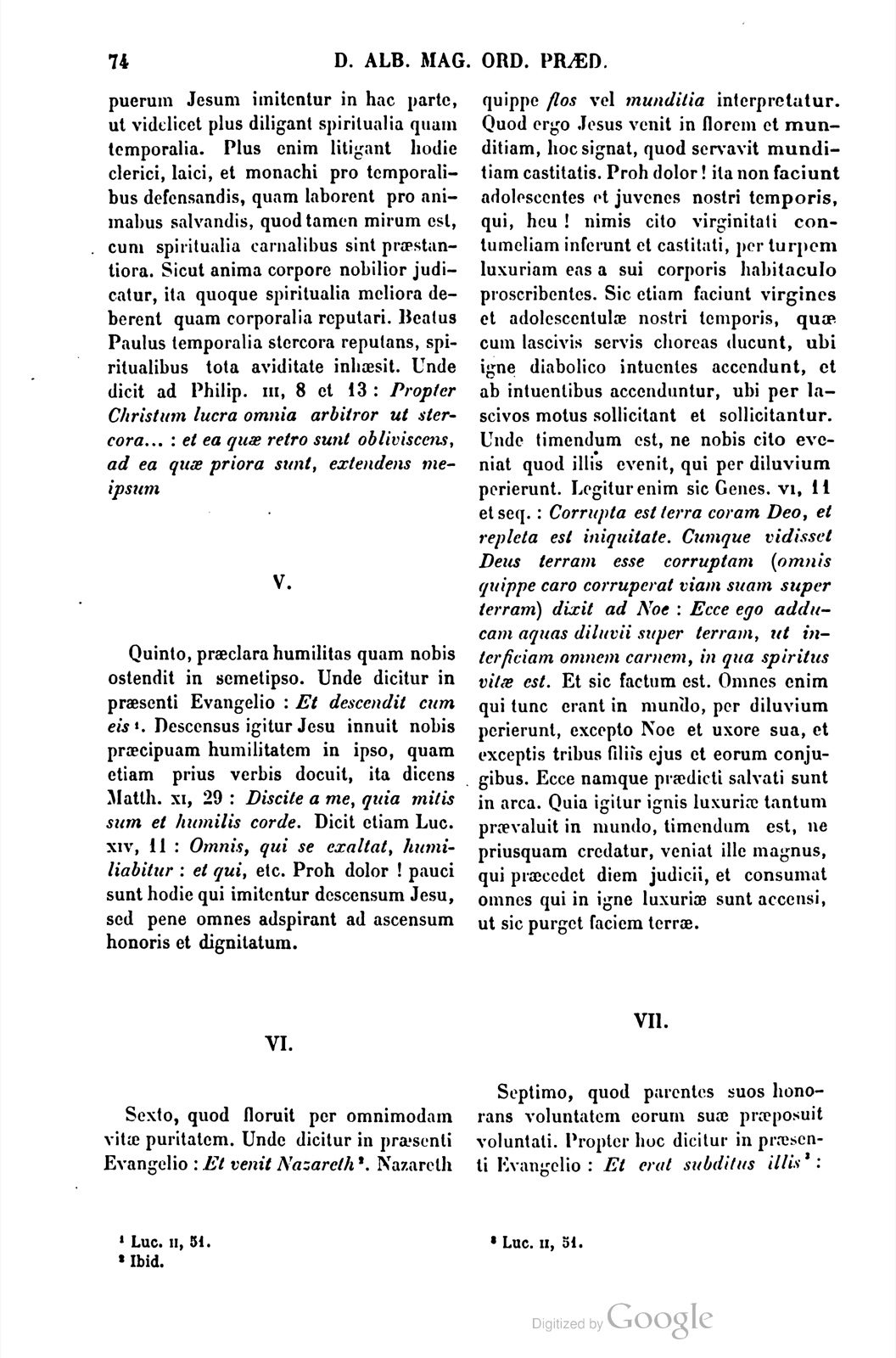
Quinto, praeclara humilitas quam nobis ostendit in semetipso. Unde dicitur in praesenti Evangelio: Et descendit cum eis 3. Descensus igitur Jesu innuit nobis praecipuam humilitatem in ipso, quam etiam prius verbis docuit, ita dicens Matth. xi, 29: Discite a me, quia mitis sum et humilis corde. Dicit etiam Luc. xiv, 11: Omnis, qui se exaltat, humiliabitur: et qui, etc. Proh dolor! pauci sunt hodie qui imitentur descensum Jesu, sed pene omnes adspirant ad ascensum honoris et dignitatum.
VI.
Sexto, quod floruit per omnimodam vitae puritatem. Unde dicitur in praesenti Evangelio: Et venit Nazareth 4. Nazareth quippe flos vel munditia interpretatur. Quod ergo Jesus venit in florem et munditiam, hoc signat, quod servavit munditiam castitatis. Proh dolor! ita non faciunt adolescentes et juvenes nostri temporis, qui, heu! nimis cito virginitati contumeliam inferunt et castitati, per turpem luxuriam eas a sui corporis habitaculo proscribentes. Sic etiam faciunt virgines et adolescentulae nostri temporis, quae cum lascivis servis choreas ducunt, ubi igne diabolico intuentes accendunt, et ab intuentibus accenduntur, ubi per lascivos motus sollicitant et sollicitantur. Unde timendum est, ne nobis cito eveniat quod illis evenit, qui per diluvium perierunt. Legitur enim sic Genes. vi, 11 et seq.: Corrupta est terra coram Deo, et repleta est iniquitate. Cumque vidisset Deus terram esse corruptam (omnis quippe caro corruperat viam suam super terram) dixit ad Noe: Ecce ego adducam aquas diluvii super terram, ut interficiam omnem carnem, in qua spiritus vitae est. Et sic factum est. Omnes enim qui tunc erant in mundo, per diluvium perierunt, excepto Noe et uxore sua, et exceptis tribus filiis ejus et eorum conjugibus. Ecce namque praedicti salvati sunt in arca. Quia igitur ignis luxuriae tantum praevaluit in mundo, timendum est, ne priusquam credatur, veniat ille magnus, qui praecedet diem judicii, et consumat omnes qui in igne luxuriae sunt accensi, ut sic purget faciem terrae.
V.
Fifthly, the splendid humility that he showed us in himself. Hence it is said in the present Gospel: And he went down with them 3. Therefore the descent of Jesus suggests to us the outstanding humility in him, which he also first taught by words, saying thus in Matthew 11:29: Learn from me, because I am meek and humble of heart. Luke 14:11 also says: Everyone who exalts himself will be humbled, and he who, etc. Alas for sorrow! Few today imitate the descent of Jesus, but almost all aspire to the ascent of honor and dignities.
VI.
Sixthly, that he flowered through purity of life of every kind. Hence it is said in the present Gospel: And he came to Nazareth 4. For Nazareth is interpreted as flower or cleanness. Therefore that Jesus came into flower and cleanness signifies that he preserved the cleanness of chastity. Alas for sorrow, adolescents and young people of our time do not do so; alas, too quickly they inflict disgrace on virginity and chastity, banishing them by foul luxury from the dwelling of their body. So also do the virgins and young girls of our time who lead dances with lascivious servants, where those looking are inflamed by diabolical fire and are inflamed by those looking, where through lascivious motions they solicit and are solicited. Hence it must be feared that what happened to those who perished through the flood will soon happen to us. For it is read thus in Genesis 6:11 and following: The earth was corrupted before God and filled with iniquity. And when God had seen that the earth was corrupted, for all flesh had corrupted its way upon the earth, he said to Noah: Behold, I will bring the waters of the flood upon the earth, to kill every flesh in which there is the spirit of life. And so it was done. For all who were then in the world perished through the flood, except Noah and his wife and except his three sons and their wives. Behold, the aforesaid were saved in the ark. Therefore, because the fire of luxury has so prevailed in the world, it must be feared that, before it is believed, that great fire which will precede the day of judgment may come and consume all who are inflamed in the fire of luxury, so that thus it may cleanse the face of the earth.
VII.
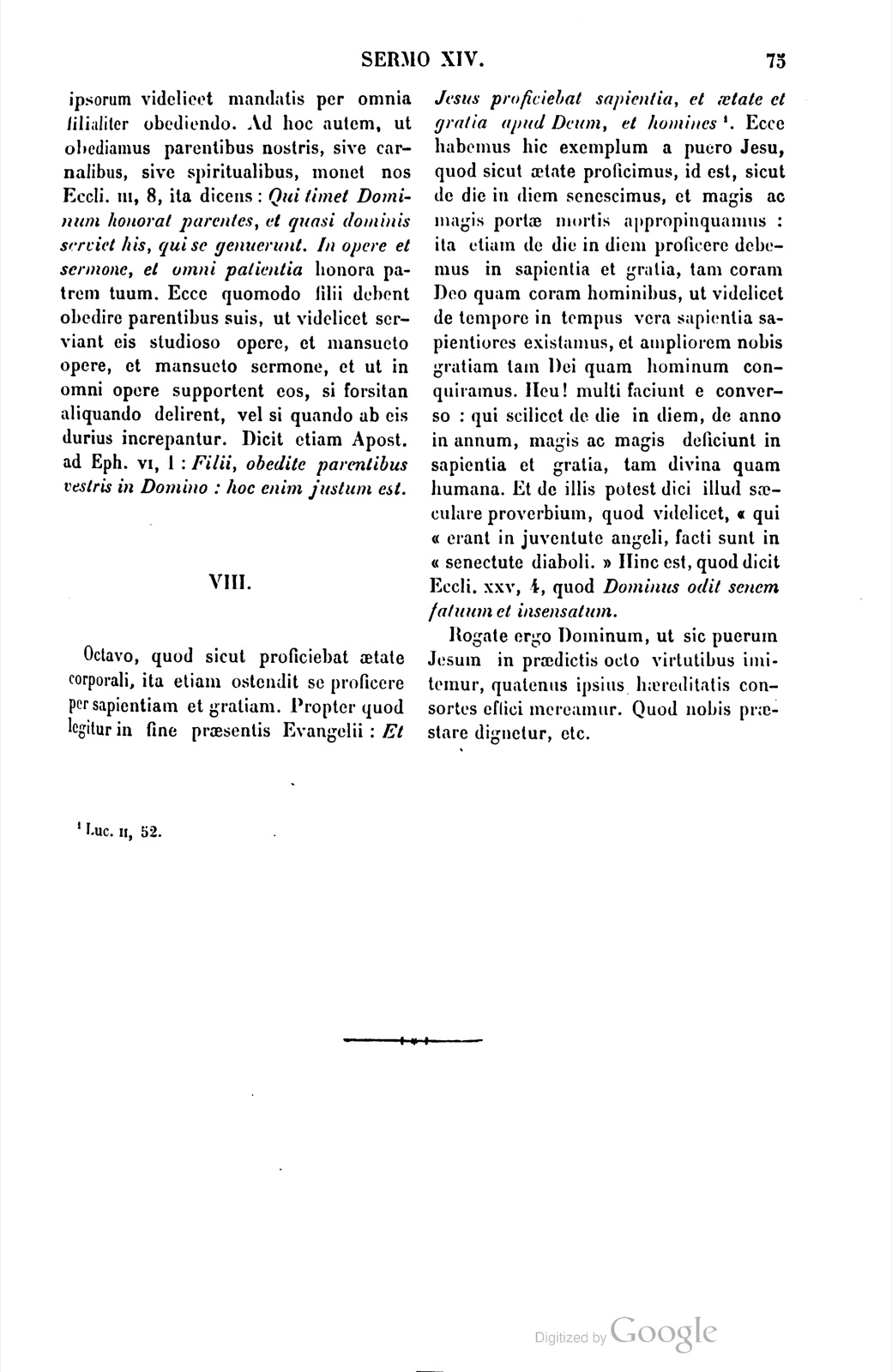
Septimo, quod parentes suos honorans voluntatem eorum suae praeposuit voluntati. Propter hoc dicitur in praesenti Evangelio: Et erat subditus illis 5: ipsorum videlicet mandatis per omnia filialiter obediendo. Ad hoc autem, ut obediamus parentibus nostris, sive carnalibus, sive spiritualibus, monet nos Eccli. iii, 8, ita dicens: Qui timet Dominum honorat parentes, et quasi dominis serviet his, qui se genuerunt. In opere et sermone, et omni patientia honora patrem tuum. Ecce quomodo filii debent obedire parentibus suis, ut videlicet serviant eis studioso opere, et mansueto opere, et mansueto sermone, et ut in omni opere supportent eos, si forsitan aliquando delirent, vel si quando ab eis durius increpantur. Dicit etiam Apost. ad Eph. vi, 1: Filii, obedite parentibus vestris in Domino: hoc enim justum est.
VIII.
Octavo, quod sicut proficiebat aetate corporali, ita etiam ostendit se proficere per sapientiam et gratiam. Propter quod legitur in fine praesentis Evangelii: Et Jesus proficiebat sapientia, et aetate et gratia apud Deum, et homines 6. Ecce habemus hic exemplum a puero Jesu, quod sicut aetate proficimus, id est, sicut de die in diem senescimus, et magis ac magis portae mortis appropinquamus: ita etiam de die in diem proficere debemus in sapientia et gratia, tam coram Deo quam coram hominibus, ut videlicet de tempore in tempus vera sapientia sapientiores existamus, et ampliorem nobis gratiam tam Dei quam hominum conquiramus. Heu! multi faciunt e converso: qui scilicet de die in diem, de anno in annum, magis ac magis deficiunt in sapientia et gratia, tam divina quam humana. Et de illis potest dici illud saeculare proverbium, quod videlicet, "qui erant in juventute angeli, facti sunt in senectute diaboli." Hinc est, quod dicit Eccli. xxv, 4, quod Dominus odit senem fatuum et insensatum.
Rogate ergo Dominum, ut sic puerum Jesum in praedictis octo virtutibus imitemur, quatenus ipsius haereditatis consortes effici mereamur. Quod nobis praestare dignetur, etc.
VII.
Seventhly, that honoring his parents he placed their will before his own will. Because of this it is said in the present Gospel: And he was subject to them 5, namely by obeying their commands filially in all things. But Ecclesiasticus 3:8 admonishes us to this, that we obey our parents, whether carnal or spiritual, saying thus: He who fears the Lord honors his parents and will serve as lords those who begot him. In work and speech and all patience honor your father. Behold how children ought to obey their parents, namely that they serve them with zealous work and meek work and meek speech, and that in every work they support them, if perhaps sometimes they rave, or if at times they are rebuked by them rather harshly. The Apostle also says in Ephesians 6:1: Children, obey your parents in the Lord, for this is just.
VIII.
Eighthly, that just as he advanced in bodily age, so also he showed himself to advance through wisdom and grace. Because of this it is read at the end of the present Gospel: And Jesus advanced in wisdom and age and grace before God and human beings 6. Behold, here we have an example from the boy Jesus, that just as we advance in age, that is, just as from day to day we grow old and approach more and more the gates of death, so also from day to day we ought to advance in wisdom and grace, both before God and before human beings, namely so that from time to time we may exist wiser with true wisdom and acquire for ourselves greater grace of both God and human beings. Alas, many do the opposite, namely those who from day to day and from year to year fail more and more in wisdom and grace, both divine and human. And about them that worldly proverb can be said, namely, "those who were angels in youth have become devils in old age." Hence Ecclesiasticus 25:4 says that the Lord hates a foolish and senseless old man.
Therefore pray to the Lord that we may so imitate the boy Jesus in the aforesaid eight virtues that we may merit to be made sharers of his inheritance. May he deign to grant this to us, etc.
If a page does not appear, its photograph has not been uploaded yet.