Volume 13 · pp. 628–629
Sermon LVII. On the Blessed Virgin Mary
A marker with ≈ is an approximate page boundary, placed by measure of the text; the page photographs remain the authority. In the paired views, clicking a page marker brings that page into view.
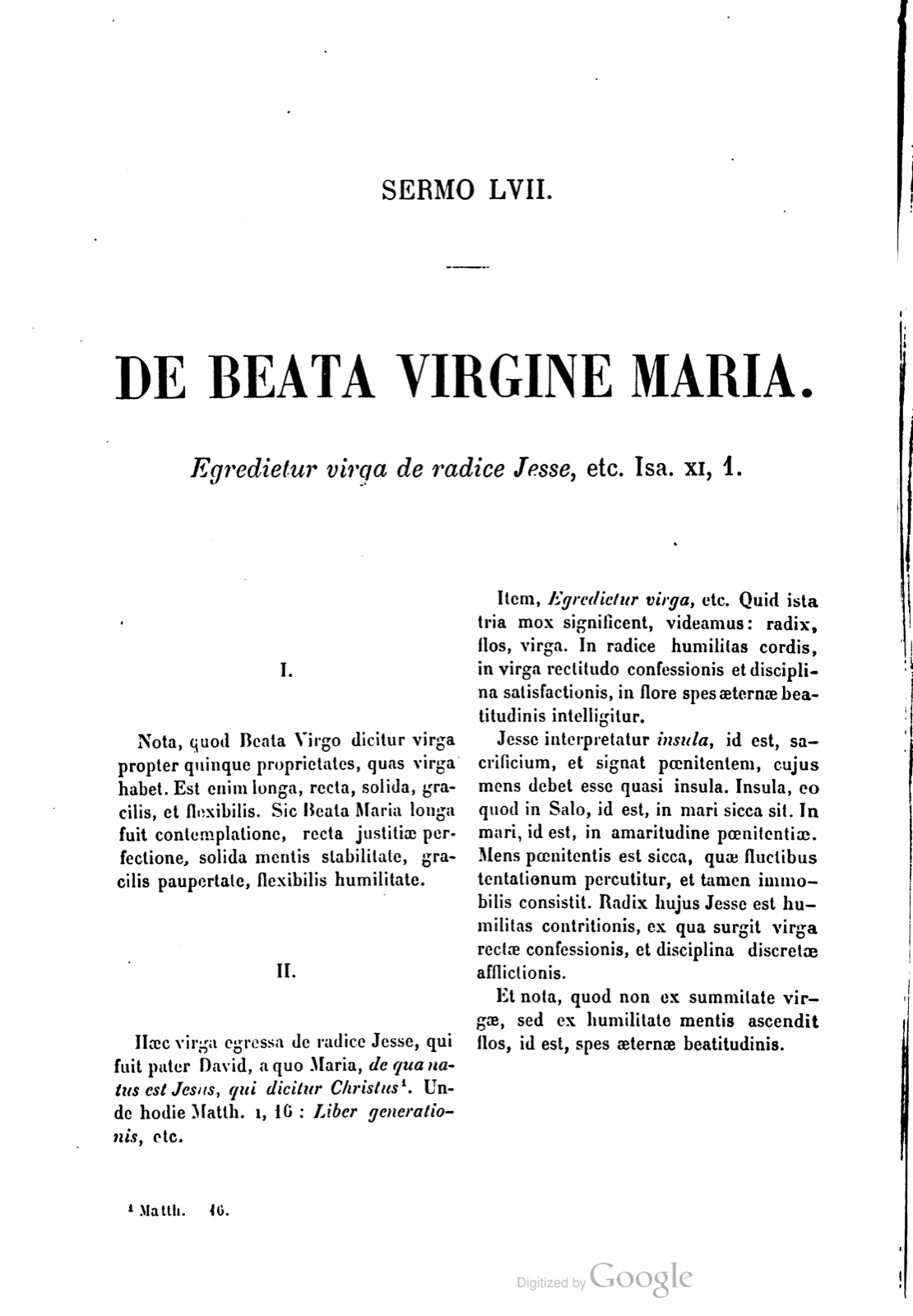
SERMO LVII.
DE BEATA VIRGINE MARIA.
Egredietur virga de radice Jesse, etc. Isa. XI, 1.
I.
Nota, quod Beata Virgo dicitur virga propter quinque proprietates, quas virga habet. Est enim longa, recta, solida, gracilis, et flexibilis. Sic Beata Maria longa fuit contemplatione, recta justitiæ perfectione, solida mentis stabilitate, gracilis paupertate, flexibilis humilitate.
II.
Hæc virga egressa de radice Jesse, qui fuit pater David, a quo Maria, de qua natus est Jesus, qui dicitur Christus 1. Unde hodie Matth. I, 16: Liber generationis, etc.
Item, Egredietur virga, etc. Quid ista tria mox significent, videamus: radix, flos, virga. In radice humilitas cordis, in virga rectitudo confessionis et disciplina satisfactionis, in flore spes æternæ beatitudinis intelligitur.
Jesse interpretatur insula, id est, sacrificium, et signat pænitentem, cujus mens debet esse quasi insula. Insula, eo quod in Salo, id est, in mari sicca sit. In mari, id est, in amaritudine pænitentiæ. Mens pœnitentis est sicca, quæ fluctibus tentationum percutitur, et tamen immobilis consistit. Radix hujus Jesse est humilitas contritionis, ex qua surgit virga rectæ confessionis, et disciplina discretæ afflictionis.
Et nota, quod non ex summitate virgæ, sed ex humilitate mentis ascendit flos, id est, spes æternæ beatitudinis.
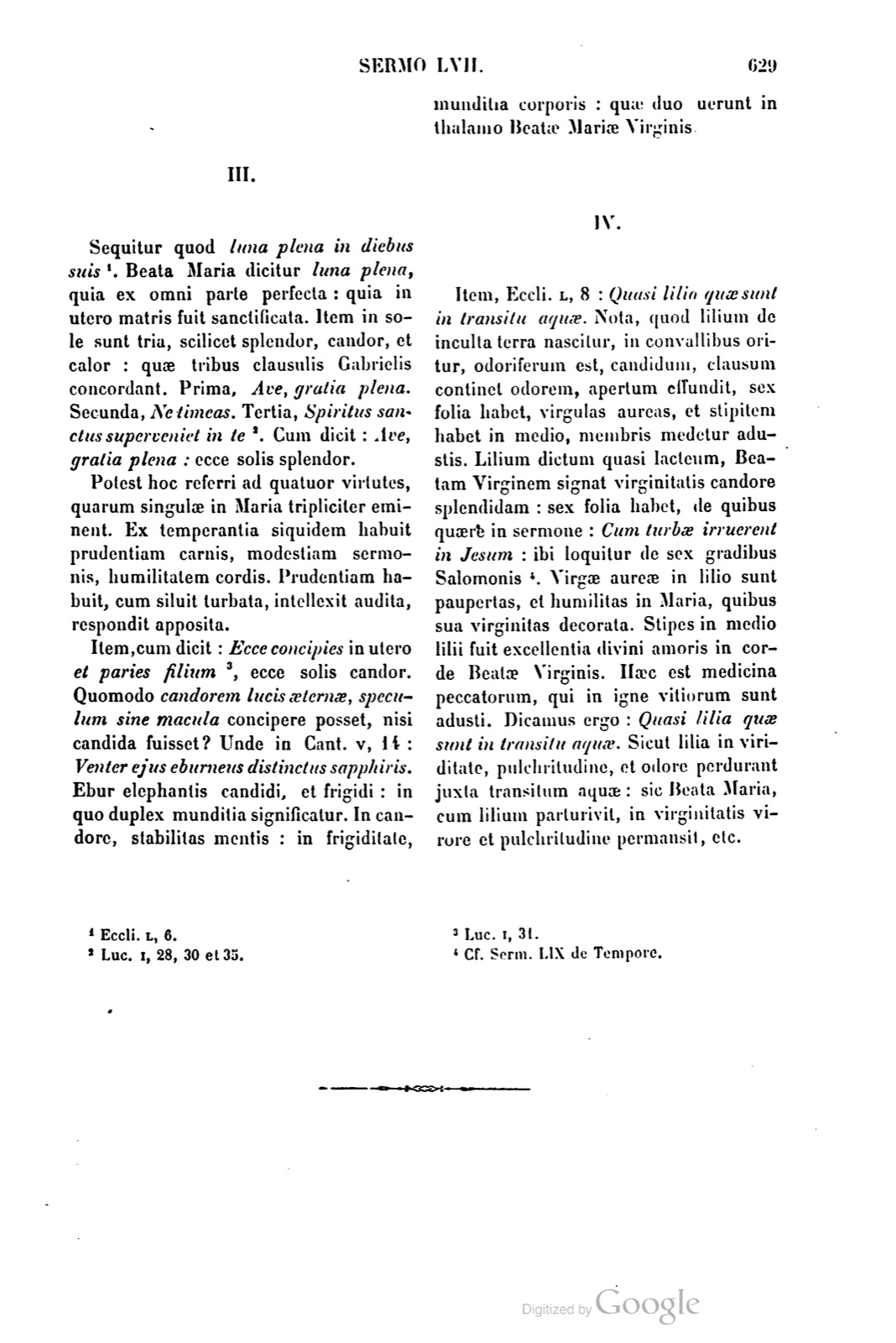
III.
Sequitur quod luna plena in diebus suis 2. Beata Maria dicitur luna plena, quia ex omni parte perfecta: quia in utero matris fuit sanctificata. Item in sole sunt tria, scilicet splendor, candor, et calor: quæ tribus clausulis Gabrielis concordant. Prima, Ave, gratia plena. Secunda, Ne timeas. Tertia, Spiritus sanctus superveniet in te 3. Cum dicit: Ave, gratia plena: ecce solis splendor.
Potest hoc referri ad quatuor virtutes, quarum singulæ in Maria tripliciter eminent. Ex temperantia siquidem habuit prudentiam carnis, modestiam sermonis, humilitatem cordis. Prudentiam habuit, cum siluit turbata, intellexit audita, respondit apposita.
SERMON LVII.
ON THE BLESSED VIRGIN MARY.
A rod will go forth from the root of Jesse, etc. Isaiah 11:1.
I.
Note that the Blessed Virgin is called a rod on account of five properties that a rod has. For it is long, straight, solid, slender, and flexible. So Blessed Mary was long by contemplation, straight by perfection of justice, solid by stability of mind, slender by poverty, flexible by humility.
II.
This rod went out from the root of Jesse, who was the father of David, from whom was Mary, of whom was born Jesus, who is called Christ 1. Hence today Matthew 1:16: The book of generation, etc.
Likewise, A rod will go forth, etc. Let us see what these three signify soon: root, flower, rod. In the root humility of heart is understood, in the rod rectitude of confession and discipline of satisfaction, in the flower hope of eternal blessedness.
Jesse is interpreted island, that is, sacrifice, and signifies the penitent, whose mind ought to be like an island. Island, because it is dry in brine, that is, in the sea. In the sea, that is, in the bitterness of penance. The mind of the penitent is dry, which is struck by the waves of temptations and nevertheless stands immovable. The root of this Jesse is humility of contrition, from which arises the rod of right confession and the discipline of discreet affliction.
And note that not from the summit of the rod, but from humility of mind ascends the flower, that is, hope of eternal blessedness.
III.
There follows that the moon is full in her days 2. Blessed Mary is called the full moon because she was perfect from every side, because she was sanctified in her mother's womb. Likewise in the sun there are three things, namely brightness, whiteness, and heat, which agree with Gabriel's three clauses. First, Hail, full of grace. Second, Do not fear. Third, The Holy Spirit will come upon you 3. When he says, Hail, full of grace, behold the brightness of the sun.
This can be referred to four virtues, of which each one shines forth triply in Mary. From temperance indeed she had prudence of the flesh, modesty of speech, humility of heart. She had prudence when, troubled, she kept silent; she understood what she heard; she responded to things set before her.
Item, cum dicit: Ecce concipies in utero et paries filium 4, ecce solis candor. Quomodo candorem lucis æternæ, speculum sine macula concipere posset, nisi candida fuisset? Unde in Cant. V, 14: Venter ejus eburneus distinctus sapphiris. Ebur elephantis candidi, et frigidi: in quo duplex munditia significatur. In candore, stabilitas mentis: in frigiditate, munditia corporis: quæ duo fuerunt in thalamo Beatæ Mariæ Virginis.
IV.
Item, Eccli. L, 8: Quasi lilia quæ sunt in transitu aquæ. Nota, quod lilium de inculta terra nascitur, in convallibus oritur, odoriferum est, candidum, clausum continet odorem, apertum effundit, sex folia habet, virgulas aureas, et stipitem habet in medio, membris medetur adustis. Lilium dictum quasi lacteum, Beatam Virginem signat virginitatis candore splendidam: sex folia habet, de quibus quære in sermone: Cum turbæ irruerent in Jesum: ibi loquitur de sex gradibus Salomonis 5. Virgæ aureæ in lilio sunt paupertas, et humilitas in Maria, quibus sua virginitas decorata. Stipes in medio lilii fuit excellentia divini amoris in corde Beatæ Virginis. Hæc est medicina peccatorum, qui in igne vitiorum sunt adusti. Dicamus ergo: Quasi lilia quæ sunt in transitu aquæ. Sicut lilia in viriditate, pulchritudine, et odore perdurant juxta transitum aquæ: sic Beata Maria, cum lilium parturivit, in virginitatis virore et pulchritudine permansit, etc.
Footnotes:
1 Matth. I, 16.
2 Eccli. L, 6.
3 Luc. I, 28, 30 et 35.
4 Luc. I, 31.
5 Cf. Serm. LIX de Tempore.
Likewise, when he says: Behold, you will conceive in the womb and bear a son 4, behold the whiteness of the sun. How could she conceive the whiteness of eternal light, a mirror without stain, unless she had been white? Hence in Song of Songs 5:14: His belly is ivory, distinguished with sapphires. Ivory is of the white and cold elephant; in this a double cleanness is signified. In whiteness, stability of mind; in coldness, cleanness of body; which two were in the bridal-chamber of the Blessed Virgin Mary.
IV.
Likewise, Ecclesiasticus 50:8: Like lilies that are in the passage of water. Note that the lily is born from uncultivated earth, rises in valleys, is fragrant, white, closed contains odor, opened pours it out, has six leaves, little golden rods, and a stalk in the middle; it heals burned limbs. Lily is said as if milky; it signifies the Blessed Virgin splendid with the whiteness of virginity. It has six leaves, concerning which seek in the sermon: When the crowds pressed upon Jesus; there he speaks concerning the six steps of Solomon 5. The golden rods in the lily are poverty and humility in Mary, by which her virginity is adorned. The stalk in the middle of the lily was the excellence of divine love in the heart of the Blessed Virgin. This is the medicine of sinners, who are burned in the fire of vices. Therefore let us say: Like lilies that are in the passage of water. Just as lilies endure in greenness, beauty, and odor beside the passage of water, so Blessed Mary, when she gave birth to the lily, remained in the freshness and beauty of virginity, etc.
Footnotes:
1 Matthew 1:16.
2 Ecclesiasticus 50:6.
3 Luke 1:28, 30 and 35.
4 Luke 1:31.
5 Compare Sermon LIX On the Time.
If a page does not appear, its photograph has not been uploaded yet.