Volume 13 · pp. 579–582
Sermon XLII. On Saint Michael
A marker with ≈ is an approximate page boundary, placed by measure of the text; the page photographs remain the authority. In the paired views, clicking a page marker brings that page into view.
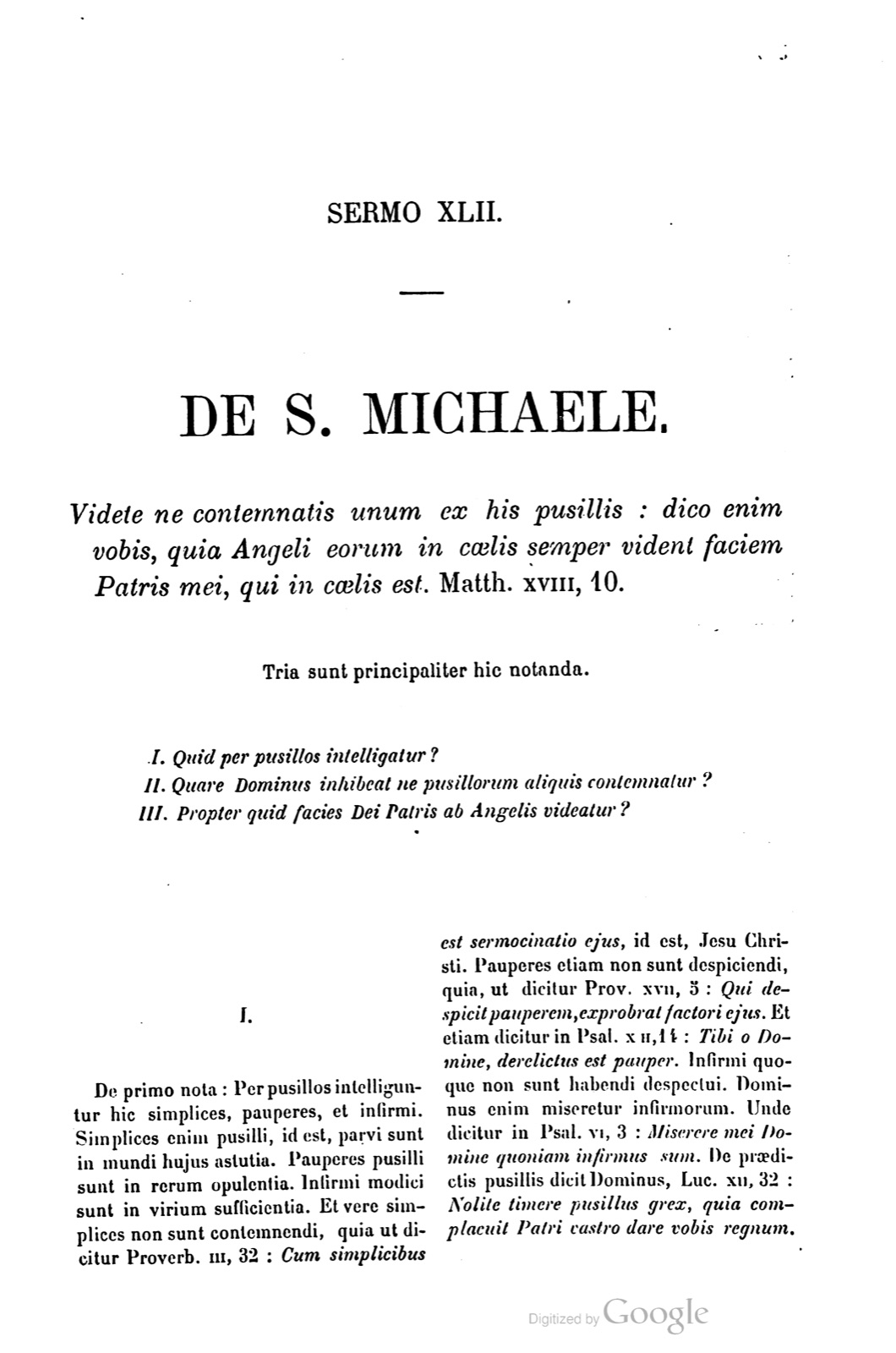
SERMO XLII.
DE S. MICHAELE.
Videte ne contemnatis unum ex his pusillis: dico enim vobis, quia Angeli eorum in cælis semper vident faciem Patris mei, qui in cælis est. Matth. XVIII, 10.
Tria sunt principaliter hic notanda.
I. Quid per pusillos intelligatur? II. Quare Dominus inhibeat ne pusillorum aliquis contemnatur? III. Propter quid facies Dei Patris ab Angelis videatur?
I.
De primo nota: Per pusillos intelliguntur hic simplices, pauperes, et infirmi. Simplices enim pusilli, id est, parvi sunt in mundi hujus astutia. Pauperes pusilli sunt in rerum opulentia. Infirmi modici sunt in virium sufficientia. Et vere simplices non sunt contemnendi, quia ut dicitur Proverb. III, 32: Cum simplicibus est sermocinatio ejus, id est, Jesu Christi. Pauperes etiam non sunt despiciendi, quia, ut dicitur Prov. XVII, 5: Qui despicit pauperem, exprobrat factori ejus. Et etiam dicitur in Psal. X, 14: Tibi o Domine, derelictus est pauper. Infirmi quoque non sunt habendi despectui. Dominus enim miseretur infirmorum. Unde dicitur in Psal. VI, 3: Miserere mei Domine quoniam infirmus sum. De prædictis pusillis dicit Dominus, Luc. XII, 32: Nolite timere pusillus grex, quia complacuit Patri vestro dare vobis regnum.
II.
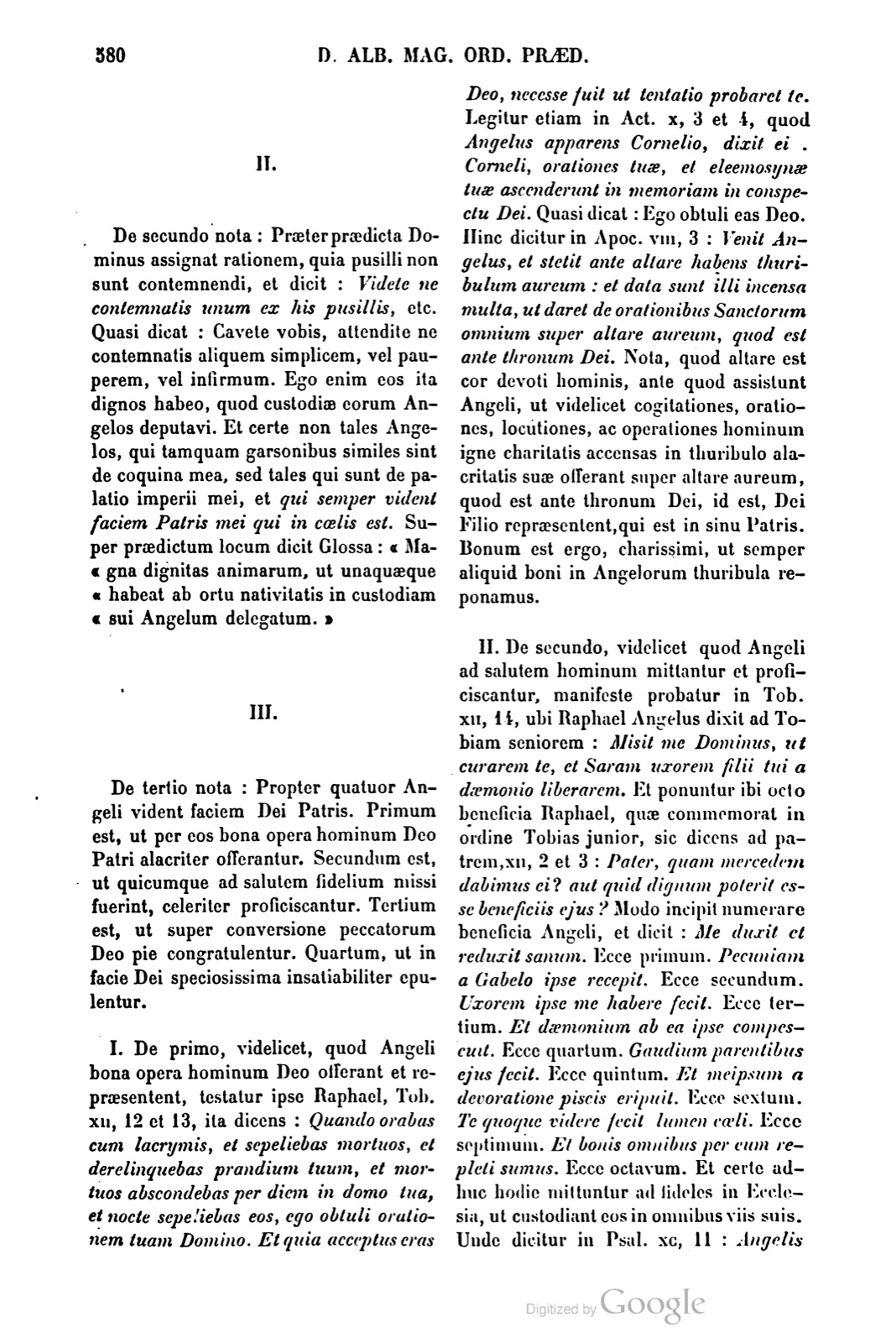
De secundo nota: Præter prædicta Dominus assignat rationem, quia pusilli non sunt contemnendi, et dicit: Videte ne contemnatis unum ex his pusillis, etc. Quasi dicat: Cavete vobis, attendite ne contemnatis aliquem simplicem, vel pauperem, vel infirmum. Ego enim eos ita dignos habeo, quod custodiæ eorum Angelos deputavi. Et certe non tales Angelos, qui tamquam garsonibus similes sint de coquina mea, sed tales qui sunt de palatio imperii mei, et qui semper vident faciem Patris mei qui in cælis est. Super prædictum locum dicit Glossa: « Magna dignitas animarum, ut unaquæque habeat ab ortu nativitatis in custodiam sui Angelum delegatum. »
III.
De tertio nota: Propter quatuor Angeli vident faciem Dei Patris. Primum est, ut per eos bona opera hominum Deo Patri alacriter offerantur. Secundum est, ut quicumque ad salutem fidelium missi fuerint, celeriter proficiscantur. Tertium est, ut super conversione peccatorum Deo pie congratulentur. Quartum, ut in facie Dei speciosissima insatiabiliter epulentur.
SERMON XLII.
ON SAINT MICHAEL.
See that you do not despise one of these little ones: for I say to you, that their Angels in heaven always see the face of my Father, who is in heaven. Matthew 18:10.
Three things are principally to be noted here.
I. What is understood by the little ones? II. Why does the Lord forbid that any of the little ones be despised? III. On account of what is the face of God the Father seen by the Angels?
I.
Concerning the first, note: By the little ones here are understood the simple, the poor, and the weak. For the simple are little ones, that is, small in the cunning of this world. The poor are little ones in the abundance of things. The weak are modest in the sufficiency of powers. And truly the simple are not to be despised, because as is said in Proverbs 3:32: With the simple is his conversation, that is, the conversation of Jesus Christ. The poor also are not to be looked down upon, because, as is said in Proverbs 17:5: He who despises the poor man reproaches his maker. And it is also said in Psalm 10:14: To you, O Lord, the poor man has been left. The weak also are not to be held in contempt. For the Lord has compassion on the weak. Hence it is said in Psalm 6:3: Have mercy on me, Lord, because I am weak. Concerning the aforesaid little ones the Lord says, Luke 12:32: Fear not, little flock, because it has pleased your Father to give you the kingdom.
II.
Concerning the second, note: Besides the aforesaid things the Lord assigns the reason why the little ones are not to be despised, and says: See that you do not despise one of these little ones, etc. As if he were saying: Beware for yourselves; take care that you do not despise any simple person, or poor person, or weak person. For I hold them so worthy that I have deputed Angels for their guardianship. And certainly not such Angels as are like serving-boys from my kitchen, but such as are of the palace of my empire, and who always see the face of my Father who is in heaven. On the aforesaid place the Gloss says: "Great is the dignity of souls, that each one from the beginning of birth has an Angel delegated for its guardianship."
III.
Concerning the third, note: For four reasons the Angels see the face of God the Father. The first is so that through them the good works of human beings may be offered eagerly to God the Father. The second is so that whoever have been sent for the salvation of the faithful may set out swiftly. The third is so that they may piously rejoice with God over the conversion of sinners. The fourth, so that they may feast insatiably in the most beautiful face of God.
I. De primo, videlicet, quod Angeli bona opera hominum Deo offerant et repræsentent, testatur ipse Raphael, Tob. XII, 12 et 13, ita dicens: Quando orabas cum lacrymis, et sepeliebas mortuos, et derelinquebas prandium tuum, et mortuos abscondebas per diem in domo tua, et nocte sepeliebas eos, ego obtuli orationem tuam Domino. Et quia acceptus eras Deo, necesse fuit ut tentatio probaret te. Legitur etiam in Act. X, 3 et 4, quod Angelus apparens Cornelio, dixit ei: Corneli, orationes tuæ, et eleemosynæ tuæ ascenderunt in memoriam in conspectu Dei. Quasi dicat: Ego obtuli eas Deo. Hinc dicitur in Apoc. VIII, 3: Venit Angelus, et stetit ante altare habens thuribulum aureum: et data sunt illi incensa multa, ut daret de orationibus Sanctorum omnium super altare aureum, quod est ante thronum Dei. Nota, quod altare est cor devoti hominis, ante quod assistunt Angeli, ut videlicet cogitationes, orationes, locutiones, ac operationes hominum igne charitatis accensas in thuribulo alacritatis suæ offerant super altare aureum, quod est ante thronum Dei, id est, Dei Filio repræsentent, qui est in sinu Patris. Bonum est ergo, charissimi, ut semper aliquid boni in Angelorum thuribula reponamus.
II. De secundo, videlicet quod Angeli ad salutem hominum mittantur et proficiscantur, manifeste probatur in Tob. XII, 14, ubi Raphael Angelus dixit ad Tobiam seniorem: Misit me Dominus, ut curarem te, et Saram uxorem filii tui a dæmonio liberarem. Et ponuntur ibi octo beneficia Raphaelis, quæ commemorat in ordine Tobias junior, sic dicens ad patrem, XII, 2 et 3: Pater, quam mercedem dabimus ei? aut quid dignum poterit esse beneficiis ejus? Modo incipit numerare beneficia Angeli, et dicit: Me duxit et reduxit sanum. Ecce primum. Pecuniam a Gabelo ipse recepit. Ecce secundum. Uxorem ipse me habere fecit. Ecce tertium. Et dæmonium ab ea ipse compescuit. Ecce quartum. Gaudium parentibus ejus fecit. Ecce quintum. Et meipsum a devoratione piscis eripuit. Ecce sextum. Te quoque videre fecit lumen cæli. Ecce septimum. Et bonis omnibus per eum repleti sumus. Ecce octavum. Et certe adhuc hodie mittuntur ad fideles in Ecclesia, ut custodiant eos in omnibus viis suis. Unde dicitur in Psal. XC, 11: Angelis suis Deus mandavit de te: ut custodiant te in omnibus viis tuis.
I. Concerning the first, namely that the Angels offer and represent the good works of human beings to God, Raphael himself bears witness, Tobit 12:12 and 13, speaking thus: When you were praying with tears, and were burying the dead, and were leaving your meal, and were hiding the dead by day in your house and burying them by night, I offered your prayer to the Lord. And because you were accepted by God, it was necessary that temptation prove you. It is also read in Acts 10:3 and 4 that an Angel, appearing to Cornelius, said to him: Cornelius, your prayers and your alms have ascended for remembrance in the sight of God. As if he were saying: I offered them to God. Hence it is said in Apocalypse 8:3: An Angel came and stood before the altar, having a golden thurible; and much incense was given to him, that he might give from the prayers of all the Saints upon the golden altar that is before the throne of God. Note that the altar is the heart of a devout human being, before which the Angels stand, namely so that they may offer the thoughts, prayers, speeches, and works of human beings, kindled by the fire of charity, in the thurible of their eagerness upon the golden altar that is before the throne of God, that is, represent them to the Son of God, who is in the bosom of the Father. It is good, therefore, dearly beloved, that we always place something good in the thuribles of the Angels.
II. Concerning the second, namely that Angels are sent and set forth for the salvation of human beings, this is plainly proved in Tobit 12:14, where Raphael the Angel said to the elder Tobias: The Lord sent me to heal you, and to free Sarah, the wife of your son, from the demon. And there are set down there eight benefits of Raphael, which the younger Tobias recalls in order, speaking thus to his father, 12:2 and 3: Father, what reward shall we give him? or what could be worthy of his benefits? Now he begins to number the benefits of the Angel, and says: He led me and brought me back sound. Behold the first. He himself received the money from Gabelus. Behold the second. He himself caused me to have a wife. Behold the third. And he himself restrained the demon from her. Behold the fourth. He caused joy for her parents. Behold the fifth. And he snatched me myself from the devouring of the fish. Behold the sixth. He also caused you to see the light of heaven. Behold the seventh. And through him we have been filled with all good things. Behold the eighth. And certainly even today they are sent to the faithful in the Church, to guard them in all their ways. Hence it is said in Psalm 90:11: God commanded his Angels concerning you, that they guard you in all your ways.
Et NOTA, quod tria genera hominum sunt in Ecclesia Dei, quorum doctrinæ ac custodiæ tres Angeli specialiter deputari videntur, videlicet Michael, Gabriel, Raphael. Hæc autem tria genera hominum signata sunt per Noe, Daniel, et Job, qui soli salvandi esse dicuntur. Legitur enim in Ezech. XIV, 14: Si fuerint tres viri isti in medio ejus, Noe, Daniel, et Job: ipsi justitia sua liberabunt animas suas. Per Noe qui rexit arcam, intelliguntur Principes sive Prælati. Per Daniel qui virgo fuit et continens, intelliguntur virgines et continentes. Per Job qui fuit in matrimonio, figurantur conjugati.
Michael igitur deputatus est custodiæ atque doctrinæ Prælatorum et Principum. Unde et ipse Princeps appellatur in Dan. X, 13, ubi dicit Gabriel ad Danielem: Ecce Michael unus de Principibus primus venit in adjutorium meum. Dicitur etiam, Dan. XII, 1: In tempore illo consurget Michael Princeps magnus qui stat pro filiis populi. Michael autem interpretatur Quis ut Deus, et ex ipsa nominis sui interpretatione innuit, quod Prælati et Principes debent esse ut dii: Deus autem est fidelis, et verax, justus, et misericors.
1. Quod Deus sit fidelis, dicitur Deut. XXXII, 4: Deus fidelis, et absque ulla iniquitate. Sic et Principes et Prælati deberent esse fideles, sed modo sunt e converso. Dicit enim Dominus, Isa. I, 23: Principes tui infideles, socii furum.
Item, Deus est verax. Unde dicitur Joan. III, 33: Qui accepit ejus testimonium, signavit quia Deus verax est. Ita et ipsi debent esse veraces. Non enim decet principem labium mentiens, ut dicitur Prov. XVII, 7.
3. Deus etiam est justus. Hinc dicit Psal. X, 8: Justus Dominus, et justitias dilexit. Sic et ipsi debent esse justi. Justitia enim firmatur solium, sicut dicitur Proverb. XVI, 12.
4. Deus etiam est misericors. Unde dicitur in Psal. LXXXV, 15: Tu, Domine Deus miserator et misericors, patiens et multæ misericordiæ. Ita Principes et Prælati debent esse misericordes, quia dicitur in Proverb. XX, 28: Misericordia, et veritas custodiunt Regem: et roboratur clementia thronus ejus.
And NOTE that there are three kinds of human beings in the Church of God, for whose teaching and guardianship three Angels especially seem to be deputed, namely Michael, Gabriel, Raphael. Now these three kinds of human beings were signified by Noah, Daniel, and Job, who alone are said to be saved. For it is read in Ezekiel 14:14: If these three men, Noah, Daniel, and Job, were in the midst of it, they themselves by their justice will free their souls. By Noah, who ruled the ark, are understood Princes or Prelates. By Daniel, who was a virgin and continent, are understood virgins and continent persons. By Job, who was in marriage, are figured married persons.
Michael therefore was deputed to the guardianship and teaching of Prelates and Princes. Hence also he himself is called Prince in Daniel 10:13, where Gabriel says to Daniel: Behold Michael, one of the first Princes, came to my assistance. It is also said, Daniel 12:1: At that time Michael will rise up, the great Prince who stands for the sons of the people. Now Michael is interpreted Who is like God, and from the very interpretation of his name he suggests that Prelates and Princes ought to be like gods; but God is faithful, and true, just, and merciful.
1. That God is faithful is said in Deuteronomy 32:4: God is faithful, and without any iniquity. So too Princes and Prelates ought to be faithful, but now they are contrariwise. For the Lord says, Isaiah 1:23: Your princes are unfaithful, companions of thieves.
Likewise, God is true. Hence it is said, John 3:33: He who has received his testimony has sealed that God is true. So also they themselves ought to be truthful. For a lying lip does not befit a prince, as is said in Proverbs 17:7.
3. God also is just. Hence Psalm 10:8 says: The Lord is just, and he has loved justices. So too they themselves ought to be just. For by justice the throne is made firm, as is said in Proverbs 16:12.
4. God also is merciful. Hence it is said in Psalm 85:15: You, Lord God, are compassionate and merciful, patient and of much mercy. So Princes and Prelates ought to be merciful, because it is said in Proverbs 20:28: Mercy and truth guard the King, and his throne is strengthened by clemency.
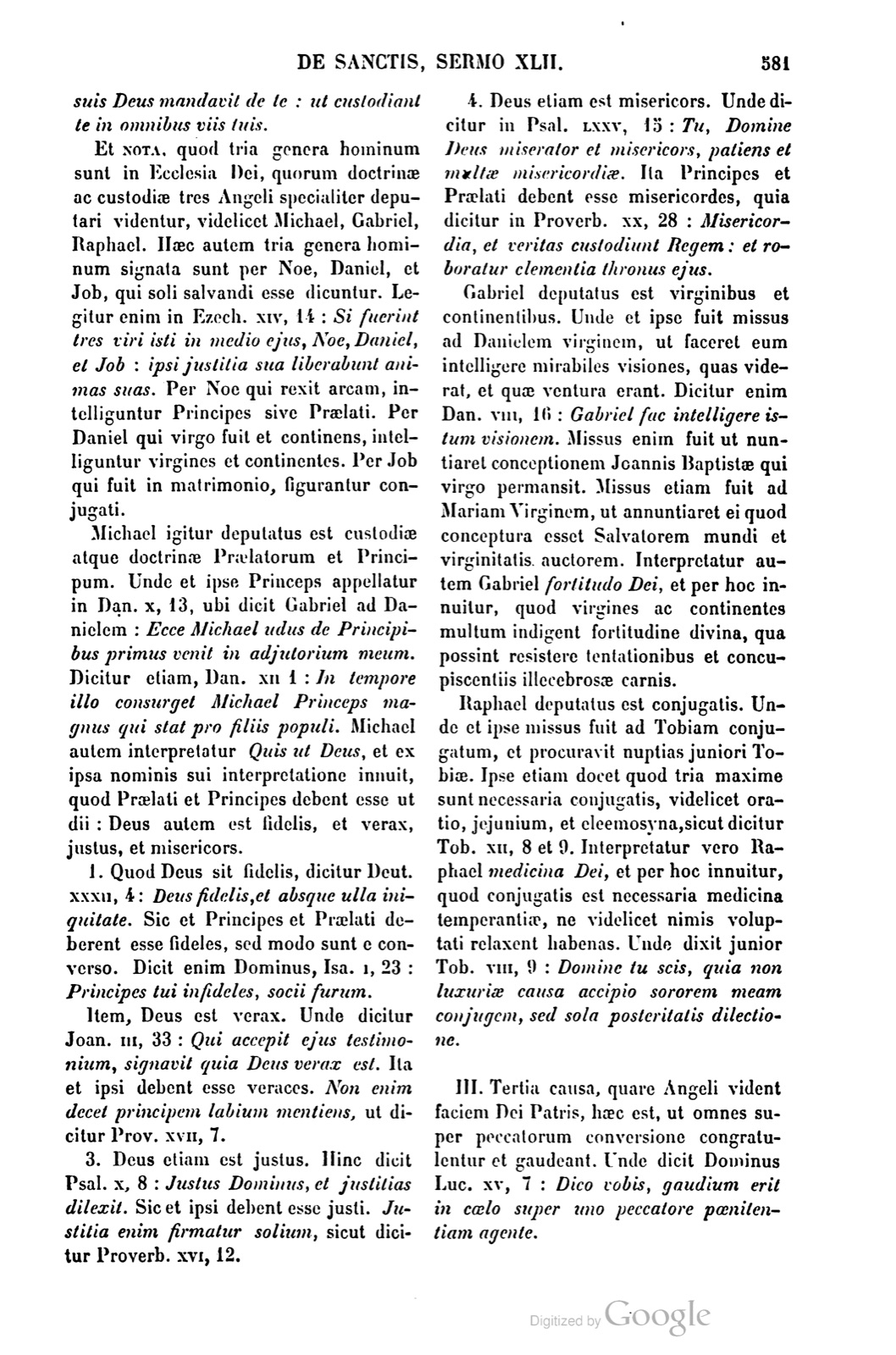
Gabriel deputatus est virginibus et continentibus. Unde et ipse fuit missus ad Danielem virginem, ut faceret eum intelligere mirabiles visiones, quas viderat, et quæ ventura erant. Dicitur enim Dan. VIII, 16: Gabriel fac intelligere istum visionem. Missus enim fuit ut nuntiaret conceptionem Joannis Baptistæ qui virgo permansit. Missus etiam fuit ad Mariam Virginem, ut annuntiaret ei quod conceptura esset Salvatorem mundi et virginitatis auctorem. Interpretatur autem Gabriel fortitudo Dei, et per hoc innuitur, quod virgines ac continentes multum indigent fortitudine divina, qua possint resistere tentationibus et concupiscentiis illecebrosæ carnis.
Raphael deputatus est conjugatis. Unde et ipse missus fuit ad Tobiam conjugatum, et procuravit nuptias juniori Tobiæ. Ipse etiam docet quod tria maxime sunt necessaria conjugatis, videlicet oratio, jejunium, et eleemosyna, sicut dicitur Tob. XII, 8 et 9. Interpretatur vero Raphael medicina Dei, et per hoc innuitur, quod conjugatis est necessaria medicina temperantiæ, ne videlicet nimis voluptati relaxent habenas. Unde dixit junior Tob. VIII, 9: Domine tu scis, quia non luxuriæ causa accipio sororem meam conjugem, sed sola posteritatis dilectione.
III. Tertia causa, quare Angeli vident faciem Dei Patris, hæc est, ut omnes super peccatorum conversione congratulentur et gaudeant. Unde dicit Dominus Luc. XV, 7: Dico vobis, gaudium erit in cælo super uno peccatore pænitentiam agente.
IV. Quarta causa est, quare Angeli tam avide faciem Patris cœlestis contemplentur, ut videlicet in ipsa ejus facie insatiabiliter delicientur. Unde I Pet. I, 12: In quem desiderant Angeli prospicere.
Rogate ergo Dominum, ut ei tam fideliter obsequamur, quod per sanctos Angelos in æternam requiem tandem deportari mereamur. Quod nobis, etc.
Footnotes:
None.
Gabriel was deputed to virgins and continent persons. Hence he himself also was sent to Daniel the virgin, that he might make him understand the marvelous visions that he had seen and that were to come. For it is said, Daniel 8:16: Gabriel, make that one understand the vision. For he was sent to announce the conception of John the Baptist, who remained a virgin. He was also sent to Mary the Virgin, that he might announce to her that she would conceive the Savior of the world and the author of virginity. Now Gabriel is interpreted the strength of God, and through this it is suggested that virgins and continent persons have much need of divine strength, by which they can resist the temptations and concupiscences of enticing flesh.
Raphael was deputed to married persons. Hence he himself was sent to Tobias the married man, and procured the marriage for the younger Tobias. He himself also teaches that three things are especially necessary to married persons, namely prayer, fasting, and alms, as is said in Tobit 12:8 and 9. But Raphael is interpreted medicine of God, and through this it is suggested that the medicine of temperance is necessary to married persons, namely lest they loosen the reins too much for pleasure. Hence the younger Tobias said, Tobit 8:9: Lord, you know that I do not take my sister as wife for the sake of lust, but for the love of posterity alone.
III. The third cause why Angels see the face of God the Father is this, so that all may rejoice together and be glad over the conversion of sinners. Hence the Lord says, Luke 15:7: I say to you, there will be joy in heaven over one sinner doing penance.
IV. The fourth cause why Angels so eagerly contemplate the face of the heavenly Father is that they may feast insatiably in his very face. Hence 1 Peter 1:12: Into whom the Angels desire to look.
Therefore pray to the Lord that we may serve him so faithfully that through the holy Angels we may at last deserve to be carried into eternal rest. Which may he grant us, etc.
Footnotes:
None.

If a page does not appear, its photograph has not been uploaded yet.