Volume 13 · pp. 571–574
Sermon XL. On the Feast of Blessed Matthew the Apostle
A marker with ≈ is an approximate page boundary, placed by measure of the text; the page photographs remain the authority. In the paired views, clicking a page marker brings that page into view.
SERMO XL.
IN FESTO BEATI MATTHÆI APOSTOLI.
Non veni vocare justos, sed peccatores ad pœnitentiam. Luc. V, 32.
Nota, quod Dominus et peccatores vocat, et justos. Unde notandum est hic de triplici vocatione Domini:
I. Dominus vocat peccatores ad pænitentiam et conversionem. II. Vocat justos ad ampliorem perfectionem. III. Vocat pænitentes et innocentes ad perpetuam remunerationem.
I.
De prima vocatione dicitur in Matth. IX, 9: Vidit Jesus hominem sedentem in telonio, Matthæum nomine. Et ait illi: Sequere me. Et surgens, secutus est eum.
Et nota, quod Beatus Matthæus quatuor fecit, quæ vere pænitens facere debet. Vocante quippe se Domino, omnia reliquit, surrexit, secutus est Jesum, et fecit ei in domo sua convivium magnum. Unde dicitur in Luc. V, 28 et 29: Relictis omnibus, surgens secutus est eum, et fecit ei convivium magnum Levi, id est, Matthæus, in domo sua. Ita etiam quilibet peccator, 1. Omnia peccata et peccatorum occasiones relinquere debet per timorem: quia timor Domini expellit peccatum 1. 2. Surgere etiam, id est, sursum se erigere debet per spem: quia spes cœlestia concupiscit. 3. Sequi quoque Deum debet per fidem. Fides enim semper innititur omnibus vestigiis Jesu Christi: sequitur quippe eum ad locum passionis et supplicii, et ad tribunal districti judicii, et ad solium cœlestis palatii. 4. Debet ei in domo animæ suæ magnum convivium præparare, per charitatem. Charitas enim bona opera operatur, in quibus Deus tamquam dulcissimis ferculis delectatur.
Item de vocatione peccatorum dicitur, Matth. IV, 17: Cœpit Jesus prædicare, et dicere: Pænitentiam agite: appropinquavit enim regnum cælorum. Dicitur etiam, Marc. I, 14 et 15: Venit Jesus in Galilæam, prædicans Evangelium Dei regni, et dicens: Quoniam impletum est tempus, et appropinquavit regnum Dei: pænitemini, et credite Evangelio.
Nota hic duas causas, quare unusquisque debeat celeriter pænitere.
1. Prima causa est temporis brevitas, quæ notatur ibi: Quoniam impletum est tempus. Cum igitur incerti simus, si cras simus victuri, quomodo conversionem nostram etiam usque in crastinum audeamus differre. Unde dicitur Eccli. V, 8 et 9: Non tardes converti ad Dominum, et ne differas de die in diem: subito enim veniet ira illius. Hinc etiam dicit Augustinus in libro de Verbis Domini: « Ipsa res est, quæ multos occidit, dum dicunt: Cras, cras: et subito ostium clauditur. Remansit foris cum voce corvina: quia non habuit gemitum columbinum. » Item, in eodem super locum illum Prov. III, 28: Ne dicas amico tuo: Vade et revertere: et cras dabo tibi: cum statim possis dare. « Audisti præceptum non differendi ut in alium sis misericors, et differendo in te es crudelis. Non debes differre panem daturus, et differs indulgentiam accepturus. »
SERMON XL.
ON THE FEAST OF BLESSED MATTHEW THE APOSTLE.
I have not come to call the just, but sinners to penance. Luke 5:32.
Note that the Lord calls both sinners and just persons. Hence one must note here concerning the threefold calling of the Lord:
I. The Lord calls sinners to penance and conversion. II. He calls the just to ampler perfection. III. He calls penitents and innocents to perpetual remuneration.
I.
Concerning the first calling it is said in Matthew 9:9: Jesus saw a man sitting in the toll-office, named Matthew. And he said to him: Follow me. And rising, he followed him.
And note that Blessed Matthew did four things that a truly penitent person ought to do. For when the Lord was calling him, he left all things, rose, followed Jesus, and made a great banquet for him in his house. Hence it is said in Luke 5:28 and 29: Leaving all things, rising, he followed him, and Levi, that is, Matthew, made a great banquet for him in his house. So also any sinner, 1. Ought to leave all sins and occasions of sins through fear, because the fear of the Lord expels sin 1. 2. He ought also to rise, that is, to raise himself upward, through hope, because hope desires heavenly things. 3. He also ought to follow God through faith. For faith always leans upon all the footsteps of Jesus Christ; for it follows him to the place of passion and punishment, and to the tribunal of strict judgment, and to the throne of the heavenly palace. 4. He ought to prepare a great banquet for him in the house of his soul, through charity. For charity works good works, in which God delights as in most sweet dishes.
Likewise concerning the calling of sinners it is said, Matthew 4:17: Jesus began to preach and to say: Do penance, for the kingdom of heaven has drawn near. It is also said, Mark 1:14 and 15: Jesus came into Galilee, preaching the Gospel of the kingdom of God and saying: Because the time has been fulfilled and the kingdom of God has drawn near, repent and believe the Gospel.
Note here two causes why each person ought to do penance quickly.
1. The first cause is the brevity of time, which is noted there: Because the time has been fulfilled. Therefore, since we are uncertain whether we will live tomorrow, how do we dare to defer our conversion even until tomorrow? Hence it is said, Ecclesiasticus 5:8 and 9: Do not delay to be converted to the Lord, and do not defer from day to day; for his wrath will come suddenly. Hence Augustine also says in the book On the Words of the Lord: "This is the very thing that has killed many, while they say: Tomorrow, tomorrow; and suddenly the door is closed. He remained outside with the raven's voice, because he did not have the dove-like groan." Likewise, in the same work on that place of Proverbs 3:28: Do not say to your friend: Go and return, and tomorrow I will give to you, when you can give at once. "You have heard the precept of not deferring, so that you may be merciful to another, and by deferring you are cruel to yourself. You ought not defer when you are going to give bread, and you defer when you are going to receive indulgence."
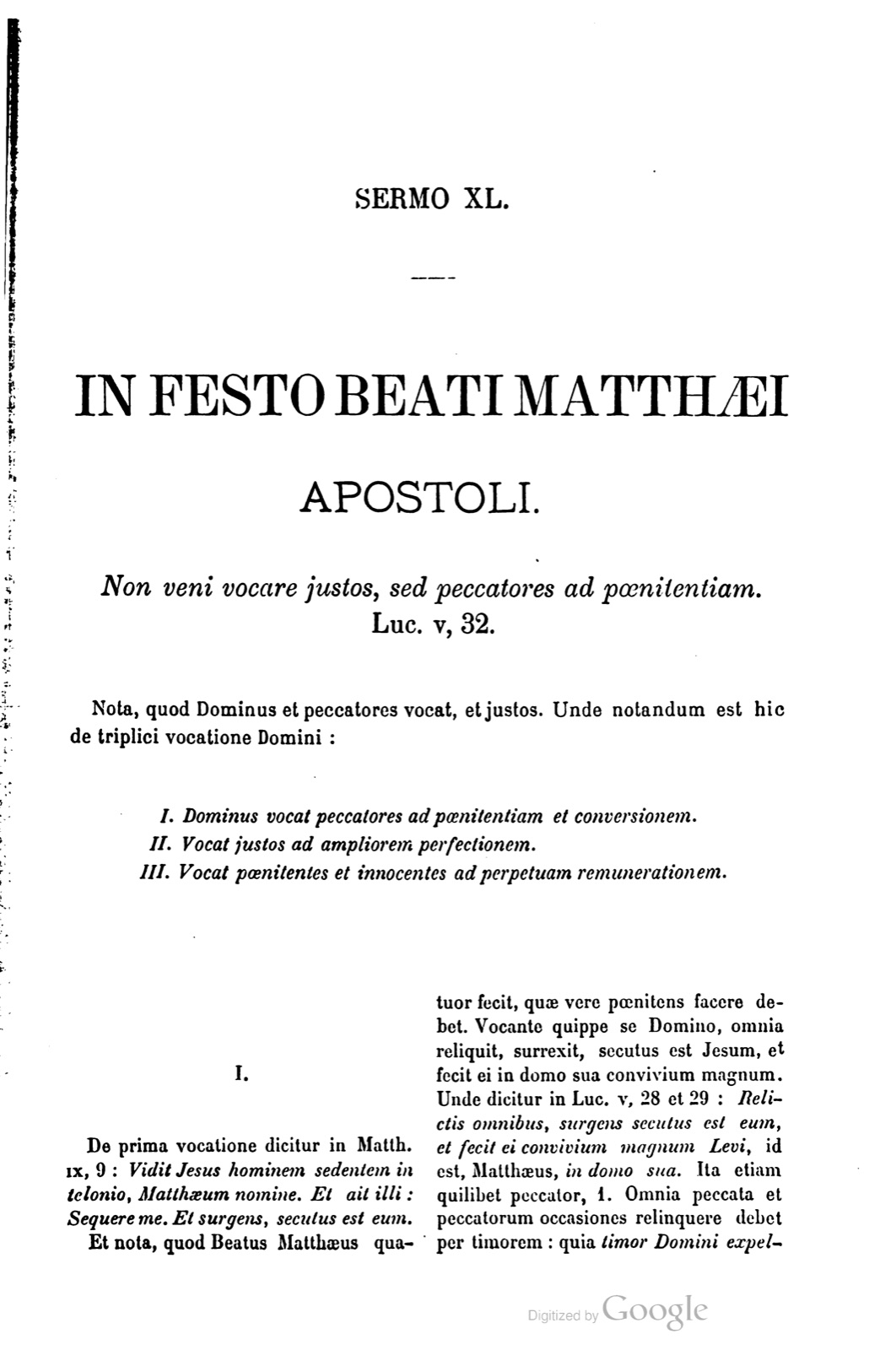
2. Secunda causa, per quam invitamur ad velocem pænitentiam, est gloriosi regni Dei jucunditas, quæ notatur ibi, Matth. IV, 17: Pænitentiam agite, appropinquavit enim regnum cælorum. Si aliquis ita famelicus esset, quod intraret stabulum porcorum, ut reficeretur de cibis eorum, et tunc ab aliquo magno principe vocaretur ad palatium suum, ubi ei ex optimis ferculis satietas veraciter promitteretur: nonne libenter et velociter ire deberet? Si vero responderet vocanti se, et diceret: Exspecta per tempus, prius enim ventrem meum siliquis porcorum implebo: nonne stultissimus judicaretur? Sic est de multis. Cum enim homo naturaliter ita famelicam habeat animam, quod non possit impleri nec satiari, nisi per solam Trinitatem: multi tamen amplexantur stercora turpium voluptatum, ut per eas satient miseram concupiscentiam suam. De ferculis vero regis æterni vel nihil vel valde parum curant. Quia igitur vocamur ad pænitentiam, oportet scire quid sit vera pœnitentia. Quædam Glossa super Matthæum ait: « Pænitentia dicitur a puniendo, qua quisque punit, quod illicite commisit. » Item, alia Glossa in Matthæo: « Pænitere est anteacta deflere, et deflenda non committere. » Augustinus in quodam sermone de Pænitentia dicit: « Pænitentes, pænitentes, pænitentes, si tamen estis pœnitentes, et non estis irridentes, mutate vitam. » Per hoc, quod ter ait pænitentes, innuit nobis quod triplex debet esse pænitentia, videlicet cordis, oris, et operis. Prima consistit in vehementi contritione, secunda in pura confessione, tertia in plena satisfactione.
II.
Secundo, Dominus vocat justos ad ampliorem perfectionem. Et nota, quod Christiana perfectio maxime consistit in quatuor. Primum est jugis continentia. Secundum est totalis obedientia. Tertium est voluntariæ paupertatis sacrificium. Quartum est fervens martyrii desiderium.
2. The second cause through which we are invited to swift penance is the pleasantness of the glorious kingdom of God, which is noted there, Matthew 4:17: Do penance, for the kingdom of heaven has drawn near. If someone were so hungry that he entered a sty of swine to be refreshed from their foods, and then were called by some great prince to his palace, where satiety from the best dishes was truly promised to him, ought he not go gladly and quickly? But if he were to answer the one calling him and say: Wait for a time, for first I will fill my belly with the husks of swine, would he not be judged most foolish? Thus it is concerning many. For since a human being naturally has a soul so hungry that it cannot be filled or satisfied except by the Trinity alone, nevertheless many embrace the dung of base pleasures, so that through them they may satisfy their wretched concupiscence. But concerning the dishes of the eternal king they care either nothing or very little. Therefore because we are called to penance, one must know what true penance is. A certain Gloss on Matthew says: "Penance is said from punishing, by which each person punishes what he has illicitly committed." Likewise, another Gloss in Matthew says: "To repent is to weep for things done before, and not to commit things to be wept over." Augustine in a certain sermon On Penance says: "Penitents, penitents, penitents, if nevertheless you are penitents and are not mockers, change your life." Through this, that he says penitents three times, he suggests to us that penance ought to be threefold, namely of heart, mouth, and work. The first consists in vehement contrition; the second in pure confession; the third in full satisfaction.
II.
Secondly, the Lord calls the just to ampler perfection. And note that Christian perfection especially consists in four things. The first is continual continence. The second is total obedience. The third is the sacrifice of voluntary poverty. The fourth is fervent desire for martyrdom.
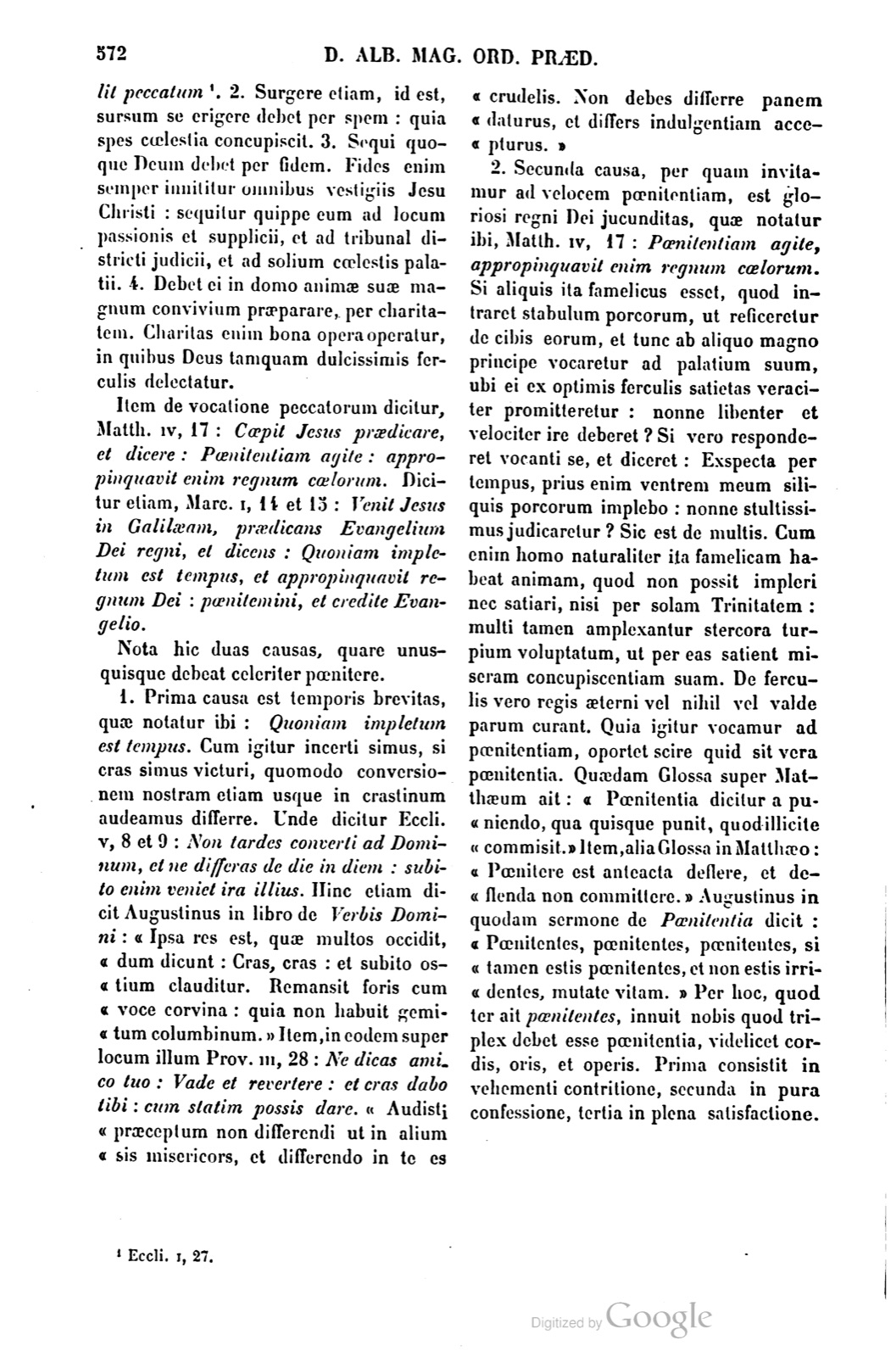
1. Ad jugem continentiam vocavit Dominus Joannem Evangelistam, cum ad ejusdem nuptias esset invitatus, sicut asserunt Sancti. De hac perfectione dicit Dominus, Matth. XIX, 12: Sunt eunuchi, qui seipsos castraverunt propter regnum cælorum. Qui potest capere, capiat. Legitur in vita S. Patrum, de quodam Laico qui diu habuerat uxorem legitimam, sed numquam eam cognoverat, sed tamquam sororem eam habebat. Hic vehementer redarguendi sunt qui nolunt etiam a fornicatione propter Deum abstinere.
2. Vocat nos etiam Dominus ad totalem obedientiam, Matth. XVI, 24: Si quis, inquit, vult venire post me, abneget semetipsum. Ille semetipsum abnegat, qui propriæ voluntati renuntiat, et totum se per obedientiam alteri recommendat. Hoc exemplum habemus a Christo, qui in agonia positus dixit ad Patrem, ut testatur Marc. XIV, 36: Abba Pater, omnia tibi possibilia sunt, transfer calicem hunc a me, sed non quod ego volo, sed quod tu. Ibi dicit Glossa: « Usque in finem non cessat nos docere parentibus obedire, et voluntatem eorum nostræ præponere voluntati. » Hic monendi sunt Laici, ut Sacerdotibus suis fideliter obediant.
3. Vocavit etiam Dominus Petrum et Andream, et filios Zebedæi ad voluntariæ paupertatis sacrificium, sicut legitur Matth. IV, 22. Dicitur enim ibi, quod relictis retibus et patre, secuti sunt eum. Hinc etiam legitur, Matth. XIX, 21, quod cum quidam adolescens dixisset se omnia mandata Domini a juventute servasse, ait illi Jesus: Si vis perfectus esse, vade, vende quæ habes, et da pauperibus, et habebis thesaurum in cælo. Hic monendi sunt illi, qui omnia relinquere non possunt, ut saltem eleemosynas suas pauperibus largiter administrent.
4. Quarto, vocat Dominus justos ad fervens martyrii desiderium. Unde dicit, Luc. XIV, 27: Qui non bajulat crucem suam, et venit post me, non potest meus esse discipulus. Ille crucem suam bajulat, qui mori pro Christo desiderat. Hic monendi sunt infirmi Christiani, qui timent mortem pati pro Christo, ut saltem ab hoc caveant, ne Christus patiatur ab eis, id est, ne rursus per peccata sua Dei Filium crucifigant.
1. The Lord called John the Evangelist to continual continence, when he had been invited to the wedding of the same man, as the Saints assert. Concerning this perfection the Lord says, Matthew 19:12: There are eunuchs who have castrated themselves for the kingdom of heaven. Let the one who can grasp it, grasp it. One reads in the life of the Holy Fathers concerning a certain layman who for a long time had had a legitimate wife, but had never known her, but had held her as a sister. Here those who do not wish even to abstain from fornication on account of God are to be vehemently rebuked.
2. The Lord also calls us to total obedience, Matthew 16:24: If anyone, he says, wishes to come after me, let him deny himself. That man denies himself who renounces his own will and entrusts himself wholly to another through obedience. We have this example from Christ, who, placed in agony, said to the Father, as Mark 14:36 testifies: Abba, Father, all things are possible to you; transfer this chalice from me, but not what I will, but what you will. There the Gloss says: "Until the end he does not cease to teach us to obey parents and to place their will before our own will." Here laypersons are to be admonished to obey their priests faithfully.
3. The Lord also called Peter and Andrew and the sons of Zebedee to the sacrifice of voluntary poverty, as is read in Matthew 4:22. For it is said there that, with nets and father left behind, they followed him. Hence it is also read in Matthew 19:21 that when a certain young man had said that he had kept all the commands of the Lord from youth, Jesus said to him: If you wish to be perfect, go, sell the things that you have and give to the poor, and you will have treasure in heaven. Here those who cannot leave all things are to be admonished that at least they should administer their alms largely to the poor.
4. Fourthly, the Lord calls the just to fervent desire for martyrdom. Hence he says, Luke 14:27: He who does not carry his cross and come after me cannot be my disciple. That man carries his cross who desires to die for Christ. Here weak Christians, who fear to suffer death for Christ, are to be admonished that at least they beware of this, lest Christ suffer from them, that is, lest through their sins they crucify the Son of God again.
III.
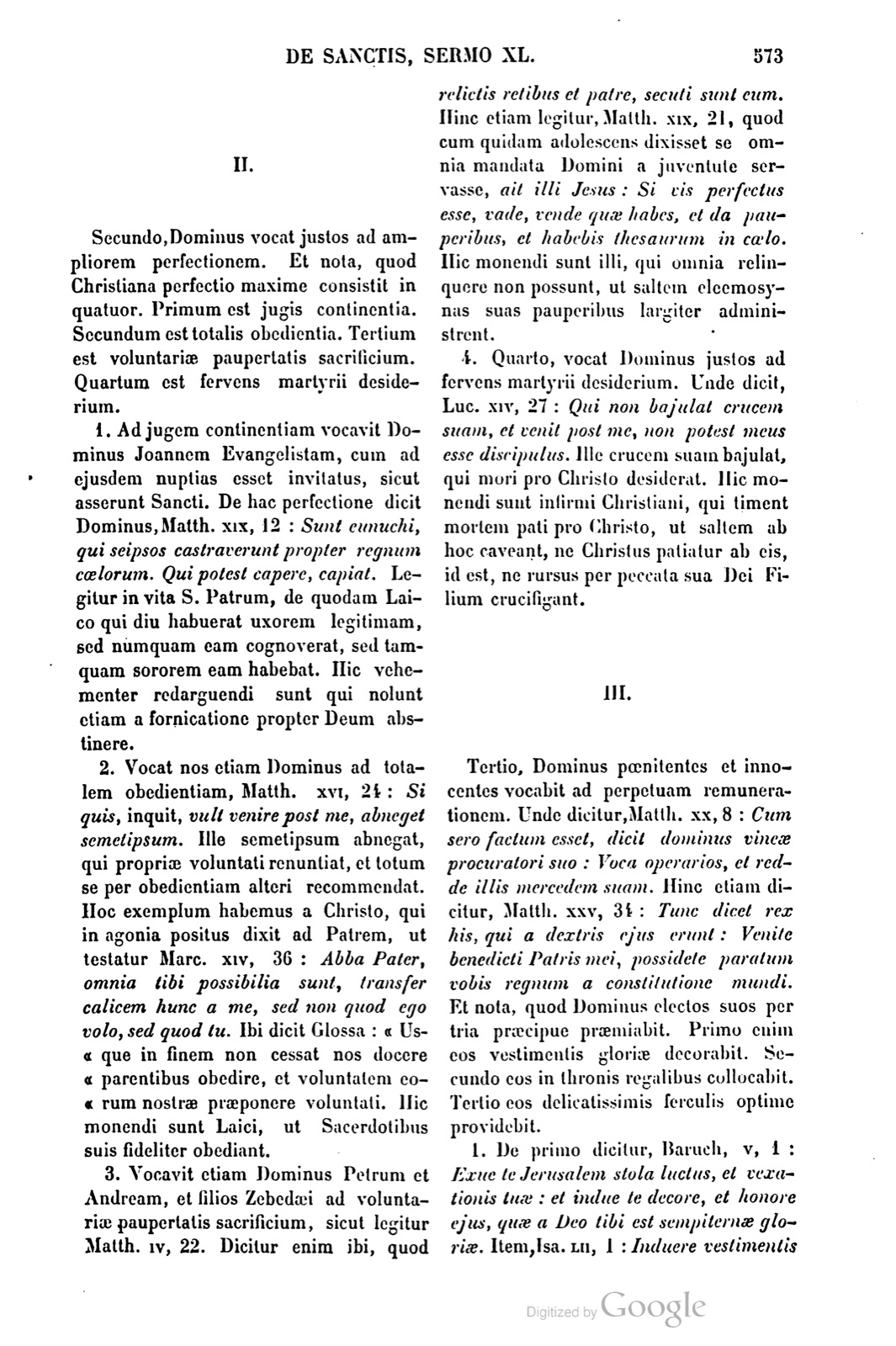
Tertio, Dominus pœnitentes et innocentes vocabit ad perpetuam remunerationem. Unde dicitur, Matth. XX, 8: Cum sero factum esset, dicit dominus vineæ procuratori suo: Voca operarios, et redde illis mercedem suam. Hinc etiam dicitur, Matth. XXV, 34: Tunc dicet rex his, qui a dextris ejus erunt: Venite benedicti Patris mei, possidete paratum vobis regnum a constitutione mundi.
Et nota, quod Dominus electos suos per tria præcipue præmiabit. Primo enim eos vestimentis gloriæ decorabit. Secundo eos in thronis regalibus collocabit. Tertio eos delicatissimis ferculis optime providebit.
1. De primo dicitur, Baruch, V, 1: Exue te Jerusalem stola luctus, et vexationis tuæ: et indue te decore, et honore ejus, quæ a Deo tibi est sempiternæ gloriæ. Item, Isa. LI, 1: Induere vestimentis gloriæ tuæ Jerusalem civitas sancti. Prædicta verba Dominus dicet ad quemlibet electum, cum induet eum stola perpetuæ claritatis. Per Jerusalem enim quilibet electus intelligitur.
2. De secundo dicitur in Job, XXXVI, 7: Non auferet Dominus a justo oculos suos, et reges in solio collocat in perpetuum, et illi eriguntur. Per reges intelliguntur boni Christiani, qui bene regunt semetipsos, et familiam suam si quam habent. Hos Dominus in soliis, id est, thronis regalibus collocabit.
3. De tertio dicitur in Isa. XLIX, 23: Erunt reges nutritii tui, et reginæ nutrices tuæ. Per reges intelliguntur Pater, et Filius, et Spiritus sanctus, qui monarchiam cœlestis regni indivisibili unitate gubernant. Per reginas designantur potentia, sapientia, benevolentia, quæ sunt quasi spirituales sponsæ Patris, et Filii, et Spiritus sancti. Qualia putatis fercula proferent de suis promptuariis hi Reges et hæ Reginæ? Econtra peccatores miseri et nudi demergentur in abyssum inferni, ubi comedent absynthium, et fel draconum bibent, id est, æterna supplicia patientur.
Rogate ergo Dominum, ut eum nunc per pænitentiam et Christianam perfectionem sic sequamur, ut tandem ad electorum epulas admittamur, etc.
III.
Thirdly, the Lord will call penitents and innocents to perpetual remuneration. Hence it is said, Matthew 20:8: When evening had come, the lord of the vineyard says to his steward: Call the workers and pay them their wage. Hence it is also said, Matthew 25:34: Then the king will say to those who will be at his right hand: Come, blessed of my Father, possess the kingdom prepared for you from the foundation of the world.
And note that the Lord will reward his elect especially through three things. For first he will adorn them with garments of glory. Secondly he will place them on royal thrones. Thirdly he will provide them excellently with most delicate dishes.
1. Concerning the first it is said, Baruch 5:1: Take off, Jerusalem, the robe of your mourning and vexation, and put on the beauty and honor that is yours from God of everlasting glory. Likewise, Isaiah 51:1: Put on the garments of your glory, Jerusalem, city of the Holy One. The Lord will say the aforesaid words to any elect person when he clothes him with the robe of perpetual brightness. For by Jerusalem any elect person is understood.
2. Concerning the second it is said in Job 36:7: The Lord will not take his eyes from the just man, and he places kings on the throne forever, and they are raised up. By kings are understood good Christians, who rule themselves and their household well, if they have one. The Lord will place these on seats, that is, royal thrones.
3. Concerning the third it is said in Isaiah 49:23: Kings will be your nourishing fathers, and queens your nurses. By kings are understood the Father, and the Son, and the Holy Spirit, who govern the monarchy of the heavenly kingdom with indivisible unity. By queens are designated power, wisdom, benevolence, which are as it were the spiritual brides of the Father, and of the Son, and of the Holy Spirit. What kinds of dishes do you think these Kings and these Queens will bring forth from their storerooms? On the contrary, wretched and naked sinners will be plunged down into the abyss of hell, where they will eat wormwood and drink the gall of dragons, that is, they will suffer eternal punishments.
Therefore pray to the Lord that we may now follow him so through penance and Christian perfection that at last we may be admitted to the banquets of the elect, etc.

Notes
- Ecclesiasticus 1:27. (Eccli. I, 27.) ↩
If a page does not appear, its photograph has not been uploaded yet.