Volume 13 · pp. 508–510
Sermon XXIII. In Commemoration of Blessed Paul the Apostle
A marker with ≈ is an approximate page boundary, placed by measure of the text; the page photographs remain the authority. In the paired views, clicking a page marker brings that page into view.
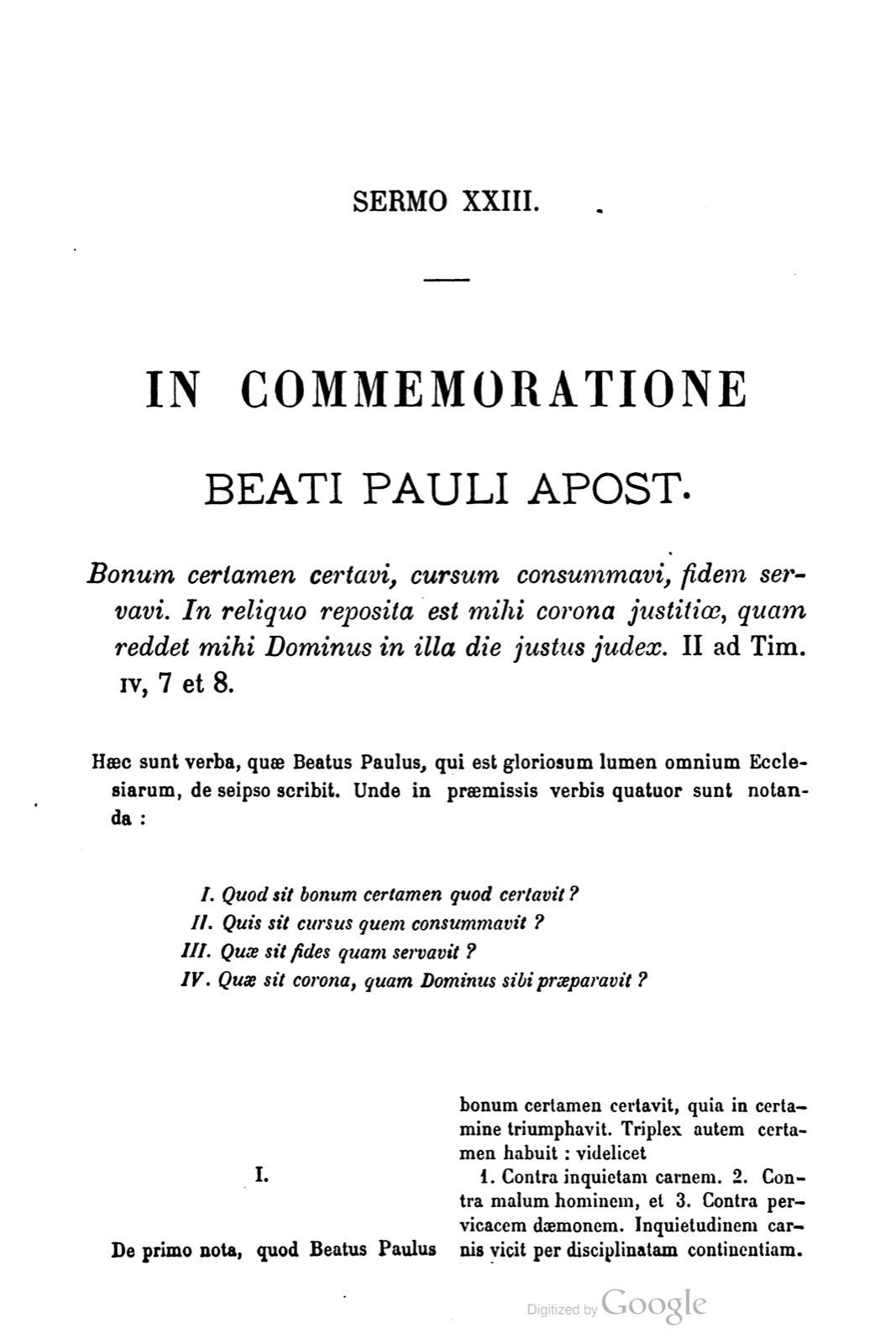
SERMO XXIII.
IN COMMEMORATIONE BEATI PAULI APOST.
Bonum certamen certavi, cursum consummavi, fidem servavi. In reliquo reposita est mihi corona justitiæ, quam reddet mihi Dominus in illa die justus judex. II ad Tim. IV, 7 et 8.
Hæc sunt verba, quæ Beatus Paulus, qui est gloriosum lumen omnium Ecclesiarum, de seipso scribit. Unde in præmissis verbis quatuor sunt notanda:
I. Quod sit bonum certamen quod certavit? II. Quis sit cursus quem consummavit? III. Quæ sit fides quam servavit? IV. Quæ sit corona, quam Dominus sibi præparavit?
I.
De primo nota, quod Beatus Paulus bonum certamen certavit, quia in certamine triumphavit. Triplex autem certamen habuit: videlicet
1. Contra inquietam carnem. 2. Contra malum hominem, et 3. Contra pervicacem dæmonem. Inquietudinem carnis vicit per disciplinatam continentiam. Malitiam hominum superavit per patientiam. Pervicaciam dæmonum conculcavit per suiipsius displicentiam.
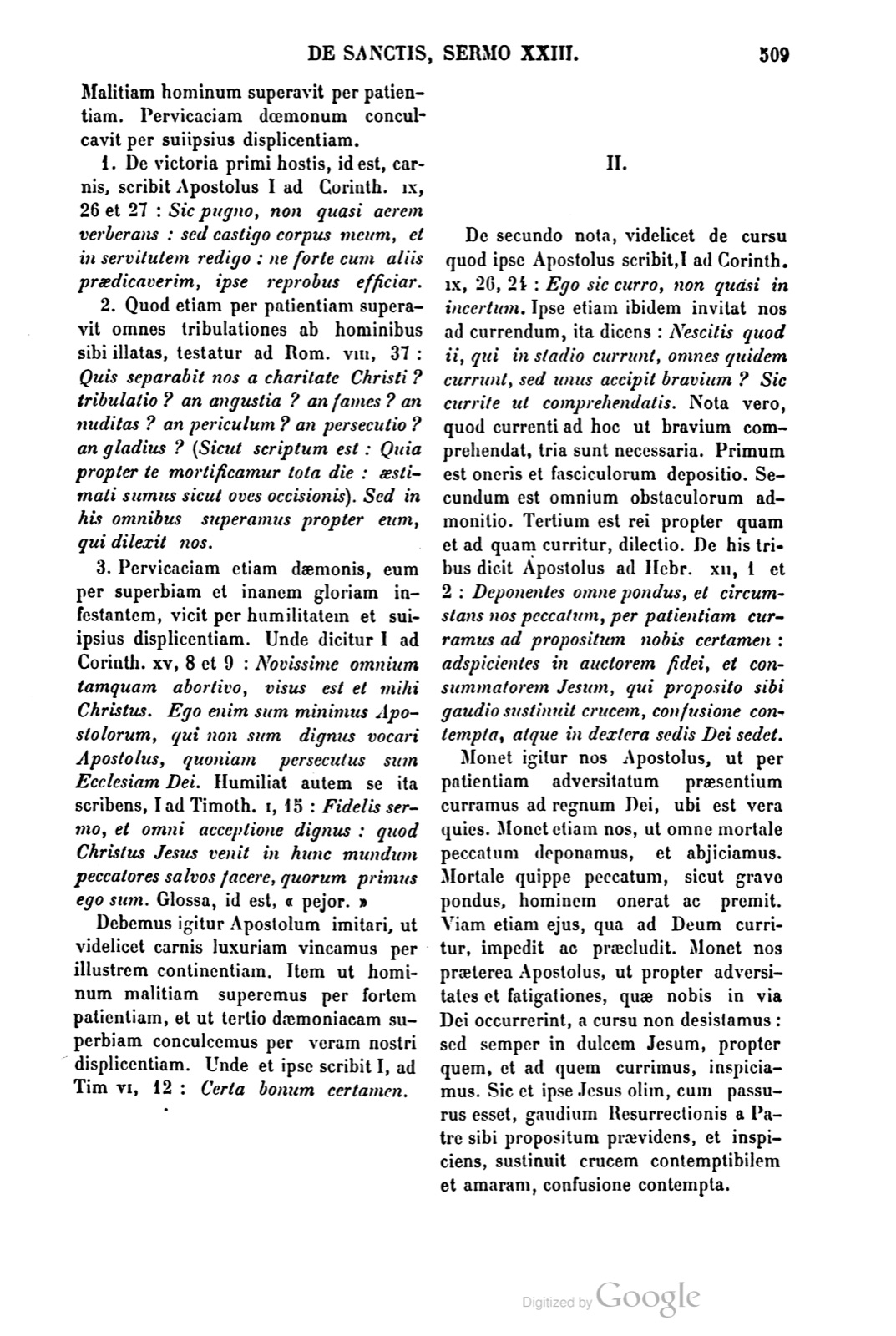
1. De victoria primi hostis, id est, carnis, scribit Apostolus I ad Corinth. IX, 26 et 27: Sic pugno, non quasi aerem verberans: sed castigo corpus meum, et in servitutem redigo: ne forte cum aliis prædicaverim, ipse reprobus efficiar.
2. Quod etiam per patientiam superavit omnes tribulationes ab hominibus sibi illatas, testatur ad Rom. VIII, 37: Quis separabit nos a charitate Christi? tribulatio? an angustia? an fames? an nuditas? an periculum? an persecutio? an gladius? (Sicut scriptum est: Quia propter te mortificamur tota die: æstimati sumus sicut oves occisionis). Sed in his omnibus superamus propter eum, qui dilexit nos.
3. Pervicaciam etiam dæmonis, eum per superbiam et inanem gloriam infestantem, vicit per humilitatem et suiipsius displicentiam. Unde dicitur I ad Corinth. XV, 8 et 9: Novissime omnium tamquam abortivo, visus est et mihi Christus. Ego enim sum minimus Apostolorum, qui non sum dignus vocari Apostolus, quoniam persecutus sum Ecclesiam Dei. Humiliat autem se ita scribens, I ad Timoth. I, 15: Fidelis sermo, et omni acceptione dignus: quod Christus Jesus venit in hunc mundum peccatores salvos facere, quorum primus ego sum. Glossa, id est, « pejor. »
Debemus igitur Apostolum imitari, ut videlicet carnis luxuriam vincamus per illustrem continentiam. Item ut hominum malitiam superemus per fortem patientiam, et ut tertio dæmoniacam superbiam conculcemus per veram nostri displicentiam. Unde et ipse scribit I, ad Tim. VI, 12: Certa bonum certamen.
SERMON XXIII.
IN COMMEMORATION OF BLESSED PAUL THE APOSTLE.
I have fought a good fight, I have finished the course, I have kept the faith. For the rest, a crown of justice has been laid up for me, which the Lord, the just judge, will render to me on that day. 2 Timothy 4:7 and 8.
These are words that Blessed Paul, who is the glorious light of all the Churches, writes concerning himself. Hence in the words set forth there are four things to be noted:
I. What is the good fight that he fought? II. What is the course that he completed? III. What is the faith that he kept? IV. What is the crown that the Lord prepared for him?
I.
On the first, note that Blessed Paul fought the good fight, because he triumphed in the fight. But he had a threefold fight: namely
1. Against the restless flesh. 2. Against an evil man. And 3. Against the stubborn demon. He conquered the restlessness of the flesh through disciplined continence. He overcame the malice of men through patience. He trampled down the stubbornness of demons through displeasure with himself.
1. Concerning the victory over the first enemy, that is, of the flesh, the Apostle writes in 1 Corinthians 9:26 and 27: Thus I fight, not as if beating the air, but I chastise my body and bring it into servitude, lest perhaps when I have preached to others, I myself should become reprobate.
2. That he also through patience overcame all tribulations inflicted on him by men, he testifies at Romans 8:37: Who will separate us from the charity of Christ? Tribulation? Or distress? Or hunger? Or nakedness? Or danger? Or persecution? Or sword? (As it is written: Because for your sake we are put to death all day long; we have been reckoned as sheep for slaughter). But in all these things we overcome because of him who loved us.
3. He also conquered the stubbornness of the demon, when it was attacking him through pride and empty glory, by humility and displeasure with himself. Hence it is said in 1 Corinthians 15:8 and 9: Last of all, as to one born out of due time, Christ was seen also by me. For I am the least of the Apostles, who am not worthy to be called an Apostle, because I persecuted the Church of God. But he humbles himself, writing thus, 1 Timothy 1:15: The saying is faithful and worthy of every acceptance: that Christ Jesus came into this world to make sinners safe, of whom I am the first. The Gloss says, that is, "the worse."
Therefore we ought to imitate the Apostle, namely so that we conquer the lust of the flesh through splendid continence; likewise so that we overcome the malice of men through strong patience; and thirdly so that we trample down demonic pride through true displeasure with ourselves. Hence he himself also writes, 1 Timothy 6:12: Fight the good fight.
II.
De secundo nota, videlicet de cursu quod ipse Apostolus scribit, I ad Corinth. IX, 26, 24: Ego sic curro, non quasi in incertum. Ipse etiam ibidem invitat nos ad currendum, ita dicens: Nescitis quod ii, qui in stadio currunt, omnes quidem currunt, sed unus accipit bravium? Sic currite ut comprehendatis. Nota vero, quod currenti ad hoc ut bravium comprehendat, tria sunt necessaria. Primum est oneris et fasciculorum depositio. Secundum est omnium obstaculorum admonitio. Tertium est rei propter quam et ad quam curritur, dilectio. De his tribus dicit Apostolus ad Hebr. XII, 1 et 2: Deponentes omne pondus, et circumstans nos peccatum, per patientiam curramus ad propositum nobis certamen: adspicientes in auctorem fidei, et consummatorem Jesum, qui proposito sibi gaudio sustinuit crucem, confusione contempta, atque in dextera sedis Dei sedet.
Monet igitur nos Apostolus, ut per patientiam adversitatum præsentium curramus ad regnum Dei, ubi est vera quies. Monet etiam nos, ut omne mortale peccatum deponamus, et abjiciamus. Mortale quippe peccatum, sicut grave pondus, hominem onerat ac premit. Viam etiam ejus, qua ad Deum curritur, impedit ac præcludit. Monet nos præterea Apostolus, ut propter adversitates et fatigationes, quæ nobis in via Dei occurrerint, a cursu non desistamus: sed semper in dulcem Jesum, propter quem, et ad quem currimus, inspiciamus. Sic et ipse Jesus olim, cum passurus esset, gaudium Resurrectionis a Patre sibi propositum prævidens, et inspiciens, sustinuit crucem contemptibilem et amaram, confusione contempta.
III.
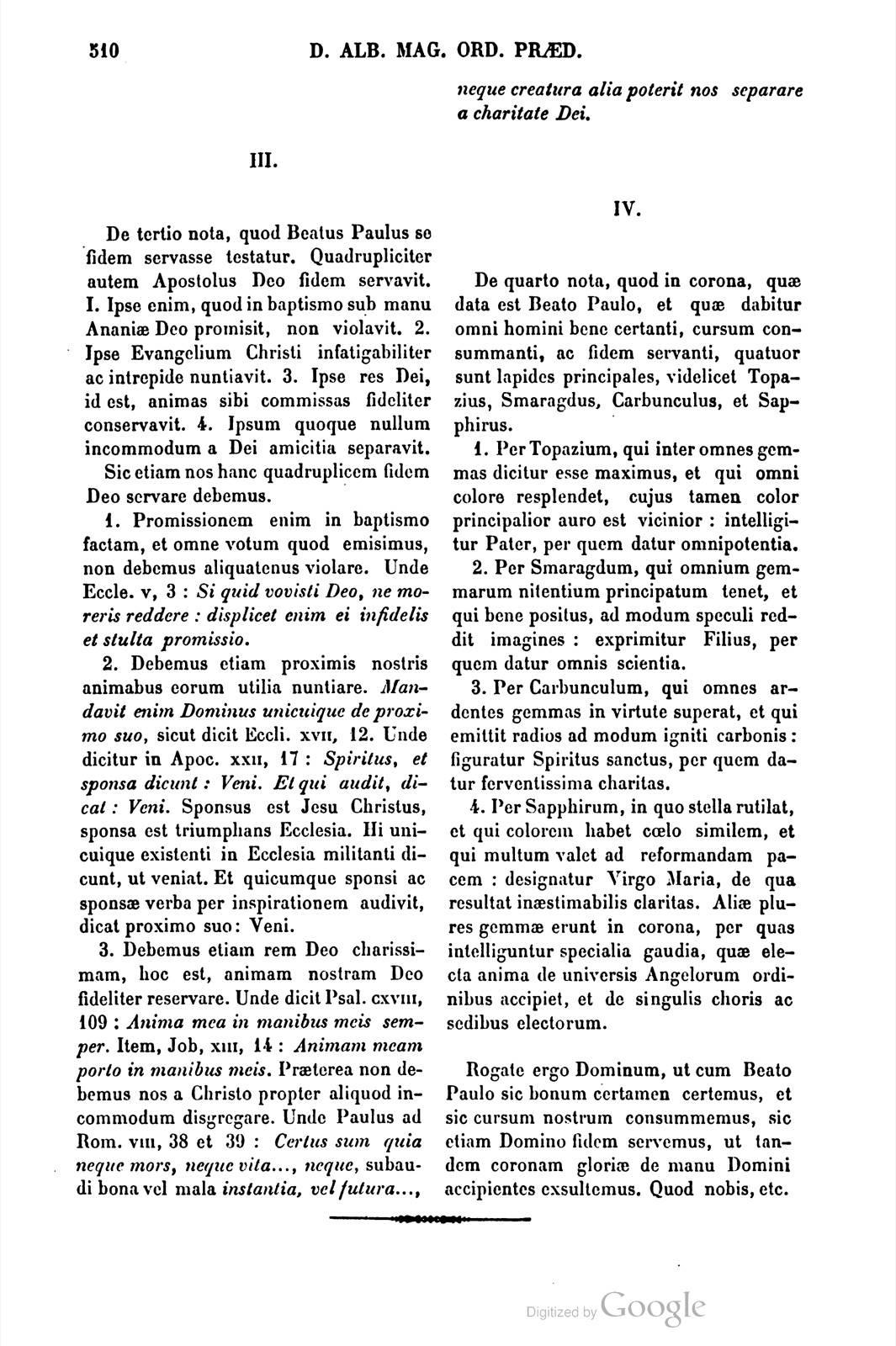
De tertio nota, quod Beatus Paulus se fidem servasse testatur. Quadrupliciter autem Apostolus Deo fidem servavit. I. Ipse enim, quod in baptismo sub manu Ananiæ Deo promisit, non violavit. 2. Ipse Evangelium Christi infatigabiliter ac intrepide nuntiavit. 3. Ipse res Dei, id est, animas sibi commissas fideliter conservavit. 4. Ipsum quoque nullum incommodum a Dei amicitia separavit.
Sic etiam nos hanc quadruplicem fidem Deo servare debemus.
1. Promissionem enim in baptismo factam, et omne votum quod emisimus, non debemus aliquatenus violare. Unde Eccle. V, 3: Si quid vovisti Deo, ne moreris reddere: displicet enim ei infidelis et stulta promissio.
II.
On the second, note, namely concerning the course, what the Apostle himself writes, 1 Corinthians 9:26, 24: I so run, not as if into uncertainty. He also there invites us to running, saying thus: Do you not know that those who run in the stadium all indeed run, but one receives the prize? So run that you may grasp it. But note that for one running, in order that he may grasp the prize, three things are necessary. The first is the laying aside of a burden and bundles. The second is the warning away of all obstacles. The third is love of the thing on account of which and toward which one runs. Concerning these three things the Apostle says at Hebrews 12:1 and 2: Laying aside every weight, and the sin that surrounds us, let us run through patience to the contest set before us, looking toward Jesus, the author and finisher of faith, who, with the joy set before him, endured the cross, despising confusion, and sits at the right hand of the throne of God.
Therefore the Apostle admonishes us to run through patience of present adversities to the kingdom of God, where there is true rest. He also admonishes us to lay aside and cast away every mortal sin. Indeed mortal sin, like a heavy weight, burdens and presses a man. It also impedes and closes off his way, by which one runs to God. Moreover the Apostle admonishes us that, because of adversities and wearinesses that occur to us in the way of God, we should not cease from the course, but should always look upon sweet Jesus, on account of whom and toward whom we run. Thus also Jesus himself once, when he was about to suffer, foreseeing and looking upon the joy of the Resurrection set before him by the Father, endured the contemptible and bitter cross, despising confusion.
III.
On the third, note that Blessed Paul testifies that he kept the faith. But the Apostle kept faith with God in four ways. I. For he did not violate what he promised to God in baptism under the hand of Ananias. 2. He proclaimed the Gospel of Christ tirelessly and fearlessly. 3. He faithfully preserved the things of God, that is, the souls entrusted to him. 4. No disadvantage at all separated him from the friendship of God.
Thus we too ought to keep this fourfold faith with God.
1. For we ought not in any way to violate the promise made in baptism, and every vow that we have emitted. Hence Ecclesiastes 5:3 says: If you have vowed anything to God, do not delay to render it; for an unfaithful and foolish promise displeases him.
2. Debemus etiam proximis nostris animabus eorum utilia nuntiare. Mandavit enim Dominus unicuique de proximo suo, sicut dicit Eccli. XVII, 12. Unde dicitur in Apoc. XXII, 17: Spiritus, et sponsa dicunt: Veni. Et qui audit, dicat: Veni. Sponsus est Jesu Christus, sponsa est triumphans Ecclesia. Hi unicuique existenti in Ecclesia militanti dicunt, ut veniat. Et quicumque sponsi ac sponsæ verba per inspirationem audivit, dicat proximo suo: Veni.
3. Debemus etiam rem Deo charissimam, hoc est, animam nostram Deo fideliter reservare. Unde dicit Psal. CXVIII, 109: Anima mea in manibus meis semper. Item, Job, XIII, 14: Animam meam porto in manibus meis. Præterea non debemus nos a Christo propter aliquod incommodum disgregare. Unde Paulus ad Rom. VIII, 38 et 39: Certus sum quia neque mors, neque vita..., neque, subaudi bona vel mala instantia, vel futura..., neque creatura alia poterit nos separare a charitate Dei.
IV.
De quarto nota, quod in corona, quæ data est Beato Paulo, et quæ dabitur omni homini bene certanti, cursum consummanti, ac fidem servanti, quatuor sunt lapides principales, videlicet Topazius, Smaragdus, Carbunculus, et Sapphirus.
1. Per Topazium, qui inter omnes gemmas dicitur esse maximus, et qui omni colore resplendet, cujus tamen color principalior auro est vicinior: intelligitur Pater, per quem datur omnipotentia.
2. Per Smaragdum, qui omnium gemmarum nitentium principatum tenet, et qui bene positus, ad modum speculi reddit imagines: exprimitur Filius, per quem datur omnis scientia.
3. Per Carbunculum, qui omnes ardentes gemmas in virtute superat, et qui emittit radios ad modum igniti carbonis: figuratur Spiritus sanctus, per quem datur ferventissima charitas.
4. Per Sapphirum, in quo stella rutilat, et qui colorem habet cælo similem, et qui multum valet ad reformandam pacem: designatur Virgo Maria, de qua resultat inæstimabilis claritas. Aliæ plures gemmæ erunt in corona, per quas intelliguntur specialia gaudia, quæ electa anima de universis Angelorum ordinibus accipiet, et de singulis choris ac sedibus electorum.
Rogate ergo Dominum, ut cum Beato Paulo sic bonum certamen certemus, et sic cursum nostrum consummemus, sic etiam Domino fidem servemus, ut tandem coronam gloriæ de manu Domini accipientes exsultemus. Quod nobis, etc.
2. We also ought to announce to our neighbors the things useful for their souls. For the Lord commanded each one concerning his neighbor, as Ecclesiasticus 17:12 says. Hence it is said in Apocalypse 22:17: The Spirit and the bride say: Come. And he who hears, let him say: Come. The bridegroom is Jesus Christ; the bride is the Church triumphant. These say to each person existing in the Church militant that he should come. And whoever has heard the words of the bridegroom and the bride through inspiration, let him say to his neighbor: Come.
3. We ought also faithfully to reserve for God the thing most dear to God, that is, our soul. Hence Psalm 118:109 says: My soul is always in my hands. Likewise, Job 13:14: I carry my soul in my hands. Moreover, we ought not to separate ourselves from Christ because of any disadvantage. Hence Paul at Romans 8:38 and 39 says: I am certain that neither death, nor life..., nor, understand, a good or evil present thing, or future things..., nor any other creature will be able to separate us from the charity of God.
IV.
On the fourth, note that in the crown that was given to Blessed Paul, and that will be given to every man fighting well, completing the course, and keeping the faith, there are four principal stones, namely topaz, emerald, carbuncle, and sapphire.
1. By topaz, which among all gems is said to be greatest and which shines with every color, whose principal color nevertheless is nearer to gold, the Father is understood, through whom omnipotence is given.
2. By emerald, which holds the principality of all shining gems and which, when well placed, returns images in the manner of a mirror, the Son is expressed, through whom all knowledge is given.
3. By carbuncle, which surpasses all burning gems in power and which sends out rays in the manner of burning coal, the Holy Spirit is figured, through whom most fervent charity is given.
4. By sapphire, in which a star glows, and which has a color similar to heaven, and which has much power for restoring peace, the Virgin Mary is designated, from whom inestimable brightness shines forth. There will be several other gems in the crown, by which are understood special joys that the elect soul will receive from all the orders of Angels and from each choir and seat of the elect.
Therefore pray to the Lord, that with Blessed Paul we may so fight the good fight, and so complete our course, and so also keep faith with the Lord, that at last, receiving the crown of glory from the hand of the Lord, we may exult. May he grant this to us, etc.
If a page does not appear, its photograph has not been uploaded yet.