Volume 13 · pp. 503–504
Sermon XXI. On the Nativity of Blessed John the Baptist, Conclusion
A marker with ≈ is an approximate page boundary, placed by measure of the text; the page photographs remain the authority. In the paired views, clicking a page marker brings that page into view.
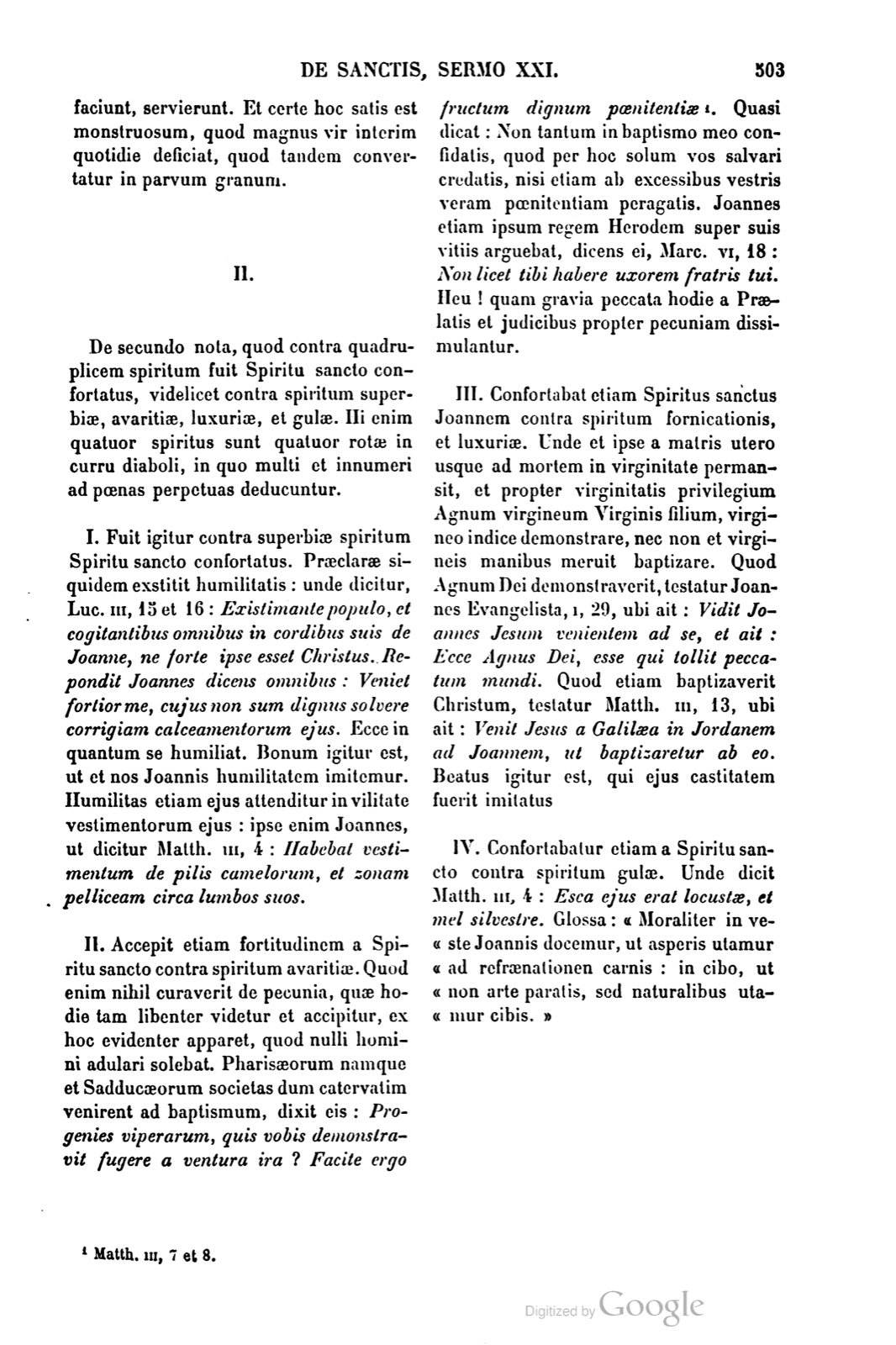
faciunt, servierunt. Et certe hoc satis est monstruosum, quod magnus vir interim quotidie deficiat, quod tandem convertatur in parvum granum.
II.
De secundo nota, quod contra quadruplicem spiritum fuit Spiritu sancto confortatus, videlicet contra spiritum superbiæ, avaritiæ, luxuriæ, et gulæ. Illi enim quatuor spiritus sunt quatuor rotæ in curru diaboli, in quo multi et innumeri ad pœnas perpetuas deducuntur.
I. Fuit igitur contra superbiæ spiritum Spiritu sancto confortatus. Præclaræ siquidem exstitit humilitatis: unde dicitur, Luc. III, 15 et 16: Existimante populo, et cogitantibus omnibus in cordibus suis de Joanne, ne forte ipse esset Christus. Respondit Joannes dicens omnibus: Veniet fortior me, cujus non sum dignus solvere corrigiam calceamentorum ejus. Ecce in quantum se humiliat. Bonum igitur est, ut et nos Joannis humilitatem imitemur. Humilitas etiam ejus attenditur in vilitate vestimentorum ejus: ipse enim Joannes, ut dicitur Matth. III, 4: Habebat vestimentum de pilis camelorum, et zonam pelliceam circa lumbos suos.
II. Accepit etiam fortitudinem a Spiritu sancto contra spiritum avaritiæ. Quod enim nihil curaverit de pecunia, quæ hodie tam libenter videtur et accipitur, ex hoc evidenter apparet, quod nulli homini adulari solebat. Pharisæorum namque et Sadducæorum societas dum catervatim venirent ad baptismum, dixit eis: Progenies viperarum, quis vobis demonstravit fugere a ventura ira? Facite ergo fructum dignum pœnitentiæ 1. Quasi dicat: Non tantum in baptismo meo confidatis, quod per hoc solum vos salvari credatis, nisi etiam ab excessibus vestris veram pœnitentiam peragatis. Joannes etiam ipsum regem Herodem super suis vitiis arguebat, dicens ei, Marc. VI, 18: Non licet tibi habere uxorem fratris tui. Heu! quam gravia peccata hodie a Prælatis et judicibus propter pecuniam dissimulantur.
III. Confortabat etiam Spiritus sanctus Joannem contra spiritum fornicationis, et luxuriæ. Unde et ipse a matris utero usque ad mortem in virginitate permansit, et propter virginitatis privilegium Agnum virgineum Virginis filium, virgineo indice demonstrare, nec non et virgineis manibus meruit baptizare. Quod Agnum Dei demonstraverit, testatur Joannes Evangelista, I, 29, ubi ait: Vidit Joannes Jesum venientem ad se, et ait: Ecce Agnus Dei, esse qui tollit peccatum mundi. Quod etiam baptizaverit Christum, testatur Matth. III, 13, ubi ait: Venit Jesus a Galilæa in Jordanem ad Joannem, ut baptizaretur ab eo. Beatus igitur est, qui ejus castitatem fuerit imitatus.
IV. Confortabatur etiam a Spiritu sancto contra spiritum gulæ. Unde dicit Matth. III, 4: Esca ejus erat locustæ, et mel silvestre. Glossa: « Moraliter in veste Joannis docemur, ut asperis utamur ad refrænationem carnis: in cibo, ut non arte paratis, sed naturalibus utamur cibis. »
III.
De tertio nota, quod propter tria in desertis manebat.
Prima causa fuit, ne in vasis sensuum suorum mundanis delectationibus inquinaretur. Unde Seneca: « Inimica est multorum conversatio. Nemo enim est, qui non aliquod nobis vitium aut commendat, aut imprimit, aut nescientibus aperit: utique quo major est populus, cui miscemur, hoc periculi plus est. Nihil vero tam damnosum bonis moribus, quam in aliquo spectaculo residere. Avarior redeo, ambitiosior, imo vero crudelior et inhumanior, quia inter homines fui. »
do, have served. And certainly this is sufficiently monstrous, that a great man meanwhile daily decreases, so that at last he is turned into a small grain.
II.
On the second, note that he was strengthened by the Holy Spirit against a fourfold spirit, namely against the spirit of pride, of avarice, of lust, and of gluttony. For these four spirits are the four wheels in the chariot of the devil, in which many and innumerable persons are led away to perpetual punishments.
I. Therefore he was strengthened by the Holy Spirit against the spirit of pride. Indeed he was of distinguished humility; hence it is said, Luke 3:15 and 16: While the people were thinking, and all were considering in their hearts concerning John, whether perhaps he himself was the Christ, John answered, saying to all: One stronger than I will come, the latchet of whose shoes I am not worthy to loose. Behold how much he humbles himself. Therefore it is good that we too imitate the humility of John. His humility is also attended to in the vileness of his garments; for John himself, as is said in Matthew 3:4, had a garment of camel hairs and a leathern girdle around his loins.
II. He also received strength from the Holy Spirit against the spirit of avarice. For that he cared nothing about money, which today is seen and received so willingly, is clearly apparent from this, that he was accustomed to flatter no man. For when the company of the Pharisees and Sadducees came in crowds to baptism, he said to them: Offspring of vipers, who has shown you to flee from the wrath to come? Therefore bring forth fruit worthy of penance 1. As if he were saying: Do not trust only in my baptism, because you believe that through this alone you are to be saved, unless you also carry out true penance for your excesses. John also reproved King Herod himself concerning his vices, saying to him, Mark 6:18: It is not lawful for you to have your brother's wife. Alas, how grave are the sins that today are hidden by Prelates and judges because of money.
III. The Holy Spirit also strengthened John against the spirit of fornication and lust. Hence he himself also remained in virginity from his mother's womb until death, and because of the privilege of virginity he merited to point out the virginal Lamb, the Son of the Virgin, with a virginal finger, and also to baptize him with virginal hands. That he pointed out the Lamb of God, John the Evangelist bears witness, 1:29, where he says: John saw Jesus coming to him, and says: Behold the Lamb of God, behold him who takes away the sin of the world. That he also baptized Christ, Matthew 3:13 bears witness, where he says: Jesus came from Galilee into the Jordan to John, that he might be baptized by him. Therefore blessed is he who has imitated his chastity.
IV. He was also strengthened by the Holy Spirit against the spirit of gluttony. Hence Matthew 3:4 says: His food was locusts and wild honey. The Gloss says: "Morally, in the garment of John we are taught to use rough things for restraining the flesh; in food, that we use foods not prepared by art, but natural foods."
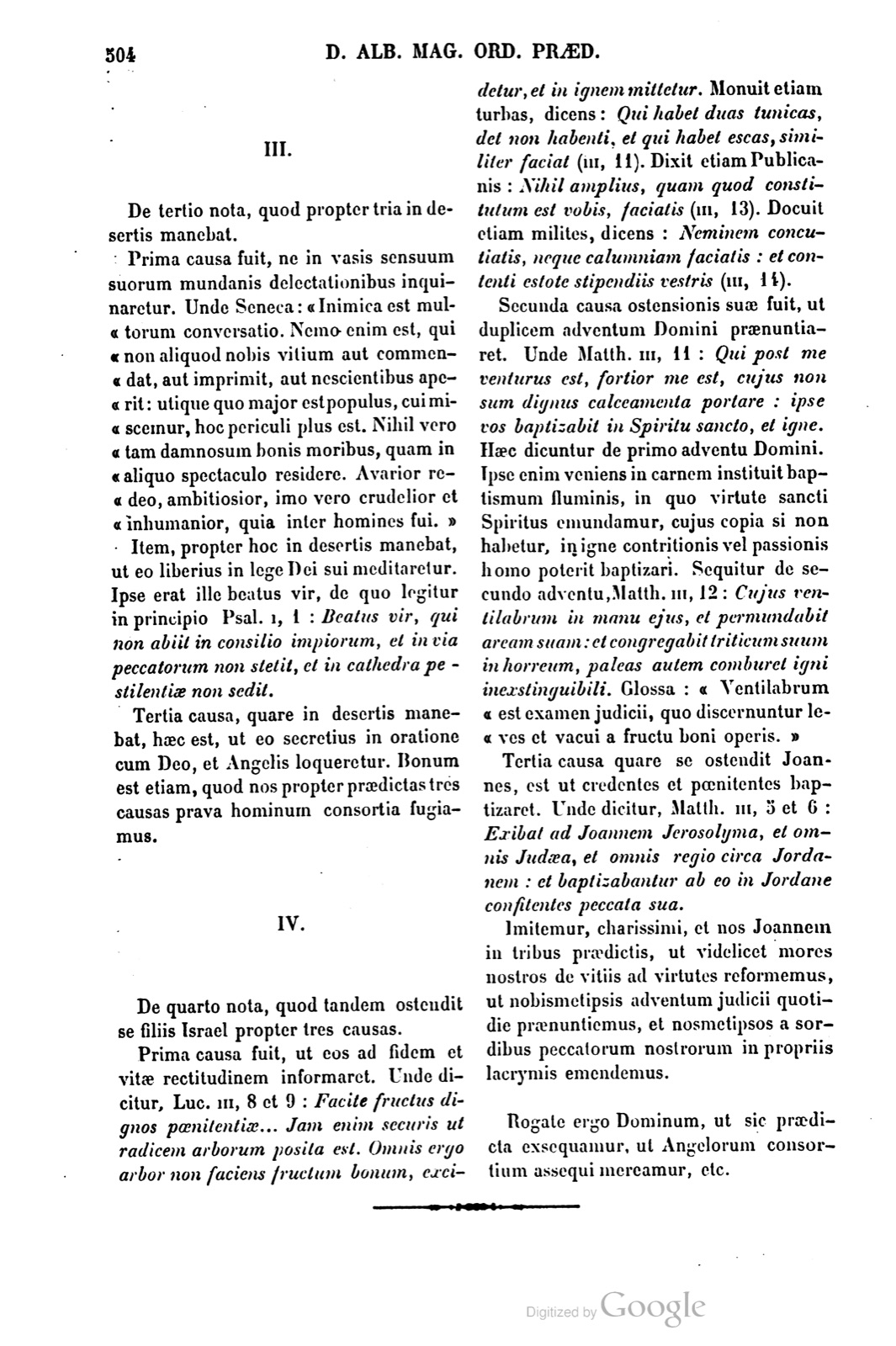
III.
On the third, note that he remained in deserts for three reasons.
The first cause was so that he would not be stained in the vessels of his senses by worldly delights. Hence Seneca says: "The conversation of many persons is hostile. For there is no one who does not either recommend some vice to us, or impress it on us, or reveal it to us when we are unaware; certainly the greater the crowd with whom we mingle, the more danger there is. Nothing, however, is so damaging to good morals as to sit at some spectacle. I return more avaricious, more ambitious, indeed more cruel and inhuman, because I have been among men."
Item, propter hoc in desertis manebat, ut eo liberius in lege Dei sui meditaretur. Ipse erat ille beatus vir, de quo legitur in principio Psal. I, 1: Beatus vir, qui non abiit in consilio impiorum, et in via peccatorum non stetit, et in cathedra pestilentiæ non sedit.
Tertia causa, quare in desertis manebat, hæc est, ut eo secretius in oratione cum Deo, et Angelis loqueretur. Bonum est etiam, quod nos propter prædictas tres causas prava hominum consortia fugiamus.
IV.
De quarto nota, quod tandem ostendit se filiis Israel propter tres causas.
Prima causa fuit, ut eos ad fidem et vitæ rectitudinem informaret. Unde dicitur, Luc. III, 8 et 9: Facite fructus dignos pœnitentiæ... Jam enim securis ut radicem arborum posita est. Omnis ergo arbor non faciens fructum bonum, excidetur, et in ignem mittetur. Monuit etiam turbas, dicens: Qui habet duas tunicas, det non habenti, et qui habet escas, similiter faciat (III, 11). Dixit etiam Publicanis: Nihil amplius, quam quod constitutum est vobis, faciatis (III, 13). Docuit etiam milites, dicens: Neminem concutiatis, neque calumniam faciatis: et contenti estote stipendiis vestris (III, 14).
Secunda causa ostensionis suæ fuit, ut duplicem adventum Domini prænuntiaret. Unde Matth. III, 11: Qui post me venturus est, fortior me est, cujus non sum dignus calceamenta portare: ipse vos baptizabit in Spiritu sancto, et igne. Hæc dicuntur de primo adventu Domini. Ipse enim veniens in carnem instituit baptismum fluminis, in quo virtute sancti Spiritus emundamur, cujus copia si non habetur, in igne contritionis vel passionis homo poterit baptizari. Sequitur de secundo adventu, Matth. III, 12: Cujus ventilabrum in manu ejus, et permundabit aream suam: et congregabit triticum suum in horreum, paleas autem comburet igni inexstinguibili. Glossa: « Ventilabrum est examen judicii, quo discernuntur leves et vacui a fructu boni operis. »
Tertia causa quare se ostendit Joannes, est ut credentes et pœnitentes baptizaret. Unde dicitur, Matth. III, 5 et 6: Exibat ad Joannem Jerosolyma, et omnis Judæa, et omnis regio circa Jordanem: et baptizabantur ab eo in Jordane confitentes peccata sua.
Imitemur, charissimi, et nos Joannem in tribus prædictis, ut videlicet mores nostros de vitiis ad virtutes reformemus, ut nobismetipsis adventum judicii quotidie prænuntiemus, et nosmetipsos a sordibus peccatorum nostrorum in propriis lacrymis emendemus.
Rogate ergo Dominum, ut sic prædicta exsequamur, ut Angelorum consortium assequi mereamur, etc.
Likewise, for this reason he remained in deserts, that he might meditate more freely in the law of his God. He was that blessed man of whom one reads at the beginning of Psalm 1:1: Blessed is the man who has not gone away in the counsel of the impious, and has not stood in the way of sinners, and has not sat in the chair of pestilence.
The third cause why he remained in deserts is this: so that he might speak more secretly in prayer with God and the Angels. It is also good that we, for the three aforesaid reasons, flee the depraved company of men.
IV.
On the fourth, note that at last he showed himself to the children of Israel for three reasons.
The first cause was so that he might instruct them toward faith and rectitude of life. Hence it is said, Luke 3:8 and 9: Bring forth fruits worthy of penance... For now the axe is set to the root of the trees. Therefore every tree not producing good fruit will be cut down and cast into the fire. He also admonished the crowds, saying: He who has two tunics, let him give to him who does not have, and he who has foods, let him do likewise (3:11). He also said to Publicans: Do nothing more than what has been appointed to you (3:13). He also taught soldiers, saying: Strike no one, and do not make false accusation; and be content with your pay (3:14).
The second cause of his showing himself was so that he might foretell the double coming of the Lord. Hence Matthew 3:11 says: He who is to come after me is stronger than I, whose shoes I am not worthy to carry; he will baptize you in the Holy Spirit and fire. These things are said concerning the first coming of the Lord. For he, coming in flesh, instituted the baptism of the stream, in which by the power of the Holy Spirit we are cleansed; if an abundance of this is not had, a man will be able to be baptized in the fire of contrition or of suffering. It follows concerning the second coming, Matthew 3:12: His fan is in his hand, and he will cleanse his threshing floor, and he will gather his wheat into the barn, but the chaff he will burn with inextinguishable fire. The Gloss says: "The fan is the examination of judgment, by which those light and empty of the fruit of good work are discerned."
The third cause why John showed himself is so that he might baptize believers and penitents. Hence it is said, Matthew 3:5 and 6: Jerusalem went out to John, and all Judea, and every region around the Jordan; and they were baptized by him in the Jordan, confessing their sins.
Let us, dearest ones, also imitate John in the three aforesaid things, namely so that we reform our morals from vices to virtues, so that we daily foretell to ourselves the coming of judgment, and so that we amend ourselves from the filths of our sins in our own tears.
Therefore pray to the Lord, that we may so carry out the aforesaid things, that we may merit to attain the fellowship of the Angels, etc.
Notes
- Matthew 3:7 and 8. (Matth. III, 7 et 8.) ↩
If a page does not appear, its photograph has not been uploaded yet.