Volume 13 · pp. 467–469
Sermon XI. Likewise, On the Purification of Blessed Mary, Conclusion
A marker with ≈ is an approximate page boundary, placed by measure of the text; the page photographs remain the authority. In the paired views, clicking a page marker brings that page into view.
miserabile quod audet se erigere contra Altissimum; sicut fecit Antiochus, de quo legitur II Mach. IX, 8, 10 et 12, quo ita erat repletus superbia, ut videretur sibi fluctibus maris imperare..., et montium altitudines in statera appendere...: et sidera cæli contingere se arbitrabatur: sed tamen ad agnitionem sui venire compulsus est, divina plaga percussus. Nam de curru regali cadens in terram, in gestatorio portabatur, et de corpore impii vermes scaturiebant, ac viventes in doloribus carnes ejus effluebant. Odore etiam ipsius et fætore exercitus gravabatur. Et cum nec ipse jam fætorem suum ferre posset, ita ait: Justum est subditum esse Deo, et mortalem non paria Deo sentire. Cum ergo mortales simus, consultum est nobis, ne Deum peccatis nostris impugnemus, sed potius cum ipso pacem habeamus.
II. Secundo morari debemus in Jerusalem per internæ pacis conservationem. Unde dicitur: Ecce homo erat in Jerusalem. Jerusalem interpretatur pacifica. Tunc autem sumus in Jerusalem, cum pacem habemus ad Deum, nec cum criminibus nostris impugnamus. Unde dicit Apostolus ad Rom. V, 1: Justificati ex fide, pacem habeamus ad Deum. Quam autem pacem nos oporteat habere ad Deum, declarat VI, 12, ubi ait: Non regnet peccatum in vestro mortali corpore, ut obediatis concupiscentiis ejus. Et vere expedit nobis, ut non peccatum, sed potius Spiritus sanctus regnet in nobis, ut videlicet ejus operatione nostra misera mortalitas gloriosam induat immortalitatem. Unde dicit Apostolus ad Roman. VIII, 11: Spiritus ejus, qui suscitavit Jesum a mortuis, habitat in vobis: qui suscitavit Jesum Christum a mortuis, vivificabit et mortalia corpora vestra, propter inhabitantem spiritum ejus in vobis. Dicit etiam I ad Corinth. XV, 53: Oportet corruptibile hoc induere incorruptionem: et mortale hoc induere immortalitatem.
III. Verum, quoniam illi, in quorum cordibus pax Christi exsultat, ut dicitur Col. III, 15, debent compati miseriis miserorum: propterea tertio debemus habere nomen Simeon per viscerosam compassionem. Unde sequitur: Cui nomen Simeon. Simeon interpretatur audiens mærorem, et signat illos, qui viscerosa compassione audiunt pauperes mœrentes, et clamantes. Talis est ipse Jesus Christus. Unde dicit Apostolus ad Hebr. IV, 15: Non habemus Pontificem, qui non possit compati infirmitatibus nostris. Talis etiam erat Job, qui dicit XXX, 25: Flebam quondam super eo qui afflictus erat, et compatiebatur anima mea pauperi. Tales quoque nos esse debemus. Unde ait Apostolus, I ad Corinth. XII, 26: Si quid patitur unum membrum, compatiuntur omnia membra.
miserable that he dares to raise himself against the Most High; as Antiochus did, concerning whom it is read in 2 Maccabees 9:8, 10 and 12, by which he was so filled with pride that he seemed to himself to command the waves of the sea..., and to weigh the heights of mountains in a balance... and he thought that he touched the stars of heaven; but nevertheless he was compelled to come to recognition of himself, struck by a divine plague. For falling from the royal chariot to the earth, he was carried in a litter, and worms swarmed from the body of the impious man, and while he was living his flesh flowed out in pains. His army also was weighed down by his odor and stench. And when he himself could no longer bear his own stench, he said thus: It is just to be subject to God, and for a mortal not to think things equal to God. Since therefore we are mortal, it has been counseled to us that we not attack God by our sins, but rather have peace with him.
II. Secondly, we ought to dwell in Jerusalem through the preservation of internal peace. Hence it is said: Behold, there was a man in Jerusalem. Jerusalem is interpreted peace-making. But then we are in Jerusalem, when we have peace toward God and do not attack him with our crimes. Hence the Apostle says at Romans 5:1: Justified from faith, let us have peace toward God. But what peace we ought to have toward God he declares in chapter 6:12, where he says: Let sin not reign in your mortal body, so that you obey its concupiscences. And truly it is expedient for us that not sin, but rather the Holy Spirit, reign in us, namely so that by his operation our miserable mortality may put on glorious immortality. Hence the Apostle says at Romans 8:11: His Spirit, who raised Jesus from the dead, dwells in you; he who raised Jesus Christ from the dead will enliven also your mortal bodies, on account of his Spirit dwelling in you. He also says in 1 Corinthians 15:53: It is necessary for this corruptible thing to put on incorruption, and this mortal thing to put on immortality.
III. But because those in whose hearts the peace of Christ exults, as is said in Colossians 3:15, ought to suffer with the miseries of the miserable, therefore thirdly we ought to have the name Simeon through deep compassion. Hence it follows: Whose name was Simeon. Simeon is interpreted hearing sorrow, and signifies those who, with deep compassion, hear the poor mourning and crying out. Such is Jesus Christ himself. Hence the Apostle says at Hebrews 4:15: We do not have a High Priest who cannot suffer with our infirmities. Such also was Job, who says in chapter 30:25: I once wept over him who was afflicted, and my soul suffered with the poor man. We too ought to be such. Hence the Apostle says, 1 Corinthians 12:26: If one member suffers anything, all the members suffer with it.
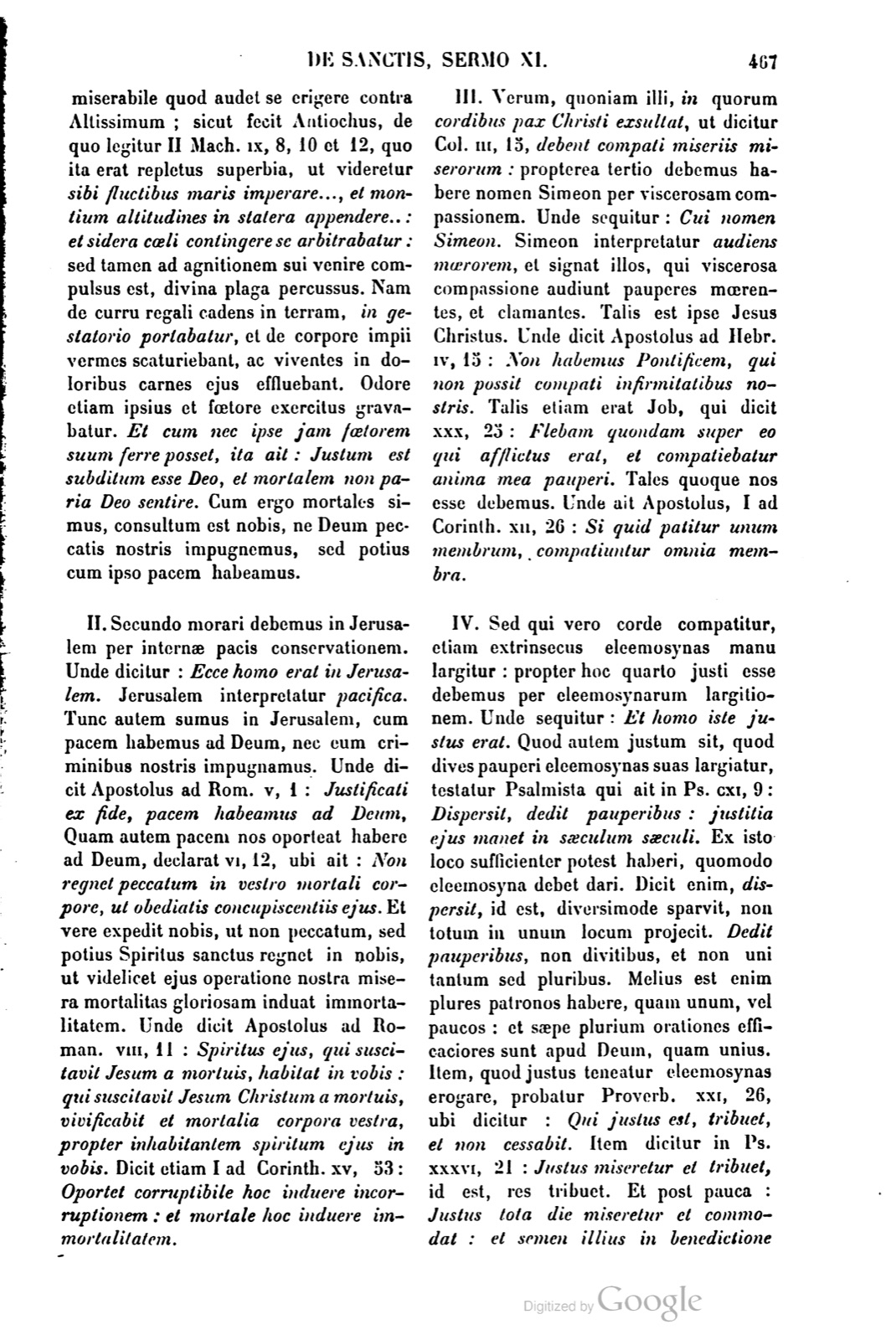
IV. Sed qui vero corde compatitur, etiam extrinsecus eleemosynas manu largitur: propter hoc quarto justi esse debemus per eleemosynarum largitionem. Unde sequitur: Et homo iste justus erat. Quod autem justum sit, quod dives pauperi eleemosynas suas largiatur, testatur Psalmista qui ait in Ps. CXI, 9: Dispersit, dedit pauperibus: justitia ejus manet in sæculum sæculi. Ex isto loco sufficienter potest haberi, quomodo eleemosyna debet dari. Dicit enim, dispersit, id est, diversimode sparsit, non totum in unum locum projecit. Dedit pauperibus, non divitibus, et non uni tantum sed pluribus. Melius est enim plures patronos habere, quam unum, vel paucos: et sæpe plurium orationes efficaciores sunt apud Deum, quam unius. Item, quod justus teneatur eleemosynas erogare, probatur Proverb. XXI, 26, ubi dicitur: Qui justus est, tribuet, et non cessabit. Item dicitur in Ps. XXXVI, 21: Justus miseretur et tribuet, id est, res tribuet. Et post pauca: Justus tota die miseretur et commodat: et semen illius in benedictione erit 1. Justus ergo dupliciter miseretur, videlicet res suas dando pauperibus, et commodando.
V. Sed quia nullus de justitia sua nimis debet confidere, sed potius se servum inutilem reputare; propterea quinto debemus esse timorati per trepidantem humilitatem. Unde sequitur: Et timoratus. Talis erat Job, qui ait IX, 28, 30 et 31: Verebar omnia opera mea, sciens quod non parceres delinquenti. Si lotus fuero quasi aquis nivis, et fulserint velut mundissimæ manus meæ: tamen sordibus intinges me. De his autem, qui timorati sunt, id est, per humilitatem in timore fundati, dicit Dominus in Isa. LXVI, 2: Ad quem respiciam, nisi ad pauperculum, et contritum spiritu, et trementem sermones meos?
VI. Verum quia non debemus solum Domino servire in timore; sed etiam oportet ut exsultemus ei cum tremore, id est, ut tremori exsultationis solatium adjungamus: ob hoc sexto debemus esse exspectantes consolationem Israel per certæ spei hilaritatem. Unde sequitur: Exspectabat consolationem Israel. Igitur quia spes est certa exspectatio futuræ beatitudinis; debemus per hilaritatem spei consolationem filiorum Dei exspectare: propter quod dicit Apostolus ad Hebr. VI, 19: Spem sicut anchoram habemus animæ tutam ac firmam, et incedentem usque ad interiora velaminis. Item, ad Hebr. X, 23: Teneamus spei nostræ confessionem indeclinabilem, (fidelis enim est qui repromisit.)
IV. But he who truly suffers with the heart also outwardly gives alms with the hand: on account of this, fourthly we ought to be just through the bestowal of alms. Hence it follows: And this man was just. But that it is just for a rich man to give his alms to the poor, the Psalmist testifies, who says in Psalm 111:9: He has dispersed, he has given to the poor; his justice remains forever and ever. From this place one can sufficiently have how alms ought to be given. For he says, he dispersed, that is, he scattered in different ways; he did not cast the whole into one place. He gave to the poor, not to the rich, and not only to one but to many. For it is better to have many patrons than one or few; and often the prayers of many are more effective before God than those of one. Likewise, that the just man is bound to distribute alms is proved in Proverbs 21:26, where it is said: He who is just will give, and will not cease. Likewise it is said in Psalm 36:21: The just man has mercy and gives, that is, gives things. And after a little: The just man has mercy all day and lends, and his seed will be in blessing 1. Therefore the just man has mercy in two ways, namely by giving his things to the poor and by lending.
V. But because no one ought to trust too much in his own justice, but rather to reckon himself an unprofitable servant, therefore fifthly we ought to be fearful through trembling humility. Hence it follows: And fearful. Such was Job, who says in 9:28, 30 and 31: I feared all my works, knowing that you would not spare the offender. If I have been washed as with waters of snow, and my hands have shone like the cleanest things, nevertheless you will dip me in filth. But concerning those who are fearful, that is, founded in fear through humility, the Lord says in Isaiah 66:2: Upon whom shall I look, except upon the poor little one, and the one contrite in spirit, and the one trembling at my words?
VI. But because we ought not only to serve the Lord in fear, but it is also necessary that we exult for him with trembling, that is, that we join the consolation of exultation to trembling, on account of this sixthly we ought to be awaiting the consolation of Israel through the cheerfulness of sure hope. Hence it follows: He was awaiting the consolation of Israel. Therefore, because hope is a sure expectation of future blessedness, we ought through the cheerfulness of hope to await the consolation of the sons of God; on account of which the Apostle says at Hebrews 6:19: We have hope as a safe and firm anchor of the soul, going in even to the inner things of the veil. Likewise, at Hebrews 10:23: Let us hold the confession of our hope undeviating, for faithful is he who promised.
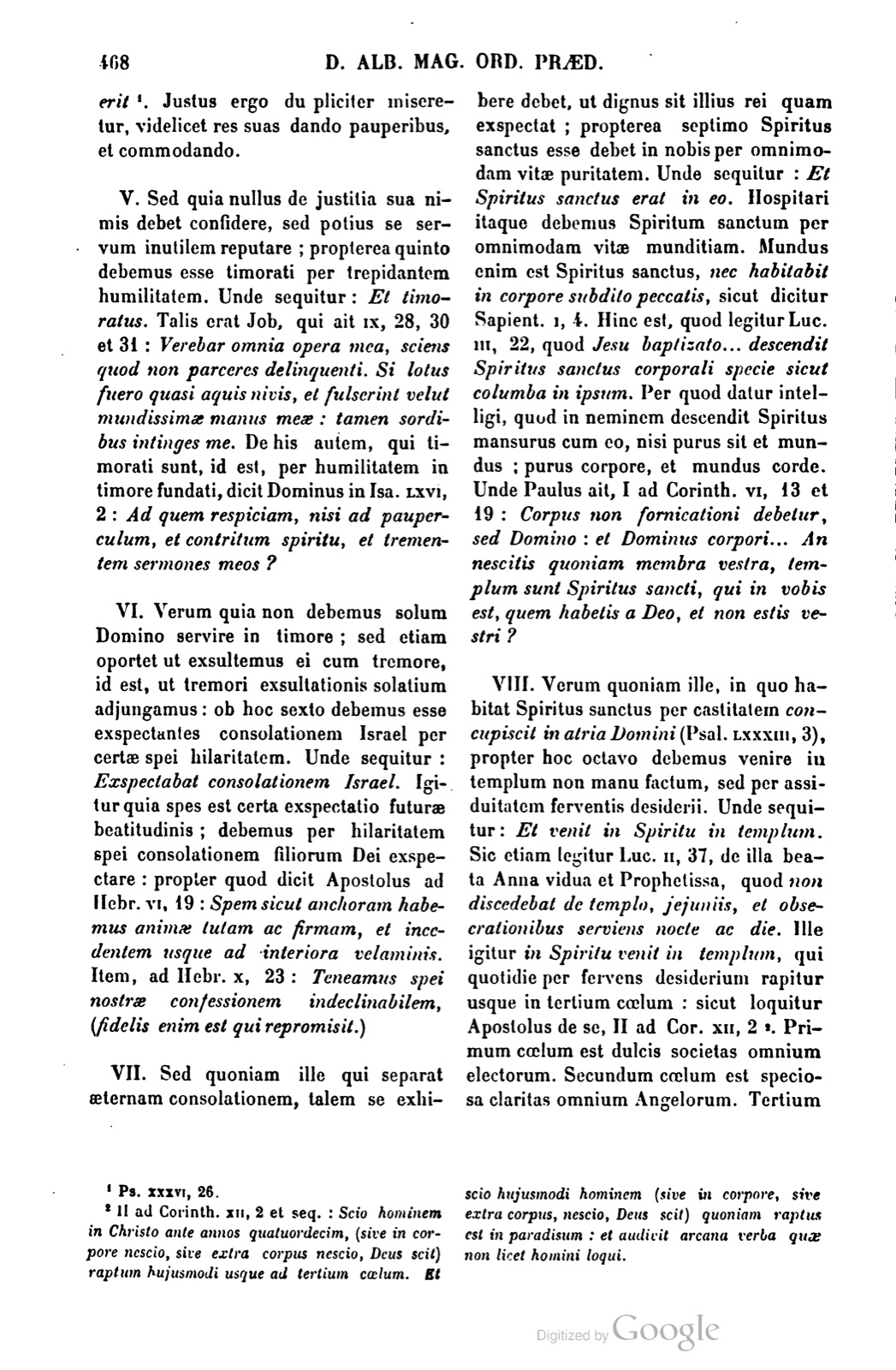
VII. Sed quoniam ille qui sperat æternam consolationem, talem se exhibere debet, ut dignus sit illius rei quam exspectat; propterea septimo Spiritus sanctus esse debet in nobis per omnimodam vitæ puritatem. Unde sequitur: Et Spiritus sanctus erat in eo. Hospitari itaque debemus Spiritum sanctum per omnimodam vitæ munditiam. Mundus enim est Spiritus sanctus, nec habitabit in corpore subdito peccatis, sicut dicitur Sapient. I, 4. Hinc est, quod legitur Luc. III, 22, quod Jesu baptizato... descendit Spiritus sanctus corporali specie sicut columba in ipsum. Per quod datur intelligi, quod in neminem descendit Spiritus mansurus cum eo, nisi purus sit et mundus; purus corpore, et mundus corde. Unde Paulus ait, I ad Corinth. VI, 13 et 19: Corpus non fornicationi debetur, sed Domino: et Dominus corpori... An nescitis quoniam membra vestra, templum sunt Spiritus sancti, qui in vobis est, quem habetis a Deo, et non estis vestri?
VIII. Verum quoniam ille, in quo habitat Spiritus sanctus per castitatem concupiscit in atria Domini (Psal. LXXXII, 3), propter hoc octavo debemus venire in templum non manu factum, sed per assiduitatem ferventis desiderii. Unde sequitur: Et venit in Spiritu in templum. Sic etiam legitur Luc. II, 37, de illa beata Anna vidua et Prophetissa, quod non discedebat de templo, jejuniis, et obsecrationibus serviens nocte ac die. Ille igitur in Spiritu venit in templum, qui quotidie per fervens desiderium rapitur usque in tertium cælum: sicut loquitur Apostolus de se, II ad Cor. XI, 2 et seq. 2. Primum cælum est dulcis societas omnium electorum. Secundum cælum est speciosa claritas omnium Angelorum. Tertium cælum est ipsa gloriosa Trinitas, a qua fluit omnis societas beatorum. Qui ergo in hoc cœlum fuerit spiritu raptus, talis potest accipere Jesum in ulnas suas, ac dicere: Nunc dimittis servum tuum Domine, secundum verbum tuum in pace. Quia viderunt oculi mei salutare tuum 3. Potest etiam lætus cantare: Suscepimus Deus misericordiam tuam, in medio templi tui 4.
Rogate ergo, charissimi, Dominum, ut sic Beatum Simeonem bonis operibus imitemur, ut tandem cum ipso Beatæ Mariæ virginis filium in ulnas nostras læti suscipere mereamur. Quod nobis præstare, etc.
VII. But because he who hopes for eternal consolation ought to show himself such that he is worthy of the thing which he awaits, therefore seventhly the Holy Spirit ought to be in us through every kind of purity of life. Hence it follows: And the Holy Spirit was in him. Therefore we ought to host the Holy Spirit through every kind of cleanness of life. For the Holy Spirit is clean, and he will not dwell in a body subject to sins, as is said in Wisdom 1:4. Hence it is read in Luke 3:22 that when Jesus had been baptized... the Holy Spirit descended upon him in bodily appearance as a dove. Through this it is given to be understood that the Spirit does not descend upon anyone to remain with him unless he is pure and clean: pure in body and clean in heart. Hence Paul says, 1 Corinthians 6:13 and 19: The body is not owed to fornication, but to the Lord, and the Lord to the body... Do you not know that your members are the temple of the Holy Spirit, who is in you, whom you have from God, and you are not your own?
VIII. But because he in whom the Holy Spirit dwells through chastity longs for the courts of the Lord (Psalm 82:3), on account of this eighthly we ought to come into the temple not made by hand, but through the constancy of fervent desire. Hence it follows: And he came in the Spirit into the temple. So also it is read in Luke 2:37 concerning that blessed Anna, widow and Prophetess, that she did not depart from the temple, serving night and day with fasts and beseechings. Therefore he comes in the Spirit into the temple who daily through fervent desire is caught up even to the third heaven, as the Apostle speaks of himself, 2 Corinthians 11:2 and following 2. The first heaven is the sweet fellowship of all the elect. The second heaven is the beautiful brightness of all Angels. The third heaven is the glorious Trinity itself, from which every fellowship of the blessed flows. Therefore he who has been caught up in spirit into this heaven, such a one can receive Jesus in his arms and say: Now you dismiss your servant, Lord, according to your word in peace, because my eyes have seen your salvation 3. He can also sing joyfully: We have received, O God, your mercy in the midst of your temple 4.
Therefore pray, dearest ones, to the Lord, that we may so imitate Blessed Simeon with good works, that at last with him we may merit joyfully to receive the Son of the Blessed Virgin Mary in our arms. May he grant this to us, etc.

Notes
- Psalm 36:26. (Ps. XXXVI, 26.) ↩
- 2 Corinthians 11:2 and following: I know a man in Christ fourteen years ago, whether in the body I do not know, whether outside the body I do not know, God knows, such a one caught up even to the third heaven. And I know such a man, whether in the body or outside the body I do not know, God knows, because he was caught up into paradise and heard secret words which it is not permitted for a man to speak. (II ad Corinth. XI, 2 et seq.: Scio hominem in Christo ante annos quatuordecim, (sive in corpore nescio, sive extra corpus nescio, Deus scit) raptum hujusmodi usque ad tertium cælum. Et scio hujusmodi hominem (sive in corpore, sive extra corpus, nescio, Deus scit) quoniam raptus est in paradisum: et audivit arcana verba quæ non licet homini loqui.) ↩
- Luke 2:29 and 30. (Luc. II, 29 et 30.) ↩
- Psalm 47:10. (Ps. XLVII, 10.) ↩
If a page does not appear, its photograph has not been uploaded yet.