Volume 13 · pp. 432–438
Sermon VI. On the Feast of the Holy Innocents
A marker with ≈ is an approximate page boundary, placed by measure of the text; the page photographs remain the authority. In the paired views, clicking a page marker brings that page into view.
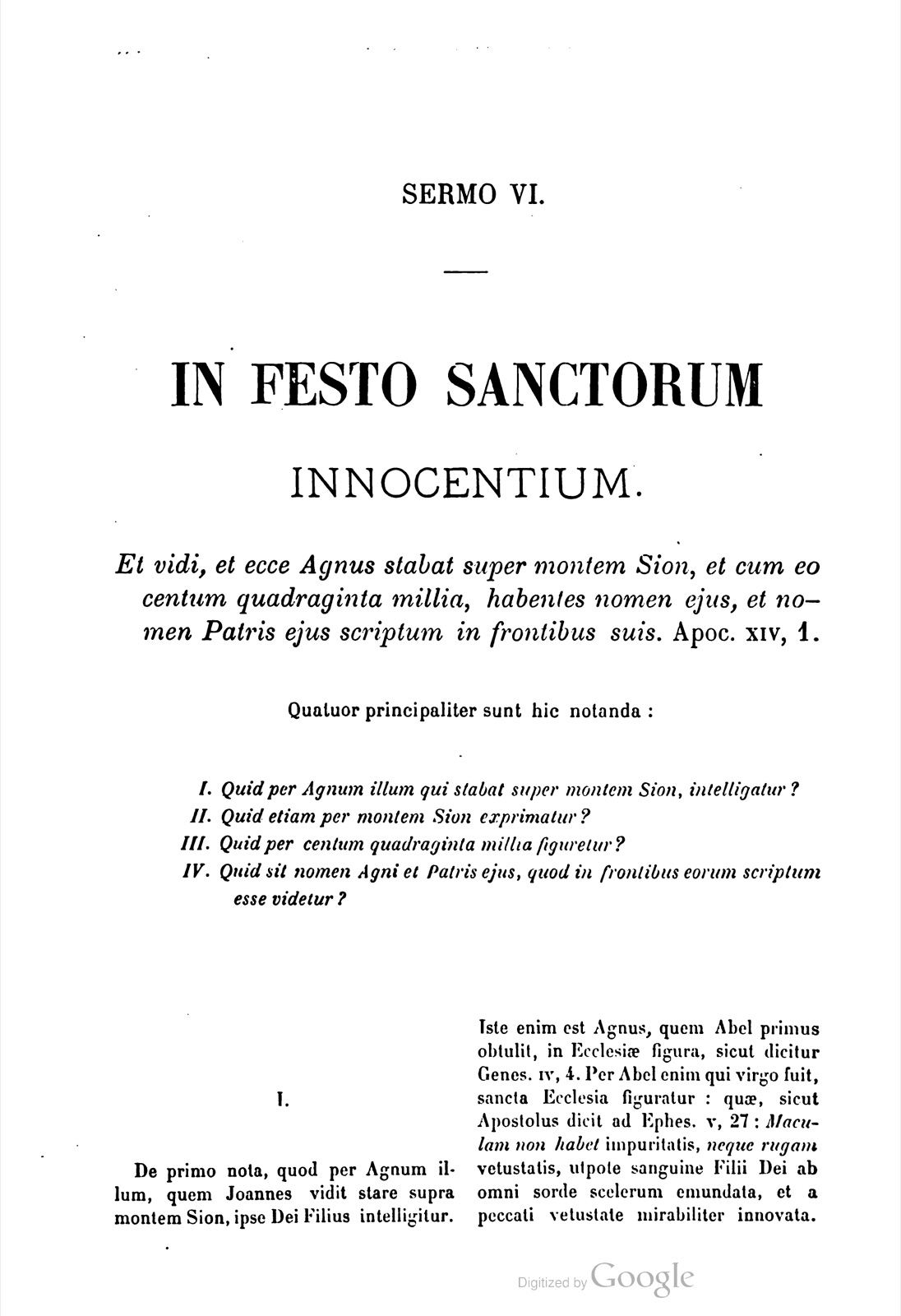
SERMO VI.
IN FESTO SANCTORUM INNOCENTIUM.
Et vidi, et ecce Agnus stabat super montem Sion, et cum eo centum quadraginta millia, habentes nomen ejus, et nomen Patris ejus scriptum in frontibus suis. Apoc. XIV, 1.
Quatuor principaliter sunt hic notanda:
I. Quid per Agnum illum qui stabat super montem Sion, intelligatur? II. Quid etiam per montem Sion exprimatur? III. Quid per centum quadraginta millia figuretur? IV. Quid sit nomen Agni et Patris ejus, quod in frontibus eorum scriptum esse videtur?
I.
De primo nota, quod per Agnum illum, quem Joannes vidit stare supra montem Sion, ipse Dei Filius intelligitur. Iste enim est Agnus, quem Abel primus obtulit, in Ecclesiæ figura, sicut dicitur Genes. IV, 4. Per Abel enim qui virgo fuit, sancta Ecclesia figuratur: quæ, sicut Apostolus dicit ad Ephes. V, 27: Maculam non habet impuritatis, neque rugam vetustatis, utpote sanguine Filii Dei ab omni sorde scelerum emundata, et a peccati vetustate mirabiliter innovata.
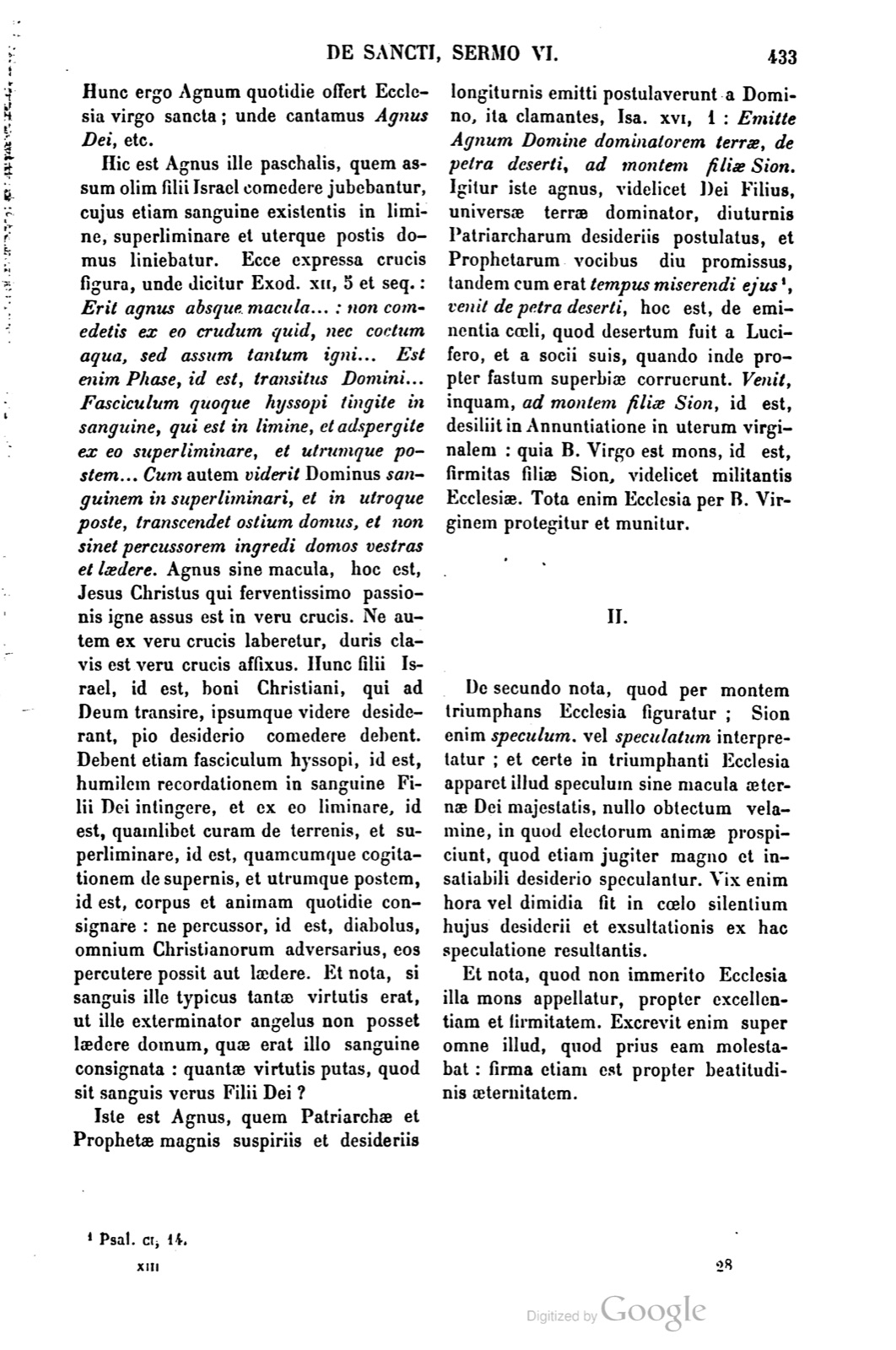
Hunc ergo Agnum quotidie offert Ecclesia virgo sancta; unde cantamus Agnus Dei, etc.
Hic est Agnus ille paschalis, quem assum olim filii Israel comedere jubebantur, cujus etiam sanguine existentis in limine, superliminare et uterque postis domus liniebatur. Ecce expressa crucis figura, unde dicitur Exod. XII, 5 et seq.: Erit agnus absque macula...: non comedetis ex eo crudum quid, nec coctum aqua, sed assum tantum igni... Est enim Phase, id est, transitus Domini... Fasciculum quoque hyssopi tingite in sanguine, qui est in limine, et adspergite ex eo superliminare, et utrumque postem... Cum autem viderit Dominus sanguinem in superliminari, et in utroque poste, transcendet ostium domus, et non sinet percussorem ingredi domos vestras et lædere. Agnus sine macula, hoc est, Jesus Christus qui ferventissimo passionis igne assus est in veru crucis. Ne autem ex veru crucis laberetur, duris clavis est veru crucis affixus. Hunc filii Israel, id est, boni Christiani, qui ad Deum transire, ipsumque videre desiderant, pio desiderio comedere debent. Debent etiam fasciculum hyssopi, id est, humilem recordationem in sanguine Filii Dei intingere, et ex eo liminare, id est, quamlibet curam de terrenis, et superliminare, id est, quamcumque cogitationem de supernis, et utrumque postem, id est, corpus et animam quotidie consignare: ne percussor, id est, diabolus, omnium Christianorum adversarius, eos percutere possit aut lædere. Et nota, si sanguis ille typicus tantæ virtutis erat, ut ille exterminator angelus non posset lædere domum, quæ erat illo sanguine consignata: quantæ virtutis putas, quod sit sanguis verus Filii Dei?
Iste est Agnus, quem Patriarchæ et Prophetæ magnis suspiriis et desideriis longiturnis emitti postulaverunt a Domino, ita clamantes, Isa. XVI, 1: Emitte Agnum Domine dominatorem terræ, de petra deserti, ad montem filiæ Sion. Igitur iste agnus, videlicet Dei Filius, universæ terræ dominator, diuturnis Patriarcharum desideriis postulatus, et Prophetarum vocibus diu promissus, tandem cum erat tempus miserendi ejus 1, venit de petra deserti, hoc est, de eminentia cæli, quod desertum fuit a Lucifero, et a sociis suis, quando inde propter fastum superbiæ corruerunt. Venit, inquam, ad montem filiæ Sion, id est, desiliit in Annuntiatione in uterum virginalem: quia B. Virgo est mons, id est, firmitas filiæ Sion, videlicet militantis Ecclesiæ. Tota enim Ecclesia per B. Virginem protegitur et munitur.
SERMON VI.
ON THE FEAST OF THE HOLY INNOCENTS.
And I saw, and behold, the Lamb was standing upon Mount Zion, and with him one hundred forty thousand, having his name and the name of his Father written on their foreheads. Apocalypse 14:1.
Four things principally are to be noted here:
I. What is understood by that Lamb who was standing upon Mount Zion? II. What also is expressed by Mount Zion? III. What is figured by the one hundred forty thousand? IV. What is the name of the Lamb and of his Father which is seen to be written on their foreheads?
I.
On the first, note that by that Lamb whom John saw standing above Mount Zion, the Son of God himself is understood. For this is the Lamb whom Abel first offered, in figure of the Church, as is said in Genesis 4:4. For by Abel, who was a virgin, holy Church is figured; she, as the Apostle says to Ephesians 5:27, does not have the stain of impurity nor the wrinkle of oldness, being cleansed by the blood of the Son of God from every filth of crimes, and marvelously renewed from the oldness of sin.
Therefore holy virgin Church daily offers this Lamb; hence we sing Lamb of God, etc.
This is that Paschal Lamb whom once the sons of Israel were commanded to eat roasted, and with whose blood, being on the threshold, the lintel and both doorposts of the house were smeared. Behold the expressed figure of the cross; hence it is said in Exodus 12:5 and following: The lamb will be without blemish... You shall not eat anything of it raw, nor cooked in water, but only roasted with fire... For it is Phase, that is, the passage of the Lord... Also dip a bundle of hyssop in the blood which is on the threshold, and sprinkle from it the lintel and both doorposts... But when the Lord sees the blood on the lintel and on both doorposts, he will pass over the door of the house and will not permit the striker to enter your houses and harm them. The lamb without blemish is Jesus Christ, who was roasted by the most fervent fire of the Passion on the spit of the cross. But lest he slip down from the spit of the cross, he was fastened to the spit of the cross by hard nails. The sons of Israel, that is, good Christians who desire to pass over to God and to see him, ought to eat him with pious desire. They ought also to dip the bundle of hyssop, that is, humble remembrance, in the blood of the Son of God, and from it daily to mark the threshold, that is, any care concerning earthly things, and the lintel, that is, any thought concerning heavenly things, and both doorposts, that is, body and soul, lest the striker, that is, the devil, the adversary of all Christians, be able to strike or harm them. And note: if that typical blood was of such great power that that exterminating angel could not harm the house which was marked by that blood, of what great power do you think the true blood of the Son of God is?
This is the Lamb whom the Patriarchs and Prophets, with great sighs and long desires, asked to be sent forth by the Lord, crying thus, Isaiah 16:1: Send forth, O Lord, the Lamb, the ruler of the earth, from the rock of the desert to the mountain of the daughter of Zion. Therefore this lamb, namely the Son of God, ruler of the whole earth, asked for by the long desires of the Patriarchs and long promised by the voices of the Prophets, at last, when it was the time for mercy on it 1, came from the rock of the desert, that is, from the eminence of heaven, which was deserted by Lucifer and his companions when they fell from there on account of the arrogance of pride. He came, I say, to the mountain of the daughter of Zion, that is, he leapt down in the Annunciation into the virginal womb, because the Blessed Virgin is the mountain, that is, the firmness of the daughter of Zion, namely of the Church militant. For the whole Church is protected and fortified through the Blessed Virgin.
II.
De secundo nota, quod per montem triumphans Ecclesia figuratur; Sion enim speculum, vel speculatum interpretatur; et certe in triumphanti Ecclesia apparet illud speculum sine macula æternæ Dei majestatis, nullo obtectum velamine, in quod electorum animæ prospiciunt, quod etiam jugiter magno et insatiabili desiderio speculantur. Vix enim hora vel dimidia fit in cœlo silentium hujus desiderii et exsultationis ex hac speculatione resultantis.
Et nota, quod non immerito Ecclesia illa mons appellatur, propter excellentiam et firmitatem. Excrevit enim super omne illud, quod prius eam molestabat: firma etiam est propter beatitudinis æternitatem.
III.
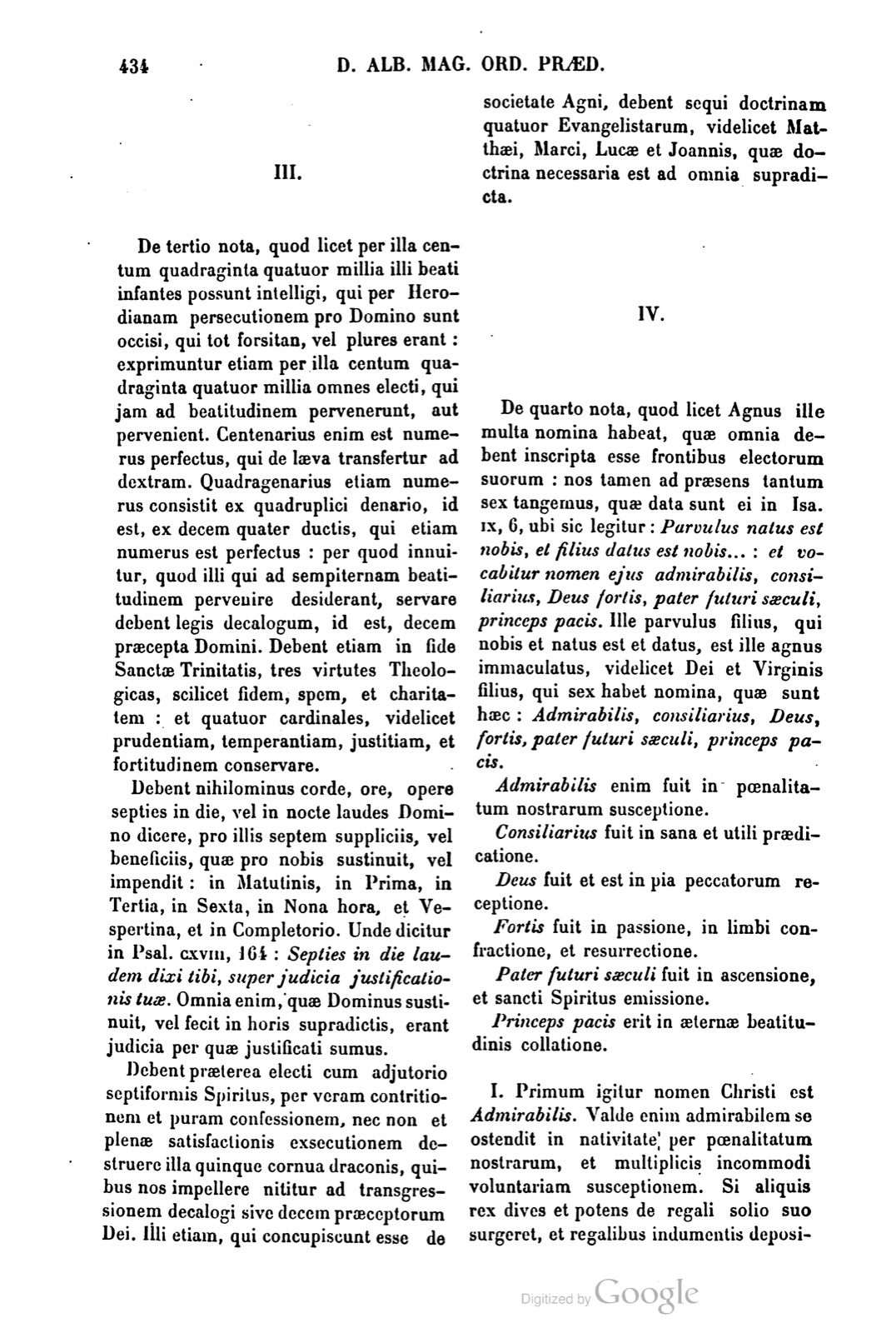
De tertio nota, quod licet per illa centum quadraginta quatuor millia illi beati infantes possunt intelligi, qui per Herodianam persecutionem pro Domino sunt occisi, qui tot forsitan, vel plures erant: exprimuntur etiam per illa centum quadraginta quatuor millia omnes electi, qui jam ad beatitudinem pervenerunt, aut pervenient. Centenarius enim est numerus perfectus, qui de læva transfertur ad dextram. Quadragenarius etiam numerus consistit ex quadruplici denario, id est, ex decem quater ductis, qui etiam numerus est perfectus: per quod innuitur, quod illi qui ad sempiternam beatitudinem pervenire desiderant, servare debent legis decalogum, id est, decem præcepta Domini. Debent etiam in fide Sanctæ Trinitatis, tres virtutes Theologicas, scilicet fidem, spem, et charitatem: et quatuor cardinales, videlicet prudentiam, temperantiam, justitiam, et fortitudinem conservare.
Debent nihilominus corde, ore, opere septies in die, vel in nocte laudes Domino dicere, pro illis septem suppliciis, vel beneficiis, quæ pro nobis sustinuit, vel impendit: in Matutinis, in Prima, in Tertia, in Sexta, in Nona hora, et Vespertina, et in Completorio. Unde dicitur in Psal. CXVII, 164: Septies in die laudem dixi tibi, super judicia justificationis tuæ. Omnia enim, quæ Dominus sustinuit, vel fecit in horis supradictis, erant judicia per quæ justificati sumus.
Debent præterea electi cum adjutorio septiformis Spiritus, per veram contritionem et puram confessionem, nec non et plenæ satisfactionis exsecutionem destruere illa quinque cornua draconis, quibus nos impellere nititur ad transgressionem decalogi sive decem præceptorum Dei. Illi etiam, qui concupiscunt esse de societate Agni, debent sequi doctrinam quatuor Evangelistarum, videlicet Matthæi, Marci, Lucæ et Joannis, quæ doctrina necessaria est ad omnia supradicta.
II.
On the second, note that by the mountain the Church triumphant is figured; for Zion is interpreted mirror, or something looked upon; and certainly in the Church triumphant there appears that mirror without stain of the eternal majesty of God, covered by no veil, into which the souls of the elect look forth, and which they also continually gaze upon with great and insatiable desire. For scarcely an hour or half hour in heaven is there silence from this desire and from the exultation resulting from this contemplation.
And note that that Church is not undeservedly called a mountain, on account of excellence and firmness. For it has grown beyond all that which previously troubled it; it is also firm on account of the eternity of blessedness.
III.
On the third, note that although by those one hundred forty-four thousand those blessed infants can be understood who were killed for the Lord through Herod's persecution, who perhaps were that many, or more, nevertheless by those one hundred forty-four thousand are also expressed all the elect who have already arrived at blessedness or will arrive. For the hundred is a perfect number, which is transferred from the left to the right. Also the forty is a number consisting from a fourfold ten, that is, from ten taken four times, which number is also perfect; through this it is suggested that those who desire to arrive at everlasting blessedness ought to keep the decalogue of the law, that is, the ten commandments of the Lord. They ought also, in the faith of the Holy Trinity, to preserve the three theological virtues, namely faith, hope, and charity, and the four cardinal virtues, namely prudence, temperance, justice, and fortitude.
Nevertheless with heart, mouth, and work they ought seven times by day or by night to say praises to the Lord, for those seven punishments or benefits which he sustained or bestowed for us: at Matins, at Prime, at Terce, at Sext, at the hour of None, and at Vespers, and at Compline. Hence it is said in Psalm 117:164: Seven times in the day I have spoken praise to you, over the judgments of your justification. For all things which the Lord sustained or did at the aforesaid hours were judgments through which we were justified.
Besides, the elect ought, with the help of the sevenfold Spirit, through true contrition and pure confession, and also the execution of full satisfaction, to destroy those five horns of the dragon by which he strives to drive us to the transgression of the decalogue or ten commandments of God. Those also who desire to be of the fellowship of the Lamb ought to follow the doctrine of the four Evangelists, namely Matthew, Mark, Luke, and John, which doctrine is necessary for all the things said above.
IV.
De quarto nota, quod licet Agnus ille multa nomina habeat, quæ omnia debent inscripta esse frontibus electorum suorum: nos tamen ad præsens tantum sex tangemus, quæ data sunt ei in Isa. IX, 6, ubi sic legitur: Parvulus natus est nobis, et filius datus est nobis...: et vocabitur nomen ejus admirabilis, consiliarius, Deus fortis, pater futuri sæculi, princeps pacis. Ille parvulus filius, qui nobis et natus est et datus, est ille agnus immaculatus, videlicet Dei et Virginis filius, qui sex habet nomina, quæ sunt hæc: Admirabilis, consiliarius, Deus, fortis, pater futuri sæculi, princeps pacis.
Admirabilis enim fuit in pœnalitatum nostrarum susceptione. Consiliarius fuit in sana et utili prædicatione. Deus fuit et est in pia peccatorum receptione. Fortis fuit in passione, in limbi confractione, et resurrectione. Pater futuri sæculi fuit in ascensione, et sancti Spiritus emissione. Princeps pacis erit in æternæ beatitudinis collatione.
I. Primum igitur nomen Christi est Admirabilis. Valde enim admirabilem se ostendit in nativitate per pœnalitatum nostrarum, et multiplicis incommodi voluntariam susceptionem. Si aliquis rex dives et potens de regali solio suo surgeret, et regalibus indumentis depositis asperrimum saccum indueret, seque abjiceret in stabulum: nonne principes ejus, et barones, hoc videntes, possent non immerito dicere? "Nimis admirabilis es, Domine, quod sic tamquam pauperrimus garcio jaceas in stabulo super modicum fœni, cum habeas pulcherrimum palatium, mollibus culcitris delicatissime stratum." Sic itaque admirabilis fuit Dominus noster, cujus admirabile est nomen in universa terra 2. Ipse enim propter nos surrexit de solio paterni sinus, et purpuræ suæ divinitatis superinduit saccum nostræ carnis, et sic ivit jacere in stabulum Bethlehemitanum.
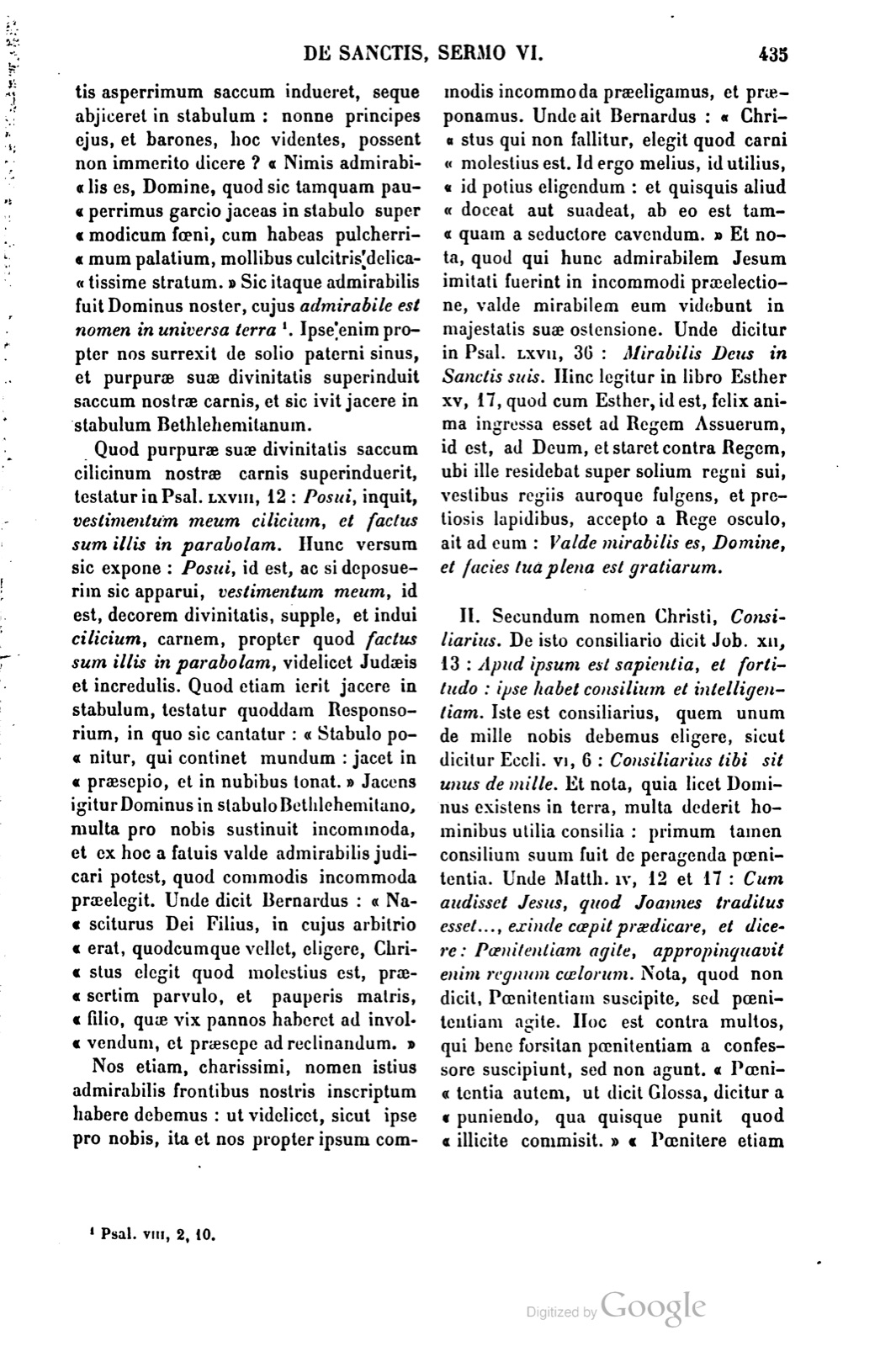
Quod purpuræ suæ divinitatis saccum cilicinum nostræ carnis superinduerit, testatur in Psal. LXVIII, 12: Posui, inquit, vestimentum meum cilicium, et factus sum illis in parabolam. Hunc versum sic expone: Posui, id est, ac si deposuerim sic apparui, vestimentum meum, id est, decorem divinitatis, supple, et indui cilicium, carnem, propter quod factus sum illis in parabolam, videlicet Judæis et incredulis. Quod etiam ierit jacere in stabulum, testatur quoddam Responsorium, in quo sic cantatur: "Stabulo ponitur, qui continet mundum: jacet in præsepio, et in nubibus tonat." Jacens igitur Dominus in stabulo Bethlehemitano, multa pro nobis sustinuit incommoda, et ex hoc a fatuis valde admirabilis judicari potest, quod commodis incommoda præelegit. Unde dicit Bernardus: "Nasciturus Dei Filius, in cujus arbitrio erat, quodcumque vellet, eligere, Christus elegit quod molestius est, præsertim parvulo, et pauperis matris, filio, quæ vix pannos haberet ad involvendum, et præsepe ad reclinandum."
IV.
On the fourth, note that although that Lamb has many names, all of which ought to be inscribed on the foreheads of his elect, nevertheless for the present we will touch only six which are given to him in Isaiah 9:6, where it is read thus: A little child is born to us, and a son is given to us... and his name will be called wonderful, counselor, strong God, father of the future age, prince of peace. That little son, who has both been born and given to us, is that immaculate lamb, namely the son of God and of the Virgin, who has six names, which are these: Wonderful, counselor, God, strong, father of the future age, prince of peace.
For he was Wonderful in the taking up of our penalities. He was Counselor in sound and useful preaching. He was and is God in the pious reception of sinners. He was Strong in the Passion, in the breaking of limbo, and in the Resurrection. He was Father of the future age in the Ascension and in the sending of the Holy Spirit. He will be Prince of peace in the bestowal of eternal blessedness.
I. Therefore the first name of Christ is Wonderful. For he showed himself very wonderful in the nativity through the voluntary taking up of our penalities and manifold discomfort. If some rich and powerful king were to rise from his royal throne, and, having laid aside royal garments, put on a very rough sack, and cast himself down into a stable, could not his princes and barons, seeing this, deservedly say: "You are exceedingly wonderful, Lord, because thus like a most poor boy you lie in a stable upon a little hay, though you have a most beautiful palace, most delicately spread with soft cushions." Thus therefore our Lord was wonderful, whose name is wonderful in the whole earth 2. For on account of us he rose from the throne of the Father's bosom, and over the purple of his divinity he put on the sack of our flesh, and thus he went to lie in the Bethlehem stable.
That over the purple of his divinity he put on the haircloth sack of our flesh, he testifies in Psalm 68:12: I put on, he says, my garment as haircloth, and I was made to them into a parable. Expound this verse thus: I put on, that is, I appeared as if I had laid aside, my garment, that is, the beauty of divinity, supply, and I put on haircloth, flesh, on account of which I was made to them into a parable, namely to the Jews and unbelievers. That he also went to lie in a stable, a certain Responsory testifies, in which it is sung thus: "He is placed in a stable who contains the world; he lies in a manger and thunders in the clouds." Therefore the Lord, lying in the Bethlehem stable, sustained many discomforts for us, and from this he can be judged very wonderful by fools, because he chose discomforts before comforts. Hence Bernard says: "The Son of God, about to be born, in whose judgment it was to choose whatever he wished, Christ chose what is more troublesome, especially for a little child and the son of a poor mother, who scarcely had cloths for wrapping and a manger for reclining."
Nos etiam, charissimi, nomen istius admirabilis frontibus nostris inscriptum habere debemus: ut videlicet, sicut ipse pro nobis, ita et nos propter ipsum commodis incommoda præeligamus, et præponamus. Unde ait Bernardus: "Christus qui non fallitur, elegit quod carni molestius est. Id ergo melius, id utilius, id potius eligendum: et quisquis aliud doceat aut suadeat, ab eo est tamquam a seductore cavendum." Et nota, quod qui hunc admirabilem Jesum imitati fuerint in incommodi præelectione, valde mirabilem eum videbunt in majestatis suæ ostensione. Unde dicitur in Psal. LXVII, 36: Mirabilis Deus in Sanctis suis. Hinc legitur in libro Esther XV, 17, quod cum Esther, id est, felix anima ingressa esset ad Regem Assuerum, id est, ad Deum, et staret contra Regem, ubi ille residebat super solium regni sui, vestibus regiis auroque fulgens, et pretiosis lapidibus, accepto a Rege osculo, ait ad eum: Valde mirabilis es, Domine, et facies tua plena est gratiarum.
II. Secundum nomen Christi, Consiliarius. De isto consiliario dicit Job. XII, 13: Apud ipsum est sapientia, et fortitudo: ipse habet consilium et intelligentiam. Iste est consiliarius, quem unum de mille nobis debemus eligere, sicut dicitur Eccli. VI, 6: Consiliarius tibi sit unus de mille. Et nota, quia licet Dominus existens in terra, multa dederit hominibus utilia consilia: primum tamen consilium suum fuit de peragenda pœnitentia. Unde Matth. IV, 12 et 17: Cum audisset Jesus, quod Joannes traditus esset..., exinde cœpit prædicare, et dicere: Pænitentiam agite, appropinquavit enim regnum cælorum. Nota, quod non dicit, Pænitentiam suscipite, sed pœnitentiam agite. Hoc est contra multos, qui bene forsitan pænitentiam a confessore suscipiunt, sed non agunt. "Pœnitentia autem, ut dicit Glossa, dicitur a puniendo, qua quisque punit quod illicite commisit." "Pœnitere etiam est ut dicit Augustinus anteacta deflere, et deflenda ulterius non committere."
Quia igitur pænitentia dura est, et aspera, ne propter amaritudinem ejus deterreamur ab ea, propter hoc eam quasi quemdam acutum hamum dulci esca Dominus pie inescat, videlicet regno cœlorum. Accede igitur, o peccator, accede confidenter ad hanc escam. Quamdiu enim regnum cælorum habueris in palato recordationis tuæ, non senties aculeum pœnitentiæ: quanto ergo aliquis magis ac magis pœnitentiam suam peregerit, tanto magis appropiat sibi regnum cælorum. Quando etiam quisque pænitere distulerit, tanto elongat a se regnum cælorum. Stulte itaque faciunt, qui pœnitentiam suam agere differunt usque ad finem vitæ suæ. Tunc enim libenter vellent intrare regnum cælorum, sed non poterunt, quia pœnitentiam suam adhuc non egerunt, et per hoc regnum Dei a se elongaverunt.
We also, dearest ones, ought to have the name of this wonderful one inscribed on our foreheads, namely so that, as he for us, so also we on account of him may choose and prefer discomforts to comforts. Hence Bernard says: "Christ, who is not deceived, chose what is more troublesome to the flesh. Therefore that is better, that more useful, that more to be chosen; and whoever teaches or persuades another thing must be guarded against as against a seducer." And note that those who have imitated this wonderful Jesus in the prior choice of discomfort will see him very wonderful in the showing of his majesty. Hence it is said in Psalm 67:36: God is wonderful in his Saints. Hence it is read in the book of Esther 15:17 that when Esther, that is, the happy soul, had entered to King Ahasuerus, that is, to God, and stood opposite the King, where he was sitting upon the throne of his kingdom, shining with royal garments and gold and precious stones, having received a kiss from the King, she said to him: You are very wonderful, Lord, and your face is full of graces.
II. The second name of Christ is Counselor. Concerning this counselor Job 12:13 says: With him is wisdom and fortitude; he has counsel and understanding. This is the counselor whom we ought to choose as one out of a thousand, as is said in Sirach 6:6: Let your counselor be one out of a thousand. And note that although the Lord, existing on earth, gave many useful counsels to men, nevertheless his first counsel was about doing penance. Hence Matthew 4:12 and 17: When Jesus had heard that John had been handed over..., from then he began to preach and to say: Do penance, for the kingdom of heaven has drawn near. Note that he does not say, Receive penance, but do penance. This is against many who perhaps receive penance well from the confessor, but do not do it. "But penance, as the Gloss says, is named from punishing, by which each one punishes what he illicitly committed." "To repent also is, as Augustine says, to weep over things done before and not further commit things to be wept over."
Therefore because penance is hard and rough, lest we be frightened away from it on account of its bitterness, on account of this the Lord piously baits it like a certain sharp hook with sweet bait, namely the kingdom of heaven. Therefore approach, O sinner, approach confidently to this bait. For as long as you have the kingdom of heaven on the palate of your remembrance, you will not feel the sting of penance. Therefore the more and more someone has carried out his penance, the more the kingdom of heaven draws near to him. Also whenever anyone has delayed repenting, so much does he make the kingdom of heaven distant from himself. Therefore they act foolishly who delay doing their penance until the end of their life. For then they would willingly wish to enter the kingdom of heaven, but they will not be able, because they have not yet done their penance, and through this they have distanced the kingdom of God from themselves.
Sed quia sunt aliqui, qui propter hoc contristantur, quod cum aliquamdiu pœnitentiam egerint, non statim regno cœlorum sibi promisso præmiantur a Domino. Propterea Mich. IV, 9, dicitur ad quemlibet pœnitentem: Quare mærore contraheris? Numquid Rex non est ibi, aut consiliarius tuus periit? Quasi dicat: Noli mæstus esse, o pœnitens, consiliarius tuus regnum quod tibi promisit, habet in potestate sua. Si igitur propter bonum tuum dare tibi illud ad tempus differt, esto securus, quia non aufert.
III. Tertium nomen parvuli Jesu est Deus: quod idem est, quod bonus. Unde hæc duo nomina, Deus et Bonus, eisdem litteris scribuntur in nostro vulgari, scilicet Gott. Hic etiam Christus Jesus dicitur in Matth. XIX, 17: Unus est bonus Deus. Solus enim Deus bonus est essentialiter; homines autem boni sunt accidentaliter. Christus igitur se Deum, id est, bonum se ostendit, et exhibuit in pia peccatorum susceptione: quod etiam per semetipsum testatur Matth. IX, 13: Non veni, inquit, vocare justos, sed peccatores 3. Hinc etiam dicitur Luc. XV, 1 et 2: Erant appropinquantes ad Jesum publicani et peccatores, ut audirent illum. Et murmurabant Pharisæi et Scribæ dicentes: Quia hic peccatores recipit, et manducat cum illis. Unde et adhuc Jesus brachia expansa habet in cruce. Quasi dicat: Venite ad me omnes peccatores, qui doletis super peccatis vestris, et ego recipiam vos, et amplectar. Hinc etiam monet nos psalmista in Psal. XCIV, 6: Venite, adoremus et procidamus, et ploremus ante Dominum, qui fecit nos, etc. Timere etiam possumus, quod si modo venire contempserimus, ut ab ipsius bonitate suscipiamur, quod tandem objiciet nobis in judicio, sicut dicitur Proverb. I, 24 et seq.: Vocavi, et renuistis; extendi manum meam, et non fuit qui adspiceret. Despexistis omne consilium meum, et increpationes meas neglexistis. Ego quoque in interitu vestro ridebo, et subsannabo, cum vobis id quod timebatis advenerit.
IV. Quartum nomen Jesu est Fortis.
1. Fuit autem fortis in Passione, sed fortitudinem suam magis ostendit passiones suas humiliter patiendo, quam se ab inimicis suis et crucifixoribus defendendo. Unde etiam cum Petrus extracto gladio secundum possibilitatem suam vellet defendere, dixit illi Jesus, secundum quod ait Matth. XXVI, 52 et 53: Converte gladium tuum in locum suum...: an putas, quia non possum rogare Patrem meum, et exhibebit mihi modo plus quam duodecim legiones Angelorum? Hinc etiam dicitur in duobus versiculis:
Fortior est feriente ferens, nec sæcula pulchrum Tam fecisse Deo, quam scelerata pati.
Nos etiam, charissimi, hanc Christi fortitudinem frontibus nostris inscriptam habere debemus, ut videlicet de quolibet adversario per fortem patientiam triumphemus. Hinc etiam dicitur Proverb. XVI, 32: Melior est patiens viro forti, et qui dominatur animo suo, expugnatore urbium.
But because there are some who are saddened on account of this, that when they have done penance for some time, they are not immediately rewarded by the Lord with the kingdom of heaven promised to them, therefore Micah 4:9 says to any penitent: Why are you contracted by grief? Is the King not there, or has your counselor perished? As if he were saying: Do not be sad, O penitent; your counselor has in his own power the kingdom which he promised to you. Therefore if, on account of your good, he delays giving it to you for a time, be secure, because he does not take it away.
III. The third name of the little child Jesus is God, which is the same as good. Hence these two names, God and Good, are written with the same letters in our common tongue, namely Gott. This Christ Jesus also is said in Matthew 19:17: One is good, God. For God alone is good essentially; but men are good accidentally. Therefore Christ showed and presented himself as God, that is, as good, in the pious reception of sinners; this he also testifies through himself, Matthew 9:13: I have not come, he says, to call the just, but sinners 3. Hence also it is said in Luke 15:1 and 2: Publicans and sinners were drawing near to Jesus, so that they might hear him. And the Pharisees and Scribes were murmuring, saying: Because this man receives sinners and eats with them. Hence even now Jesus has his arms stretched out on the cross. As if he were saying: Come to me, all sinners who grieve over your sins, and I will receive you and embrace you. Hence also the psalmist admonishes us in Psalm 94:6: Come, let us adore and fall down, and let us weep before the Lord who made us, etc. We can also fear that if we now scorn to come, so that we may be received by his goodness, at last he will object to us in judgment, as is said in Proverbs 1:24 and following: I called, and you refused; I stretched out my hand, and there was none who looked. You despised all my counsel and neglected my rebukes. I too will laugh at your destruction and will mock when that which you feared has come upon you.
IV. The fourth name of Jesus is Strong.
1. But he was strong in the Passion; yet he showed his strength more by humbly suffering his sufferings than by defending himself from his enemies and crucifiers. Hence also when Peter, with sword drawn, wished to defend him according to his ability, Jesus said to him, according to what Matthew 26:52 and 53 says: Turn your sword into its place... or do you think that I cannot ask my Father, and he will now present to me more than twelve legions of Angels? Hence also it is said in two little verses:
The one bearing is stronger than the one striking; nor is it a beautiful thing for God to have done so much as to suffer wicked things.
We also, dearest ones, ought to have this strength of Christ inscribed on our foreheads, namely that we may triumph over any adversary through strong patience. Hence also it is said in Proverbs 16:32: The patient man is better than a strong man, and he who rules his own spirit is better than an attacker of cities.
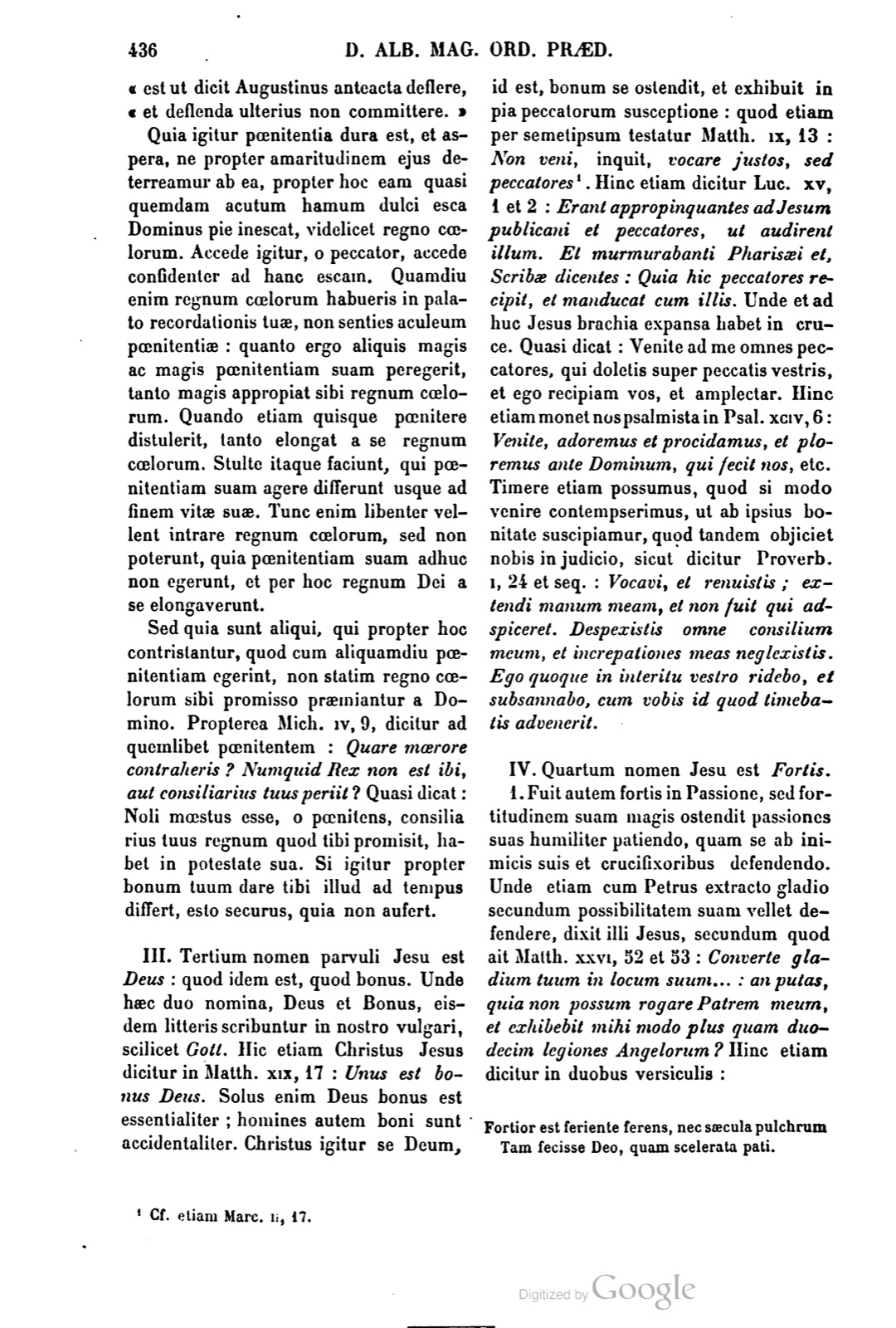
2. Fortem etiam se ostendit in limbi confractione. Cum enim omnes passiones suas patienter sustinendo exspirasset in cruce, statim anima Christi cum multa divinitatis virtute transivit ad inferos: ut inde eriperet animas electorum, diu inibi violenta diaboli potestate retentas. Potestates, itaque tartareæ animam Christi tanta fortitudine divinitatis advenire videntes, tremefactæ dixerunt: Quis est iste Rex gloriæ? Quibus Angeli responderunt qui erant cum anima Christi: Dominus virtutum, ipse est Rex gloriæ. Dominus, inquam, virtutum cœlestium, terrestrium, et infernorum 4.
3. Fortem etiam se ostendit in Resurrectione. Surrexit enim de sepulcro invitis illis armatis militibus, qui ad custodiam sepulcri deputati fuerunt. Etiam si tunc omnes Judæi non solum qui erant in Jerusalem, sed qui erant in omni regno Jerosolymitano a Dan usque Bersabee custodissent sepulcrum Domini, adhuc omnibus eis invitis surrexisset a morte. De fortitudine Resurrectionis suæ dicitur in Psal. XCII, 1: Dominus regnavit, decorem indutus est: indutus est Dominus fortitudinem, et præcinxit se virtute.
V. Quintum nomen Christi est Pater futuri sæculi. Patrem vero futuri sæculi se ostendit esse in Ascensione: per hoc enim quod mundo relicto, ascendit in cœlum, omnibus hominibus clarissime demonstravit, quod regnum non esset de hoc mundo, sed in futuro sæculo. Unde etiam dixit ad Pilatum, Joan. XVI, 36: Regnum meum non est de hoc mundo.
Patrem etiam futuri sæculi se esse declaravit in sancti Spiritus emissione: Discipuli enim suscipientes tunc Spiritum sanctum ita inflammati sunt et accensi desiderio supernorum, ut gaudium esset eis, contumelias et verbera sustinere pro ipso, qui jam eos præcesserat ad superna. Unde legitur Act. V, 41, quod Apostoli flagellati ibant gaudentes a conspectu concilii, quoniam digni habiti sunt pro nomine Jesu contumeliam pati.
Nos etiam, charissimi, hoc nomen frontibus nostris inscriptum habere debemus, ut videlicet vitam futuri sæculi toto desiderio concupiscamus; ibi enim est Pater charissimus et omnia bona. Unde et quotidie oramus: Pater noster, qui es in cælis, etc. Adveniat regnum tuum. Hanc igitur petitionem quam ore proferimus, bonis operibus exsequi debemus. Hinc etiam dicit Apostolus ad Philip. II, 13 et 14: Quæ retro sunt obliviscens, ad ea vero quæ sunt priora extendens meipsum, ad destinatum persequor, ad bravium supernæ vocationis Dei in Christo Jesu. Persequor, id est, perseveranter sequor. Nos facimus e converso, obliviscimur supercœlestium, et tota mente terrestribus inhiamus: et per hoc manifeste declaramus, quod nos Patrem futuri sæculi non amamus.
VI. Sextum nomen Christi est Princeps pacis. Pacis autem Principem se esse declarabit in generali resurrectione. Tunc enim quidquid prius infestabat, aut molestabat electos, totum ab electorum finibus elongabit. Tunc omnis Jerusalem, id est, congregatio electorum laudabit Deum suum, quoniam posuit fines suos pacem 5. De cætero quippe neque mors, neque diabolus, sed nec aliquis homo malus nocere poterit electis Dei. Quod mors ulterius nocere non potest, testatur Isa. XXV, 8: Præcipitabit, inquit, Dominus mortem in sempiternum. Præcipitata igitur morte, a monte sancto Dei insultabunt ei electi Dei, et dicent, secundum quod dicit Apostolus, I ad Corinth. XV, 53: Ubi est mors victoria tua? Ubi est mors stimulus tuus? Quod etiam diabolus electis ulterius nocere non possit, testatur Joan. in Apoc. XII, 10, ubi ait: Audivi vocem magnam in cælo dicentem: Nunc facta est salus, et virtus, et regnum Dei nostri, et potestas Christi ejus: quia projectus est accusator fratrum nostrorum, qui accusabat illos ante conspectum Dei nostri die ac nocte. Accusabat, id est, ad hoc ut illos accusabiles redderet, laborabat. Nullus etiam malus homo deinceps nocere valebit electis; omnes enim tunc reprobi ibunt in ignem æternum. Hinc est, quod dicit ipsa Veritas, Matth. XXV, 41: Tunc dicet Rex et his qui a sinistris ejus erunt: Discedite a me maledicti in ignem æternum, qui præparatus est diabolo, et angelis ejus.
2. He also showed himself strong in the breaking of limbo. For when, patiently sustaining all his sufferings, he had breathed out his spirit on the cross, immediately the soul of Christ with much power of divinity passed to the lower regions, so that from there he might snatch away the souls of the elect, long held there by the violent power of the devil. Therefore the powers of Tartarus, seeing the soul of Christ coming with such great strength of divinity, trembled and said: Who is this King of glory? To them the Angels who were with the soul of Christ answered: The Lord of virtues, he is the King of glory. The Lord, I say, of heavenly, earthly, and infernal powers 4.
3. He also showed himself strong in the Resurrection. For he rose from the sepulcher against the will of those armed soldiers who had been appointed to the guard of the sepulcher. Even if then all the Jews, not only those who were in Jerusalem, but those who were in the whole Jerusalemite kingdom from Dan even to Beersheba, had guarded the sepulcher of the Lord, still against the will of all of them he would have risen from death. Concerning the strength of his Resurrection it is said in Psalm 92:1: The Lord has reigned; he has put on beauty; the Lord has put on strength and girded himself with power.
V. The fifth name of Christ is Father of the future age. He showed himself to be Father of the future age in the Ascension; for through this, that, having left the world, he ascended into heaven, he demonstrated most clearly to all men that the kingdom was not of this world but in the future age. Hence also he said to Pilate, John 16:36: My kingdom is not of this world.
He also declared himself to be Father of the future age in the sending of the Holy Spirit. For the disciples, then receiving the Holy Spirit, were so inflamed and kindled with desire for supernal things that it was a joy to them to sustain insults and blows for him who had already gone before them to the things above. Hence it is read in Acts 5:41 that the Apostles, having been scourged, went rejoicing from the sight of the council, because they were held worthy to suffer insult for the name of Jesus.
We also, dearest ones, ought to have this name inscribed on our foreheads, namely so that we may desire the life of the future age with our whole desire; for there is the most dear Father and all good things. Hence also we pray daily: Our Father, who are in heaven, etc. Thy kingdom come. Therefore this petition which we bring forth with the mouth, we ought to carry out by good works. Hence also the Apostle says to Philippians 2:13 and 14: Forgetting the things which are behind, and stretching myself out toward the things which are before, I pursue toward the destination, toward the prize of the supernal calling of God in Christ Jesus. I pursue, that is, I follow perseveringly. We do the opposite: we forget the things above heaven, and with our whole mind gape after earthly things; and through this we plainly declare that we do not love the Father of the future age.
VI. The sixth name of Christ is Prince of peace. But he will declare himself to be Prince of peace in the general resurrection. For then whatever previously attacked or troubled the elect, he will remove all of it from the borders of the elect. Then all Jerusalem, that is, the congregation of the elect, will praise its God, because he has placed peace as its borders 5. For henceforth neither death, nor the devil, nor any evil man will be able to harm the elect of God. That death cannot harm further is testified by Isaiah 25:8: The Lord, he says, will cast down death forever. Therefore, when death has been cast down, from the holy mountain of God the elect of God will mock it and will say, according to what the Apostle says in 1 Corinthians 15:53: Where, O death, is your victory? Where, O death, is your sting? That also the devil cannot further harm the elect is testified by John in Apocalypse 12:10, where he says: I heard a great voice in heaven saying: Now salvation has been made, and virtue, and the kingdom of our God, and the power of his Christ, because the accuser of our brothers has been cast forth, who accused them before the sight of our God day and night. He accused, that is, he labored to this, that he might render them accusable. No evil man also will henceforth be able to harm the elect; for all the reprobate will then go into eternal fire. Hence it is that Truth itself says, Matthew 25:41: Then the King will also say to those who will be at his left: Depart from me, accursed ones, into the eternal fire which has been prepared for the devil and his angels.
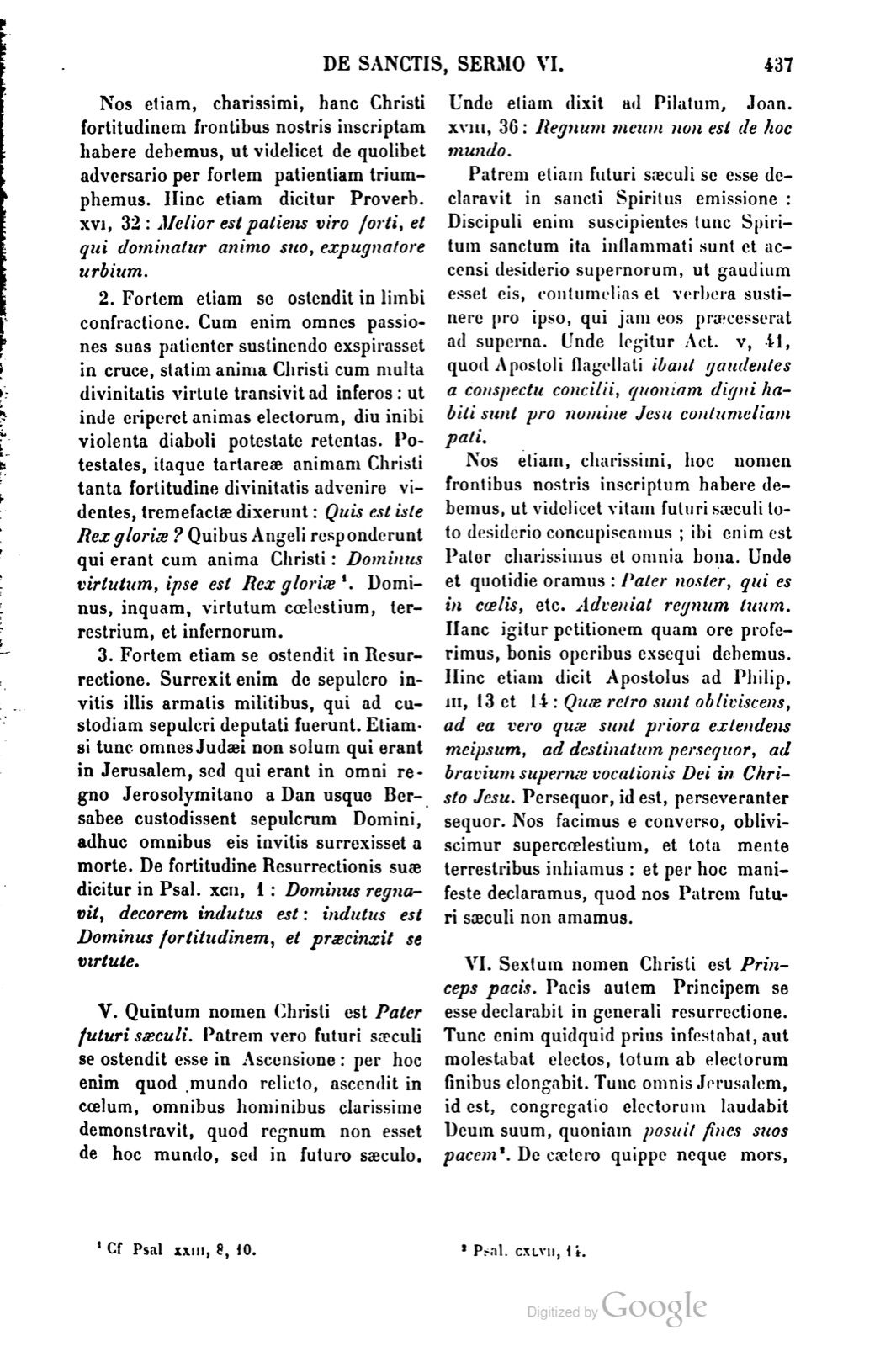
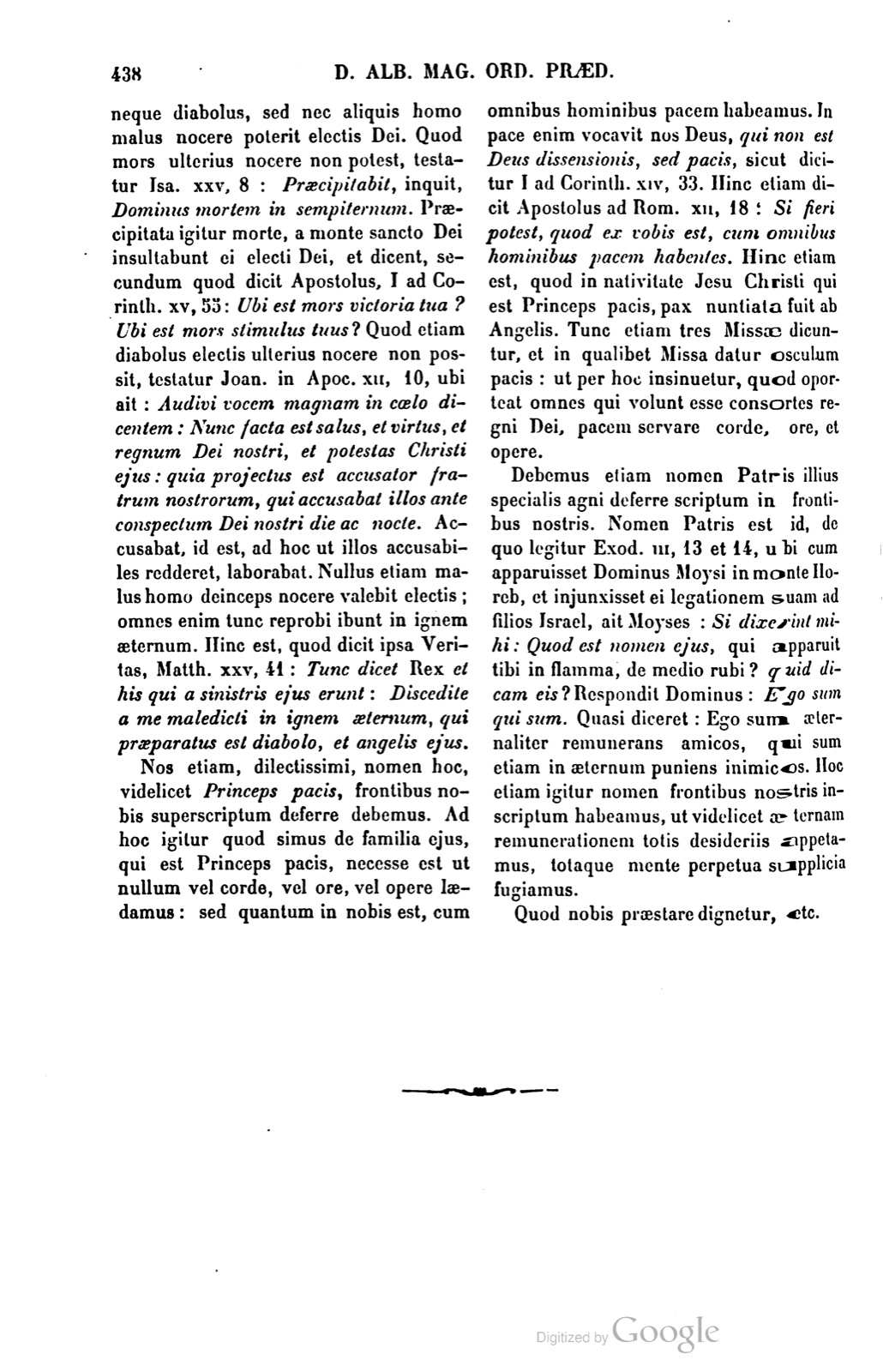
Nos etiam, dilectissimi, nomen hoc, videlicet Princeps pacis, frontibus nobis superscriptum deferre debemus. Ad hoc igitur quod simus de familia ejus, qui est Princeps pacis, necesse est ut nullum vel corde, vel ore, vel opere lædamus: sed quantum in nobis est, cum omnibus hominibus pacem habeamus. In pace enim vocavit nos Deus, qui non est Deus dissensionis, sed pacis, sicut dicitur I ad Corinth. XIV, 33. Hinc etiam dicit Apostolus ad Rom. XII, 18: Si fieri potest, quod ex vobis est, cum omnibus hominibus pacem habentes. Hinc etiam est, quod in nativitate Jesu Christi qui est Princeps pacis, pax nuntiata fuit ab Angelis. Tunc etiam tres Missæ dicuntur, et in qualibet Missa datur osculum pacis: ut per hoc insinuetur, quod oporteat omnes qui volunt esse consortes regni Dei, pacem servare corde, ore, et opere.
Debemus etiam nomen Patris illius specialis agni deferre scriptum in frontibus nostris. Nomen Patris est id, de quo legitur Exod. III, 13 et 14, ubi cum apparuisset Dominus Moysi in monte Horeb, et injunxisset ei legationem suam ad filios Israel, ait Moyses: Si dixerint mihi: Quod est nomen ejus, qui apparuit tibi in flamma, de medio rubi? quid dicam eis? Respondit Dominus: Ego sum qui sum. Quasi diceret: Ego sum æternaliter remunerans amicos, qui sum etiam in æternum puniens inimicos. Hoc etiam igitur nomen frontibus nostris inscriptum habeamus, ut videlicet æternam remunerationem totis desideriis appetamus, totaque mente perpetua supplicia fugiamus.
Quod nobis præstare dignetur, etc.
We also, most beloved, ought to bear this name, namely Prince of peace, written above on our foreheads. Therefore, in order that we may be of the family of him who is Prince of peace, it is necessary that we harm no one either in heart, or mouth, or work; but, as much as is in us, we should have peace with all men. For God has called us in peace, he who is not the God of dissension but of peace, as is said in 1 Corinthians 14:33. Hence also the Apostle says at Romans 12:18: If it can be done, as far as it depends on you, having peace with all men. Hence also it is that in the nativity of Jesus Christ, who is Prince of peace, peace was announced by the Angels. Then also three Masses are said, and in each Mass the kiss of peace is given, so that through this it may be suggested that all who wish to be companions of the kingdom of God must preserve peace in heart, mouth, and work.
We ought also to bear the name of the Father of that special lamb written on our foreheads. The name of the Father is that concerning which it is read in Exodus 3:13 and 14, where, when the Lord had appeared to Moses on Mount Horeb and enjoined his embassy to the sons of Israel, Moses said: If they say to me: What is the name of him who appeared to you in the flame from the midst of the bush? what shall I say to them? The Lord answered: I am who am. As if he were saying: I am the one eternally rewarding friends, who am also the one punishing enemies forever. Therefore let us also have this name inscribed on our foreheads, namely so that with all desires we may seek eternal reward, and with our whole mind flee perpetual punishments.
May he deign to grant this to us, etc.
If a page does not appear, its photograph has not been uploaded yet.