Volume 13 · pp. 411–415
Sermon II. On Blessed Nicholas the Bishop
A marker with ≈ is an approximate page boundary, placed by measure of the text; the page photographs remain the authority. In the paired views, clicking a page marker brings that page into view.
SERMO II.
DE BEATO NICOLAO EPISCOPO.
Beati servi illi, quos cum venerit Dominus, invenerit vigilantes. Luc. XII, 37.
Quinque principaliter sunt hic notanda:
I. Quis sit ille Dominus cui dignum est, ut ab omnibus serviatur? II. Quorum servorum servitium specialiter requiratur? III. Quomodo et quando quilibet vigilare teneatur? IV. Quale damnum ab his qui dormierunt, incurratur? V. Quæ beatitudo eis qui bene vigilaverint, promittatur?
I.
De primo nota, quod Dominus iste cui dignum et justum est ut omnes serviant, est Dei Filius. De isto Domino legitur in Genes. XXVII, 29, quod Isaac, cum benediceret Jacob filium suum, inter cætera sic ait: Serviant tibi populi, et adorent te tribus: esto Dominus fratrum tuorum.
1. Per Isaac, qui interpretatur risus, vel gaudium, Deus Pater intelligitur, qui cor et os illorum qui modo pro peccatis suis flent et lugent, gaudio adimplebit et risu. Unde et ipse Filius fidelis nuntius Dei Patris dixit ad discipulos suos, Luc. VI, 21: Beati qui nunc fletis, quia ridebitis. Unde etiam dicit ad quemlibet fidelem in Job, VIII, 20 et 21: Deus non projiciet simplicem, nec porriget manum malignis: donec impleatur risu os tuum et labia tua jubilo.
2. Per Jacob, qui luctator interpretatur, Dei Filius intelligitur, qui tamquam verus David cum Goliath, id est, diabolo, singularem luctam aggressus est in cruce, eumque moriendo, quod mirabile erat, subegit et occidit, id est, iniquam potentiam sibi abstulit. Huic Filio ait Deus Pater: Serviant tibi populi Gentilium, adorent te tribus Judæorum, esto Dominus fratrum tuorum, id est, Christianorum. Christiani enim specialiter dicuntur fratres Domini, quia sunt cum eo in eadem religione. Est enim illis cum Christo una fides, et unum baptisma. Fidem namque quam Christus prædicavit, ipsi susceperunt, et per ejus baptisma a peccatis originalibus ipsi ablui meruerunt.
II.
De secundo nota, quod Christiani specialiter dicuntur servi Domini, quia ipsi in baptismo servitio diaboli renuntiaverunt, et se ad Christi obsequium obligaverunt. De his servis dicitur Exod. XXI, 1 et 2: Si emeris servum Hebræum, sex annis serviet tibi: in septimo egredietur liber gratis. Cum quali veste intraverit, cum tali exeat. Hæc auctoritas exponitur de Christianis, et Christo. Hebræi interpretantur vincentes, vel transeuntes, et sic Christiani debent esse Hebræi, ut videlicet per fidem vincant diabolum et mundum, et ita transire mereantur in regnum æternum. De hac victoria dicit I Joan. II, 14: Verbum Dei manet in vobis, et vicistis malignum, id est, diabolum. Dicit etiam ibidem: Hæc est victoria, quæ vincit mundum, fides nostra 1.
Hos itaque servos Dominus emit magno pretio, videlicet sanguine suo. Unde sex annis ei servire debent, ut in septimo liberi gratis egrediantur. Per sex annos totum spatium vitæ nostræ figuratur, in quo laborare debemus, cum ad laborem nati simus, et cum etiam ipse Dominus sex diebus operatus fuerit, et in septimo quieverit, sicut dicitur in Gen. II, 2: Requievit Deus die septimo ab omni opere, quod patrarat. Septimus annus est tempus post hanc vitam, quod est tempus animarum. Igitur sex annis, id est, toto tempore vitæ nostræ, ei servire debent, ut septimo liberi gratis egrediantur, id est, per Christi gratiam ab omni miseria liberati ad æternam requiem tunc ingredi mereantur.
SERMON II.
ON BLESSED NICHOLAS THE BISHOP.
Blessed are those servants whom, when the Lord has come, he will have found watching. Luke 12:37.
Five things principally are to be noted here:
I. Who is that Lord whom it is fitting that all should serve? II. The service of which servants is especially required? III. How and when is each person bound to keep watch? IV. What sort of loss is incurred by those who have slept? V. What blessedness is promised to those who have watched well?
I.
On the first, note that this Lord whom it is fitting and just that all should serve is the Son of God. Concerning this Lord it is read in Genesis 27:29 that Isaac, when he blessed Jacob his son, among other things spoke thus: Let peoples serve you, and tribes adore you; be lord of your brothers.
1. By Isaac, which is interpreted laughter, or joy, God the Father is understood, who will fill with joy and laughter the heart and mouth of those who now weep and mourn for their sins. Hence also the Son himself, the faithful messenger of God the Father, said to his disciples, Luke 6:21: Blessed are you who now weep, because you will laugh. Hence also he says to any faithful one in Job 8:20 and 21: God will not cast away the simple, nor stretch out his hand to the malicious, until your mouth is filled with laughter and your lips with jubilation.
2. By Jacob, who is interpreted wrestler, the Son of God is understood; he, as the true David with Goliath, that is, with the devil, undertook a single combat on the cross, and by dying, which was marvelous, subdued and killed him, that is, took from him his unjust power. To this Son God the Father says: Let the peoples of the Gentiles serve you, let the tribes of the Jews adore you; be Lord of your brothers, that is, of Christians. For Christians are especially called brothers of the Lord because they are with him in the same religion. For with Christ they have one faith and one baptism. For the faith which Christ preached, they received; and through his baptism they merited to be washed from original sins.
II.
On the second, note that Christians are especially called servants of the Lord, because in baptism they renounced the service of the devil and bound themselves to the obedience of Christ. Concerning these servants it is said in Exodus 21:1 and 2: If you buy a Hebrew servant, he will serve you six years; in the seventh he will go out free without payment. With whatever garment he entered, with such a one let him go out. This authority is expounded concerning Christians and Christ. Hebrews are interpreted as conquerors, or passers-over, and thus Christians ought to be Hebrews, namely so that by faith they may conquer the devil and the world, and thus may merit to pass over into the eternal kingdom. Concerning this victory 1 John 2:14 says: The Word of God remains in you, and you have conquered the malignant one, that is, the devil. He also says in the same place: This is the victory which conquers the world, our faith 1.
Therefore the Lord bought these servants at a great price, namely with his blood. Hence they ought to serve him for six years, so that in the seventh they may go out free without payment. By the six years the whole span of our life is figured, in which we ought to labor, since we were born for labor, and since also the Lord himself worked for six days and rested on the seventh, as is said in Genesis 2:2: God rested on the seventh day from every work which he had done. The seventh year is the time after this life, which is the time of souls. Therefore for six years, that is, during the whole time of our life, they ought to serve him, so that in the seventh they may go out free without payment, that is, having been freed by the grace of Christ from every misery, they may then merit to enter eternal rest.
Cum quali etiam veste homo intravit in servitutem Christi, cum tali tunc exibit. Vestis est innocentia, quæ confertur homini in baptismo, sive sit baptismus aquæ, vel pœnitentiæ. Et cum hac veste qui Christo devote servierit, exibit in morte.
Et nota, quod a servis Christi triplex servitus exigitur, videlicet servitus cordis, oris, et operis.
1. Servitus autem cordis consistit in tribus, videlicet in cogitationum puritate, et affectionis sinceritate, ac compassionis ubertate. Debet enim servus Christi puras cogitationes habere, ut videlicet recogitet singula beneficia Christi, et cum ea recogitaverit, sinceræ affectionis dulcedine circa ipsum moveatur. Debet etiam habere uberem compassionem, per quam pauperibus et afflictis condoleat, ac misereatur. Sic fecit S. Nicolaus. "Erat enim, sicut de eo cantatur, valde compatiens, et super afflictos pia gestans viscera."
2. Servitus etiam oris consistit in tribus, videlicet in devota gratiarum actione, in supplici oratione, et in fraterna admonitione. Debet enim quilibet super singulis beneficiis Jesu devotas sibi referre gratiarum actiones: cum etiam ei ab electis in patria jugiter gratiæ referantur. Unde et Sacerdos quotidie invitat nos in Missa: Gratias, inquit, agamus Domino Deo nostro. Debet etiam homo Creatori suo continuo supplices orationes offerre, postulans ab eo gratiam in præsenti, et gloriam in futuro. Gratiam siquidem et gloriam, Psalmistæ testimonio, dabit Dominus 2. Debet nihilominus homo proximum suum ad omne opus bonum admonere, ut ipsum, quantum in ipso est, secum pertrahat ad regnum Dei.
3. Servitus etiam operis consistit in tribus. Debemus enim Domino servire operibus munditiæ, justitiæ, et misericordiæ: ut videlicet per munditiam corpora nostra ab inquinamentis luxuriæ custodiamus, ut per justitiam proximum nostrum in nullo lædamus aut offendamus, ut etiam per misericordiam pauperibus et afflictis benefaciamus. Sic fecit Beatus Nicolaus, qui juste, munde, ac pie vivendo, ad honorem sacerdotii meruit promoveri divinitus. Unde adhuc oleum resudat ex ossibus ejus mundis et justis.
NOTA etiam, quod Domino serviendum est cum timore et exsultatione. Justitia enim Domini facit hominem trepidare; sed benignitas ejus facit eum exsultare. De servitio timoris dicitur in Psal. II, 11: Servite Domino in timore. De servitio vero exsultationis habetur Gen. XLVII, 23, ubi populus Ægypti, id est, hujus mundi, dicit ad Joseph, per quem Christus intelligitur: Salus nostra in manu tua est: respiciat nos tantum Dominus noster, et læti serviemus Regi, id est, Deo Patri.
Also, with whatever garment a man entered into the service of Christ, with such a garment he will then go out. The garment is innocence, which is conferred on a man in baptism, whether it is the baptism of water or of penance. And with this garment the one who has devoutly served Christ will go out in death.
And note that from the servants of Christ a threefold service is required, namely the service of heart, of mouth, and of work.
1. The service of the heart consists in three things, namely in purity of thoughts, and sincerity of affection, and abundance of compassion. For a servant of Christ ought to have pure thoughts, so that namely he may think back upon the individual benefits of Christ, and when he has thought back upon them, he may be moved toward him by the sweetness of sincere affection. He ought also to have abundant compassion, through which he may grieve with the poor and afflicted and have mercy. Thus Saint Nicholas did. "For he was, as is sung concerning him, very compassionate, and toward the afflicted bearing pious inward parts."
2. The service also of the mouth consists in three things, namely in devout giving of thanks, in suppliant prayer, and in fraternal admonition. For each person ought, over the individual benefits of Jesus, to render to him devout thanksgivings, since thanks are also rendered to him unceasingly by the elect in the homeland. Hence also the priest daily invites us in the Mass: Let us give thanks, he says, to the Lord our God. A man ought also continually to offer suppliant prayers to his Creator, asking from him grace in the present and glory in the future. Indeed grace and glory, according to the testimony of the Psalmist, the Lord will give 2. Nevertheless a man ought to admonish his neighbor to every good work, so that, as much as lies in him, he may draw him with himself to the kingdom of God.
3. The service also of work consists in three things. For we ought to serve the Lord with works of cleanness, justice, and mercy: namely so that through cleanness we may guard our bodies from the defilements of luxury; so that through justice we may harm or offend our neighbor in nothing; so that also through mercy we may do good to the poor and afflicted. Thus Blessed Nicholas did, who, by living justly, cleanly, and piously, merited to be promoted by divine action to the honor of priesthood. Hence even now oil sweats out from his clean and just bones.
NOTE also that the Lord must be served with fear and exultation. For the justice of the Lord makes a man tremble; but his kindness makes him exult. Concerning the service of fear it is said in Psalm 2:11: Serve the Lord in fear. But concerning the service of exultation there is Genesis 47:23, where the people of Egypt, that is, of this world, says to Joseph, by whom Christ is understood: Our salvation is in your hand; only let our lord look upon us, and we shall serve the King joyfully, that is, God the Father.
III.
De tertio nota, quod vigiliæ quibus vigilare tenemur, hæ sunt, ut videlicet semper Dei reminiscamur, ac salutis propriæ animæ non obliviscamur. Et hoc facere debet omnis homo, sive sit in pueritia, sive in adolescentia, sive in virili ætate, sive in senecta, sive in senio constitutus. Hinc est, quod Dominus dicit Marc. XIII, 35 et seq.: Vigilate, nescitis enim quando Dominus veniat: sero, an media nocte, an galli cantu, an mane. Ne cum venerit repente, inveniat vos dormientes. Quod autem vobis dico: Vigilate. Describit ergo Dominus hic quatuor vigilias, per quas quatuor principales ætates hominis figurantur.
1. Per sero quippe intelliguntur homines decrepitæ ætatis, utpote octogenarii, nonagenarii, et centenarii. His enim dies hujus vitæ jam pene elapsus est, et instat eis nox mortis, et talibus est necessarium vigilare.
2. Per mediam noctem designantur homines, qui in multis sollicitudinibus hujus vitæ jam per longum tempus vixerunt, et necesse est eis ut de animæ suæ requie cogitarent. Qui etiam dicere possunt: Media vita in morte sumus; utpote homines annorum quinquaginta, sexaginta, et septuaginta. Illi quippe qui libenter nocte vigilant, saltem in media nocte vadunt dormitum, ut pausent, et requiescant. Sic etiam utile esset talibus, ut tandem nunc de animarum requie cogitarent.
3. Per galli cantum notantur homines quos gallus multiplicis sollicitudinis inquietat, videlicet qui de conjugum suarum, et parvulorum, et cæteræ familiæ procuratione solliciti existunt, utpote vicenarii, trecenarii, quadragenarii. Et certe a talibus exigitur ut vigilent. Nescit enim homo quantumcumque robustæ ætatis sit, quid superventura pariat dies.
4. Per mane intelliguntur parvi, et adolescentuli, qui sunt infra annos viginti, quibus adhuc longior dies vitæ præsentis promittitur: et forte tales credunt quod longam et serenam sint victuri, qui forsitan vix vivent unam diem brevem, et per auræ intemperiem nihilominus perturbatam: propter quod et talibus est vigilandum.
BEATUS NICOLAUS mane cœpit Domino vigilare.
1. Propterea legitur de ipso, quod dum penderet ad ubera matris, quarta feria et sexta semel in die papillas sugebat.
2. Cantatur etiam de eo, quod nobilis progenie, sed nobilior moribus ab ipso puerili ævo secutus Dominum, meruit divina revelatione ad summum provehi sacerdotium.
3. Nota etiam, quod ad litteram B. Nicolaus ad hoc ut bene ageret, vigilavit. Quidam enim patrifamilias qui ad magnam devenerat inopiam, ad subsidium ipsius, ac filiarum ejus, ipso dormiente aurum projecit, et abscessit. Heu! multi faciunt e converso: qui ad hoc vigilant, ut malefaciant de noctibus, utpote fures, raptores, latrones, et domorum incensores, et fornicatores. De talibus dicitur Proverb. IV, 14, 16 et 17: Ne delecteris in semitis impiorum, nec tibi placeat malorum via... Non enim dormiunt nisi malefecerint, et somnus rapitur ab eis nisi supplantaverint. Comedunt panem impietatis, et vinum iniquitatis bibunt.
III.
On the third, note that the watches by which we are bound to watch are these, namely that we should always remember God and not forget the salvation of our own soul. And every man ought to do this, whether he is set in boyhood, or in adolescence, or in manly age, or in old age, or in extreme old age. Hence it is that the Lord says in Mark 13:35 and following: Watch; for you do not know when the Lord is coming: in the evening, or at midnight, or at cockcrow, or in the morning. Lest when he comes suddenly, he find you sleeping. But what I say to you: Watch. Therefore the Lord describes here four watches, through which the four principal ages of man are figured.
1. By evening, indeed, men of decrepit age are understood, such as octogenarians, nonagenarians, and centenarians. For the day of this life has already almost passed away for them, and the night of death stands near them, and for such people it is necessary to watch.
2. By midnight are designated men who have already lived through much time amid many anxieties of this life, and it is necessary for them to think about the rest of their soul. They also can say: In the midst of life we are in death; such are men of fifty, sixty, and seventy years. For those who willingly keep watch at night go to sleep at least at midnight, so that they may pause and rest. Thus also it would be useful for such men finally now to think about the rest of souls.
3. By cockcrow are marked men whom the cock of manifold anxiety disturbs, namely those who exist as anxious about the care of their wives, and little children, and the rest of the household, such as those of twenty, thirty, and forty years. And certainly it is demanded from such men that they watch. For a man, however robust his age may be, does not know what the coming day may bring forth.
4. By morning are understood children and young adolescents who are below twenty years, to whom a longer day of present life is still promised; and perhaps such people believe that they are going to live a long and serene life, though perhaps they will scarcely live one short day, and one nonetheless disturbed by the inclemency of the air; on account of which even such people must watch.
BLESSED NICHOLAS began in the morning to watch for the Lord.
1. Therefore it is read concerning him that, while he was hanging at his mother's breasts, on Wednesday and Friday he sucked the nipples once in the day.
2. It is also sung concerning him that, noble in lineage but nobler in morals, following the Lord from his very boyish age, he merited by divine revelation to be advanced to the highest priesthood.
3. Note also that, according to the letter, Blessed Nicholas kept watch for this purpose, that he might act well. For while a certain father of a family who had come to great want was sleeping, Nicholas threw gold in for the relief of him and of his daughters, and departed. Alas! many do the opposite: they keep watch for this purpose, that they may do evil at night, such as thieves, plunderers, robbers, burners of houses, and fornicators. Concerning such people it is said in Proverbs 4:14, 16 and 17: Do not delight in the paths of the impious, nor let the way of the evil please you... For they do not sleep unless they have done evil, and sleep is snatched from them unless they have supplanted someone. They eat the bread of impiety, and drink the wine of iniquity.
IV.
De quarto nota, quod ad minus sunt quatuor genera hominum qui non vigilant, sed dormiunt, et propter hoc pœnam et mortem incurrunt æternam. Dormire enim est Deum non attendere, et propriam salutem negligere. Faciunt autem homines sic dormire superbia, avaritia, luxuria, et de longiore vita confidentia: et per hæc etiam quatuor homines morte trucidantur æterna. Nota ergo de primis duobus, videlicet superbia, et avaritia, quod faciunt hominem Dei ac propriæ salutis oblivisci, et tandem ipsum morte interficiunt sempiterna. Unde legitur in II Reg. IV, quod duo principes latronum Rechab et Baana, Isboseth filium Saulis fervente die in meridie super lectum suum dormientem interfecerunt, et sublato capite ejus abierunt: ostiaria quippe domus etiam dormiebat.
Isboseth interpretatur vir confusionis, et signat quemlibet qui diligit hunc mundum, qui plenus est confusione. Confusa quippe sunt hic omnia: spes, metus, mœror, gaudium. Hunc Rechab et Baana dormientem interficient. Rechab interpretatur excelsus, et signat superbiam, quæ semper excelsa quærit. Baana vero interpretatur, venit donatus, et signat avaritiam, quæ semper appetit dona et munera rerum præsentium.
Superbia igitur et avaritia interficiunt hominem dormientem, id est, salutem propriam negligentem; interficiunt autem eum in meridie et in lecto.
1. Superbi enim semper volunt esse in meridie, id est, semper appetunt in hoc sæculo splendere, et gloriosi apparere.
2. Avari etiam propter hoc res tam inhianter congregant et acquirunt, ut de divitiis quasi quemdam lectum sibi faciant, in quo postea suaviter pausent et quiescant. Et quare tales interficiuntur? Quia certe ostiaria domus, id est, ratio hominis obdormivit. Ipsa quippe ratio hominis deberet hominem excitare, et ei persuadere, ut caveret sibi a superbia et avaritia, præsertim cum homo sit pulvis et vas stercorum: propter quod indignum est ut superbiat; præterea cum homo nudus natus sit, nudum eum egredi oporteat: propter quod etiam contra rationem est, ut ad tanta conquirenda se extendat, cum omnia eum hic relinquere sit necesse.
3. Luxuria etiam hominem facit dormire, id est, aufert ei memoriam Dei, et sollicitudinem salutis propriæ. Unde legitur Judicum, XV, quod Dalila fecit dormire Samsonem super genua sua, et in sinu suo reclinare caput. Deinde cum rasum eum abjiceret, apprehenderunt eum Philisthæi, et eruerunt oculos ejus, et vinctum catenis molere fecerunt in carcere suo. Samson interpretatur sol fortis, et signat quemlibet Christianum, qui deberet esse sol et lumen fidei, et fortis per opus virtutis. Hæc enim duo requiruntur a quolibet Christiano, ut videlicet credat per fidem, et operetur per charitatem.
IV.
On the fourth, note that there are at least four kinds of men who do not watch, but sleep, and on account of this they incur eternal penalty and death. For to sleep is not to attend to God, and to neglect one's own salvation. But pride, avarice, luxury, and confidence concerning a longer life make men sleep in this way; and through these four things men are also slain by eternal death. Therefore note concerning the first two, namely pride and avarice, that they make a man forgetful of God and of his own salvation, and at last kill him with everlasting death. Hence it is read in 2 Kings 4 that two princes of robbers, Rechab and Baana, killed Isboseth, the son of Saul, sleeping on his bed in the heat of the day at midday, and, with his head taken away, they departed; for the doorkeeper woman of the house also was sleeping.
Isboseth is interpreted man of confusion, and signifies anyone who loves this world, which is full of confusion. For all things here are confused: hope, fear, grief, joy. Rechab and Baana will kill this sleeping man. Rechab is interpreted lofty, and signifies pride, which always seeks lofty things. But Baana is interpreted, he came endowed, and signifies avarice, which always desires gifts and the goods of present things.
Therefore pride and avarice kill a sleeping man, that is, one neglecting his own salvation; and they kill him at midday and on a bed.
1. For the proud always wish to be at midday, that is, they always desire to shine in this age and to appear glorious.
2. The avaricious also gather and acquire things so greedily on account of this, that from riches they may make for themselves as it were a certain bed, in which afterward they may pause and rest sweetly. And why are such people killed? Because certainly the doorkeeper woman of the house, that is, the reason of man, has fallen asleep. For the very reason of man ought to rouse the man and persuade him to beware for himself of pride and avarice, especially since man is dust and a vessel of dung; on account of which it is unworthy for him to be proud. Moreover, since man was born naked, it is fitting for him to go out naked; on account of which it is also contrary to reason for him to stretch himself out to acquiring such great things, since it is necessary for him to leave all things here.
3. Luxury also makes a man sleep, that is, takes from him the memory of God and solicitude for his own salvation. Hence it is read in Judges 15 that Delilah made Samson sleep upon her knees and recline his head in her bosom. Then when she cast him away shaved, the Philistines seized him and dug out his eyes, and made him grind, bound with chains, in their prison. Samson is interpreted strong sun, and signifies any Christian, who ought to be sun and light of faith, and strong through the work of virtue. For these two things are required of any Christian, namely that he believe through faith and work through charity.
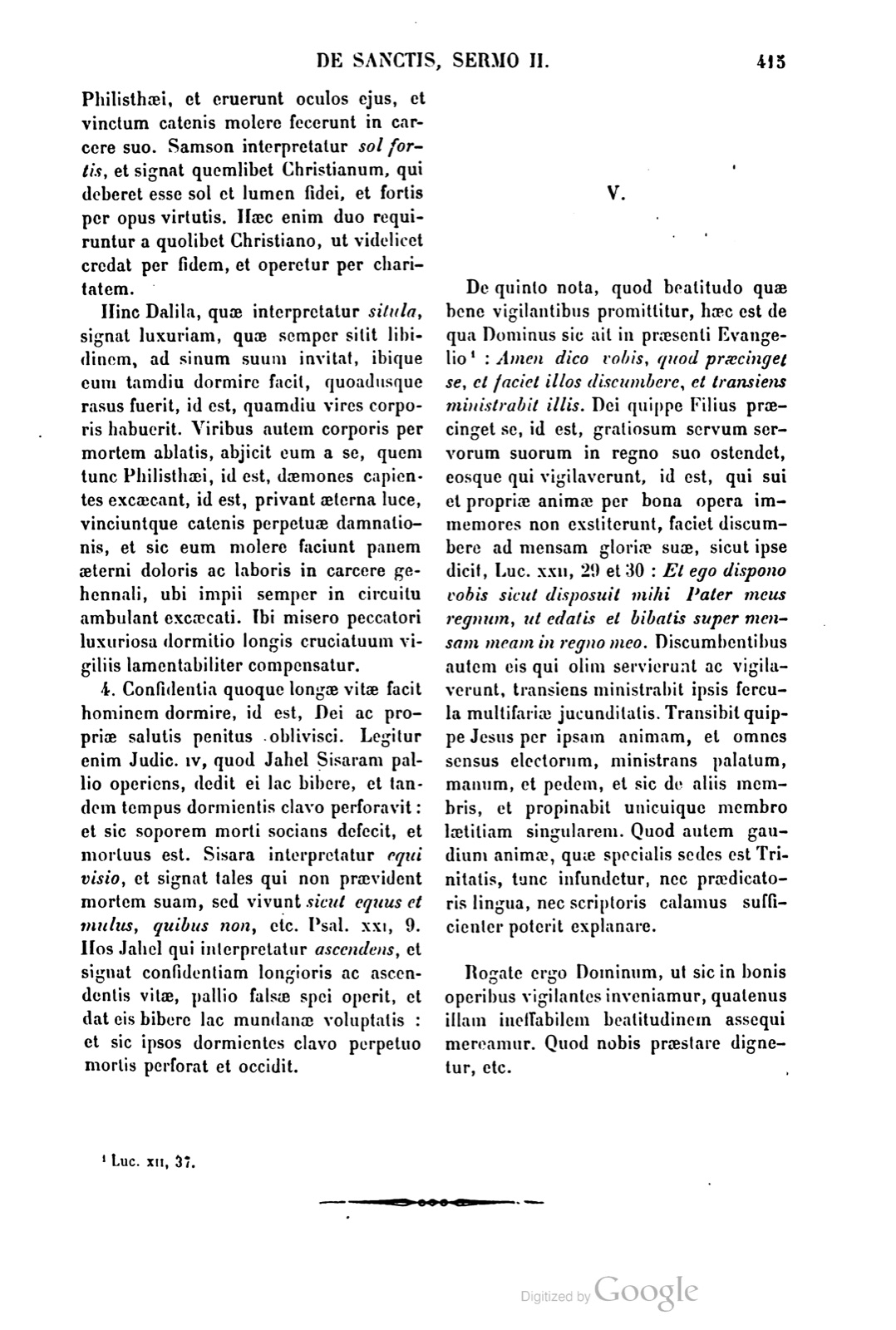
Hinc Dalila, quæ interpretatur situla, signat luxuriam, quæ semper sitit libidinem, ad sinum suum invitat, ibique eum tamdiu dormire facit, quoadusque rasus fuerit, id est, quamdiu vires corporis habuerit. Viribus autem corporis per mortem ablatis, abjicit eum a se, quem tunc Philisthæi, id est, dæmones capientes excæcant, id est, privant æterna luce, vinciuntque catenis perpetuæ damnationis, et sic eum molere faciunt panem æterni doloris ac laboris in carcere gehennali, ubi impii semper in circuitu ambulant excæcati. Ibi misero peccatori luxuriosa dormitio longis cruciatuum vigiliis lamentabiliter compensatur.
4. Confidentia quoque longæ vitæ facit hominem dormire, id est, Dei ac propriæ salutis penitus oblivisci. Legitur enim Judic. IV, quod Jahel Sisaram pallio operiens, dedit ei lac bibere, et tandem tempus dormientis clavo perforavit: et sic soporem morti socians defecit, et mortuus est. Sisara interpretatur equi visio, et signat tales qui non prævident mortem suam, sed vivunt sicut equus et mulus, quibus non, etc. Psal. XXI, 9. Hos Jahel qui interpretatur ascendens, et signat confidentiam longioris ac ascendentis vitæ, pallio falsæ spei operit, et dat eis bibere lac mundanæ voluptatis: et sic ipsos dormientes clavo perpetuo mortis perforat et occidit.
V.
De quinto nota, quod beatitudo quæ bene vigilantibus promittitur, hæc est de qua Dominus sic ait in præsenti Evangelio 3: Amen dico vobis, quod præcinget se, et faciet illos discumbere, et transiens ministrabit illis. Dei quippe Filius præcinget se, id est, gratiosum servum servorum suorum in regno suo ostendet, eosque qui vigilaverunt, id est, qui sui et propriæ animæ per bona opera immemores non exstiterunt, faciet discumbere ad mensam gloriæ suæ, sicut ipse dicit, Luc. XXII, 29 et 30: Et ego dispono vobis sicut disposuit mihi Pater meus regnum, ut edatis et bibatis super mensam meam in regno meo. Discumbentibus autem eis qui olim servierunt ac vigilaverunt, transiens ministrabit ipsis fercula multifariæ jucunditatis. Transibit quippe Jesus per ipsam animam, et omnes sensus electorum, ministrans palatum, manum, et pedem, et sic de aliis membris, et propinabit unicuique membro lætitiam singularem. Quod autem gaudium animæ, quæ specialis sedes est Trinitatis, tunc infundetur, nec prædicatoris lingua, nec scriptoris calamus sufficienter poterit explanare.
Rogate ergo Dominum, ut sic in bonis operibus vigilantes inveniamur, quatenus illam ineffabilem beatitudinem assequi mereamur. Quod nobis præstare dignetur, etc.
Hence Delilah, who is interpreted bucket, signifies luxury, which always thirsts for lust; she invites him to her bosom and there makes him sleep so long until he has been shaved, that is, as long as he has had the powers of the body. But when the powers of the body have been taken away by death, she casts him away from herself; then the Philistines, that is, the demons, taking him, blind him, that is, deprive him of eternal light, and bind him with the chains of perpetual damnation, and thus make him grind the bread of eternal pain and labor in the prison of Gehenna, where the impious always walk in a circle, blinded. There, for the wretched sinner, luxurious sleep is lamentably compensated by long watches of torments.
4. Confidence also of a long life makes a man sleep, that is, makes him forgetful entirely of God and of his own salvation. For it is read in Judges 4 that Jael, covering Sisera with a cloak, gave him milk to drink, and at last pierced the temple of the sleeping man with a nail; and thus, joining sleep to death, he failed and died. Sisera is interpreted vision of the horse, and signifies such people who do not foresee their own death, but live like the horse and mule, for whom there is no, etc., Psalm 21:9. Jael, who is interpreted ascending, and signifies confidence of a longer and ascending life, covers these people with the cloak of false hope, and gives them the milk of worldly pleasure to drink; and thus she pierces and kills them while sleeping with the perpetual nail of death.
V.
On the fifth, note that the blessedness which is promised to those who watch well is this, concerning which the Lord speaks thus in the present Gospel 3: Amen I say to you, that he will gird himself, and make them recline, and passing by he will minister to them. For the Son of God will gird himself, that is, he will show himself as the gracious servant of his servants in his kingdom; and those who have watched, that is, those who have not existed unmindful of themselves and of their own soul through good works, he will make recline at the table of his glory, as he himself says, Luke 22:29 and 30: And I dispose to you a kingdom, as my Father disposed it to me, that you may eat and drink at my table in my kingdom. But as those who once served and watched recline, passing by he will minister to them dishes of manifold delight. For Jesus will pass through the very soul and all the senses of the elect, ministering to the palate, hand, and foot, and so concerning the other members; and he will pour out for each member a singular joy. But what joy will then be poured into the soul, which is the special seat of the Trinity, neither the tongue of a preacher nor the pen of a writer will be able sufficiently to explain.
Therefore pray to the Lord that we may be found thus watching in good works, so that we may merit to obtain that ineffable blessedness. May he deign to grant this to us, etc.
If a page does not appear, its photograph has not been uploaded yet.