Volume 1
Works Not Published at Lyons, Vallisoletanus Index 1-54
A marker with ≈ is an approximate page boundary, placed by measure of the text; the page photographs remain the authority. In the paired views, clicking a page marker brings that page into view.
SEQUUNTUR OPERA QUAE IN SUPERIORI laudata Lugdunensi editione non prodierunt, et a citatis Laurentio Pignon et Ludovico a Valleoleti recensentur, ita tamen ut posterioris ordinem sequamur, singulis nomen prioris addendo, ubi idem habet, adjectis cod. MS vel etiam editis qui mihi occurrerunt. Sic ergo Valleoletanus: 1. Scripsit Albertus super totam Bibliam per modum postillae. Hic inutile esset sacrae scripturae libros omnes sigillatim enumerare, ut quidam fecerunt, nam nec recenset Valleoletanus. 2. Item super multos libros ejusdem modo quo scripsit naturalem philosophiam per tractatus et capitula ordine commentario. Catal. Anglic. T. I, P. I, cod. 947: Albertus Magnus super aliquot textus veteris et novi testamenti. Apud Sanderum, P. II in valle S. Martini p. 209: Expositiones vocabulorum Bibliae. Laurentius Pignon quid habet distinctius: Scripsit, inquit, 3. Postillas super Job. In catal. Bibl. Mediceae, Plut. XIII cod. 10 fol. memb. Scriptum super Job F. Alberti Theutonici de Ordine FF. Praedic. opus ineditum, codex rarus cui adjicitur haec nota: Hanc Jobi explanationem anno MDCLXXX annuente serenissimo Cosmo III Magno duce Pater Maximilianus Deza Lucensis Congregationis SS. Matris Dei tunc temporis disertissimus verbi Dei praeco in ecclesia S. Laurentii sibi transcribendam curavit typis eam daturus quamprimum. Sic ibi, quod an opere praestiterit clarus ecclesiastes, mihi hactenus incompertum. Simile exemplum vidit Petrus de Prussia. 4. Super Cantica. Dicunt extare MS in-fol. in Bibl. Cisterciensi. 5. Super Isaiam. Dicunt haberi apud nostros Colonienses. 6. Super Jeremiam et Ezechielem. Vidit Petrus de Prussia et ex iis quaedam fragmenta identidem refert in vita B. Alberti. 7. Super omnes epistolas B. Pauli Apostoli. Noverat Petrus de Prussia virum doctum, penes quem erat hujus commentarii exemplum. Audiendus hic Tholomaeus de Lucca (Hist. Eccles. Nov. lib. 12, cap. 18) ubi sic habet de Alberto: Hic exposuit magnam partem Bibliae, quia postillavit Evangelia, epistolas Pauli, Prophetas majores et minores, libros Salomonis et Job. Quae non parum confirmant hactenus dicta. Prosequitur Valleoletanus addendo Summae theologicae, cujus tantum habentur duae priores partes, alias duas: 8. Tertiam scilicet de Christo et virtutibus. 9. Quartam de sacramentis et gloria resurrectionis. Et quidem Albertus has prioribus adjicere in animo habuisse dubitari nequit, cum divisionem illam quatrimembrem proponat (P. I, Q. 3, art. ult.) ac variis etiam primae partis locis indicet se de virtutibus ac donis acturum, eoque remittat, at quacumque de causa promissis non stetisse certum: primo enim Laurentius Pignon jam ante MCCCC scribens nonnisi duas priores partes quae typis prodierunt agnovit: at quod rem extra dubium ponit, Tholomaeus de Lucca loco mox citato sic habet: Hic Summam theologiae inchoavit sed non complevit, fecit tamen duo volumina, quae ad divinam naturam pertinent et emanationes creaturarum. Nihil clarius. 9. De perfectione vitae spiritualis. Sic etiam Pignon. Dicunt extare in Victorina. Vide supra T. XXI art. 6, ubi conjectu solum dictum forte illud esse opusculum cui titulus De adhaerendo Deo. 10. Contra Guillemistas impugnantes religiosos. Pignon contra Guillelmum de Sanctoamore. Alii vocant Defensorium mendicantium, et dicunt extare in Victorina: vidit saltem Petrus de Prussia in nostra Coloniensi. 11. De partu hominis, et de formatione hominis in utero. Sic etiam Pignon. Dicunt extare in Victor. Utrumque facile crediderim excerptam esse ex magno opere De animalibus (lib. IX et X). Ut ut sit seorsim prodiit Alberti libellus de formatione hominis in utero. Antverpiae, 1538-8. Quae editio Romae in Barber. et e re esset a peritis examinari. 12. Liber multarum quaestionum determinativus ad Parisienses. Pignon sic habet: Determinationes quarumdem quaestionum ad clerum Parisiensem. Vidit Petrus de Prussia, et dicit esse circa undecim quaestiones, quas F. Aegidius Ordinis Praedic. ad Albertum misit ejus judicio terminandas, tractatum vero esse notum, et hoc habere principium: Intellectus hominis, etc. 13. Multae prosae seu sequentiae et alia devota. Pignon: Sequentiae plures. Dicunt extare in Victorina. Inter has numerant Prosam de Trinitate, quae ad nostra usque tempora in Ordine fuit in usu, et in nostris missalibus excepta ultima editione Romana anni 1694 habetur. Pr. Profitentes unitatem. 14. Unum officium de corpore Christi quod non est in usu communi Ecclesiae cum diversis prosis de eodem sacramento. 15. Super librum Dionysii de divinis nominibus. Pignon etiam meminit. Extare dicunt in Victor. forte in aliis codicibus quam a me visis et supra T. XIII laudatis: at quantum memini extat in Navarr. et vidit Petrus de Prussia. 16. Liber de arte praedicandi. 17. Liber de reparatione hominis lapsi.
THERE FOLLOW THE WORKS WHICH did not come forth in the above-praised Lyons edition, and are reviewed by the cited Laurence Pignon and Ludovicus of Valladolid, yet so that we follow the order of the latter, adding the name of the former to individual items where he has the same, with manuscript codices or even printed editions which have occurred to me added. Thus therefore Valladolid: 1. Albert wrote on the whole Bible in the manner of a postilla. Here it would be useless to enumerate one by one all the books of sacred Scripture, as certain men have done, for Valladolid does not review them either. 2. Likewise on many books of the same, in the manner in which he wrote natural philosophy, by treatises and chapters in a commentary order. English catalogue, volume I, part I, codex 947: Albert the Great on some texts of the Old and New Testament. In Sanderus, part II in the valley of St. Martin, page 209: Expositions of biblical words. Laurence Pignon has something more distinct: He wrote, he says, 3. Postillas on Job. In the catalogue of the Medicean Library, Pluteus XIII, codex 10, folio parchment: Writing on Job by Brother Albert the Teuton of the Order of Friars Preachers, an unpublished work, a rare codex, to which this note is added: In the year 1680, with the assent of the most serene Cosimo III, Grand Duke, Father Maximilianus Deza of Lucca, of the Congregation of the Most Holy Mother of God, at that time a most eloquent preacher of the word of God in the church of St. Lawrence, took care that this explanation of Job should be transcribed for himself, intending to give it to print as soon as possible. Thus there; whether the distinguished preacher accomplished this in fact is unknown to me thus far. Peter of Prussia saw a similar copy. 4. On the Song of Songs. They say it exists in manuscript, in folio, in the Cistercian Library. 5. On Isaiah. They say it is held among our men of Cologne. 6. On Jeremiah and Ezekiel. Peter of Prussia saw it and repeatedly reports certain fragments from them in the Life of Blessed Albert. 7. On all the epistles of Blessed Paul the Apostle. Peter of Prussia knew a learned man in whose possession there was a copy of this commentary. Here Ptolemy of Lucca should be heard (New Ecclesiastical History, book 12, chapter 18), where he has thus about Albert: This man expounded a great part of the Bible, because he wrote postillas on the Gospels, the epistles of Paul, the major and minor Prophets, the books of Solomon and Job. These things confirm in no small measure the things said thus far. Valladolid proceeds by adding to the Theological Summa, of which only the two former parts are held, two others: 8. namely the third on Christ and the virtues. 9. the fourth on the sacraments and the glory of the resurrection. And indeed that Albert had it in mind to add these to the former parts cannot be doubted, since he proposes that four-member division (Part I, Question 3, final article), and in various places of the first part also indicates that he is going to treat of the virtues and gifts and refers to that place; but that, for whatever cause, he did not stand by his promises is certain. For first, Laurence Pignon, writing already before 1400, recognized only the two earlier parts which came forth in print; but what places the matter beyond doubt is that Ptolemy of Lucca in the place just cited has thus: This man began the Summa of Theology but did not complete it; nevertheless he made two volumes which pertain to the divine nature and the emanations of creatures. Nothing is clearer. 9. On the perfection of the spiritual life. Thus also Pignon. They say it exists in the Victor Library. See above, volume XXI, article 6, where it was said only by conjecture that perhaps it is that little work whose title is On Cleaving to God. 10. Against the Guillelmites attacking religious. Pignon: against William of Saint-Amour. Others call it The Defense of the Mendicants and say that it exists in Victor; Peter of Prussia at least saw it in our Cologne library. 11. On the birth of man and on the formation of man in the womb. Thus also Pignon. They say it exists in Victor. I would easily believe each to have been excerpted from the great work On Animals (books 9 and 10). However the matter stands, Albert's little book On the Formation of Man in the Womb came forth separately. Antwerp, 1538 octavo. This edition is at Rome in the Barberini, and it would be useful for it to be examined by experts. 12. A book determining many questions for the Parisians. Pignon has thus: Determinations of certain questions for the Parisian clergy. Peter of Prussia saw it and says that there are about eleven questions which Brother Giles of the Order of Preachers sent to Albert to be settled by his judgment, and that the treatise is known and has this beginning: The intellect of man, etc. 13. Many proses or sequences and other devotional things. Pignon: Several sequences. They say these exist in Victor. Among these they number the Prose on the Trinity, which even to our own times has been in use in the Order, and is held in our missals except the last Roman edition of the year 1694. Beginning: Professing unity. 14. One office on the body of Christ which is not in the common use of the Church, with various proses on the same sacrament. 15. On the book of Dionysius On the Divine Names. Pignon also mentions it. They say it exists in Victor, perhaps in other codices than those seen by me and praised above in volume XIII; but as far as I remember, it exists in Navarre, and Peter of Prussia saw it. 16. Book on the art of preaching. 17. Book on the restoration of fallen man.
PHILOSOPHICA.
PHILOSOPHICAL WORKS.
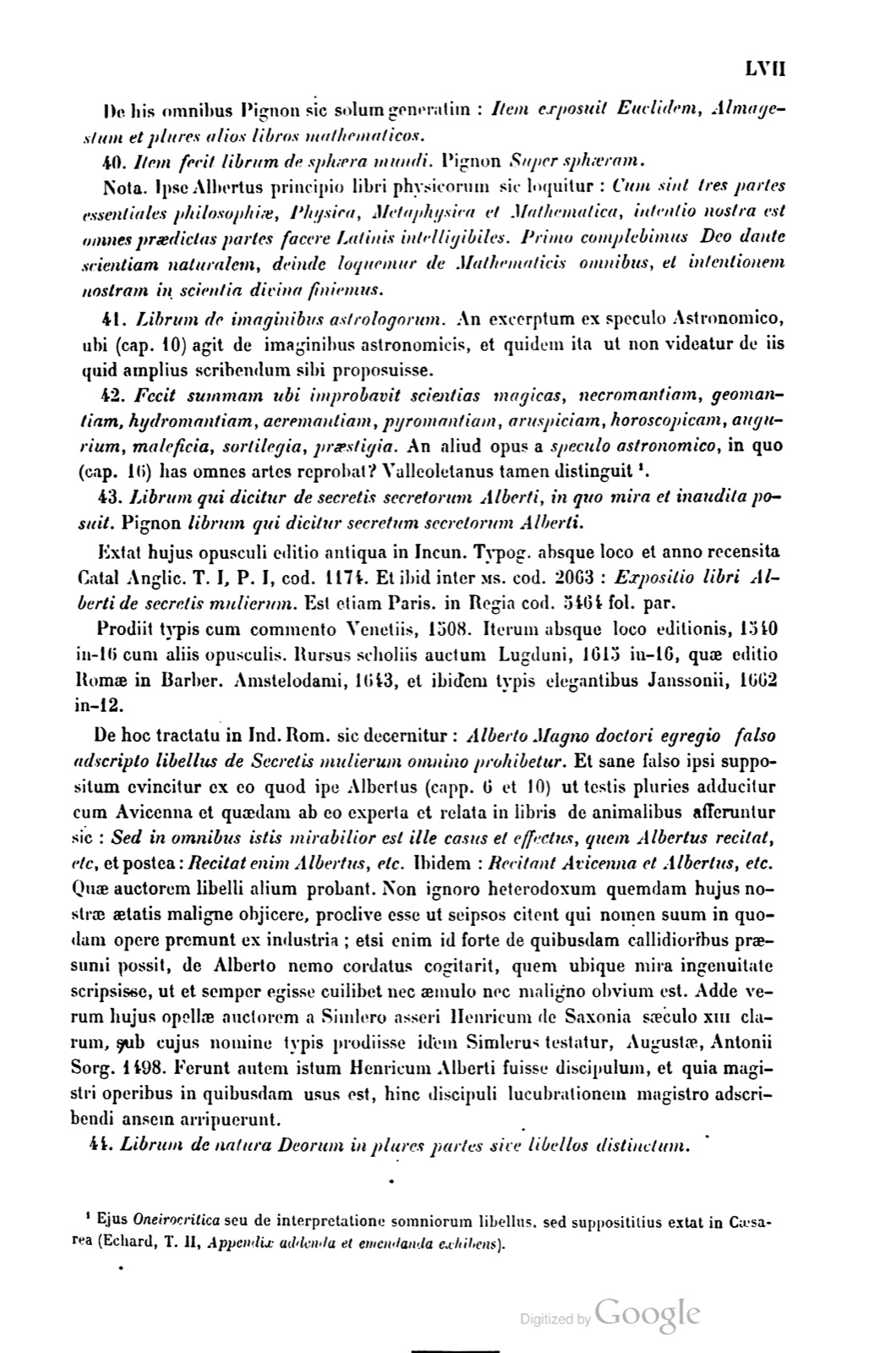
18. De longitudine et brevitate vitae. Sic distinguit Pignon sed non Valleoletanus, forte quod idem sit cum tractatu secundi opusculi De morte et vita. Vide supra T. V, n. 7. 19. De differentia corporis et animae. Sic Valleoletanus sed non habet Pignon. 20. Liber XV Quaestionum contra Averroistas. Sic Valleoletanus, Pignon vero, Problemata contra Averroistarum quaestiones³. 21. De unitate formae. Sic etiam Pignon. Eamdem quaestionem pluribus agitat Summa de homine. Vide T. XI. 22. De lapidibus et herbis. Sic Pignon, non habet Valleoletanus. An quod prodiit cum libello de Secretis mulierum, et ejusdem est furfuris? Vide catalogo sequenti, n. 32. Catal. Anglic. T. II, P. I, cod. 9435. Liber de lapidibus quem composuit F. Albertus de Colonia. An idem, an excerptus ex libro de mineralibus? Vide T. II, n. 5.
MORALIA.
23. De monastica libri quinque, et de aeconomica libri quatuor. Extare apud nostros Coloniae testis est Petrus de Prussia. Item exposuit ad litteram omnes libros philosophiae Aristotelis. Sic prosequitur Valleoletanus. 24. Super libros decem Ethicorum. An repetitio operis de quam jam supra T. IV, an alterum quod Pignon inscribit, Quaestiones super libros Ethicorum? Petrus de Prussia dicit super hos libros scripsisse duplici modo, per modum scripti et per modum commenti, et utrumque haberi apud nostros Coloniae. Apud Sanderum, P. II in valle S. Martini p. 209: Quaestiones Ethicorum. In Claravalle etiam extant Quaestiones super Ethica. 25. Libros octo Politicorum. Idem de hoc ac de superiori judicium. 26. Libros duos aeconomicorum. 27. Libros duos magnorum moralium. 28. Item problemata Aristotelis. Dicunt haberi in Victorina. 29. Exposuit etiam tres libros Rhetoricorum.
MATHEMATICA.
Omnes scientias mathematicas copiose pertractavit, non ipse fecit 30. Summam de scientia arithmetica. 31. Item aliam de scientia musicali. 32. Item aliam de scientia geometriae. 33. Item aliam de scientia perspectivae. 34. Item aliam copiosissimam de astronomia. Et quamlibet istarum in multos libros distinxit. Qui modus loquendi Valleoletani omnia ista ab eo visa indicat. Catal. Anglic. T. I, P. I, cod. 3467 laudantur Excerpta ex libris maxime astrologicis, inter alios ex Alberto. Beughemius citat opus Alberti Magni editum absque loco, anno et nomine typothetae in Incun. Typ. hoc titulo De duabus sapientiis et de recapitulatione omnium librorum Astronomiae. 35. Item commentatus est Arithmeticam Boetii. 36. Musicam ejusdem. 37. Geometriam Euclidis. 38. Almagestum Ptolemaei. 39. Perspectivam Alacenis. Alii legunt Alcionis, alii Alcenis. De his omnibus Pignon sic solum generatim: Item exposuit Euclidem, Almagestum et plures alios libros mathematicos. 40. Item fecit librum de sphaera mundi. Pignon Super sphaeram. Nota. Ipse Albertus principio libri physicorum sic loquitur: Cum sint tres partes essentiales philosophiae, Physica, Metaphysica et Mathematica, intentio nostra est omnes praedictas partes facere Latinis intelligibiles. Primo complebimus Deo dante scientiam naturalem, deinde loquemur de Mathematicis omnibus, et intentionem nostram in scientia divina finiemus. 41. Librum de imaginibus astrologorum. An excerptum ex speculo Astronomico, ubi (cap. 10) agit de imaginibus astronomicis, et quidem ita ut non videatur de iis quid amplius scribendum sibi proposuisse. 42. Fecit summam ubi improbavit scientias magicas, necromantiam, geomantiam, hydromantiam, aeremantiam, pyromantiam, aruspiciam, horoscopicam, augurium, maleficia, sortilegia, praestigia. An aliud opus a speculo astronomico, in quo (cap. 16) has omnes artes reprobat? Valleoletanus tamen distinguit⁴. 43. Librum qui dicitur de secretis secretorum Alberti, in quo mira et inaudita posuit. Pignon librum qui dicitur secretum secretorum Alberti. Extat hujus opusculi editio antiqua in Incun. Typog. absque loco et anno recensita Catal. Anglic. T. I, P. I, cod. 1174. Et ibid inter MS. cod. 2063: Expositio libri Alberti de secretis mulierum. Est etiam Paris. in Regia cod. 5464 fol. par. Prodiit typis cum commento Venetiis, 1508. Iterum absque loco editionis, 1540 in-16 cum aliis opusculis. Rursus scholiis auctum Lugduni, 1615 in-16, quae editio Romae in Barber. Amstelodami, 1643, et ibidem typis elegantibus Janssonii, 1662 in-12. De hoc tractatu in Ind. Rom. sic decernitur: Alberto Magno doctori egregio falso adscripto libellus de Secretis mulierum omnino prohibetur. Et sane falso ipsi suppositum evincitur ex eo quod ipse Albertus (capp. 6 et 10) ut testis pluries adducitur cum Avicenna et quaedam ab eo experta et relata in libris de animalibus afferuntur sic: Sed in omnibus istis mirabilior est ille casus et effectus, quem Albertus recitat, etc, et postea: Recitat enim Albertus, etc. Ibidem: Recitant Avicenna et Albertus, etc. Quae auctorem libelli alium probant. Non ignoro heterodoxum quemdam hujus nostrae aetatis maligne objicere, proclive esse ut seipsos citent qui nomen suum in quodam opere premunt ex industria; etsi enim id forte de quibusdam callidioribus praesumi possit, de Alberto nemo cordatus cogitarit, quem ubique mira ingenuitate scripsisse, ut et semper egisse cuilibet nec aemulo nec maligno obvium est. Adde verum hujus opellae auctorem a Simlero asseri Henricum de Saxonia saeculo XIII clarum, sub cujus nomine typis prodiisse idem Simlerus testatur, Augustae, Antonii Sorg. 1498. Ferunt autem istum Henricum Alberti fuisse discipulum, et quia magistri operibus in quibusdam usus est, hinc discipuli lucubrationem magistro adscribendi ansam arripuerunt. 44. Librum de natura Deorum in plures partes sive libellos distinctum. 45. Librum de homine immortali. Forte idem cum eo cui titulus De origine et immortalitate animae. Vide indicem sequentem n. 8. 46. Librum de duodecim alphabetis. An opus distinctum, an collectio alphabetorum quae variis in operibus Albertus proponit, ab aliquo curioso concinnata? Sic T. II, lib. 2, tract. 2 de mineralibus est alphabetum lapidum pretiosorum. T. V opusculo de vegetabilibus lib. 6 sunt duo alphabeta, unum de arboribus, alterum de herbis. T. VI, lib. 22 sunt quinque alphabeta, 1. de quadrupedibus; 2. de avibus; 3. de natatilibus; 4. de serpentibus; 5. de parvis animalibus sanguinem non habentibus. Quatuor alia ad complendum numerum duodecimum necessaria alphabeta forte ex aliis ejusdem operibus a curioso eruta, et in unum digesta fuerint. 47. Librum de ingeniis purgandis et erigendis. Scio haec alios aliter interpretari, ego vero censeo his significari vel instrumenta bellica, vel machinas ad aquas et alia onera gravia sursum attollenda. Sic enim ea aetate quae gallice vocamus engins, latine dicebant ingenia, quo sensu Universitas Parisiensis scribens capitulo nostro generali Lugduni anno MCCLXXIV coacto, petebat sibi mitti opus ei a S. Thoma de Aquino promissum, De aquarum conductibus et ingeniis erigendis. Titulum a Valleoletano positum corruperunt, qui sic referunt De magistris purgandis et erigendis. Legesis etiam Ducangium, vocabulo Ingenia.
18. On length and shortness of life. Thus Pignon distinguishes it, but not Valladolid, perhaps because it is the same as the treatise of the second little work On Death and Life. See above, volume V, number 7. 19. On the difference of body and soul. Thus Valladolid, but Pignon does not have it. 20. Book of fifteen Questions against the Averroists. Thus Valladolid; but Pignon has Problems against the questions of the Averroists.³ 21. On the unity of form. Thus also Pignon. The Summa on Man treats the same question in many places. See volume XI. 22. On stones and herbs. Thus Pignon; Valladolid does not have it. Is it what came forth with the little book On the Secrets of Women, and is it of the same bran? See the following catalogue, number 32. English catalogue, volume II, part I, codex 9435: Book on stones which Brother Albert of Cologne composed. Is it the same, or excerpted from the book On Minerals? See volume II, number 5.
MORAL WORKS.
23. Five books On Monastic Life, and four books On Economics. Peter of Prussia is witness that they exist among our men at Cologne. Likewise he expounded to the letter all the books of Aristotle's philosophy. Thus Valladolid proceeds. 24. On the ten books of the Ethics. Is this a repetition of the work about which above, volume IV, or another which Pignon inscribes Questions on the books of the Ethics? Peter of Prussia says that he wrote on these books in two ways, by way of a writing and by way of a commentary, and that each is held among our men at Cologne. In Sanderus, part II in the valley of St. Martin, page 209: Questions of the Ethics. In Clairvaux there also exist Questions on the Ethics. 25. The eight books of the Politics. The same judgment about this as about the preceding. 26. The two books of Economics. 27. The two books of the Great Morals. 28. Likewise the Problems of Aristotle. They say it is held in Victor. 29. He also expounded the three books of the Rhetoric.
MATHEMATICAL WORKS.
He treated all the mathematical sciences abundantly; he himself did not make 30. a Summa on the science of arithmetic. 31. Likewise another on the science of music. 32. Likewise another on the science of geometry. 33. Likewise another on the science of perspective. 34. Likewise another, most abundant, on astronomy. And he divided each of those into many books. This manner of speaking of Valladolid indicates that all these things were seen by him. English catalogue, volume I, part I, codex 3467: Excerpts are praised from chiefly astrological books, among others from Albert. Beughem cites a work of Albert the Great published without place, year, and name of printer among incunabula, under this title: On the Two Wisdoms and on the Recapitulation of all the Books of Astronomy. 35. Likewise he commented on the Arithmetic of Boethius. 36. The Music of the same. 37. The Geometry of Euclid. 38. The Almagest of Ptolemy. 39. The Perspective of Alhazen. Others read Alcionis, others Alcenis. Concerning all these Pignon says only generally thus: Likewise he expounded Euclid, the Almagest, and several other mathematical books. 40. Likewise he made a book On the Sphere of the World. Pignon: On the Sphere. Note. Albert himself speaks thus at the beginning of the book of Physics: Since there are three essential parts of philosophy, Physics, Metaphysics, and Mathematics, our intention is to make all the aforesaid parts intelligible to Latins. First, God granting, we shall complete natural science; then we shall speak of all mathematical matters, and we shall finish our intention in divine science. 41. A book on the images of astrologers. Is it an excerpt from the Astronomical Mirror, where in chapter 10 he treats of astronomical images, and indeed in such a way that he does not seem to have proposed to himself anything more to be written about them? 42. He made a summa in which he rejected the magical sciences, necromancy, geomancy, hydromancy, aeromancy, pyromancy, haruspicy, horoscopy, augury, evil spells, sorceries, and tricks. Is it another work than the Astronomical Mirror, in which in chapter 16 he reproves all these arts? Yet Valladolid distinguishes it.⁴ 43. A book which is called On the Secrets of the Secrets of Albert, in which he set down marvelous and unheard-of things. Pignon: the book which is called The Secret of the Secrets of Albert. There exists an old edition of this little work among incunabula, without place and year, reviewed in the English Catalogue, volume I, part I, codex 1174. And in the same place among manuscript codices, 2063: Exposition of Albert's book On the Secrets of Women. It is also at Paris in the Royal Library, codex 5464, small folio. It came forth in print with commentary at Venice, 1508. Again without place of edition, 1540, sextodecimo, with other little works. Again enlarged with scholia at Lyons, 1615, sextodecimo; this edition is at Rome in the Barberini. Amsterdam, 1643, and in the same place in the elegant type of Janssonius, 1662, duodecimo. Concerning this treatise it is decreed thus in the Roman Index: The little book On the Secrets of Women, falsely ascribed to the distinguished doctor Albert the Great, is wholly prohibited. And indeed it is proved to have been falsely attributed to him from the fact that Albert himself in chapters 6 and 10 is brought forward several times as a witness with Avicenna, and certain things experienced by him and related in the books On Animals are brought forward thus: But in all those things more wonderful is that case and effect which Albert relates, etc.; and afterward: For Albert relates, etc. In the same place: Avicenna and Albert relate, etc. These things prove that the author of the little book is someone else. I am not ignorant that a certain heterodox man of our age maliciously objects that it is easy for those who deliberately suppress their name in some work to cite themselves; for although perhaps this can be presumed about certain more crafty men, no sensible man will have thought it about Albert, whom it is obvious to anyone neither rivalrous nor malicious to have written everywhere with marvelous ingenuousness, as also always to have acted. Add that the true author of this little work is asserted by Simler to be Henry of Saxony, famous in the thirteenth century, under whose name the same Simler testifies it came forth in print at Augsburg, Anton Sorg, 1498. They report, moreover, that this Henry was Albert's disciple, and because he used the master's works in certain things, hence they seized the opportunity of ascribing the student's work to the master. 44. A book On the Nature of the Gods, divided into several parts or little books. 45. A book On the Immortal Man. Perhaps the same as that whose title is On the Origin and Immortality of the Soul. See the following index, number 8. 46. A book On the Twelve Alphabets. Is it a distinct work, or a collection of alphabets which Albert sets forth in various works, put together by some curious person? Thus in volume II, book 2, treatise 2 On Minerals there is an alphabet of precious stones. In volume V, in the little work On Vegetables, book 6, there are two alphabets, one on trees, the other on herbs. In volume VI, book 22, there are five alphabets: 1. on quadrupeds; 2. on birds; 3. on swimming creatures; 4. on serpents; 5. on small animals not having blood. Four other alphabets necessary to complete the number twelve perhaps were dug out by a curious person from other works of the same man and arranged into one. 47. A book On Purging and Erecting Machines. I know that others interpret these things otherwise; but I judge that by these are meant either war engines or machines for lifting waters and other heavy burdens upward. For thus in that age the things which in French we call engins they called in Latin ingenia; in this sense the University of Paris, writing to our general chapter assembled at Lyons in the year 1274, asked that the work promised to it by St. Thomas of Aquino On Aqueducts and Erecting Machines be sent to it. Those who report thus, On Purging and Erecting Masters, corrupted the title set down by Valladolid. Read also Du Cange under the word Ingenia.
LOGICALIA.
LOGICAL WORKS.
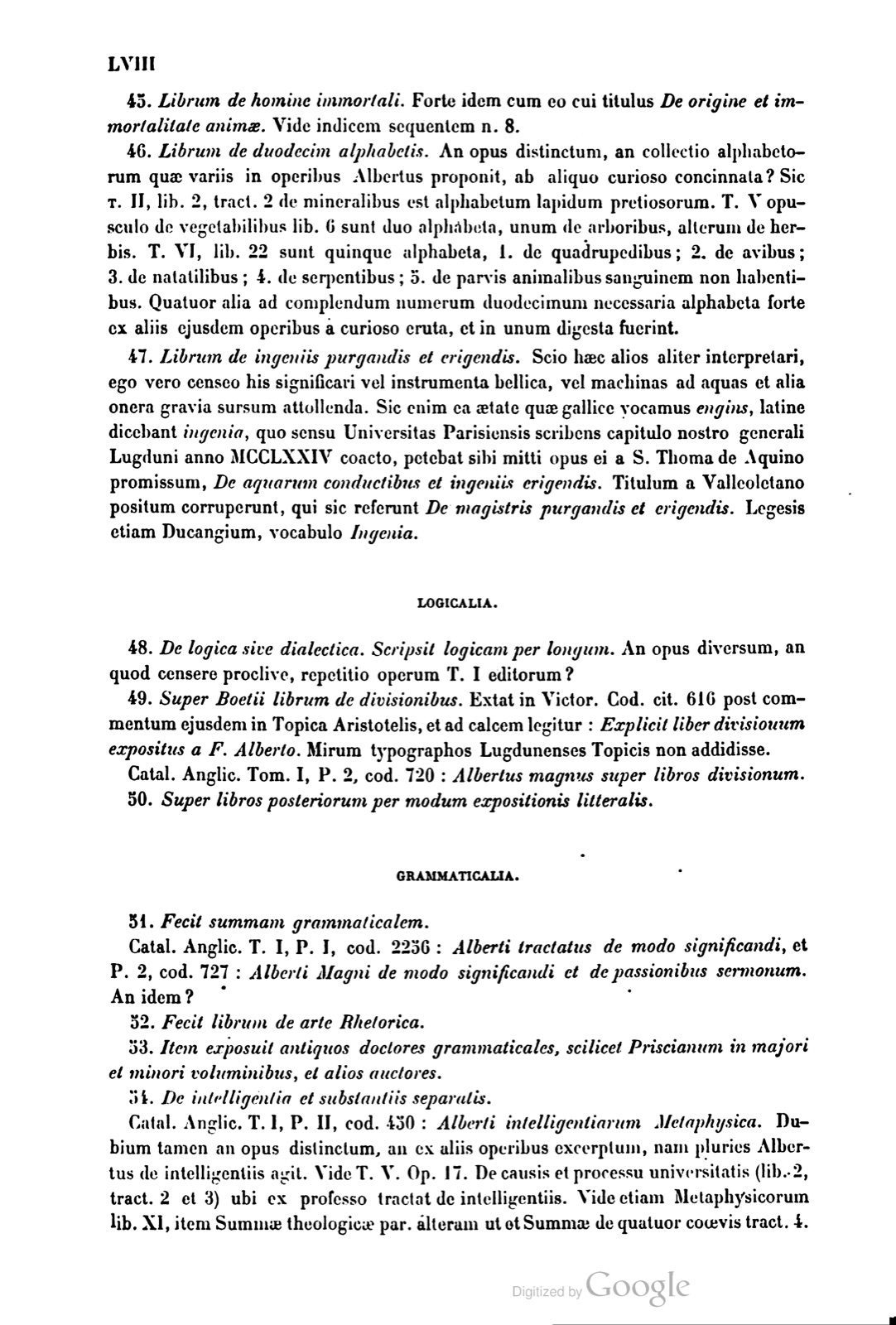
48. De logica sive dialectica. Scripsit logicam per longum. An opus diversum, an quod censere proclive, repetitio operum T. I editorum? 49. Super Boetii librum de divisionibus. Extat in Victor. Cod. cit. 616 post commentum ejusdem in Topica Aristotelis, et ad calcem legitur: Explicit liber divisionum expositus a F. Alberto. Mirum typographos Lugdunenses Topicis non addidisse. Catal. Anglic. Tom. I, P. 2, cod. 720: Albertus magnus super libros divisionum. 50. Super libros posteriorum per modum expositionis litteralis.
48. On logic or dialectic. He wrote logic at length. Is it a different work, or, what is easy to judge, a repetition of the works published in volume I? 49. On Boethius's book On Divisions. It exists in Victor, cited codex 616, after his commentary on Aristotle's Topics, and at the end it is read: Here ends the book of divisions expounded by Brother Albert. It is remarkable that the Lyons printers did not add it to the Topics. English catalogue, volume I, part 2, codex 720: Albert the Great on the books of divisions. 50. On the books of the Posterior Analytics by way of literal exposition.
GRAMMATICALIA.
51. Fecit summam grammaticalem. Catal. Anglic. T. I, P. I, cod. 2236: Alberti tractatus de modo significandi, et P. 2, cod. 727: Alberti Magni de modo significandi et de passionibus sermonum. An idem? 52. Fecit librum de arte Rhetorica. 53. Item exposuit antiquos doctores grammaticales, scilicet Priscianum in majori et minori voluminibus, et alios auctores. 54. De intelligentia et substantiis separatis. Catal. Anglic. T. I, P. II, cod. 430: Alberti intelligentiarum Metaphysica. Dubium tamen an opus distinctum, an ex aliis operibus excerptum, nam pluries Albertus de intelligentiis agit. Vide T. V. Op. 17. De causis et processu universitatis (lib. 2, tract. 2 et 3) ubi ex professo tractat de intelligentiis. Vide etiam Metaphysicorum lib. XI, item Summae theologicae par. alteram ut et Summae de quatuor coaevis tract. 4.
GRAMMATICAL WORKS.
51. He made a grammatical summa. English catalogue, volume I, part I, codex 2236: Albert's treatise On the Mode of Signifying, and part 2, codex 727: Albert the Great On the Mode of Signifying and on the Passions of Utterances. Is it the same? 52. He made a book on the art of rhetoric. 53. Likewise he expounded the ancient grammatical doctors, namely Priscian in the greater and lesser volumes, and other authors. 54. On Intelligence and Separate Substances. English catalogue, volume I, part II, codex 430: Albert's Metaphysics of the intelligences. It is doubtful, however, whether it is a distinct work or excerpted from other works, for Albert treats several times of intelligences. See volume V, work 17, On the Causes and Process of the Universe (book 2, treatises 2 and 3), where he treats expressly of intelligences. See also book XI of the Metaphysics, likewise the second part of the Theological Summa and also treatise 4 of the Summa on the Four Coeval Things.
If a page does not appear, its photograph has not been uploaded yet.