Volume 1
Annotations on the Life, Notes 17-23
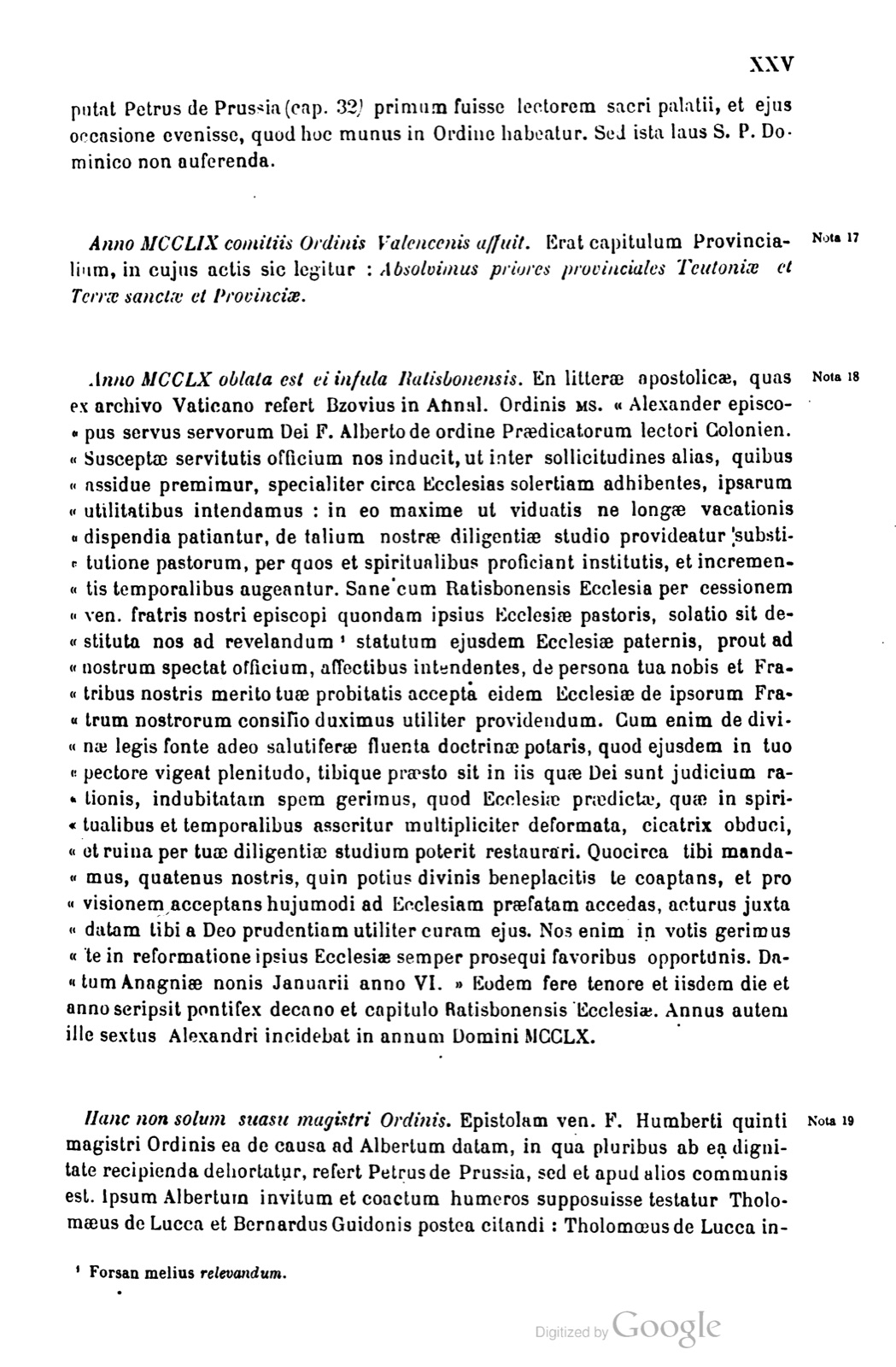
Nota 17. Anno MCCLIX comitiis Ordinis Valencenis affuit. Erat capitulum Provincialium, in cujus actis sic legitur: Absolvimus priores provinciales Teutoniae et Terrae sanctae et Provinciae.
Nota 18. Anno MCCLX oblata est ei infula Ratisbonensis. En litterae apostolicae, quas ex archivo Vaticano refert Bzovius in Annal. Ordinis MS. « Alexander episcopus servus servorum Dei F. Alberto de ordine Praedicatorum lectori Colonien. Susceptae servitutis officium nos inducit, ut inter sollicitudines alias, quibus assidue premimur, specialiter circa Ecclesias solertiam adhibentes, ipsarum utilitatibus intendamus: in eo maxime ut viduatis ne longae vacationis dispendia patiantur, de talium nostrae diligentiae studio provideatur substitutione pastorum, per quos et spiritualibus proficiant institutis, et incrementis temporalibus augeantur. Sane cum Ratisbonensis Ecclesia per cessionem ven. fratris nostri episcopi quondam ipsius Ecclesiae pastoris, solatio sit destituta nos ad revelandum¹ statutum ejusdem Ecclesiae paternis, prout ad nostrum spectat officium, affectibus intendentes, de persona tua nobis et Fratribus nostris merito tuae probitatis accepta eidem Ecclesiae de ipsorum Fratrum nostrorum consilio duximus utiliter providendum. Cum enim de divinae legis fonte adeo salutiferae fluenta doctrinae potaris, quod ejusdem in tuo pectore vigeat plenitudo, tibique praesto sit in iis quae Dei sunt judicium rationis, indubitatam spem gerimus, quod Ecclesiae praedictae, quae in spiritualibus et temporalibus asseritur multipliciter deformata, cicatrix obduci, et ruina per tuae diligentiae studium poterit restaurari. Quocirca tibi mandamus, quatenus nostris, quin potius divinis beneplacitis te coaptans, et provisionem acceptans hujusmodi ad Ecclesiam praefatam accedas, acturus juxta datam tibi a Deo prudentiam utiliter curam ejus. Nos enim in votis gerimus te in reformatione ipsius Ecclesiae semper prosequi favoribus opportunis. Datum Anagniae nonis Januarii anno VI. » Eodem fere tenore et iisdem die et anno scripsit pontifex decano et capitulo Ratisbonensis Ecclesiae. Annus autem ille sextus Alexandri incidebat in annum Domini MCCLX.
Nota 19. Hanc non solum suasu magistri Ordinis. Epistolam ven. F. Humberti quinti magistri Ordinis ea de causa ad Albertum datam, in qua pluribus ab ea dignitate recipienda dehortatur, refert Petrus de Prussia, sed et apud alios communis est. Ipsum Albertum invitum et coactum humeros supposuisse testatur Tholomaeus de Lucca et Bernardus Guidonis postea citandi: Tholomaeus de Lucca indicat anno MCCLXII vel LXIII abdicasse, cum ait postea XVIII annorum spatio lectorem Coloniae egisse ad mortem usque quae accidit anno MCCLXXX. Litteras citat noster Ghilbertus de la Haye supra laudatus ab Alberto anno MCCLXIII datas, quibus se quondam episcopum signat.
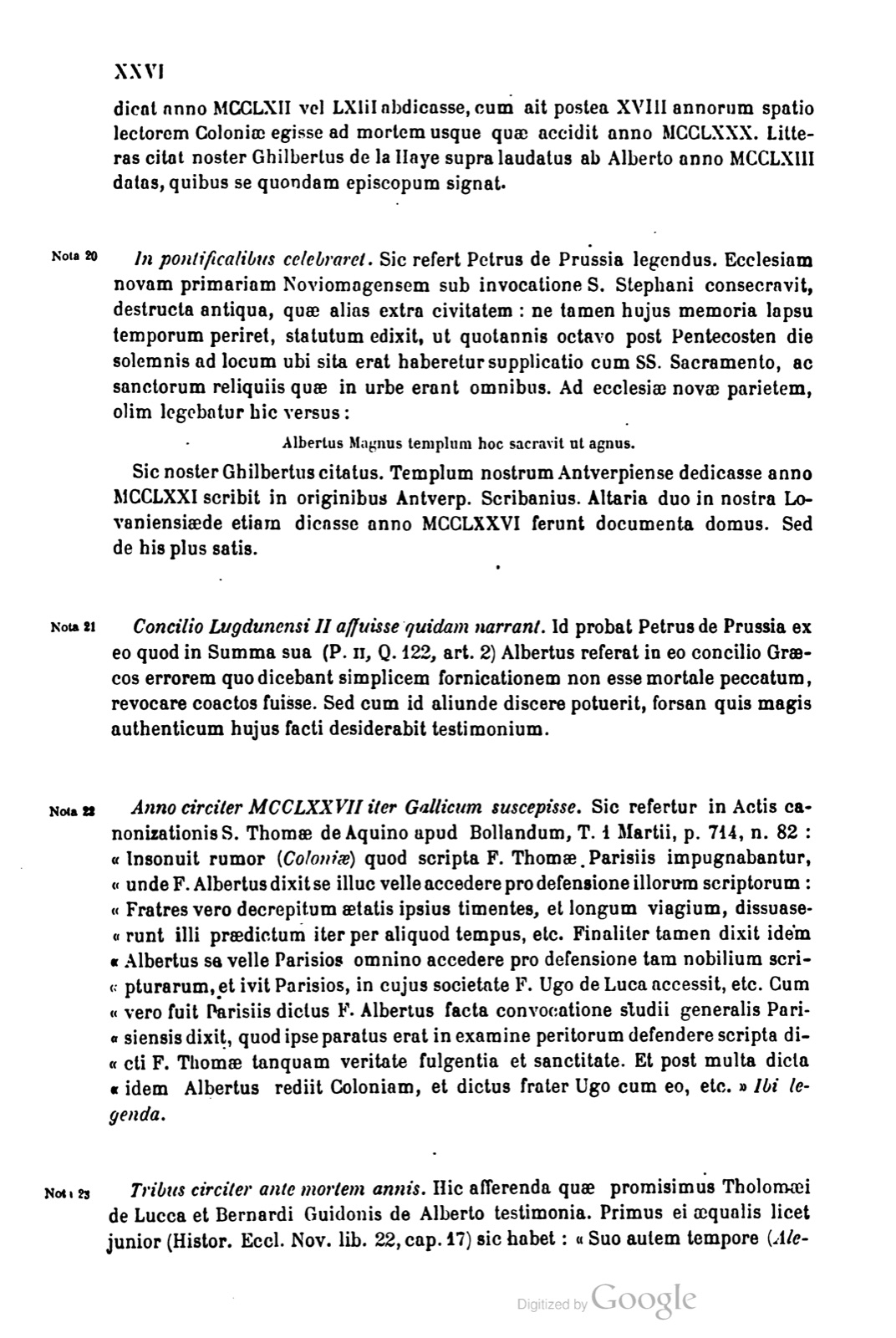
Nota 20. In pontificalibus celebraret. Sic refert Petrus de Prussia legendus. Ecclesiam novam primariam Noviomagensem sub invocatione S. Stephani consecravit, destructa antiqua, quae alias extra civitatem: ne tamen hujus memoria lapsu temporum periret, statutum edixit, ut quotannis octavo post Pentecosten die solemnis ad locum ubi sita erat haberetur supplicatio cum SS. Sacramento, ac sanctorum reliquiis quae in urbe erant omnibus. Ad ecclesiae novae parietem, olim legebatur hic versus: Albertus Magnus templum hoc sacravit ut agnus. Sic noster Ghilbertus citatus. Templum nostrum Antverpiense dedicasse anno MCCLXXI scribit in originibus Antverp. Scribanius. Altaria duo in nostra Lovaniensi aede etiam dicasse anno MCCLXXVI ferunt documenta domus. Sed de his plus satis.
Nota 21. Concilio Lugdunensi II affuisse quidam narrant. Id probat Petrus de Prussia ex eo quod in Summa sua (P. II, Q. 122, art. 2) Albertus referat in eo concilio Graecos errorem quo dicebant simplicem fornicationem non esse mortale peccatum, revocare coactos fuisse. Sed cum id aliunde discere potuerit, forsan quis magis authenticum hujus facti desiderabit testimonium.
Nota 22. Anno circiter MCCLXXVII iter Gallicum suscepisse. Sic refertur in Actis canonizationis S. Thomae de Aquino apud Bollandum, T. 1 Martii, p. 714, n. 82: « Insonuit rumor (Coloniae) quod scripta F. Thomae Parisiis impugnabantur, unde F. Albertus dixit se illuc velle accedere pro defensione illorum scriptorum: Fratres vero decrepitum aetatis ipsius timentes, et longum viagium, dissuaserunt illi praedictum iter per aliquod tempus, etc. Finaliter tamen dixit idem Albertus se velle Parisios omnino accedere pro defensione tam nobilium scripturarum, et ivit Parisios, in cujus societate F. Ugo de Luca accessit, etc. Cum vero fuit Parisiis dictus F. Albertus facta convocatione studii generalis Parisiensis dixit, quod ipse paratus erat in examine peritorum defendere scripta dicti F. Thomae tanquam veritate fulgentia et sanctitate. Et post multa dicta idem Albertus rediit Coloniam, et dictus frater Ugo cum eo, etc. » Ibi legenda.
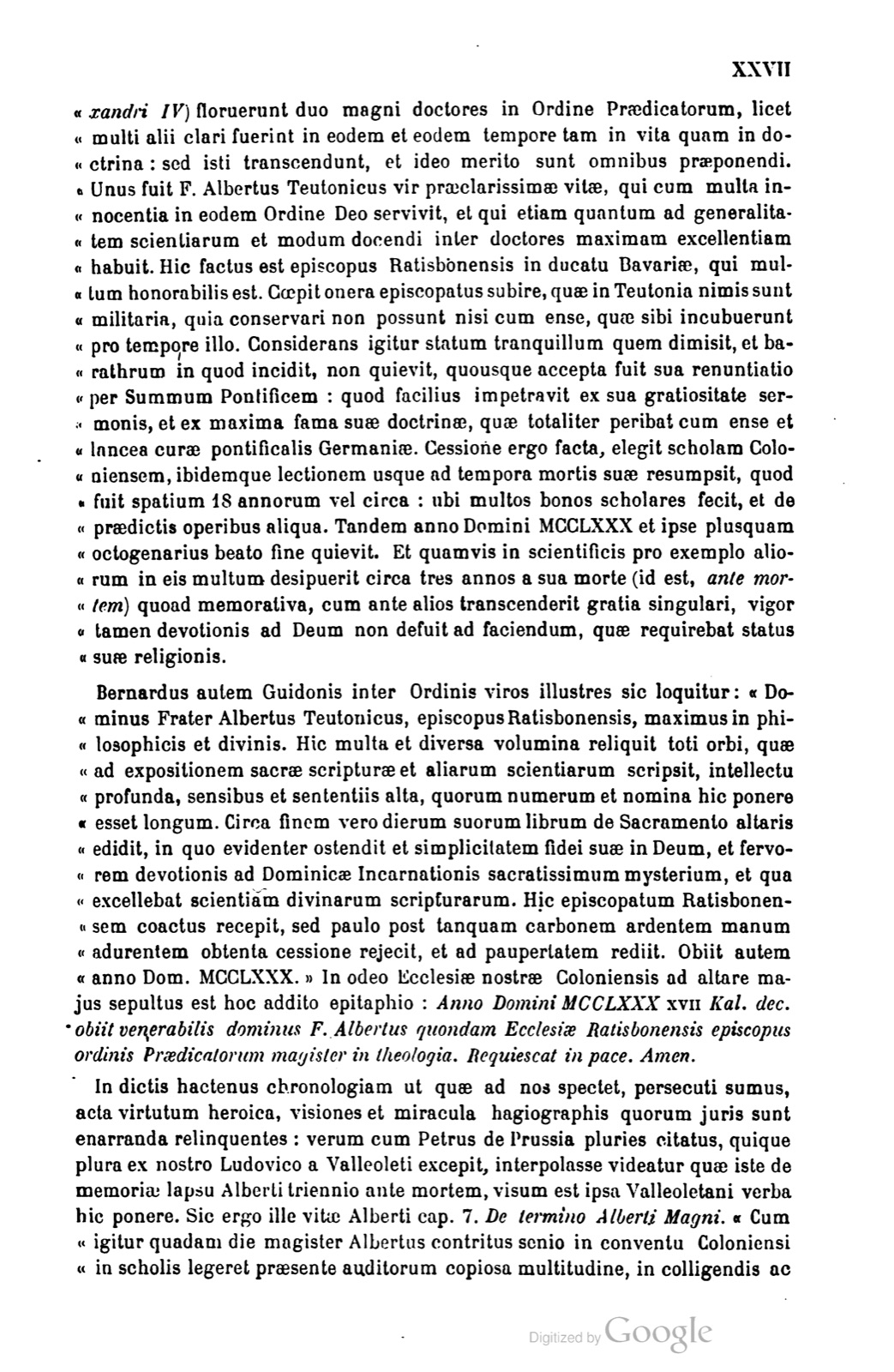
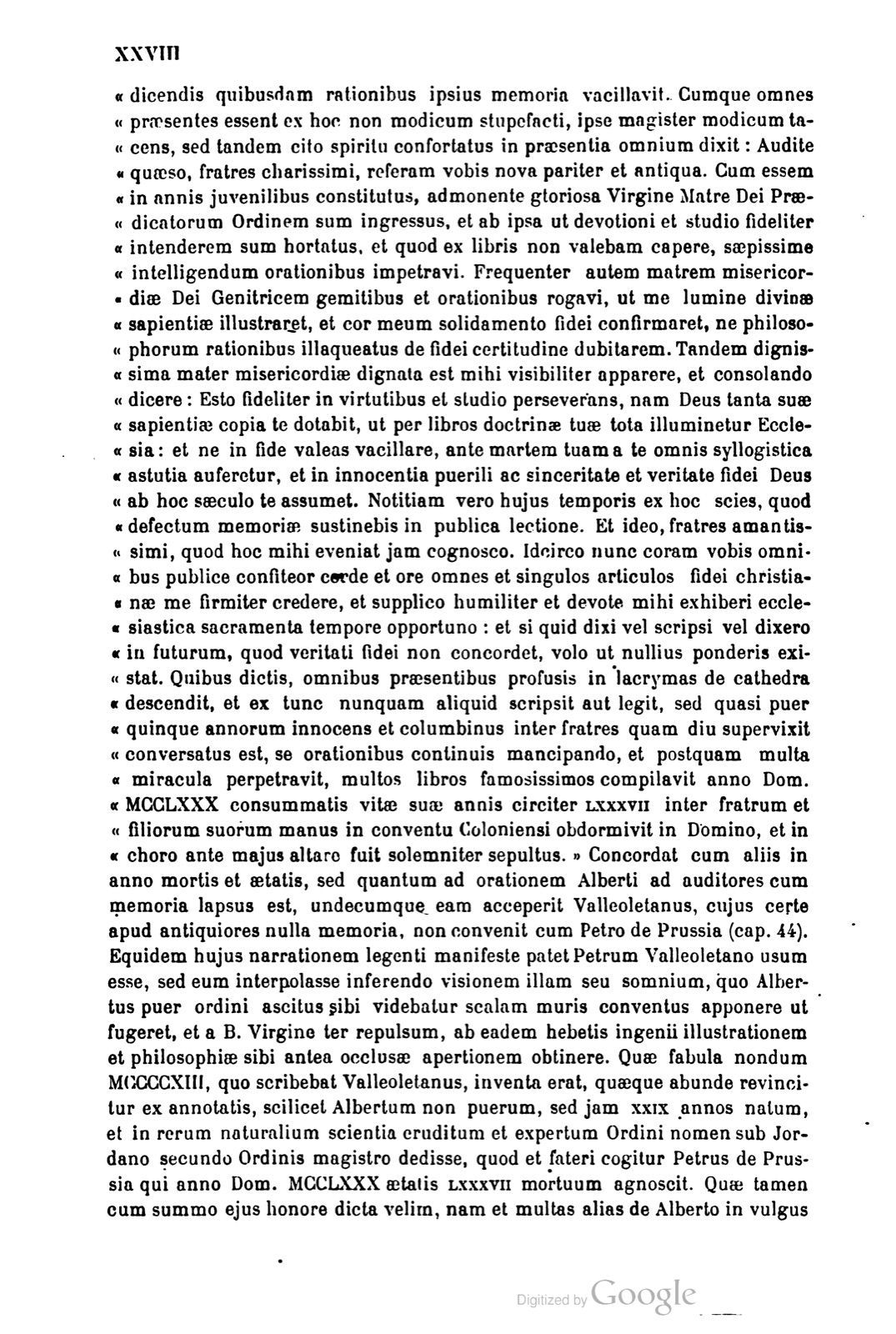
Nota 23. Tribus circiter ante mortem annis. Hic afferenda quae promisimus Tholomaei de Lucca et Bernardi Guidonis de Alberto testimonia. Primus ei aequalis licet junior (Histor. Eccl. Nov. lib. 22, cap. 17) sic habet: « Suo autem tempore (Alexandri IV) floruerunt duo magni doctores in Ordine Praedicatorum, licet multi alii clari fuerint in eodem et eodem tempore tam in vita quam in doctrina: sed isti transcendunt, et ideo merito sunt omnibus praeponendi. Unus fuit F. Albertus Teutonicus vir praeclarissimae vitae, qui cum multa innocentia in eodem Ordine Deo servivit, et qui etiam quantum ad generalitatem scientiarum et modum docendi inter doctores maximam excellentiam habuit. Hic factus est episcopus Ratisbonensis in ducatu Bavariae, qui multum honorabilis est. Coepit onera episcopatus subire, quae in Teutonia nimis sunt militaria, quia conservari non possunt nisi cum ense, quae sibi incubuerunt pro tempore illo. Considerans igitur statum tranquillum quem dimisit, et barathrum in quod incidit, non quievit, quousque accepta fuit sua renuntiatio per Summum Pontificem: quod facilius impetravit ex sua gratiositate sermonis, et ex maxima fama suae doctrinae, quae totaliter peribat cum ense et lancea curae pontificalis Germaniae. Cessione ergo facta, elegit scholam Coloniensem, ibidemque lectionem usque ad tempora mortis suae resumpsit, quod fuit spatium 18 annorum vel circa: ubi multos bonos scholares fecit, et de praedictis operibus aliqua. Tandem anno Domini MCCLXXX et ipse plusquam octogenarius beato fine quievit. Et quamvis in scientificis pro exemplo aliorum in eis multum desipuerit circa tres annos a sua morte (id est, ante mortem) quoad memorativa, cum ante alios transcenderit gratia singulari, vigor tamen devotionis ad Deum non defuit ad faciendum, quae requirebat status suae religionis. » Bernardus autem Guidonis inter Ordinis viros illustres sic loquitur: « Dominus Frater Albertus Teutonicus, episcopus Ratisbonensis, maximus in philosophicis et divinis. Hic multa et diversa volumina reliquit toti orbi, quae ad expositionem sacrae scripturae et aliarum scientiarum scripsit, intellectu profunda, sensibus et sententiis alta, quorum numerum et nomina hic ponere esset longum. Circa finem vero dierum suorum librum de Sacramento altaris edidit, in quo evidenter ostendit et simplicitatem fidei suae in Deum, et fervorem devotionis ad Dominicae Incarnationis sacratissimum mysterium, et qua excellebat scientiam divinarum scripturarum. Hic episcopatum Ratisbonensem coactus recepit, sed paulo post tanquam carbonem ardentem manum adurentem obtenta cessione rejecit, et ad paupertatem rediit. Obiit autem anno Dom. MCCLXXX. » In odeo Ecclesiae nostrae Coloniensis ad altare majus sepultus est hoc addito epitaphio: Anno Domini MCCLXXX xvi Kal. dec. obiit venerabilis dominus F. Albertus quondam Ecclesiae Ratisbonensis episcopus ordinis Praedicatorum magister in theologia. Requiescat in pace. Amen. In dictis hactenus chronologiam ut quae ad nos spectet, persecuti sumus, acta virtutum heroica, visiones et miracula hagiographis quorum juris sunt enarranda relinquentes: verum cum Petrus de Prussia pluries citatus, quique plura ex nostro Ludovico a Valleoleti excepit, interpolasse videatur quae iste de memoriae lapsu Alberti triennio ante mortem, visum est ipsa Valleoletani verba hic ponere. Sic ergo ille vitae Alberti cap. 7. De termino Alberti Magni. « Cum igitur quadam die magister Albertus contritus senio in conventu Coloniensi in scholis legeret praesente auditorum copiosa multitudine, in colligendis ac dicendis quibusdam rationibus ipsius memoria vacillavit. Cumque omnes praesentes essent ex hoc non modicum stupefacti, ipse magister modicum tacens, sed tandem cito spiritu confortatus in praesentia omnium dixit: Audite quaeso, fratres charissimi, referam vobis nova pariter et antiqua. Cum essem in annis juvenilibus constitutus, admonente gloriosa Virgine Matre Dei Praedicatorum Ordinem sum ingressus, et ab ipsa ut devotioni et studio fideliter intenderem sum hortatus, et quod ex libris non valebam capere, saepissime intelligendum orationibus impetravi. Frequenter autem matrem misericordiae Dei Genitricem gemitibus et orationibus rogavi, ut me lumine divinae sapientiae illustraret, et cor meum solidamento fidei confirmaret, ne philosophorum rationibus illaqueatus de fidei certitudine dubitarem. Tandem dignissima mater misericordiae dignata est mihi visibiliter apparere, et consolando dicere: Esto fideliter in virtutibus et studio perseverans, nam Deus tanta suae sapientiae copia te dotabit, ut per libros doctrinae tuae tota illuminetur Ecclesia: et ne in fide valeas vacillare, ante mortem tuam a te omnis syllogistica astutia auferetur, et in innocentia puerili ac sinceritate et veritate fidei Deus ab hoc saeculo te assumet. Notitiam vero hujus temporis ex hoc scies, quod defectum memoriae sustinebis in publica lectione. Et ideo, fratres amantissimi, quod hoc mihi eveniat jam cognosco. Idcirco nunc coram vobis omnibus publice confiteor corde et ore omnes et singulos articulos fidei christianae me firmiter credere, et supplico humiliter et devote mihi exhiberi ecclesiastica sacramenta tempore opportuno: et si quid dixi vel scripsi vel dixero in futurum, quod veritati fidei non concordet, volo ut nullius ponderis existat. Quibus dictis, omnibus praesentibus profusis in lacrymas de cathedra descendit, et ex tunc nunquam aliquid scripsit aut legit, sed quasi puer quinque annorum innocens et columbinus inter fratres quam diu supervixit conversatus est, se orationibus continuis mancipando, et postquam multa miracula perpetravit, multos libros famosissimos compilavit anno Dom. MCCLXXX consummatis vitae suae annis circiter LXXXVII inter fratrum et filiorum suorum manus in conventu Coloniensi obdormivit in Domino, et in choro ante majus altare fuit solemniter sepultus. » Concordat cum aliis in anno mortis et aetatis, sed quantum ad orationem Alberti ad auditores cum memoria lapsus est, undecumque eam acceperit Valleoletanus, cujus certe apud antiquiores nulla memoria, non convenit cum Petro de Prussia (cap. 44). Equidem hujus narrationem legenti manifeste patet Petrum Valleoletano usum esse, sed eum interpolasse inferendo visionem illam seu somnium, quo Albertus puer ordini ascitus sibi videbatur scalam muris conventus apponere ut fugeret, et a B. Virgine ter repulsum, ab eadem hebetis ingenii illustrationem et philosophiae sibi antea occlusae apertionem obtinere. Quae fabula nondum MCCCCXIII, quo scribebat Valleoletanus, inventa erat, quaeque abunde revincitur ex annotatis, scilicet Albertum non puerum, sed jam xxix annos natum, et in rerum naturalium scientia eruditum et expertum Ordini nomen sub Jordano secundo Ordinis magistro dedisse, quod et fateri cogitur Petrus de Prussia qui anno Dom. MCCLXXX aetatis LXXXVII mortuum agnoscit. Quae tamen cum summo ejus honore dicta velim, nam et multas alias de Alberto in vulgus sparsas fabulas egregie refellit, et plura de eodem Alberto vel ex ejus operibus, vel ex aliis auctoribus certa accurate collegit, quibus et nos utimur. Caeterum, ut ad Albertum redeam, non mirum nec insolitum, hominem LXXXIV annos natum vigiliis, jejuniis, studiis continuis fractum ac debilitatum memoriae lapsum tandem incurrere, ac, si velis, repuerascere, cum ista sint humanae infirmitatis, ut propterea non sic ad visiones et miracula recurrendum, ut nec recurrit Tholomaeus de Luca eorum antiquior qui de eo scripserunt, et ejus aetate jam clarus, cujus proinde temporibus nondum vulgatae illae visiones, nec producta miracula, ne dicam adinventa. Laudem Alberti ex ejus nominis etymologia desumptam, quam habet Petrus de Prussia (cap. 57), accepit ex eodem Valleoletano (vitae Alberti cap. XII) et quadamtenus mollivit, sed quam etsi rudiorem et absonam cordatus lector facile condonet genio saec. XIII et XIV, quibus etiam doctiores usi similibus, ne extra argumentum saltare viderentur, plura revera bona et laude digna minutiis annectere solebant, quod jam tempora nostra delicatiora non patiuntur. Ne ergo lector ad etymologiam Alberti attendat, quam uterque derivat ab al quod est altum, et ber quod est fons sive puteus, et thus quod est species gommi odoriferi, quae quis forte rideat, et forsan ipsi auctores primi riserunt ut puerilia, sed his annexa seria et solida accipiat, nec contemnenda judicavit. Duplicem translationem corporis Beati invenio, priorem, cujus meminit Valleoletanus (cap. XI) longo tempore, inquit, factam post sepulturam, ac proinde saec. XIV, tumque inventum est corpus ejus supinum, quod ille miratur, sed forte hoc vocabulo aliud intelligebat, quam quod vulgo, alioquin non video quid in eo sit miri, caeterum incorruptum, et in omnibus membris et indumentis integrum ac suavissimo odore fragrans, idque sane mirabile, tum vero eodem loco repositum. Alteram, anno MCCCCLXXXIII, astante et jubente magistro Ordinis F. Salvo Cassetta III Idus Januar. quam describit Petrus de Prussia ipse etiam praesens et legendus (cap. 58) ubi statum corporis late et accurate refert. Alberti Magni acta plura laudantur, quae quanta apud omnes valeret fama et auctoritate manifeste probant. Anno MCCXLIX eo plurimum satagente praeclara fori privilegia civibus Coloniensibus ab eorum antistite Conrado asserta fuere. Vix biennium effluxerat, litigantibus iisdem Coloniensibus cum eodem archiepiscopo Conrado, ac super telonii monetarumque ratione contendentibus, delectus est arbiter cum F. Hugone de Sancto Charo tum cardinali, suaque sententia litem absolvit. Anno MCCLVIII, vigilia SS. Petri et Pauli cum quatuor aliis Goswino decano majori, Henrico S. Severini, Henrico SS. Apostolorum et Philippo Susatiensi praepositis, iterum sedit arbiter eumdem archiepiscopum inter et cives Colonienses. Cum iidem postea inimicitias non parvas generent cum comite Montensi, qui nunc dux est Montensis et Juliacensis, ipse pacem utrique parti sua prudentia contulit ac composuit, ita ut etiam nunc senatus Coloniensis Alberti sapientiam miretur, cum acta eo sequestro compacta in suis archivis servata intuentur et legunt. Videsis Heisterum citatum et Petrum de Prussia (cap. 41). Praeter jam citatos scriptores alii plures Alberti cum laude meminerunt, in primis F. Ulricus Engelberti de Friburgo, vir eruditus sacrae theologiae lector et baccalaureus Parisiensis Alberti discipulus, vivo magistro scribens qui in Summa sua de summo bono lib. IV, tract. III de substantiis spiritualibus sive de angelis, cap. IX de modo apparitionis tam bonorum quam malorum angelorum, scilicet an fiat in corpore vel in specie corporali, sic habet: « Aliter autem ab omnibus praemissis sentit doctor meus dominus Albertus episcopus quondam Ratisbonensis vir in omni scientia adeo divinus, ut nostri temporis stupor et miraculum congrue vocari possit, et in magicis expertus, ex quibus multum dependet hujus materiae scientia, etc. » Ubi cum dicit in magicis expertum, ne intelligas has artes unquam exercuisse, alioquin non fuisset vir divinus sui saeculi stupor et miraculum, sed tam vastae fuisse scientiae, ut nihil esset in quavis arte reconditius, quod non penetrasset ac mente teneret omnia probando, quae bona tenendo, ut expertum confessarium dicimus qui conscientiae casus omnes ita perfecte callet, ut de rarioribus et difficilioribus ex tempore respondere possit. Non minus eum ornat Trithemius. « Non surrexit, inquit, post eum vir similis ei, qui in omnibus litteris, scientiis et rebus tam doctus, eruditus et expertus fuerit. Quod autem de necromantia accusatur, injuriam patitur vir Deo dilectus. » Sixto Senensi. « Vir est eruditionis admirandae, quem divinarum rerum pauca, humanarum fortasse nulla latuerunt, sublimibus ingenii ac memoriae viribus usque ad miraculum praestans, in divinis studiis longe eruditissimus et philosophorum omnium quos vel ante vel post eum universa Germania protulit princeps: ob scientiarum multitudinem magnitudinemque Magni cognomen, quod nulli unquam eruditorum contingit ante mortem adeptus. » Joannes Aventinus (lib. 7 Annalium) impensissime laudat, Germanum eum Varronem appellans, longeque Varrone doctiorem asserens, quem nihil penitus fugerit, omnia perfecte noverit, naturae secundum Aristotelem verissimus interpres extiterit, adeoque singula, quae de omnibus scientiis et facultatibus scripsit in suo genere absoluta esse, ac si uni duntaxat operam navasset, caetera ne attigisset quidem. Mitto alios recentiores, Gabrielem Naudaeum (Bibl. Politic.); Vossium (de Scient. Mathemat. p. 362); Sebastianum Schefferum (Introduct. in Arte medicali, p. 164) et alios. Sed nec obtrectatoribus suis caruit quibusdam eum magum dicere ausis, quam calumniam vir sanctissimus patitur cum viris sua tempestate peritissimis: sic enim Guibertum² qui ad summum pontificatum ascendens Sylvester II dictus est magum celebrem et malis artibus infamem dixere plures, quos egregie revincunt Onuphrius Panvinius in notis suis ad Platinam, et Bzovius noster (Annal. T. XX). Sic Joannem Petrum Lusitanum summum Pontificem Joannem XXI dictum magum appellat auctor Annalium Colmariensium ad annum MCCLXXVII ob insignem medicinae peritiam. Sed quid Alberto opponant videamus. Convivium magicum imperatori Coloniae exhibitum jam expunximus, quod et nemo paululum sapiens credet, quod et seipsum destruit, sicut enim caetera omnia fuerunt phantasmata, sic et cibi fuissent imaginarii, quibus non gratiam sed iram imperatoris et totius aulae demeruisset ac in se provocasset. Deinde excutiantur archiva civitatis Coloniensis, nam hujusmodi principum adventus in urbium regestis solent annotari, ut et solemnia iis exhibita convivia, an in iis vel umbra magicarum harum epularum reperietur? Nemo certe hactenus prodidit. Libros objiciunt: sed notandum non opera Alberti Magni indubitata quibus quidquid in eo fuit acuminis, quidquid sapientiae, quidquid habuit experimentorum conclusit, ab his enim maxime cavent, sed libellos quosdam spurios ut sub magni nominis umbra facilius reciperentur, ab impostoribus et planis editos, vel anonymos, et ab imprudentibus perperam Alberto adscriptos objicere, quos in sequentibus, ubi de singulis agetur, sapientissimo doctori abjudicabimus, nec ab ejus vena fluxisse demonstrabimus. Denique Androiden objicient, seu fuerit figura hominis integra carnea vel aenea, neque enim sibi constant, vel solum caput hominis aeneum tanta arte fabricatum ut vocem humanam ederet, et cum de occultis ab Alberto interrogabatur, responsa certa daret: quod aliquando audiens juvenis Thomas de Aquino stupens et conterritus baculo confregerit, unde solemnis illa a rudioribus accepta Alberti praeceptoris ad Aquinatem increpatio, Fili mi, opus triginta annorum fregisti. Sed quis hujus fabulae toto saeculo XIII et sequenti testis affertur? certe nullus. Nam quod aliqui volunt ad hujusmodi fabricam alludere S. Thomam de Aquino (Contra Gentiles, lib. 3, capp. 104, 105 et 106) egregie allucinantur. Equidem illic sanctus doctor statuas arte magica fabrefactas impugnat, sed quas apud Augustinum (lib. 8 de civ. Dei, cap. 23) legerat ab Hermete ejusque similibus laudatas, quas non solum impossibiles secundum naturam invicte demonstrat, sed et si fiant, opera esse intellectus non bene secundum virtutem dispositi, imo sceleratorum, impudicorum, homicidarum fautoris: quod argumentum invictum simile apud suum praeceptorem Albertum nunquam vidisse, nam si aliquando vidisset, ut cujus innocentiam et pietatem noverat, ad cui cum illi semper fuit summa studiorum ac animorum conjunctio, et innocenter quandoque fieri addidisset. Quem primum hanc calumniam in vulgus propalasse ferunt? Henricum de Hassia, quem videre non licuit, ac mihi dubium ut cujus locum non indicant, sed is mortuus est anno MCCCCXVIII: Alphonsum Tostatum anno MCCCCXIV natum, et juvenem aetatis XL defunctum (in Genes. cap. 31 et Exod. cap. 14). Sed etsi virum alias peritum, nimis tamen credulum censent, et plurium similium narratorem seu collectorem fabularum: F. Bartholomaeum Sibylla nostrum (Peregr. quaest. Dec. 3, cap. 4, q. 3). Sed hic relative tantum loquitur ex Henrico de Hassia in Genes., imo revocat in dubium, sic enim habet: Quomodo enim homo per artem faceret corpus heterogeneum et tam tenerum quale requirit anima rationalis, qui facere non potest per artem grossum et respectu hominis ignobile corpus puta aurum vel argentum. Quod si dicatur Albertum Magnum caput formasse hominis loquentis arte et sola virium naturalium operatione, illud negatur, et dicitur quod fuerit, si tamen fuit, latenti operatione daemonum. Unde cum certo certius sit Alberto Magno cum daemonibus nihil unquam fuisse negotii, et historiolam illam ab impiis, ut malitiae suae sanctissimum virum faventem haberent, adinventam pro comperto teneas. Adde, ut jam indicavimus, testes adductos non convenire. Nam Henricus de Hassia referente Sibylla volebat caput fuisse ossibus, nervis, venis, carne compactum, quale hominis vivi, Tostatus citatus in Exod. dicit fuisse caput ferreum, recentiores nullo auctore imaginantur et fingunt fuisse aeneum, et ubi illi antiquiores caput solum memorant, isti statuam integram sub certis constellationibus compositam ariolantur: quae linguarum diversitas prudentem omnem cogit, ut ista omnia cum Theophilo Raynaudo (Hopl. sect. 2, ser. 1, cap. 14) ad Deum Fabulinum ableget. Legendus et Naudaeus libro cui titulus Apologie des grands hommes soupçonnez de magie, p. 516 et seqq. Plures alias fabulas de Alberto Magno a viris otiosis confictas refert Petrus de Prussia (Vitae capp. 49, 50, 51 et 52) quas et egregie refellit: hanc unam placet annotare, qua dicunt staturae tam exiguae Beatum fuisse, ut stantem coram se putaret summus Pontifex genuflexum, et ut surgeret jusserit, qui respondit inquiunt, se jam stare in pedibus, addunt vero ab ea corporis exiguitate cum tanta divinarum et humanarum rerum cognitione conjuncta Magni nomen sortitum esse. Quod falsum esse contendit Petrus citatus et falsum esse scire potuit, qui translationi corporis Beati anno MCCCCLXXXIII factae ac supra laudatae praesens affuit, ossaque omnia numeravit ac dimensus est. Sed de his plus jam satis, nunc Opera recensenda.
Marginal label: Note 17. In the year 1259 he was present at the assemblies of the Order at Valenciennes. It was a chapter of Provincials, in whose acts it is thus read: We absolve the provincial priors of Teutonia and of the Holy Land and of Provence.
Marginal label: Note 18. In the year 1260 the mitre of Ratisbon was offered to him. Here are the apostolic letters, which Bzovius reports from the Vatican archive in the manuscript Annals of the Order. « Alexander, bishop, servant of the servants of God, to Brother Albert of the Order of Preachers, lector of Cologne. The office of the servitude we have received induces us, amid the other anxieties by which we are continually pressed, while we apply diligence especially about Churches, to attend to their advantages: especially in this, that when they have been widowed, lest they suffer the losses of a long vacancy, provision may be made by the study of our diligence through the substitution of such pastors, through whom they may both advance in spiritual institutions and be increased in temporal increments. Indeed, since the Church of Ratisbon, through the resignation of our venerable brother, formerly bishop and pastor of that Church, has been deprived of consolation, we, intending with paternal affections, as pertains to our office, to relieve¹ the condition of the same Church, judged that useful provision should be made for that Church concerning your person, acceptable to us and to our Brothers by merit of your probity, by the counsel of those same Brothers of ours. For since from the fountain of divine law you have drunk the streams of saving doctrine to such a degree that the fullness of that doctrine flourishes in your breast, and the judgment of reason in those things that are God's is ready for you, we bear an undoubted hope that a scar can be drawn over the aforesaid Church, which is asserted to be deformed in many ways in spiritual and temporal matters, and that its ruin can be restored through the study of your diligence. Wherefore we command you that, adapting yourself to our good pleasures, or rather to the divine good pleasures, and accepting provision of this sort, you approach the aforesaid Church, about to perform the care of it usefully according to the prudence given to you by God. For we have it in our prayers always to pursue you in the reformation of that Church with opportune favors. Given at Anagni on the Nones of January, in the sixth year. » In almost the same tenor and on the same day and year the pontiff wrote to the dean and chapter of the Church of Ratisbon. But that sixth year of Alexander fell in the year of the Lord 1260.
Marginal label: Note 19. This not only by the counsel of the master of the Order. Peter of Prussia reports the letter of the venerable Brother Humbert, fifth master of the Order, given to Albert for this reason, in which with many arguments he discourages him from receiving that dignity; but it is also common among others. Ptolemy of Lucca and Bernard Gui, to be cited later, testify that Albert himself unwilling and compelled put his shoulders under it: Ptolemy of Lucca indicates that he abdicated in the year 1262 or 1263, when he says that afterward for a space of eighteen years he acted as lector at Cologne up to his death, which happened in the year 1280. Our Ghilbert de la Haye, praised above, cites letters given by Albert in the year 1263, in which he signs himself former bishop.
Marginal label: Note 20. That he should celebrate in pontificals. Thus Peter of Prussia reports, who should be read. He consecrated the new principal church of Nijmegen under the invocation of St. Stephen, the old one having been destroyed, which otherwise was outside the city; yet lest the memory of this should perish by lapse of time, he issued a statute that every year on the eighth day after Pentecost a solemn supplication should be held to the place where it had been situated, with the most holy Sacrament and with all the relics of the saints that were in the city. On the wall of the new church this verse was once read: Albert the Great consecrated this temple as a lamb. Thus our cited Ghilbert. Scribanius writes in the Origins of Antwerp that he dedicated our Antwerp church in the year 1271. The documents of the house report that he also dedicated two altars in our Louvain church in the year 1276. But more than enough about these things.
Marginal label: Note 21. Certain men narrate that he was present at the Second Council of Lyons. Peter of Prussia proves this from the fact that in his Summa (Part II, Question 122, article 2) Albert reports that in that council the Greeks were compelled to revoke the error by which they said that simple fornication was not a mortal sin. But since he could have learned this from elsewhere, perhaps someone will desire a more authentic testimony of this fact.
Marginal label: Note 22. That about the year 1277 he undertook a French journey. Thus it is reported in the Acts of the canonization of St. Thomas of Aquino in Bollandus, volume 1 of March, page 714, number 82: « A rumor sounded at Cologne that the writings of Brother Thomas were being attacked at Paris; whence Brother Albert said that he wished to go there for the defense of those writings. But the Brothers, fearing his decrepit age and the long journey, dissuaded him from the aforesaid journey for some time, etc. Finally, however, the same Albert said that he wished absolutely to go to Paris for the defense of such noble writings, and he went to Paris, in whose company Brother Hugh of Lucca went, etc. But when the said Brother Albert was at Paris, after a convocation of the general study of Paris had been made, he said that he was prepared in the examination of experts to defend the writings of the said Brother Thomas as shining with truth and holiness. And after many things had been said the same Albert returned to Cologne, and the said Brother Hugh with him, etc. » They are to be read there.
Marginal label: Note 23. About three years before his death. Here are to be brought forward the testimonies about Albert of Ptolemy of Lucca and Bernard Gui, which we promised. The first, his contemporary though younger (New Ecclesiastical History, book 22, chapter 17), has thus: « In his time (that of Alexander IV) two great doctors flourished in the Order of Preachers, although many others were distinguished in the same order and at the same time both in life and in doctrine; but these surpass them, and therefore deservedly are to be set before all. One was Brother Albert the Teuton, a man of most illustrious life, who served God in the same Order with much innocence, and who also, as regards the generality of the sciences and the manner of teaching, had the greatest excellence among doctors. This man was made bishop of Ratisbon in the duchy of Bavaria, which is very honorable. He began to undergo the burdens of the episcopate, which in Germany are excessively military, because they cannot be preserved except with the sword, and which lay upon him for that time. Considering therefore the tranquil state which he had left, and the abyss into which he had fallen, he did not rest until his renunciation was accepted by the Supreme Pontiff; this he obtained more easily from the graciousness of his speech and from the very great fame of his doctrine, which was wholly perishing with the sword and lance of the pontifical care of Germany. Therefore, after the resignation was made, he chose the Cologne school, and there resumed his lecture up to the time of his death, which was a space of eighteen years or thereabout; there he made many good students, and some of the aforesaid works. At last, in the year of the Lord 1280, being himself more than an octogenarian, he rested with a blessed end. And although in scientific matters, as an example for others in them, he became very foolish about three years from his death, that is, before death, as regards memory, nevertheless, since he had surpassed others by singular grace, vigor of devotion toward God was not lacking for doing the things that the state of his religion required. » But Bernard Gui speaks thus among the illustrious men of the Order: « Lord Brother Albert the Teuton, bishop of Ratisbon, greatest in philosophical and divine things. He left many and diverse volumes to the whole world, which he wrote for the exposition of sacred Scripture and of other sciences, deep in understanding, lofty in meanings and judgments; to place their number and names here would be long. But around the end of his days he published the book On the Sacrament of the Altar, in which he evidently showed both the simplicity of his faith in God, and the fervor of his devotion toward the most sacred mystery of the Lord's Incarnation, and the knowledge of divine Scriptures in which he excelled. This man, compelled, received the episcopate of Ratisbon, but a little after, having obtained resignation, he cast it away as though a burning coal burning the hand, and returned to poverty. He died in the year of the Lord 1280. » He was buried in the choir of our Cologne church at the high altar, with this epitaph added: In the year of the Lord 1280, on the sixteenth day before the Kalends of December, died the venerable lord Brother Albert, formerly bishop of the Church of Ratisbon, of the Order of Preachers, master in theology. May he rest in peace. Amen. In the things said thus far we have followed the chronology, as being what pertains to us, leaving heroic acts of virtues, visions, and miracles to be narrated by hagiographers, to whom they belong; but since Peter of Prussia, cited several times, and who took many things from our Ludovicus of Valladolid, seems to have interpolated what that man said about the lapse of Albert's memory three years before death, it has seemed good to place here the very words of the Valladolid writer. Thus therefore he, in chapter 7 of the Life of Albert, On the End of Albert the Great: « Therefore, when on a certain day master Albert, broken by old age, was reading in the schools in the Cologne convent with a great multitude of hearers present, in gathering and saying certain arguments his memory wavered. And when all who were present were not a little astonished at this, the master himself, silent for a little, but at last quickly strengthened in spirit, said in the presence of all: Listen, I ask, dearest brothers; I shall relate to you things new and ancient alike. When I was set in my youthful years, with the glorious Virgin Mother of God admonishing me, I entered the Order of Preachers, and by her I was exhorted to apply myself faithfully to devotion and study, and what I was not able to grasp from books, very often I obtained by prayers that it be understood. Frequently, moreover, I begged with groans and prayers the mother of mercy, the Mother of God, that she would illuminate me with the light of divine wisdom, and confirm my heart with the strengthening of faith, lest, ensnared by the reasonings of philosophers, I should doubt about the certainty of faith. At last the most worthy mother of mercy deigned to appear visibly to me and, consoling me, to say: Be one faithfully persevering in virtues and study, for God will endow you with so great an abundance of his wisdom that through the books of your doctrine the whole Church will be illuminated; and lest you be able to waver in faith, before your death all syllogistic cleverness will be taken away from you, and in childish innocence and in sincerity and truth of faith God will take you from this world. But you will know the knowledge of this time from this, that you will suffer a defect of memory in a public lecture. And therefore, most loving brothers, I now know that this is happening to me. For that reason now before you all I publicly confess, with heart and mouth, that I firmly believe all and each of the articles of the Christian faith, and I humbly and devoutly ask that the ecclesiastical sacraments be given to me at the proper time; and if I have said or written, or shall say in the future, anything that does not agree with the truth of the faith, I wish it to be of no weight. When these things had been said, with all present poured out into tears, he descended from the chair, and from that time he never wrote or read anything, but, like an innocent and dove-like child of five years among the brothers as long as he survived, he lived, giving himself over to continual prayers, and after he had performed many miracles and compiled many very famous books, in the year of the Lord 1280, when the years of his life, about 87, were completed, he fell asleep in the Lord among the hands of his brothers and sons in the Cologne convent, and was solemnly buried in the choir before the high altar. » He agrees with the others in the year of death and of age; but as regards Albert's speech to the hearers when his memory failed, from wherever the Valladolid writer received it, of which among the older writers certainly there is no memory, he does not agree with Peter of Prussia (chapter 44). Indeed, to one reading this narrative it is plainly clear that Peter used the Valladolid writer, but interpolated him by inserting that vision or dream, in which Albert, as a boy attached to the order, seemed to himself to place a ladder against the walls of the convent in order to flee, and, having been repelled three times by the Blessed Virgin, to obtain from the same one illumination of a dull mind and opening of philosophy previously closed to him. That fable had not yet been invented in 1413, when the Valladolid writer was writing, and it is abundantly refuted from the things noted, namely that Albert gave his name to the Order under Jordan, second master of the Order, not as a boy, but already twenty-nine years old, and learned and experienced in the science of natural things; and Peter of Prussia is compelled to confess this, since he acknowledges that Albert died in the year of the Lord 1280 at the age of 87. Yet I would wish these things to be said with the highest honor for him, for he both excellently refutes many other fables about Albert spread among the people, and accurately collected many certain things concerning the same Albert either from his works or from other authors, which we also use. For the rest, to return to Albert, it is not strange nor unusual that a man eighty-four years old, broken and weakened by vigils, fasts, and continual studies, should at last incur a lapse of memory, and, if you will, become childlike again, since these things belong to human weakness; so that for that reason one must not thus have recourse to visions and miracles, as neither did Ptolemy of Lucca, the older of those who wrote about him, and already famous in his age, in whose times therefore those visions had not yet been made common, nor miracles produced, not to say invented. Peter of Prussia took from the same Valladolid writer (Life of Albert, chapter 12), and softened somewhat, the praise of Albert drawn from the etymology of his name; and although the sensible reader may easily pardon that praise, as rather rude and discordant, to the genius of the thirteenth and fourteenth centuries, in which even more learned men, using similar things, lest they seem to leap outside the subject, were accustomed to attach to trifles many things in truth good and worthy of praise, which our now more delicate times do not allow. Therefore, lest the reader attend to the etymology of Albert, which each derives from al, which is high, and ber, which is a spring or well, and thus, which is a species of fragrant gum, things which someone perhaps may laugh at, and perhaps the first authors themselves laughed at as childish, but rather that he may accept the serious and solid things attached to these, he judged them not to be despised. I find a twofold translation of the body of the Blessed man. The first, of which Valladolid (chapter 11) makes mention, was made, he says, a long time after the burial, and therefore in the fourteenth century; and then his body was found supine, which he marvels at, but perhaps by this word he understood something other than what is commonly meant; otherwise I do not see what in it is marvelous. For the rest, it was incorrupt, and whole in all members and garments, and fragrant with a most sweet odor, and that indeed is marvelous; then it was replaced in the same place. The other, in the year 1483, with the master of the Order, Brother Salvo Cassetta, standing by and commanding it, on the third day before the Ides of January, Peter of Prussia, himself also present and to be read (chapter 58), describes, where he reports broadly and accurately the condition of the body. Many acts of Albert the Great are praised, which clearly prove how much he was held in reputation and authority among all. In the year 1249, with him exerting himself very much, illustrious privileges of the forum were asserted for the citizens of Cologne by their prelate Conrad. Scarcely two years had flowed by when, as the same Cologne citizens were litigating with the same archbishop Conrad and contending over the matter of toll and coinage, he was chosen as arbiter with Brother Hugh of Saint-Cher, then cardinal, and by his sentence settled the dispute. In the year 1258, on the vigil of Saints Peter and Paul, with four others, Goswin the major dean, Henry of St. Severin, Henry of the Holy Apostles, and Philip of Soest, provosts, he again sat as arbiter between the same archbishop and the citizens of Cologne. When these same men afterward generated no small enmities with the count of Montensis, who is now duke of Montensis and Jülich, he himself by his prudence brought and composed peace for each party, so that even now the senate of Cologne admires Albert's wisdom, when they inspect and read in their archives the acts composed with him as mediator. See the cited Heister and Peter of Prussia (chapter 41). Besides the writers already cited, several others remembered Albert with praise, first of all Brother Ulrich Engelbert of Freiburg, a learned man, lector of sacred theology and Parisian bachelor, Albert's disciple, writing while the master was alive. In his Summa on the Supreme Good, book 4, treatise 3, on spiritual substances or angels, chapter 9, on the mode of apparition of both good and evil angels, namely whether it happens in a body or in a bodily appearance, he has thus: « But otherwise than all the foregoing thinks my teacher lord Albert, formerly bishop of Ratisbon, a man so divine in every science that he can fittingly be called the astonishment and miracle of our time, and experienced in magical matters, from which much of the knowledge of this matter depends, etc. » When he says experienced in magical matters, do not understand that he ever practiced these arts, otherwise he would not have been a divine man, the astonishment and miracle of his age, but rather that he was of such vast knowledge that there was nothing more hidden in any art which he had not penetrated and held in his mind, testing all things and holding the good things, just as we call a confessor experienced who knows all cases of conscience so perfectly that he can answer extempore concerning the rarer and more difficult ones. Trithemius adorns him no less. « There has not risen, he says, after him a man like him, who was so taught, learned, and experienced in all letters, sciences, and things. But as for the fact that he is accused of necromancy, the man beloved by God suffers injury. » Sixtus of Siena says: « He is a man of admirable learning, from whom few divine things and perhaps no human things were hidden, excelling even to a miracle by the sublime powers of intellect and memory, by far most learned in divine studies and the foremost of all philosophers whom the whole of Germany produced either before or after him; because of the multitude and greatness of the sciences he obtained the surname Great, which happened to none of the learned before death. » John Aventinus (book 7 of the Annals) praises him most intensely, calling him the German Varro and asserting that he was far more learned than Varro, that absolutely nothing escaped him, that he knew all things perfectly, that he existed as the truest interpreter of nature according to Aristotle, and that each of the things which he wrote about all sciences and faculties was so complete in its own kind as if he had devoted his labor to one alone and had not even touched the rest. I pass over other more recent men, Gabriel Naudé (Political Library), Vossius (On Mathematical Science, page 362), Sebastian Scheffer (Introduction to Medical Art, page 164), and others. But neither did he lack detractors of his own, certain men daring to call him a magician, a calumny which the most holy man suffers along with men most skilled in their time: for thus several men called Guibert,² who, ascending to the supreme pontificate, was called Sylvester II, a celebrated magician and infamous for evil arts; Onuphrius Panvinius, in his notes on Platina, and our Bzovius (Annals, volume 20) excellently refute them. Thus the author of the Annals of Colmar at the year 1277 calls John Peter the Lusitanian, the supreme Pontiff called John XXI, a magician on account of his outstanding skill in medicine. But let us see what they oppose to Albert. We have already erased the magical banquet displayed to the emperor at Cologne, which no one even a little wise will believe, and which also destroys itself; for just as all the other things were phantasms, so also the foods would have been imaginary, by which he would have deserved and provoked against himself not the favor but the anger of the emperor and of the whole court. Next, let the archives of the city of Cologne be searched, for arrivals of princes of this sort are accustomed to be noted in the registers of cities, and also solemn banquets exhibited to them; will even a shadow of these magical feasts be found in them? Certainly no one has reported it thus far. They object to books: but it must be noted that they object not to the undoubted works of Albert the Great, in which he enclosed whatever acuity was in him, whatever wisdom, whatever experiences he had, for they are especially on guard against these, but to certain spurious booklets, published by impostors and cheats so that they might be more easily received under the shadow of a great name, or anonymous ones, and wrongly ascribed to Albert by imprudent men. In what follows, where each will be treated, we shall adjudge them away from the most wise doctor, and we shall show that they did not flow from his vein. Finally they will object to the Android, whether it was a complete figure of a man, fleshy or bronze, for they do not agree with themselves, or only a bronze head of a man fashioned with such art that it uttered a human voice and, when it was asked by Albert about hidden things, gave certain answers; and they say that once, when the young Thomas of Aquino heard it, stunned and terrified, he broke it with a staff, whence came that solemn rebuke of Albert the teacher to Aquinas, received from the ruder people: My son, you have broken a work of thirty years. But what witness of this fable is brought forward for the whole thirteenth century and the following one? certainly none. For when some wish St. Thomas of Aquino to allude to a fabrication of this sort (Against the Gentiles, book 3, chapters 104, 105, and 106), they are splendidly hallucinating. Indeed, there the holy doctor attacks statues fashioned by magical art, but those which he had read in Augustine (book 8 On the City of God, chapter 23) as praised by Hermes and those like him; he not only proves them unconquerably impossible according to nature, but also, if they are made, that they are works of an intellect not well disposed according to virtue, indeed of one favoring the wicked, impure, and murderous. This is a similar invincible argument which he had never seen in his teacher Albert; for if he had ever seen it, since he knew his innocence and piety, to whom with him there was always the greatest union of studies and minds, he would have added that it sometimes happened innocently. Whom do they report first made this calumny public? Henry of Hesse, whom I was not able to see, and it is doubtful to me because they do not indicate his place, but he died in the year 1418; Alfonso Tostado, born in the year 1414 and dead as a young man at the age of forty (on Genesis, chapter 31, and Exodus, chapter 14). But although they judge him otherwise a skilled man, still they judge him too credulous, and a narrator or collector of many similar fables; our Brother Bartholomew Sibylla (Pilgrimage of Questions, decade 3, chapter 4, question 3). But this man speaks only relatively from Henry of Hesse on Genesis; indeed he calls it back into doubt, for thus he has it: How would a man by art make a heterogeneous body, and one so tender as the rational soul requires, when by art he cannot make a body gross and, in respect to man, ignoble, suppose gold or silver? But if it is said that Albert the Great formed a head of a speaking man by art and by the operation of natural powers alone, that is denied, and it is said that it was, if indeed it was, by the hidden operation of demons. Whence, since it is more certain than certain that Albert the Great never had any business with demons, you may hold as proved that that little history was invented by impious men so that they might have the most holy man as favoring their wickedness. Add, as we have already indicated, that the witnesses brought forward do not agree. For Henry of Hesse, as Sibylla reports, wished the head to have been compacted with bones, nerves, veins, and flesh, like that of a living man; the cited Tostado in Exodus says that it was an iron head; more recent men, with no author, imagine and pretend that it was bronze; and where those older men mention only a head, these divine that it was an entire statue composed under certain constellations. This diversity of tongues compels every prudent man to send all these things away with Theophile Raynaud (Hopl. section 2, series 1, chapter 14) to the god Fabulinus. Naudé also should be read in the book whose title is Apology for Great Men Suspected of Magic, page 516 and following. Peter of Prussia (Life, chapters 49, 50, 51, and 52) reports several other fables fabricated by idle men about Albert the Great, and excellently refutes them; it is pleasing to note this one, in which they say that the Blessed man was of such slight stature that the Supreme Pontiff thought him, standing before him, to be kneeling, and ordered him to rise, and he, they say, answered that he was already standing on his feet. They add moreover that from that smallness of body, joined with such knowledge of divine and human things, he received the name Great. The cited Peter contends that this is false, and he could have known it to be false, since he was present at the translation of the body of the Blessed man made in the year 1483 and praised above, and counted and measured all the bones. But about these things now more than enough; now the Works must be reviewed.
If a page does not appear, its photograph has not been uploaded yet.