Volume 1 · pp. 207–208
End of Chapter VII and Chapter VIII. On doubts which concern what has been said about surface and body
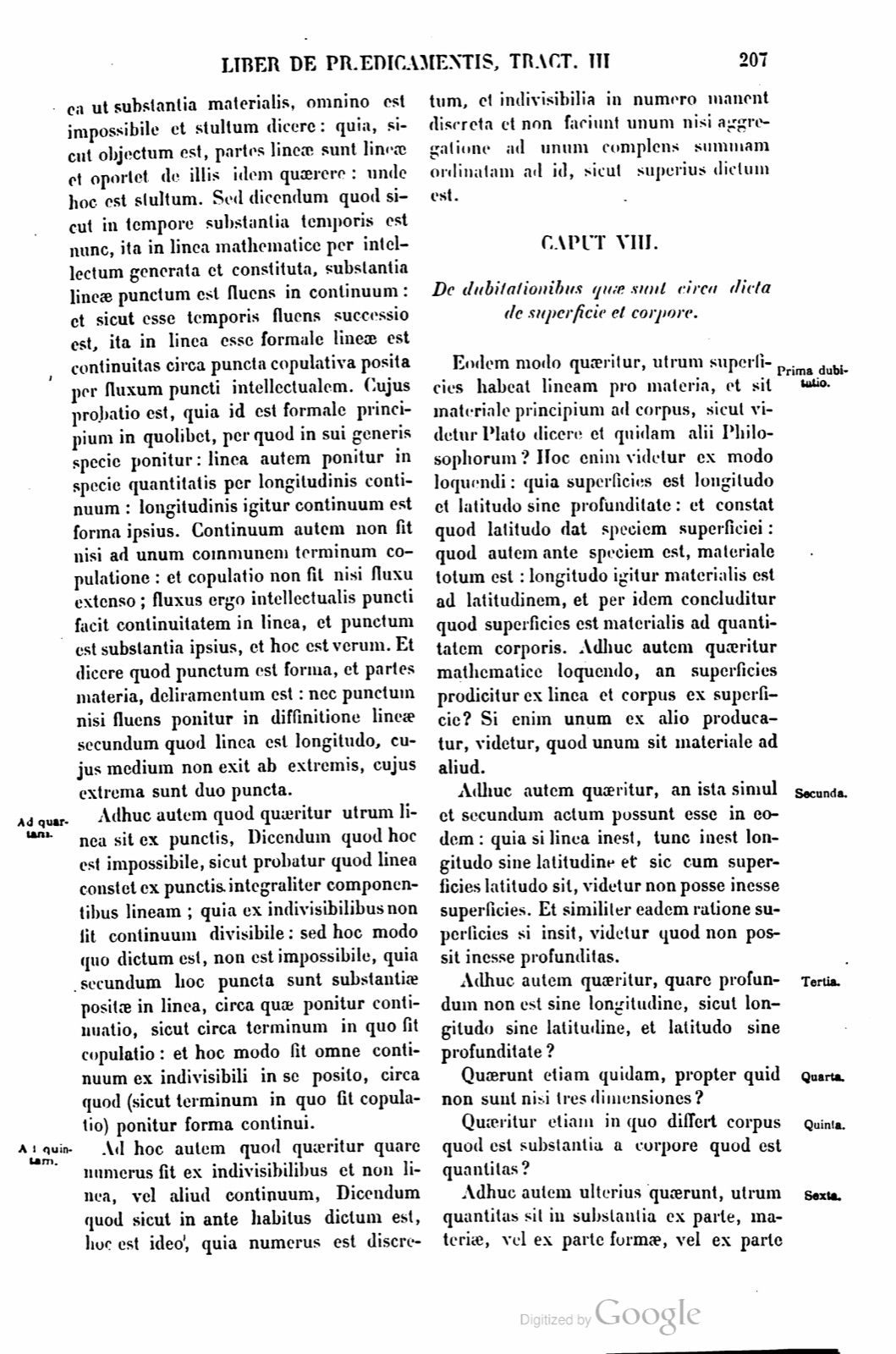
ea ut substantia materialis, omnino est impossibile et stultum dicere: quia, sicut objectum est, partes lineæ sunt lineæ et oportet de illis idem quærere: unde hoc est stultum. Sed dicendum quod sicut in tempore substantia temporis est nunc, ita in linea mathematice per intellectum generata et constituta, substantia lineæ punctum est fluens in continuum: et sicut esse temporis fluens successio est, ita in linea esse formale lineæ est continuitas circa puncta copulativa posita per fluxum puncti intellectualem. Cujus probatio est, quia id est formale principium in quolibet, per quod in sui generis specie ponitur: linea autem ponitur in specie quantitatis per longitudinis continuum: longitudinis igitur continuum est forma ipsius. Continuum autem non fit nisi ad unum communem terminum copulatione: et copulatio non fit nisi fluxu extenso; fluxus ergo intellectualis puncti facit continuitatem in linea, et punctum est substantia ipsius, et hoc est verum. Et dicere quod punctum est forma, et partes materia, deliramentum est: nec punctum nisi fluens ponitur in diffinitione lineæ secundum quod linea est longitudo, cujus medium non exit ab extremis, cujus extrema sunt duo puncta.
Adhuc autem quod quæritur utrum linea sit ex punctis, Dicendum quod hoc est impossibile, sicut probatur quod linea constet ex punctis integraliter componentibus lineam; quia ex indivisibilibus non fit continuum divisibile: sed hoc modo quo dictum est, non est impossibile, quia secundum hoc puncta sunt substantiæ positæ in linea, circa quæ ponitur continuatio, sicut circa terminum in quo fit copulatio: et hoc modo fit omne continuum ex indivisibili in se posito, circa quod (sicut terminum in quo fit copulatio) ponitur forma continui.
Ad hoc autem quod quæritur quare numerus fit ex indivisibilibus et non linea, vel aliud continuum, Dicendum quod sicut in ante habitis dictum est, hoc est ideo, quia numerus est discretum, et indivisibilia in numero manent discreta et non faciunt unum nisi aggregatione ad unum complens summam ordinatam ad id, sicut superius dictum est.
CAPUT VIII.
De dubitationibus quæ sunt circa dicta de superficie et corpore.
Eodem modo quæritur, utrum superficies habeat lineam pro materia, et sit materiale principium ad corpus, sicut videtur Plato dicere et quidam alii Philosophorum? Hoc enim videtur ex modo loquendi: quia superficies est longitudo et latitudo sine profunditate: et constat quod latitudo dat speciem superficiei: quod autem ante speciem est, materiale totum est: longitudo igitur materialis est ad latitudinem, et per idem concluditur quod superficies est materialis ad quantitatem corporis. Adhuc autem quæritur mathematice loquendo, an superficies producitur ex linea et corpus ex superficie? Si enim unum ex alio producatur, videtur, quod unum sit materiale ad aliud.
Adhuc autem quæritur, an ista simul et secundum actum possunt esse in eodem: quia si linea inest, tunc inest longitudo sine latitudine et sic cum superficies latitudo sit, videtur non posse inesse superficies. Et similiter eadem ratione superficies si insit, videtur quod non possit inesse profunditas.
Adhuc autem quæritur, quare profundum non est sine longitudine, sicut longitudo sine latitudine, et latitudo sine profunditate?
Quærunt etiam quidam, propter quid non sunt nisi tres dimensiones?
Quæritur etiam in quo differt corpus quod est substantia a corpore quod est quantitas?
Adhuc autem ulterius quærunt, utrum quantitas sit in substantia ex parte, materiæ, vel ex parte formæ, vel ex parte
it as material substance, is altogether impossible and foolish to say, because, as was objected, the parts of line are lines, and one must ask the same thing about them; whence this is foolish. But one must say that just as in time the substance of time is the now, so in line generated and constituted mathematically through understanding, the substance of line is point flowing into a continuum; and just as the flowing being of time is succession, so in line the formal being of line is continuity placed around joining points through the intellectual flux of point. The proof of this is that in anything that is the formal principle by which it is placed in the species of its genus; but line is placed in the species of quantity through the continuum of length; therefore the continuum of length is its form. But the continuous is not made except by joining to one common term, and joining is not made except by extended flux; therefore the intellectual flux of point makes continuity in line, and point is its substance, and this is true. And to say that point is form and the parts are matter is delirament; nor is point placed in the definition of line except as flowing, according as line is length whose middle does not depart from the extremes, whose extremes are two points.
Further, as to what is asked, whether line is from points, one must say that this is impossible, as is proved, that line should consist of points integrally composing line, because a divisible continuum is not made from indivisibles; but in this mode in which it has been stated, it is not impossible, because according to this, points are substances placed in line, around which continuation is placed, as around a term in which joining is made; and in this mode every continuum is made from an indivisible positioned in itself, around which, as around a term in which joining is made, the form of the continuous is placed.
But to this which is asked, why number is made from indivisibles and not line, or another continuum, one must say that, as was said in the things held before, this is so because number is discrete, and indivisibles in number remain discrete and do not make one except by aggregation to one thing completing the sum ordered to it, as was said above.
CHAPTER VIII.
On doubts which concern what has been said about surface and body.
In the same mode it is asked whether surface has line for matter, and is a material principle toward body, as Plato seems to say and certain others of the Philosophers. For this seems so from the mode of speaking, because surface is length and breadth without depth, and it is agreed that breadth gives species to surface; but what is before species is a material whole; therefore length is material toward breadth, and by the same thing it is concluded that surface is material toward the quantity of body. Further it is asked, speaking mathematically, whether surface is produced from line and body from surface. For if one is produced from another, it seems that one is material toward another.
Further it is asked whether those things can be at once and according to act in the same thing, because if line is present, then length without breadth is present, and thus, since surface is breadth, it seems that surface cannot be present. And similarly by the same argument, if surface is present, it seems that depth cannot be present.
Further it is asked why depth is not without length, as length is without breadth, and breadth without depth.
Certain people also ask on account of what there are only three dimensions.
It is also asked in what body which is substance differs from body which is quantity.
Further also they ask beyond this whether quantity is in substance from the part of matter, or from the part of form, or from the part of
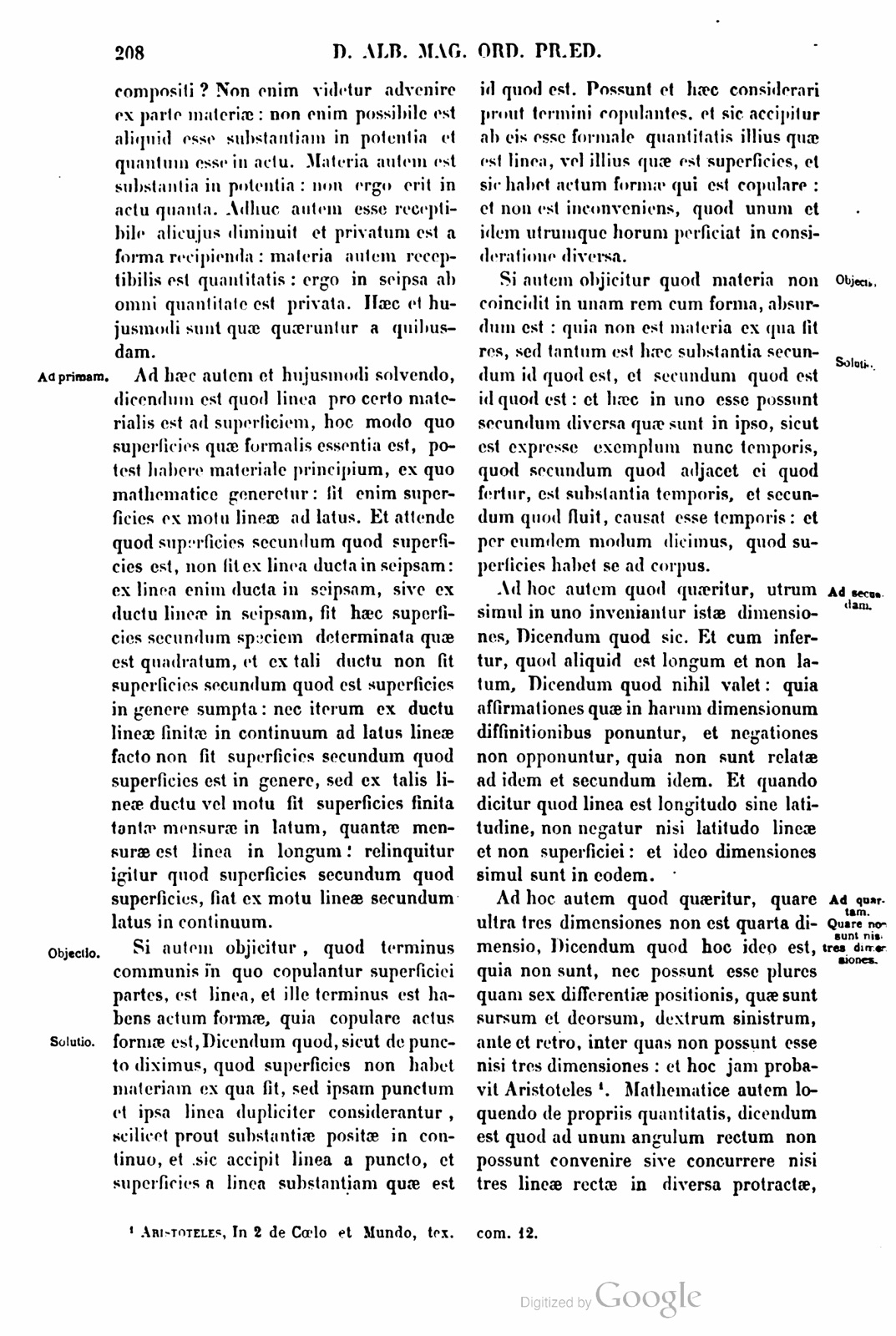
compositi? Non enim videtur advenire ex parte materiæ: non enim possibile est aliquid esse substantiam in potentia et quantum esse in actu. Materia autem est substantia in potentia: non ergo erit in actu quanta. Adhuc autem esse receptibile alicujus diminuit et privatum est a forma recipienda: materia autem receptibilis est quantitatis: ergo in seipsa ab omni quantitate est privata. Hæc et hujusmodi sunt quæ quæruntur a quibusdam.
Ad hæc autem et hujusmodi solvendo, dicendum est quod linea pro certo materialis est ad superficiem, hoc modo quo superficies quæ formalis essentia est, potest habere materiale principium, ex quo mathematice generetur: fit enim superficies ex motu lineæ ad latus. Et attende quod superficies secundum quod superficies est, non fit ex linea ducta in seipsam: ex linea enim ducta in seipsam, sive ex ductu lineæ in seipsam, fit hæc superficies secundum speciem determinata quæ est quadratum, et ex tali ductu non fit superficies secundum quod est superficies in genere sumpta: nec iterum ex ductu lineæ finitæ in continuum ad latus lineæ facto non fit superficies secundum quod superficies est in genere, sed ex talis lineæ ductu vel motu fit superficies finita tantæ mensuræ in latum, quantæ mensuræ est linea in longum: relinquitur igitur quod superficies secundum quod superficies, fiat ex motu lineæ secundum latus in continuum.
Si autem objicitur, quod terminus communis in quo copulantur superficiei partes, est linea, et ille terminus est habens actum formæ, quia copulare actus formæ est, Dicendum quod, sicut de puncto diximus, quod superficies non habet materiam ex qua fit, sed ipsum punctum et ipsa linea dupliciter considerantur, scilicet prout substantiæ positæ in continuo, et sic accipit linea a puncto, et superficies a linea substantiam quæ est id quod est. Possunt et hæc considerari prout termini copulantes, et sic accipitur ab eis esse formale quantitatis illius quæ est linea, vel illius quæ est superficies, et sic habet actum formæ qui est copulare: et non est inconveniens, quod unum et idem utrumque horum perficiat in consideratione diversa.
Si autem objicitur quod materia non coincidit in unam rem cum forma, absurdum est: quia non est materia ex qua fit res, sed tantum est hæc substantia secundum id quod est, et secundum quod est id quod est: et hæc in uno esse possunt secundum diversa quæ sunt in ipso, sicut est expresse exemplum nunc temporis, quod secundum quod adjacet ei quod fertur, est substantia temporis, et secundum quod fluit, causat esse temporis: et per eumdem modum dicimus, quod superficies habet se ad corpus.
Ad hoc autem quod quæritur, utrum simul in uno inveniantur istæ dimensiones, Dicendum quod sic. Et cum infertur, quod aliquid est longum et non latum, Dicendum quod nihil valet: quia affirmationes quæ in harum dimensionum diffinitionibus ponuntur, et negationes non opponuntur, quia non sunt relatæ ad idem et secundum idem. Et quando dicitur quod linea est longitudo sine latitudine, non negatur nisi latitudo lineæ et non superficiei: et ideo dimensiones simul sunt in eodem.
Ad hoc autem quod quæritur, quare ultra tres dimensiones non est quarta dimensio, Dicendum quod hoc ideo est, quia non sunt, nec possunt esse plures quam sex differentiæ positionis, quæ sunt sursum et deorsum, dextrum sinistrum, ante et retro, inter quas non possunt esse nisi tres dimensiones: et hoc jam probavit Aristoteles 1. Mathematice autem loquendo de propriis quantitatis, dicendum est quod ad unum angulum rectum non possunt convenire sive concurrere nisi tres lineæ rectæ in diversa protractæ,
the composite? For it does not seem to come from the part of matter: for it is not possible that something be substance in potency and be quantified in act. But matter is substance in potency; therefore it will not be quantified in act. Further, being receptive of something diminishes and is deprived of the form to be received; but matter is receptive of quantity; therefore in itself it is deprived of every quantity. These and things of this sort are the things which are asked by certain people.
But in solving these things and things of this sort, one must say that line is certainly material toward surface, in this mode in which surface, which is a formal essence, can have a material principle from which it may be generated mathematically; for surface is made from the motion of a line to the side. And note that surface, according as it is surface, is not made from a line drawn into itself. For from a line drawn into itself, or from the drawing of a line into itself, this surface determined according to species is made, which is a square, and from such a drawing surface is not made according as it is surface taken in the genus. Nor again from the drawing of a finite line into a continuum made to the side of the line is surface made according as surface is in the genus, but from the drawing or motion of such a line a finite surface is made of as much measure in breadth as the measure of the line is in length. Therefore it remains that surface, according as it is surface, is made from the motion of a line according to the side into a continuum.
But if it is objected that the common term in which the parts of surface are joined is a line, and that term is having the act of form, because to join is an act of form, one must say that, as we said about point, surface does not have matter from which it is made, but point itself and line itself are considered in two ways, namely insofar as they are substances placed in a continuum, and thus line receives from point, and surface from line, the substance which is that which it is. And these can be considered insofar as they are joining terms, and thus there is received from them the formal being of that quantity which is line, or of that which is surface, and thus it has the act of form, which is to join; and it is not unfitting that one and the same thing should perfect both of these in a diverse consideration.
But if it is objected that matter does not coincide into one thing with form, this is absurd, because it is not matter from which the thing is made, but it is only this substance according to that which it is, and according as it is that which it is; and these can be in one thing according to diverse things which are in it, just as there is the express example of the now of time, which, according as it lies adjacent to that which is carried, is the substance of time, and according as it flows, causes the being of time; and in the same mode we say that surface is related to body.
But to this which is asked, whether those dimensions are found together in one thing, one must say yes. And when it is inferred that something is long and not broad, one must say that this is worth nothing, because the affirmations which are placed in the definitions of these dimensions and the negations are not opposed, because they are not related to the same thing and according to the same thing. And when it is said that line is length without breadth, only the breadth of line is denied, and not the breadth of surface; and therefore dimensions are together in the same thing.
But to this which is asked, why beyond three dimensions there is not a fourth dimension, one must say that this is so because there are not, nor can there be, more than six differences of position, which are up and down, right and left, before and behind, among which there cannot be except three dimensions; and Aristotle has already proved this 1. But speaking mathematically about the proper features of quantity, one must say that at one right angle there cannot come together or concur except three straight lines drawn out in diverse directions,
Notes
- Aristotle, in book 2 On Heaven and the World, text, commentary 12. (Aristoteles, In 2 de Cœlo et Mundo, tex. com. 12.) ↩
If a page does not appear, its photograph has not been uploaded yet.