[Source: Catecismo de la doctrina cristiana explicado, Barcelona 1848, pp. 65–72 (lesson six).]
Explanation of the plate and of the third article of the Creed, which is: Who was conceived by the Holy Spirit, and born of holy Mary the Virgin
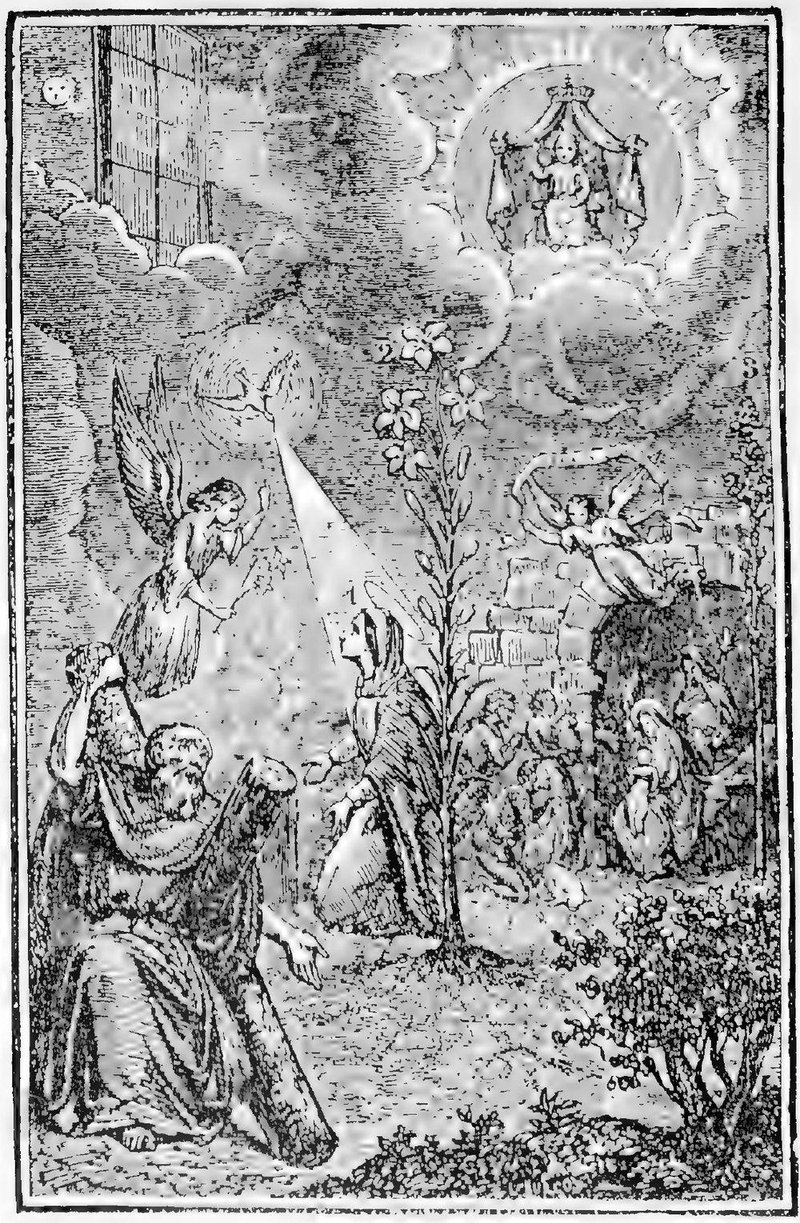
Plate IX of the Catechism, from the 1867 printing: 1. Most holy Mary. 2. The rod of Jesse. 3. The rod of Aaron. 4. The birth of Jesus.
My child, do you not see there in the middle of the plate that Lady (no. 1), so modest and as if amazed? It is the Most Holy Virgin, to whom the archangel St. Gabriel brings an embassy from heaven, telling her that she will be Mother of the Son of God. That you may understand all this better, you must know that when the devil led our first parents into sin he made use of the woman; and God our Lord, to redeem them and all their posterity, which is all of us men, also makes use of a woman, who is the Most Holy Virgin Mary, as God himself said to the serpent, or to the devil who was in it: she (the woman) shall crush your head.1 In Adam’s sin we were all defiled.2 Just as from a cistern or tank whose waters are dirty all that is drawn out comes out dirty, so all men, descendants of Adam, contracted and came forth with original sin (except the Most Holy Virgin Mary, who was preserved), which is the stain of our first parents, and we were left children of wrath and reprobation.3
God our Lord could very well have left men in this wretched state and cast them into hell, like the rebel Angels, without doing them any injustice, since even human justice punishes the offender without waiting for him to commit a new crime. But the tender mercy of God our Lord was moved towards us,4 and at the same time as he cast Adam and Eve out of paradise, punishing them, he promised them a Liberator, a Redeemer, who was to be no less, as I have already said, than his only natural Son, our Lord Jesus Christ, and who would be born of a woman who was to crush the head of the infernal serpent.5
From the time our parents sinned until this God became incarnate, the long space of four thousand years went by, whether because God so disposed it, or so that man, who sinned through pride, might more clearly recognize the need of the remedy and so cry out for the physician, or also so that he might hold this incomparable benefit in greater esteem. But meanwhile God sent Prophets, who announced the coming of the Redeemer, marking the time, the character with which he would come, the circumstances of his coming, of his passion and death, and by various likenesses and figures he made them understand the mysteries of the Desired of the nations; such are what you see in no. 2 of the plate, which is the rod of Jesse, prophesied by Isaiah (11:1) when he said: A rod shall come forth from the root of Jesse, and from his root a flower shall rise,6 which is a figure of the Most Holy Virgin, who brought forth Jesus for us as a most fragrant flower; and what is in no. 3, which is the rod of Aaron, also a figure of this mystery.7 At last that so longed-for day came, which was the twenty-fifth of March, the day on which, it is thought, our first parents were created and placed in the earthly paradise; and so on this same day, after so many years, the new Adam, Jesus Christ, was created and placed in the Marian paradise, in the womb of the Virgin Mary, who was however betrothed to the glorious St. Joseph,8 for the two had made, and always kept, a vow of chastity and lived as brother and sister with complete fidelity and love.
The manner in which the mystery of the Incarnation was accomplished, or the Son of God became man, was, as the evangelist St. Luke tells us in chapter 1, as follows: The angel Gabriel was sent by God to a city of Galilee called Nazareth, to a Virgin betrothed to a man whose name was Joseph, of the house of David; and the Virgin’s name was Mary. And the Angel, coming in to where she was, said: Hail, full of grace, the Lord is with you; blessed are you among women. And when she heard this, she was troubled at his words, and considered what kind of greeting this might be. And the Angel said to her: Do not be afraid, Mary, for you have found grace before God; behold, you will conceive in your womb and bear a son, and you shall call his name Jesus (in proof of what I am telling you). He will be great and will be called Son of the Most High, and the Lord God will give him the throne of David his father; and he will reign over the house of Jacob for ever, and of his kingdom there will be no end. And Mary said to the Angel: How shall this be, since I know not man? (as if to say: I have made a vow of chastity, and I wish to keep it always). And the Angel answered and said to her: You will not conceive by the work of man, but by the work of the Holy Spirit, so that the Holy Spirit will come upon you, and the power of the Most High will overshadow you. And therefore the Holy One to be born of you will be called Son of God. And in proof that this is the work of God, I tell you that Elizabeth your kinswoman has also conceived a son in her old age; and this is the sixth month for her who is called barren, for nothing is impossible with God.9
This manner of bringing about the conception of the Redeemer of the world, if one looks at it well, has nothing strange about it; rather it is very fitting that it should be so. For if the first man, Adam, who by his sin corrupted the whole human race, was formed not by way of generation but by the work of God himself, and from the red and virgin earth of the Damascene field, as some Holy Fathers say, the second Adam, Jesus Christ, who came to repair what the first destroyed, ought with all the more reason to be the work of God, and not by way of generation, but from the red and virgin blood of the most chaste and most pure heart of Mary.
Mary at last surrendered with all humility, and, believing most firmly what the Angel announced to her on God’s behalf, she said: Behold the handmaid of the Lord; be it done to me according to your word.10 And just as at the beginning of the world the three Persons of the Most Holy Trinity said, Let us make man in our image and likeness,11 and formed him from clay, so now the same Persons make God to be man. The authors explain the Incarnation in this way: the three divine Persons took three drops of blood from the most pure heart of Mary; from this blood they formed a body, created a rational soul and united it to that body, and to the body and soul, thus united, the second Person of the Most Holy Trinity united himself; and this is what it was for the Son of God to become incarnate or become man.12
That radiance which comes from the Holy Spirit and ends in Most Holy Mary means that the Son of God, coming down from heaven, was conceived in the womb of the most pure Virgin Mary by the work of the same divine Spirit; that is why the Church says that for us men and for our salvation he came down from heaven. He set up his throne in the womb of the Most Holy Virgin Mary, who is chosen as the sun,13 and this is what that child you see seated there means. David had already said in Psalm 18: He has set his tabernacle in the sun.14
The reason for saying that the Incarnation was the work of the Holy Spirit is that, since power is attributed to the Father, wisdom to the Son and love to the Holy Spirit, and the Incarnation was a work of love, it is therefore attributed to the Holy Spirit. It is as with a very skilful tailor who has made a well-fitting suit: even if two other tailors have worked on it, it is said to be his work; in the same way in the Incarnation, although, being a work ad extra, as the theologians say, all three Persons concurred in it, and it was the work of the three, nevertheless, because of the infinite love for men that this mystery shows, it is attributed to the Holy Spirit.
Perhaps the doubt will come to you how it is possible, the three Persons being one and the same and only God, that the Son became incarnate, and not the Father or the Holy Spirit. To which I will answer you with this likeness: just as on a tree with three equal branches one can be grafted without grafting the others, so also the Son could become incarnate without the Father or the Holy Spirit becoming incarnate. Another likeness: just as in a sacristy there may be three priests, of whom one will vest and the other two will help him vest (I mean that the three will vest only one, and he alone will be left vested and will offer the sacrifice of the altar), so also the three Persons clothed the second, and he alone was left clothed in human nature, and offered the great sacrifice of the redemption of the human race.
If you ask me why the Father or the Holy Spirit did not become incarnate, among many reasons of fittingness I could put forward, I will confine myself to pointing out the simplest. You know already that our first parents were lost by believing the devil, the father of lies,15 who promised them the knowledge of good and evil, telling them they would be like God, and this disordered appetite for knowledge made them fall into the snare;16 it was therefore very fitting that the Son of God, the eternal truth, to whom wisdom is attributed, should come to break this snare; and just as Adam and Eve were lost by believing the lying devil, so their descendants are saved by believing the Son of God, who is truth itself, as he himself assures us: I am, he says, the way, the truth and the life.17 Consequently, if man has such a desire to know, he knows now to whom he must go to satisfy it fully: to the Son of God, who is wisdom itself. There is yet another reason: the Incarnation was in order to make us adopted children of God, and it was very fitting that this should be done by the only natural Son of God.
Do you see in the plate the birth of Jesus (no. 4)? It means that after the nine months from the Incarnation the Son of God made man was born in a cave very near Bethlehem; the Angels of heaven came down to adore him, singing: Glory to God in the highest;18 the shepherds also came, and even the kings of the East.19 And the Most Holy Virgin, although she conceived and gave birth to the Son of God made man, for which reason she is called, and is with complete propriety, Mother of God, remained nevertheless a virgin after childbirth and in childbirth, as she was before childbirth; just as the sun, passing through a pane of glass, leaves it as whole and undamaged, after passing and while passing, as it was before it passed through it, so Jesus Christ, who is called the sun of justice,20 in being born of holy Mary, who is cleaner and more beautiful than the most beautiful and clean crystal, did not make her lose her beauty and virginal chastity (as is shown in the plate by that sun which, at her left side, passes through those panes), but rather perfected and beautified it.
Ah, my child! How many thanks we must continually give to God for so great a benefit as his becoming man himself, so that all men may be saved, making them sharers in the divine nature21 and happy in God himself! And this for ever! Let us always love God, then, since he first loved us,22 for not only has he created us, but he has also deigned to come down from heaven to redeem us.
— What does was conceived by the work of the Holy Spirit mean?
— That Most Holy Mary did not conceive him by the work of man, but by the power of the Holy Spirit.
— What does and was born of holy Mary the Virgin mean?
— That Most Holy Mary conceived and bore him without harm to her virginity; and that is why we say that Mary was always a Virgin, not only before childbirth, but also in childbirth and after childbirth.
Footnotes
-
Cf. Gen 3:15. ↩
-
Cf. 1 Cor 15:22. ↩
-
Cf. Eph 2:3. ↩
-
Cf. Lk 1:78. ↩
-
Cf. Gen 3:15. ↩
-
Is 11:1. ↩
-
Cf. Ex 7:12. ↩
-
Cf. Mt 1:18; Lk 1:27. ↩
-
Lk 1:26–37. ↩
-
Lk 1:38. ↩
-
Gen 1:26. ↩
-
Cf. BAC ed., Obras completas [Madrid 1970], vol. III, p. 168. Sermo I de Nativ.. ↩
-
Song 6:9 [Vulgate]. ↩
-
Ps 18:5 [Vulgate; Ps 19:4–5 in the Hebrew numbering]. ↩
-
Cf. Jn 8:44. ↩
-
Cf. Gen 2:16–17; 3:1–24. ↩
-
Jn 14:6. ↩
-
Lk 2:14. ↩
-
Mt 2:1–12. ↩
-
Mal 3:20 [4:2 in some versions]. ↩
-
Cf. 2 Pet 1:4. ↩
-
Cf. 1 Jn 4:19. ↩