[Source: loose leaflet (LR no. 22), Sé fiel hasta la muerte y te daré la corona de la vida, Barcelona 1859, 4 pp.]
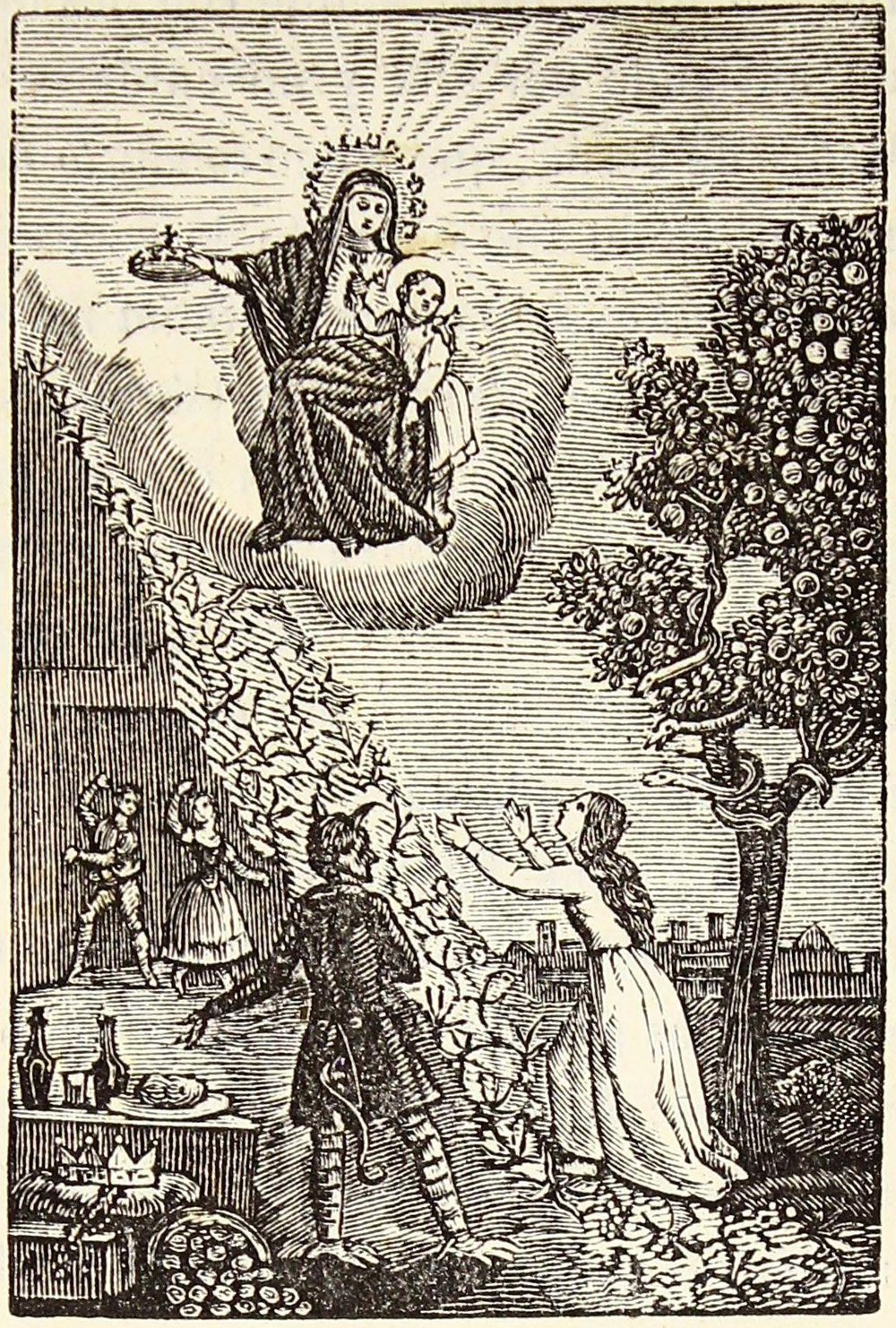
The woodcut the leaflet explains, from the Barcelona printing of 1858.
All this I will give you, said Satan to Jesus Christ, showing him all the kingdoms of the world and their glory, if you will fall down and adore me.1 Since, then, Jesus willed to be tempted in order to overcome our temptations and to teach us how we must behave in them so as to come out victorious, let us hear what, for our instruction, he at once answered the devil with indignation: Begone, he said, begone, Satan; for it is written: You shall adore the Lord your God, and him only shall you serve;2 and behold, the devil, put to shame by this answer, left him, and angels came (in visible form, since in such form the tempter had come) and ministered to him.3 We have seen the temptation and what Jesus did to overcome it; let us now see what the enemy does with the Christian soul, and what the soul must do to conquer, in imitation of Jesus and his Saints.
Fix your gaze on the picture, devout soul who read this, for even the smallest thing in it is very significant. Do you see there at the very top a resplendent Lady with a Child on her left, who with her right hand holds up a crown, as if offering it to that white-robed maiden who is climbing that steep path strewn with thorns, and who, her eyes fixed on the crown, stretches out her arms as though longing for it, heedless of what she treads on? Well, that is Mary, the Mother of Jesus, who, as the channel of her Son’s graces and the ladder of sinners, calls out to souls from high heaven, saying to them: My daughters, hear me: Happy is he who comes to me, imitates my virtues and listens to me; for whoever finds me will find the life of grace (signified by the child Jesus) and will be saved (which is what the crown she offers signifies).4
That maiden adorned in the white garment is a symbol of the Christian soul, which, on hearing the voice of Mary, conceives desires of attaining the crown;5 but, seeing how high the mountain on which it stands, how steep the path and how strewn with thistles that hurt her feet, even as she stretches her arms towards the crown, because she knows her own weakness she asks with tenderness, humility and confidence for help from Mary, of whom she knows that her Son so honours her that he wills all graces to pass through her hands; and because she inwardly hears a voice that says to her: Ite ad Mariam, go to Mary — which is what is meant by the Child’s looking at the maiden and pointing with his right hand to the Lady.6
But the devil, who had the audacious pride to tempt Jesus, in the excess of his rage at the efforts he sees in this soul to gain the crown, devises how to prevent her; and what does he do? Here it is: do you see him figured in that monster who, though he looks like a man, is sufficiently betrayed by his marks? Well, he comes out to meet the soul; he gives her a vivid but exaggerated picture of the difficulty of the road; he paints the devout life in the blackest colours, calling it an exaggerated mysticism; he urges her not to ruin her health with so much weariness and so many thorns; and then he entreats her to get herself some relaxation after the example of those dancers, and to try to cut a brilliant figure in society, winning honours, figured in the crown he shows her down there; so that she may keep up the lustre of honours, he incites her to procure temporal goods, figured in those coins you see in the mouth of that money-bag. With money, he tells her, everything is obtained; and flattering her with the pleasures of the table, figured in the dishes, bottles and glasses he offers her, he suggests that afterwards she will be able to give herself with less expense and greater intensity to the other, coarser and more brutish pleasures that follow upon dances, figured also in that couple dancing so brazenly. And these suggestions he hurls at her, like poisoned darts, at every time and place, and with such persistence that he gives her no rest.
But he does not always tempt by himself; he sometimes also makes use of his allies, worldly men, as in paradise he made use of the serpent to tempt Eve.7 These men fall into three classes, figured in those three serpents you see coiled round that tree, whose tongues are continually hissing in the soul’s ear. Some (the first class) persecute with threats and violent means: such are the enemies of the faith and of Religion, and these have crowned constant souls with martyrdom; and such are those who, finding themselves rebuffed like Potiphar’s wife or the lustful elders,8 contrive by calumnies and other means that the Josephs and chaste Susannas be buried in a dungeon, or murdered, or stabbed. Others (the second class) insult her, now mocking her retirement, which they call misanthropy, now her practices, which they call useless sanctimony [beaterio]; and when they cannot bite at her works, they try to blacken her intentions, saying she does it to deceive the world and swindle. And finally there are others (the third class) who openly oppose virtue, and oppose the soul’s embracing a more perfect state in conformity with the evangelical counsels; and these are relatives, because they see in it the failure of their hopes of worldly goods which they promised themselves from her or through her; and they are figured in that leafy tree, well furnished with leaves, flowers and fruit.
And the soul, in the midst of such powerful, bold and tireless enemies wounding her right and left, what does she do? There you see her, her eyes fixed on the immortal crown Mary offers her, not daunted by the difficulty of the road, nor by the devil’s flatteries, nor by the poisoned hissing of the serpents; while she flees the vicious extremes of right and left, she follows undaunted the middle way, where virtue lies and which leads to the life of heaven.9 In her weariness, caused by the roughness of the road, and amid the thorns that hurt her feet, she takes heart on seeing that Jesus compassionately holds out a hand to her while he points her to his Mother, whose charge it is to give her help; and so, kindled more and more in that love of Jesus and Mary, which increases with the blows of temptation as fire does with the blows of steel struck on flint, she longs more and more for the crown, strives to pray more earnestly, despises more bravely the devil with all his works, the world with its pomps, amusements, riches, glitter and honours, and the flesh with all its flatteries and delights; and, ignoring everything that is not a means of reaching Jesus more quickly, her whole care is to follow constantly the plan of life traced out for her; and to succeed better she uses these resolutions:
-
In temptations I will say: God sees you and hears you; will you have the courage to sin with God watching you? Life is like a dream; death comes after me; it will overtake me when I least think of it; after death I must be judged on all I have thought, said and done; if death finds me in the state of grace, an eternity of joy awaits me in heaven; if in mortal sin, I shall go to suffer eternally with the devils; this is inevitable, whether I believe it or cease to believe it.
-
The moment I feel tempted, I will call Jesus and Mary to my help with some ejaculatory prayer: Jesus, save me; Virgin Mary, protect me.
-
Every day I will make the Christian’s exercise morning and evening (as found in the Camino recto);10 I will say one part of the Rosary; the Hail Mary when the clock strikes the hours; before dinner and supper I will ask God’s blessing and afterwards give him thanks, as is in the Camino recto.
-
I will have at least a quarter of an hour of mental prayer in the morning and another in the afternoon; I will read a little in some spiritual book; and, as a craftsman tries to have the tools of his trade, I will try to have tools to help me in my good works, such as the Catecismo explicado con estampas; the Villacastín, besides the Camino recto cited in no. 3; the Devout Life of St. Francis de Sales; the Spiritual Combat, etc.11
-
Feast days I will spend attending the services of the Church, examining these resolutions of mine to see whether I keep them, reading a little more, praying more and doing works of mercy.
-
Each month I will go to confession and communion at least once.
-
I will never fail in my duties out of human respect.
-
I will flee the occasions of sin, bad company, courtships or flirtations, dances, gaming, cafés, taverns and social gatherings [tertulias], and I will never read impious or obscene books nor look at provocative images.
-
I will keep my senses recollected, neither looking at nor listening to obscene things or gossip, taking the greatest care not to fail in charity; I will not utter indecent words, still less blasphemies; if I hear them, I will say “Hail Mary most pure”; and if I fail in anything, I will kiss the ground when I am alone, as a sign of sorrow, and say a Hail Mary in penance.
-
To obtain the grace of never offending my neighbours in anything, I will say a Hail Mary daily, and another so as never to take revenge on whoever offends me.
-
To obtain the grace of never staining myself with any impurity, I will say three Hail Marys to the purity of the Virgin of Virgins.
-
If, which God forbid, I should fall into mortal sin, I will at once try to make acts of sorrow and of love of God, and I will go to confession as soon as I can.
-
I will try to have a good director and obey him blindly. If I do this I shall be saved. Hoc fac, et vives.