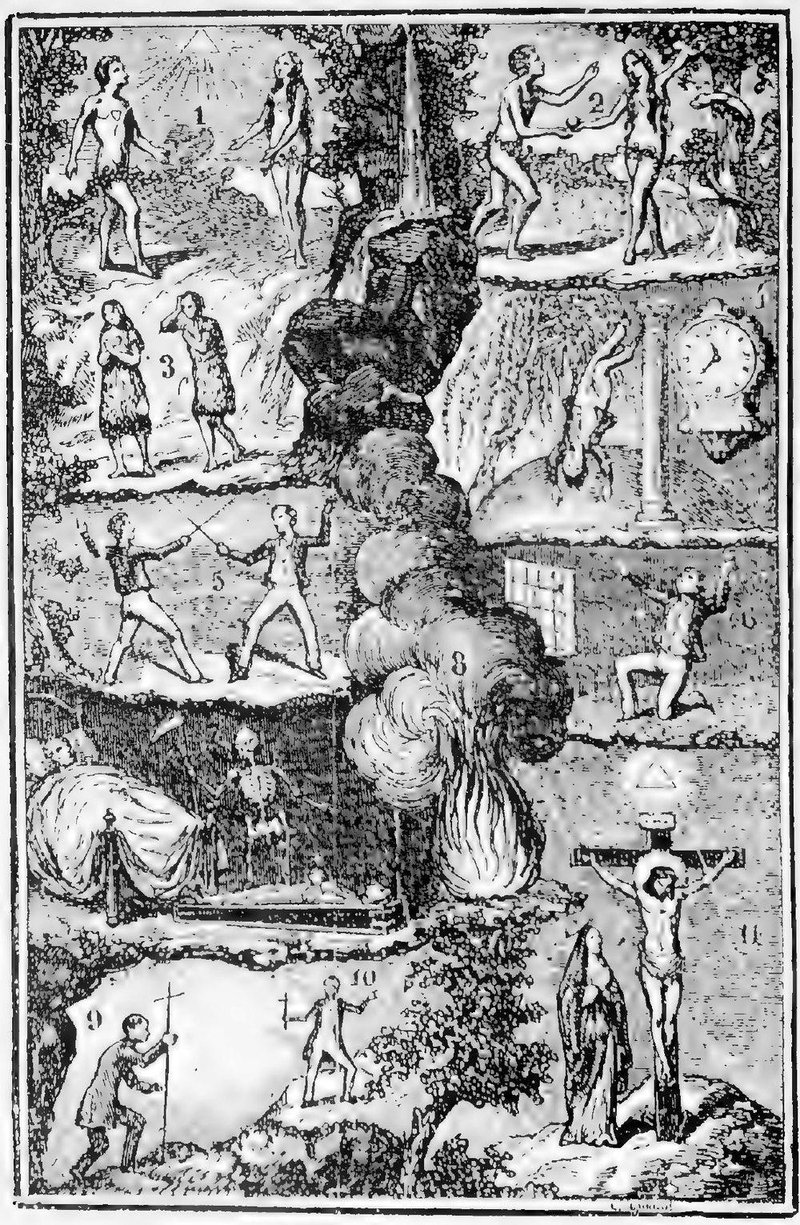
Plate VII. Original sin, its consequences and remedies. 1. Adam and Eve in the state of grace. 2. Adam and Eve break God’s command. 3. Adam and Eve driven out of paradise. 4. Fallen man, the clock and the weeping tree. 5. Two men fighting a duel. 6. A man in prison. 7. Sickness and death. 8. The flames of hell. 9. A man with the cross. 10. Another man with the cross. 11. Jesus and Mary.
Do you see, my son, that man and that woman in no. 1 of the plate? You know already that they are our parents Adam and Eve. They are adorned with every kind of knowledge, as shown by the rays coming to them from the triangle, figure of the Most Holy Trinity. They are clothed with original justice, as shown by the whiteness and purity of their hearts, all their affections directed to God, and they are placed in a garden of delights. What concord, what harmony reigns in them! How perfect they are while they keep the state of innocence! They have a body, but it is as if they had none, because it is entirely subject to their soul. The soul, for its part, is obedient to God in all things and sweetly busy loving him, as the white dots running from their heart to God signify; and it rules the body. The lower appetites are under the rule of reason, and the flesh is a faithful companion of the spirit, docile to its promptings. Their understanding, full of the light God gave it, knows all the secrets of nature and delights in contemplating it and in praising God, who created it as their dwelling. And their will, full too of uprightness and love, sees itself master of itself and of all its movements; always even and calm, it enjoys a sweet inward peace and rest. This, while their innocence lasted, was the happy state of Adam and Eve. They loved God with all their heart, with all their soul, with all their mind and with all their strength. They knew God to be supremely lovable and loving, and they had no passion or evil inclination to hinder or even delay them in loving the supreme goodness, which is God.
But you must know, my son, that they were not only happy within themselves. They also enjoyed full peace and quiet outwardly. All the animals, even the fiercest and wildest, obeyed them and served them in their way. The trees delighted their eyes with their leafiness and green, and treated their appetite to the choicest fruits. The plants offered them wholesome and plentiful food for their sustenance. And the fruit of the tree of life preserved them from old age and death. Everything, in a word, contributed to their happiness, and nothing could disturb it. Heat, cold, thirst, hunger, sickness and death were evils that for them were as if they did not exist, because they were not subject to them. Every evil was incompatible with the state of original justice in which God had created them.
Great is the satisfaction and pleasure parents have in leaving their children heirs and peaceful possessors of their rich estates. And so, to crown their joy, our parents knew for certain that the happiness they possessed would pass entire to their descendants. For they did not possess it only as private persons but as heads of the great family that was to people the world, and as the stock from which all men were to be born and descend. God had made them kings, and the parents of those who were to reign over all the creatures of the universe.
Besides this temporal happiness, which left nothing to be desired, they had a clear road to eternal happiness. They had only to follow this holy road, keeping the one command God had given them and his most holy will. Then, when the Lord was satisfied with the obedience and fidelity with which they had acknowledged, served and loved him, he would carry them to the eternal joys he had prepared for them in heaven. For this they would not have to pass through the bitterness and anguish of death. It would be like moving from a small house to a great and splendid palace. Do you see how lightly and boldly the eagle rises from the earth and soars through the air? So our parents would have risen to heaven if they had not sinned. But they sinned, and by sin they were stripped of all supernatural gifts and graces and wounded in their natural gifts, as St. Thomas says; and unhappily we all know it by bitter experience.
I want to tell you, my son, the story of the sin and fall of our parents, which is the origin of all our misfortunes. You will remember what I told you in the last lesson: God had created the Angels. Some of them were faithful in serving and loving God and were confirmed in grace; these are the good Angels. Some were unfaithful. Instead of being grateful and loving toward the Lord from whom they had just received so many favors, they saw themselves so adorned with grace and beauty that they grew proud and rebelled against God, wanting to make themselves like the most High (Isa. 14:14). The Lord, angered at such ingratitude and rashness, pronounced against them the sentence their crime deserved. He withdrew from them all supernatural graces and gifts and left them in the state of their simple spiritual nature. He hurled them like thunderbolts from the height of heaven into the depths of the infernal abyss. And to humble them further he subjected them to the punishment of the eternal fire of hell, which the Gospel says is prepared for the devil and his angels (Matt. 25:41). Many of these bad angels roam through the air and over the earth, without ceasing on that account to suffer the pains of the damned. They busy themselves tempting and provoking men to sin and damnation, for two reasons. The first is the hatred they have for God, and so they persecute man, whom they know to be his image and whom he loves very much. The second is the envy they have of man, whom they know God has created and favored and wants to make a sharer in his heavenly joys. God allows them to do it. It is partly so that, against their will, they may serve the glory of God by exercising the good. It is also so that men may have the chance to merit and to give proof of their constancy, courage and fidelity.
The devil tried out and began this temptation in paradise with our parents (see the plate, no. 2), and to our misfortune it turned out as he wished: he managed to make them fall into the snare he had set for them. For this he made use of the serpent, taking possession of that cunning reptile. Eve, idle and moved by curiosity, wandered away from her husband and began to go about paradise, admiring its beauties and delights. Walking alone, she came to the middle of paradise, where the tree of knowledge of good and evil stood. Here the infernal enemy was waiting to make her fall. Before her eyes he moved the organs of the serpent, which he had taken as the instrument of his wickedness, and forming human words he said to her: Why hath God commanded you, that you should not eat of every tree of paradise? And she answered him: Of the fruit of the trees that are in paradise we do eat: But of the fruit of the tree which is in the midst of paradise, God hath commanded us that we should not eat; and that we should not touch it, lest perhaps we die. God had forbidden it to test their obedience, fidelity and love. No, said the serpent then, you shall not die the death. For God doth know that in what day soever you shall eat thereof, your eyes shall be opened: and you shall be as Gods, knowing good and evil. And the woman saw that the tree was good to eat… and she took of the fruit thereof, and did eat, and gave to her husband who did eat (Gen. 3:1–6). Ah, unspeakably fatal mouthful! Ah, unhappy moment! At that very instant their eyes were opened: not to know good and evil like gods, as the tempter had promised them, but to see the abyss of evils into which their disobedience had plunged them. From angelic men they suddenly became carnal men. They saw themselves naked and were ashamed.
They felt the rebellion of the flesh, and this rebellion covered them with embarrassment and confusion. Original justice, which kept nature in perfect order, served as a kind of veil hiding their nakedness. In punishment of their disobedience God withdrew this veil, and at once they found themselves naked and ashamed. Finding themselves in so shameful a state, they went to a fig tree, cut leaves, sewed them together and covered themselves with them.
Hardly had they covered themselves with these leaves when they heard the voice of God, and in terror they fled and hid in the thickest part of paradise. Where art thou, Adam? said the Lord. And Adam, all confused, answered: I heard thy voice in paradise; and I was afraid, because I was naked, and I hid myself. And who hath told thee that thou wast naked, said the Lord, but that thou hast eaten of the tree whereof I commanded thee that thou shouldst not eat? Adam answered: The woman, whom thou gavest me to be my companion, gave me of the tree, and I did eat. And to Eve he said: Why hast thou done this? The serpent deceived me, and I did eat, answered Eve. Then God said to the serpent: Thou art cursed among all cattle, and beasts of the earth: upon thy breast shalt thou go, and earth shalt thou eat all the days of thy life. I will put enmities between thee and the woman, and thy seed and her seed: she shall crush thy head, and thou shalt lie in wait for her heel (Gen. 3:9–15).1 You will notice, my son, that this curse of God falls on the serpent as an animal and on the infernal serpent, which is the devil. The animal was cursed for having served as the devil’s instrument in making our parents sin. That serpent and its descendants have borne this curse of God ever since: they crawl, and are objects of loathing, horror and fear. On this I must warn you that the enemy then made use of the serpent because he had no other man to tempt man with. But now that he has other men, he uses them to catch others, just as the hunter uses decoy birds to catch birds of their own kind. But woe to the one who serves as the devil’s instrument for catching souls! Woe to that man by whom the scandal cometh! (Matt. 18:7). Keep away, my son, from the one who gives scandal as from the sight of the serpent.
The devil, chief agent of this fall, is cursed by God a second time. He is threatened with the confusion and defeats he will suffer, and with a woman, who will be Mary, crushing his proud and haughty head. And to his greater confusion and shame, God will use the same weapons to defeat him. He made use of a woman, and God will make use of one called Mary. Eve took the fruit of the tree and gave it to Adam and ruined him. Mary will take the blessed fruit of her womb, Jesus, from the tree of the cross and give him to us for our salvation; and where sin abounded, grace did more abound (Rom. 5:20).
After these curses God turned to those of our parents. Addressing the woman, he said to her: I will multiply thy sorrows, and thy conceptions: in sorrow shalt thou bring forth children, and thou shalt be under thy husband’s power, and he shall have dominion over thee. And to Adam he said: Cursed is the earth in thy work; with labour and toil shalt thou eat thereof all the days of thy life. Thorns and thistles shall it bring forth to thee; and thou shalt eat the herbs of the earth. In the sweat of thy face shalt thou eat bread till thou return to the earth, out of which thou wast taken: for dust thou art (as to the body), and into dust thou shalt return (Gen. 3:16–19).
After the Lord had pronounced these terrible sentences, which have been fulfilled to the letter, he was moved by his love of modesty and decency. He made garments or coats of skins to cover the shameful nakedness of these offenders, as you will see in the plate at no. 3, and when they were covered with them he cast them out of paradise. So those who had been placed in that garden of delights like two Angels left it covered with skins like two beasts. See well, my son, what disobedience brings.
Fallen into sin and cast out of paradise, our parents found themselves more wretched than a fish out of water. They were deprived of the grace of God, of original justice, of innocence, of the virtues and gifts of the Holy Ghost, and of all the graces they had received from heaven. They were slaves of the devil, for he had conquered and won them by sin. They were subject to all the troubles and sicknesses of the body, and even to death itself. Besides this they were covered with the darkness of ignorance and ruled by concupiscence. Concupiscence is the disordered love of ourselves, a love that draws us away from God our creator, and from which flow all the sins that lead to the eternal death of hell.
To help you understand better the evils and misfortunes this sin brought on our parents and on all human nature, look at no. 4 in the plate. There you will see a clock, a tree called the weeping tree, and a man falling from a tall column. Take the clock first. A very good clock, well regulated, does not stop, or run fast or slow, but always keeps good time, as the clockmaker designed it. But if this clock has a great fall, and has received so heavy a shock that the whole mechanism is put out of order and all the wheels and axles are disarranged, it hardly goes; and if it goes at all, it almost always runs wrong, fast or slow. This clock is a figure of the human race, arranged and ordered by the wisest of craftsmen, God himself. Its movements were always perfectly ordered according to God’s will. But as soon as it had the misfortune of this great fall, the dreadful blow put all nature out of order and overturned the wonderful order in which it had been formed. At the very moment when our parents sinned by disobeying God, everything rebelled against them and against the human race. The body refused the rule of the soul; the flesh rebelled against the spirit; the passions mutinied against reason; the appetites refused to obey the will. In short, the lower, carnal man rebelled against the higher, spiritual man. From then on began that inner struggle of which St. Paul complained so much (Rom. 7:23), and which all of us, unhappily, experience only too well. The animals too, and the other creatures, refused in the same way to obey those who had failed in obedience to their Creator.
To help you understand this very important matter well, I will explain the other emblem, the weeping tree. Compare this tree with a fruit tree. The fruit tree you will see leafy, cheerful and laden with fruit. It is true that the very weight of the fruit makes it bend its branches a little, as if to let man pick it. Yet it always stretches them upward, as if to praise its Creator and report to him how it does its duty as a faithful creature. But look at the weeping tree: it stands without fruit, sad and melancholy, with its branches drooping to the ground. Such is the human race fallen into sin,
without the fruit of good works, virtues and graces: sad, melancholy and exiled in this valley of tears. But let these tears at least not be only for the punishments it has deserved. Let them be chiefly for having sinned. Then God would grant it pardon and grace, as he granted them to our parents, who wept for their sin and did penance; and God forgave them and they were saved.
I think you are eager to know what this man falling from a column means. Let us come to it. This man represents the human race. But first of all I must tell you that theologians distinguish three states of the human race: that of pure nature, that of nature in its integrity, and that of nature fallen and corrupted. When God created man, he gave him the natural graces, and besides these, by a special favor, he adorned him with supernatural graces, with original justice and the other gifts I have already explained to you. To help you understand it better, I have used the comparison of this man falling from a column. You have seen how a sculptor forms a statue in his workshop and then sets it on top of a tall column. So God created man with natural graces and set him on the tall column of supernatural graces. But the unhappy man grew dizzy, and that dizziness was his disobedience, the daughter of his pride. He fell, and by this fall he was stripped of supernatural graces and wounded in his natural ones, as St. Thomas says. Natural reason and experience make this truth, which we call the fall of our parents or original sin, so plain that even if faith did not teach it, no one could doubt it. For we see that in the whole universe there is no work more exquisite on the one hand, nor on the other more full of defects, than man. This creature, like the others, is the work of God’s hands; and since all God’s works are most perfect in their kind, where could the disorder we all feel in man come from, if not from this original fall, which faith teaches us and all the traditions of the human race attest? It is as with a particular man who has a fall, injures his legs and walks with a limp: walking belongs to his nature, but the limping is the result of the fall.
Stop a little, my son, and consider man, and you will see in him the most clashing, contradictory and monstrous things. You will find in him an understanding whose object is truth. It is keen, sharp, inventive, shrewd and ingenious. It catches and masters the animals of the earth, the fish of the waters and the birds of the air; it weighs the stars and calculates their distances and motions. But how strange and astonishing! In the midst of so much nobility, power and knowledge, it degrades itself so far that it entirely changes its object: it abandons truth and seeks falsehood, plunging willingly into a thousand falsehoods and errors. God complains of this through his Prophet in Psalm 4:3: O ye sons of men, how long will you be dull of heart? why do you love vanity, and seek after lying? Strange thing! It abandons God, who is truth by essence, and follows the devil, who is the father of lies (John 8:44); and though he is its greatest enemy, it venerates and worships him by vices or idolatry. What monstrousness!
I can tell you the same of the will. Its object is the good, and the Lord in creating it stamped on it this holy law of love: to love God above all things and one’s neighbor as oneself. But see what monstrousness. In spite of this law of love, so natural to man, man despises God, offends him, and perhaps comes to hate him, preferring riches, honors and pleasures to God himself. As the reward for keeping this law God promises man the eternal joys of heaven, and he threatens transgressors with the eternal pains of hell; and unhappy man pays no heed to any of it. You will see this disorder marked in the plate. Do you see that man falling from the column? See how, on reaching the ground, he is upside down: head downward, feet toward heaven, head and hands toward the globe. The globe represents the earth or the world, where all there is is the concupiscence of the flesh, and the concupiscence of the eyes, and the pride of life (1 John 2:16), as St. John says. And so that you may understand well the disorder that has come from this fall, consider the will of man. Its object was God alone, who is goodness itself in essence, and only in God can it be satisfied. But see: the unhappy will abandons him and applies all its powers and senses to the things of the earth, where it seeks happiness. That is why the man is head and hands toward the earth. But since it seeks happiness where it is not, it never finds it.
I tell you the same of the second part of this love, which is to love one’s neighbor as oneself. There is a proverb that says: “Every animal loves its like.” But men are sometimes so far from this that they hate, persecute and kill one another with such slaughter as was never heard of even among the fiercest beasts. They glory in inventing ways to kill more people with little effort, or to inflict incurable wounds, as you will see in the plate at no. 5. And instead of honoring, assisting and helping one another and seeking every good for one another, they do the opposite. That man in the plate at no. 6 shows it. By slanders, injustices and oppressions they have dishonored him and stripped him of all he possessed; and since he finds no charity or justice among men, he lifts his hands to God to protect him.
In the same plate (no. 7) you will see four things: a sick man, a dead man, a skeleton and a heap of dust. This shows you that men are subject, as to the body, to calamities, miseries and sicknesses, to death and to dust, as God told our father. But on this I must tell you that, given what the human body is made of, every man is by nature mortal. But if man had not sinned, he would have enjoyed the immortality with which God had endowed him. As a result of original sin he lost immortality and death came, as the Apostle says (Rom. 5:12). The sting of death is sin (1 Cor. 15:56): personal sin is the goad that drives death on and hastens it. And at last the body becomes a skeleton, dust and ashes.
I have told you already that if men had kept original justice, they would have gone to heaven without passing through death. But now they are unworthy of such a grace. And if besides original sin they add personal sins, they will have to go to the fires of hell, which is what the bonfire of no. 8 signifies.
But let us give thanks to God, who, for the great love he had for us, sent us his most holy Son. Taking our human nature, he suffered the most terrible pains, giving his life for us on a cross. He redeemed us, as St. Peter says, not with corruptible things as gold or silver, but with the blood of his veins (1 Pet. 1:18–19). Ah, my son, stop a little and consider these three things: Who is the Redeemer? What did he do to redeem us? And what effects has his redemption produced? As to the first: the Redeemer is God the creator himself, so that our heart might not be divided, as St. Augustine says, but that we might love with our whole heart the God who has loved us so much. Considering this great condescension of God, holy Church our mother, carried away, sings in the Exsultet of Holy Saturday: O felix culpa, quae talem ac tantum meruit habere Redemptorem! [O happy fault, which merited to have so good and so great a Redeemer!]. So the graces Jesus Christ’s redemption has brought us are greater than the misfortunes the fall of our parents Adam and Eve had brought upon us. By the fall human nature was enslaved by the devil; but Jesus Christ not only redeemed it but also divinized it, uniting it to his divine person. This is the greatest honor he could do it and we could receive. And from children of wrath (Eph. 2:3) he made us children of God and his brothers. What goodness! What mercy!
But what is most wonderful in the redemption is the way he redeemed us: the pains and labors he suffered to redeem and save us. It is true that he could have used a thousand other means. But he chose this one because it was the most painful, and so the most suited to show us his great love. And he chose to do it with the full extent and intensity of suffering, to show us his most ardent love. A small pain would have been enough: being the pain and suffering of a God-Man, it was of infinite value, enough to redeem thousands of worlds. But as St. John Chrysostom says: Quod sufficiebat redemptioni non sufficiebat amori [What was enough for redemption was not enough for love]. For greater love than this no man hath, that a man lay down his life for his friends, as Jesus Christ says in his holy Gospel (John 15:13).
But what shall I tell you, my son, of the effects this redemption has produced in the human race? From children of wrath it has made us children of God, and from slaves of the devil, heirs of heaven. It is true that, by a special design of his infinite wisdom, he did not choose to take away from us the punishment due to original sin: all the miseries and disorders we see in the nature of men. But he left them for great and most lofty ends, and for our greater merit. The man of no. 9 will show you this. As you see, he is bent toward the earth and leans on a cross, which he uses as a staff. See how he is climbing the holy mountain of Christian perfection, though he is troubled and inclined to evil by the weight of his passions and concupiscence. But he says to God with the Prophet: Virga tua, et baculus tuus, ipsa me consolata sunt [Thy rod and thy staff, they have comforted me] (Ps. 22:4). The virga or rod of the Lord means the most holy Virgin, the Mother of God, who is that rod out of the root of Jesse, says the prophet Isaias (Isa. 11:1); and the staff is the holy cross of Jesus Christ. On this rests all the merit of the redemption: the remedy of our ills, the strength for our weaknesses, the weapons with which we are to conquer all our enemies, and the grace by which we are succored and helped to begin, continue and complete our perfection. That is why holy Church, very fittingly, in the preface of the holy cross says, speaking to God: “Who didst establish the salvation of mankind on the wood of the cross, that whence death arose, thence life might rise again; and that he who overcame by the tree might also by the tree be overcome; through Christ our Lord.”
To understand better how the remedy fits the kind of sickness, remember what I told you of how the fall of the human race came about. Do you remember how the devil used a tree to bring death? Well, God uses the tree of the cross to give us life. The devil used Adam and Eve to infect the world; God uses Jesus and Mary to save and redeem it. The devil conquered and enslaved the human race by the tree; God conquers him by the tree of the cross. The devil poisoned the world by the fruit of the tree that Eve picked; God gives life to the world by the fruit of the holy cross, which most holy Mary receives in her arms when they take him down dead from the cross.
And this fruit is so effective and so nourishing that it not only gives life but also preserves it, and gives strength to overcome and master all our enemies. So we can say with the Apostle: I can do all things in him who strengtheneth me (Phil. 4:13); and with the Prophet: If a battle should rise up against me, in this will I be confident (Ps. 26:3), and I shall come out of everything victorious.
I want you to know too, my son, that by the merits of Jesus Christ God could very well have taken away this disorder of the passions, the fomes peccati [the tinder of sin], that inclination we feel to sin, and bound all our enemies. But he chose to leave them so, that we might have the chance to merit more and more. It is like a general who has enemies to defeat: his enemies, once beaten, are the occasion of his greater merit. Yet this comparison does not explain the point quite properly. A general who has enemies may perhaps not win the victory over them, however much he wants it and whatever he does to gain it. But we shall never be tempted beyond the strength God will give us to conquer, as St. Paul says (1 Cor. 10:13). So we shall always sing of victory, if on our part we do what we should and ask the Lord for what we cannot do by our own strength. And this is another reason our Lord Jesus Christ had for leaving these miseries, though the redemption he worked was most abundant. Weighed down by our sicknesses and weaknesses, we find ourselves needing to turn to the good God, whom we might otherwise forget, like a child who, frightened by some bogeyman or other danger, calls out and runs to his mother. He had yet another reason: that, experiencing so much misery in ourselves, we might be humble and not proud. For pride is the origin of all wickedness, and was the cause of our parents’ fall.
You must know, my son, that Jesus Christ not only redeemed us. He also gave us the example of how to live, despising riches, honors and pleasures, the things most loved by men stained with original sin, as I showed you with the figure of that man falling from a tall column. He gave us this example and this lesson continually, in words and deeds, from the crib to the cross, loving poverty, dishonor and suffering and teaching us to love them, and summing it all up in the tree of the cross. Hence some have been such good and advanced disciples that they will glory in nothing but in the cross of our Lord Jesus Christ (Gal. 6:14): a St. Paul, a St. John of the Cross, a St. Catherine of Siena, a St. Teresa of Jesus, and others. That is exactly what the other man in the plate at no. 10 teaches you. As you see, he is climbing the mountain of perfection with great joy and gladness, carrying the holy cross in his hand like a trophy. This is how the Saints and all good Christians climb and advance in perfection, glorying in their infirmities, that the power of Christ may dwell in them, as the Apostle says (2 Cor. 12:9). At last they reach the summit of perfection, signified by that Calvary at no. 11, where you will see Jesus crucified and most holy Mary at his feet. There, as the Apostle says, they are made conformable to the image of the Son of God (Rom. 8:29). And so we come to be what we were before, and much more: children of God and co-heirs of heavenly glory with Christ, having crucified these vices and concupiscences, which were the consequences of original sin. Jesus Christ, though he had no concupiscence or sins, chose to be crucified to redeem us and to teach us, who need it, how we must do it. That is why the same holy Apostle tells us that if we suffer with him, we shall be also glorified with him; and to encourage us he says: The sufferings of this time are not worthy to be compared with the glory to come, that shall be revealed in us (Rom. 8:17–18).
If you look closely at the first quarter of the plate, above Adam and Eve before they sinned there is a triangle, symbol of God, three in one. And in no. 11, above Jesus and Mary, there is another triangle. This is so you may understand that Jesus and Mary have brought us back to God, from whom Adam and Eve had separated us, and have done so with great advantage.
So, my son, in this fall of man and in the redemption Jesus Christ has worked, we see shining forth the charity or love of God, his wisdom, his mercy, his justice and all his divine attributes. At the same time we see the opportunity man has of exercising all the virtues and acquiring great merits for heaven. With this explanation, my son, you will understand that great mystery we see in man. He is the noblest of all creatures on earth, yet he is troubled by so many pains, labors and miseries that he can rightly be called more unhappy than the other animals. Believe, my son, this truth and all the others God commands you to believe, and try to make your works conform to this faith, and so you will be saved. Otherwise you would be damned, as the Gospel says: He that believeth and is baptized (and you know already that Baptism is the Sacrament that blots out original sin) shall be saved: but he that believeth not shall be condemned (Mark 16:16).
Q. What does “almighty” mean?
A. That he can make and unmake all things.
Q. What does “creator of heaven and earth” mean?
A. That he made heaven and earth out of nothing.
Q. Did God not also create the Angels, men, animals, plants and other things?
A. Yes.
Q. Then why is he not called creator of all these things?
A. Because under the name of heaven is understood everything in heaven, and under the name of earth everything on earth.
Q. What are the Angels?
A. They are intelligent spirits, of a nature higher than ours.
Q. In what state did God create the Angels?
A. In the state of grace.
Q. Did they all persevere in this state?
A. Some persevered, and they are those we call good Angels. Others rebelled against God through their pride, and they are the bad angels or devils.
Q. What do the good Angels do?
A. They adore, love, serve and praise God, and guard men.
Q. From what you say, have you an Angel who guards you?
A. Yes, I have; and each man has his own, and he is called the Guardian Angel.
Q. How should we behave toward our Guardian Angel?
A. We should respect his presence, follow his inspirations with docility, and call on him in temptations and dangers.
Q. What is man?
A. He is a rational creature made up of soul and body.
Q. How do you know that man has a soul?
A. Because he thinks, reflects, and is aware of what he does and for what end he does it, things of which the body is not capable.
Q. In what does the excellence of the soul consist?
A. In its having been created to the image and likeness of God.
Q. In what is it the image of God?
A. In being a free and immortal spirit, capable of knowing and loving its Creator, and of sharing in heaven the happiness of God himself.
Q. How did God create man?
A. He formed a body from the slime of the earth, and then created a soul out of nothing, which he joined to this body to give it life.
Q. What were the names of the first man and the first woman God created?
A. Adam and Eve, and they are our first parents.
Q. In what state did he create them?
A. In the state of grace and honor.
Q. Did they persevere in this state?
A. No, because they sinned, deceived by the infernal serpent.
Q. For whom did God create the animals, plants and other things?
A. For man, so that, using them as means, he may attain the end for which he was created.
Q. Who preserves all the things God created?
A. God himself, by his wonderful omnipotence, wisdom and goodness.
Q. Is everything that happens in this world disposed by God?
A. Yes. All the events of the universe, great and small, are disposed or permitted by his Providence, and everything is directed to his greater glory.
Q. If it is God who does or permits all things, why are there so many pains and troubles?
A. So that we may understand that this world is an exile and a valley of tears, and that our homeland and the center of all our happiness is heaven.
Q. Why does God permit there to be rich and poor, when it would be so easy for him to give to all alike?
A. So that all may have occasion to practice the virtues according to their condition, and so merit heaven.
Q. In what does man’s happiness on earth consist?
A. In keeping the commandments of God and of the Church, in fulfilling his duties, and in being content with his lot, conforming himself in everything to the will of God.
Footnotes
-
ipsa. ↩